REVIEW 4 major objections 5 minor 77 references
Efficient Nonlinear Function Approximation in Analog Resistive Crossbars for Recurrent Neural Networks
T0 review · 4 major / 5 minor · reviewed 2026-08-12 · deepseek-v4-flash
Pith's one-line read By programming a memristor column with the inverse of a nonlinear activation, a ramp ADC can compute that activation during digitization, eliminating the digital nonlinearity step that bottlenecks recurrent neural network inference…
desk verdict The nonlinear-ramp ADC concept is sound and the memristor ramp generation is genuinely measured, but the paper oversells the hardware demonstration: the ADC's comparator and integrator are software models, not on-chip circuits. read the letter →
The pith
A machine-rendered reading of the paper's core claim, the machinery that carries it, and where it could break.
The reading
What carries the argument
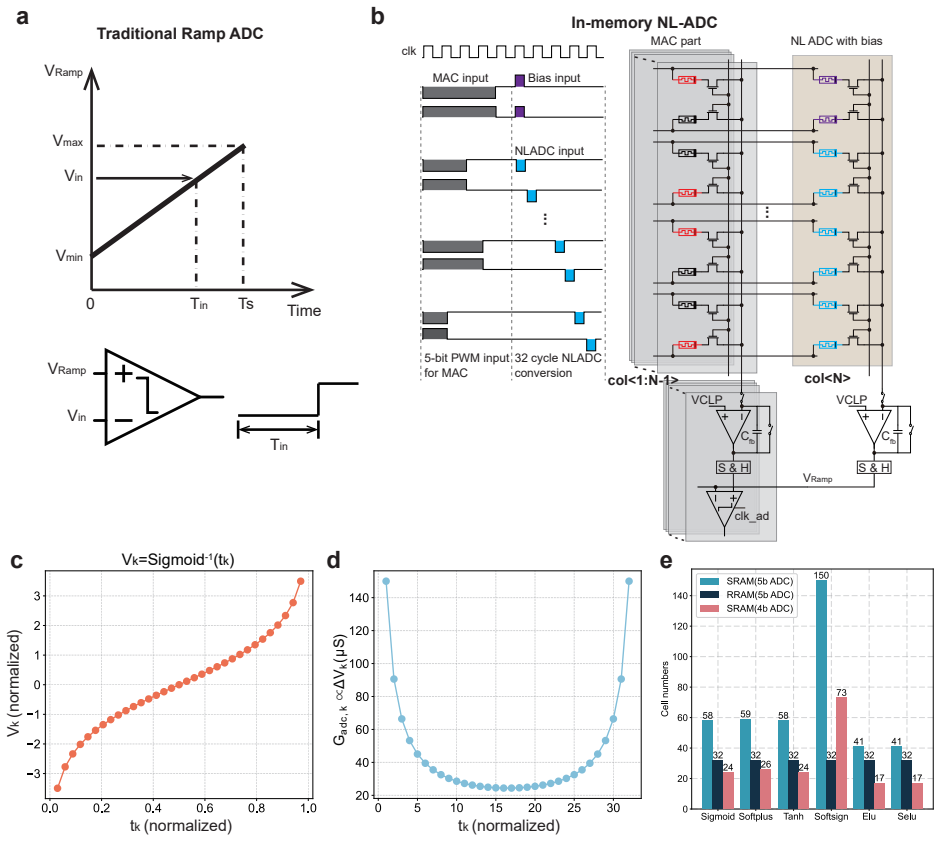
The central object is the inverse-function ramp identity $t_{\mathrm{in}} = g^{-1}(V_{\mathrm{in}})$: when the ADC ramp $f(t)$ is chosen so that $f = g^{-1}$, the comparator crossing time becomes the activation value $g(V_{\mathrm{in}})$, so the activation is computed during digitization. The hardware that realizes this is a dedicated memristor column in the same crossbar: each of the $2^b$ ramp steps is a programmable conductance $G_{\mathrm{adc},k} \propto \Delta V_k$, integrated on a feedback capacitor to build the predistorted ramp, with the comparator being the existing sense amplifier. A few bias memristors set the ramp's start voltage and perform a one-point calibration that corrects programming errors and stuck devices, and using the same memristor circuits for MAC and reference makes read-voltage noise common-mode.
What would settle it
Fabricate a complete macro with real integrators, comparators, and ripple counters; measure the 5-bit sigmoid and tanh transfer functions' INL and the keyword-spotting LSTM accuracy, and compare measured LSTM-layer area and energy against a same-precision conventional ramp-ADC baseline. If the realized INL exceeds roughly 1 LSB, or the measured accuracy falls below the reported 88.5% by more than a few points, or the area/energy ratios do not approach the projected 6.2X and 1.46X, the central hardware claim is refuted.
Extended reading notes
Core claim
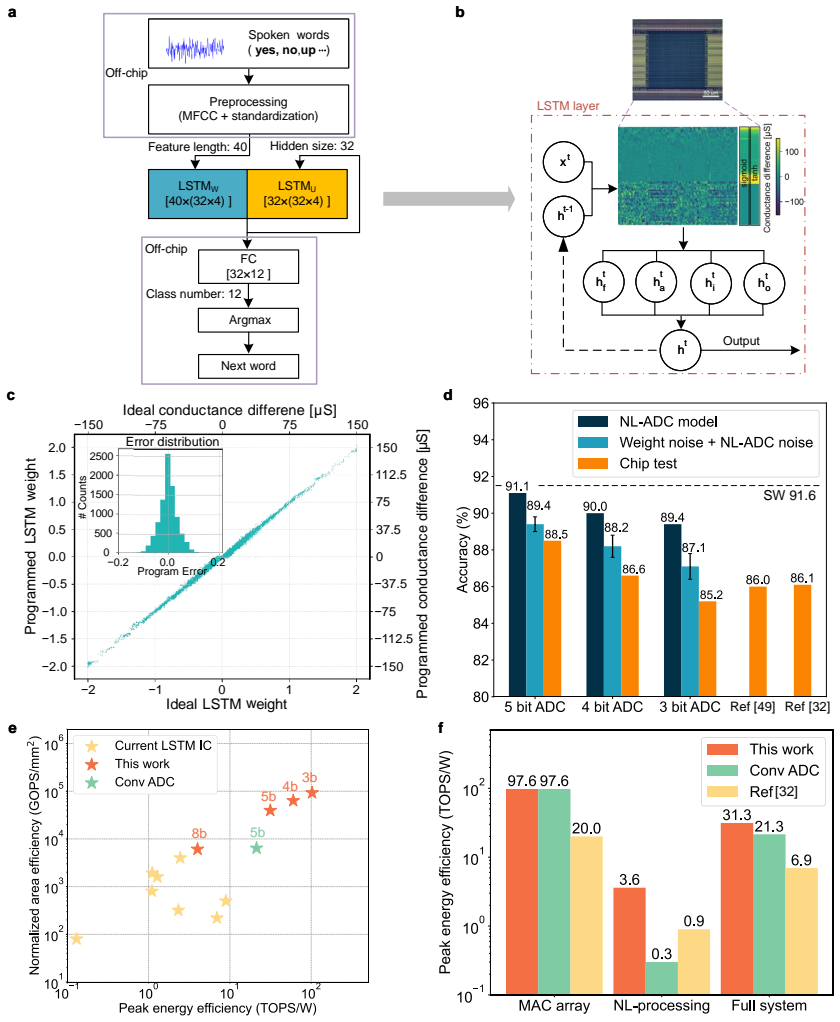
The central claim is that the nonlinear activation of a recurrent network can be made physically part of the analog-to-digital conversion step in a memristive crossbar. The method replaces the linear ramp of a conventional ramp ADC with a predistorted ramp whose shape is the inverse of the desired activation $g^{-1}$; the comparator then trips at a time proportional to $g(V_{\mathrm{in}})$ instead of $V_{\mathrm{in}}$. In the crossbar, the ramp is generated by one extra memristor column whose conductances $G_{\mathrm{adc},k}$ encode the successive step sizes $\Delta V_k = g^{-1}(t_k) - g^{-1}(t_{k-1})$, with a small set of bias memristors providing a one-point calibration. Because the MAC result and the ADC reference come from the same memristor circuits, read-voltage fluctuations cancel, giving maximum integral nonlinearity (INL) between 0.02 and 0.44 LSB when read voltage varies from 0.15 V to 0.25 V. The paper supports the claim with on-chip inference of a 12-class keyword-spotting LSTM (32 hidden neurons, 9216 memristors) reaching 88.5% accuracy at 5-bit, and with system-level estimates showing roughly 6.2X area efficiency and 1.46X energy efficiency over a same-precision conventional ramp-ADC baseline, plus a scaled 6.1-million-weight character-prediction LSTM that stays within 0.015 bits per character of software.
Load-bearing premise
The load-bearing premise is that the integrator and comparator, which are not fabricated on the chip and are instead emulated in software after reading the crossbar output, can be physically built with the area, speed, noise, and power assumed in the circuit simulations and system-level estimates; if those real circuits are larger, slower, noisier, or more power-hungry than modeled, the projected efficiency gains and the on-chip inference accuracy would not carry over to a complete system.
Editorial extensions
If this is right
- LSTM inference can be executed with the nonlinear activations produced directly by the ADC, so the digital processor that normally computes sigmoid and tanh is removed from the critical path.
- On the fabricated 9216-memristor crossbar, the 5-bit NL-ADC achieved 88.5% measured accuracy on a 12-class keyword-spotting task; the 4-bit and 3-bit versions achieved 86.6% and 85.2%.
- At the system level the LSTM layer is projected to be about 6.2X more area-efficient and 1.46X more energy-efficient than a same-precision conventional ramp-ADC baseline, and roughly 9.9X and 4.5X better than earlier LSTM circuits.
- For a 6.1-million-weight character-prediction LSTM, simulated 5-bit NL-ADC reaches 1.349 bits per character under measured write and read noise, close to the 1.334 software baseline.
- Because the ramp and the MAC result use the same memristor circuits, read-voltage variation cancels: maximum INL stays between 0.02 and 0.44 LSB across a 0.15-0.25 V read sweep, versus 4.12-5.5 LSB for a conventional ADC.
Reading between the lines
- The inverse-ramp construction is not limited to activations; any bijective function of the MAC output, such as a quantizer, a normalizer, or a log-softmax term, could in principle be fused into the same conversion by reprogramming the ramp column.
- The decisive next experiment is a full macro that includes the real integrators, comparators, and ripple counters the current chip omits; measuring the LSTM-layer energy, area, and accuracy directly would verify the projected gains rather than relying on estimates.
- Because the supplement shows non-monotonic GELU and Swish can be approximated by splitting the inverse into monotonic pieces, the same mechanism is a plausible route to transformer-style workloads, where those activations are common.
- Passing the pulse-width-modulated output directly to the next layer, which the paper mentions but does not quantify, would compound the savings in deep RNNs by also removing input DAC or PWM-generation circuits, so the efficiency advantage should grow with depth.
Editorial analysis
A structured set of objections, weighed in public.
Referee Report
Summary. The manuscript proposes an in-memory nonlinear ADC (NL-ADC) for analog resistive crossbars, in which an extra memristor column is programmed with conductances proportional to the steps of the inverse of a desired activation function. Integration of that column's current produces a nonlinear ramp, and comparison with the MAC result yields a thermometer code that approximates the activation. The authors derive the mapping, experimentally program six activation functions on a memristor array, demonstrate a one-point calibration scheme, show robustness to read-voltage variations, and estimate accuracy and efficiency for keyword spotting (88.5% claimed) and Penn Treebank character prediction through simulations. The fabricated chip includes the memristor array but not the integrator and comparator, which are implemented in software after the crossbar output is obtained.
Significance. If the central hardware claim were fully validated, the NL-ADC would attack a genuine bottleneck in IMC-based RNNs by merging nonlinear activation with digitization and removing the digital activation processor. The mathematical derivation is sound and parameter-free in the sense that the ramp shape is not fitted to data, and the measured conductance-mapped ramps for six activations, the one-point calibration, and the read-voltage-tracking property are valuable experimental results. The public code and the detailed efficiency-estimation methodology are also strengths. However, because the ADC periphery is not fabricated, the paper does not currently demonstrate an integrated NL-ADC; the headline accuracy and efficiency claims are estimates contingent on simulated peripherals.
major comments (4)
- [Results, 'In-memory Implementation of Nonlinear ADC and Vector Matrix Multiply in a Crossbar Array'] The paper states, 'The fabricated chip does not include the integrators and the comparator which are implemented in software after obtaining the crossbar output.' This means the transfer functions in Fig. 3 and the KWS accuracy of 88.5% in Fig. 4d combine measured memristor ramp generation with a software model of the analog periphery; they are not end-to-end hardware measurements. The Discussion's claim that the NL-ADC 'removes the need for any digital processor to implement nonlinear activations' is therefore not yet experimentally established. Please either fabricate and characterize the integrator and comparator or clearly re-label all such results as memristor measurements with simulated peripherals and temper the corresponding claims.
- [Supplementary Note S3, Tab. S3] The macro-level energy budget assigns 324.42 pJ to the integrator and 33.10 pJ to the comparator out of a total of 557.79 pJ (Tab. S3), sourced from references [51] and [45] and scaled to 16 nm; these are not measured values for the present design. The SPICE validation in Supplementary Note S2 varies only integrator DC gain and gain-bandwidth product and does not model comparator offset, noise, mismatch, or layout parasitics. Since the integrator and comparator together dominate the macro energy, the claimed 1.46X system-level energy-efficiency advantage over a conventional 5-bit ADC baseline is not robust unless these peripheral assumptions are bounded by measurement or by a sensitivity analysis.
- [Table 1 and Fig. 4] Table 1 reports 'KWS task on GSCD (Accuracy %): 88.5' without qualification, and the abstract claims 'experimentally demonstrate the implementation of a non-linear activation function integrated with a ramp ADC.' Because the comparator and integrator are software models, this overstates the level of integration actually demonstrated. The comparisons to prior integrated LSTM chips (e.g., 9.9X area efficiency, 4.5X energy efficiency) should be relabeled as estimates or projections rather than measured system performance.
- [Supplementary Note S4.b and Fig. 5] The NLP scalability results in Fig. 5 and Tabs. S14–S17 are based on NeuroSim system-level simulations in which the ADC is replaced by the proposed NL-ADC model. These results are therefore simulation-based, not experimentally demonstrated, and the main text should state this explicitly; the current phrasing in the 'Scaling to large RNNs' section, relying on 'experimentally validated nonideality models,' is potentially misleading.
minor comments (5)
- [Eq. (2)] The notation 'f () =g−1()' obscures the argument; write f(t) = g^{-1}(t) for clarity.
- [Abstract and Introduction] The phrase 'tasted limited success' in the abstract is awkward; 'had limited success' would be clearer. There is also a typo in the Introduction: 'network ouptut' should be 'network output.'
- [Fig. 3b] Please state explicitly how the 'Normal ADC' INL results are generated (e.g., a simulated linear ramp with the same Vread sweep), since the comparison is central to the robustness claim.
- [Table 1] In the header of Table 1, 'Nature'2332' contains a stray apostrophe, and reference formatting is inconsistent across the paper; please unify the citation style.
- [Discussion] The statement that the NL-ADC 'removes the need for any digital processor' should be qualified: non-monotonic activations such as GELU and Swish still require additional logic as described in Supplementary Note S12.
Circularity Check
No material circularity: the inverse-ramp construction is a mathematical implementation identity, not a fitted prediction; the reported accuracy and efficiency claims rest on measured chip data and externally sourced component data.
full rationale
The central derivation is the identity in Eq. (2): the paper sets t_in = f^{-1}(V_in) = g(V_in), which forces the ramp to be f() = g^{-1}(). This is the design equation of a predistorted ramp ADC, not a claim that g is empirically predicted from something independent of g. The paper's actual hardware claim is that a memristor column can be programmed to realize this inverse ramp accurately and that the resulting comparator output implements g during digitization; that claim is tested by measured INL values, by the measured transfer functions in Fig. 3, and by the measured 88.5% KWS accuracy in Fig. 4d. The one-point calibration is not a fit of the nonlinear shape: it only shifts Vinit so that the zero crossing of the programmed ramp matches the theoretical ramp, as stated in the Calibration section, leaving the 32 programmed step conductances fixed. The self-citation that is most load-adjacent is ref. 41 for defect-aware training, by co-authors of the present paper, but the method is fully restated as Algorithm 1 in Methods and is used as a standard robustness technique; it is not the evidence for the inverse-ramp construction or for the measured accuracy. Other self-references supply device characterization or component-level energy/area data and are not used to forbid alternatives. The paper also explicitly discloses a real limitation: 'The fabricated chip does not include the integrators and the comparator which are implemented in software after obtaining the crossbar output.' This means the full end-to-end ADC periphery is unbuilt, which is a correctness and external-validity risk for the projected system-level efficiency numbers, but it is not a circularity: the missing circuits are independent of the mathematical identity and are modeled using external component data. The NLP scalability results are simulations using noise distributions measured from the same chip; this is a model-based projection rather than a circular prediction, because the noise model is an external measurement and the simulated network behavior is not assumed to equal the target result. Overall, no derivation step reduces to its own input in a way that would make the central claim forced by definition or by self-citation.
Assumptions & free parameters
free parameters (5)
- Maximum conductance gmax =
150 µS
- Weight clipping bound |w|max =
2
- One-point calibration offset Vinit,new =
Per-chip value via Ncali bias memristors
- Training noise sigma =
5 µS
- Read voltage Vread =
0.2 V
assumptions (5)
- standard math Comparator acts as an ideal Heaviside threshold function (Eq. 1).
- domain assumption Memristor conductances are programmable to arbitrary values within [0, 150 µS].
- domain assumption The charge integrator and comparator operate with the performance assumed in SPICE (gain ~1000, GBW ~200 MHz) and with the area/energy figures from refs 15, 45, 51.
- standard math The activation functions are bijective (or split into monotonic segments).
- domain assumption Conductance drift is slow enough that inference accuracy remains acceptable over the relevant time window.
Cite this review
Pith. "Pith review of Efficient Nonlinear Function Approximation in Analog Resistive Crossbars for Recurrent Neural Networks." pith.science (2026). https://pith.science/paper/QHEINMV7
@misc{pith2026241118271,
  author       = {Pith},
  title        = {Pith review of: Efficient Nonlinear Function Approximation in Analog Resistive Crossbars for Recurrent Neural Networks},
  year         = {2026},
  howpublished = {\url{https://pith.science/paper/QHEINMV7}},
  note         = {Machine review of arXiv:2411.18271}
}
read the original abstract
Analog In-memory Computing (IMC) has demonstrated energy-efficient and low latency implementation of convolution and fully-connected layers in deep neural networks (DNN) by using physics for computing in parallel resistive memory arrays. However, recurrent neural networks (RNN) that are widely used for speech-recognition and natural language processing have tasted limited success with this approach. This can be attributed to the significant time and energy penalties incurred in implementing nonlinear activation functions that are abundant in such models. In this work, we experimentally demonstrate the implementation of a non-linear activation function integrated with a ramp analog-to-digital conversion (ADC) at the periphery of the memory to improve in-memory implementation of RNNs. Our approach uses an extra column of memristors to produce an appropriately pre-distorted ramp voltage such that the comparator output directly approximates the desired nonlinear function. We experimentally demonstrate programming different nonlinear functions using a memristive array and simulate its incorporation in RNNs to solve keyword spotting and language modelling tasks. Compared to other approaches, we demonstrate manifold increase in area-efficiency, energy-efficiency and throughput due to the in-memory, programmable ramp generator that removes digital processing overhead.
Figures


Figures from the paper (2 more)

Reference graph
Works this paper leans on
-
[51]
Cai, F. & et. al. Power-efficient combinatorial optimization using intrinsic noise in memristor hopfield neural networks. Nat. Electron. 3, 409–418 (2020)
work page 2020
-
[45]
Yu, C., Yoo, T., Chai, K. T. C., Kim, T. T.-H. & Kim, B. A 65-nm 8T SRAM compute-in-memory macro with column ADCs for processing neural networks. IEEE J. Solid-State Circuits 57, 3466–3476 (2022)
work page 2022
-
[1]
Kolesnikov, A. et al. An Image is Worth 16x16 Words: Transformers for Image Recognition at Scale. In The International Conference on Learning Representations (ICLR) (2021)
work page 2021
-
[2]
Graves, A., Mohamed, A.-R. & Hinton, G. Speech recognition with deep recurrent neural networks. In 2013 IEEE International Conference on Acoustics, Speech and Signal Processing , 6645–6649 (Ieee, 2013)
work page 2013
-
[3]
Silver, D. et al. Mastering the game of go with deep neural networks and tree search. Nature 529, 484–489 (2016)
2016
-
[4]
Senior, A. W. et al. Improved protein structure prediction using potentials from deep learning. Nature 577, 706–710 (2020)
2020
-
[5]
Vaswani, A. et al. Attention is all you need. Adv. Neural Inf. Process. Syst. 30 (2017)
2017
-
[6]
Computing’s energy problem (and what we can do about it)
Horowitz, M. Computing’s energy problem (and what we can do about it). In 2014 IEEE International Solid-State Circuits Conference digest of technical papers (ISSCC) , 10–14 (IEEE, 2014)
work page 2014
Show all 77 references
-
[7]
& Williams, S
Yang, J., Strukov, D. & Williams, S. Memristive devices for computing. Nat. Nanotechnol. 8, 13–24 (2013)
2013
-
[8]
Prezioso, M. et al. Training and operation of an integrated neuromorphic network based on metal-oxide memristors.Nature 521, 61–64 (2015)
2015
-
[9]
& Strukov, D
Alibart, F., Zamanidoost, E. & Strukov, D. Pattern classification by memristive crossbar circuits using ex situ and in situ training. Nat. Commun. 4 (2013)
2013
-
[10]
Can, L. & et. al. Efficient and self-adaptive in-situ learning in multilayer memristor neural networks. Nat. Commun. 9 (2018)
2018
-
[11]
& Eleftheriou, E
Sebastian, A., Le Gallo, M., Khaddam-Aljameh, R. & Eleftheriou, E. Memory devices and applications for in-memory computing. Nat. Nanotechnol. 15, 529–544 (2020)
2020
-
[12]
Peng, Y . & et. al. Fully hardware-implemented memristor convolutional neural network.Nature 577, 641–646 (2020)
2020
-
[13]
Kiani, F. & et. al. A fully hardware-based memristive multilayer neural network. Sci. Adv. 7 (2021)
2021
-
[14]
Yang, K. et al. Transiently chaotic simulated annealing based on intrinsic nonlinearity of memristors for efficient solution of optimization problems. Sci. advances 6, eaba9901 (2020)
2020
-
[15]
Jiang, M., Shan, K., He, C. & Li, C. Efficient combinatorial optimization by quantum-inspired parallel annealing in analogue memristor crossbar. Nat. Commun. 14, 5927 (2023)
2023
-
[16]
John, R. A. et al. Halide perovskite memristors as flexible and reconfigurable physical unclonable functions. Nat. Commun. 12, 3681 (2021)
2021
-
[17]
Mao, R. et al. Experimentally validated memristive memory augmented neural network with efficient hashing and similarity search. Nat. Commun. 13, 6284 (2022)
2022
-
[18]
Sheridan, P. M. et al. Sparse coding with memristor networks. Nat. nanotechnology 12, 784–789 (2017). 17/52
2017
-
[19]
Zidan, M. A. et al. A general memristor-based partial differential equation solver. Nat. Electron. 1, 411–420 (2018)
2018
-
[20]
Le Gallo, M. & et. al. Mixed-precision in-memory computing. Nat. Electron. 1, 246–253 (2018)
2018
-
[21]
Khwa, W. S. et al. A 40-nm, 2M-cell, 8b-precision, hybrid SLC-MLC PCM computing-in-memory macro with 20.5–65.0TOPS/W for tiny-Al edge devices. In 2022 IEEE International Solid-State Circuits Conference-(ISSCC) , 1–3 (IEEE, 2022)
2022
-
[22]
J-.M, H. & et. al. A four-megabit compute-in-memory macro with eight-bit precision based on CMOS and resistive random-access memory for AI edge devices. Nat. Electron. 4, 921–930 (2021)
2021
-
[23]
Le Gallo, M. et al. A 64-core mixed-signal in-memory compute chip based on phase-change memory for deep neural network inference. Nat. Electron. 6, 680–693 (2023)
2023
-
[24]
Giraldo, J. S. P. & Verhelst, M. Laika: A 5 µW programmable LSTM accelerator for always-on keyword spotting in 65nm CMOS. In ESSCIRC 2018-IEEE 44th European Solid State Circuits Conference (ESSCIRC) , 166–169 (IEEE, 2018)
2018
-
[25]
& Seo, J.-S
Kadetotad, D., Yin, S., Berisha, V ., Chakrabarti, C. & Seo, J.-S. An 8.93 TOPS/W LSTM recurrent neural network accelerator featuring hierarchical coarse-grain sparsity for on-device speech recognition. IEEE J. Solid-State Circuits 55, 1877–1887 (2020)
2020
-
[26]
& Yoo, H.-J
Shin, D., Lee, J., Lee, J. & Yoo, H.-J. DNPU: An 8.1 TOPS/W reconfigurable CNN-RNN processor for general-purpose deep neural networks. In 2017 IEEE International Solid-State Circuits Conference (ISSCC) , 240–241 (IEEE, 2017)
2017
-
[27]
& Benini, L
Conti, F., Cavigelli, L., Paulin, G., Susmelj, I. & Benini, L. Chipmunk: A systolically scalable 0.9 mm 2, 3.08 Gop/s/mW@ 1.2 mW accelerator for near-sensor recurrent neural network inference. In 2018 IEEE Custom Integrated Circuits Conference (CICC), 1–4 (IEEE, 2018)
2018
-
[28]
Yin, S. et al. A 1.06-to-5.09 TOPS/W reconfigurable hybrid-neural-network processor for deep learning applications. In 2017 Symposium on VLSI Circuits , C26–C27 (IEEE, 2017)
2017
-
[29]
Li, C. et al. Long short-term memory networks in memristor crossbar arrays. Nat. Mach. Intell. 1, 49–57 (2019)
2019
-
[30]
Tsai, H. et al. Inference of long-short term memory networks at software-equivalent accuracy using 2.5 M analog phase change memory devices. In 2019 Symposium on VLSI Technology, T82–T83 (IEEE, 2019)
2019
-
[31]
Survey of neuromorphic and machine learning accelerators in SOVC, ISSCC and Nature/Science series of journals from 2017 onwards,
“Survey of neuromorphic and machine learning accelerators in SOVC, ISSCC and Nature/Science series of journals from 2017 onwards,”. https://docs.google.com/spreadsheets/d/1_j-R-QigJTuK6W5Jg8w2Yl85Tn2J_S-x/edit?usp=drive_link& ouid=117536134117165308204&rtpof=true&sd=true. Acce...
2017
-
[32]
Ambrogio, S. et al. An analog-AI chip for energy-efficient speech recognition and transcription. Nature 620, 768–775 (2023)
2023
-
[33]
A twofold lookup table architecture for efficient approximation of activation functions
Xie, Y .et al. A twofold lookup table architecture for efficient approximation of activation functions. IEEE Transactions on V ery Large Scale Integration (VLSI) Syst.28, 2540–2550 (2020)
2020
-
[34]
Arvind, T. K. et al. Hardware implementation of hyperbolic tangent activation function for floating point formats. In 2020 24th International Symposium on VLSI Design and Test (VDAT) , 1–6 (IEEE, 2020)
2020
-
[35]
Kwon, D. et al. A 1ynm 1.25 v 8gb 16gb/s/pin gddr6-based accelerator-in-memory supporting 1tflops mac operation and various activation functions for deep learning application. IEEE J. Solid-State Circuits 58, 291–302 (2022)
2022
-
[36]
Raut, G. & et. al. A CORDIC based Configurable Activation Function for ANN Applications. In International Symposium on VLSI (ISVLSI) (IEEE, 2020)
2020
-
[37]
Chong, Y . & et. al. Efficient implementation of activation functions for LSTM accelerators. In VLSI System on Chip (VLSI-SOC) (IEEE, 2021)
2021
-
[38]
Pasupuleti, S. K. et al. Low complex & high accuracy computation approximations to enable on-device rnn applications. In 2019 IEEE International Symposium on Circuits and Systems (ISCAS) , 1–5 (IEEE, 2019)
2019
-
[39]
Feng, X. et al. A high-precision flexible symmetry-aware architecture for element-wise activation functions. In 2021 International Conference on Field-Programmable Technology (ICFPT), 1–4 (IEEE, 2021)
2021
-
[40]
& Wang, L
Li, Y ., Cao, W., Zhou, X. & Wang, L. A low-cost reconfigurable nonlinear core for embedded dnn applications. In2020 International Conference on Field-Programmable Technology (ICFPT), 35–38 (IEEE, 2020)
2020
-
[41]
Mao, R., Wen, B., Jiang, M., Chen, J. & Li, C. Experimentally-Validated Crossbar Model for Defect-Aware Training of Neural Networks. IEEE Transactions on Circuits Syst. II: Express Briefs 69, 2468–2472, DOI: 10.1109/TCSII.2022. 3160591 (2022). 18/52
2022 doi
-
[42]
Speech commands: A dataset for limited-vocabulary speech recognition
Warden, P. Speech commands: A dataset for limited-vocabulary speech recognition. arXiv preprint arXiv:1804.03209 (2018)
2018 arXiv
-
[43]
& Marcinkiewicz, M
Marcus, M., Santorini, B. & Marcinkiewicz, M. A. Building a large annotated corpus of English: The Penn Treebank. Comput. Linguist. 19 (1993)
1993
-
[44]
E and Holberg, D
Allen, P. E and Holberg, D. CMOS Analog Circuit Design (Oxford University Press, 2011)
2011
-
[46]
Rao, M. & et al. Thousands of conductance levels in memristors integrated on CMOS. Nature (2023)
2023
-
[47]
Song, W. & et al. Programming memristor arrays with arbitrarily high precision for analog computing. Science (2024)
2024
-
[48]
Sheng, X. & et al. Low-Conductance and Multilevel CMOS-Integrated Nanoscale Oxide Memristors. Adv. Electron. Mater. 5 (2019)
2019
-
[49]
Kim, K. et al. A 23µW solar-powered keyword-spotting ASIC with ring-oscillator-based time-domain feature extraction. In 2022 IEEE International Solid-State Circuits Conference (ISSCC) , vol. 65, 1–3 (IEEE, 2022)
2022
-
[50]
Kim, K. et al. A 23-µW keyword spotting IC with ring-oscillator-based time-domain feature extraction.IEEE J. Solid-State Circuits 57, 3298–3311 (2022)
2022
-
[52]
Liu, Q. et al. A fully integrated analog ReRAM based 78.4 TOPS/W compute-in-memory chip with fully parallel MAC computing. In 2020 IEEE International Solid-State Circuits Conference-(ISSCC) , 500–502 (IEEE, 2020)
2020
-
[53]
Zhang, W. et al. Edge learning using a fully integrated neuro-inspired memristor chip. Science 381, 1205–1211 (2023)
2023
-
[54]
& Basu, A
Yi, C., Wang, Z., Patil, A. & Basu, A. A 2.86-TOPS/W Current Mirror Cross-Bar Based Machine-Learning and Physical Unclonable Function Engine for Internet-of-Things Applications. IEEE Trans. on CAS-I 66, 2240–52 (2018)
2018
-
[55]
Yan, B., Q., Y . & et. al. RRAM-based spiking nonvolatile computing-in-memory processing engine with precision- configurable in situ nonlinear activation. In 2019 Symposium on VLSI Technology (SOVC), T86–T87 (IEEE, 2019)
2019
-
[56]
W, L. & et al. A 40-nm MLC-RRAM Compute-in-Memory Macro With Sparsity Control, On-Chip Write-Verify, and Temperature-Independent ADC References. IEEE J. Solid-State Circuits (JSSC) 2868–77 (2022)
2022
-
[57]
Jiang, H. & et al. A 40nm Analog-Input ADC-Free Compute-in-Memory RRAM Macrowith Pulse-Width Modulation between Sub-arrays. In 2022 Symposium on VLSI Circuits (IEEE, 2022)
2022
-
[58]
Yue, J. et al. A 65nm 0.39-to-140.3 TOPS/W 1-to-12b unified neural network processor using block-circulant-enabled transpose-domain acceleration with 8.1× higher TOPS/mm 2 and 6T HBST-TRAM-based 2D data-reuse architecture. In 2019 IEEE International Solid-State Circuits Confer...
2019
-
[59]
Jouppi, N. P. et al. In-datacenter performance analysis of a tensor processing unit. In Proceedings of the 44th annual international symposium on computer architecture, 1–12 (2017)
2017
-
[60]
& Seo, J.-s
Yin, S., Sun, X., Yu, S. & Seo, J.-s. High-throughput in-memory computing for binary deep neural networks with monolithically integrated rram and 90-nm cmos. IEEE Transactions on Electron Devices 67, 4185–4192 (2020)
2020
-
[61]
He, W. et al. 2-bit-per-cell rram-based in-memory computing for area-/energy-efficient deep learning. IEEE Solid-State Circuits Lett. 3, 194–197 (2020)
2020
-
[62]
Cai, F. et al. A fully integrated reprogrammable memristor–cmos system for efficient multiply–accumulate operations. Nat. electronics 2, 290–299 (2019)
2019
-
[63]
Huo, Q. et al. A computing-in-memory macro based on three-dimensional resistive random-access memory. Nat. Electron. 5, 469–477 (2022)
2022
-
[64]
A 510-nW wake-up keyword-spotting chip using serial-FFT-based MFCC and binarized depthwise separable CNN in 28-nm CMOS
Shan, W.et al. A 510-nW wake-up keyword-spotting chip using serial-FFT-based MFCC and binarized depthwise separable CNN in 28-nm CMOS. IEEE J. Solid-State Circuits 56, 151–164 (2020)
2020
-
[65]
DNN+NeuroSim framework
“DNN+NeuroSim framework”. https://github.com/neurosim/DNN_NeuroSim_V2.1
-
[66]
Kingma, D. & J, B. Adam: A Method for Stochastic Optimization. In The International Conference on Learning Representations (ICLR) (2014)
2014
-
[67]
Evaluation Metrics for Language Modeling,
“Evaluation Metrics for Language Modeling,”. https://thegradient.pub/understanding-evaluation-metrics-for-language-models/. Accessed: 2024-1-31. 19/52
2024
-
[68]
Efficient Nonlinear Function Approximation in Analog Resistive Crossbars for Recurrent Neural Networks
"Efficient Nonlinear Function Approximation in Analog Resistive Crossbars for Recurrent Neural Networks". https: //github.com/CityU-BRAINSys-Lab/NLADC_code
-
[69]
H, L. & et al. Resistive RAM-centric computing: Design and modeling methodology. IEEE Trans. on Circuits Syst. - I (TCAS-I) 2263–2273 (2017)
2017
-
[70]
Chen, P.-Y ., Peng, X. & Yu, S. Neurosim: A circuit-level macro model for benchmarking neuro-inspired architectures in online learning. IEEE Transactions on Comput. Des. Integr. Circuits Syst. 37, 3067–3080 (2018)
2018
-
[71]
Esmanhotto, E. & et al. Experimental Demonstration of Multilevel Resistive Random Access Memory Programming for up to Two Months Stable Neural Networks Inference Accuracy. Adv. Intell. Syst. (2022)
2022
-
[72]
Park, J. S. & et al. A 2.2mW 12-bit 200MS/s 28nm CMOS Pipelined SAR ADC with Dynamic Register-Based High-Speed SAR Logic. In 2020 IEEE Asian Solid-State Circuits Conference digest of technical papers (A-SSCC) (IEEE, 2020)
2020
-
[73]
Charan, G. & et al. Accurate Inference with Inaccurate RRAM Devices: Statistical Data, Model Transfer, and On-line Adaptation. In 2020 Design Automation Conference (DAC) (IEEE, 2020)
2020
-
[74]
R., P. & et. al. SWISH: A SELF-GATED ACTIV ATION FUNCTION.arXiv preprint arXiv:1710.05941 (2017)
2017 arXiv
-
[75]
Hendrycks, D. & et. al. Gaussian error linear units (gelus). arXiv preprint arXiv:1606.08415 (2016)
2016 arXiv
-
[76]
Dosovitskiy, A. & et al. An image is worth 16x16 words: Transformers for image recognition at scale. arXiv preprint arXiv:2010.11929 (2020)
2020 arXiv
-
[77]
k" represents the number of processors in the system, which signifies the degree of parallelism in processing nonlinear functions. A higher value of
Tan, M. & Le, Q. V . Mixed depthwise convolutional kernels.arXiv preprint arXiv:1907.09595 (2019). 20/52 Supplementary Supplementary Note S1. Nonlinear function approximation by ramp ADC Six commonly used nonlinear functions in neural networks and their inverse functions are p...
2019 arXiv
Reviewed August 12, 2026 · model on record in the stance chip above.
Discussion (0). Continue with ORCID to comment.