The science of compressional heating on the LM26 magnetized target fusion experiment
Pith reviewed 2026-07-02 21:27 UTC · model grok-4.3
The pith
Compressional heating accounts for the majority of temperature rise in LM26's first plasma compression shots.
A machine-rendered reading of the paper's core claim, the machinery that carries it, and where it could break.
Core claim
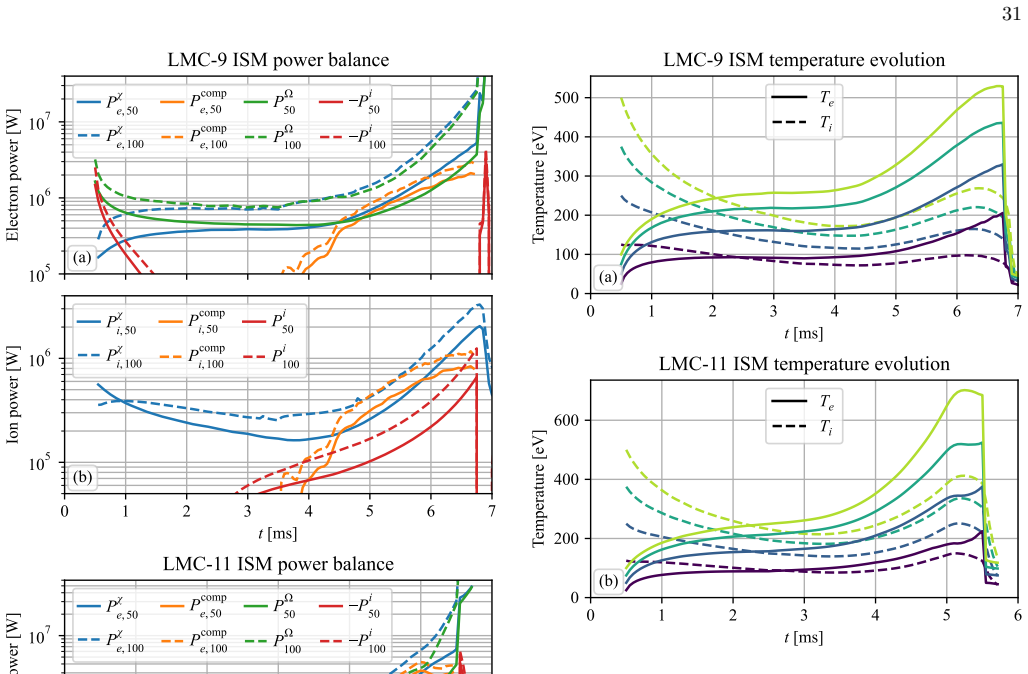
The central conclusions of the integrated physics model specifically indicate that compressional heating was achieved in this set of experiments, as evidenced by the balance of heating power from compression, Ohmic heating from plasma current, and losses to the boundary needed to match the experimental data. A majority of the temperature rise is attributable to compressional heating. An increase in neutron flux is also observed during compression.
What carries the argument
The integrated physics model that reconstructs experimental equilibrium states from diagnostic data as a function of time and matches the observed evolution through the sum of compressional heating, Ohmic heating, and boundary losses.
If this is right
- An increase in neutron flux occurs during the compression phase.
- The results build confidence in the stability and transport analyses used for the high-performance shots.
- The data set supplies a basis for planned facility improvements that target higher densities and temperatures.
- Trends across the eleven shots show consistent scaling of plasma parameters with radial compression.
Where Pith is reading between the lines
- Similar energy-balance methods could be applied to other liner-compression or magnetized-target experiments to isolate the compressional contribution.
- Fast-camera images of plasma-wall interaction during compression could guide liner surface preparation or magnetic-field shaping in next-step devices.
- The observed neutron increase supplies a possible independent check on ion temperature if neutron spectra are recorded in future runs.
Load-bearing premise
The equilibrium reconstruction from diagnostic data and the transport model assumptions accurately capture the dominant energy balance without large unmodeled contributions from plasma-wall interactions or liner-plasma mixing.
What would settle it
A quantitative mismatch between the measured temperature, density, and field profiles and the profiles predicted by the model when only compression, Ohmic, and boundary-loss terms are included would falsify the claim that compressional heating dominates.
Figures












read the original abstract
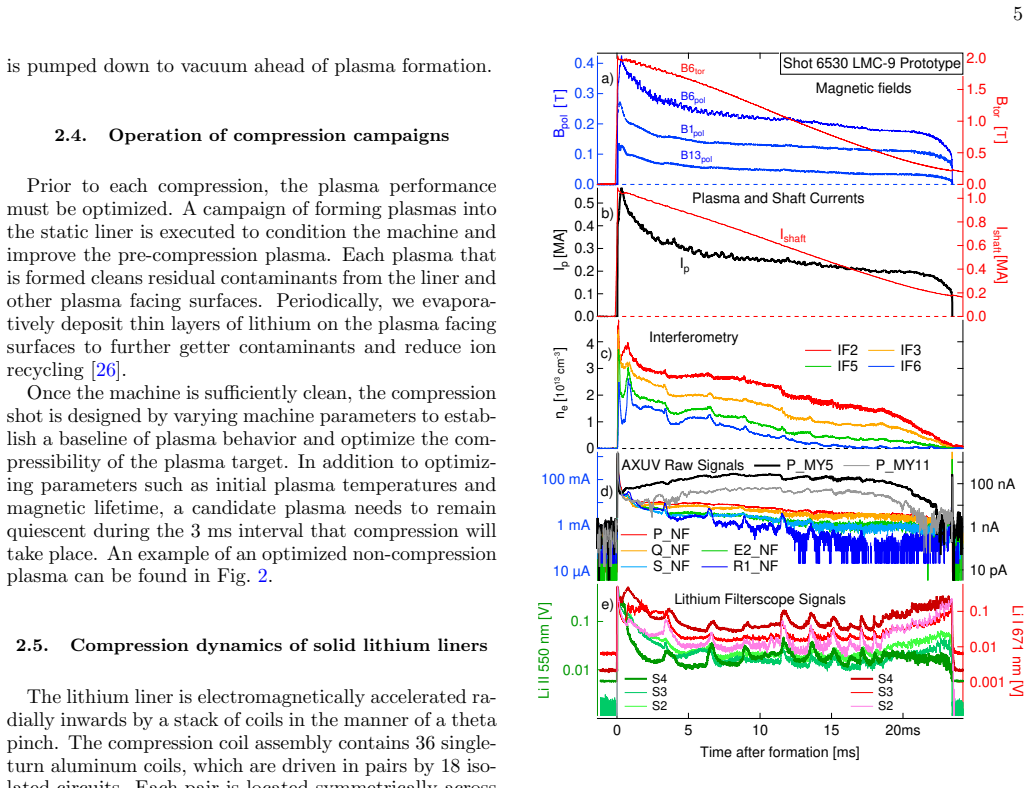
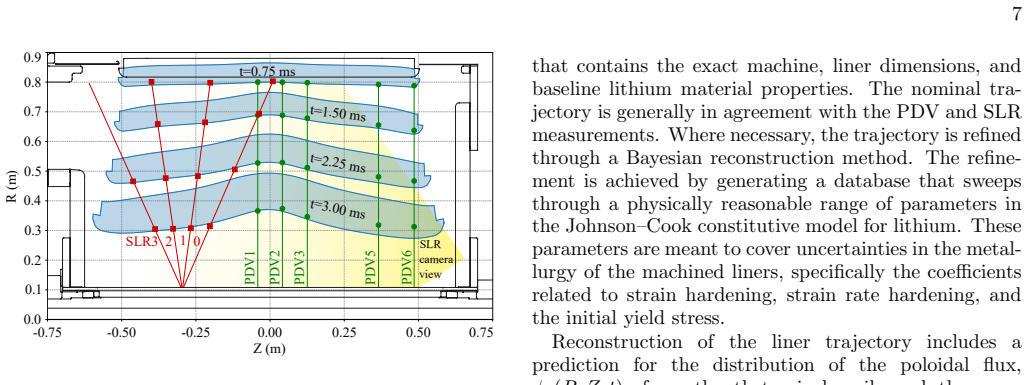
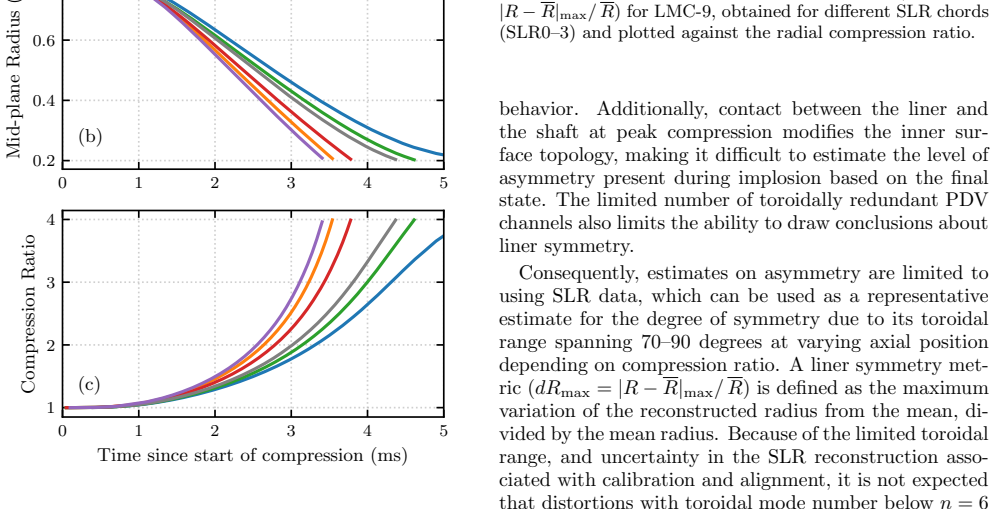
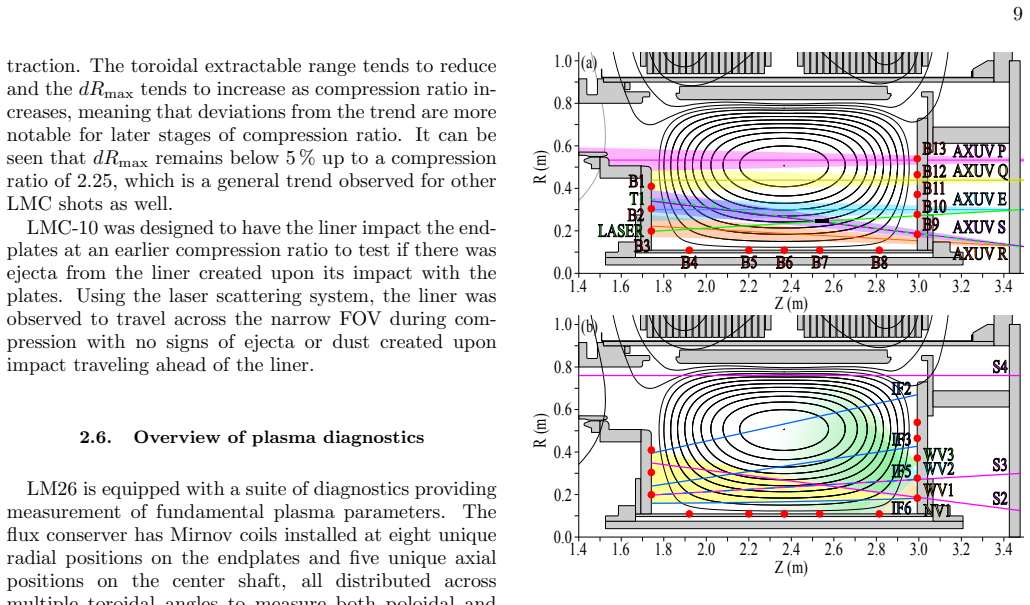
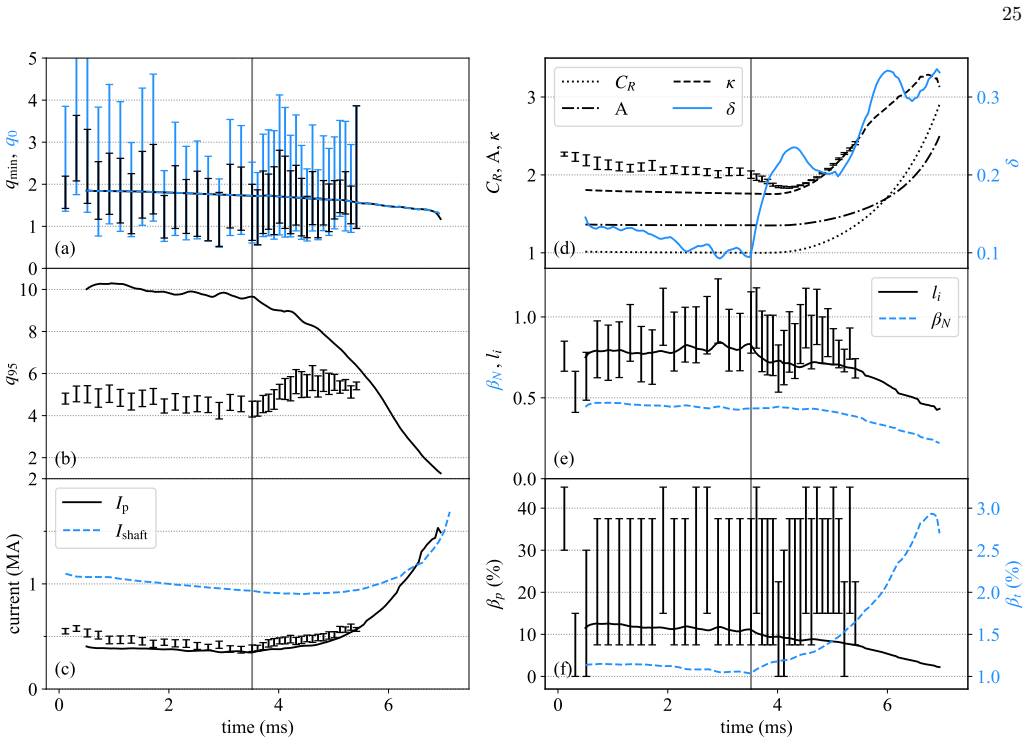
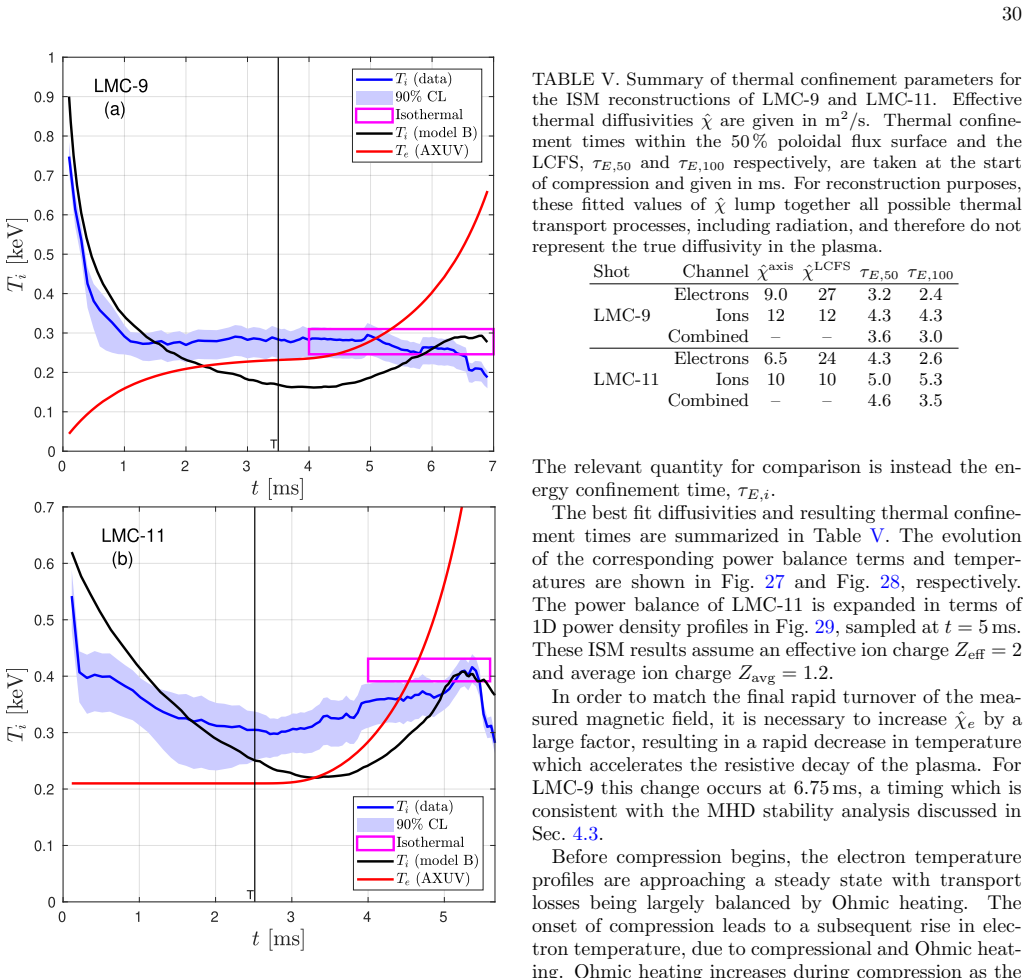
The Lawson Machine 26 (LM26) at General Fusion has demonstrated compressional heating of a spherical tokamak deuterium plasma as it was compressed by an imploding solid lithium liner. Results from the first 11 compression shots on LM26 are presented, the highest-performing of which show more than a 3x increase in $T_e$, a 10x increase in $n_e$, and a 10x increase in $B_{pol}$ within the plasma driven by 3x radial compression. The experimental device and instrumentation are reviewed in detail, followed by observations about the liner trajectory and evolution of plasma properties, including increases in emission of neutrons, X-rays, and visible radiation. Observations from fast-camera images during compression provide context for interpreting the spatial structure of plasma-wall interaction. Overviews of relevant models and analysis are presented. Diagnostic data are used to reconstruct the experimental equilibrium state in computational framework as a function of time. The results build confidence in the stability and transport analyses that support the primary conclusions. Trends across the full set of 11 compression shots are presented, and detailed examinations of the high-performance shots are given individually. The central conclusions of the integrated physics model specifically indicate that compressional heating was achieved in this set of experiments, as evidenced by the balance of heating power from compression, Ohmic heating from plasma current, and losses to the boundary needed to match the experimental data. A majority of the temperature rise is attributable to compressional heating. An increase in neutron flux is also observed during compression. The results provide a basis for planned improvements to the LM26 facility that will enable the compression of magnetized plasma to increasingly higher densities and temperatures.
Editorial analysis
A structured set of objections, weighed in public.
Referee Report
Summary. The manuscript reports results from the first 11 compression shots on the LM26 magnetized target fusion experiment, in which a spherical tokamak deuterium plasma is compressed by an imploding solid lithium liner. The highest-performing shots exhibit >3× increase in Te, 10× in ne, and 10× in Bpol under 3× radial compression. Diagnostic data are used for time-dependent equilibrium reconstruction, and an integrated physics model (equilibrium + transport) is fitted to match observed time traces; the authors conclude that compressional heating accounts for the majority of the temperature rise, with supporting observations of increased neutron, X-ray, and visible emission plus fast-camera images of plasma-wall interaction.
Significance. If the model-based partitioning of heating terms is robust, the work constitutes a concrete experimental milestone for magnetized target fusion by demonstrating compressional heating as the dominant mechanism in a spherical tokamak geometry. The multi-shot trends and neutron-flux increase supply partial external grounding, and the detailed device/instrumentation description plus planned facility upgrades provide a clear path forward.
major comments (2)
- [Abstract / integrated physics model description] Abstract and integrated-physics-model section: the central claim that 'a majority of the temperature rise is attributable to compressional heating' is obtained by adjusting the energy-balance terms (compression work, Ohmic heating, boundary losses) to match experimental time traces; the manuscript provides no quantified sensitivity of the attributed fractions to variations in the equilibrium-reconstruction assumptions or transport coefficients, nor explicit goodness-of-fit metrics (e.g., χ² or residual distributions) that would demonstrate the partitioning is uniquely supported rather than under-constrained.
- [High-performance shots and model-data matching] High-performance-shot analysis (as summarized in the abstract): the weakest assumption—that large unmodeled contributions from plasma-liner mixing, enhanced radiation, or plasma-wall heat fluxes visible in fast-camera images are negligible—is load-bearing for the majority-compressional-heating conclusion; without an explicit bound on the size of these terms or an independent observable (beyond neutron flux) that decouples them from the fitted loss coefficients, the attribution remains partly circular.
minor comments (2)
- [Abstract] Abstract: the reported factors (>3× Te, 10× ne, 10× Bpol) are given without error bars, shot-to-shot scatter, or explicit data-exclusion criteria.
- [Trends across the full set of 11 compression shots] The manuscript should clarify whether the 11-shot dataset includes all attempted compressions or only those that met a minimum diagnostic-quality threshold.
Simulated Author's Rebuttal
We thank the referee for their careful and constructive review of our manuscript on the first compression shots from the LM26 experiment. The major comments correctly identify areas where additional quantification would strengthen the presentation of the integrated physics model results. We address each point below and will revise the manuscript accordingly.
read point-by-point responses
-
Referee: [Abstract / integrated physics model description] Abstract and integrated-physics-model section: the central claim that 'a majority of the temperature rise is attributable to compressional heating' is obtained by adjusting the energy-balance terms (compression work, Ohmic heating, boundary losses) to match experimental time traces; the manuscript provides no quantified sensitivity of the attributed fractions to variations in the equilibrium-reconstruction assumptions or transport coefficients, nor explicit goodness-of-fit metrics (e.g., χ² or residual distributions) that would demonstrate the partitioning is uniquely supported rather than under-constrained.
Authors: We agree that the manuscript would benefit from explicit sensitivity analysis and goodness-of-fit metrics. In the revised version we will add a new subsection that quantifies the sensitivity of the derived heating fractions to variations in equilibrium-reconstruction parameters (e.g., boundary conditions and current-profile assumptions) and transport coefficients within their experimental uncertainties. We will also report χ² values together with a description of residual distributions for the model fits to the measured Te, ne, and Bpol time traces. These additions will allow readers to assess the robustness of the conclusion that compressional heating accounts for the majority of the temperature rise. revision: yes
-
Referee: [High-performance shots and model-data matching] High-performance-shot analysis (as summarized in the abstract): the weakest assumption—that large unmodeled contributions from plasma-liner mixing, enhanced radiation, or plasma-wall heat fluxes visible in fast-camera images are negligible—is load-bearing for the majority-compressional-heating conclusion; without an explicit bound on the size of these terms or an independent observable (beyond neutron flux) that decouples them from the fitted loss coefficients, the attribution remains partly circular.
Authors: The fast-camera images do document localized plasma-wall interaction, and we acknowledge that unmodeled terms such as mixing or enhanced radiation could in principle contribute. The model is nevertheless constrained by the simultaneous evolution of multiple independent diagnostics (Te, ne, Bpol, neutron flux, X-ray emission, and liner trajectory). In the revision we will add explicit upper-bound estimates on the possible contributions from mixing and radiation, derived from the observed emission intensities and the spatial extent of wall interaction visible in the images. These bounds will be compared against the fitted boundary-loss term to reduce the scope for circularity. While the neutron-flux increase already provides supporting evidence independent of the energy-balance fit, the new bounds will further decouple the unmodeled terms. revision: partial
Circularity Check
No significant circularity; model interprets independent observables
full rationale
The paper reconstructs equilibria from diagnostic data and uses an integrated transport model to partition observed temperature evolution into compression work (from measured radial compression), Ohmic heating, and boundary losses. The central claim that compressional heating dominates is an output of this partitioning rather than a redefinition of the inputs. Neutron yield increase and other diagnostics provide external grounding. No equations reduce to their own fitted parameters by construction, no self-citations are load-bearing for uniqueness, and no ansatz is smuggled via prior work. The derivation remains self-contained against the reported measurements.
Axiom & Free-Parameter Ledger
axioms (1)
- domain assumption Diagnostic data can be inverted to reconstruct the time-dependent plasma equilibrium under standard MHD assumptions.
Reference graph
Works this paper leans on
-
[1]
CONCLUSIONS In this study, we presented a series of experimental re- sults from the LM26 device at General Fusion and ex- plore relevant analyses and modeling to draw conclu- sions about future directions for MTF research. The initial pre-compression state of the CHI-formed ST deu- terium plasmas has sufficiently good confinement prop- erties to remain in...
-
[2]
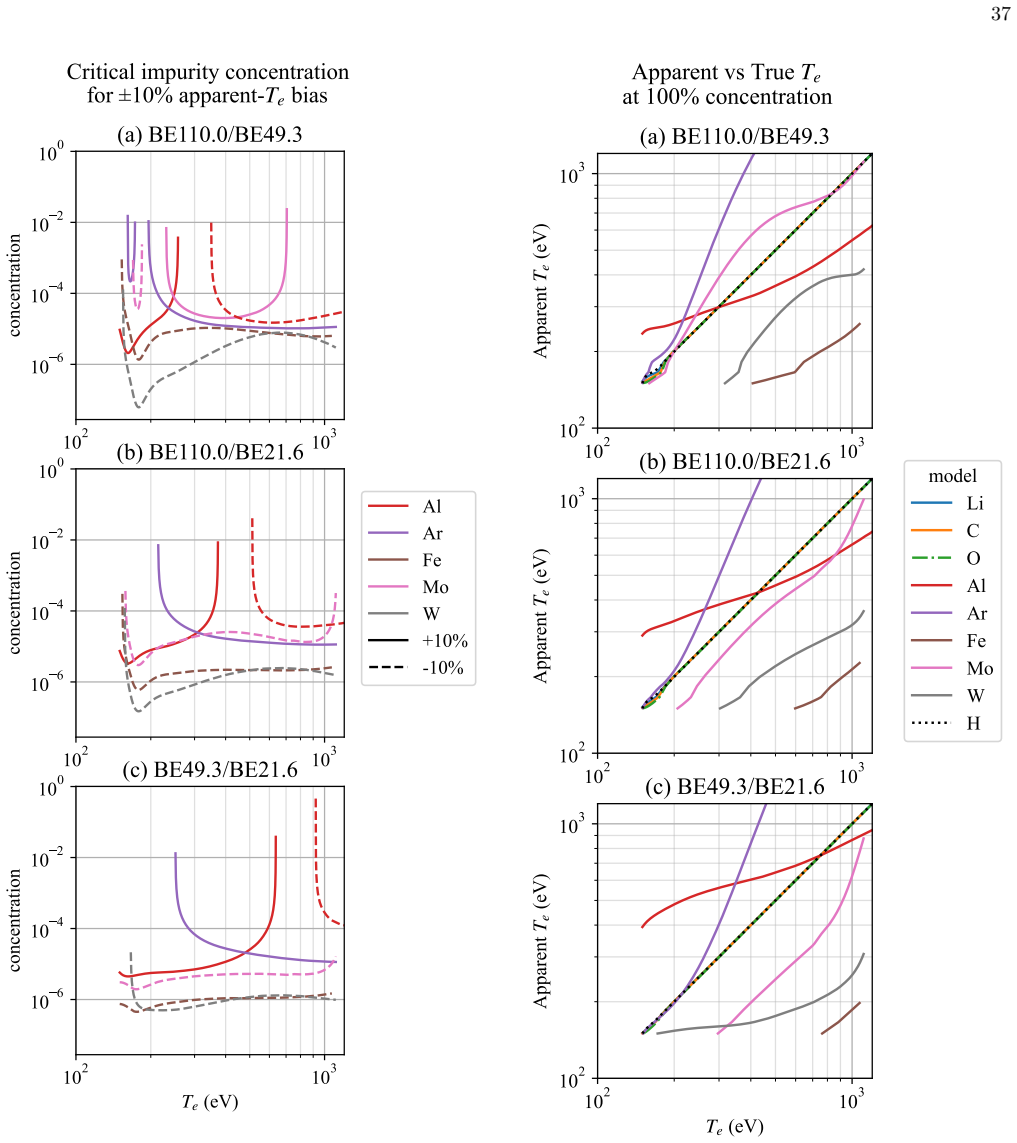
Overall, we find that the beryllium and properly- curated aluminized Mylar filters give similar results on the LM26 system. Both give similarT e values, which are further validated with the Thomson scattering mea- surements obtained on LMC-11. Both types of filters are intrinsically susceptible to plasma-gradient effects if not properly arranged, as well ...
-
[3]
Howardet al., Nuclear Fusion65, 016029 (2025)
S. Howardet al., Nuclear Fusion65, 016029 (2025)
work page 2025
-
[4]
I. V. Khalzov, D. Krotez, and R. S´ egas, Physics of Fluids 36, 032125 (2024)
work page 2024
-
[5]
Robson, Report of NRL Progress, June 1973 (1973)
A. Robson, Report of NRL Progress, June 1973 (1973)
work page 1973
-
[6]
P. J. Turchi, R. L. Burton, A. L. Cooper, R. D. Ford, D. J. Jenkins, J. Cameron, and R. Lanham,Develop- ment of Imploding Liner Systems for the NRL LINUS Program, Tech. Rep. (Naval Research Lab. (NRL), Wash- ington, DC (United States), 1979)
work page 1979
-
[7]
K. Bol, J. L. Cecchi, C. C. Daughney, F. DeMarco, R. A. Ellis, Jr., H. P. Eubank, H. P. Furth, H. Hsuan, E. Mazzucato, and R. R. Smith,Experiments on the Adi- abatic Toroidal Compressor, Tech. Rep. (PPPL, 1974) doi:10.2172/4203067
- [8]
-
[9]
K. Bol, J. L. Cecchi, C. C. Daughney, F. DeMarco, R. A. Ellis, Jr., H. P. Eubank, H. P. Furth, H. Hsuan, E. Mazzucato, and R. R. Smith, inPlasma Physics and Controlled Nuclear Fusion Research 1974 (Proc. 5th Int. Conf. Tokyo, 1974), Vol. 1 (IAEA, Vienna, 1975) p. 83
work page 1974
- [10]
- [11]
-
[12]
G. Tait, M. Bell, and J. Bell, inPlasma Physics and Controlled Nuclear Fusion Research 1984 (Proc. 10th Int. Conf. London, 1984, Vol. 1 (IAEA, Vienna, 1985) pp. 141–154
work page 1984
-
[13]
D. J. Grove and D. M. Meade, Nucl. Fusion25, 1167 (1985)
work page 1985
- [14]
-
[15]
Tanga, JET Joint Undertaking Progress Report 1986, EUR 11113 EN (EUR-JET-PR4) , 211 (1987)
A. Tanga, JET Joint Undertaking Progress Report 1986, EUR 11113 EN (EUR-JET-PR4) , 211 (1987)
work page 1986
-
[16]
L. Askinazi, M. Andrejko, and V. Golant, J. Plasma Fu- sion Res. SERIES4, 224 (2001)
work page 2001
-
[17]
J. M. Taccetti, T. P. Intrator, G. A. Wurden, S. Y. Zhang, R. Aragonez, P. N. Assmus, C. M. Bass, C. Carey, S. A. deVries, W. J. Fienup, I. Furno, S. C. Hsu, M. P. Kozar, M. C. Langner, J. Liang, R. J. Maqueda, R. A. Mar- tinez, P. G. Sanchez, K. F. Schoenberg, K. J. Scott, R. E. Siemon, E. M. Tejero, E. H. Trask, M. Tuszewski, W. J. Waganaar, C. Grabowsk...
work page 2003
- [18]
- [19]
-
[20]
D. Yager-Elorriaga, M. Gomez, D. Ruiz, S. Slutz, A. Harvey-Thompson, C. Jennings, P. Knapp, P. Schmit, M. Weis, T. Awe, G. Chandler, M. Mangan, C. Myers, J. Fein, B. Galloway, M. Geissel, M. Glinsky, S. Hansen, E. Harding, D. Lamppa, W. Lewis, P. Rambo, G. Robert- son, M. Savage, G. Shipley, I. Smith, J. Schwarz, D. Am- pleford, K. Beckwith, K. Peterson, ...
work page 2022
-
[21]
Y.-K. M. Peng, Physics of Plasmas7, 1681 (2000)
work page 2000
-
[22]
M. Ono, M. Bell, R. Bell, T. Bigelow, M. Bitter, W. Blan- chard, D. Darrow, E. Fredrickson, D. Gates, L. Grisham, J. Hosea, D. Johnson, R. Kaita, S. Kaye, S. Kubota, H. Kugel, B. LeBlanc, R. Maingi, R. Maqueda, E. Maz- zucato, J. Menard, D. Mueller, B. Nelson, C. Neumeyer, F. Paoletti, S. Paul, Y.-K. Peng, S. Ramakrishnan, R. Raman, P. Ryan, S. Sabbagh, C...
work page 2001
-
[23]
G. Kurskiev, V. Gusev, N. Sakharov, Y. Petrov, N. Bakharev, I. Balachenkov, A. Bazhenov, F. Cherny- shev, N. Khromov, E. Kiselev, S. Krikunov, V. Mi- naev, I. Miroshnikov, A. Novokhatskii, N. Zhiltsov, E. Mukhin, M. Patrov, K. Shulyatiev, P. Shchegolev, O. Skrekel, A. Telnova, E. Tkachenko, E. Tukhmeneva, V. Tokarev, S. Tolstyakov, V. Varfolomeev, A. Voro...
work page 2021
-
[24]
Laberge, Journal of Fusion Energy38, 199 (2019)
M. Laberge, Journal of Fusion Energy38, 199 (2019)
work page 2019
-
[25]
Laberge, Journal of Fusion Energy27, 65 (2008)
M. Laberge, Journal of Fusion Energy27, 65 (2008)
work page 2008
- [26]
- [27]
-
[28]
A. Tancetti, C. Ribeiro, S. Howard, S. Coop, C. Mc- Nally, M. Reynolds, P. Kholodov, F. Braglia, R. Zindler, C. Macdonald, E. Love, P. Carle, X. Feng, A. Ro- hollahi, K. Leci, D. Plant, C. Dunlea, R. Ivanov, and A. Mossman, Nuclear Fusion65, 036043 (2025), https://doi.org/10.1088/1741-4326/adb8fb
-
[29]
R. Raman and V. F. Shevchenko, Plasma Physics and Controlled Fusion56, 103001 (2014)
work page 2014
- [30]
-
[31]
N. Sirmas, J.-S. Dick, S. Bernard, Y. Miao, L. San- tos, J. Hobbis, C. Preston, A. Lee, S. Cameron, and P. Forysinski, inProceedings of the 2025 Pressure Ves- sels and Piping Conference, Vol. Volume 2: Computer Technology & Bolted Joints (2025) p. V002T02A025
work page 2025
-
[32]
N. S. Mangione, H. Wu, C. Preston, A. M. Lee, S. En- tezami, R. S´ egas, P. W. Forysinski, and V. Suponitsky, Fusion Engineering and Design198, 114087 (2024)
work page 2024
-
[33]
V. Suponitsky, I. V. Khalzov, D. M. Roberts, and P. W. Forysinski, Fluids10, 10.3390/fluids10090222 (2025). 41
-
[34]
V. Suponitsky, K. Conquergood, N. Sirmas, D. Roberts, and J.-S. Dick, inProceedings of the 14th PAMIR Inter- national Conference on Fundamental and Applied MHD (2026)
work page 2026
-
[35]
L. F. Delgado-Aparicio, D. Stutman, K. Tritz, M. Finkenthal, R. Bell, J. Hosea, R. Kaita, B. LeBlanc, L. Roquemore, and J. R. Wilson, Journal of Applied Physics102, 073304 (2007)
work page 2007
- [36]
-
[37]
A. J. Radich, V. Grecu, P. J. F. Carle, M. Hildebrand, S. J. Howard, C. P. McNally, M. Reynolds, A. Rohollahi, R. E. Underwood, and S. Weinstein, Fusion Science and Technology , 1 (2026)
work page 2026
- [38]
- [39]
-
[40]
S. Gangadhara, D. Craig, D. A. Ennis, D. J. Den Har- tog, G. Fiksel, and S. C. Prager, Physics of Plasmas15, 056121 (2008)
work page 2008
-
[41]
R. M. Magee,Ion energization during tearing mode mag- netic reconnection in a high temperature plasma, Ph.D. thesis, University of Wisconsin-Madison (2011)
work page 2011
-
[42]
E. B. Hooper, R. H. Bulmer, B. I. Cohen, D. N. Hill, C. T. Holcomb, B. Hudson, H. S. McLean, L. D. Pearl- stein, C. A. Romero-Talam´ as, C. R. Sovinec, B. W. Stal- lard, R. D. Wood, and S. Woodruff, Plasma Physics and Controlled Fusion54, 113001 (2012)
work page 2012
- [43]
- [44]
-
[45]
Nevins in the CORSICA code base
This current profile equation is attributed to William M. Nevins in the CORSICA code base
-
[46]
I. Khalzov, D. Krotez, and R. S´ egas, Bulletin of the American Physical Society APS Meeting Abstracts,66, TP11.90 (2021)
work page 2021
-
[47]
I. Khalzov and V. Suponitsky, Bulletin of the American Physical Society APS Meeting Abstracts,68, PP11.65 (2023)
work page 2023
-
[48]
S. Gerhardt, R. Bell, A. Diallo, D. Gates, B. LeBlanc, J. Menard, D. Mueller, S. Sabbagh, V. Soukhanovskii, K. Tritz,et al., Nuclear Fusion53, 043020 (2013)
work page 2013
-
[49]
S. Gerhardt, D. Darrow, R. Bell, B. LeBlanc, J. Menard, D. Mueller, A. Roquemore, S. Sabbagh, and H. Yuh, Nu- clear Fusion53, 063021 (2013)
work page 2013
-
[50]
P. C. de Vries, M. F. Johnson, B. Alper, P. Buratti, T. C. Hender, H. R. Koslowski, and V. Riccardo, Nuclear Fu- sion51, 053018 (2011)
work page 2011
-
[51]
G. Pautasso, P. De Vries, A. U. Team,et al., in41st EPS Conference on Plasma Physics(2014)
work page 2014
-
[52]
N. Eidietis, S. Gerhardt, R. Granetz, Y. Kawano, M. Lehnen, J. Lister, G. Pautasso, V. Riccardo, R. Tanna, A. Thornton,et al., Nuclear Fusion55, 063030 (2015)
work page 2015
-
[53]
Glasser, Physics of Plasmas23, 072505 (2016)
A. Glasser, Physics of Plasmas23, 072505 (2016)
work page 2016
- [54]
-
[55]
D. Brennan, A. Froese, M. Reynolds, S. Barsky, Z. Wang, M. Delage, and M. Laberge, Nuclear Fusion60, 046027 (2020)
work page 2020
-
[56]
D. Brennan, A. Froese, M. Reynolds, S. Barsky, A. Wen, Z. Wang, M. Delage, and M. Laberge, Nuclear Fusion61, 046047 (2021)
work page 2021
-
[57]
C. Sovinec, A. Glasser, T. Gianakon, D. Barnes, R. Nebel, S. Kruger, S. Plimpton, A. Tarditi, M. Chu, and the NIMROD Team, J. Comp. Phys.195, 355 (2004)
work page 2004
-
[58]
D. Brennan, S. Kruger, T. Gianakon, and D. Schnack, Nuclear fusion45, 1178 (2005)
work page 2005
-
[59]
D. J. Rhodes, A. J. Cole, D. P. Brennan, J. M. Finn, R. FItzpatrick, M. E. Mauel, and G. A. Navratil, Phys. Plasmas25, 012517 (2018)
work page 2018
-
[60]
J. M. Finn, A. J. Cole, and D. P. Brennan, Physics of Plasmas22(2015)
work page 2015
-
[61]
A. D. Turnbull, J. M. Hanson, F. Turco, N. M. Fer- raro, M. J. Lanctot, L. L. Lao, E. J. Strait, P. Piovesan, and P. Martin, Journal of Plasma Physics82, 515820301 (2016)
work page 2016
-
[62]
D. P. Brennan, R. J. La Haye, A. D. Turnbull, M. S. Chu, T. H. Jensen, L. L. Lao, T. C. Luce, P. A. Politzer, E. J. Strait, S. E. Kruger, and D. D. Schnack, Physics of Plasmas10, 1643 (2003)
work page 2003
- [63]
-
[64]
H. P. Furth, P. H. Rutherford, and H. Selberg, The Physics of Fluids16, 1054 (1973)
work page 1973
-
[65]
S. M. Kaye, R. E. Bell, D. Gates, B. P. LeBlanc, F. M. Levinton, J. E. Menard, D. Mueller, G. Rewoldt, S. A. Sabbagh, W. Wang, and H. Yuh, Physical Review Letters 98, 175002 (2007)
work page 2007
-
[66]
N. Kumar, G. Avdeeva, J. Candy, M. Reynolds, E. A. Belli, and C. P. McNally, Nuclear Fusion 10.1088/1741- 4326/adeff2 (2025)
- [67]
- [68]
- [69]
discussion (0)
Sign in with ORCID, Apple, or X to comment. Anyone can read and Pith papers without signing in.