Non-Hermitian thermoelectric transport in graphene: Tunable anomalous transmission through complex barriers
Pith reviewed 2026-05-20 04:06 UTC · model grok-4.3
The pith
A complex barrier with imaginary potential in graphene produces a gain-loss trade-off that lets loss yield the largest thermoelectric figure of merit at finite temperature.
A machine-rendered reading of the paper's core claim, the machinery that carries it, and where it could break.
Core claim
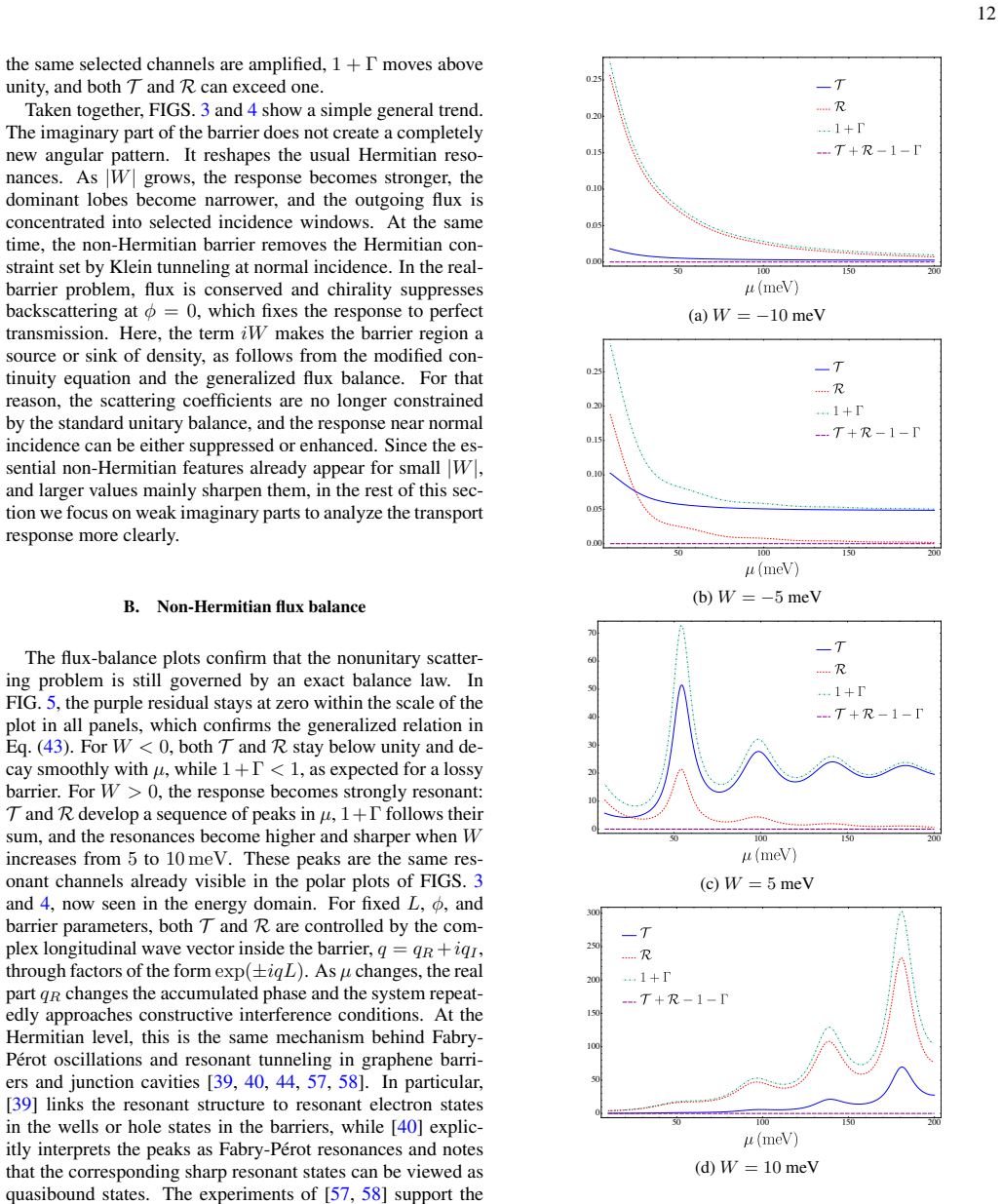
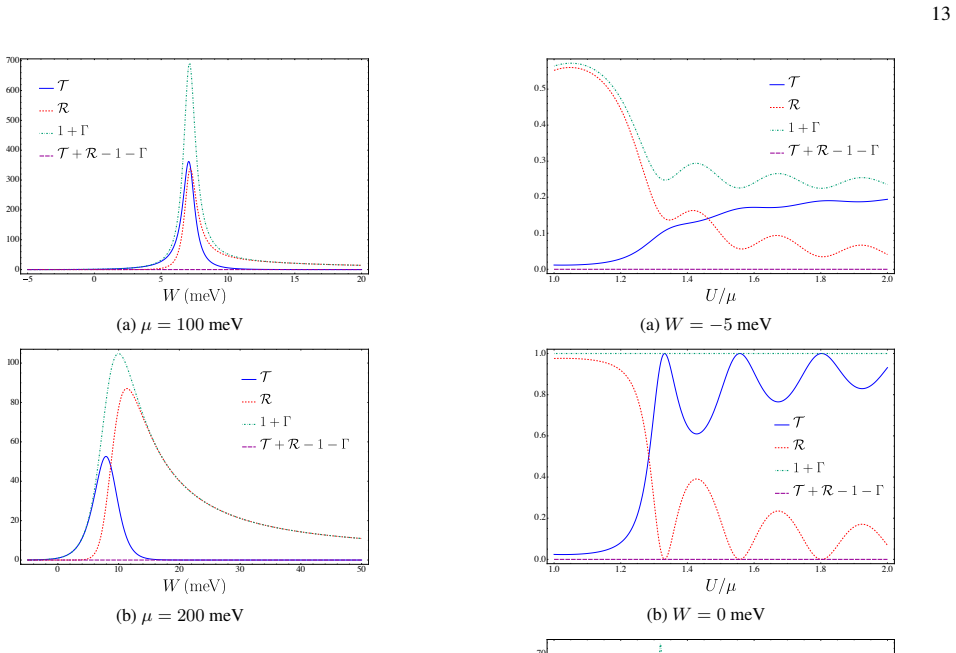
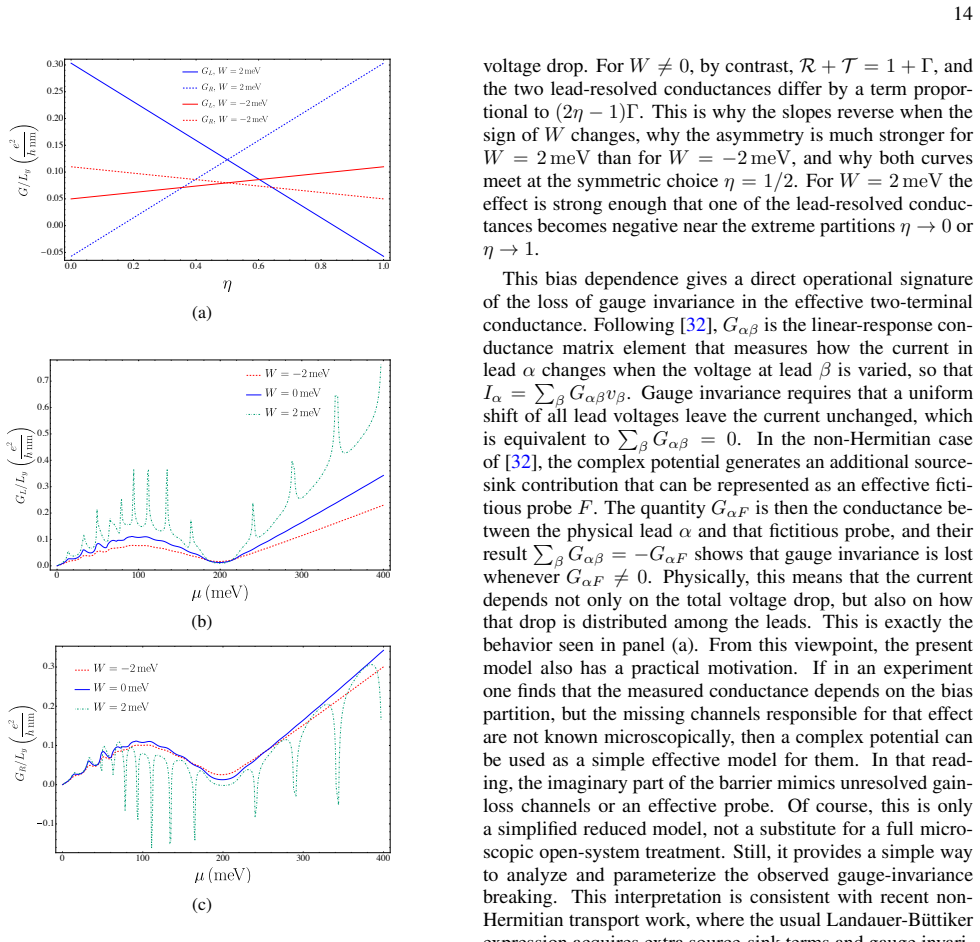
Solving the Dirac-Weyl problem exactly, the imaginary part of the barrier renders the scattering matrix nonunitary and replaces the usual Hermitian flux conservation by a generalized flux-balance relation determined by the net gain or loss inside the barrier. In the Hermitian limit the standard graphene n-p-n behavior is recovered, including perfect transmission at normal incidence and Fabry-Perot resonances. For finite imaginary part the same resonant channels are selectively attenuated or amplified, modifying both the angular response and the conductance profile; the lead-resolved conductances become dependent on the bias partition. At finite temperature the exact linear-response transport
What carries the argument
The complex potential barrier inserted into the Dirac-Weyl Hamiltonian, which produces a non-unitary scattering matrix together with a generalized flux-balance relation controlled by net gain or loss.
If this is right
- Gain inside the barrier enhances both electrical and thermal conductances.
- Loss suppresses the thermal conductance more efficiently than gain increases it.
- The largest thermoelectric figure of merit occurs in the loss-dominated regime.
- Lead-resolved conductances depend on how the bias is partitioned between the two terminals.
- Resonant transmission channels are selectively amplified or attenuated according to the sign of the imaginary potential.
Where Pith is reading between the lines
- The same complex-barrier construction could be applied to other Dirac materials to explore analogous non-Hermitian thermoelectric effects.
- Device designs might deliberately introduce auxiliary probes or sinks to emulate the effective imaginary potential for practical tuning.
- The breakdown of gauge invariance in the two-terminal response offers a measurable signature that could be tested independently of the thermoelectric coefficients.
Load-bearing premise
The imaginary potential serves as an effective reduced description of unresolved source-sink channels or additional probes coupled to the device when a fully microscopic model of the environment is unavailable.
What would settle it
A measurement of the thermoelectric figure of merit in a graphene device containing an engineered complex barrier, performed at finite temperature for both positive and negative values of the imaginary part, would show whether loss indeed produces the largest value within the studied range.
Figures





read the original abstract
We investigate thermoelectric transport in monolayer graphene across a finite complex barrier within a Landauer scattering framework. Solving the Dirac-Weyl problem exactly, we show that the imaginary part of the barrier renders the scattering matrix nonunitary and replaces the usual Hermitian flux conservation by a generalized flux-balance relation determined by the net gain or loss inside the barrier. In the Hermitian limit, the standard graphene $n$-$p$-$n$ barrier behavior is recovered, including perfect transmission at normal incidence and Fabry-Perot-type resonances. For a finite imaginary part, however, the same resonant channels are selectively attenuated or amplified, which significantly modifies both the angular response and the conductance profile. We further show that the lead-resolved conductances become dependent on the bias partition, providing a direct signature of the breakdown of gauge invariance in the effective two-terminal response. At finite temperature, the exact linear-response coefficients reveal a clear trade-off controlled by the imaginary part of the barrier: gain enhances both the electrical and thermal conductances, whereas loss suppresses the thermal conductance more efficiently and yields the largest thermoelectric figure of merit within the parameter range considered. These results demonstrate that complex barriers extend the range of transport behaviors accessible in graphene beyond the usual Hermitian $n$-$p$-$n$ junction. They also suggest a practical interpretation of the imaginary potential as an effective reduced description of unresolved source-sink channels or additional probes coupled to the device, particularly when a fully microscopic model of the environment is not available.
Editorial analysis
A structured set of objections, weighed in public.
Referee Report
Summary. The manuscript solves the Dirac-Weyl scattering problem exactly for monolayer graphene with a finite complex barrier in the Landauer framework. It shows that a nonzero imaginary barrier component renders the S-matrix non-unitary, replaces Hermitian flux conservation with a generalized flux-balance relation set by net gain or loss inside the barrier, modifies angular transmission and conductance profiles, breaks gauge invariance in lead-resolved conductances, and produces a finite-temperature trade-off in which loss suppresses thermal conductance K more efficiently than electrical conductance G, yielding the largest ZT within the explored parameter range.
Significance. If the reported trade-off and ZT enhancement survive a corrected energy-current definition, the work is significant: it supplies an exactly solvable non-Hermitian extension of the canonical graphene n-p-n junction, demonstrates tunable thermoelectric response via an effective imaginary potential, and offers a practical interpretation of complex barriers as reduced models for unresolved source-sink channels. The recovery of perfect normal-incidence transmission and Fabry-Perot resonances in the Hermitian limit, together with the explicit generalized flux-balance relation, are clear strengths.
major comments (2)
- [finite-temperature thermoelectric coefficients] In the finite-temperature linear-response section, the thermal conductance is evaluated with the conventional Landauer integral K ~ ∫ (E-μ)^2 T(E) (-∂f/∂E) dE using the modified transmission probabilities from the non-unitary S-matrix. However, the generalized flux-balance relation is derived only for particle current; the manuscript does not re-derive the energy-current operator from the continuity equation of the non-Hermitian Dirac Hamiltonian or include possible extra terms proportional to Im(V). This omission is load-bearing for the central claim that loss yields the largest ZT via stronger K suppression.
- [lead-resolved conductances] The lead-resolved conductances are stated to depend on the bias partition, presented as a direct signature of gauge-invariance breakdown. An explicit side-by-side comparison with the Hermitian limit (where partition independence must hold) would strengthen this claim and clarify the magnitude of the effect.
minor comments (3)
- [model definition] The complex barrier potential is introduced as V = V_r + i V_i; an explicit equation number or definition box would help readers track the sign convention for gain versus loss.
- [figures] Figure captions for the angular transmission plots should state the precise value of the imaginary part used and whether the curves are normalized to the Hermitian case.
- [scattering solution] A brief remark on the numerical stability of the exact Dirac-Weyl solution for large |Im(V)| would be useful, given that the S-matrix becomes strongly non-unitary.
Simulated Author's Rebuttal
We thank the referee for the careful reading and constructive comments. Below we respond point by point to the major comments and indicate the revisions we will implement.
read point-by-point responses
-
Referee: In the finite-temperature linear-response section, the thermal conductance is evaluated with the conventional Landauer integral K ~ ∫ (E-μ)^2 T(E) (-∂f/∂E) dE using the modified transmission probabilities from the non-unitary S-matrix. However, the generalized flux-balance relation is derived only for particle current; the manuscript does not re-derive the energy-current operator from the continuity equation of the non-Hermitian Dirac Hamiltonian or include possible extra terms proportional to Im(V). This omission is load-bearing for the central claim that loss yields the largest ZT via stronger K suppression.
Authors: We thank the referee for identifying this point. The generalized flux-balance relation was derived from the continuity equation applied to the particle current. Because the non-Hermitian term is localized inside the barrier while the leads remain Hermitian, the energy flux operators in the asymptotic regions retain their standard form; the scattering matrix already incorporates the net gain or loss into the transmission probabilities used in the Landauer integrals. To make this explicit, we will add a short derivation of the energy current from the continuity equation in a new appendix of the revised manuscript, confirming that no additional Im(V)-dependent source terms appear in the lead-resolved energy currents. This addition will substantiate that the reported suppression of thermal conductance under loss and the resulting ZT enhancement remain valid. revision: yes
-
Referee: The lead-resolved conductances are stated to depend on the bias partition, presented as a direct signature of gauge-invariance breakdown. An explicit side-by-side comparison with the Hermitian limit (where partition independence must hold) would strengthen this claim and clarify the magnitude of the effect.
Authors: We agree that an explicit comparison would improve clarity. In the revised manuscript we will insert a new panel (or supplementary figure) that plots the lead-resolved conductances versus bias partition for both the Hermitian case (imaginary barrier component set to zero) and the non-Hermitian case. The Hermitian curves will be independent of partition, while the non-Hermitian curves will exhibit clear dependence, thereby quantifying the gauge-invariance breakdown and directly addressing the referee’s request. revision: yes
Circularity Check
Derivation self-contained from Dirac-Weyl scattering and Landauer framework
full rationale
The paper begins from the Dirac-Weyl Hamiltonian with complex barrier potential, solves the scattering problem exactly to obtain the non-unitary S-matrix and the associated generalized flux-balance relation for particle current, then inserts the resulting transmission probabilities into the standard Landauer-Büttiker integrals for linear-response conductances and thermoelectric coefficients at finite temperature. No parameters are fitted to a data subset and then relabeled as predictions, no self-citation chain supplies a uniqueness theorem or ansatz that forces the central trade-off result, and the reported gain/loss effects on G and K follow directly from the modified transmission without reducing to the input definitions by construction. The derivation is therefore independent and self-contained.
Axiom & Free-Parameter Ledger
free parameters (1)
- imaginary part of barrier potential
axioms (2)
- standard math Dirac-Weyl equation governs low-energy electrons in monolayer graphene
- domain assumption Landauer scattering framework applies to non-Hermitian systems with generalized flux balance
Lean theorems connected to this paper
-
IndisputableMonolith/Cost/FunctionalEquation.leanwashburn_uniqueness_aczel unclear?
unclearRelation between the paper passage and the cited Recognition theorem.
the imaginary part of the barrier renders the scattering matrix nonunitary and replaces the usual Hermitian flux conservation by a generalized flux-balance relation determined by the net gain or loss inside the barrier
-
IndisputableMonolith/Foundation/AlphaCoordinateFixation.leanJ_uniquely_calibrated_via_higher_derivative unclear?
unclearRelation between the paper passage and the cited Recognition theorem.
At finite temperature, the exact linear-response coefficients reveal a clear trade-off controlled by the imaginary part of the barrier
What do these tags mean?
- matches
- The paper's claim is directly supported by a theorem in the formal canon.
- supports
- The theorem supports part of the paper's argument, but the paper may add assumptions or extra steps.
- extends
- The paper goes beyond the formal theorem; the theorem is a base layer rather than the whole result.
- uses
- The paper appears to rely on the theorem as machinery.
- contradicts
- The paper's claim conflicts with a theorem or certificate in the canon.
- unclear
- Pith found a possible connection, but the passage is too broad, indirect, or ambiguous to say the theorem truly supports the claim.
Reference graph
Works this paper leans on
-
[1]
Estancias Pos- doctorales por M ´exico
links the resonant structure to resonant electron states in the wells or hole states in the barriers, while [40] explic- itly interprets the peaks as Fabry-P ´erot resonances and notes that the corresponding sharp resonant states can be viewed as quasibound states. The experiments of [57, 58] support the same interpretation by showing that the oscillatory...
work page 2025
-
[2]
A. H. Castro Neto, F. Guinea, N. M. R. Peres, K. S. Novoselov, and A. K. Geim, The electronic properties of graphene, Rev. Mod. Phys.81, 109 (2009)
work page 2009
-
[3]
S. Das Sarma, S. Adam, E. H. Hwang, and E. Rossi, Electronic transport in two-dimensional graphene, Rev. Mod. Phys.83, 407 (2011)
work page 2011
-
[4]
M. I. Katsnelson, Graphene: Carbon in Two Dimensions (Cam- bridge University Press, Cambridge, United Kingdom, 2012)
work page 2012
-
[5]
M. I. Katsnelson, K. S. Novoselov, and A. K. Geim, Chiral tun- nelling and the klein paradox in graphene, Nat. Phys.2, 620 (2006)
work page 2006
-
[6]
Landauer, Electrical resistance of disordered one- dimensional lattices, Philos
R. Landauer, Electrical resistance of disordered one- dimensional lattices, Philos. Mag.21, 863 (1970)
work page 1970
-
[7]
Landauer, Conductance determined by transmission: probes and quantised constriction resistance, J
R. Landauer, Conductance determined by transmission: probes and quantised constriction resistance, J. Phys.: Condens. Matter 1, 8099 (1989)
work page 1989
-
[8]
M. B ¨uttiker, Y . Imry, R. Landauer, and S. Pinhas, Generalized many-channel conductance formula with application to small rings, Phys. Rev. B31, 6207 (1985)
work page 1985
-
[9]
B ¨uttiker, Four-terminal phase-coherent conductance, Phys
M. B ¨uttiker, Four-terminal phase-coherent conductance, Phys. Rev. Lett.57, 1761 (1986)
work page 1986
-
[10]
S. Datta, Electronic Transport in Mesoscopic Systems (Cam- bridge University Press, Cambridge, United Kingdom, 1995)
work page 1995
-
[11]
Y . V . Nazarov and Y . M. Blanter, Quantum Transport: Introduction to Nanoscience (Cambridge University Press, Cambridge, United Kingdom, 2009)
work page 2009
-
[12]
E. Mu ˜noz and R. Soto-Garrido, Analytic approach to magneto- strain tuning of electronic transport through a graphene nanobubble: perspectives for a strain sensor, J. Phys.: Condens. Matter29, 445302 (2017)
work page 2017
-
[13]
D. A. Bonilla, J. D. Casta ˜no-Yepes, A. Mart ´ın-Ruiz, and E. Mu ˜noz, Electromagnetic coupling and transport in a topo- logical insulator–graphene heterostructure, Phys. Rev. B107, 245103 (2023)
work page 2023
-
[14]
S. G. y. Garc ´ıa, Y . Betancur-Ocampo, F. S´anchez-Ochoa, and T. Stegmann, Atomically thin current pathways in graphene through kekul´e-o engineering, Nano Letters24, 2322 (2024)
work page 2024
-
[15]
J. A. Ca ˜nas, D. A. Bonilla, and A. Mart ´ın-Ruiz, Thermoelec- tric transport in graphene under strain fields modeled by dirac oscillators, Phys. Rev. B112, 104206 (2025)
work page 2025
-
[16]
J. A. Ca ˜nas, D. A. Bonilla, J. C. P´erez-Pedraza, and A. Mart´ın- Ruiz, Charge and energy transport in graphene with smooth finite-range disorder, Physica B: Condens. Matter729, 418431 (2026)
work page 2026
-
[17]
R. Soto-Garrido and E. Mu ˜noz, Electronic transport in tor- sional strained weyl semimetals, J. Phys.: Condens. Matter30, 195302 (2018)
work page 2018
-
[18]
E. Mu ˜noz and R. Soto-Garrido, Thermoelectric transport in tor- sional strained weyl semimetals, J. Appl. Phys.125, 082507 (2019)
work page 2019
-
[19]
D. Bonilla, E. Mu ˜noz, and R. Soto-Garrido, Thermo-magneto- electric transport through a torsion dislocation in a type i weyl semimetal, Nanomaterials11, 2972 (2021)
work page 2021
-
[20]
D. Bonilla and E. Mu˜noz, Electronic transport in weyl semimet- als with a uniform concentration of torsional dislocations, Nanomaterials12, 3711 (2022)
work page 2022
-
[21]
D. A. Bonilla and E. Mu ˜noz, Thermoelectric transport in weyl semimetals under a uniform concentration of torsional disloca- tions, Nanoscale Adv.6, 2701 (2024)
work page 2024
-
[22]
N. Moiseyev, Non-Hermitian Quantum Mechanics (Cambridge University Press, Cambridge, United Kingdom, 2011)
work page 2011
-
[23]
Rotter, A non-hermitian hamilton operator and the physics of open quantum systems, J
I. Rotter, A non-hermitian hamilton operator and the physics of open quantum systems, J. Phys. A: Math. Theor.42, 153001 (2009)
work page 2009
-
[24]
C. M. Bender, Making sense of non-hermitian hamiltonians, Rep. Prog. Phys.70, 947 (2007)
work page 2007
-
[25]
R. El-Ganainy, K. G. Makris, M. Khajavikhan, Z. H. Mus- slimani, S. Rotter, and D. N. Christodoulides, Non-hermitian 19 physics and PT symmetry, Nat. Phys.14, 11 (2018)
work page 2018
-
[26]
L. E. F. Foa Torres, Perspective on topological states of non- hermitian lattices, J. Phys. Mater.3, 014002 (2020)
work page 2020
-
[27]
K. Kawabata, K. Shiozaki, and S. Ryu, Many-body topology of non-hermitian systems, Phys. Rev. B105, 165137 (2022)
work page 2022
-
[28]
H. Schomerus, From scattering theory to complex wave dynam- ics in non-hermitian PT-symmetric resonators, Philos. Trans. R. Soc. A371, 20120194 (2013)
work page 2013
-
[29]
J. G. Muga, J. P. Palao, B. Navarro, and I. L. Egusquiza, Com- plex absorbing potentials, Phys. Rep.395, 357 (2004)
work page 2004
-
[30]
H. Ghaemi-Dizicheh, T. Kottos, and B. Shapiro, Transport ef- fects in non-hermitian nonreciprocal systems, Phys. Rev. B107, 125155 (2023)
work page 2023
-
[31]
A. F. Tzortzakakis, K. G. Makris, A. Szameit, and E. N. Economou, Transport and spectral features in non-hermitian open systems, Phys. Rev. Research3, 013208 (2021)
work page 2021
-
[32]
Q. Yan, H. Li, Q.-F. Sun, and X. C. Xie, Transport theory in non-hermitian systems, Phys. Rev. B110, 045138 (2024)
work page 2024
-
[33]
M. Wei, B. Wang, and J. Wang, Gauge invariant quantum transport theory for non-hermitian systems, Phys. Rev. B111, 075135 (2025)
work page 2025
-
[34]
C. Yang and Y . Wang, Extended landauer-b¨uttiker formula for current through open quantum systems with gain or loss, Phys. Rev. Lett.136, 056304 (2026)
work page 2026
-
[35]
Bagarello, PT-symmetric graphene under a magnetic field, Proc
F. Bagarello, PT-symmetric graphene under a magnetic field, Proc. R. Soc. A472, 20160365 (2016)
work page 2016
-
[36]
D. J. Fern ´andez and J. D. Garc´ıa-Mu˜noz, Graphene in complex magnetic fields, Eur. Phys. J. Plus137, 1013 (2022)
work page 2022
-
[37]
M. Sarisaman and M. Tas, Unidirectional invisibility and PT symmetry with graphene, Phys. Rev. B97, 045409 (2018)
work page 2018
-
[38]
R. Chaturvedi, V . K¨onye, E. M. Hankiewicz, J. van den Brink, and I. C. Fulga, Non-hermitian topology of transport in the quantum hall phases in graphene, Phys. Rev. B111, 245424 (2025)
work page 2025
-
[39]
B. ¨Ozer, K. Ochkan, R. Chaturvedi, E. Maltsev, V . K ¨onye, R. Giraud, A. Veyrat, E. M. Hankiewicz, K. Watanabe, T. Taniguchi, B. B¨uchner, J. van den Brink, I. C. Fulga, J. Du- fouleur, and L. Veyrat, Non-hermitian topology in the quantum hall effect of graphene, arXiv , arXiv:2410.14329 (2024)
-
[40]
J. Pereira, J. Milton, P. Vasilopoulos, and F. M. Peeters, Graphene-based resonant-tunneling structures, Appl. Phys. Lett.90, 132122 (2007)
work page 2007
-
[41]
M. Ramezani Masir, P. Vasilopoulos, and F. M. Peeters, Fabry- p´erot resonances in graphene microstructures: Influence of a magnetic field, Phys. Rev. B82, 115417 (2010)
work page 2010
-
[42]
J. D. Lejarreta, C. H. Fuentevilla, E. Diez, and J. M. Cervero, An exact transmission coefficient with one and two barriers in graphene, J. Phys. A: Math. Theor.46, 155304 (2013)
work page 2013
-
[43]
C. H. Fuentevilla, J. D. Lejarreta, C. Cobaleda, and E. Diez, Angle dependent conductivity in graphene fet transistors, Solid- State Electron.104, 47 (2015)
work page 2015
-
[44]
P. M. Krstajic and P. Vasilopoulos, Ballistic transport through graphene nanostructures of velocity and potential barriers, J. Phys.: Condens. Matter23, 135302 (2011)
work page 2011
-
[45]
S. Shekhar, B. P. Mandal, and A. Dutta, Relativistic particles in a superperiodic potential: Exploring graphene and fractal sys- tems, Phys. Rev. B112, 165106 (2025)
work page 2025
-
[46]
G. L. Celardo and L. Kaplan, Superradiance transition in one-dimensional nanostructures: An effective non-Hermitian Hamiltonian formalism, Phys. Rev. B79, 155108 (2009)
work page 2009
-
[47]
G. G. Giusteri, F. Mattiotti, and G. L. Celardo, Non-Hermitian Hamiltonian approach to quantum transport in disordered net- works with sinks: Validity and effectiveness, Phys. Rev. B91, 094301 (2015)
work page 2015
-
[48]
B. G. Cook, P. Dignard, and K. Varga, Calculation of electron transport in multiterminal systems using complex absorbing po- tentials, Phys. Rev. B83, 205105 (2011)
work page 2011
-
[49]
H. Xie, Y . Kwok, F. Jiang, X. Zheng, and G. Chen, Complex absorbing potential based Lorentzian fitting scheme and time dependent quantum transport, The Journal of Chemical Physics 141, 164122 (2014)
work page 2014
-
[50]
C. Wu, A. Fan, and S.-D. Liang, Complex Berry curvature and complex energy band structures in non-Hermitian graphene model, AAPPS Bulletin32, 39 (2022)
work page 2022
-
[51]
H. Geng, J. Y . Wei, M. H. Zou, L. Sheng, W. Chen, and D. Y . Xing, Nonreciprocal charge and spin transport induced by non- Hermitian skin effect in mesoscopic heterojunctions, Phys. Rev. B107, 035306 (2023)
work page 2023
-
[52]
J. C. Kl ¨ockner, M. Matt, P. Nielaba, F. Pauly, and J. C. Cuevas, Thermal conductance of metallic atomic-size contacts: Phonon transport and wiedemann-franz law, Phys. Rev. B96, 205405 (2017)
work page 2017
-
[53]
U. Sivan and Y . Imry, Multichannel landauer formula for ther- moelectric transport with application to thermopower near the mobility edge, Phys. Rev. B33, 551 (1986)
work page 1986
-
[54]
P. N. Butcher, Thermal and electrical transport formalism for electronic microstructures with many terminals, Journal of Physics: Condensed Matter2, 4869 (1990)
work page 1990
-
[55]
J. C. Cuevas and E. Scheer, Molecular Electronics: An Introduction to Theory and Experiment, V ol. 1 (World Scientific Publishing, Singapore, 2010)
work page 2010
- [56]
- [57]
-
[58]
A. F. Young and P. Kim, Quantum interference and klein tun- nelling in graphene heterojunctions, Nat. Phys.5, 222 (2009)
work page 2009
-
[59]
A. L. Grushina, D.-K. Ki, and A. F. Morpurgo, A ballistic pn junction in suspended graphene with split bottom gates, Appl. Phys. Lett.102, 223102 (2013)
work page 2013
-
[60]
J. Tworzydlo, B. Trauzettel, M. Titov, A. Rycerz, and C. W. J. Beenakker, Sub-poissonian shot noise in graphene, Phys. Rev. Lett.96, 246802 (2006)
work page 2006
-
[61]
M. I. Katsnelson, Zitterbewegung, chirality, and minimal con- ductivity in graphene, Eur. Phys. J. B51, 157 (2006)
work page 2006
-
[62]
M. M ¨uller, M. Br¨auninger, and B. Trauzettel, Temperature de- pendence of the conductivity of ballistic graphene, Phys. Rev. Lett.103, 196801 (2009)
work page 2009
- [63]
-
[64]
S. K. Mishra, A. Kumar, C. P. Kaushik, and B. Dikshit, Reso- nant tunneling effect in graphene superlattice heterostructures by tuning the electric potential of defect layer, J. Appl. Phys. 121, 184301 (2017)
work page 2017
-
[65]
S. K. Mishra, A. Kumar, C. P. Kaushik, and B. Dikshit, An efficient tunable thermoelectric device based on n and p doped graphene superlattice heterostructures, Superlattices Mi- crostruct.142, 106520 (2020)
work page 2020
discussion (0)
Sign in with ORCID, Apple, or X to comment. Anyone can read and Pith papers without signing in.