The Quantum Statistical Approach to Parton Distributions upgraded with recent experimental data
Pith reviewed 2026-07-02 09:46 UTC · model grok-4.3
The pith
The Quantum Statistical Parton Model is upgraded to incorporate Marathon and SeaQuest data while entropy variations clarify the role of its thermodynamical potentials.
A machine-rendered reading of the paper's core claim, the machinery that carries it, and where it could break.
Core claim
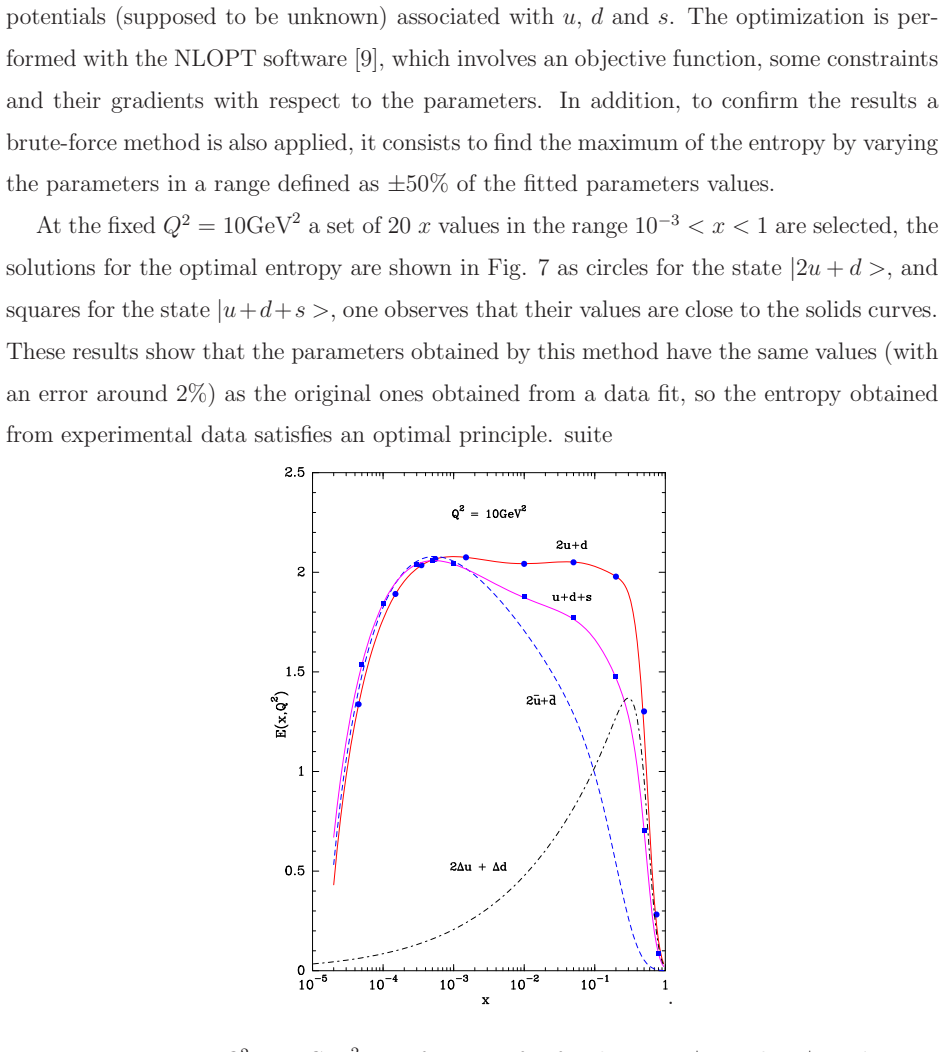
The Quantum Statistical Parton Model has been successful over the years explaining a great set of unpolarized and polarized experimental data. With the advent of the Marathon and SeaQuest experiments an upgraded version is required to maintain the validity of the model. Moreover, in order to clarify the role of the thermodynamical potentials, the main parameters of the model, we examine the variation of the proton and the neutron entropy with the potentials.
What carries the argument
The quantum statistical approach to parton distributions, with thermodynamical potentials as the central parameters whose effects are diagnosed through entropy changes in the proton and neutron.
If this is right
- The upgraded model continues to describe existing unpolarized and polarized data sets.
- Entropy variation with the potentials directly identifies the influence of the main parameters.
- The statistical framework remains applicable to proton and neutron parton distributions after the update.
Where Pith is reading between the lines
- The entropy diagnostic could be applied to other hadrons to test whether the same parameter roles appear.
- Predictions from the upgraded model for quantities not yet measured could be checked in upcoming collider runs.
- The thermodynamic language might suggest links to statistical mechanics treatments of other QCD observables.
Load-bearing premise
Prior successes with unpolarized and polarized data can be retained after adding Marathon and SeaQuest constraints without changing the underlying statistical framework.
What would settle it
A fit to the new data that produces large deviations from previously successful descriptions of unpolarized and polarized observables would falsify the claim that an upgraded version maintains validity.
Figures


read the original abstract
The Quantum Statistical Parton Model has been successful over the years explain a great set of unpolarized and polarized experimental data. to With the advent of the Marathon and SeaQuest experiments an upgraded version is required to maintain the validity of the model. Moreover, in order to clarify the role of the thermodynamical potentials, the main parameters of the model, we examine the variation of the proton and the neutron entropy with the potentials.
Editorial analysis
A structured set of objections, weighed in public.
Referee Report
Summary. The manuscript asserts that the Quantum Statistical Parton Model, previously successful for unpolarized and polarized data, requires an upgrade to remain valid in light of new constraints from the Marathon and SeaQuest experiments; it further states that examining the variation of proton and neutron entropy with the model's thermodynamical potentials will clarify the role of those parameters.
Significance. If the upgrade were shown to preserve the statistical framework while incorporating the new data, and if explicit entropy calculations were provided, the work could help refine statistical approaches to PDFs. However, the manuscript supplies no functional forms, fit results, entropy expressions, or validation, so no positive significance can be assigned.
major comments (2)
- [Abstract] The entire manuscript consists solely of the abstract-level assertion that an 'upgraded version is required' and that entropy variation 'clarifies the role' of the potentials, with no equations, no explicit parton distributions (Fermi-Dirac or Bose-Einstein factors), no numerical constraints from Marathon/SeaQuest, and no entropy expressions S(μ,T). This absence is load-bearing for both central claims.
- No comparison is shown between prior fits and any new fit that retains the statistical ansatz while satisfying the new experiments; without this, it is impossible to test the weakest assumption that the prior framework can be retained unchanged.
minor comments (1)
- [Abstract] Grammatical and typographical errors in the abstract: 'explain a great set' should read 'explaining a great set'; 'to With the advent' is garbled.
Simulated Author's Rebuttal
We thank the referee for the detailed report. The submitted manuscript is indeed a concise statement outlining the motivation for upgrading the Quantum Statistical Parton Model with Marathon and SeaQuest data and for examining entropy dependence on the thermodynamical potentials. We address the specific comments below and will revise the manuscript to incorporate the requested details.
read point-by-point responses
-
Referee: [Abstract] The entire manuscript consists solely of the abstract-level assertion that an 'upgraded version is required' and that entropy variation 'clarifies the role' of the potentials, with no equations, no explicit parton distributions (Fermi-Dirac or Bose-Einstein factors), no numerical constraints from Marathon/SeaQuest, and no entropy expressions S(μ,T). This absence is load-bearing for both central claims.
Authors: We agree that the current manuscript contains only the abstract and lacks the explicit functional forms, numerical constraints, and entropy expressions. The text was intended as a brief announcement of the planned upgrade and analysis. In revision we will add the Fermi-Dirac and Bose-Einstein distributions used in the model, the updated constraints from the Marathon and SeaQuest experiments, and the explicit entropy expressions S(μ,T) for the proton and neutron. revision: yes
-
Referee: [—] No comparison is shown between prior fits and any new fit that retains the statistical ansatz while satisfying the new experiments; without this, it is impossible to test the weakest assumption that the prior framework can be retained unchanged.
Authors: The manuscript does not contain such a comparison because it is limited to the abstract-level statement. We concur that demonstrating retention of the statistical framework while accommodating the new data is necessary. The revised version will include a direct comparison of the previous fits with the upgraded fits that incorporate the Marathon and SeaQuest constraints. revision: yes
Circularity Check
No derivation chain or equations present; circularity cannot be assessed
full rationale
The provided manuscript text consists only of the abstract, which makes high-level assertions about prior model success and the need for an upgrade based on new data but supplies no equations, functional forms for parton distributions, entropy expressions, fit procedures, or self-citations. Absent any explicit derivation steps or load-bearing claims that could reduce to inputs by construction, no circular patterns from the enumerated list can be identified. The text is therefore self-contained against external benchmarks for the purpose of this analysis, as there is no derivation to inspect.
Axiom & Free-Parameter Ledger
free parameters (1)
- thermodynamical potentials
Reference graph
Works this paper leans on
-
[1]
= AqX h 0qxbq exp[(x − X h 0q)/ ¯x] + 1 + ˜Aqx˜bq exp(x/ ¯x) + 1 , (1) x¯qh(x, Q 2
-
[2]
= ¯Aq(X − h 0q )− 1x¯bq exp[(x + X − h 0q )/ ¯x] + 1 + ˜Aqx ˜bq exp(x/ ¯x) + 1 , (2) 2 defined at the input energy scale Q2 0 = 1GeV 2. We note that the diffractive term is absent in the polarized quark helicity distributions ∆ q = qh=+ − qh=− and also in the quark valence contribution q − ¯q. In Eq. (1) the multiplicative factors X h 0q in the numerator an...
-
[3]
= AGxbG exp(x/ ¯x) − 1 , (3) a quasi Bose-Einstein function, with bG being the only free parameter, since AG is determined by the momentum sum rule. In our earlier work [2] we were assuming th at, at the input energy scale, the polarized gluon distribution vanishes, so it was set to x∆ G(x, Q 2
-
[4]
= 0 . (4) 3 However, as a result of the present analysis of a much larger set of very accurate unpolarized and polarized DIS data, one must give up this simple form. A new expre ssion is assumed: x∆ G(x, Q 2
-
[5]
(5) It is clear that we don’t have a serious justification of the functiona l form of Eq
= ˜AGx ˜bG (1 + cGxdG) · 1 exp(x/ ¯x − 1) . (5) It is clear that we don’t have a serious justification of the functiona l form of Eq. 5. The above expression shows that it is strongly related to G(x, Q 2
-
[6]
and therefore constructed by means of a Bose-Einstein distribution with zero potential. Actually since ∆ G(x, Q 2
-
[7]
= P (x)G(x, Q 2 0) a simpler expression would be P (x) = Axb, but an additional term in the denominator is needed in order to get a reasonable fit of the polarized DIS data. Als o to insure that positivity is satisfied we must have |P (x)| ≤ 1, which is automatically fullfilled by construction. An other justification of the polarized gluon expression is given...
-
[8]
In the above results the quark distributions are the essential source of information to obtain an optimum such a property should b e reflected in the quarks themselves. One may consider that a true optimization is obtained when all the par ameters are free to participate to the calculations of the optimization, here only the the rmodybamical potentials are...
work page 2015
- [9]
-
[10]
C. Bourrely, F. Buccella and J. Soffer, A statistical appro ach for polarized parton distributions, Eur. Phys. J. C23 (2002) 187
work page 2002
- [11]
-
[12]
New developments in the statistical approach of parton d istributions: tests and predictions up to LHC energies; C. Bourrely and J. Soffer, Nucl. Phys. A941 (2015) 307
work page 2015
-
[13]
Relativistic Thermodynamics: Transverse Momentum Distributions in High-Energy Physics
J. Cleymans and D. Worku, Eur. Phys. J. A 48, 160 (2012), arXiv:1203.4343 [hep-ph]
work page internal anchor Pith review Pith/arXiv arXiv 2012
-
[14]
FNAL E866 Collaboration, J.C. Peng et al . , Phys. Rev. 58 (1998) 092004, R.S. Towell et al . , Phys. Rev. 64 2001) 052002
work page 1998
-
[15]
FNAL E906 SeaQuest collaboration, J. Dove et al . , Phys. Rev. C 108 (2023) 035202 15
work page 2023
-
[16]
A Higher Order Perturbative Parton Evolution Toolkit (HOPPET)
G.P. Salam and J. Rojo, Comput. Phys. Commun. 180, 120 (2009) (arXiv:0804.3755 [hep-ph])
work page internal anchor Pith review Pith/arXiv arXiv 2009
-
[17]
Johnson, http://ab-initio.mit.edu/wiki/index
S.G. Johnson, http://ab-initio.mit.edu/wiki/index. php/NLopt
-
[18]
C. Bourrely, F. Buccella, W. C. Chang, D. Di Bario, P. H. F rampton, J. C. Peng, Nuc. Phys. A 1067 (2026) 123300
work page 2026
-
[19]
MARATHON experiment, D. Abrams et al . , Phys. Rev. Lett. 128, 132003 (2022)
work page 2022
- [20]
-
[21]
D. de Florian, R. Sassot, M. Stratmann, W. V ogelsang, Phys. Rev. Lett. 11 3 (2014) 012001
work page 2014
- [22]
- [23]
-
[24]
Y ang et al., CCFR/NuT eV Collaboration, Phys
U.K. Y ang et al., CCFR/NuT eV Collaboration, Phys. Rev. Lett. 87 (200 1)251802
-
[25]
M. Tzanov et al . (NuT eV Collaboration), Phys. Rev. D 74, 012008 (2006)
work page 2006
-
[26]
G. Onengut et al . (CHORUS Collaboration), Phys. Lett. B 632, 65 (2006)
work page 2006
- [27]
-
[28]
S. Chekanov et al . (ZEUS Collaboration), Eur. Phys. J. C 21, 443 (2001)
work page 2001
- [29]
- [31]
- [32]
-
[33]
P . Amaudruz et al . (NMC Collaboration), Phys. Rev. Lett. 66, 2712 (1991)
work page 1991
- [34]
- [35]
- [36]
-
[37]
A. Airapetian et al . (HERMES Collaboration), Phys. Rev. D 71, 012003 (2005)
work page 2005
-
[38]
(SLAC E155 Collaboration), Phys
P .L Anthony et al . (SLAC E155 Collaboration), Phys. Lett. B 493, 19 (2000)
work page 2000
- [39]
-
[40]
P . L. Anthony et al . (SLAC E142 Collaboration), Phys. Rev. D 54, 6620 (1996)
work page 1996
- [41]
- [42]
- [43]
-
[44]
M.G. Alekseev et al . (COMP ASS Collaboration), Phys. Lett. B 690, 466 (2010) 16
work page 2010
- [45]
-
[46]
X. Zheng et al . (Jefferson Lab Hall A Collaboration), Phys. Rev. C 70, 065207 (2004)
work page 2004
-
[47]
D.S. Parno et al . , Phys. Rev. C 91, 045506 (2015) arXiv:1406.1207 [nucl-ex]
-
[48]
K.V. Dharmawardane et al . (CLAS Collaboration), Phys. Lett. B 641, 11 (2006)
work page 2006
-
[49]
A. Airapetian et al . (HERMES Collaboration), Phys. Rev. D 75, 012007 (2007)
work page 2007
-
[50]
V.Y u. Alexakhin et al . (COMP ASS Collaboration), Phys.Lett. B 647, 8 (2007)
work page 2007
-
[51]
P .L. Anthony et al . (SLAC E155 Collaboration), Phys. Lett. B 463, 339 (1999)
work page 1999
- [52]
-
[53]
S. Alekhin, J. Bl¨ umlein and S. Moch, Phys. Rev. D 86, 054009 (2012) and refe r- ences therein
work page 2012
- [54]
- [55]
- [56]
-
[57]
Dove (Sea Quest Experiment), PoS
J. Dove (Sea Quest Experiment), PoS. DIS2019 (2019) 011
work page 2019
- [58]
-
[59]
A. Airapetian et al. (HERMES Collaboration), Phys. Rev. D 75, 012007 (2007) and Erratum ibid., D 76, 039901 (2007)
work page 2007
- [60]
-
[61]
Stolarski (COMP ASS Collaboration), preliminary results presented at DIS 2014
M. Stolarski (COMP ASS Collaboration), preliminary results presented at DIS 2014
work page 2014
- [62]
- [63]
-
[64]
A.C. Benvenuti et al. (BCDMS Collaboration), Phys. Lett. B 223, 485 (1989)
work page 1989
- [65]
-
[66]
N. Baillie et al. (CLAS Collaboration), Phys. Rev. Lett. 108, 142001 (2012), Erratum-ibid 108, 199902 (2012)
work page 2012
- [67]
- [68]
-
[69]
H. Abramowicz et al. (ZEUS Collaboration), Phys. Rev. D 87, 052014 (2013) 17
work page 2013
- [70]
-
[71]
B. Abelev et al. (ST AR Collaboration), Phys. Rev. Lett. 97, 252001 (2006); see also T. Sakuma, MIT Thesis (2009)
work page 2006
-
[72]
L. Adamczyk et al. (ST AR Collaboration), arXiv:1405.5134 [hep-ex]
work page internal anchor Pith review Pith/arXiv arXiv
- [73]
- [74]
-
[75]
G. Aad et al. (A TLAS Collaboration), arXiv:1410.8857 [hep-ex]
work page internal anchor Pith review Pith/arXiv arXiv
-
[76]
S. Chatrchyan et al . (CMS Collaboration), Phys. Rev. D 87, 112002 (2013); Erratum-ibid, 119902
work page 2013
-
[77]
L. Adamczyk et al. (ST AR Collaboration), Phys. Rev. Lett. 113, 072301 (2014)
work page 2014
-
[78]
T. Aaltonen et al. (CDF Collaboration), Phys. Rev. Lett. 102, 181801 (2009)
work page 2009
-
[79]
V.M. Abazov et al. (D0 Collaboration), Phys. Rev. Lett. 112, 151803 (2014)
work page 2014
- [80]
-
[81]
S. Chatrchyan et al . (CMS Collaboration), Phys. Rev. D 90, 032004 (2014)
work page 2014
discussion (0)
Sign in with ORCID, Apple, or X to comment. Anyone can read and Pith papers without signing in.