REVIEW 4 major objections 4 minor 75 references
Unifying Attribution-Based Explanations Using Functional Decomposition
T0 review · 4 major / 4 minor · reviewed 2026-08-11 · deepseek-v4-flash
Pith's one-line read This paper claims that every removal-based attribution method—Shapley values, LIME, occlusion, LOCO and many others—is fully determined by a behaviour mapping, a set of removal operators, and aggregation coefficients, and that each such…
desk verdict The CAD is indexed the wrong way around: under the paper's own definitions the components sum to P_[d], not f, so Theorem 19 and everything riding on it collapses—though the framework looks salvageable with a re-indexing. read the letter →
The pith
A machine-rendered reading of the paper's core claim, the machinery that carries it, and where it could break.
The reading
What carries the argument
The canonical additive decomposition (CAD): given removal operators {P_T}, define components recursively as g_S(f) = P_S(f) − Σ_{T⊂S} g_T(f), equivalently g_S(f) = Σ_{T⊆S} (−1)^{|S|−|T|} P_T(f). Its summation property P_T = Σ_{S⊆T} g_S connects removal operators to function components, and the pointwise cooperative game v(S) = Φ(P_S(f))(x) − Φ(P_[d](f))(x) turns the decomposition into a cooperative game. The RBAM representation theorem then writes any RBAM's attribution as an aggregation of this game, making the CAD the bridge between removal-based explanations and game theory.
What would settle it
Compute the canonical additive decomposition for the one-variable function f(x) = x using the removal operator that averages over the feature, P_1(f) = E[f]. The recursion gives g_∅(f) = f and g_1(f) = E[f] − f, whose sum is E[f], not f; checking whether the components add back to the original function for this case settles the completeness claim.
Extended reading notes
Core claim
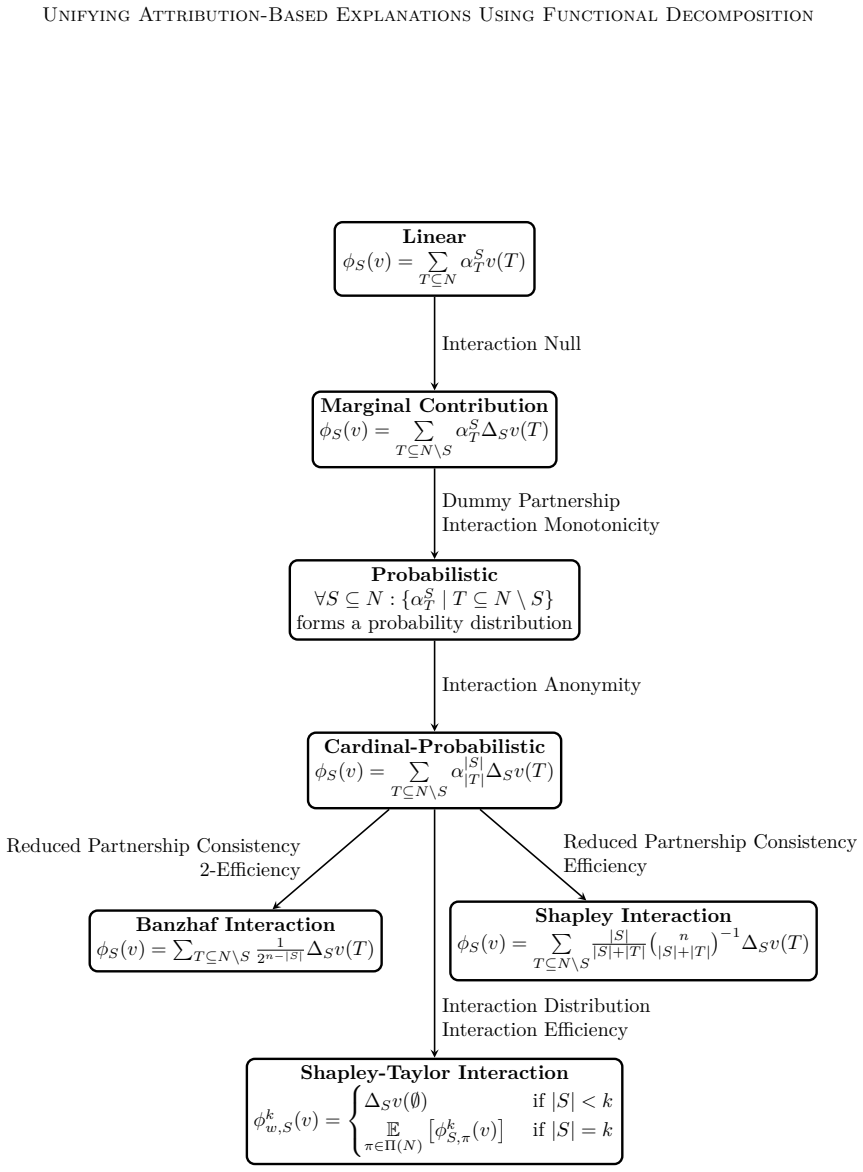
The central claim is that the class of removal-based attribution methods, which includes Shapley-based methods, permutation importance, occlusion, LIME on tabular data, and many interaction indices, is exactly the class of linear functions of pointwise cooperative games. For any RBAM, the removal operators define a canonical additive decomposition of the explained function; the decomposition plus the behaviour mapping defines a cooperative game on feature subsets; and the aggregation coefficients define a value (for single features) or interaction index (for feature groups) on that game. The paper further claims that any additive functional decomposition—any way of writing f as a sum of components each depending on a subset of features—can be represented as a CAD for some removal operators, which would make the CAD a genuinely canonical construction. This equivalence turns questions about explanation methods into questions about additive decompositions and game-theoretic indices, and yields sufficient conditions under which methods satisfy intuitive guarantees about independent, additive, symmetric, or anonymous features.
Load-bearing premise
The central claim depends on the assumption that the canonical additive decomposition's components always sum back to the original function, which in turn requires the empty-set removal operator to recover the full sum of components.
Editorial extensions
If this is right
- Every removal-based attribution method can be viewed as a value or interaction index for a specific pointwise cooperative game, so heuristics like occlusion and LOCO are unified with Shapley-based methods into one family.
- If the corresponding decomposition is minimal, then probabilistic and MC attribution methods automatically satisfy the functional dummy and null axioms, giving provable behavioural guarantees.
- Any internally consistent MC attribution method can be written as a weighted sum of functional components, and for cardinal-probabilistic methods the weights collapse to a linear-time computation.
- The framework provides a taxonomy of attribution methods by pointwise game-theoretic axioms, clarifying which axioms a method actually guarantees once behaviour and removal choices are fixed.
Reading between the lines
- The same decomposition machinery could be applied to non-removal explanations that still rely on feature subsets, such as counterfactual explanations, extending the unification beyond attribution scores (an extension the paper mentions as future work).
- One can design new attribution methods by pairing any set of removal operators with any game-theoretic value or interaction index; the paper's sufficient conditions then serve as a testable recipe for creating methods with prescribed functional behaviours.
- The framework's functional axioms could be turned into a method-selection tool: a practitioner picks the axiom they need (e.g., functional null) and the sufficient conditions tell them which removal operator and value combinations are compatible.
Editorial analysis
A structured set of objections, weighed in public.
Referee Report
Summary. This paper proposes a unifying framework for removal-based attribution methods (RBAMs) in explainable AI. It formalizes RBAMs through removal operators, behaviour mappings, and aggregation coefficients; introduces the canonical additive decomposition (CAD); claims (Theorem 19) that every additive functional decomposition is a CAD and that every RBAM is a game-theoretic value or interaction index of a pointwise cooperative game (Theorem 43); derives sufficient conditions for functional axioms; and discusses efficient approximations. The central claimed equivalence is the foundation for the rest of the framework.
Significance. If correct, the framework would unify a broad class of attribution methods, enable rigorous method selection, and provide a game-theoretic interpretation of many heuristics. The paper also introduces functional axioms and a useful taxonomy of game-theoretic values and indices. However, the central mathematical claim is false under the paper's own definitions, so the proposed unification does not hold.
major comments (4)
- [Theorem 19 / Appendix A] The proof of Theorem 19 asserts f = P_∅(f) = Σ_{S⊆∅} g_S(f) = Σ_{S⊆[d]} g_S(f). Under Definition 18 the summation property is P_T = Σ_{S⊆T} g_S, so P_∅ = g_∅, not the full sum. Consequently the CAD components sum to P_[d](f), which is required to be feature-independent and is generally not equal to f. For example, with d=1, f(x)=x, and removal P_1(f)=E[f] (so P_∅=I), the CAD gives g_∅=x and g_1=E[f]-x, and g_∅+g_1=E[f] ≠ f. Thus the CAD does not generally satisfy the completeness axiom of Definition 14, and the theorem's claim that every CAD is an additive functional decomposition is false.
- [Definition 40 / Section 7.1] The pointwise cooperative game is defined as v_Φ_G(f,x)(S) = Φ(P_S(f))(x) − Φ(P_[d](f))(x), and the equality with Φ(Σ_{T⊆S} g_T(f))(x) − Φ(g_∅(f))(x) is claimed to follow from the summation property. This substitution is incorrect: the summation property gives P_[d] = Σ_{T⊆[d]} g_T, not g_∅. The error propagates to Theorem 43, where the constant shift Φ(g_∅(f))(x) should be Φ(P_[d](f))(x); these differ for any non-constant P_[d](f).
- [Theorem 19, converse / Appendix A] In the converse direction, the proof defines P_S := Σ_{T⊆S} g_T for a given additive decomposition. Then P_∅ = g_∅, which is not generally the identity operator. Since removal operators are required to satisfy P_∅ = I, the constructed operators are not valid removal operators. Hence the claimed 'if and only if' fails in both directions.
- [Sections 7.3-7.4, Propositions 47-53] The efficient-computation results and the functional-axiom conditions all rely on the corresponding functional decomposition being a valid additive decomposition of f. Because the CAD does not generally satisfy completeness, these results do not follow from the framework as stated. For instance, Proposition 47 expresses m(f,S) as a linear combination of components g_T(f); without completeness, those components do not sum to f, so the attribution method is not anchored in a decomposition of the explained function.
minor comments (4)
- [Throughout] The manuscript switches between 'I' and 'we' (e.g., §4.2.2, §4.3.3); please harmonize.
- [Table 2] Table 2 lists PredDiff and CXPlain without references.
- [Section 3] The notation for the complement of a set S is defined but appears visually identical to S in the provided text; please ensure the typeset version distinguishes them (e.g., \overline{S}).
- [Definition 40] Definition 40 uses G for both the decomposition and the set of games; consider renaming one to avoid confusion.
Circularity Check
No circularity found; the paper's central defect is an internal summation error (P_∅ vs P_[d]), which is a correctness issue rather than a circular reduction.
full rationale
The paper does not fit parameters and then call a nearby quantity a prediction, nor does it import a load-bearing uniqueness theorem from the authors' own prior work. Definition 18 defines the CAD components by Möbius inversion over removal operators, and Theorem 19 attempts to show that every additive decomposition is a CAD. The attempted proof contains a genuine error: it asserts 'f = P_∅(f) = Σ_{S⊆∅} g_S(f) = Σ_{S⊆[d]} g_S(f)', but under the paper's own summation property P_T = Σ_{S⊆T} g_S, the full sum over all subsets equals P_[d](f), not P_∅(f). Since P_[d](f) is required to be independent of all features, the CAD components generally do not sum to a non-constant f, as the example f(x)=x with averaging removal shows. This invalidates the claimed equivalence, but it is a mathematical/notational error, not a circular dependence of the conclusion on the premise. The RBAM representation theorem (Theorem 43) is close to definitional, because the pointwise cooperative game is defined so that v(T)+Φ(g_∅) = Φ(P_T(f)), making the identity immediate; however, this is an explicit reformulation rather than a hidden circular assumption. Self-citations appear only as applications for efficient approximations and as motivation, not as premises of the central theorems. Therefore, the appropriate finding is no significant circularity, with the paper's substantive mathematical flaw belonging to correctness review rather than circularity analysis.
Assumptions & free parameters
assumptions (3)
- domain assumption The function space F is a linear space closed under the removal operators P_T and behaviour mapping Φ.
- domain assumption Removal operators satisfy P_∅ = I and P_T(f) is independent of X_T.
- standard math Möbius inversion over the subset lattice is valid for set functions on 2^[d].
Cite this review
Pith. "Pith review of Unifying Attribution-Based Explanations Using Functional Decomposition." pith.science (2026). https://pith.science/paper/QMJJP4BX
@misc{pith2026241213623,
  author       = {Pith},
  title        = {Pith review of: Unifying Attribution-Based Explanations Using Functional Decomposition},
  year         = {2026},
  howpublished = {\url{https://pith.science/paper/QMJJP4BX}},
  note         = {Machine review of arXiv:2412.13623}
}
read the original abstract
The black box problem in machine learning has led to the introduction of an ever-increasing set of explanation methods for complex models. These explanations have different properties, which in turn has led to the problem of method selection: which explanation method is most suitable for a given use case? In this work, we propose a unifying framework of attribution-based explanation methods, which provides a step towards a rigorous study of the similarities and differences of explanations. We first introduce removal-based attribution methods (RBAMs), and show that an extensively broad selection of existing methods can be viewed as such RBAMs. We then introduce the canonical additive decomposition (CAD). This is a general construction for additively decomposing any function based on the central idea of removing (groups of) features. We proceed to show that indeed every valid additive decomposition is an instance of the CAD, and that any removal-based attribution method is associated with a specific CAD. Next, we show that any removal-based attribution method can be completely defined as a game-theoretic value or interaction index for a specific (possibly constant-shifted) cooperative game, which is defined using the corresponding CAD of the method. We then use this intrinsic connection to define formal descriptions of specific behaviours of explanation methods, which we also call functional axioms, and identify sufficient conditions on the corresponding CAD and game-theoretic value or interaction index of an attribution method under which the attribution method is guaranteed to adhere to these functional axioms. Finally, we show how this unifying framework can be used to develop new, efficient approximations for existing explanation methods.
Figures


Reference graph
Works this paper leans on
-
[1]
Towards better understanding of gradient-based attribution methods for deep neural networks
Marco Ancona, Enea Ceolini, Cengiz Öztireli, and Markus Gross. Towards better understanding of gradient-based attribution methods for deep neural networks. In International Conference on Learning Representations, 2018. URL https://openreview.net/forum?id=Sy21R9JAW
work page 2018
-
[2]
John F. Banzhaf. Weighted voting doesn't work: A mathematical analysis. Rutgers Law Review, 19: 0 317--343, 1965
work page 1965
-
[3]
Alejandro Barredo Arrieta , Natalia D\' az-Rodr\' guez, Javier Del Ser , Adrien Bennetot, Siham Tabik, Alberto Barbado, Salvador Garc\' a, Sergio Gil-L\' o pez, Daniel Molina, Richard Benjamins, Raja Chatila, and Francisco Herrera. Explainable artificial intelligence (xai): Concepts, taxonomies, opportunities and challenges toward responsible ai. Informat...
-
[4]
From shapley values to generalized additive models and back
Sebastian Bordt and Ulrike von Luxburg. From shapley values to generalized additive models and back. In Francisco Ruiz, Jennifer Dy, and Jan-Willem van de Meent, editors, Proceedings of The 26th International Conference on Artificial Intelligence and Statistics, volume 206 of Proceedings of Machine Learning Research, pages 709--745. PMLR, 25--27 Apr 2023....
work page 2023
-
[5]
Leo Breiman. Random forests. Machine Learning, 45: 0 5--32, 2001. ISSN 08856125. doi:10.1023/A:1010933404324. URL http://link.springer.com/10.1023/A:1010933404324
-
[6]
Visualizing the Feature Importance for Black Box Models
Giuseppe Casalicchio, Christoph Molnar, and Bernd Bischl. Visualizing the feature importance for black box models. arXiv:1804.06620 [cs, stat], 11051: 0 655--670, 2019. doi:10.1007/978-3-030-10925-7\_40. URL http://arxiv.org/abs/1804.06620
work page Pith review arXiv 2019
-
[7]
Janizek, Scott Lundberg, and Su-In Lee
Hugh Chen, Joseph D. Janizek, Scott Lundberg, and Su-In Lee. True to the model or true to the data? arXiv preprint arXiv:2006.16234, 6 2020. URL http://arxiv.org/abs/2006.16234
arXiv 2006
-
[8]
Understanding global feature contributions with additive importance measures
Ian Covert, Scott Lundberg, and Su-In Lee. Understanding global feature contributions with additive importance measures. arXiv:2004.00668 [cs, stat], 10 2020. URL http://arxiv.org/abs/2004.00668
arXiv 2004
Show all 75 references
-
[9]
Explaining by removing: A unified framework for model explanation
Ian Covert, Scott Lundberg, and Su-In Lee. Explaining by removing: A unified framework for model explanation. Journal of Machine Learning Research, 22: 0 1--90, 2021. ISSN 1533-7928. URL http://jmlr.org/papers/v22/20-1316.html
2021
-
[10]
D. R. Cox. Interaction. International Statistical Review / Revue Internationale de Statistique, 52: 0 1--24, 1984. ISSN 0306-7734. doi:10.2307/1403235. URL https://www.jstor.org/stable/1403235
1984
-
[11]
Algorithmic transparency via quantitative input influence: Theory and experiments with learning systems
Anupam Datta, Shayak Sen, and Yair Zick. Algorithmic transparency via quantitative input influence: Theory and experiments with learning systems. In 2016 IEEE Symposium on Security and Privacy (SP), pages 598--617, 2016. doi:10.1109/SP.2016.42
2016 doi
-
[12]
P. Dubey. On the uniqueness of the shapley value. International Journal of Game Theory, 4: 0 131--139, 9 1975. doi:10.1007/bf01780630. URL http://dx.doi.org/10.1007/bf01780630
1975 doi
-
[13]
Value theory without efficiency
Pradeep Dubey, Abraham Neyman, and Robert James Weber. Value theory without efficiency. Mathematics of Operations Research, 6: 0 122--128, 1981. ISSN 0364-765X. URL https://www.jstor.org/stable/3689271
1981
-
[14]
Asymmetric shapley values: incorporating causal knowledge into model-agnostic explainability
Christopher Frye, Colin Rowat, and Ilya Feige. Asymmetric shapley values: incorporating causal knowledge into model-agnostic explainability. In H. Larochelle, M. Ranzato, R. Hadsell, M.F. Balcan, and H. Lin, editors, Advances in Neural Information Processing Systems, volume 33...
2020
-
[15]
Axiomatic characterizations of probabilistic and cardinal-probabilistic interaction indices
Katsushige Fujimoto, Ivan Kojadinovic, and Jean-Luc Marichal. Axiomatic characterizations of probabilistic and cardinal-probabilistic interaction indices. Games and Economic Behavior, 55: 0 72--99, 4 2006. ISSN 0899-8256. doi:10.1016/j.geb.2005.03.002. URL https://www.scienced...
2006 doi
-
[16]
Pdd-shap: Fast approximations for shapley values using functional decomposition
Arne Gevaert and Yvan Saeys. Pdd-shap: Fast approximations for shapley values using functional decomposition. In International Workshops of ECML PKDD 2022, Proceedings, page 12, 2022. URL https://hal.science/hal-03773430/document
2022
-
[17]
Efficient approximation of asymmetric shapley values using functional decomposition
Arne Gevaert, Anna Saranti, Andreas Holzinger, and Yvan Saeys. Efficient approximation of asymmetric shapley values using functional decomposition. In Andreas Holzinger, Peter Kieseberg, Federico Cabitza, Andrea Campagner, A. Min Tjoa, and Edgar Weippl, editors, Machine Learni...
2023
-
[18]
Evaluating feature attribution methods in the image domain
Arne Gevaert, Axel-Jan Rousseau, Thijs Becker, Dirk Valkenborg, Tijl De Bie, and Yvan Saeys. Evaluating feature attribution methods in the image domain. Machine Learning, May 2024. ISSN 1573-0565. doi:10.1007/s10994-024-06550-x. URL http://dx.doi.org/10.1007/s10994-024-06550-x
2024 doi
-
[19]
An axiomatic approach to the concept of interaction among players in cooperative games
Michel Grabisch and Marc Roubens. An axiomatic approach to the concept of interaction among players in cooperative games. International Journal of Game Theory, 28: 0 547--565, 11 1999. ISSN 1432-1270. doi:10.1007/s001820050125. URL https://doi.org/10.1007/s001820050125
1999 doi
-
[20]
Equivalent representations of set functions
Michel Grabisch, Jean-Luc Marichal, and Marc Roubens. Equivalent representations of set functions. Mathematics of Operations Research, 25: 0 157--178, 2000. ISSN 0364-765X. URL https://www.jstor.org/stable/3690575
2000
-
[21]
Graham, Martin Gr\" o tschel, and L\' a szl\' o Lov\' a sz
Ronald L. Graham, Martin Gr\" o tschel, and L\' a szl\' o Lov\' a sz. Handbook of combinatorics. Elsevier : MIT Press, 1995. ISBN 978-0-444-88002-4 978-0-262-07169-7 978-0-444-82346-5 978-0-262-07170-3 978-0-444-82351-9 978-0-262-07171-0
1995
-
[22]
An introduction to variable and feature selection
Isabelle Guyon and Andre Elisseeff. An introduction to variable and feature selection. Journal of Machine Learning Research, 3: 0 1157--1182, 2003. ISSN 1533-7928. URL https://www.jmlr.org/papers/volume3/guyon03a/guyon03a.pdf?trk=public_post_comment-text
2003
-
[23]
Harsanyi
John C. Harsanyi. A simplified bargaining model for the n-person cooperative game. International Economic Review, 4: 0 194, 5 1963. doi:10.2307/2525487. URL http://dx.doi.org/10.2307/2525487
1963 doi
-
[24]
o m, Philine Lou Bommer, Kristoffer Knutsen Wickstr m, Wojciech Samek, Sebastian Lapuschkin, and Marina MC H \
Anna Hedstr \"o m, Philine Lou Bommer, Kristoffer Knutsen Wickstr m, Wojciech Samek, Sebastian Lapuschkin, and Marina MC H \"o hne. The meta-evaluation problem in explainable AI : Identifying reliable estimators with metaquantus. Transactions on Machine Learning Research, 2023...
2023
-
[25]
o m, Leander Weber, Daniel Krakowczyk, Dilyara Bareeva, Franz Motzkus, Wojciech Samek, Sebastian Lapuschkin, and Marina M.-C. H\
Anna Hedstr\" o m, Leander Weber, Daniel Krakowczyk, Dilyara Bareeva, Franz Motzkus, Wojciech Samek, Sebastian Lapuschkin, and Marina M.-C. H\" o hne. Quantus: An explainable ai toolkit for responsible evaluation of neural network explanations and beyond. Journal of Machine Le...
2023
-
[26]
Richard Hahn
Andrew Herren and P. Richard Hahn. Statistical aspects of shap: Functional anova for model interpretation, 2022. URL https://arxiv.org/abs/2208.09970
2022 arXiv
-
[27]
Causal shapley values: Exploiting causal knowledge to explain individual predictions of complex models
Tom Heskes, Evi Sijben, Ioan Gabriel Bucur, and Tom Claassen. Causal shapley values: Exploiting causal knowledge to explain individual predictions of complex models. arXiv:2011.01625 [cs], 11 2020. URL http://arxiv.org/abs/2011.01625
2011 arXiv
-
[28]
Meyer, and Marvin N
Munir Hiabu, Joseph T. Meyer, and Marvin N. Wright. Unifying local and global model explanations by functional decomposition of low dimensional structures. In Francisco Ruiz, Jennifer Dy, and Jan-Willem van de Meent, editors, Proceedings of The 26th International Conference on...
2023
-
[29]
A class of statistics with asymptotically normal distribution
Wassily Hoeffding. A class of statistics with asymptotically normal distribution. The Annals of Mathematical Statistics, 19: 0 293--325, 9 1948. ISSN 0003-4851, 2168-8990. doi:10.1214/aoms/1177730196. URL https://projecteuclid.org/journals/annals-of-mathematical-statistics/vol...
1948
-
[30]
o ning, G \
Andreas Holzinger. The next frontier: Ai we can really trust. In Michael Kamp, Irena Koprinska, Adrien Bibal, Tassadit Bouadi, Beno \^i t Fr \'e nay, Luis Gal \'a rraga, Jos \'e Oramas, Linara Adilova, Yamuna Krishnamurthy, Bo Kang, Christine Largeron, Jefrey Lijffijt, Tiphain...
2021
-
[31]
Diagnostics and extrapolation in machine learning
Giles Hooker. Diagnostics and extrapolation in machine learning. PhD thesis, Stanford University, Stanford, CA, USA, 2004. AAI3145521
2004
-
[32]
Generalized functional anova diagnostics for high-dimensional functions of dependent variables
Giles Hooker. Generalized functional anova diagnostics for high-dimensional functions of dependent variables. Journal of Computational and Graphical Statistics, 16: 0 709--732, 9 2007. ISSN 1061-8600, 1537-2715. doi:10.1198/106186007X237892. URL http://www.tandfonline.com/doi/...
2007 doi
-
[33]
Janizek, Pascal Sturmfels, and Su-In Lee
Joseph D. Janizek, Pascal Sturmfels, and Su-In Lee. Explaining explanations: Axiomatic feature interactions for deep networks. Journal of Machine Learning Research, 22 0 (104): 0 1--54, 2021. URL http://jmlr.org/papers/v22/20-1223.html
2021
-
[34]
Improved feature importance computation for tree models based on the banzhaf value
Adam Karczmarz, Tomasz Michalak, Anish Mukherjee, Piotr Sankowski, and Piotr Wygocki. Improved feature importance computation for tree models based on the banzhaf value. In James Cussens and Kun Zhang, editors, Proceedings of the Thirty-Eighth Conference on Uncertainty in Arti...
2022
-
[35]
Ron Kohavi and George H. John. Wrappers for feature subset selection. Artificial Intelligence, 97: 0 273--324, 12 1997. ISSN 0004-3702. doi:10.1016/S0004-3702(97)00043-X. URL https://www.sciencedirect.com/science/article/pii/S000437029700043X
1997 doi
-
[36]
Elizabeth Kumar, Suresh Venkatasubramanian, Carlos Scheidegger, and Sorelle Friedler
I. Elizabeth Kumar, Suresh Venkatasubramanian, Carlos Scheidegger, and Sorelle Friedler. Problems with shapley-value-based explanations as feature importance measures. arXiv:2002.11097 [cs, stat], 6 2020. URL http://arxiv.org/abs/2002.11097
2002 arXiv
-
[37]
F. Kuo, I. Sloan, G. Wasilkowski, and H. Wo\' z niakowski. On decompositions of multivariate functions. Mathematics of Computation, 79: 0 953--966, 4 2010. ISSN 0025-5718, 1088-6842. doi:10.1090/S0025-5718-09-02319-9. URL https://www.ams.org/mcom/2010-79-270/S0025-5718-09-02319-9/
2010 doi
-
[38]
Weightedshap: analyzing and improving shapley based feature attributions
Yongchan Kwon and James Y Zou. Weightedshap: analyzing and improving shapley based feature attributions. In S. Koyejo, S. Mohamed, A. Agarwal, D. Belgrave, K. Cho, and A. Oh, editors, Advances in Neural Information Processing Systems, volume 35, pages 34363--34376. Curran Asso...
2022
-
[39]
Analysis of regression in game theory approach
Stan Lipovetsky and Michael Conklin. Analysis of regression in game theory approach. Applied Stochastic Models in Business and Industry, 17 0 (4): 0 319--330, 2001. doi:https://doi.org/10.1002/asmb.446. URL https://onlinelibrary.wiley.com/doi/abs/10.1002/asmb.446
2001 doi
-
[40]
A unified approach to interpreting model predictions
Scott Lundberg and Su-In Lee. A unified approach to interpreting model predictions. Advances in Neural Information Processing Systems, 30: 0 4766--4775, 2017. URL http://arxiv.org/abs/1705.07874
2017 arXiv
-
[41]
Lundberg, Gabriel Erion, Hugh Chen, Alex DeGrave, Jordan M
Scott M. Lundberg, Gabriel Erion, Hugh Chen, Alex DeGrave, Jordan M. Prutkin, Bala Nair, Ronit Katz, Jonathan Himmelfarb, Nisha Bansal, and Su-In Lee. Explainable ai for trees: From local explanations to global understanding. arXiv:1905.04610 [cs, stat], 5 2019 a . URL http://...
1905 arXiv
-
[42]
Lundberg, Gabriel G
Scott M. Lundberg, Gabriel G. Erion, and Su-In Lee. Consistent individualized feature attribution for tree ensembles, 2019 b . URL https://arxiv.org/abs/1802.03888
2019 arXiv
-
[43]
Axiomatic characterizations of generalized values
Jean-Luc Marichal, Ivan Kojadinovic, and Katsushige Fujimoto. Axiomatic characterizations of generalized values. Discrete Applied Mathematics, 155 0 (1): 0 26--43, 2007. ISSN 0166-218X. doi:https://doi.org/10.1016/j.dam.2006.05.002. URL https://www.sciencedirect.com/science/ar...
2007 doi
-
[44]
The explanation game: Explaining machine learning models using shapley values
Luke Merrick and Ankur Taly. The explanation game: Explaining machine learning models using shapley values. arXiv:1909.08128 [cs, stat], 6 2020. URL http://arxiv.org/abs/1909.08128
1909 arXiv
-
[45]
Interpretable Machine Learning
Christoph Molnar. Interpretable Machine Learning. 2 edition, 2022. URL https://christophm.github.io/interpretable-ml-book
2022
-
[46]
Andrzej S. Nowak. On an axiomatization of the banzhaf value without the additivity axiom. International Journal of Game Theory, 26 0 (1): 0 137–141, March 1997. ISSN 1432-1270. doi:10.1007/bf01262517. URL http://dx.doi.org/10.1007/BF01262517
1997 doi
-
[47]
Art B. Owen. Monte Carlo theory, methods and examples. https://artowen.su.domains/mc/, 2013 a
2013
-
[48]
Art B. Owen. Variance components and generalized sobol' indices. SIAM/ASA Journal on Uncertainty Quantification, 1 0 (1): 0 19--41, 2013 b . doi:10.1137/120876782. URL https://doi.org/10.1137/120876782
2013 doi
-
[49]
Art B. Owen. Sobol' indices and shapley value. SIAM/ASA Journal on Uncertainty Quantification, 2: 0 245--251, 1 2014. ISSN 2166-2525. doi:10.1137/130936233. URL http://epubs.siam.org/doi/10.1137/130936233
2014 doi
-
[50]
High dimensional model explanations: An axiomatic approach
Neel Patel, Martin Strobel, and Yair Zick. High dimensional model explanations: An axiomatic approach. In Proceedings of the 2021 ACM Conference on Fairness, Accountability, and Transparency, FAccT '21, page 401–411, New York, NY, USA, 2021. Association for Computing Machinery...
2021
-
[51]
The do-calculus revisited
Judea Pearl. The do-calculus revisited. In Proceedings of the Twenty-Eighth Conference on Uncertainty in Artificial Intelligence, UAI'12, page 3–11, Arlington, Virginia, USA, 2012. AUAI Press. ISBN 9780974903989
2012
-
[52]
L. S. Penrose. The elementary statistics of majority voting. Journal of the Royal Statistical Society, 109 0 (1): 0 53--57, 1946. ISSN 09528385. URL http://www.jstor.org/stable/2981392
1946
-
[53]
why should i trust you?
Marco Tulio Ribeiro, Sameer Singh, and Carlos Guestrin. "why should i trust you?": Explaining the predictions of any classifier. In Proceedings of the 22nd ACM SIGKDD International Conference on Knowledge Discovery and Data Mining, KDD '16, page 1135–1144, New York, NY, USA, 2...
2016
-
[54]
Visualization And Exploration Of High-Dimensional Functions Using The Functional ANOVA Decomposition
Charles Benjamin Roosen. Visualization And Exploration Of High-Dimensional Functions Using The Functional ANOVA Decomposition. PhD thesis, Stanford University, 1995
1995
-
[55]
obius functions. Zeitschrift f\
Gian-Carlo Rota. On the foundations of combinatorial theory i. theory of m\"obius functions. Zeitschrift f\"ur Wahrscheinlichkeitstheorie und Verwandte Gebiete, 2: 0 340--368, 1964. doi:10.1007/bf00531932. URL http://dx.doi.org/10.1007/bf00531932
1964 doi
-
[56]
Stop explaining black box machine learning models for high stakes decisions and use interpretable models instead
Cynthia Rudin. Stop explaining black box machine learning models for high stakes decisions and use interpretable models instead. Nature Machine Intelligence, 1 0 (5): 0 206–215, May 2019. ISSN 2522-5839. doi:10.1038/s42256-019-0048-x. URL http://dx.doi.org/10.1038/s42256-019-0048-x
2019 doi
-
[57]
Sculley, Gary Holt, Daniel Golovin, Eugene Davydov, Todd Phillips, Dietmar Ebner, Vinay Chaudhary, Michael Young, Jean-Fran c ois Crespo, and Dan Dennison
D. Sculley, Gary Holt, Daniel Golovin, Eugene Davydov, Todd Phillips, Dietmar Ebner, Vinay Chaudhary, Michael Young, Jean-Fran c ois Crespo, and Dan Dennison. Hidden technical debt in machine learning systems. In C. Cortes, N. Lawrence, D. Lee, M. Sugiyama, and R. Garnett, edi...
2015
-
[58]
A value for n-person games
Lloyd S Shapley. A value for n-person games. Contributions to the Theory of Games, 2: 0 307--317, 1953
1953
-
[59]
Shapley and Alvin E
Lloyd S. Shapley and Alvin E. Roth. The Shapley value: essays in honor of Lloyd S. Shapley. Cambridge University Press, 1988. ISBN 978-0-521-36177-4
1988
-
[60]
Global sensitivity indices for nonlinear mathematical models and their monte carlo estimates
I.M Sobol ' . Global sensitivity indices for nonlinear mathematical models and their monte carlo estimates. Mathematics and Computers in Simulation, 55: 0 271--280, 2 2001. ISSN 03784754. doi:10.1016/S0378-4754(00)00270-6. URL https://linkinghub.elsevier.com/retrieve/pii/S0378...
2001 doi
-
[61]
Nelson, and Jeremy Staum
Eunhye Song, Barry L. Nelson, and Jeremy Staum. Shapley effects for global sensitivity analysis: Theory and computation. SIAM/ASA Journal on Uncertainty Quantification, 4: 0 1060--1083, 1 2016. doi:10.1137/15M1048070. URL https://epubs.siam.org/doi/abs/10.1137/15M1048070
2016 doi
-
[62]
Conditional variable importance for random forests
Carolin Strobl, Anne-Laure Boulesteix, Thomas Kneib, Thomas Augustin, and Achim Zeileis. Conditional variable importance for random forests. BMC Bioinformatics, 9 0 (1), July 2008. ISSN 1471-2105. doi:10.1186/1471-2105-9-307. URL http://dx.doi.org/10.1186/1471-2105-9-307
2008 doi
-
[63]
The many shapley values for model explanation
Mukund Sundararajan and Amir Najmi. The many shapley values for model explanation. In Hal Daumé III and Aarti Singh, editors, Proceedings of the 37th International Conference on Machine Learning, volume 119 of Proceedings of Machine Learning Research, pages 9269--9278. PMLR, 1...
2020
-
[64]
The shapley taylor interaction index
Mukund Sundararajan, Kedar Dhamdhere, and Ashish Agarwal. The shapley taylor interaction index. In Hal Daumé III and Aarti Singh, editors, Proceedings of the 37th International Conference on Machine Learning, volume 119 of Proceedings of Machine Learning Research, pages 9259--...
2020
-
[65]
Sanity checks for saliency metrics
Richard Tomsett, Dan Harborne, Supriyo Chakraborty, Prudhvi Gurram, and Alun Preece. Sanity checks for saliency metrics. Proceedings of the AAAI conference on artificial intelligence, 34, 2020. URL www.aaai.org
2020
-
[66]
McCradden, and Anna Goldenberg
Sana Tonekaboni, Shalmali Joshi, Melissa D. McCradden, and Anna Goldenberg. What clinicians want: Contextualizing explainable machine learning for clinical end use. In Finale Doshi-Velez, Jim Fackler, Ken Jung, David Kale, Rajesh Ranganath, Byron Wallace, and Jenna Wiens, edit...
2019
-
[67]
Faith-shap: The faithful shapley interaction index
Che-Ping Tsai, Chih-Kuan Yeh, and Pradeep Ravikumar. Faith-shap: The faithful shapley interaction index. Journal of Machine Learning Research, 24 0 (94): 0 1--42, 2023. URL http://jmlr.org/papers/v24/22-0202.html
2023
-
[68]
S trumbelj, I
E. S trumbelj, I. Kononenko, and M. Robnik S ikonja . Explaining instance classifications with interactions of subsets of feature values. Data & Knowledge Engineering, 68 0 (10): 0 886--904, 2009. ISSN 0169-023X. doi:https://doi.org/10.1016/j.datak.2009.01.004. URL https://www...
2009 doi
-
[69]
Explaining prediction models and individual predictions with feature contributions
Erik S trumbelj and Igor Kononenko. Explaining prediction models and individual predictions with feature contributions. Knowledge and Information Systems, 41: 0 647--665, 12 2014. ISSN 0219-1377, 0219-3116. doi:10.1007/s10115-013-0679-x. URL http://link.springer.com/10.1007/s1...
2014 doi
-
[70]
An efficient explanation of individual classifications using game theory
Erik S trumbelj, Erik and Igor Kononenko. An efficient explanation of individual classifications using game theory. Journal of Machine Learning Research, 11: 0 1--18, 2010. ISSN 1533-7928. URL http://jmlr.org/papers/v11/strumbelj10a.html
2010
-
[71]
Probabilistic values for games
Robert J Weber. Probabilistic values for games. The Shapley Value. Essays in Honor of Lloyd S. Shapley, page 101 119, 1988
1988
-
[72]
Efficient nonparametric statistical inference on population feature importance using shapley values
Brian Williamson and Jean Feng. Efficient nonparametric statistical inference on population feature importance using shapley values. In Hal Daum\' e III and Aarti Singh, editors, Proceedings of the 37th International Conference on Machine Learning, volume 119 of Proceedings of...
2020
-
[73]
Inouye, and Pradeep Ravikumar
Chih-Kuan Yeh, Cheng-Yu Hsieh, Arun Sai Suggala, David I. Inouye, and Pradeep Ravikumar. On the (in)fidelity and sensitivity for explanations. arXiv preprint arXiv:1901.09392, 1 2019. URL http://arxiv.org/abs/1901.09392
1901 arXiv
-
[74]
Threading the needle of on and off-manifold value functions for shapley explanations
Chih-Kuan Yeh, Kuan-Yun Lee, Frederick Liu, and Pradeep Ravikumar. Threading the needle of on and off-manifold value functions for shapley explanations. arXiv:2202.11919 [cs], 2 2022. URL http://arxiv.org/abs/2202.11919
2022 arXiv
-
[75]
Zeiler and Rob Fergus
Matthew D. Zeiler and Rob Fergus. Visualizing and understanding convolutional networks. In David Fleet, Tomas Pajdla, Bernt Schiele, and Tinne Tuytelaars, editors, Computer Vision -- ECCV 2014, pages 818--833, Cham, 2014. Springer International Publishing. ISBN 978-3-319-10590-1
2014
Reviewed August 11, 2026 · model on record in the stance chip above.
Discussion (0). Continue with ORCID to comment.