REVIEW 4 major objections 5 minor 1 cited by
Integrated Hierarchical Decision-Making in Inverse Kinematic Planning and Control
T0 review · 4 major / 5 minor · reviewed 2026-08-12 · deepseek-v4-flash
Pith's one-line read A single nonlinear solver can now pick a goal and plan the whole-body motion to reach it.
desk verdict A credible new formulation for sparse hierarchical IK with autonomous goal selection, but the convergence transfer is unproved and the log-objective is ambiguous; deserves serious refereeing with major revision. read the letter →
The pith
A machine-rendered reading of the paper's core claim, the machinery that carries it, and where it could break.
The reading
What carries the argument
The load-bearing object is the selection constraint group: a vector of least-squares constraints, one per candidate goal, whose ℓ0-norm counts how many candidates remain unsatisfied. The continuous surrogate uses a logarithmic barrier over auxiliary variables, with weights that are re-fixed once the hierarchical step-filter commits to a level's solution. The interior-point solver NQP then forms normal equations in the nullspace of previously active constraints; because the sparse auxiliary variables are eliminated via the one-sided-activity theorem, each sparse constraint contributes only linearly to the factorization cost.
What would settle it
Run S-SHQP on a small hierarchy with a known unique sparse solution, such as a two-level problem where the sparse level has two candidate targets and the lower level is a Rosenbrock regularization, and check whether the filter can be made to accept steps that monotonically increase the true nonlinear logarithmic objective. If a step sequence cycles or diverges while the filter accepts every step, the convergence assumption fails.
Extended reading notes
Core claim
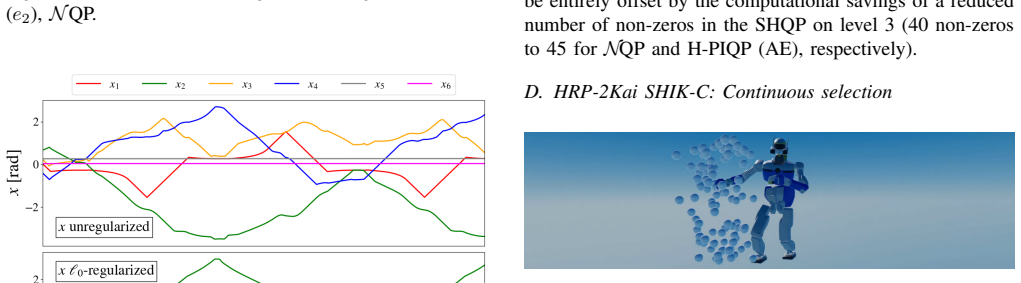
The paper's central discovery is a sequential sparse hierarchical quadratic programming solver, S-SHQP, that extends the authors' earlier least-squares hierarchical solver to ℓ0-norm selection. The ℓ0 objective is replaced by a continuous logarithmic reformulation, and the solver's interior-point method NQP exploits a key property: for each sparse constraint, the auxiliary bound is always active on exactly one side unless the slack is zero. This lets the auxiliary variables be eliminated, so the per-iteration cost depends linearly on the number of sparse constraints instead of cubically. The paper demonstrates the resulting autonomous goal selection on a humanoid robot, including selecting from 100 passing objects at roughly 5 ms per control cycle.
Load-bearing premise
The proof of convergence assumes that the hierarchical step-filter, which was designed for least-squares objectives, still guarantees progress when applied to the new sparse logarithmic cost.
Editorial extensions
If this is right
- Robot planners can select a discrete goal and compute a feasible whole-body trajectory in one optimization, removing the separate reachability approximation step.
- The same solver handles both offline planning and instantaneous control, with the control mode accepting every step under a constant trust-region radius.
- Real-time autonomous goal selection scales to hundreds of candidate targets: the paper reports 100 goals on a humanoid at roughly 5 ms per solve.
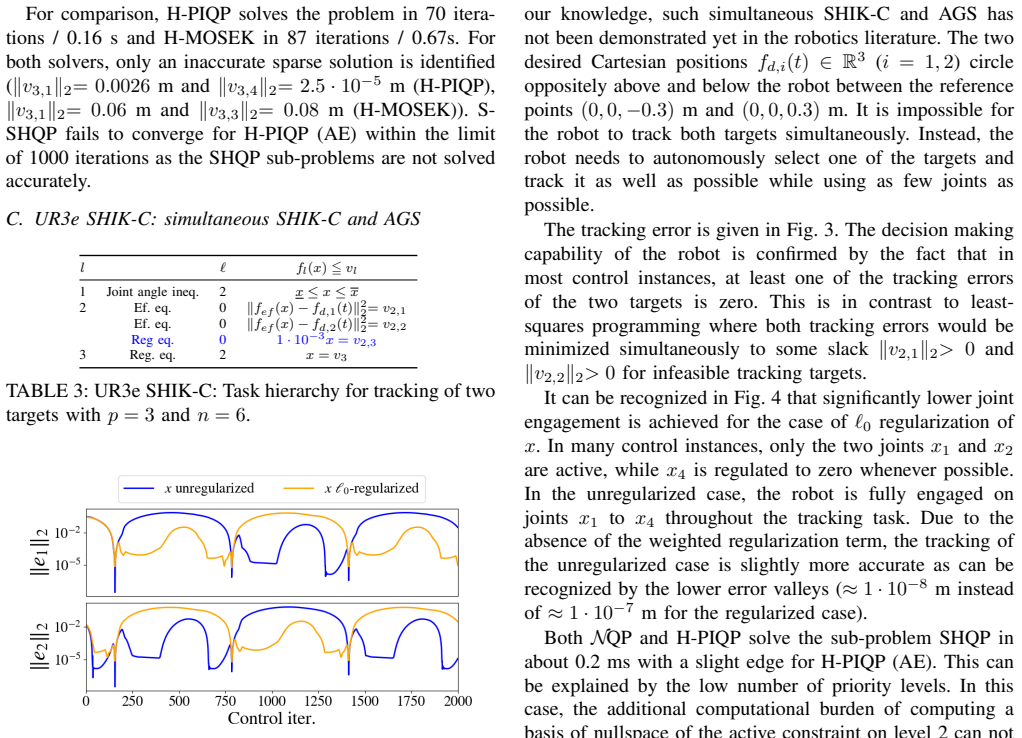
- Sparse ℓ0 regularization of joint motion yields visibly reduced joint engagement compared to unregularized least-squares control.
- The approach is positioned as a step toward simultaneous contact planning and optimal control from many candidate contacts.
Reading between the lines
- The one-sided-activity argument suggests the method could be extended to other combinatorial selections, such as contact-point choice or grasp selection, where the candidate set enters as a group of least-squares constraints.
- Because the per-iteration cost scales linearly in the number of sparse constraints, the practical bottleneck for very large candidate sets will shift from the solver to the nullspace basis computation and the number of S-SHQP iterations.
- A straightforward test of the solver's reliability is to compare its selected goal against an exhaustive combinatorial check on small candidate sets, where the true ℓ0 optimum can be computed exactly.
- The control mode's constant trust-region acceptance rule means its real-time guarantee depends on the trust-region radius being small enough for the linearized subproblem to stay valid; a harder test would push the robot near singular configurations during selection.
Signed reviews
Editorial analysis
A structured set of objections, weighed in public.
Referee Report
Summary. The paper proposes a sequential sparse hierarchical quadratic programming solver (S-SHQP) for sparse hierarchical nonlinear programs (SH-NLP), targeting robot inverse kinematic planning and control with autonomous goal selection. The method reformulates l0-norm selection via a log-barrier approximation and reweighted l1 weights, solves each SHQP subproblem with an interior-point method called NQP, and embeds this in a hierarchical step-filter framework adapted from the authors' earlier l2 NL-HLSP solver. The authors claim linear scaling in the number of sparse constraints and demonstrate the approach on hierarchies of test functions, HRP-2Kai SHIK planning with goal selection, UR3e SHIK control with target selection, and HRP-2Kai SHIK control with continuous selection from 100 goals at 5 ms loop time.
Significance. If the claims hold, the paper makes a useful contribution to robotic hierarchical inverse kinematics: it enables discrete goal selection and whole-body IK/control within a single nonlinear optimization, without reachability approximations, and reports linear scaling in the number of candidate goals. The evaluation against external QP solvers (MOSEK, PIQP variants) and the explicit Theorem 1 on auxiliary-variable activity are strengths, and the reported 5 ms loop time for 100 goals, if reproducible, would support the real-time claim. The central limitation is that the convergence guarantee of the underlying l2 solver is asserted rather than proved for the new l0/log-barrier objective, which leaves the reliability claim for S-SHQP open.
major comments (4)
- [Section III] The transfer of the hierarchical step-filter (HSF) convergence property from the l2 solver [13] to the new sparse logarithmic objective is asserted, not proved. In [13] the global-convergence argument relies on sufficient decrease of an l2 least-squares measure or constraint violation; here the filter is updated with log(P(|f>=0_Cl|) + epsilon), and the optimality measure for the reweighted l1/log objective is never defined. Without a sufficient-decrease argument for the new objective, the claim that S-SHQP reliably solves SH-NLP with sparse nonlinear constraints on any priority level is unsupported. This is a load-bearing gap because the experiments demonstrate behavior but do not supply the missing proof.
- [Eqs. (1)-(2)] There is an internal inconsistency in the problem definition. Eq. (1) defines the log term as log(1^T t_Cl + xi), whose derivative is a scalar common to all components, while Eq. (2) defines per-component weights 1/(t_Cl,i + xi), which are the derivatives of sum_i log(t_Cl,i + xi). These are different objectives. The actual problem being solved is therefore ambiguous, and the convergence and weighting arguments in Section III cannot be separated from this ambiguity. Please clarify which formulation is intended and adjust the derivation of the SHQP cost and weights accordingly.
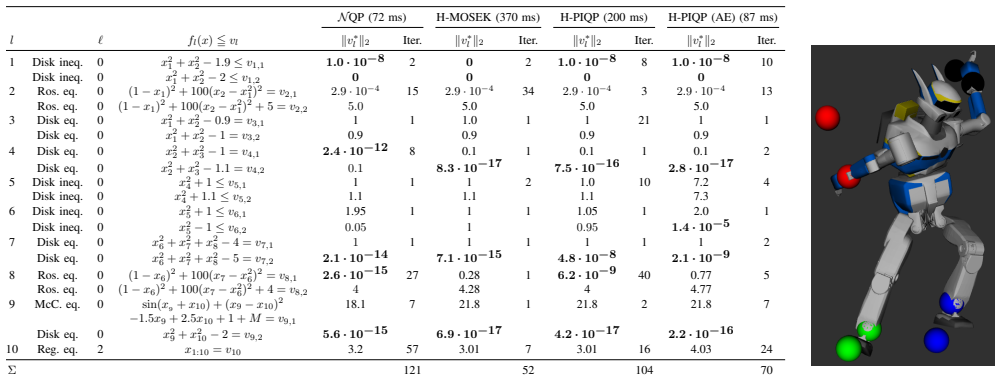
- [Section VI-A, Table 1] Table 1 reports low-accuracy sparsity on at least one level for each solver (e.g., level 6 for NQP gives ||v6,1||=1.95 and ||v6,2||=0.05, rather than an exact zero) and the text acknowledges that 'at least one of the levels is solved only to low accuracy sparsity.' Since the central claim includes 'accurate' sparse solutions and exact selection, the paper should quantify the sparsity accuracy achieved in the robot experiments and state whether the nonzero slacks in such cases remain below the selection threshold used in Section IV. Without this, the practical reliability of the autonomous goal selection is not fully demonstrated.
- [Sections III and VI] Several numerical thresholds that are load-bearing for reproducibility are left unspecified: xi (log approximation threshold), epsilon (sparse/activity threshold and switching threshold), chi (step convergence threshold), and the trust-region radius rho in control mode are all introduced without values, and the UR3e joint sparsity weight and object removal distance in Section VI-D are also not given. Please provide the specific values used in each experiment, or state how they were chosen.
minor comments (5)
- [Section III] The phrase 'It can be shown that the step of SHQP and Newton's method applied to the first-order optimality conditions of (1) are the same' is standard for SQP, but a short derivation or a precise pointer to the relevant result would improve clarity.
- [Section V, Eq. (9)-(15)] The right-hand side terms r_El, r_Il, and r_Il-1 in Eqs. (13)-(15) are dense and hard to parse; a brief derivation or a compact notation for the eliminated variables would help readers verify the linear-complexity claim.
- [Table 1] The column headers mix norms and constraint types (e.g., 'Disk ineq.' and 'Ros. eq.') in a way that requires cross-referencing the text; defining all abbreviations in the caption would improve readability.
- [Section VI-C] The statement that 'in most control instances, at least one of the tracking errors of the two targets is zero' would be more informative with a quantitative fraction and a tolerance threshold, since exact zero is unlikely in floating-point arithmetic.
- [General] The paper does not state whether the implementation and experiment scripts are available for reproduction; providing code or detailed parameter lists would substantially strengthen the reproducibility of the reported timings and sparsity patterns.
Circularity Check
No circularity found: the solver is benchmarked against external QP solvers and the central l0 selection result is not an input to the method.
full rationale
The derivation chain is self-contained in the relevant sense. S-SHQP is an algorithmic proposal; its outputs (selected goals, tracking errors, sparsity patterns) are generated by the proposed optimization and compared against MOSEK, PIQP, and standard test functions, so there is no fitted parameter renamed as a prediction. The l0/log-barrier reformulation and selection-constraint group (Sec. IV) are stated as constructions rather than as consequences of the results they are used to demonstrate. The paper does lean on the authors' earlier NL-HLSP work [12], [13], [19] for the hierarchical step-filter, trust-region, and interior-point machinery, but those are published independent algorithmic results and are not restatements of the target claim. The lack of a convergence proof for the transfer of HSF to the new sparse logarithmic objective is a real correctness gap, and the inconsistent derivatives between Eq. (1) and Eq. (2) are a mathematical flaw, but both are evidentiary and robustness concerns rather than cases where a prediction reduces by construction to its own input. Therefore no circularity is established.
Assumptions & free parameters
free parameters (6)
- Log approximation threshold xi =
not reported
- Sparse and activity threshold epsilon =
not reported
- Step convergence threshold chi =
not reported
- Trust-region radius rho in control mode =
not reported
- UR3e joint sparsity weight =
1e-3
- Object removal distance =
1 cm
assumptions (4)
- domain assumption The log-sum objective (1) is a faithful continuous relaxation of the l0 norm for the robot problems.
- domain assumption The HSF and trust-region acceptance rules of [13] remain convergent for the l0-log objective.
- domain assumption For every selection group S, at least one candidate goal is feasible and all candidate goals are pairwise distinct.
- domain assumption Linear constraint qualification holds at the active constraints when Newton's method is switched on.
Cite this review
Pith. "Pith review of Integrated Hierarchical Decision-Making in Inverse Kinematic Planning and Control." pith.science (2026). https://pith.science/paper/QMLOHJ62
@misc{pith2026241201324,
  author       = {Pith},
  title        = {Pith review of: Integrated Hierarchical Decision-Making in Inverse Kinematic Planning and Control},
  year         = {2026},
  howpublished = {\url{https://pith.science/paper/QMLOHJ62}},
  note         = {Machine review of arXiv:2412.01324}
}
abstract
This work presents a novel and efficient nonlinear programming framework that tightly integrates hierarchical decision-making with whole-body inverse kinematic planning and control. Decision-making plays a central role in many aspects of robotics, from sparse inverse kinematic control with a minimal number of joints, to inverse kinematic planning while simultaneously selecting a discrete end-effector location from multiple candidates. Current approaches often rely on heavy computations using mixed-integer nonlinear programming, separate decision-making from inverse kinematics (some times approximated by reachability methods), or employ efficient but less versatile $\ell_1$-norm formulations of linear sparse programming, without addressing the underlying nonlinear problem formulations. In contrast, the proposed sparse hierarchical nonlinear programming solver is efficient, versatile, and accurate by exploiting sparse hierarchical structure and leveraging the $\ell_0$-norm which is rarely used in robotics. The solver efficiently tackles complex nonlinear hierarchical decision-making problems previously unaddressed in the literature, such as inverse kinematic planning with simultaneous prioritized selection of end-effector locations from a large set of candidates, or inverse kinematic control with simultaneous selection of bi-manual grasp locations on a randomly rotated box.
Figures

Figures from the paper (1 more)
Forward citations
Cited by 1 Pith paper
-
Dual Hierarchical Least-Squares Programming with Equality Constraints
A convex dual formulation of hierarchical least-squares programming with equality constraints, plus an ADMM solver that eliminates primal-dual variables from the matrix factorization.
Reference graph
Works this paper leans on
-
[13]
Sequential hierarchical least-squares programming for prioritized non-linear optimal control,
K. Pfeiffer and A. Kheddar, “Sequential hierarchical least-squares programming for prioritized non-linear optimal control,” Optimization Methods and Software , vol. 0, no. 0, pp. 1–39, 2024
2024
-
[1]
Parsimonious kinematic control of highly redundant robots,
V . Gonc ¸alves, P. Fraisse, A. Crosnier, and B. Adorno, “Parsimonious kinematic control of highly redundant robots,” IEEE Robotics and Automation Letters, vol. 1, 09 2015
2015
-
[2]
The inactivation principle: Mathematical solutions minimizing the absolute work and biological implications for the planning of arm movements,
B. Berret, C. Darlot, F. Jean, T. Pozzo, C. Papaxanthis, and J. P. Gau- thier, “The inactivation principle: Mathematical solutions minimizing the absolute work and biological implications for the planning of arm movements,” PLOS Computational Biology , vol. 4, no. 10, pp. 1–25, 10 2008
2008
-
[3]
Sparse optimization of contact forces for balancing control of multi- legged humanoids,
M. Polverini, E. Mingo Hoffman, A. Laurenzi, and N. Tsagarakis, “Sparse optimization of contact forces for balancing control of multi- legged humanoids,” IEEE Robotics and Automation Letters , vol. PP, pp. 1–1, 01 2019
2019
-
[4]
Sl1m: Sparse l1-norm minimization for contact plan- ning on uneven terrain,
S. Tonneau, D. Song, P. Fernbach, N. Mansard, M. Ta ¨ıx, and A. Del Prete, “Sl1m: Sparse l1-norm minimization for contact plan- ning on uneven terrain,” in 2020 IEEE International Conference on Robotics and Automation (ICRA) , 2020, pp. 6604–6610
2020
-
[5]
A study on sparse hierarchical inverse kinematics algorithms for humanoid robots,
E. Mingo Hoffman, M. Polverini, A. Laurenzi, and N. Tsagarakis, “A study on sparse hierarchical inverse kinematics algorithms for humanoid robots,” IEEE Robotics and Automation Letters , vol. PP, pp. 1–1, 11 2019
2019
-
[6]
Enhancing sparsity by reweighted ℓ1 minimization,
E. Cand `es, M. Wakin, and S. Boyd, “Enhancing sparsity by reweighted ℓ1 minimization,” Journal of F ourier Analysis and Applications , vol. 14, pp. 877–905, 11 2007
2007
-
[7]
l0-norm based short-term sparse portfolio optimization algorithm based on alternating direction method of multipliers,
H. Wang, W. Zhang, Y . He, and W. Cao, “l0-norm based short-term sparse portfolio optimization algorithm based on alternating direction method of multipliers,” Signal Processing, vol. 208, p. 108957, 2023
2023
Show all 23 references
-
[8]
An interior-point method for large- scale ℓ1-regularized logistic regression,
K. Koh, S.-J. Kim, and S. Boyd, “An interior-point method for large- scale ℓ1-regularized logistic regression,” Journal of Machine Learning Research, vol. 8, pp. 1519–1555, 07 2007
2007
-
[9]
On the global convergence of a filter–sqp algorithm,
R. Fletcher, S. Leyffer, and P. L. Toint, “On the global convergence of a filter–sqp algorithm,” SIAM Journal on Optimization , vol. 13, no. 1, pp. 44–59, 2002
2002
-
[10]
Sparsity-inducing optimal control via differential dynamic program- ming,
T. Dinev, W. Merkt, V . Ivan, I. Havoutis, and S. Vijayakumar, “Sparsity-inducing optimal control via differential dynamic program- ming,” in 2021 IEEE International Conference on Robotics and Automation (ICRA) , 2021, pp. 8216–8222
2021
-
[11]
A lagrange–newton algorithm for sparse nonlinear programming,
C. Zhao, N. Xiu, H. Qi, and Z. Luo, “A lagrange–newton algorithm for sparse nonlinear programming,” Math. Program., vol. 195, no. 1–2, p. 903–928, sep 2022
2022
-
[12]
The hier- archical newton’s method for numerically stable prioritized dynamic control,
K. Pfeiffer, A. Escande, P. Gergondet, and A. Kheddar, “The hier- archical newton’s method for numerically stable prioritized dynamic control,” IEEE Transactions on Control Systems Technology, pp. 1–14, 2023
2023
-
[14]
Piqp: A proximal interior-point quadratic programming solver,
R. Schwan, Y . Jiang, D. Kuhn, and C. N. Jones, “Piqp: A proximal interior-point quadratic programming solver,” 2023
2023
-
[15]
ApS, MOSEK Fusion API for C++ 10.1.12 , 2019
M. ApS, MOSEK Fusion API for C++ 10.1.12 , 2019. [Online]. Available: https://docs.mosek.com/latest/cxxfusion/index.html
2019
-
[16]
Nocedal and S
J. Nocedal and S. J. Wright, Numerical Optimization , 2nd ed. New York, NY , USA: Springer, 2006
2006
-
[17]
Singularity resolution in equality and inequality constrained hierarchical task-space control by adaptive nonlinear least squares,
K. Pfeiffer, A. Escande, and A. Kheddar, “Singularity resolution in equality and inequality constrained hierarchical task-space control by adaptive nonlinear least squares,” IEEE Robotics and Automation Letters, vol. 3, no. 4, pp. 3630–3637, Oct 2018
2018
-
[18]
Hierarchical quadratic programming: Fast online humanoid-robot motion generation,
A. Escande, N. Mansard, and P.-B. Wieber, “Hierarchical quadratic programming: Fast online humanoid-robot motion generation,” The International Journal of Robotics Research , vol. 33, no. 7, pp. 1006– 1028, 2014
2014
-
[19]
N ipm-hlsp: an efficient interior-point method for hierarchical least-squares programs,
K. Pfeiffer, A. Escande, and L. Righetti, “ N ipm-hlsp: an efficient interior-point method for hierarchical least-squares programs,” Opti- mization and Engineering , vol. 25, no. 2, pp. 759–794, June 2024
2024
-
[20]
On the performance of algorithms for the minimization of ℓ1-penalized functionals,
I. Loris, “On the performance of algorithms for the minimization of ℓ1-penalized functionals,” Inverse Problems, vol. 25, no. 3, p. 035008, jan 2009
2009
-
[21]
A primal–dual interior-point framework for using the ℓ1 or ℓ2 norm on the data and regularization terms of inverse problems,
A. Borsic and A. Adler, “A primal–dual interior-point framework for using the ℓ1 or ℓ2 norm on the data and regularization terms of inverse problems,” Inverse Problems, vol. 28, 09 2012
2012
-
[22]
Eigen v3,
G. Guennebaud, B. Jacob et al., “Eigen v3,” http://eigen.tuxfamily.org, 2010
2010
-
[23]
The pinocchio c++ library – a fast and flexible implementation of rigid body dynamics algorithms and their analytical derivatives,
J. Carpentier, G. Saurel, G. Buondonno, J. Mirabel, F. Lamiraux, O. Stasse, and N. Mansard, “The pinocchio c++ library – a fast and flexible implementation of rigid body dynamics algorithms and their analytical derivatives,” in IEEE International Symposium on System Integratio...
2019
Reviewed August 12, 2026 · model on record in the stance chip above.
Discussion (0). Continue with ORCID to comment.