REVIEW 3 major objections 4 minor 39 references
Information Bottleneck under Perfect Privacy
T0 review · 3 major / 4 minor · reviewed 2026-08-12 · deepseek-v4-flash
Pith's one-line read The paper proposes a proximal perturbed ADMM for the finite-alphabet information bottleneck with an active rate constraint and a perfect privacy constraint, and proves that the whole iterate sequence converges to approximate KKT points…
desk verdict A serious proof of a narrower-than-claimed result: convergence of a perturbed ADMM for the Lagrangian relaxation of perfect-privacy IB, conditional on an unverified uniform-positivity assumption. read the letter →
The pith
A machine-rendered reading of the paper's core claim, the machinery that carries it, and where it could break.
The reading
What carries the argument
The load-bearing object is the perturbed augmented Lagrangian L_{ρ,τ}(x,z,λ)=F_0(x)+F_1(x)+H_0(z)+H_1(z)+⟨(1−τ)λ,Ax−Bz⟩+(ρ/2)||Ax−Bz||^2 with the multiplier update $λ^{{k+1}}$=(1−τ)λ^k+ρ($Ax^{{k+1}}$−$Bz^{{k+1}}$). Because the constraint matrices are rank deficient and the probability constraints introduce nonsmooth indicators, the standard ADMM descent argument fails; instead the paper constructs a Lyapunov function P($w^{{k+1}}$) that adds scaled memory terms d||$z^{{k+1}}$−z^k||_{D_z}^2 + d(1−τ)/(2ρ)||$λ^{{k+1}}$−λ^k||^2 to the shifted augmented Lagrangian. The perturbation τ makes the dual increase controllable, the Lyapunov correction absorbs history-dependent terms, and the Kurdyka–Łojasiewicz property of P, established by definability in R_exp, converts the descent and subgradient estimates into finite length and explicit convergence rates.
What would settle it
Take a joint distribution for which the optimal perfect-private mechanism lies on the boundary of the probability simplex, run Algorithm 1 from several initializations, and record min_{u,x}{p_U^k(u), p_{U|X}^k(u|x)}; if this minimum crosses any fixed epsilon>0 before the residual ||Ax^k−Bz^k|| reaches the desired tolerance, then Assumption 2 is violated at exactly the operating points the convergence guarantee is meant to cover.
Extended reading notes
Core claim
The paper establishes that the rate-constrained perfect-privacy information bottleneck can be written as min F(x)+H(z) subject to Ax−Bz=0, where x encodes the marginal distribution of the representation, z encodes the release mechanism, and the linear constraint enforces both marginal consistency and perfect privacy. It then defines a proximal perturbed ADMM whose block updates keep the probability constraints inside the subproblems and whose dual update is $λ^{{k+1}}$=(1−τ)λ^k+ρ($Ax^{{k+1}}$−$Bz^{{k+1}}$). Under Assumptions 1–2 and the parameter condition (6), the Lyapunov function decreases sufficiently, the dual sequence is bounded, successive differences vanish, and every accumulation point is an epsilon-KKT point with epsilon=(τ/ρ) limsup ||λ^k||. Using the Kurdyka–Łojasiewicz property of the Lyapunov function, the paper proves finite-length and whole-sequence convergence, with finite termination when the KŁ exponent is zero, linear convergence when it is in (0,1/2], and sublinear convergence when it is in (1/2,1). The inexact variant shows that square-summable subproblem residuals preserve these conclusions.
Load-bearing premise
The proof requires a fixed positive lower bound on every probability entry p_U^k(u) and p_{U|X}^k(u|x) of every iterate, and the algorithm neither enforces nor verifies this bound.
Editorial extensions
If this is right
- In the active-rate regime, a user can compute a representation that is independent of the sensitive variable up to numerical precision while respecting an explicit rate budget, instead of tuning an unknown privacy penalty.
- The whole sequence converges under the KŁ property, not just a subsequence, so the final iterate carries a certified approximate-stationarity guarantee.
- Inexact subproblem solutions with square-summable residuals preserve convergence, permitting inner projected-gradient iterations in practice.
- The asymptotic feasibility gap is controlled by τ/ρ times the asymptotic dual norm, so the parameter choices in condition (6) trade off the final epsilon against the convergence behavior.
- The convergence rates split into finite termination, linear, and sublinear regimes depending on the KŁ exponent, giving a concrete prediction of the algorithm's tail behavior.
Reading between the lines
- Beyond the paper's claims, the uniform-positivity assumption could be turned into an algorithmic feature by projecting iterates onto a probability simplex with a small floor, which would let the convergence guarantees extend to boundary solutions the unmodified algorithm cannot certify.
- The perturbed-dual Lyapunov construction appears portable to other finite-alphabet information-theoretic optimizations with rank-deficient linear constraints, such as zero-leakage variants of the privacy funnel.
- The residual bound epsilon=(τ/ρ)limsup||λ^k|| suggests a practical hyperparameter tradeoff that the paper does not explore numerically: shrinking τ or enlarging ρ should shrink the limiting feasibility gap, but condition (6) couples these parameters in a way that could be mapped empirically.
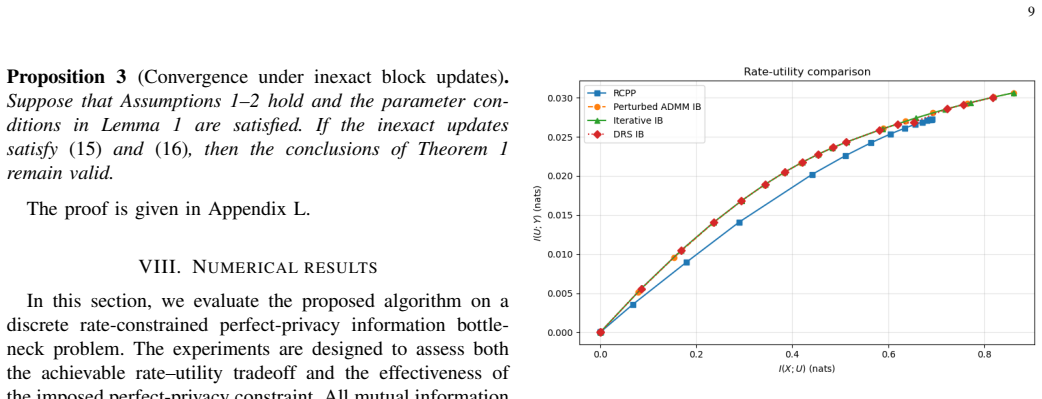
- The numerical results use one synthetic distribution; a stress test on distributions whose optimal perfect-private mechanism sits on the boundary of the simplex would separate the solver's practical behavior from the coverage of Assumption 2.
Editorial analysis
A structured set of objections, weighed in public.
Referee Report
Summary. The paper studies the information bottleneck problem with a perfect-privacy constraint I(S;U)=0 and a representation-rate constraint I(X;U)≤R, focusing on the active-rate regime 0<R<R*. It reformulates the rate-constrained problem into a Lagrangian form (P2) with tradeoff parameter β, then into a linearly constrained composite problem (P4), and proposes a proximal perturbed ADMM algorithm (Algorithm 1). Under Assumptions 1–2 and a set of parameter conditions (6), the authors prove sufficient descent of a Lyapunov function, boundedness of the iterates, vanishing successive differences, and that every accumulation point is an ε-KKT point of (P4) with ε=(τ/ρ)limsup‖λ^k‖ (Theorem 1). Using the Kurdyka–Łojasiewicz property of the Lyapunov function, they establish whole-sequence convergence with rates depending on the KŁ exponent (Theorems 2–3, Corollary 1), and extend the analysis to inexact block updates (Proposition 3). Numerical experiments on a synthetic distribution compare the resulting rate–utility curves with those of conventional IB algorithms.
Significance. If the central claim is taken as stated, the paper would provide the first provably convergent ADMM-type solver for the rate-constrained perfect-privacy information bottleneck in the active-rate regime. The optimization machinery is largely self-contained: the perturbed dual update, the construction of a Lyapunov function adapted to the probability-simplex constraints, the use of the Kurdyka–Łojasiewicz framework, and the o-minimal definability proof for the entropy terms are technically substantial and appear internally consistent for the Lagrangian problem (P4). The extension to inexact block updates is a practical and welcome feature. However, the paper's claimed contribution to the rate-constrained problem (P1) is not supported by the analysis: the bridge from (P1) to (P2) is asserted rather than proved, and the central convergence theorems are conditional on an unenforced trajectory assumption that may fail exactly in the active-rate regime. The value of the paper therefore depends on whether these gaps can be closed or the claims appropriately narrowed.
major comments (3)
- [Section III, Remark 6 and (P2)] The central claim of the paper concerns the rate-constrained perfect-privacy problem (P1), but the algorithm and all convergence theorems are for the Lagrangian form (P2) and its equivalent (P4). The statement in Remark 6 that “the rate constraint can be represented through an appropriate Lagrange multiplier β” is asserted without proof. No argument is given that for every R in the active-rate regime 0<R<R* there exists a β such that a solution of (P2) is feasible and optimal for (P1), nor is the mapping between R and β established. In particular, the claim that “0<R<R* corresponds to the nontrivial parameter range 0<β<β*” and the subsequent restriction to “1<β<β*” are not derived. Because the rate constraint I(X;U)≤R never appears in the algorithmic formulation, Theorems 1–3 and Corollary 1 only characterize stationary points of (P4), not solutions of the rate-constrained problem that the abstract and introduction promise. The authors should either prove the equivalence (or a valid relaxation) or explicitly reframe the contribution as a solver for the Lagrangian (P2).
- [Section V, Assumption 2] Assumption 2 is a condition on the trajectory generated by Algorithm 1, not on the problem data or the optimal set. It requires a fixed ε>0 such that p_U^k(u)≥ε and p_{U|X}^k(u|x)≥ε for every iterate and every u,x. Algorithm 1 contains no projection, barrier, or restart mechanism that enforces this condition, and Section VIII reports no monitoring of min_{u,x} min(p_U^k(u), p_{U|X}^k(u|x)). The restricted weak convexity of H_0 from [20, Lemma 3] and the strong convexity of F_0 are used throughout the descent analysis; as the proof of Proposition 1 shows, the curvature terms involve entries of order -1/q_{u|y}, which become unbounded as conditional probabilities approach zero. Consequently, the matrices E_z and M_z in Lemma 1 cannot be formed with finite constants, and the sufficient descent estimate and all subsequent convergence results cease to apply. This is not a harmless regularity condition: in the active-rate regime the rate constraint is binding, and the paper gives no argument that optimal mechanisms or generated iterates remain in the interior of the probability simplex. The theorems therefore describe paths that never reach the boundary, not the behavior of the solver in the regime the paper claims to solve. The authors should enforce the condition algorithmically and prove invariance, or verify it in the numerical experiments and explicitly state the limitation of the convergence guarantee.
- [Section VIII, Fig. 1 and surrounding text] The numerical section states that “the RCPP curve is generated by solving the proposed problem under different representation-rate constraints,” but Algorithm 1 solves (P2) with a fixed β and contains no rate constraint. Varying β and plotting the achieved (I(X;U), I(U;Y)) points produces a tradeoff curve only if the Lagrangian equivalence of Remark 6 is valid; otherwise the points are simply solutions of (P2) at different β values. The claim that each point represents the utility achieved for a different rate limit R is therefore not justified by the experiments, and the same issue affects the comparison with the baseline IB curves and the statement that the RCPP solution approaches the perfect-privacy utility as R increases. If the equivalence is not proved, the experimental section should be described as demonstrating the behavior of the Lagrangian solver, not of the rate-constrained problem.
minor comments (4)
- [Section III, after Eq. (1)] The text first states that the active-rate regime 0<R<R* corresponds to 0<β<β*, then immediately restricts the subsequent analysis to “1<β<β*”. The lower bound changes from 0 to 1 without explanation; the role of the interval (0,1] should be clarified.
- [Algorithm 1 and Lemma 1] The Require line of Algorithm 1 asks for parameters ρ,τ,γ,Q “satisfying (6)”, but condition (6) is stated in Lemma 1 using auxiliary constants d and η_1 that are not defined or listed at that point. Please clarify that d and η_1 are analysis-only constants whose existence is required, not algorithm parameters.
- [Section VI, Lemma 6] The displayed definition of ̅C in Lemma 6 is typeset ambiguously as ̅C:=C1C2 3 C2 2; from the proof in Appendix H it should be C1 C3^2 / C2^2. The notation should be corrected for readability.
- [Appendix M] The definability proof invokes Wilkie's theorem and [35], which is appropriate, but the main text never introduces the structure R_exp before Appendix M. A one-sentence definition or reference in Section II would help the reader.
Circularity Check
No significant circularity: the convergence analysis is a self-contained Lyapunov/KL derivation against external benchmarks; the only self-citation ([11]) appears in the problem setup and experiments and is not load-bearing.
full rationale
Walking the derivation chain: (P4) is a linearly constrained reformulation of (P2)/(P3) with the probability constraints placed in indicators; no target result is reused as an input. The x- and z-updates of Algorithm 1 are proximal/perturbed ADMM steps; Propositions 1-2 are proved from the first-order optimality conditions of these subproblems, the strong convexity of F0 under Assumption 2, the restricted weak convexity of H0 from [20, Lemma 3] (an external published result), and Young-type inequalities. Lemmas 1-2 then construct the Lyapunov function and prove its sufficient descent and lower boundedness; Theorem 1 derives vanishing successive differences and the epsilon-KKT characterization from those inequalities plus the dual update, rather than assuming them. The rates in Theorems 2-3 and Corollary 1 follow the standard KL machinery: Lemma 7 and Appendices M-N prove, with Wilkie's theorem and [33, Theorem 14], that the Lyapunov function is definable in R_exp and hence a KL function; this is an independent argument, not a restatement of a conclusion. The only self-citation is [11] (coauthor Sreekumar), used for the inactive-rate linear-programming characterization, the definition of R*, the nontrivial-privacy condition in Definition 9, and the synthetic test distribution; none of these enters the convergence proof, so the citation is not load-bearing. Section V, Assumption 2 is a genuine trajectory regularity condition: a fixed epsilon bounding all iterates away from the simplex boundary is neither enforced by Algorithm 1 nor verified in Section VIII, so if iterates approach zero-probability entries the hypotheses of Lemmas 1-6 and Theorems 1-3 fail; this is a coverage limitation, not circularity. The epsilon-KKT level epsilon = (tau/rho) limsup ||lambda^k|| is obtained post-hoc from the dual update and not imposed as an external accuracy target. No fitted parameter is renamed as a prediction, and no known result is repackaged under new coordinates. Therefore no circular step can be exhibited, and the score is 1 rather than 0 only to acknowledge the minor non-load-bearing self-citation.
Assumptions & free parameters
free parameters (6)
- beta
- rho
- tau
- gamma
- Q
- d, eta1
assumptions (6)
- domain assumption Assumption 1: (P4) is feasible and its stationary set is nonempty.
- ad hoc to paper Assumption 2: all iterates stay uniformly away from probability zero.
- standard math H0 is omega-restricted weakly convex with respect to B1, hence with respect to B.
- standard math F0 is strongly convex under Assumption 2.
- standard math The Lyapunov function P is definable in R_exp and thus satisfies the Kurdyka-Lojasiewicz property.
- ad hoc to paper The rate constraint can be represented by a Lagrange multiplier beta in the nondegenerate case.
Cite this review
Pith. "Pith review of Information Bottleneck under Perfect Privacy." pith.science (2026). https://pith.science/paper/QNRMUZME
@misc{pith2026260811003,
  author       = {Pith},
  title        = {Pith review of: Information Bottleneck under Perfect Privacy},
  year         = {2026},
  howpublished = {\url{https://pith.science/paper/QNRMUZME}},
  note         = {Machine review of arXiv:2608.11003}
}
read the original abstract
In this work, we study the information bottleneck under perfect privacy, with particular emphasis on the active-rate regime, where the representation-rate constraint is binding and directly limits the achievable utility. The goal is to construct a representation that preserves utility-relevant information while remaining statistically independent of a sensitive variable. This exact independence requirement introduces an additional constraint beyond the classical rate-relevance tradeoff and must be explicitly incorporated into the optimization. To this end, we develop an alternating direction method of multipliers (ADMM)-based method tailored to the resulting problem structure. Under suitable regularity conditions, we establish global convergence of the generated sequence, characterize its convergence rate through the Kurdyka-Lojasiewicz exponent, and extend the analysis to inexact block updates.
Figures

Reference graph
Works this paper leans on
-
[1]
The information bottleneck method,
N. Tishby, F. C. Pereira, and W. Bialek, “The information bottleneck method,” 2000. [Online]. Available: https://arxiv.org/abs/ physics/0004057
arXiv 2000
-
[2]
The information bottleneck revisited or how to choose a good distortion measure,
P. Harremo ¨es and N. Tishby, “The information bottleneck revisited or how to choose a good distortion measure,” in2007 IEEE International Symposium on Information Theory. IEEE, 2007, pp. 566–570
work page 2007
-
[3]
Bottleneck problems: An information and estimation-theoretic view,
S. Asoodeh and F. P. Calmon, “Bottleneck problems: An information and estimation-theoretic view,”Entropy, vol. 22, no. 11, p. 1325, 2020
work page 2020
-
[4]
Privacy against statistical inference,
F. du Pin Calmon and N. Fawaz, “Privacy against statistical inference,” in2012 50th annual Allerton conference on communication, control, and computing (Allerton). IEEE, 2012, pp. 1401–1408
work page 2012
-
[5]
Utility-privacy tradeoffs in databases: An information-theoretic approach,
L. Sankar, S. R. Rajagopalan, and H. V . Poor, “Utility-privacy tradeoffs in databases: An information-theoretic approach,”IEEE Transactions on Information Forensics and Security, vol. 8, no. 6, pp. 838–852, 2013
work page 2013
-
[6]
Information extraction under privacy constraints,
S. Asoodeh, M. Diaz, F. Alajaji, and T. Linder, “Information extraction under privacy constraints,”Information, vol. 7, no. 1, 2016. [Online]. Available: https://www.mdpi.com/2078-2489/7/1/15
work page 2016
-
[7]
From the information bottleneck to the privacy funnel,
A. Makhdoumi, S. Salamatian, N. Fawaz, and M. M ´edard, “From the information bottleneck to the privacy funnel,” in2014 IEEE Information Theory Workshop (ITW 2014), 2014, pp. 501–505
2014
-
[8]
Fundamental limits of perfect privacy,
F. P. Calmon, A. Makhdoumi, and M. M ´edard, “Fundamental limits of perfect privacy,” in2015 IEEE International Symposium on Information Theory (ISIT), 2015, pp. 1796–1800
work page 2015
Show all 39 references
-
[9]
On perfect privacy,
B. Rassouli and D. G ¨und¨uz, “On perfect privacy,”IEEE Journal on Selected Areas in Information Theory, vol. 2, no. 1, pp. 177–191, 2021
2021
-
[10]
Bottle- necks club: Unifying information-theoretic trade-offs among complexity, leakage, and utility,
B. Razeghi, F. P. Calmon, D. Gunduz, and S. V oloshynovskiy, “Bottle- necks club: Unifying information-theoretic trade-offs among complexity, leakage, and utility,”IEEE Transactions on Information Forensics and Security, vol. 18, pp. 2060–2075, 2023
2023
-
[11]
Optimal privacy-utility trade-off under a rate constraint,
S. Sreekumar and D. G ¨und¨uz, “Optimal privacy-utility trade-off under a rate constraint,” in2019 IEEE International Symposium on Information Theory (ISIT), 2019, pp. 2159–2163
2019
-
[12]
On the privacy-utility trade-off with and without direct access to the private data,
A. Zamani, T. J. Oechtering, and M. Skoglund, “On the privacy-utility trade-off with and without direct access to the private data,”IEEE Transactions on Information Theory, vol. 70, no. 3, pp. 2177–2200, 2024
2024
-
[13]
On information theoretic fairness: From perfect to bounded demographic parity,
A. Zamani, A. Changizi, and M. Skoglund, “On information theoretic fairness: From perfect to bounded demographic parity,”IEEE Transac- tions on Information Theory, vol. 72, no. 7, pp. 5122–5138, 2026. 19
2026
-
[14]
A dual algorithm for the solution of nonlinear variational problems via finite element approximation,
D. Gabay and B. Mercier, “A dual algorithm for the solution of nonlinear variational problems via finite element approximation,” Computers & Mathematics with Applications, vol. 2, no. 1, pp. 17– 40, 1976. [Online]. Available: https://www.sciencedirect.com/science/ article/pii/...
1976
-
[15]
Sur l’approximation, par ´el´ements finis d’ordre un, et la r ´esolution, par p ´enalisation-dualit´e d’une classe de probl`emes de dirichlet non lin´eaires,
R. Glowinski and A. Marroco, “Sur l’approximation, par ´el´ements finis d’ordre un, et la r ´esolution, par p ´enalisation-dualit´e d’une classe de probl`emes de dirichlet non lin´eaires,”Revue franc ¸aise d’automatique, in- formatique, recherche op´erationnelle. Analyse num´e...
1975
-
[16]
Convergence analysis of alternating direction method of multipliers for a family of nonconvex problems,
M. Hong, Z.-Q. Luo, and M. Razaviyayn, “Convergence analysis of alternating direction method of multipliers for a family of nonconvex problems,”SIAM Journal on Optimization, vol. 26, no. 1, pp. 337–364,
-
[17]
Global convergence of admm in nonconvex nonsmooth optimization,
Y . Wang, W. Yin, and J. Zeng, “Global convergence of admm in nonconvex nonsmooth optimization,”Journal of Scientific Computing, vol. 78, no. 1, pp. 29–63, Jan 2019. [Online]. Available: https: //doi.org/10.1007/s10915-018-0757-z
2019 doi
-
[18]
Information bottleneck problem revisited,
F. Bayat and S. Wei, “Information bottleneck problem revisited,” in 2019 57th Annual Allerton Conference on Communication, Control, and Computing (Allerton), 2019, pp. 40–47
2019
-
[19]
A provably convergent information bottleneck solution via admm,
T.-H. Huang and A. el Gamal, “A provably convergent information bottleneck solution via admm,” in2021 IEEE International Symposium on Information Theory (ISIT), 2021, pp. 43–48
2021
-
[20]
A linearly convergent douglas-rachford splitting solver for markovian information-theoretic optimization problems,
T.-H. Huang, A. E. Gamal, and H. E. Gamal, “A linearly convergent douglas-rachford splitting solver for markovian information-theoretic optimization problems,”IEEE Transactions on Information Theory, vol. 69, no. 5, pp. 3372–3399, 2023
2023
-
[21]
Multiuser optimization: Distributed algorithms and error analysis,
J. Koshal, A. Nedi ´c, and U. V . Shanbhag, “Multiuser optimization: Distributed algorithms and error analysis,”SIAM Journal on Optimization, vol. 21, no. 3, pp. 1046–1081, 2011. [Online]. Available: https://doi.org/10.1137/090770102
2011 doi
-
[22]
Perturbed proximal primal–dual algorithm for nonconvex nonsmooth optimization,
D. Hajinezhad and M. Hong, “Perturbed proximal primal–dual algorithm for nonconvex nonsmooth optimization,”Mathematical Programming, vol. 176, no. 1, pp. 207–245, Jul 2019. [Online]. Available: https://doi.org/10.1007/s10107-019-01365-4
2019 doi
-
[23]
Online proximal-admm for time-varying constrained convex optimization,
Y . Zhang, E. Dall’Anese, and M. Hong, “Online proximal-admm for time-varying constrained convex optimization,”IEEE Transactions on Signal and Information Processing over Networks, vol. 7, pp. 144–155, 2021
2021
-
[24]
Proximal admm for nonconvex and nonsmooth optimization,
Y . Yang, Q.-S. Jia, Z. Xu, X. Guan, and C. J. Spanos, “Proximal admm for nonconvex and nonsmooth optimization,”Automatica, vol. 146, p. 110551, 2022. [Online]. Available: https://www.sciencedirect. com/science/article/pii/S0005109822004125
2022
-
[25]
Perturbed proximal gradient admm for nonconvex composite optimization,
Y . Zhou, X. Shi, L. Guo, J. Cao, and M. Abdel-Aty, “Perturbed proximal gradient admm for nonconvex composite optimization,”IEEE Transactions on Automatic Control, pp. 1–8, 2026
2026
-
[26]
R. T. Rockafellar and R. J. Wets,Variational analysis. Springer, 1998
1998
-
[27]
Convergence of descent methods for semi-algebraic and tame problems: proximal algorithms, forward–backward splitting, and regularized gauss–seidel methods,
H. Attouch, J. Bolte, and B. F. Svaiter, “Convergence of descent methods for semi-algebraic and tame problems: proximal algorithms, forward–backward splitting, and regularized gauss–seidel methods,” Mathematical Programming, vol. 137, no. 1, pp. 91–129, Feb 2013. [Online]. Ava...
2013 doi
-
[28]
Learnability for the information bottleneck,
T. Wu, I. Fischer, I. L. Chuang, and M. Tegmark, “Learnability for the information bottleneck,” inProceedings of The 35th Uncertainty in Artificial Intelligence Conference, ser. Proceedings of Machine Learning Research, R. P. Adams and V . Gogate, Eds., vol
-
[29]
Splitting methods with variable metric for kurdyka–łojasiewicz functions and general convergence rates,
P. Frankel, G. Garrigos, and J. Peypouquet, “Splitting methods with variable metric for kurdyka–łojasiewicz functions and general convergence rates,”Journal of Optimization Theory and Applications, vol. 165, no. 3, pp. 874–900, Jun 2015. [Online]. Available: https://doi.org/10...
2015 doi
-
[30]
Efficient projections onto the l1-ball for learning in high dimensions,
J. Duchi, S. Shalev-Shwartz, Y . Singer, and T. Chandra, “Efficient projections onto the l1-ball for learning in high dimensions,” inProceedings of the 25th International Conference on Machine Learning, ser. ICML ’08. New York, NY , USA: Association for Computing Machinery, 20...
2008
-
[31]
R. T. Rockafellar,Convex analysis. Princeton university press, 1997, vol. 28
1997
-
[32]
Model completeness results for expansions of the ordered field of real numbers by restricted pfaffian functions and the exponential function,
A. J. Wilkie, “Model completeness results for expansions of the ordered field of real numbers by restricted pfaffian functions and the exponential function,”Journal of the American Mathematical Society, vol. 9, no. 4, pp. 1051–1094, 1996. [Online]. Available: http://www.jstor....
1996
-
[33]
Clarke subgradients of stratifiable functions,
J. Bolte, A. Daniilidis, A. Lewis, and M. Shiota, “Clarke subgradients of stratifiable functions,”SIAM Journal on Optimization, vol. 18, no. 2, pp. 556–572, 2007. [Online]. Available: https://doi.org/10.1137/060670080
2007 doi
-
[34]
Multi-block nonconvex nonsmooth proximal admm: Convergence and rates under kurdyka–łojasiewicz property,
M. Yashtini, “Multi-block nonconvex nonsmooth proximal admm: Convergence and rates under kurdyka–łojasiewicz property,”Journal of Optimization Theory and Applications, vol. 190, no. 3, pp. 966–998, Sep
-
[35]
L. P. D. v. d. Dries,Tame Topology and O-minimal Structures, ser. Lon- don Mathematical Society Lecture Note Series. Cambridge University Press, 1998
1998
-
[36]
Geometric categories and o- minimal structures,
L. van den Dries and C. Miller, “Geometric categories and o- minimal structures,”Duke Mathematical Journal, vol. 84, no. 2, pp. 497 – 540, 1996. [Online]. Available: https://doi.org/10.1215/ S0012-7094-96-08416-1
1996
-
[115]
1050–1060
PMLR, 22–25 Jul 2020, pp. 1050–1060. [Online]. Available: https://proceedings.mlr.press/v115/wu20b.html
2020
-
[2016]
Available: https://doi.org/10.1137/140990309
[Online]. Available: https://doi.org/10.1137/140990309
-
[2021]
Available: https://doi.org/10.1007/s10957-021-01919-7
[Online]. Available: https://doi.org/10.1007/s10957-021-01919-7
Reviewed August 12, 2026 · model on record in the stance chip above.
Discussion (0). Continue with ORCID to comment.