REVIEW 4 major objections 6 minor 38 references
Disentangling Reasoning Tokens and Boilerplate Tokens For Language Model Fine-tuning
T0 review · 4 major / 6 minor · reviewed 2026-08-11 · deepseek-v4-flash
Pith's one-line read Shuffle-aware fine-tuning beats SFT by reweighting reasoning tokens
desk verdict It is a genuinely new shuffle-based token classifier with consistent gains across benchmarks; the mechanism is plausible but not fully isolated, and it deserves a serious referee. read the letter →
The pith
A machine-rendered reading of the paper's core claim, the machinery that carries it, and where it could break.
The reading
What carries the argument
The load-bearing mechanism is the loss-difference classifier $LD(y_k)=l_s(y_k)-l_o(y_k)$, where $l_s$ is the token loss of a model fine-tuned on shuffled input-output pairs and $l_o$ is the loss of the original model. The rule is: boilerplate if $LD(y_k) \leq 0$, otherwise reasoning. Shuffling destroys the input-output correspondence for reasoning tokens while leaving repetitive boilerplate tokens predictable, which is what lets the loss shift separate the two groups. RFT then uses softmax group weights $\omega_b$ and $\omega_r$ over the total losses of each token group to emphasize the reasoning part.
What would settle it
Construct a synthetic agent dataset with known ground-truth token roles, for example by randomizing the output format while copying the reasoning text verbatim across samples. Run the SHAD shuffle-tune-and-compare procedure and count how many tokens with decreased loss are actually content-bearing reasoning tokens; a substantial misclassification rate would falsify the claim that shuffling cleanly separates the two groups.
Extended reading notes
Core claim
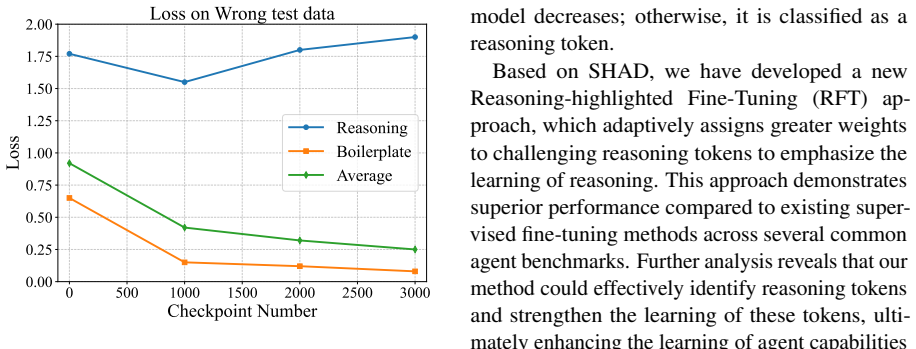
The paper claims that a Shuffle-Aware Discriminator (SHAD) can label each token as reasoning or boilerplate by fine-tuning a model on a small shuffled subset of the data and comparing token-level losses before and after. A token whose loss decreases after shuffle tuning is classified as boilerplate; a token whose loss increases is classified as reasoning. Building on these labels, Reasoning-highlighted Fine-Tuning (RFT) weights the total loss of the reasoning group and the boilerplate group with a softmax, so the harder, more informative reasoning part receives more gradient pressure. In their experiments with LLaMA-3-8B and LLaMA-3.1-8B trained on ToolBench and APIGen data, the paper reports that SHAD+RFT outperforms all baselines on all held-in and held-out evaluation datasets, with the single exception of BFCL on LLaMA-3-8B.
Load-bearing premise
The method depends on boilerplate tokens being nearly identical across samples so shuffling leaves them predictable; if boilerplate tokens vary a lot, or reasoning tokens repeat fixed phrases, the loss-difference labels flip and the reweighting can backfire.
Editorial extensions
If this is right
- Agent fine-tuning pipelines can label every token automatically with no manual regex, using only a small shuffled subset of the training data and one forward pass.
- Models trained this way should overfit less to output formats and spend more of their learning budget on sample-specific tool-use and planning content.
- The same shuffle-loss diagnostic should transfer to other structured-output SFT tasks, such as JSON generation or code generation, where boilerplate tokens are shared across samples.
- On the benchmarks studied, held-out tool-use and planning scores rise while held-in scores stay at least comparable, suggesting the gains reflect better generalization rather than memorization of training formats.
Reading between the lines
- The shuffle-loss signal could be reused as a general measure of how template-like any token is, not only in agent outputs, making it a diagnostic for format overfitting before training even begins.
- The zero threshold in the classifier is likely fragile; a margin-based or percentile-based threshold would be a natural robustness improvement, especially under the high boilerplate diversity the paper itself lists as a limitation.
- Because the classification step is cheap, it could be combined with token-level reward or loss weighting methods to separate hard reasoning substeps within a single sample, an extension the paper mentions but does not pursue.
Editorial analysis
A structured set of objections, weighed in public.
Referee Report
Summary. The paper argues that when fine-tuning LLMs on agent-task datasets, tokens play different roles: reasoning tokens carry sample-specific problem-solving content, while boilerplate tokens (format markers and template-connecting phrases) are repetitive and easier to learn. The authors propose SHAD, which labels tokens by fine-tuning a small reference model on 1% of the data with input–output pairs shuffled, then classifying a token as boilerplate iff its loss decreases relative to the original model and as reasoning otherwise. They then introduce RFT, a fine-tuning loss that applies softmax weights to the group totals of reasoning and boilerplate token losses, emphasizing the higher-loss group. Experiments on LLaMA3-8B and LLaMA3.1-8B compare SHAD+RFT with SFT, Regex, Rho-1, RewardFT, and two variants (SHAD+α-FT, Regex+RFT) on StableToolBench, BFCL, T-eval, and Nexus, reporting that SHAD+RFT generally outperforms baselines. The paper also includes case studies, a temperature sensitivity plot, and a short limitations section.
Significance. If the central claim is validated, the paper offers a simple, low-cost heuristic for token-level differentiation during agent fine-tuning, with a plausible mechanistic story (shuffling disrupts reasoning tokens but not boilerplate tokens). The writing is clear, the method is easy to reproduce from the description, and the authors are candid about limitations. The paper does not currently ship code or checkable artifacts, but the experimental design is within the scope of the claims. The main issue is that the empirical evidence does not yet establish that the SHAD labels themselves are responsible for the gains, because the threshold rule is un-sensitivity-tested, no variance or significance information is provided, the temperature is selected on the evaluation benchmarks, and the direct classification validation covers only regex-identifiable format tokens.
major comments (4)
- [Section 3.1, Eq. (2), Table 1] The classification rule 'boilerplate if LD(yk) ≤ 0; reasoning otherwise' is the load-bearing component of the method, but neither the zero threshold nor the 1% shuffle ratio is sensitivity-tested. The authors' own Limitations section (Section 7) states that the method may fail when boilerplate diversity is high, which is exactly the regime where the loss-change sign assumption can break. To support the claim that SHAD's labels drive the Table 1 gains, the paper needs ablations that vary the LD threshold around 0 and the shuffle ratio, plus controls with inverted labels and random labels. Without such controls, the observed improvements could come from a generic high-loss emphasis rather than from identifying reasoning tokens.
- [Table 1, Section 4.2] Table 1 reports a single number per method and benchmark, with no standard deviation, number of seeds, or significance tests. Some differences are small (e.g., 89.4 vs 89.3 on BFCL with LLaMA3.1-8B), and even the larger gaps (e.g., Nexus 27.8 vs 14.0 for LLaMA3-8B) cannot be assessed for stability from one run. The authors should report mean±std over at least three seeds and, where appropriate, paired significance tests or confidence intervals. This is necessary to support the claim that SHAD+RFT 'outperforms all baselines' on the evaluated benchmarks.
- [Section 5, Figure 7] The temperature τ is selected by varying 1/τ and observing the averaged performance on the same evaluation benchmarks that appear in Table 1, with no mention of a separate validation split. If τ is tuned on the test benchmarks, the comparison in Table 1 is not a clean evaluation of the final method. Please specify a held-out validation protocol for hyperparameter selection and report the chosen τ (and the α used for SHAD+α-FT, which is not stated anywhere).
- [Appendix D.2, Section 5] The direct validation of SHAD's classification quality is limited to formatting tokens that can be identified by regular expressions (misclassification 0.82% on ToolBench and 2.62% on APIGen). This subset is the easiest part of boilerplate, and the paper's own examples show that template-connecting tokens and reasoning tokens are more ambiguous. The absence of any quantitative validation on these harder categories—for example, human annotations on a sample of template-connecting and reasoning tokens—means the central mechanism remains unverified. The downstream improvements in Table 1 are suggestive but cannot substitute for evidence that SHAD labels are accurate on the categories it is designed to distinguish.
minor comments (6)
- [Section 3.1] In the paragraph before the three steps, 'tree steps' should be 'three steps'.
- [Appendix B, Table 3] The table header 'warmup radio' should be 'warmup ratio'.
- [Figures 1, 5, and 8] The color coding for token types is inconsistent across figures: Figure 1 uses green for reasoning and yellow/blue for boilerplate, while Figures 5 and 8 use blue for reasoning and brown for boilerplate. Please harmonize the colors and ensure captions describe the current figure.
- [Appendix F, Figure 9] For Example 1, the 'Response (SFT):' block appears empty in the provided text, making the qualitative comparison incomplete. Please fill in the missing response.
- [References] The entry for 'Yang et al.' appears without a year in the reference list, and the same work appears twice ('Yang et al., 2023' in two forms). Please unify and complete the citation information.
- [Table 1] The numbers '83.81' and '80.31' for Regex+RFT appear to carry a footnote marker '1' with no corresponding footnote in the text; please clarify or remove the marker.
Circularity Check
Minor self-referential validation of SHAD's own labels; the central benchmark claim is external and non-circular.
-
self definitional
[Section 5, 'RFT Enhancing Reasoning Token Learning' (Figure 6), using the SHAD classifier in Section 3.1 and the RFT reweighting in Section 3.2, Eqs. (4)-(5).]
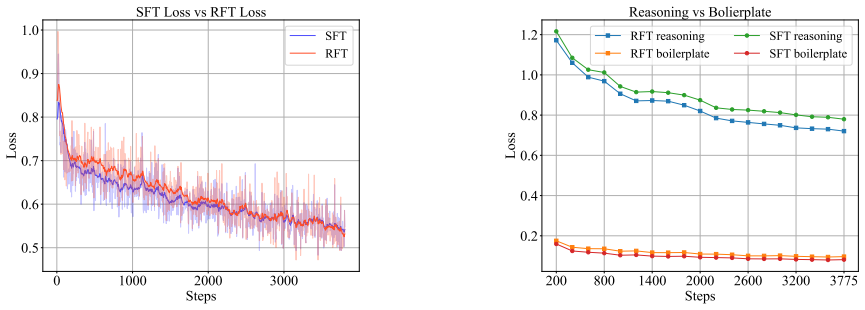
"The findings indicate that RFT significantly reduces the loss for reasoning tokens while maintaining a comparable loss for boilerplate tokens compared to SFT, confirming that RFT effectively enhances the learning for reasoning tokens."
The 'reasoning' and 'boilerplate' groups used in this analysis are not independently annotated; they are produced by SHAD's own rule in Section 3.1, which classifies a token as boilerplate iff LD(y_k) <= 0 and as reasoning otherwise. RFT then explicitly upweights the SHAD-reasoning group via omega_r = exp(L_r/tau)/(exp(L_b/tau)+exp(L_r/tau)) in Eqs. (4)-(5), where L_r and L_b are the total losses on exactly those SHAD-labeled groups.
full rationale
The central derivation is not circular. SHAD labels tokens by a fixed, explicit heuristic (token-level loss change after tuning on 1% shuffled data), and RFT is evaluated on external held-in and held-out benchmarks (StableToolBench, BFCL, T-eval, Nexus) rather than on data derived from the labels. The performance gains in Table 1 do not reduce by construction to the classifier's own outputs. There is no load-bearing self-citation or imported uniqueness theorem. The only notable self-referential element is in Section 5, where the authors validate RFT by showing that it lowers loss on 'reasoning tokens,' but those tokens are defined by SHAD itself and are precisely the group RFT upweights; this confirmatory loop is quasi-tautological. Appendix D.2's sub-3% misclassification rate is also measured only on regex-identifiable formatting tokens, the easy subset, and Section 7 concedes that high boilerplate diversity can break the method's core assumption; these are support and robustness limitations rather than circularity. Hyperparameter tau is explored in Figure 7 using evaluation averages, which is a selection-bias concern for the headline comparison but not a circular reduction of the method to its inputs.
Assumptions & free parameters
free parameters (3)
- temperature tau =
Selected via sweep of 1/tau in [0, 2]; Figure 7 shows an interior optimum
- shuffle ratio =
1%
- classification threshold =
0
assumptions (4)
- domain assumption Boilerplate tokens are sample-independent and remain predictable after shuffling input-output pairs.
- domain assumption Reasoning tokens are sample-specific and become unpredictable after shuffling.
- ad hoc to paper A token is boilerplate if its loss decreases on the shuffle-tuned model and reasoning if its loss increases.
- domain assumption Fine-tuning on 1% shuffled data teaches mainly boilerplate patterns without systematically changing reasoning-token losses in a way that breaks the sign rule.
Cite this review
Pith. "Pith review of Disentangling Reasoning Tokens and Boilerplate Tokens For Language Model Fine-tuning." pith.science (2026). https://pith.science/paper/QSMJBTON
@misc{pith2026241214780,
  author       = {Pith},
  title        = {Pith review of: Disentangling Reasoning Tokens and Boilerplate Tokens For Language Model Fine-tuning},
  year         = {2026},
  howpublished = {\url{https://pith.science/paper/QSMJBTON}},
  note         = {Machine review of arXiv:2412.14780}
}
read the original abstract
When using agent-task datasets to enhance agent capabilities for Large Language Models (LLMs), current methodologies often treat all tokens within a sample equally. However, we argue that tokens serving different roles - specifically, reasoning tokens versus boilerplate tokens (e.g., those governing output format) - differ significantly in importance and learning complexity, necessitating their disentanglement and distinct treatment. To address this, we propose a novel Shuffle-Aware Discriminator (SHAD) for adaptive token discrimination. SHAD classifies tokens by exploiting predictability differences observed after shuffling input-output combinations across samples: boilerplate tokens, due to their repetitive nature among samples, maintain predictability, whereas reasoning tokens do not. Using SHAD, we propose the Reasoning-highlighted Fine-Tuning (RFT) method, which adaptively emphasizes reasoning tokens during fine-tuning, yielding notable performance gains over common Supervised Fine-Tuning (SFT).
Figures


Figures from the paper (7 more)




Reference graph
Works this paper leans on
-
[1]
https://gorilla.cs.berkeley.edu/leaderboard.html Berkeley Function Calling Leaderboard V3 (aka Berkeley Tool Calling Leaderboard V3 )
-
[2]
2024 a . https://huggingface.co/datasets/allenai/ultrafeedback_binarized_cleaned allenai/ultrafeedback\_binarized\_cleaned · Datasets at Hugging Face
work page 2024
-
[3]
2024 b . https://huggingface.co/datasets/anon8231489123/ShareGPT_Vicuna_unfiltered anon8231489123/ ShareGPT \_vicuna\_unfiltered · Datasets at Hugging Face
work page 2024
-
[4]
2024 c . https://huggingface.co/datasets/Intel/orca_dpo_pairs Intel/orca\_dpo\_pairs · Datasets at Hugging Face
work page 2024
-
[5]
Baian Chen, Chang Shu, Ehsan Shareghi, Nigel Collier, Karthik Narasimhan, and Shunyu Yao. 2023. https://arxiv.org/abs/2310.05915 Fireact: Toward language agent fine-tuning . Preprint, arXiv:2310.05915
arXiv 2023
-
[6]
Zehui Chen, Weihua Du, Wenwei Zhang, Kuikun Liu, Jiangning Liu, Miao Zheng, Jingming Zhuo, Songyang Zhang, Dahua Lin, Kai Chen, and Feng Zhao. 2024 a . https://doi.org/10.18653/V1/2024.ACL-LONG.515 T-eval: Evaluating the tool utilization capability of large language models step by step . In Proceedings of the 62nd Annual Meeting of the Association for Com...
-
[7]
Zehui Chen, Kuikun Liu, Qiuchen Wang, Wenwei Zhang, Jiangning Liu, Dahua Lin, Kai Chen, and Feng Zhao. 2024 b . https://doi.org/10.18653/V1/2024.FINDINGS-ACL.557 Agent-flan: Designing data and methods of effective agent tuning for large language models . In Findings of the Association for Computational Linguistics, ACL 2024, Bangkok, Thailand and virtual ...
-
[8]
Zehui Chen, Kuikun Liu, Qiuchen Wang, Wenwei Zhang, Jiangning Liu, Dahua Lin, Kai Chen, and Feng Zhao. 2024 c . http://arxiv.org/abs/2403.12881 Agent- FLAN : Designing Data and Methods of Effective Agent Tuning for Large Language Models . arXiv preprint. ArXiv:2403.12881 [cs]
arXiv 2024
Show all 38 references
- [9]
-
[10]
Zhicheng Guo, Sijie Cheng, Hao Wang, Shihao Liang, Yujia Qin, Peng Li, Zhiyuan Liu, Maosong Sun, and Yang Liu. 2024. https://doi.org/10.18653/V1/2024.FINDINGS-ACL.664 Stabletoolbench: Towards stable large-scale benchmarking on tool learning of large language models . In Findin...
2024 doi
-
[11]
Tsung-Yi Lin, Priya Goyal, Ross Girshick, Kaiming He, and Piotr Dollár. 2020. https://doi.org/10.1109/TPAMI.2018.2858826 Focal loss for dense object detection . IEEE Transactions on Pattern Analysis and Machine Intelligence, 42(2):318--327
2020
-
[12]
Zhenghao Lin, Zhibin Gou, Yeyun Gong, Xiao Liu, Yelong Shen, Ruochen Xu, Chen Lin, Yujiu Yang, Jian Jiao, Nan Duan, and Weizhu Chen. 2024. http://arxiv.org/abs/2404.07965 Rho-1: Not All Tokens Are What You Need . arXiv preprint. ArXiv:2404.07965 [cs]
2024 arXiv
-
[13]
Zuxin Liu, Thai Hoang, Jianguo Zhang, Ming Zhu, Tian Lan, Shirley Kokane, Juntao Tan, Weiran Yao, Zhiwei Liu, Yihao Feng, Rithesh Murthy, Liangwei Yang, Silvio Savarese, Juan Carlos Niebles, Huan Wang, Shelby Heinecke, and Caiming Xiong. 2024. http://arxiv.org/abs/2406.18518 A...
2024 arXiv
-
[14]
Reiichiro Nakano, Jacob Hilton, Suchir Balaji, Jeff Wu, Long Ouyang, Christina Kim, Christopher Hesse, Shantanu Jain, Vineet Kosaraju, William Saunders, Xu Jiang, Karl Cobbe, Tyna Eloundou, Gretchen Krueger, Kevin Button, Matthew Knight, Benjamin Chess, and John Schulman. 2021...
2021 arXiv
-
[15]
Haojie Pan, Zepeng Zhai, Hao Yuan, Yaojia Lv, Ruiji Fu, Ming Liu, Zhongyuan Wang, and Bing Qin. 2024. http://arxiv.org/abs/2312.04889 KwaiAgents : Generalized Information -seeking Agent System with Large Language Models . arXiv preprint. ArXiv:2312.04889 [cs]
2024 arXiv
- [16]
-
[17]
Shishir G Patil, Tianjun Zhang, Xin Wang, and Joseph E Gonzalez. 2023. Gorilla: Large language model connected with massive apis. arXiv preprint arXiv:2305.15334
2023 arXiv
-
[18]
Shuofei Qiao, Ningyu Zhang, Runnan Fang, Yujie Luo, Wangchunshu Zhou, Yuchen Jiang, Chengfei Lv, and Huajun Chen. 2024. https://doi.org/10.18653/v1/2024.acl-long.165 A uto A ct: Automatic agent learning from scratch for QA via self-planning . In Proceedings of the 62nd Annual ...
2024 doi
-
[19]
Yujia Qin, Shihao Liang, Yining Ye, Kunlun Zhu, Lan Yan, Yaxi Lu, Yankai Lin, Xin Cong, Xiangru Tang, Bill Qian, Sihan Zhao, Lauren Hong, Runchu Tian, Ruobing Xie, Jie Zhou, Mark Gerstein, Dahai Li, Zhiyuan Liu, and Maosong Sun. 2023. http://arxiv.org/abs/2307.16789 ToolLLM : ...
2023 arXiv
-
[20]
Yujia Qin, Shihao Liang, Yining Ye, Kunlun Zhu, Lan Yan, Yaxi Lu, Yankai Lin, Xin Cong, Xiangru Tang, Bill Qian, Sihan Zhao, Lauren Hong, Runchu Tian, Ruobing Xie, Jie Zhou, Mark Gerstein, Dahai Li, Zhiyuan Liu, and Maosong Sun. 2024. https://openreview.net/forum?id=dHng2O0Jjr...
2024
-
[21]
Rafael Rafailov, Joey Hejna, Ryan Park, and Chelsea Finn. 2024. http://arxiv.org/abs/2404.12358 From \ r\ to \ Q *\ : Your Language Model is Secretly a Q - Function . arXiv preprint. ArXiv:2404.12358 [cs]
2024 arXiv
-
[22]
Timo Schick, Jane Dwivedi - Yu, Roberto Dess \` , Roberta Raileanu, Maria Lomeli, Eric Hambro, Luke Zettlemoyer, Nicola Cancedda, and Thomas Scialom. 2023. http://papers.nips.cc/paper\_files/paper/2023/hash/d842425e4bf79ba039352da0f658a906-Abstract-Conference.html Toolformer: ...
2023
-
[23]
Weizhou Shen, Chenliang Li, Hongzhan Chen, Ming Yan, Xiaojun Quan, Hehong Chen, Ji Zhang, and Fei Huang. 2024. https://doi.org/10.18653/v1/2024.emnlp-main.929 Small LLMs are weak tool learners: A multi- LLM agent . In Proceedings of the 2024 Conference on Empirical Methods in ...
2024 doi
-
[24]
Yongliang Shen, Kaitao Song, Xu Tan, Dongsheng Li, Weiming Lu, and Yueting Zhuang. 2023. http://papers.nips.cc/paper\_files/paper/2023/hash/77c33e6a367922d003ff102ffb92b658-Abstract-Conference.html Hugginggpt: Solving AI tasks with chatgpt and its friends in hugging face . In ...
2023
-
[25]
Noah Shinn, Federico Cassano, Ashwin Gopinath, Karthik Narasimhan, and Shunyu Yao. 2023. http://papers.nips.cc/paper\_files/paper/2023/hash/1b44b878bb782e6954cd888628510e90-Abstract-Conference.html Reflexion: language agents with verbal reinforcement learning . In Advances in ...
2023
-
[26]
Qiaoyu Tang, Ziliang Deng, Hongyu Lin, Xianpei Han, Qiao Liang, Boxi Cao, and Le Sun. 2023. http://arxiv.org/abs/2306.05301 ToolAlpaca : Generalized Tool Learning for Language Models with 3000 Simulated Cases . arXiv preprint. ArXiv:2306.05301 [cs]
2023 arXiv
-
[27]
Nexusflow.ai team. 2023. https://nexusflow.ai/blogs/ravenv2 Nexusraven-v2: Surpassing gpt-4 for zero-shot function calling
2023
-
[28]
Lei Wang, Chen Ma, Xueyang Feng, Zeyu Zhang, Hao Yang, Jingsen Zhang, Zhiyuan Chen, Jiakai Tang, Xu Chen, Yankai Lin, Wayne Xin Zhao, Zhewei Wei, and Jirong Wen. 2024. https://doi.org/10.1007/S11704-024-40231-1 A survey on large language model based autonomous agents . Frontie...
2024 doi
-
[29]
Chi, Quoc V
Jason Wei, Xuezhi Wang, Dale Schuurmans, Maarten Bosma, Brian Ichter, Fei Xia, Ed H. Chi, Quoc V. Le, and Denny Zhou. 2022. http://papers.nips.cc/paper\_files/paper/2022/hash/9d5609613524ecf4f15af0f7b31abca4-Abstract-Conference.html Chain-of-thought prompting elicits reasoning...
2022
-
[30]
Lilian Weng. 2023. https://lilianweng.github.io/posts/2023-06-23-agent/ Llm-powered autonomous agents . lilianweng.github.io
2023
-
[31]
Preference-grounded Token -level Guidance for Language Model Fine -tuning
Shentao Yang, Shujian Zhang, Congying Xia, Yihao Feng, Caiming Xiong, and Mingyuan Zhou. Preference-grounded Token -level Guidance for Language Model Fine -tuning
-
[32]
Shentao Yang, Shujian Zhang, Congying Xia, Yihao Feng, Caiming Xiong, and Mingyuan Zhou. 2023. http://arxiv.org/abs/2306.00398 Preference-grounded Token -level Guidance for Language Model Fine -tuning . arXiv preprint. ArXiv:2306.00398 [cs]
2023 arXiv
-
[33]
Shunyu Yao, Howard Chen, John Yang, and Karthik Narasimhan. 2022. Webshop: Towards scalable real-world web interaction with grounded language agents. Advances in Neural Information Processing Systems, 35:20744--20757
2022
-
[34]
Narasimhan, and Yuan Cao
Shunyu Yao, Jeffrey Zhao, Dian Yu, Nan Du, Izhak Shafran, Karthik R. Narasimhan, and Yuan Cao. 2023. https://openreview.net/forum?id=WE\_vluYUL-X React: Synergizing reasoning and acting in language models . In The Eleventh International Conference on Learning Representations, ...
2023
-
[35]
Aohan Zeng, Mingdao Liu, Rui Lu, Bowen Wang, Xiao Liu, Yuxiao Dong, and Jie Tang. 2023. http://arxiv.org/abs/2310.12823 AgentTuning : Enabling Generalized Agent Abilities for LLMs . arXiv preprint. ArXiv:2310.12823 [cs]
2023 arXiv
-
[36]
Andrew Zhao, Daniel Huang, Quentin Xu, Matthieu Lin, Yong-Jin Liu, and Gao Huang. 2023. http://arxiv.org/abs/2308.10144 ExpeL : LLM Agents Are Experiential Learners . arXiv preprint. ArXiv:2308.10144 [cs]
2023 arXiv
-
[37]
online" 'onlinestring :=
ENTRY address archivePrefix author booktitle chapter edition editor eid eprint eprinttype howpublished institution journal key month note number organization pages publisher school series title type volume year doi pubmed url lastchecked label extra.label sort.label short.list...
-
[38]
write newline
" write newline "" before.all 'output.state := FUNCTION n.dashify 't := "" t empty not t #1 #1 substring "-" = t #1 #2 substring "--" = not "--" * t #2 global.max substring 't := t #1 #1 substring "-" = "-" * t #2 global.max substring 't := while if t #1 #1 substring * t #2 gl...
Reviewed August 11, 2026 · model on record in the stance chip above.
Discussion (0). Continue with ORCID to comment.