Giant Fluctuations in Self-Propelled Particles with Age-Dependent Switching
Pith reviewed 2026-06-26 10:53 UTC · model grok-4.3
The pith
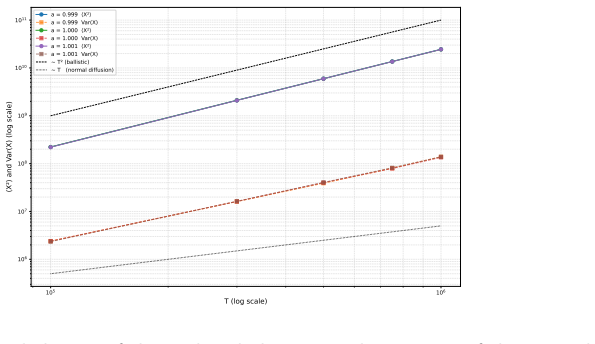
At a critical switching parameter the displacement variance of these particles grows as T squared over log T.
A machine-rendered reading of the paper's core claim, the machinery that carries it, and where it could break.
Core claim
The dynamics alternate between a Markovian downstream phase with constant switching probability r and a semi-Markovian upstream phase whose age-dependent hazard probability a/(b+c) decays with the internal clock c. The time-averaged velocity shows a continuous transition at a=1 that separates an upstream-dominated ballistic regime for a less than 1 from an ergodic diffusive regime for a greater than 1. At the critical point a=1 the variance of displacement scales as T squared over log T, demonstrating a marginal breakdown of the central limit theorem produced by the slowly decaying reorientation probabilities.
What carries the argument
The age-dependent hazard probability a/(b+c) in the semi-Markovian upstream phase, which controls the duration of persistent orientation and produces the critical scaling.
If this is right
- The time-averaged velocity serves as the order parameter that jumps from ballistic to diffusive behavior across a=1.
- Exact expressions for the propagator are obtained via generating-function methods and discrete-time moment recurrences.
- For a less than 1 the mean displacement grows linearly with time while for a greater than 1 it grows diffusively.
- The same mechanism produces unusually high-variance exploratory paths in any biased environment with slowly decaying reorientation.
Where Pith is reading between the lines
- Similar giant-fluctuation scalings may appear in other persistent-motion models whenever the memory kernel decays slower than exponentially but still allows a critical point.
- The marginal CLT breakdown suggests that weak power-law tails in waiting times can be tuned to produce intermediate regimes between normal diffusion and superdiffusion.
- Generating-function techniques developed here can be reused for any semi-Markov process whose hazard rate depends on an internal age variable.
Load-bearing premise
The upstream phase is governed by a semi-Markovian process whose hazard probability takes the specific form a/(b+c) that decays with the internal clock c.
What would settle it
Measure the long-time variance of particle position in an experiment where the upstream reorientation probability is tuned to decay exactly as a/(b+c) and check whether it follows T squared over log T when a equals 1.
Figures

read the original abstract
We investigate the transport and fluctuation properties of self-propelled particles whose motion is governed by an age-dependent phase-switching mechanism. The dynamics alternate between a Markovian downstream phase with a constant switching probability $r$ and a semi-Markovian upstream phase in which the age-dependent hazard probability $a/(b+c)$ decays with the internal clock $c$, representing persistent orientation. The time-averaged velocity, as an order parameter, shows a continuous transition at $a=1$ which separates an upstream-dominated ballistic regime ($a<1$) from an ergodic diffusive regime ($a>1$). Through generating-function methods and discrete-time moment recurrences, we derive exact expressions for the propagator and determine the long-time asymptotics of the mean displacement and variance. At the critical point $a=1$, the system exhibits giant fluctuations, with the variance scaling ballistically up to a logarithmic correction, $\mathrm{Var}(x_T) \propto T^2 / \log T$. These results demonstrate how slowly decaying reorientation probabilities lead to a marginal breakdown of the Central Limit Theorem, enabling unusually high-variance exploratory dynamics in biased environments.
Editorial analysis
A structured set of objections, weighed in public.
Referee Report
Summary. The manuscript studies self-propelled particles that alternate between a Markovian downstream phase (constant switching rate r) and a semi-Markovian upstream phase whose reorientation hazard is a/(b+c) with internal age c. Generating-function and discrete-time moment-recurrence methods are used to obtain exact expressions for the propagator. The time-averaged velocity undergoes a continuous transition at a=1 separating an upstream-dominated ballistic regime (a<1) from an ergodic diffusive regime (a>1). At criticality the variance is reported to scale as T²/log T, indicating giant fluctuations and a marginal violation of the central limit theorem.
Significance. If the derivations are correct, the work supplies an exactly solvable active-particle model in which a slowly decaying hazard produces a tunable transition to super-ballistic fluctuations. The explicit propagator and the T²/log T scaling constitute concrete, falsifiable predictions that could be tested in colloidal or bacterial systems with controlled persistence. The generating-function approach is a methodological strength.
major comments (2)
- [§3] §3 (or equivalent section deriving the moment recurrences): the claimed T²/log T scaling at a=1 is obtained from the solution of the recurrence for the second moment; the precise asymptotic analysis that isolates the logarithmic correction must be shown explicitly, because the hazard a/(b+c) at a=1 is marginally non-integrable and small changes in the cutoff can alter the log factor.
- [Model definition and §4] The definition of the order parameter (time-averaged velocity) and the location of the transition at a=1 rely on the specific functional form a/(b+c). It is not shown whether the same critical scaling persists for other slowly decaying hazards (e.g., 1/(b+c)^α with α≠1); this limits the generality of the “marginal breakdown of the CLT” claim.
minor comments (2)
- [Abstract and §2] The abstract states that the downstream phase is Markovian with constant probability r, yet the upstream phase is semi-Markovian; a brief remark on whether the overall process remains Markovian when both phases are considered together would clarify the scope of the generating-function method.
- [Throughout] Notation for the internal clock c versus global time t should be made uniform throughout; occasional use of c for both the age variable and a constant is confusing.
Simulated Author's Rebuttal
We thank the referee for the careful reading, the positive evaluation, and the constructive suggestions. We address the two major comments below.
read point-by-point responses
-
Referee: §3 (or equivalent section deriving the moment recurrences): the claimed T²/log T scaling at a=1 is obtained from the solution of the recurrence for the second moment; the precise asymptotic analysis that isolates the logarithmic correction must be shown explicitly, because the hazard a/(b+c) at a=1 is marginally non-integrable and small changes in the cutoff can alter the log factor.
Authors: We agree that an explicit asymptotic analysis is required. The recurrence for the second moment at a=1 yields a generating function whose singularity structure produces the T²/log T leading term; we will add a dedicated appendix (or subsection) that carries out the Tauberian analysis and the Euler-Maclaurin summation needed to isolate the logarithmic correction, confirming robustness against cutoff variations. revision: yes
-
Referee: The definition of the order parameter (time-averaged velocity) and the location of the transition at a=1 rely on the specific functional form a/(b+c). It is not shown whether the same critical scaling persists for other slowly decaying hazards (e.g., 1/(b+c)^α with α≠1); this limits the generality of the “marginal breakdown of the CLT” claim.
Authors: The hazard a/(b+c) is deliberately chosen as the exactly solvable marginal case (α=1) that permits closed-form generating functions. The transition at a=1 and the associated scaling are therefore specific to this functional form. We will revise the text to state explicitly that the marginal CLT breakdown is demonstrated for this critical hazard and that other exponents generally require different techniques; a short remark will be added noting the scope of the result. revision: partial
Circularity Check
Derivation self-contained from explicit hazard function; no circularity
full rationale
The model is defined by the explicit semi-Markovian hazard a/(b+c) in the upstream phase. The abstract and description state that generating-function methods and discrete-time moment recurrences are applied to this process to obtain the propagator, mean displacement, and variance asymptotics, including the T²/log T scaling at a=1. No equation reduces the claimed scaling to a fitted parameter, self-citation, or ansatz smuggled from prior work; the result is obtained by direct analysis of the stated dynamics. No load-bearing self-citations or uniqueness theorems are invoked in the provided text.
Axiom & Free-Parameter Ledger
free parameters (3)
- a
- b
- r
axioms (2)
- domain assumption The particle dynamics consist of alternating Markovian downstream and semi-Markovian upstream phases with the given hazard.
- standard math Generating functions and discrete-time moment recurrences suffice to obtain the exact propagator and long-time asymptotics.
Reference graph
Works this paper leans on
-
[1]
Run-and- Tumble Particles with Hydrodynamics: Sedimentation, Trapping, and Upstream Swimming,
R. Z. Nash, A. Adhikari, J. Tailleur, and M. E. Cates, “Run-and- Tumble Particles with Hydrodynamics: Sedimentation, Trapping, and Upstream Swimming,”Phys. Rev. Lett.104, 258101 (2010). doi: 10.1103/PhysRevLett.104.258101
-
[2]
Microswimmers in patterned environments,
G. Volpe, I. Buttinoni, D. Vogt, H. J. K¨ ummerer, and C. Bechinger, “Microswimmers in patterned environments,”Soft Matter7, 8810–8815 (2011). doi: 10.1039/C1SM05960B
-
[3]
Lieb-schultz-mattis type theorem with higher-form symmetry and the quantum dimer mod- els,
A. Z¨ ottl and H. Stark, “Hydrodynamics Determines Collective Mo- tion and Phase Behavior of Active Colloids in Quasi-Two-Dimensional Confinement,”Phys. Rev. Lett.112, 118101 (2014). doi: 10.1103/Phys- RevLett.112.118101
-
[4]
Active particles in complex and crowded environ- ments,
C. Bechinger, R. Di Leonardo, H. L¨ owen, C. Reichhardt, G. Volpe, and G. Volpe, “Active particles in complex and crowded environ- ments,”Rev. Mod. Phys.88, 045006 (2016). doi: 10.1103/RevMod- Phys.88.045006
-
[5]
ApplicationsofB-splinesin atomic and molecular physics
J. Elgeti, R. G. Winkler, and G. Gompper, “Physics of microswimmers—single particle motion and collective behavior: a review,”Rep. Prog. Phys.78, 056601 (2015). doi: 10.1088/0034- 4885/78/5/056601
-
[6]
Orientational memory of active parti- cles in multistate non-Markovian processes,
Z. Sadjadi and M. R. Shaebani, “Orientational memory of active parti- cles in multistate non-Markovian processes,”Phys. Rev. E104, 054613 (2021). doi: 10.1103/PhysRevE.104.054613
-
[7]
, year = 2000, month = dec, volume = 339, pages =
R. Metzler and J. Klafter, “The random walk’s guide to anomalous dif- fusion: a fractional dynamics approach,”Phys. Rep.339, 1–77 (2000). doi: 10.1016/S0370-1573(00)00070-3
-
[8]
Non-Markovian intracellular transport with sub-diffusion and run-length dependent de- tachment rate,
N. Korabel, T. A. Waigh, S. Fedotov, and V. J. Allan, “Non-Markovian intracellular transport with sub-diffusion and run-length dependent de- tachment rate,”PLoS ONE13, e0207436 (2018). doi: 10.1371/jour- nal.pone.0207436
-
[9]
Current fluctuations in nonequilibrium diffusive systems: an additivity principle,
T. Bodineau and B. Derrida, “Current fluctuations in nonequilibrium diffusive systems: an additivity principle,”Phys. Rev. Lett.92, 180601 (2004). doi: 10.1103/PhysRevLett.92.180601 18
-
[10]
S. Sohrabi and F. H. Jafarpour, “Semi-Markovian dynamics of a self- propelled particle in a confined environment: a large-deviation study”, J. Stat. Mech. (2026) 043203. doi: 10.1088/1742-5468/ae5c91
-
[11]
The large deviation approach to statistical mechanics,
H. Touchette, “The large deviation approach to statistical mechanics,” Phys. Rep.478, 1–69 (2009). doi: 10.1016/j.physrep.2009.05.002
-
[12]
Introduction to dynamical large deviations of Markov processes,
H. Touchette, “Introduction to dynamical large deviations of Markov processes,”Physica A504, 5–19 (2018). doi: 10.1016/j.physa.2017.10.046
-
[13]
Korevaar,Tauberian Theory: A Century of Developments, Grundlehren der mathematischen Wissenschaften, vol
J. Korevaar,Tauberian Theory: A Century of Developments, Grundlehren der mathematischen Wissenschaften, vol. 329, Springer, Berlin (2004)
2004
-
[14]
V. Zaburdaev, S. Denisov, and J. Klafter, “L´ evy walks,”Rev. Mod. Phys.87, 483–530 (2015). doi: 10.1103/RevModPhys.87.483
-
[15]
Klafter and I
J. Klafter and I. M. Sokolov,First Steps in Random Walks: From Tools to Applications, Oxford University Press, Oxford (2011). 19
2011
discussion (0)
Sign in with ORCID, Apple, or X to comment. Anyone can read and Pith papers without signing in.