When positive and negative pairs differ in femtoscopy: residual Coulomb and isospin effects
Pith reviewed 2026-06-27 23:03 UTC · model grok-4.3
The pith
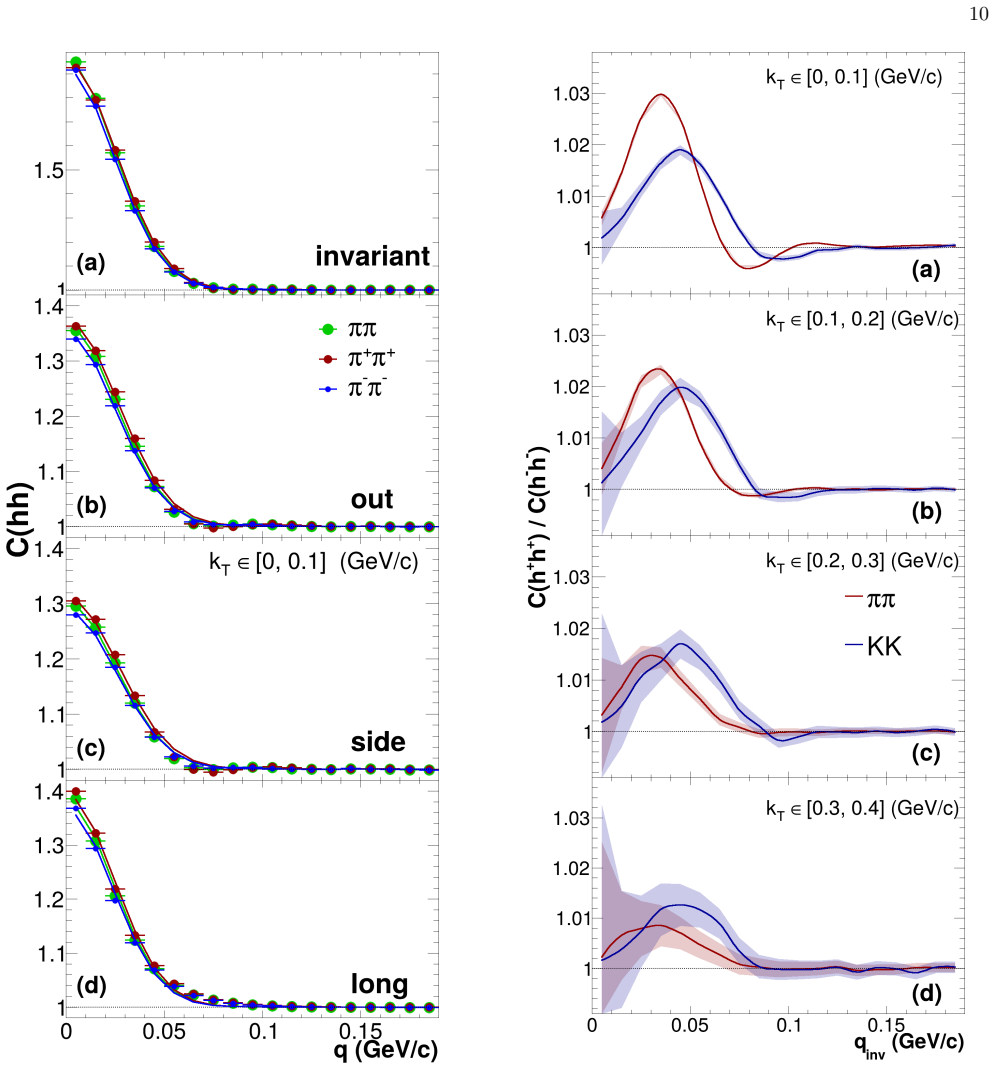
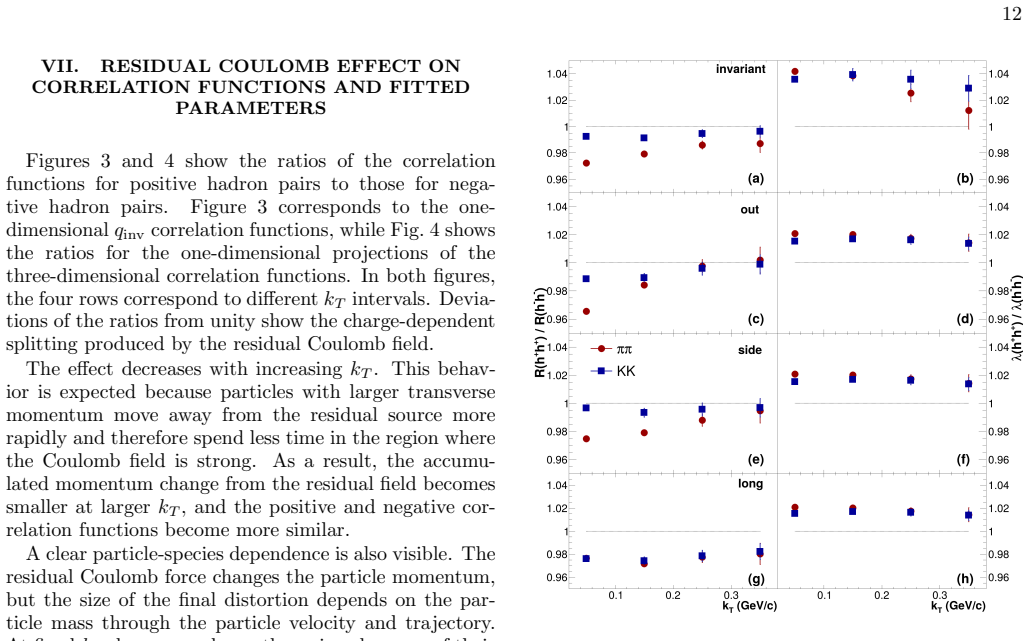
Residual Coulomb fields produce charge-dependent splitting in pion and kaon correlation functions that must be modeled together with isospin effects.
A machine-rendered reading of the paper's core claim, the machinery that carries it, and where it could break.
Core claim
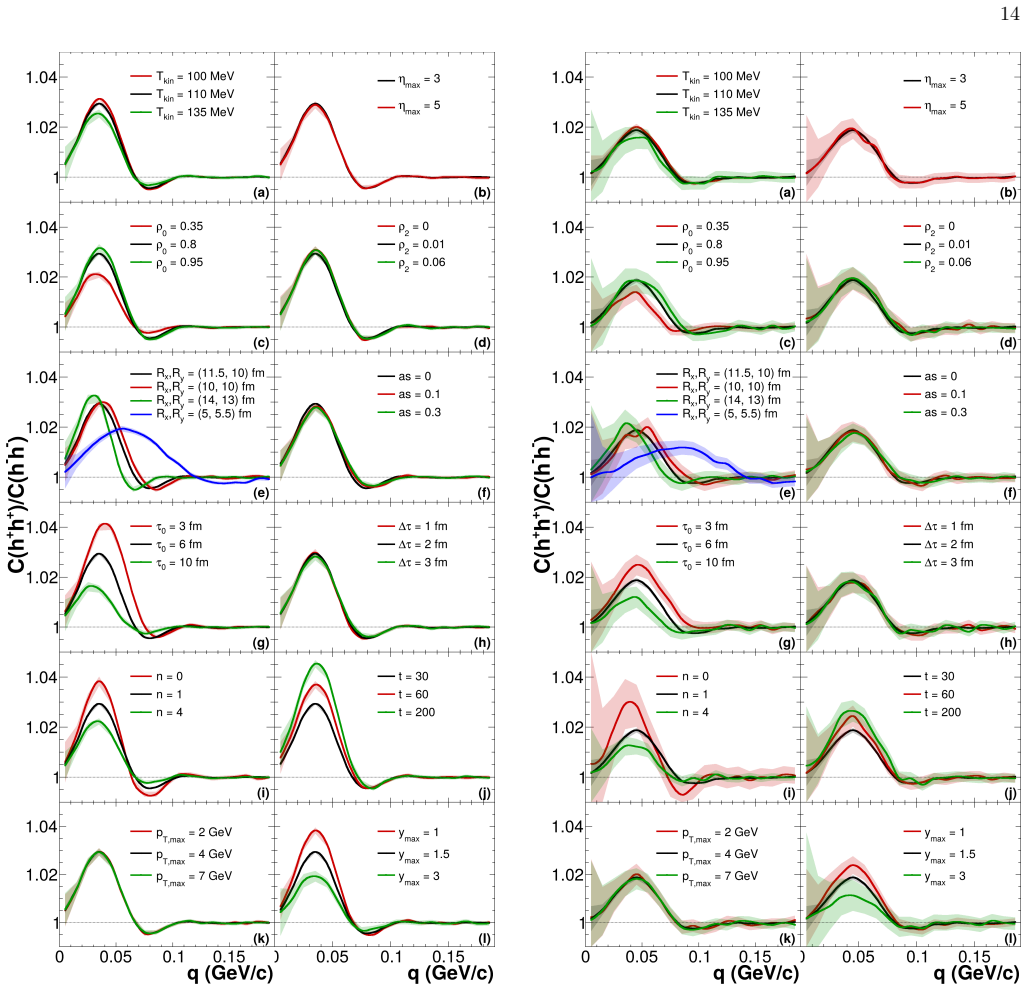
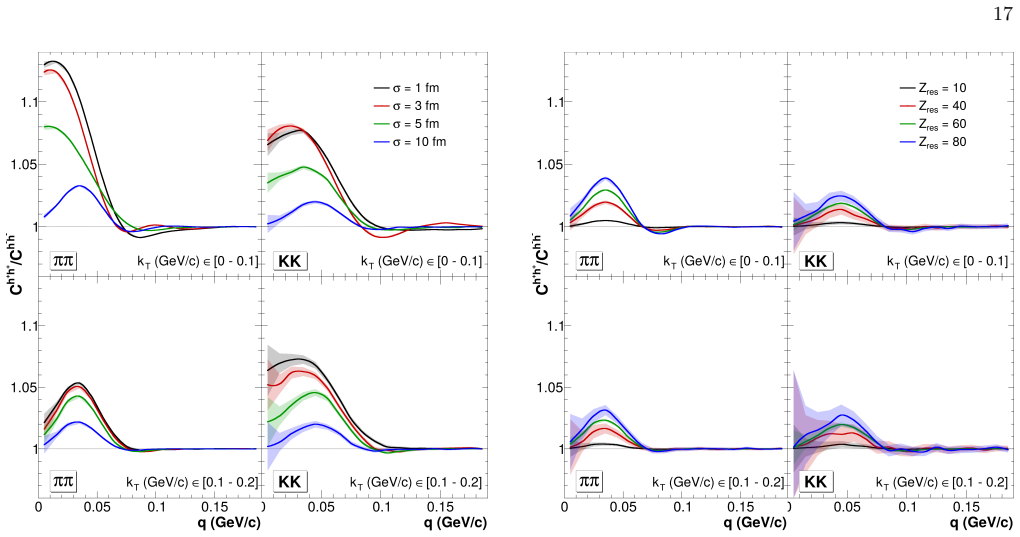
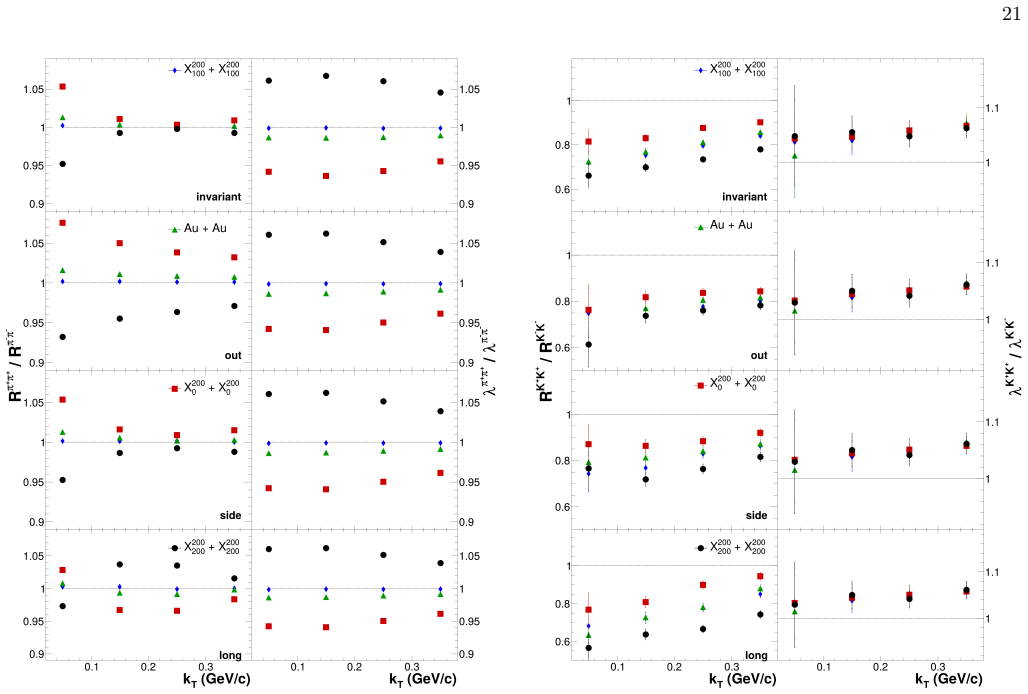
The residual Coulomb field produces a small but systematic positive-to-negative splitting of the correlation functions, strongest at low k_T and sensitive to the effective charge, spatial width, and expansion velocity of the residual source. It also modifies the height and shape of the correlation function, complicating interpretation of the fitted radii. UrQMD 3.4 cascade calculations for Au+Au collisions at sqrt(s_NN)=7.7 GeV show that charge-dependent splittings can also appear even without a residual Coulomb field, driven mainly by initial isospin composition for pions and by different production mechanisms and hadronic evolution for kaons.
What carries the argument
Modified Retiere-Lisa blast-wave source that propagates the same particles with opposite charge signs through an effective residual field, together with UrQMD cascade simulations.
If this is right
- The splitting is strongest at low transverse momentum and depends on the effective charge, spatial extent, and expansion velocity of the residual source.
- The Coulomb contribution changes both the height and the shape of the correlation function, which affects the radii extracted from fits.
- For pions the isospin-driven splitting arises mainly from the initial charge composition of the system.
- For kaons the splitting is shaped by differences in production channels and subsequent hadronic rescattering.
- Residual Coulomb and isospin effects can compete, so neither can be isolated without a joint model.
Where Pith is reading between the lines
- Analyses that fit radii without including both effects together may systematically misestimate source sizes at low momentum.
- Similar charge-dependent signals could appear in other collision energies or systems once the same modeling is applied.
- Low-momentum data with high statistics could be used to separate the Coulomb and isospin contributions by their different sensitivities to source parameters.
Load-bearing premise
An effective residual field inside the blast-wave source is sufficient to capture the real Coulomb interactions between emitted particles and the remaining charged source.
What would settle it
Measured positive and negative pion correlation functions at low k_T in 7.7 GeV Au+Au collisions that show no charge splitting after isospin contributions are subtracted would contradict the predicted residual Coulomb splitting.
Figures




read the original abstract
We study charge-dependent modifications of identical-pion and identical-kaon femtoscopic correlation functions from two sources: the residual Coulomb field of the charged source and isospin-related hadronic dynamics. The residual Coulomb effect is modeled with a modified Retiere--Lisa blast-wave source, where the same emitted particles are propagated with positive and negative charge signs through an effective residual field. The residual Coulomb field produces a small but systematic positive-to-negative splitting of the correlation functions, strongest at low $k_T$ and sensitive to the effective charge, spatial width, and expansion velocity of the residual source. It also modifies the height and shape of the correlation function, complicating interpretation of the fitted radii. UrQMD 3.4 cascade calculations for Au+Au collisions at $\sqrt{s_{NN}}=7.7~\mathrm{GeV}$ show that charge-dependent splittings can also appear even without a residual Coulomb field. For pions, this difference is mainly driven by the initial isospin composition, while for kaons it is strongly affected by different $K^+$ and $K^-$ production mechanisms and subsequent hadronic evolution. These results show that residual Coulomb and isospin-related effects can compete, and neither can be interpreted reliably without constraining the other within the same model framework.
Editorial analysis
A structured set of objections, weighed in public.
Referee Report
Summary. The manuscript claims that residual Coulomb fields from the charged source produce a small but systematic positive-to-negative splitting in identical-pion and identical-kaon femtoscopic correlation functions (strongest at low k_T and sensitive to effective charge, spatial width, and expansion velocity), modeled by propagating identical particles with flipped charge signs through an effective residual field in a modified Retiere-Lisa blast-wave source. It further claims that UrQMD 3.4 cascade calculations for Au+Au at 7.7 GeV show comparable splittings arising from isospin-related dynamics (initial isospin composition for pions; production mechanisms and hadronic evolution for kaons) even without residual Coulomb, implying the two effects compete and must be constrained jointly to avoid misinterpreting fitted radii.
Significance. If the modeling holds, the result is significant for femtoscopy analyses in heavy-ion collisions because it demonstrates that both electromagnetic and isospin effects can alter correlation-function height and shape, providing concrete examples via modified blast-wave propagation and UrQMD simulations that can guide more robust source-size extractions.
major comments (1)
- [Abstract and modeling description] Abstract and modeling section: the residual-Coulomb claim rests on re-propagating the same emitted particles (identical positions and momenta) with flipped charge signs through an effective residual field whose strength, width, and velocity are independently tunable. This implicitly treats the field as external and static while assuming charge-independent emission at freeze-out; in a dynamically expanding system the net charge density evolves with the same dynamics, so the approximation risks under- or over-estimating the low-k_T splitting that is central to the paper's interpretation.
minor comments (2)
- Clarify whether the blast-wave parameters (effective charge, spatial width, expansion velocity) are chosen to match the UrQMD source or are varied independently, and state the criterion used for that choice.
- Add explicit comparison of the correlation-function splitting magnitude between the blast-wave model and the UrQMD runs at the same k_T bins to quantify how the two effects compete.
Simulated Author's Rebuttal
We thank the referee for the careful reading and constructive feedback. The single major comment is addressed below with an honest assessment of the modeling approximation.
read point-by-point responses
-
Referee: [Abstract and modeling description] Abstract and modeling section: the residual-Coulomb claim rests on re-propagating the same emitted particles (identical positions and momenta) with flipped charge signs through an effective residual field whose strength, width, and velocity are independently tunable. This implicitly treats the field as external and static while assuming charge-independent emission at freeze-out; in a dynamically expanding system the net charge density evolves with the same dynamics, so the approximation risks under- or over-estimating the low-k_T splitting that is central to the paper's interpretation.
Authors: We agree that the approach is an effective approximation that treats the residual field as external and static while assuming charge-independent emission. This choice isolates the electromagnetic contribution in a controlled blast-wave framework and allows systematic variation of effective charge, width, and velocity. We acknowledge that a fully dynamical treatment, in which charge density evolves self-consistently with the expanding medium, could modify the precise size of the low-k_T splitting. The present model therefore provides an estimate of the effect rather than a complete dynamical prediction. We will revise the modeling section to state these limitations explicitly and to note that the reported splittings should be viewed as indicative of the magnitude and k_T dependence that residual Coulomb fields can produce. revision: partial
Circularity Check
No circularity; results from explicit model propagation and external simulations
full rationale
The paper constructs its central results by propagating identical particles through a modified Retiere-Lisa blast-wave source (with charge sign flip) and by running separate UrQMD cascade calculations. No equation or step reduces a claimed prediction to a fitted input by construction, and no load-bearing premise rests on a self-citation chain. The derivation remains self-contained against the external benchmarks it invokes.
Axiom & Free-Parameter Ledger
Reference graph
Works this paper leans on
-
[1]
the true sample, before residual Coulomb propaga- tion
-
[2]
the negatively charged sample, after propagation withq=−1
-
[3]
long” direction is along the beam axis, the “out
the positively charged sample, after propagation withq= +1. The true sample is useful as a reference, but the main comparison in this study is between the final positively and negatively charged samples. Since both charge cases start from the same underlying freeze-out distribu- tion, differences between them can be directly associated, within this model,...
-
[4]
M. A. Lisa, S. Pratt, R. Soltz, and U. Wiedemann, Fem- toscopy in relativistic heavy ion collisions, Ann. Rev. Nucl. Part. Sci.55, 357 (2005), arXiv:nucl-ex/0505014
Pith/arXiv arXiv 2005
-
[5]
U. W. Heinz and B. V. Jacak, Two particle correlations in relativistic heavy ion collisions, Ann. Rev. Nucl. Part. Sci.49, 529 (1999), arXiv:nucl-th/9902020
Pith/arXiv arXiv 1999
-
[6]
G. I. Kopylov and M. I. Podgoretsky, Correlations of identical particles emitted by highly excited nuclei, Sov. J. Nucl. Phys.15, 219 (1972)
1972
-
[7]
Pratt, Pion Interferometry of Quark-Gluon Plasma, Phys
S. Pratt, Pion Interferometry of Quark-Gluon Plasma, Phys. Rev. D33, 1314 (1986)
1986
-
[8]
Bertsch, M
G. Bertsch, M. Gong, and M. Tohyama, Pion Interferom- etry in Ultrarelativistic Heavy Ion Collisions, Phys. Rev. C37, 1896 (1988)
1988
-
[9]
S. V. Akkelin and Y. M. Sinyukov, The HBT interferom- etry of expanding sources, Phys. Lett. B356, 525 (1995)
1995
-
[10]
F. Retiere and M. A. Lisa, Observable implications of geometrical and dynamical aspects of freeze out in heavy ion collisions, Phys. Rev. C70, 044907 (2004), arXiv:nucl-th/0312024
Pith/arXiv arXiv 2004
-
[11]
Lednicky and V
R. Lednicky and V. L. Lyuboshits, Final State Inter- action Effect on Pairing Correlations Between Particles with Small Relative Momenta, Yad. Fiz.35, 1316 (1981)
1981
-
[12]
Lednicky, Finite-size effects on two-particle produc- tion in continuous and discrete spectrum, Phys
R. Lednicky, Finite-size effects on two-particle produc- tion in continuous and discrete spectrum, Phys. Part. Nucl.40, 307 (2009), arXiv:nucl-th/0501065
Pith/arXiv arXiv 2009
-
[13]
S. Voloshin, R. Lednicky, S. Panitkin, and N. Xu, Rel- ative space-time asymmetries in pion and nucleon pro- duction in noncentral nucleus-nucleus collisions at high- energies, Phys. Rev. Lett.79, 4766 (1997), arXiv:nucl- th/9708044
arXiv 1997
-
[14]
Lednicky, V
R. Lednicky, V. L. Lyuboshits, B. Erazmus, and D. Nouais, How to measure which sort of particles was emitted earlier and which later, Phys. Lett. B373, 30 (1996)
1996
-
[15]
Adamset al.(STAR), Pion kaon correlations in Au+Au collisions at s(NN)**1/2 = 130-GeV, Phys
J. Adamset al.(STAR), Pion kaon correlations in Au+Au collisions at s(NN)**1/2 = 130-GeV, Phys. Rev. Lett.91, 262302 (2003), arXiv:nucl-ex/0307025
Pith/arXiv arXiv 2003
-
[16]
S. E. Koonin, Proton Pictures of High-Energy Nuclear Collisions, Phys. Lett. B70, 43 (1977)
1977
-
[17]
A. Collaborationet al.(ALICE), Unveiling the strong interaction among hadrons at the LHC, Nature588, 232 (2020), [Erratum: Nature 590, E13 (2021)], arXiv:2005.11495 [nucl-ex]
arXiv 2020
-
[18]
L. Fabbietti, V. Mantovani Sarti, and O. Vazquez Doce, Study of the Strong Interaction Among Hadrons with Correlations at the LHC, Ann. Rev. Nucl. Part. Sci.71, 377 (2021), arXiv:2012.09806 [nucl-ex]
arXiv 2021
-
[19]
L. Adamczyket al.(STAR), Measurement of Inter- action between Antiprotons, Nature527, 345 (2015), arXiv:1507.07158 [nucl-ex]
Pith/arXiv arXiv 2015
- [20]
-
[21]
Adamczyket al.(STAR), ΛΛ Correlation Function in Au+Au collisions at √sN N = 200 GeV, Phys
L. Adamczyket al.(STAR), ΛΛ Correlation Function in Au+Au collisions at √sN N = 200 GeV, Phys. Rev. Lett. 114, 022301 (2015), arXiv:1408.4360 [nucl-ex]
Pith/arXiv arXiv 2015
-
[22]
Adamet al.(STAR), The Proton-Ω correlation func- tion in Au+Au collisions at √sN N=200 GeV, Phys
J. Adamet al.(STAR), The Proton-Ω correlation func- tion in Au+Au collisions at √sN N=200 GeV, Phys. Lett. B790, 490 (2019), arXiv:1808.02511 [hep-ex]
Pith/arXiv arXiv 2019
-
[23]
S. Acharyaet al.(ALICE), Study of the Λ-Λ interac- tion with femtoscopy correlations in pp and p-Pb col- 24 lisions at the LHC, Phys. Lett. B797, 134822 (2019), arXiv:1905.07209 [nucl-ex]
arXiv 2019
-
[24]
Acharyaet al.(ALICE), Experimental Evidence for an Attractive p-ϕInteraction, Phys
S. Acharyaet al.(ALICE), Experimental Evidence for an Attractive p-ϕInteraction, Phys. Rev. Lett.127, 172301 (2021), arXiv:2105.05578 [nucl-ex]
arXiv 2021
-
[25]
B. I. Abelevet al.(STAR), Neutral kaon interferometry in Au+Au collisions at s(NN)**(1/2) = 200-GeV, Phys. Rev. C74, 054902 (2006), arXiv:nucl-ex/0608012
Pith/arXiv arXiv 2006
-
[26]
D. L. Mihaylov, V. Mantovani Sarti, O. W. Arnold, L. Fabbietti, B. Hohlweger, and A. M. Mathis, A fem- toscopic Correlation Analysis Tool using the Schr¨ odinger equation (CATS), Eur. Phys. J. C78, 394 (2018), arXiv:1802.08481 [hep-ph]
Pith/arXiv arXiv 2018
-
[27]
A. Kisiel, H. Zbroszczyk, and M. Szyma´ nski, Extract- ing baryon-antibaryon strong interaction potentials from p¯Λ femtoscopic correlation functions, Phys. Rev. C89, 054916 (2014), arXiv:1403.0433 [nucl-th]
Pith/arXiv arXiv 2014
-
[28]
S. Acharyaet al.(ALICE), p-p, p-Λ and Λ-Λ correlations studied via femtoscopy in pp reactions at √s= 7 TeV, Phys. Rev. C99, 024001 (2019), arXiv:1805.12455 [nucl- ex]
Pith/arXiv arXiv 2019
-
[29]
R. Maj and S. Mrowczynski, Coulomb Effects in Femtoscopy, Phys. Rev. C80, 034907 (2009), arXiv:0903.0111 [nucl-th]
Pith/arXiv arXiv 2009
-
[30]
M. G. Bowler, Coulomb corrections to Bose-Einstein cor- relations have been greatly exaggerated, Phys. Lett. B 270, 69 (1991)
1991
-
[31]
Sinyukov, R
Y. Sinyukov, R. Lednicky, S. V. Akkelin, J. Pluta, and B. Erazmus, Coulomb corrections for interferome- try analysis of expanding hadron systems, Phys. Lett. B 432, 248 (1998)
1998
-
[32]
H. W. Barz, Effects of nuclear Coulomb field on two me- son correlations, Phys. Rev. C53, 2536 (1996)
1996
-
[33]
H. W. Barz, J. P. Bondorf, J. J. Gaardhoje, and H. Heiselberg, Freezeout time in ultrarelativistic heavy ion collisions from Coulomb effects in transverse pion spectra, Phys. Rev. C56, 1553 (1997), arXiv:nucl- th/9704045
arXiv 1997
-
[34]
T. D. Shoppa, S. E. Koonin, and R. Seki, Effect of the source charge on charged boson interferometry, Phys. Rev. C61, 054902 (2000), arXiv:nucl-th/9811075
Pith/arXiv arXiv 2000
-
[35]
J. Adamczewski-Muschet al.(HADES), Identical pion intensity interferometry at √sNN = 2.4 GeV: HADES collaboration, Eur. Phys. J. A56, 140 (2020), arXiv:1910.07885 [nucl-ex]
arXiv 2020
-
[36]
W. Reisdorfet al.(FOPI), Systematics of pion emission in heavy ion collisions in the 1A- GeV regime, Nucl. Phys. A781, 459 (2007), arXiv:nucl-ex/0610025
Pith/arXiv arXiv 2007
-
[37]
Esteeet al.(SpiRIT), Probing the Symmetry En- ergy with the Spectral Pion Ratio, Phys
J. Esteeet al.(SpiRIT), Probing the Symmetry En- ergy with the Spectral Pion Ratio, Phys. Rev. Lett.126, 162701 (2021), arXiv:2103.06861 [nucl-ex]
arXiv 2021
-
[38]
J. L. Klayet al.(E-0895), Charged pion production in 2 to 8 agev central au+au collisions, Phys. Rev. C68, 054905 (2003), arXiv:nucl-ex/0306033
Pith/arXiv arXiv 2003
-
[39]
B.-A. Li, L.-W. Chen, and C. M. Ko, Recent Progress and New Challenges in Isospin Physics with Heavy-Ion Reactions, Phys. Rept.464, 113 (2008), arXiv:0804.3580 [nucl-th]
Pith/arXiv arXiv 2008
-
[40]
E. Schnedermann, J. Sollfrank, and U. W. Heinz, Ther- mal phenomenology of hadrons from 200-A/GeV S+S collisions, Phys. Rev. C48, 2462 (1993), arXiv:nucl- th/9307020
arXiv 1993
-
[41]
Ollitrault, Anisotropy as a signature of transverse collective flow, Phys
J.-Y. Ollitrault, Anisotropy as a signature of transverse collective flow, Phys. Rev. D46, 229 (1992)
1992
-
[42]
S. A. Voloshin, A. M. Poskanzer, and R. Snellings, Collective phenomena in non-central nuclear collisions, Landolt-Bornstein23, 293 (2010), arXiv:0809.2949 [nucl- ex]
Pith/arXiv arXiv 2010
-
[43]
De Vries, C
H. De Vries, C. W. De Jager, and C. De Vries, Nuclear charge and magnetization density distribution parame- ters from elastic electron scattering, Atom. Data Nucl. Data Tabl.36, 495 (1987)
1987
-
[44]
Hofstadter, Electron scattering and nuclear structure, Rev
R. Hofstadter, Electron scattering and nuclear structure, Rev. Mod. Phys.28, 214 (1956)
1956
-
[45]
P. Batyuk, I. Karpenko, R. Lednicky, L. Malinina, K. Mikhaylov, O. Rogachevsky, and D. Wielanek, Cor- relation femtoscopy study at energies available at the JINR Nuclotron-based Ion Collider fAcility and the BNL Relativistic Heavy Ion Collider within a viscous hydro- dynamic plus cascade model, Phys. Rev. C96, 024911 (2017), arXiv:1703.09628 [nucl-th]
Pith/arXiv arXiv 2017
-
[46]
M. I. Abdulhamidet al.(STAR), Tilted geometry of the pion emission source in Au+Au collisions in the RHIC Beam Energy Scan, arXiv e-prints , arXiv:2605.15013 (2026), arXiv:2605.15013 [nucl-ex]
Pith/arXiv arXiv 2026
-
[47]
L. Adamczyket al.(STAR), Beam-energy-dependent two-pion interferometry and the freeze-out eccentricity of pions measured in heavy ion collisions at the STAR de- tector, Phys. Rev. C92, 014904 (2015), arXiv:1403.4972 [nucl-ex]
Pith/arXiv arXiv 2015
-
[48]
M. L. Miller, K. Reygers, S. J. Sanders, and P. Stein- berg, Glauber modeling in high energy nuclear collisions, Ann. Rev. Nucl. Part. Sci.57, 205 (2007), arXiv:nucl- ex/0701025
arXiv 2007
-
[49]
B. Abelevet al.(ALICE), Centrality determination of Pb-Pb collisions at √sN N = 2.76 TeV with ALICE, Phys. Rev. C88, 044909 (2013), arXiv:1301.4361 [nucl-ex]
Pith/arXiv arXiv 2013
-
[50]
H. W. Barz, J. P. Bondorf, J. J. Gaardhoje, and H. Heiselberg, Coulomb effects on particle spectra in rel- ativistic nuclear collisions, Phys. Rev. C57, 2536 (1998), arXiv:nucl-th/9711064
Pith/arXiv arXiv 1998
-
[51]
J. Xuet al.(TMEP), Comparing pion production in transport simulations of heavy-ion collisions at 270AMeV under controlled conditions, Phys. Rev. C109, 044609 (2024), arXiv:2308.05347 [nucl-th]
arXiv 2024
-
[52]
J. Xu, C. M. Ko, and Y. Oh, Isospin-dependent pion in-medium effects on charged pion ratio in heavy ion col- lisions, Phys. Rev. C81, 024910 (2010), arXiv:0906.1602 [nucl-th]
Pith/arXiv arXiv 2010
-
[53]
T. Csorgo and B. Lorstad, Bose-Einstein correlations for three-dimensionally expanding, cylindrically symmetric, finite systems, Phys. Rev. C54, 1390 (1996), arXiv:hep- ph/9509213
arXiv 1996
-
[54]
T. J. Humanic, Effects of non-causal artifacts in a hadronic rescattering model for RHIC collisions, Phys. Rev. C73, 054902 (2006), arXiv:nucl-th/0602027
Pith/arXiv arXiv 2006
-
[55]
T. Csorgo, S. Hegyi, and W. A. Zajc, Bose-Einstein cor- relations for Levy stable source distributions, Eur. Phys. J. C36, 67 (2004), arXiv:nucl-th/0310042
Pith/arXiv arXiv 2004
-
[56]
M. Csanad, T. Csorgo, and M. Nagy, Anomalous diffu- sion of pions at RHIC, Braz. J. Phys.37, 1002 (2007), arXiv:hep-ph/0702032
Pith/arXiv arXiv 2007
-
[57]
D. Kincses, M. Nagy, and M. Csan´ ad, L´ evy walk of pi- ons in heavy-ion collisions, Commun. Phys.8, 55 (2025), arXiv:2409.10373 [nucl-th]
arXiv 2025
-
[58]
S. A. Basset al., Microscopic models for ultrarelativis- tic heavy ion collisions, Prog. Part. Nucl. Phys.41, 255 (1998), arXiv:nucl-th/9803035. 25
Pith/arXiv arXiv 1998
-
[59]
M. Bleicheret al., Relativistic hadron hadron collisions in the ultrarelativistic quantum molecular dynamics model, J. Phys. G25, 1859 (1999), arXiv:hep-ph/9909407
Pith/arXiv arXiv 1999
-
[60]
C. Hartnack, H. Oeschler, Y. Leifels, E. L. Bratkovskaya, and J. Aichelin, Strangeness Production close to Thresh- old in Proton-Nucleus and Heavy-Ion Collisions, Phys. Rept.510, 119 (2012), arXiv:1106.2083 [nucl-th]
Pith/arXiv arXiv 2012
-
[61]
Fuchs, Kaon production in heavy ion reactions at in- termediate energies, Prog
C. Fuchs, Kaon production in heavy ion reactions at in- termediate energies, Prog. Part. Nucl. Phys.56, 1 (2006), arXiv:nucl-th/0507017
Pith/arXiv arXiv 2006
discussion (0)
Sign in with ORCID, Apple, or X to comment. Anyone can read and Pith papers without signing in.