Evidence for New D_s-Family Molecular States
Pith reviewed 2026-06-27 09:25 UTC · model grok-4.3
The pith
D_s1(2700) is a pure P-wave DK* molecule and the 2860 states are D*K* molecular states with dominant 1P1 and 5P3 components.
A machine-rendered reading of the paper's core claim, the machinery that carries it, and where it could break.
Core claim
Within the Gaussian expansion method the Schrödinger equation with σ, ρ, ω, π, and η exchange potentials yields bound states whose masses and quantum numbers match D_s1(2700) as a pure P-wave DK* molecule and D_s1(2860), D_s3(2860) as D*K* molecular states dominated by the 1P1 and 5P3 components, respectively; additional molecular states with assorted J^P are predicted.
What carries the argument
Gaussian expansion method solution of the Schrödinger equation for molecular bound states generated by light-meson exchange potentials.
If this is right
- D_s1(2700) is assigned as a pure P-wave DK* molecule.
- D_s1(2860) and D_s3(2860) are assigned as D*K* molecular states with dominant 1P1 and 5P3 components.
- Further molecular states with various J^P quantum numbers are predicted in the same framework.
- The results supply additional input for studies of heavy-quark flavor symmetry breaking between charm and bottom sectors.
Where Pith is reading between the lines
- Confirmation would sharpen predictions for unobserved K B(*) molecular states in the bottom-strange sector.
- Decay patterns of the assigned states could be used to test whether the molecular picture distinguishes them from nearby conventional quark-model levels.
- The same potential model could be applied to search for molecular partners of the predicted states in other flavor sectors.
Load-bearing premise
The observed D_s resonances are molecular bound states whose masses and quantum numbers are correctly reproduced by the chosen set of light-meson exchange potentials rather than by conventional quark-model configurations.
What would settle it
A precise measurement of the partial decay width of D_s1(2700) into DK* that deviates significantly from the value expected for a pure P-wave molecular state would falsify the assignment.
Figures

read the original abstract
Motivated by the observed $KD^{(*)}$ molecular candidates $D_{s0}(2317)$ and $D_{s1}(2460)$, their bottom--strange counterparts, $K\bar{B}^{(*)}$ molecular states, are naturally expected, although not yet experimentally established. This discrepancy may reflect sizable heavy-quark flavor symmetry breaking, which introduces significant model uncertainties. Current studies of heavy-quark flavor symmetry breaking effects still exhibit strong parameter dependence, and further experimental input is required to constrain these effects, in particular regarding possible additional $K^{(*)}D^{(*)}$ and $K^{(*)}\bar{B}^{(*)}$ molecular states. In this work, we examine whether additional $K^{*}D^{(*)}$ molecular states can be identified among the observed $D_s$ resonances. Within the Gaussian expansion method, we solve the Schr\"{o}dinger equation using $\sigma$, $\rho$, $\omega$, $\pi$, and $\eta$ exchange potentials, systematically including $S$-wave and higher partial waves. We find that $D_{s1}(2700)$ can be interpreted as a pure $P$-wave $DK^{*}$ molecule, while $D_{s1}(2860)$ and $D_{s3}(2860)$ are well described as $D^{*}K^{*}$ molecular states dominated by the $^{1}P_{1}$ and $^{5}P_{3}$ components, respectively. We also predict additional molecular states with various $J^{P}$ quantum numbers. These results provide a new description of the charmed-strange spectrum, and once confirmed will provide additional input data for studies of heavy-quark flavor symmetry breaking effects.
Editorial analysis
A structured set of objections, weighed in public.
Referee Report
Summary. The manuscript uses one-boson-exchange potentials (σ, ρ, ω, π, η) regularized by a monopole form factor and solved via the Gaussian expansion method to interpret observed D_s resonances as molecular states. It assigns D_s1(2700) as a pure P-wave DK* molecule and D_s1(2860), D_s3(2860) as D*K* molecular states (dominated by ^{1}P_{1} and ^{5}P_{3} components), while predicting additional states with various J^P.
Significance. If the assignments are robust, the work supplies a molecular picture of the charmed-strange spectrum and additional constraints on heavy-quark flavor symmetry breaking. The systematic inclusion of higher partial waves via the Gaussian expansion method is a methodological strength.
major comments (2)
- [§2] §2 (Formalism): The cutoff Λ in the form factor is adjusted to reproduce the masses of the established D_s0(2317) and D_s1(2460) states before assigning the higher resonances; no scan or error band on Λ is shown, yet the binding energies of the DK* and D*K* channels are known to be sensitive to this parameter, so the claimed matches for D_s1(2700), D_s1(2860) and D_s3(2860) lack demonstrated stability.
- [§4] §4 (Numerical results): The calculated masses are presented without uncertainty estimates arising from reasonable variations in the coupling constants or cutoff; this makes it impossible to judge whether the agreement with the experimental values of D_s1(2700) and the 2860 MeV states is within the model’s intrinsic precision.
minor comments (2)
- [Abstract] The abstract and §1 should explicitly state the numerical value(s) of Λ adopted in the fits.
- [Table 2] Tables listing the dominant partial-wave components would benefit from an additional column showing the experimental mass for direct comparison.
Simulated Author's Rebuttal
We thank the referee for the detailed and constructive report. The two major comments both concern the treatment of model parameters (primarily the cutoff Λ) and the absence of explicit uncertainty quantification. We address each point below and indicate the revisions we will make.
read point-by-point responses
-
Referee: [§2] §2 (Formalism): The cutoff Λ in the form factor is adjusted to reproduce the masses of the established D_s0(2317) and D_s1(2460) states before assigning the higher resonances; no scan or error band on Λ is shown, yet the binding energies of the DK* and D*K* channels are known to be sensitive to this parameter, so the claimed matches for D_s1(2700), D_s1(2860) and D_s3(2860) lack demonstrated stability.
Authors: We agree that a demonstration of stability with respect to Λ is desirable. In the present work Λ is fixed by a simultaneous fit to the two established states D_s0(2317) and D_s1(2460), which determines its value for all channels. In the revised manuscript we will add a short subsection (or appendix) that varies Λ within the narrow interval still compatible with the experimental masses of the two calibration states (within their quoted uncertainties) and shows the resulting spread in the predicted masses of the higher resonances. This will quantify the sensitivity and strengthen the robustness claim. revision: yes
-
Referee: [§4] §4 (Numerical results): The calculated masses are presented without uncertainty estimates arising from reasonable variations in the coupling constants or cutoff; this makes it impossible to judge whether the agreement with the experimental values of D_s1(2700) and the 2860 MeV states is within the model’s intrinsic precision.
Authors: We accept the criticism. The current tables list only central values. In the revision we will supplement the numerical results with uncertainty bands obtained by (i) the Λ variation described above and (ii) a modest variation of the coupling constants g_σ, g_ρ, g_ω, g_π, g_η within the ranges commonly adopted in the literature for similar one-boson-exchange studies. The revised tables and figures will display these bands, allowing a direct comparison with experimental errors. revision: yes
Circularity Check
No significant circularity; assignments emerge from numerical solution of fixed potentials
full rationale
The derivation applies the Gaussian expansion method to the Schrödinger equation with σ/ρ/ω/π/η exchange potentials taken from the literature. The abstract states that the method is used to interpret observed resonances as molecular states and to predict additional ones; no text indicates that cutoffs or couplings are refitted to the target Ds1(2700), Ds1(2860) or Ds3(2860) resonances themselves. The matching of masses and dominant partial waves is therefore an output of the calculation rather than an input by construction. No self-citation chain, uniqueness theorem, or ansatz smuggling is invoked to force the result. The framework remains self-contained against external benchmarks.
Axiom & Free-Parameter Ledger
Reference graph
Works this paper leans on
-
[1]
For the D∗K∗→ D∗K∗channel, the exchanges of the π, η, ρ, and ω mesons are taken into account
Specifically, for the elastic DK ∗→ DK ∗channel, the exchanges of theσ,ρ, andωmesons are included. For the D∗K∗→ D∗K∗channel, the exchanges of the π, η, ρ, and ω mesons are taken into account. To compute the potential V(r) corresponding to Fig. 1, the following e ffective Lagrangians, which describe the interac- 3 FIG. 1: Feynman diagram for the process D(∗...
-
[2]
The coe fficients are given by Cσ = 1, Cπ= −3 2 , Cη= 1 6 , Cρ= −3 2 , and Cω = 1 2 , which are obtained from the following isospin relations
The explicit expressions are given as follows: MDK ∗→DK ∗ σ = −4gsg′ s i q2 −m2 σ (ǫ2 ·ǫ† 4 )F 2 σCσ, (10) MDK ∗→DK ∗ ρ/ω = −2ββ′gVg′ V vµ i(−gµν+ qµqν/ m2 ρ/ω) q2 −m2 ρ/ω (ǫ2 ·ǫ† 4 )v′ νF 2 ρ/ωCρ/ω, (11) MD∗K∗→D∗K∗ σ = 4gsg′ s(ǫ1 ·ǫ† 3 ) i q2 −m2 σ (ǫ2 ·ǫ† 4 )F 2 σCσ, (12) MD∗K∗→D∗K∗ π/η = −4gg′ f 2π ǫi jkǫi 1ǫk† 3 q j i q2 −m2 π/η ×ǫi jkǫi 2ǫk† 4 q j F ...
-
[3]
First, we investigate whether the DK ∗interaction alone can form a molecular state
7. First, we investigate whether the DK ∗interaction alone can form a molecular state. The spin-parity quantum numbers of the system considered in this work are listed in Table I. Since the D and K∗mesons have JP = 0− and 1 −, respectively, a DK ∗molecular state with JP = 0+ is not allowed. In the table, the notation −is used to indicate the absence of th...
-
[4]
3 −4. 62 2 . 3 −4. 62
-
[5]
8 −12. 01 2 . 8 −12. 01 JP = 2+ 4. 2 −0. 54 JP = 3+ 4. 2 −0. 54
-
[6]
7 −4. 53 4 . 7 −4. 53
-
[7]
2 −9. 28 5 . 2 −9. 28 JP = 3− × × × × × × P[3S 1/ 3D1] P[3P2/ 3F2] JP = 1+ 0. 7 −0. 11 100 / 0 JP = 2− 1. 8 −0. 06 100 / 0
-
[8]
60 100 / 0 2
2 −4. 60 100 / 0 2 . 3 −4. 62 100 / 0
-
[9]
56 100 / 0 2
7 −14. 56 100 / 0 2 . 8 −12. 01 100 / 0 P[1S 0/ 5D0] P[3S 1/ 3D1/ 5D1] D∗K∗ JP = 0+ 0. 5 −0. 21 99 . 96/ 0. 04 JP = 1+ 0. 5 −0. 59 99 . 83/ 0. 17/ 0
-
[10]
8 −4. 30 99 . 99/ 0. 01 0 . 7 −3. 96 99 . 96/ 0. 04/ 0
-
[11]
99 100 / 0 0
1 −14. 99 100 / 0 0 . 9 −11. 22 99 . 99/ 0. 01/ 0 P[1P1/ 3P1/ 5P1/ 5F1] P[1D2/ 3D2/ 5S 2/ 5D2] JP = 1− 1. 2 −1. 58 83 . 29/ 0/ 16. 66/ 0. 05 JP = 2+ 0. 6 −0. 38 0 . 25/ 0/ 99. 72/ 0. 03
-
[12]
4 −7. 04 83 . 32/ 0/ 16. 66/ 0. 01 0 . 8 −2. 65 0 . 07/ 0/ 99. 92/ 0. 01
-
[13]
6 −15. 52 83 . 33/ 0/ 16. 67/ 0. 01 1 . 0 −7. 29 0 . 03/ 0/ 99. 97/ 0 P[3P2/ 3F2/ 5P2/ 5F2] P[3D3/ 5D3] JP = 2− 1. 2 −0. 43 99 . 56/ 0. 44/ 0/ 0 JP = 3+ 2. 3 −1. 07 100 / 0
-
[14]
4 −4. 50 99 . 86/ 0. 14/ 0/ 0 2 . 5 −6. 69 100 / 0
-
[15]
6 −11. 10 99 . 94/ 0. 06/ 0/ 0 2 . 7 −14. 19 100 / 0 P[1F3/ 3F3/ 5P3/ 5F3] JP = 3− 1. 6 −0. 82 0 . 49/ 0/ 99. 45/ 0. 05 JP = 0− 0.6 -0.22
-
[16]
8 −3. 47 0 . 30/ 0/ 99. 67/ 0. 03 1.1 -8.70
-
[17]
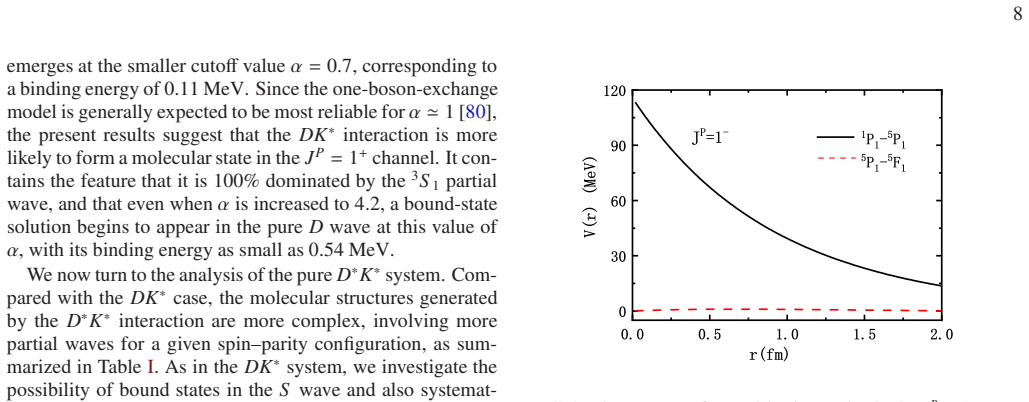
0 −7. 16 0 . 21/ 0/ 99. 76/ 0. 02 1.6 -29.87 the value of unity in all three cases. In the present analysis , these channels are dominated solely by the 3D2, 3D3, and 3F3 partial waves, respectively. This feature naturally sugge sts similar bound-state properties for the JP = 2+ and JP = 3+ channels. Our numerical results indeed support this expect a- tio...
-
[18]
As αincreases to 0
21 MeV. As αincreases to 0. 8 and 1. 1, the binding energy rises to 4. 30 MeV and 14. 99 MeV, respectively. We also find that the S -wave component is strongly dominant, contributing about 99. 96% at α= 0. 5, and increasing to nearly 100% as α grows to 1. 1. Another D∗K∗molecular state with a dominant S -wave component is found in the JP = 1+ and JP = 2+ c...
-
[19]
Navas et al
S. Navas et al. [Particle Data Group], Phys. Rev. D 110, 030001 (2024)
2024
-
[20]
Oset and A
E. Oset and A. Ramos, Nucl. Phys. A 635 (1998), 99-120
1998
-
[21]
S. K. Choi et al. [Belle], Phys. Rev. Lett. 91, 262001 (2003)
2003
-
[22]
L. Meng, B. Wang, G. J. Wang and S. L. Zhu, Phys. Rept. 1019, 1-149 (2023)
2023
-
[23]
Brambilla, S
N. Brambilla, S. Eidelman, C. Hanhart, A. Nefediev, C. P . Shen, C. E. Thomas, A. V airo and C. Z. Y uan, Phys. Rept.873, 1-154 (2020)
2020
-
[24]
H. X. Chen, W. Chen, X. Liu, Y . R. Liu and S. L. Zhu, Rept. Prog. Phys. 86, 026201 (2023)
2023
-
[25]
H. X. Chen, W. Chen and S. L. Zhu, Phys. Rev. D 100, 051501 (2019)
2019
-
[26]
F. K. Guo, H. J. Jing, U. G. Meißner and S. Sakai, Phys. Rev. D 99,091501 (2019)
2019
-
[27]
C. W. Xiao, J. Nieves and E. Oset, Phys. Rev. D 100,014021 (2019)
2019
-
[28]
J. He, Eur. Phys. J. C 79,393 (2019)
2019
-
[29]
C. J. Xiao, Y . Huang, Y . B. Dong, L. S. Geng and D. Y . Chen, Phys. Rev. D 100,014022 (2019)
2019
-
[30]
L. Roca, J. Nieves and E. Oset, Phys. Rev. D 92, 094003 (2015)
2015
-
[31]
H. X. Chen, W. Chen, X. Liu, T. G. Steele and S. L. Zhu, Phys . Rev. Lett. 115,172001 (2015)
2015
-
[32]
R. Chen, X. Liu, X. Q. Li and S. L. Zhu, Phys. Rev. Lett. 115,132002 (2015)
2015
-
[33]
Yang and J
G. Yang and J. Ping, Phys. Rev. D 95, 014010 (2017)
2017
-
[34]
Huang, C
H. Huang, C. Deng, J. Ping and F. Wang, Eur. Phys. J. C 76, 624 (2016)
2016
-
[35]
M. L. Du, V . Baru, F. K. Guo, C. Hanhart, U. G. Meißner, J. A. Oller and Q. Wang, Phys. Rev. Lett. 124 (2020), 072001
2020
-
[36]
Aaij et al
R. Aaij et al. [LHCb], Phys. Rev. Lett. 115, 072001 (2015)
2015
-
[37]
Aaij et al
R. Aaij et al. [LHCb], Phys. Rev. Lett. 117, 082002 (2016)
2016
-
[38]
Aaij et al
R. Aaij et al. [LHCb], Phys. Rev. Lett. 117,082003 (2016)
2016
-
[39]
Aaij et al
R. Aaij et al. [LHCb], Phys. Rev. Lett. 122, 222001 (2019)
2019
-
[40]
Aaij et al
R. Aaij et al. [LHCb], Phys. Rev. D 110 (2024), 032001
2024
-
[41]
Aubert et al
B. Aubert et al. [BaBar], Phys. Rev. Lett. 90 (2003), 242001
2003
-
[42]
Mikami et al
Y . Mikami et al. [Belle], Phys. Rev. Lett. 92 (2004), 012002
2004
-
[43]
Besson et al
D. Besson et al. [CLEO], Phys. Rev. D 68 (2003), 032002 [er- ratum: Phys. Rev. D 75 (2007), 119908]
2003
-
[44]
Godfrey and N
S. Godfrey and N. Isgur, Phys. Rev. D 32 (1985), 189-231
1985
-
[45]
E. E. Kolomeitsev and M. F. M. Lutz, Phys. Lett. B 582 (2004), 39-48
2004
-
[46]
Barnes, F
T. Barnes, F. E. Close and H. J. Lipkin, Phys. Rev. D 68 (2003), 054006
2003
-
[47]
Faessler, T
A. Faessler, T. Gutsche, V . E. Lyubovitskij and Y . L. Ma, Phys. Rev. D 76 (2007), 014005
2007
-
[48]
Z. X. Xie, G. Q. Feng and X. H. Guo, Phys. Rev. D 81 (2010), 036014
2010
-
[49]
F. K. Guo, P . N. Shen, H. C. Chiang, R. G. Ping and B. S. Zou, Phys. Lett. B 641 (2006), 278-285
2006
-
[50]
F. K. Guo, P . N. Shen and H. C. Chiang, Phys. Lett. B 647 (2007), 133-139
2007
-
[51]
Gamermann, E
D. Gamermann, E. Oset, D. Strottman and M. J. Vicente V ac as, Phys. Rev. D 76 (2007), 074016
2007
-
[52]
Zhu and Y
H. Zhu and Y . Huang, Phys. Rev. D 100 (2019), 054031
2019
-
[53]
Mohler, C
D. Mohler, C. B. Lang, L. Leskovec, S. Prelovsek and R. M. Woloshyn, Phys. Rev. Lett. 111 (2013), 222001
2013
-
[54]
Altenbuchinger, L
M. Altenbuchinger, L. S. Geng and W. Weise, Phys. Rev. D 89 (2014), 014026
2014
-
[55]
Isgur and M
N. Isgur and M. B. Wise, Phys. Rev. Lett. 66 (1991), 1130- 1133
1991
-
[56]
Y . R. Liu, H. X. Chen, W. Chen, X. Liu and S. L. Zhu, Prog. Part. Nucl. Phys. 107, 237-320 (2019)
2019
-
[57]
Z. Y . Wang, J. J. Qi, Q. X. Y u and X. H. Guo, Phys. Rev. D 100 (2019), 096009
2019
-
[58]
H. Y . Cheng and F. S. Y u, Phys. Rev. D 89 (2014), 114017. 10
2014
-
[59]
Colangelo, F
P . Colangelo, F. De Fazio, F. Giannuzzi and S. Nicotri, P hys. Rev. D 86 (2012), 054024
2012
-
[60]
Z. Yang, G. J. Wang, J. J. Wu, M. Oka and S. L. Zhu, JHEP 01 (2023), 058
2023
-
[61]
C. B. Lang, D. Mohler, S. Prelovsek and R. M. Woloshyn, Ph ys. Lett. B 750 (2015), 17-21
2015
-
[62]
Aaij et al
R. Aaij et al. [LHCb], Phys. Rev. Lett. 117, 152003 (2016)
2016
-
[63]
A. M. Sirunyan et al. [CMS], Phys. Rev. Lett. 120 (2018), 202005
2018
-
[64]
Aaboud et al
M. Aaboud et al. [A TLAS], Phys. Rev. Lett. 120 (2018), 202007
2018
-
[65]
Aaltonen et al
T. Aaltonen et al. [CDF], Phys. Rev. Lett. 120 (2018), 202006
2018
-
[66]
Neubert, Phys
M. Neubert, Phys. Rept. 245 (1994), 259-396
1994
-
[67]
A. F. Falk and M. E. Luke, Phys. Lett. B 292 (1992), 119-127
1992
-
[68]
M. E. Luke and A. V . Manohar, Phys. Lett. B 286 (1992), 348- 354
1992
-
[69]
M. Endo, S. Iguro and S. Mishima, [arXiv:2604.27970 [he p- ph]]
-
[70]
Becirevic, S
D. Becirevic, S. Fajfer and S. Prelovsek, Phys. Lett. B 599 (2004), 55
2004
-
[71]
H. Y . Cheng and F. S. Y u, Eur. Phys. J. C 77 (2017), 668
2017
-
[72]
Albertus, E
C. Albertus, E. Hernandez, J. Nieves and J. M. V erde-V el asco, Phys. Rev. D 71 (2005), 113006
2005
-
[73]
D. M. Li, P . F. Ji and B. Ma, Eur. Phys. J. C 71 (2011), 1582
2011
-
[74]
F. E. Close, C. E. Thomas, O. Lakhina and E. S. Swanson, Ph ys. Lett. B 647 (2007), 159-163
2007
-
[75]
Godfrey and I
S. Godfrey and I. T. Jardine, Phys. Rev. D 89 (2014), 074023
2014
-
[76]
Z. G. Wang, Chin. Phys. C 32 (2008), 797-802
2008
-
[77]
W. Hao, Y . Lu and B. S. Zou, Phys. Rev. D 106 (2022), 074014
2022
-
[78]
Z. G. Wang, Eur. Phys. J. C 75 (2015), 25
2015
-
[79]
Q. T. Song, D. Y . Chen, X. Liu and T. Matsuki, Eur. Phys. J. C 75 (2015), 30
2015
-
[80]
Aaij et al
R. Aaij et al. [LHCb], Phys. Rev. Lett. 113 (2014), 162001
2014
discussion (0)
Sign in with ORCID, Apple, or X to comment. Anyone can read and Pith papers without signing in.