Decentralized Power Control for Over-the-Air Computation with Phase Noise
Pith reviewed 2026-06-26 19:22 UTC · model grok-4.3
The pith
Truncated channel inversion for over-the-air computation yields mean-square error independent of receiver antenna count under local channel estimates and phase noise.
A machine-rendered reading of the paper's core claim, the machinery that carries it, and where it could break.
Core claim
The proposed TCI scheme for optimizing local power scaling factors in OAC with phase noise achieves an MSE that is independent of the number of receiver antennas. The analysis establishes a direct connection between this MSE and the expected aggregate phase error across devices, providing insight into scalability.
What carries the argument
Truncated channel inversion (TCI), a local precoding method that inverts channel gains up to a truncation threshold and optimizes the threshold and scaling to minimize MSE using only device-local estimates.
If this is right
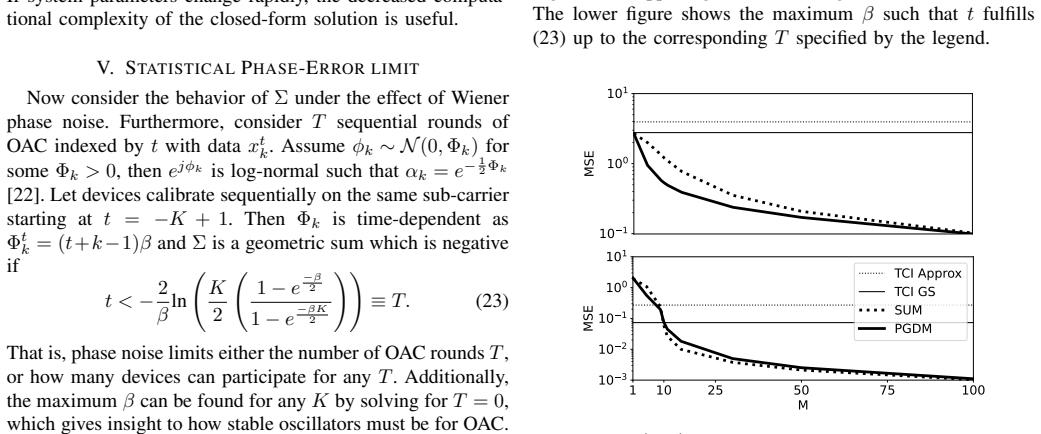
- MSE performance remains unchanged as the number of receiver antennas grows.
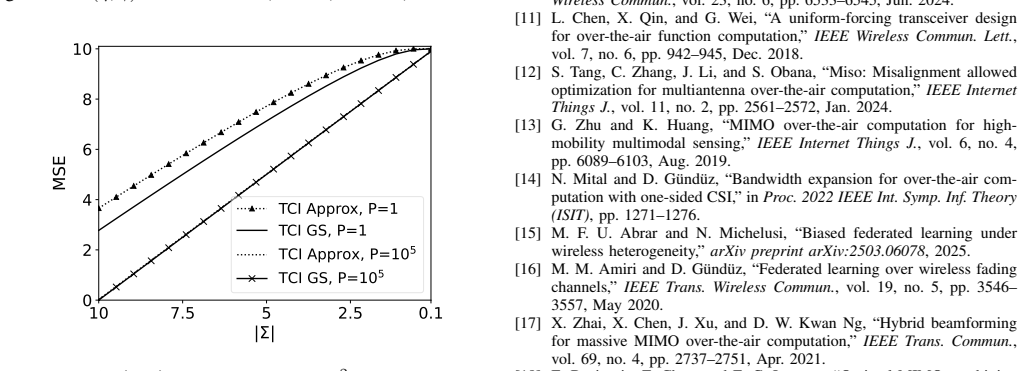
- Error scales directly with expected aggregate phase error summed over devices.
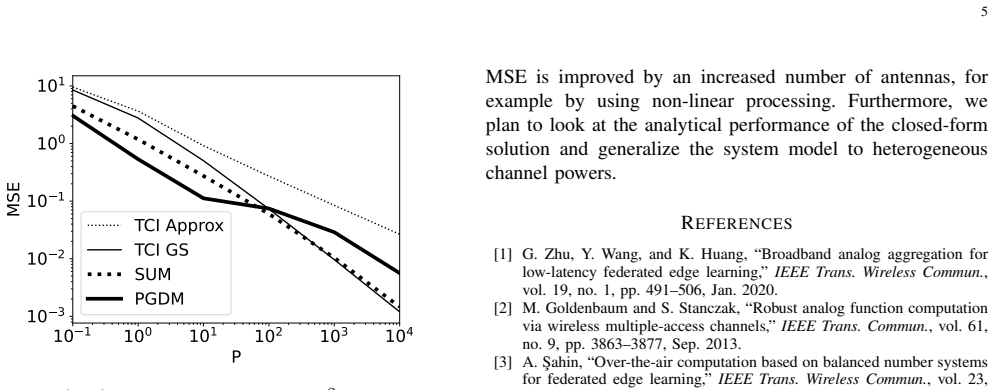
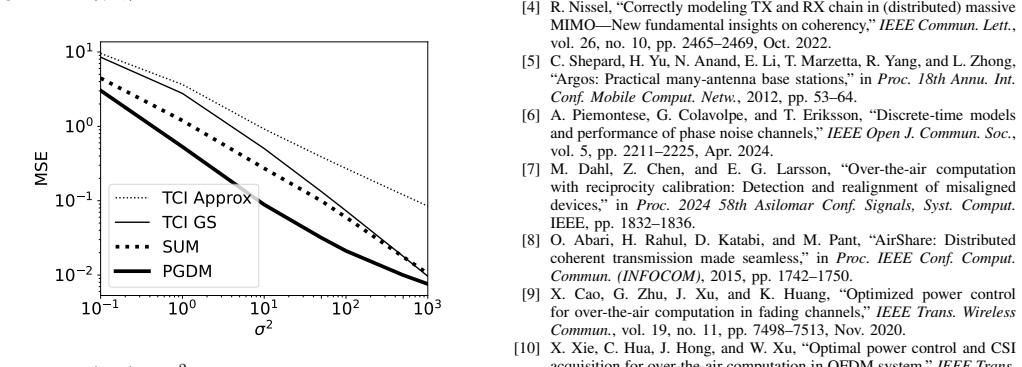
- The scheme performs close to or better than centralized methods that assume perfect global channel knowledge in some tested conditions.
- Power control can be solved approximately in closed form or exactly by numerical search at each device without central coordination.
Where Pith is reading between the lines
- The antenna-count independence may allow system designers to add receive antennas for other benefits such as interference rejection without trading off computation accuracy.
- The phase-error connection suggests that reducing phase noise variance at individual devices could be more effective for scaling than increasing antenna count.
- The local TCI approach could extend to scenarios with multiple computation tasks or time-varying phase statistics if the same isolation property holds.
Load-bearing premise
Channel estimates are available only locally at each device via calibrated reciprocity, and the phase noise model isolates its aggregate effect on MSE from the power-control parameters.
What would settle it
A simulation or measurement in which the MSE of the optimized TCI scheme changes when the number of receiver antennas is varied while holding all other parameters fixed.
Figures

read the original abstract
Estimation of uplink channels is required for coherent over-the-air computation (OAC). When channel estimation is done using calibrated reciprocity, the estimates are only available locally to the devices. This poses a challenge for precoding and decoding, which cannot be coordinated centrally. To this end we use truncated channel inversion (TCI) and propose an approximate closed form solution and an exact numerical solver to optimize the TCI parameters. Importantly, we prove that the proposed TCI scheme is independent of the number of receiver antennas in terms of mean-square-error (MSE). Furthermore, our analysis reveals a clear connection between the MSE and expected aggregate phase error across devices which gives insight to the scalability of OAC. Finally, simulations with comparisons to reference methods from prior work with globally available error-free channel estimates show that proposed is close, even outperforming these references in MSE under some conditions.
Editorial analysis
A structured set of objections, weighed in public.
Referee Report
Summary. The manuscript proposes a decentralized truncated channel inversion (TCI) power control scheme for over-the-air computation (OAC) in the presence of phase noise, where channel estimates are available only locally at each device due to calibrated reciprocity. It develops an approximate closed-form optimization and an exact numerical solver for the TCI truncation threshold, proves that the mean-square error (MSE) of the scheme is independent of the number of receive antennas M, and derives a connection between the MSE and the expected aggregate phase error across devices. Simulations demonstrate that the proposed method performs close to or better than centralized reference methods that assume error-free global channel state information.
Significance. If the claimed MSE independence from M holds under the given phase noise model, the result would be significant for scalable decentralized OAC, indicating that receive antenna count does not degrade performance when using local TCI. The explicit connection to aggregate phase error offers design insight. Credit is due for providing both the closed-form approximation and numerical solver, plus the mathematical proof of independence and the simulation comparisons.
major comments (3)
- [§4] §4 (MSE derivation and independence proof): The central claim that optimized MSE is independent of M requires that the expected aggregate phase error enters the MSE expression in a form fully separable from the local-channel-dependent TCI optimization; the manuscript must explicitly substitute the optimal truncation threshold (closed-form or numerical) and show that no M-dependent cross-terms remain after optimization.
- [§3.2, §4] §3.2 and §4: The phase noise model is stated to allow isolation of its aggregate effect, but the proof of independence is load-bearing only if the effective inverted channel after TCI does not re-couple phase noise with the local estimates; a concrete expansion of the MSE expression post-optimization is needed to confirm absence of residual M dependence.
- [§5] §5 (Simulation setup): The reported outperformance versus centralized references under some conditions should be accompanied by explicit verification that the simulated MSE remains flat across varying M, together with error-bar details and precise baseline definitions for the reference methods.
minor comments (2)
- [Abstract] Abstract: the phrasing 'proposed is close' is grammatically incomplete and should read 'the proposed scheme is close'.
- Notation: the definition of the TCI truncation threshold and its relation to the free parameter should be stated once in a dedicated subsection for clarity.
Simulated Author's Rebuttal
We thank the referee for the thorough review and constructive comments on our manuscript. We address each major comment point by point below, providing clarifications and agreeing to revisions where they strengthen the presentation of our results on the MSE independence from M and the connection to aggregate phase error.
read point-by-point responses
-
Referee: [§4] §4 (MSE derivation and independence proof): The central claim that optimized MSE is independent of M requires that the expected aggregate phase error enters the MSE expression in a form fully separable from the local-channel-dependent TCI optimization; the manuscript must explicitly substitute the optimal truncation threshold (closed-form or numerical) and show that no M-dependent cross-terms remain after optimization.
Authors: We agree that an explicit substitution step would make the independence clearer. In Section 4 the MSE is expressed as a product of the optimized TCI term (dependent on local channel statistics) and the expected aggregate phase error term. The latter is independent of M by the phase noise model, and the optimization of the truncation threshold is performed solely over local statistics. In the revised manuscript we will insert the explicit substitution of both the closed-form approximation and the numerical solver into the MSE expression, confirming that all M-dependent factors cancel after optimization. revision: yes
-
Referee: [§3.2, §4] §3.2 and §4: The phase noise model is stated to allow isolation of its aggregate effect, but the proof of independence is load-bearing only if the effective inverted channel after TCI does not re-couple phase noise with the local estimates; a concrete expansion of the MSE expression post-optimization is needed to confirm absence of residual M dependence.
Authors: The phase noise enters only through the aggregate term across devices and is not present in the local channel estimates used for TCI. Consequently the post-TCI effective channel separates the phase-noise contribution from the local inversion. To address the request we will add a concrete term-by-term expansion of the optimized MSE in the revised Section 4, explicitly showing that no residual M dependence remains after the substitution of the optimal threshold. revision: yes
-
Referee: [§5] §5 (Simulation setup): The reported outperformance versus centralized references under some conditions should be accompanied by explicit verification that the simulated MSE remains flat across varying M, together with error-bar details and precise baseline definitions for the reference methods.
Authors: We agree that these details will improve reproducibility and clarity. In the revised Section 5 we will add (i) explicit simulation results or a dedicated plot confirming that MSE remains constant across a range of M values, (ii) error bars on all reported curves, and (iii) precise parameter settings and implementation details for the centralized reference methods that assume error-free global CSI. revision: yes
Circularity Check
No circularity: MSE independence derived from separable phase-noise model and local TCI optimization
full rationale
The paper's central claim is a mathematical proof that optimized TCI yields MSE independent of receiver antenna count M, obtained by isolating the expected aggregate phase error term from the decentralized power-control coefficients. This separation follows directly from the stated channel estimation model (calibrated reciprocity, local estimates only) and the phase-noise model that permits the aggregate effect to enter the MSE expression without re-coupling to the TCI parameters. No fitted input is renamed as a prediction, no self-citation is invoked to justify uniqueness or an ansatz, and the derivation does not reduce to its own inputs by construction. The result is therefore self-contained against the paper's own equations and assumptions.
Axiom & Free-Parameter Ledger
free parameters (1)
- TCI truncation threshold
axioms (2)
- domain assumption Calibrated reciprocity provides only local channel estimates at each device
- domain assumption Phase noise permits isolation of aggregate error from power-control MSE
Reference graph
Works this paper leans on
-
[1]
Broadband analog aggregation for low-latency federated edge learning,
G. Zhu, Y . Wang, and K. Huang, “Broadband analog aggregation for low-latency federated edge learning,”IEEE Trans. Wireless Commun., vol. 19, no. 1, pp. 491–506, Jan. 2020
2020
-
[2]
Robust analog function computation via wireless multiple-access channels,
M. Goldenbaum and S. Stanczak, “Robust analog function computation via wireless multiple-access channels,”IEEE Trans. Commun., vol. 61, no. 9, pp. 3863–3877, Sep. 2013
2013
-
[3]
Over-the-air computation based on balanced number systems for federated edge learning,
A. S ¸ahin, “Over-the-air computation based on balanced number systems for federated edge learning,”IEEE Trans. Wireless Commun., vol. 23, no. 5, pp. 4564–4579, May 2024
2024
-
[4]
Correctly modeling TX and RX chain in (distributed) massive MIMO—New fundamental insights on coherency,
R. Nissel, “Correctly modeling TX and RX chain in (distributed) massive MIMO—New fundamental insights on coherency,”IEEE Commun. Lett., vol. 26, no. 10, pp. 2465–2469, Oct. 2022
2022
-
[5]
Argos: Practical many-antenna base stations,
C. Shepard, H. Yu, N. Anand, E. Li, T. Marzetta, R. Yang, and L. Zhong, “Argos: Practical many-antenna base stations,” inProc. 18th Annu. Int. Conf. Mobile Comput. Netw., 2012, pp. 53–64
2012
-
[6]
Discrete-time models and performance of phase noise channels,
A. Piemontese, G. Colavolpe, and T. Eriksson, “Discrete-time models and performance of phase noise channels,”IEEE Open J. Commun. Soc., vol. 5, pp. 2211–2225, Apr. 2024
2024
-
[7]
Over-the-air computation with reciprocity calibration: Detection and realignment of misaligned devices,
M. Dahl, Z. Chen, and E. G. Larsson, “Over-the-air computation with reciprocity calibration: Detection and realignment of misaligned devices,” inProc. 2024 58th Asilomar Conf. Signals, Syst. Comput. IEEE, pp. 1832–1836
2024
-
[8]
AirShare: Distributed coherent transmission made seamless,
O. Abari, H. Rahul, D. Katabi, and M. Pant, “AirShare: Distributed coherent transmission made seamless,” inProc. IEEE Conf. Comput. Commun. (INFOCOM), 2015, pp. 1742–1750
2015
-
[9]
Optimized power control for over-the-air computation in fading channels,
X. Cao, G. Zhu, J. Xu, and K. Huang, “Optimized power control for over-the-air computation in fading channels,”IEEE Trans. Wireless Commun., vol. 19, no. 11, pp. 7498–7513, Nov. 2020
2020
-
[10]
Optimal power control and CSI acquisition for over-the-air computation in OFDM system,
X. Xie, C. Hua, J. Hong, and W. Xu, “Optimal power control and CSI acquisition for over-the-air computation in OFDM system,”IEEE Trans. Wireless Commun., vol. 23, no. 6, pp. 6533–6545, Jun. 2024
2024
-
[11]
A uniform-forcing transceiver design for over-the-air function computation,
L. Chen, X. Qin, and G. Wei, “A uniform-forcing transceiver design for over-the-air function computation,”IEEE Wireless Commun. Lett., vol. 7, no. 6, pp. 942–945, Dec. 2018
2018
-
[12]
Miso: Misalignment allowed optimization for multiantenna over-the-air computation,
S. Tang, C. Zhang, J. Li, and S. Obana, “Miso: Misalignment allowed optimization for multiantenna over-the-air computation,”IEEE Internet Things J., vol. 11, no. 2, pp. 2561–2572, Jan. 2024
2024
-
[13]
MIMO over-the-air computation for high- mobility multimodal sensing,
G. Zhu and K. Huang, “MIMO over-the-air computation for high- mobility multimodal sensing,”IEEE Internet Things J., vol. 6, no. 4, pp. 6089–6103, Aug. 2019
2019
-
[14]
Bandwidth expansion for over-the-air com- putation with one-sided CSI,
N. Mital and D. G ¨und¨uz, “Bandwidth expansion for over-the-air com- putation with one-sided CSI,” inProc. 2022 IEEE Int. Symp. Inf. Theory (ISIT), pp. 1271–1276
2022
-
[15]
Biased federated learning under wireless heterogeneity,
M. F. U. Abrar and N. Michelusi, “Biased federated learning under wireless heterogeneity,”arXiv preprint arXiv:2503.06078, 2025
Pith/arXiv arXiv 2025
-
[16]
Federated learning over wireless fading channels,
M. M. Amiri and D. G ¨und¨uz, “Federated learning over wireless fading channels,”IEEE Trans. Wireless Commun., vol. 19, no. 5, pp. 3546– 3557, May 2020
2020
-
[17]
Hybrid beamforming for massive MIMO over-the-air computation,
X. Zhai, X. Chen, J. Xu, and D. W. Kwan Ng, “Hybrid beamforming for massive MIMO over-the-air computation,”IEEE Trans. Commun., vol. 69, no. 4, pp. 2737–2751, Apr. 2021
2021
-
[18]
Optimal MIMO combining for blind federated edge learning with gradient sparsification,
E. Becirovic, Z. Chen, and E. G. Larsson, “Optimal MIMO combining for blind federated edge learning with gradient sparsification,” inProc. 2022 IEEE 23rd Int. Workshop Signal Process. Advances Wireless Commun. (SPA WC), pp. 1–5
2022
-
[19]
Transceiver beamforming for over-the-air com- putation in massive MIMO systems,
S. Jing and C. Xiao, “Transceiver beamforming for over-the-air com- putation in massive MIMO systems,”IEEE Trans. Wireless Commun., vol. 22, no. 10, pp. 6978–6992, Oct. 2023
2023
-
[20]
Abramowitz and I
M. Abramowitz and I. A. Stegun,Handbook of mathematical functions: with formulas, graphs, and mathematical tables. Courier Corporation, 1965, vol. 55
1965
-
[21]
On the Lambert W function,
R. M. Corless, G. H. Gonnet, D. E. Hare, D. J. Jeffrey, and D. E. Knuth, “On the Lambert W function,”Adv. Comput. Math., vol. 5, no. 1, pp. 329–359, Dec. 1996
1996
-
[22]
N. L. Johnson, S. Kotz, and N. Balakrishnan,Continuous univariate distributions. John wiley & sons, 1995, vol. 2
1995
discussion (0)
Sign in with ORCID, Apple, or X to comment. Anyone can read and Pith papers without signing in.