Charting Dark Matter down to the neutrino floor/fog in the 2HD+a scenario
Pith reviewed 2026-06-26 08:12 UTC · model grok-4.3
The pith
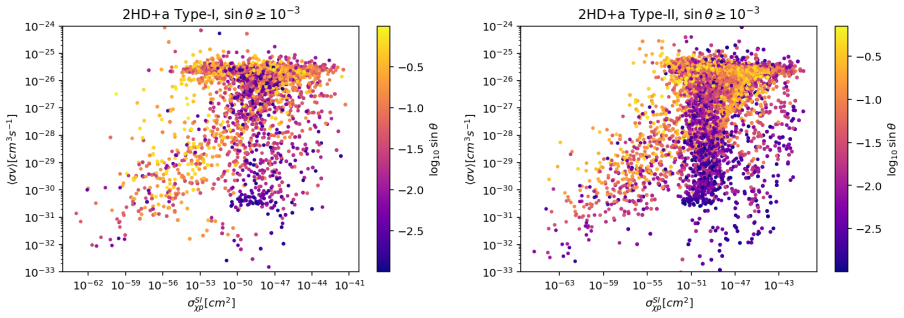
In the 2HD+a model with vanishing A-a mixing, annihilation to ha and Ha states sets the observed relic density while loop-induced direct detection rates fall inside the neutrino fog.
A machine-rendered reading of the paper's core claim, the machinery that carries it, and where it could break.
Core claim
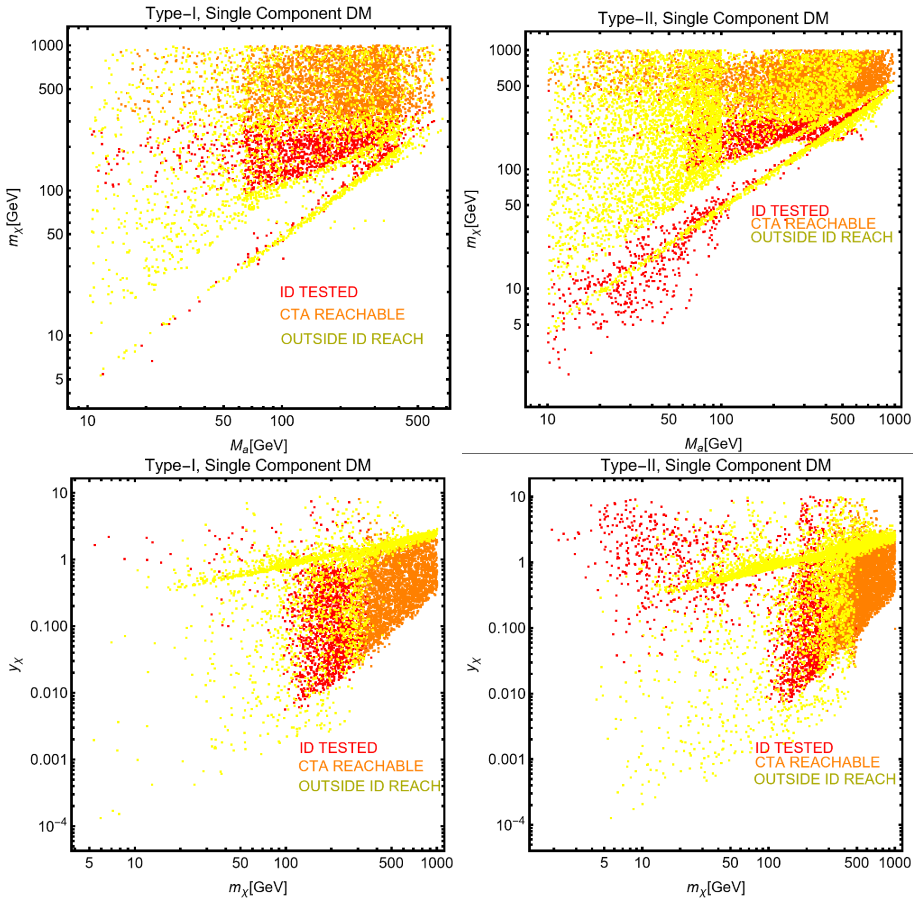
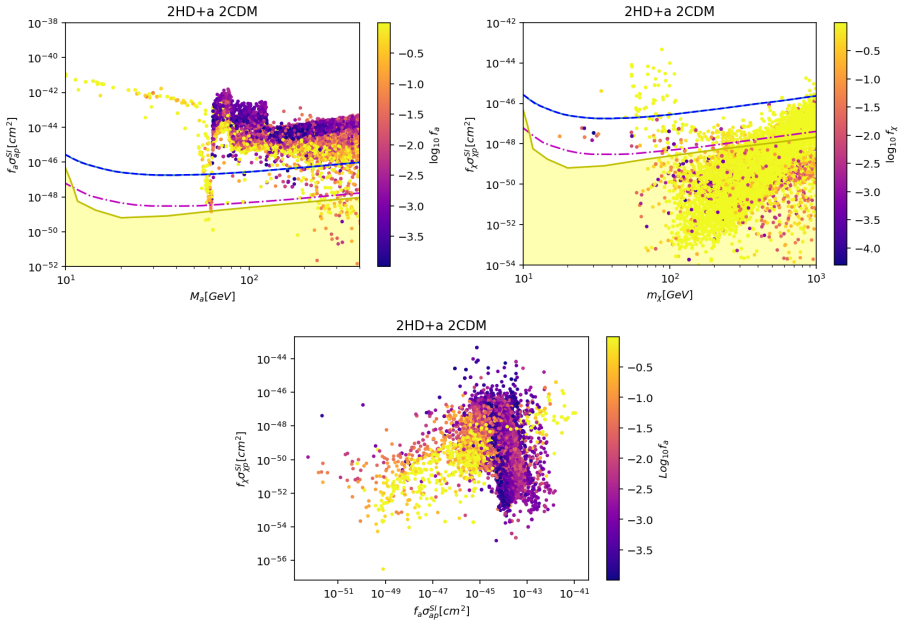
With sinθ driven to zero, the 2HD+a model permits dark matter to annihilate into ha and Ha states to achieve the observed relic density, while loop-induced direct detection cross sections naturally reside inside the neutrino fog; the single-component setup lies below the floor for masses above 100 GeV, whereas the two-component setup with a stable a is strongly disfavored by present limits, although specific parameter relations that suppress the 125 GeV boson coupling to two a states can enlarge the viable space.
What carries the argument
The limit of strongly suppressed singlet-doublet A-a mixing (sinθ → 0) that simultaneously enables ha/Ha annihilation for the relic density and suppresses tree-level direct detection while rendering the light a long-lived or stable.
If this is right
- Single-component dark matter naturally lies below the neutrino floor for masses above 100 GeV while satisfying relic density.
- Two-component dark matter with stable a is largely excluded by existing LZ and FERMI-LAT bounds.
- The light pseudoscalar a becomes long-lived and produces displaced vertices at colliders.
- Specific relations among parameters that suppress the 125 GeV boson coupling to two a states enlarge the viable space for both scenarios.
- Future XLZD and CTA data can further test or exclude the remaining parameter regions.
Where Pith is reading between the lines
- The same suppression mechanism could be applied in other two-Higgs-doublet extensions to push dark matter signals below irreducible neutrino backgrounds.
- Collider searches for long-lived pseudoscalars become a complementary probe that does not rely on direct detection.
- If the two-component scenario is realized, multi-component dark matter searches at future experiments would need to account for both stable states simultaneously.
Load-bearing premise
The assumption that the singlet-doublet pseudoscalar mixing angle is driven exactly to zero is required for both the relic-density mechanism and the placement of direct detection rates inside the neutrino fog.
What would settle it
A positive direct detection signal above the neutrino fog for dark matter masses above 100 GeV, or the absence of displaced-vertex signatures for the light pseudoscalar at colliders, would rule out the single-component setup in this limit.
Figures





read the original abstract
Next-generation direct detection experiments will probe dark matter (DM) scattering cross-sections deep into the neutrino fog, the regime where coherent neutrino scattering becomes an irreducible background. We investigate whether thermally produced weakly interacting massive particles (WIMPs) can naturally populate this regime while satisfying relic density and indirect detection constraints. Adopting as a case study the 2HD+a model, we have performed comprehensive parameter scans over the Type-I and Type-II Yukawa configurations. We have included the limit of strongly suppressed singlet--doublet {\it A-a} mixing sin$\theta \! \to \! 0$ and we show that annihilation into {\it ha} and ${\it Ha}$ final states sustains the correct relic density while loop-induced direct detection cross-sections naturally land inside the neutrino fog; in the same limit the light pseudoscalar boson becomes long-lived, featuring displaced-vertex signatures when produced at colliders. Finally, in the case of zero mixing, we have considered a new possibility for DM phenomenology as the $a$ state becomes cosmologically stable and, consequently, an additional DM component. We map all the viable parameter space against current LZ and FERMI-LAT bounds and projected XLZD and CTA sensitivities. We find that the single component setup lies naturally below the neutrino floor for DM masses above 100 GeV while, on the contrary, most of the parameter space of the two component DM scenario is strongly disfavored already considering present limit. The parameter space of both single and two component DM scenario can be nevertheless broadened by considering specific relations among the model parameters to suppress the coupling between the 125 GeV bosons and two $a$ states. Our results represent in any case a motivation to fully exploit future tonne-scale detectors.
Editorial analysis
A structured set of objections, weighed in public.
Referee Report
Summary. The paper studies thermally produced WIMP dark matter in the 2HD+a model, focusing on the limit of strongly suppressed singlet-doublet A-a mixing (sinθ → 0). Comprehensive parameter scans are performed for Type-I and Type-II Yukawa configurations. The authors show that annihilation into ha and Ha final states can yield the observed relic density, while loop-induced spin-independent direct-detection cross sections naturally fall inside the neutrino fog for single-component DM with m_DM > 100 GeV. In the same limit the light pseudoscalar a is long-lived (displaced-vertex signatures at colliders). For zero mixing they also consider a as a second, cosmologically stable DM component; most of that parameter space is excluded by current LZ and FERMI-LAT data, although specific parameter relations can enlarge the viable region. Viable points are mapped against present and projected bounds from LZ, FERMI-LAT, XLZD and CTA.
Significance. If the numerical results hold, the work supplies a concrete, motivated example in which a WIMP naturally populates the neutrino-fog regime while satisfying relic-density and indirect-detection constraints. The explicit treatment of both single- and two-component DM, together with the collider phenomenology of a long-lived a, adds useful phenomenology. The comprehensive scans over Type-I and Type-II configurations constitute a clear strength of the analysis.
major comments (1)
- [discussion of the sinθ → 0 limit and the associated parameter scans] The central claims (correct relic density via ha/Ha annihilation and loop-only σ_SI inside the neutrino fog) are obtained exclusively in the strict sinθ → 0 limit. The manuscript should demonstrate the robustness of these conclusions for small but finite sinθ, because even modest mixing reintroduces tree-level DD scattering and modifies the annihilation matrix elements; a brief scan or scaling argument quantifying the size of the tree-level contribution as a function of sinθ would be required to establish that the quoted results are representative rather than an isolated limiting case.
minor comments (2)
- [model definition] Notation for the two Higgs doublets and the singlet pseudoscalar should be introduced once with a clear table of quantum numbers and mixing angles before the scans are presented.
- [results and discussion] The text refers to “the parameter space of both single and two component DM scenario” being broadened by “specific relations among the model parameters”; an explicit example of such a relation (e.g., a coupling suppression condition) would improve clarity.
Simulated Author's Rebuttal
We thank the referee for the positive summary and constructive feedback on our manuscript. We address the major comment below.
read point-by-point responses
-
Referee: The central claims (correct relic density via ha/Ha annihilation and loop-only σ_SI inside the neutrino fog) are obtained exclusively in the strict sinθ → 0 limit. The manuscript should demonstrate the robustness of these conclusions for small but finite sinθ, because even modest mixing reintroduces tree-level DD scattering and modifies the annihilation matrix elements; a brief scan or scaling argument quantifying the size of the tree-level contribution as a function of sinθ would be required to establish that the quoted results are representative rather than an isolated limiting case.
Authors: We agree that the central results are derived in the sinθ → 0 limit and that finite mixing introduces tree-level direct-detection contributions proportional to sin²θ. The limit is theoretically motivated as the decoupling regime between the singlet and doublet sectors. In the revised manuscript we will add a dedicated paragraph with a scaling argument: the tree-level SI cross section scales as sin²θ (times the usual Higgs mixing factors), while annihilation matrix elements receive O(sinθ) corrections. For sinθ ≲ 0.01 the tree-level term remains subdominant to the loop-induced contribution and lies below the neutrino fog for m_DM > 100 GeV. We will also note that the relic-density condition is only mildly affected in this range. This establishes that the quoted phenomenology is representative for sufficiently small but non-zero mixing. revision: yes
Circularity Check
No significant circularity: results from numerical scans in an explicit model limit
full rationale
The paper's central claims rest on comprehensive parameter scans of the 2HD+a model in the explicitly adopted sinθ → 0 limit. Relic density is obtained via standard annihilation channels into ha/Ha states, while direct-detection rates are computed as loop-induced quantities that fall inside the neutrino fog for m_DM > 100 GeV; these outcomes follow from the model's Lagrangian and numerical exploration rather than from any self-definitional equation, fitted parameter renamed as prediction, or load-bearing self-citation. No derivation step reduces by construction to its own inputs, and the single- versus two-component distinction is a direct consequence of setting the mixing to zero. The analysis is therefore self-contained against external benchmarks.
Axiom & Free-Parameter Ledger
free parameters (2)
- sinθ (A-a mixing angle)
- Yukawa configuration (Type-I or Type-II)
axioms (2)
- domain assumption Thermal production of WIMPs via standard freeze-out
- domain assumption Loop-induced direct-detection cross-section formula remains valid at sinθ → 0
Reference graph
Works this paper leans on
-
[1]
E. W. Kolb and M. S. Turner,The Early Universe, vol. 69 ofFrontiers in Physics. Addison-Wesley, Redwood City, USA, 1990
1990
-
[2]
G. Jungman, M. Kamionkowski, and K. Griest, “Supersymmetric dark matter,” Phys. Rept.267(1996) 195–373,arXiv:hep-ph/9506380
Pith/arXiv arXiv 1996
-
[3]
Particle dark matter: Evidence, candidates and constraints,
G. Bertone, D. Hooper, and J. Silk, “Particle dark matter: Evidence, candidates and constraints,”Phys. Rept.405(2005) 279–390,arXiv:hep-ph/0404175
Pith/arXiv arXiv 2005
-
[4]
The waning of the WIMP? A review of models, searches, and constraints,
G. Arcadi, M. Dutra, P. Ghosh, M. Lindner, Y. Mambrini, M. Pierre, S. Profumo, and F. S. Queiroz, “The waning of the WIMP? A review of models, searches, and constraints,”Eur. Phys. J. C78no. 3, (2018) 203,arXiv:1703.07364 [hep-ph]
Pith/arXiv arXiv 2018
-
[5]
The Waning of the WIMP: Endgame?,
G. Arcadi, D. Cabo-Almeida, M. Dutra, P. Ghosh, M. Lindner, Y. Mambrini, J. P. Neto, M. Pierre, S. Profumo, and F. S. Queiroz, “The Waning of the WIMP: Endgame?,”Eur. Phys. J. C85no. 2, (2025) 152,arXiv:2403.15860 [hep-ph]
arXiv 2025
-
[6]
Dark Matter through the Higgs portal,
G. Arcadi, A. Djouadi, and M. Raidal, “Dark Matter through the Higgs portal,” Phys. Rept.842(2020) 1–180,arXiv:1903.03616 [hep-ph]
arXiv 2020
-
[7]
Detectability of Certain Massive Neutrinos,
M. W. Goodman and E. Witten, “Detectability of Certain Massive Neutrinos,” Phys. Rev. D31(1985) 3059
1985
-
[8]
Detecting Cold Dark Matter Candidates,
A. K. Drukier, K. Freese, and D. N. Spergel, “Detecting Cold Dark Matter Candidates,”Phys. Rev. D33(1986) 3495–3508. [10]PandaX-4TCollaboration, Y. Menget al., “Dark Matter Search Results from the PandaX-4T Commissioning Run,”Phys. Rev. Lett.127no. 26, (2021) 261802, arXiv:2107.13438 [hep-ex]. [11]XENONCollaboration, E. Aprileet al., “First Dark Matter Se...
arXiv 1986
-
[9]
J. Billard, L. Strigari, and E. Figueroa-Feliciano, “Implication of neutrino backgrounds on the reach of next generation dark matter direct detection experiments,”Phys. Rev. D89no. 2, (2014) 023524,arXiv:1307.5458 [hep-ph]
Pith/arXiv arXiv 2014
-
[10]
New Definition of the Neutrino Floor for Direct Dark Matter Searches,
C. A. J. O’Hare, “New Definition of the Neutrino Floor for Direct Dark Matter Searches,”Phys. Rev. Lett.127no. 25, (2021) 251802,arXiv:2112.09122 [hep-ph]. [16]LUX-ZEPLINCollaboration, D. S. Akeribet al., “Snowmass2021 Cosmic Frontier Dark Matter Direct Detection to the Neutrino Fog,”arXiv:2203.07354 [hep-ex]
arXiv 2021
-
[11]
A review of indirect searches for particle dark matter,
J. M. Gaskins, “A review of indirect searches for particle dark matter,”Contemp. Phys.57no. 4, (2016) 496–525,arXiv:1604.00014 [astro-ph.HE]
Pith/arXiv arXiv 2016
-
[12]
A taste of dark matter: Flavour constraints on pseudoscalar mediators,
M. J. Dolan, F. Kahlhoefer, C. McCabe, and K. Schmidt-Hoberg, “A taste of dark matter: Flavour constraints on pseudoscalar mediators,”JHEP03(2015) 171, arXiv:1412.5174 [hep-ph]. [Erratum: JHEP 07, 103 (2015)]
Pith/arXiv arXiv 2015
-
[13]
Pseudoscalar Mediators: A WIMP model at the Neutrino Floor,
G. Arcadi, M. Lindner, F. S. Queiroz, W. Rodejohann, and S. Vogl, “Pseudoscalar Mediators: A WIMP model at the Neutrino Floor,”JCAP03(2018) 042, arXiv:1711.02110 [hep-ph]
Pith/arXiv arXiv 2018
-
[14]
Simplified dark matter models with two Higgs doublets: I. Pseudoscalar mediators,
M. Bauer, U. Haisch, and F. Kahlhoefer, “Simplified dark matter models with two Higgs doublets: I. Pseudoscalar mediators,”JHEP05(2017) 138, arXiv:1701.07427 [hep-ph]
Pith/arXiv arXiv 2017
-
[15]
A Renormalizable Model for the Galactic Center Gamma Ray Excess from Dark Matter Annihilation,
S. Ipek, D. McKeen, and A. E. Nelson, “A Renormalizable Model for the Galactic Center Gamma Ray Excess from Dark Matter Annihilation,”Phys. Rev. D90no. 5, (2014) 055021,arXiv:1404.3716 [hep-ph]
Pith/arXiv arXiv 2014
-
[16]
G. Arcadi and A. Djouadi, “2HD plus light pseudoscalar model for a combined explanation of the possible excesses in the CDF MW measurement and (g-2)µwith dark matter,”Phys. Rev. D106no. 9, (2022) 095008,arXiv:2204.08406 [hep-ph]
arXiv 2022
-
[17]
Two-Higgs-doublet-plus-pseudoscalar model: Collider, dark matter, and gravitational wave signals,
G. Arcadi, N. Benincasa, A. Djouadi, and K. Kannike, “Two-Higgs-doublet-plus-pseudoscalar model: Collider, dark matter, and gravitational wave signals,”Phys. Rev. D108no. 5, (2023) 055010, arXiv:2212.14788 [hep-ph]. [24]ATLASCollaboration, G. Aadet al., “Search for dark matter produced in association with a Standard Model Higgs boson decaying intob-quarks...
arXiv 2023
-
[18]
Long-lived particle phenomenology in the 2HDM+a model,
U. Haisch and L. Schnell, “Long-lived particle phenomenology in the 2HDM+a model,”JHEP04(2023) 134,arXiv:2302.02735 [hep-ph]
arXiv 2023
-
[19]
Novel collider signatures in the type-I 2HDM+a model,
S. Argyropoulos, U. Haisch, and I. Kalaitzidou, “Novel collider signatures in the type-I 2HDM+a model,”JHEP07(2024) 263,arXiv:2404.05704 [hep-ph]
arXiv 2024
-
[20]
Loop corrections to dark matter direct detection in a pseudoscalar mediator dark matter model,
T. Abe, M. Fujiwara, and J. Hisano, “Loop corrections to dark matter direct detection in a pseudoscalar mediator dark matter model,”JHEP02(2019) 028, arXiv:1810.01039 [hep-ph]
Pith/arXiv arXiv 2019
-
[21]
Loop-induced direct detection signatures from CP-violating scalar mediators,
F. Ertas and F. Kahlhoefer, “Loop-induced direct detection signatures from CP-violating scalar mediators,”JHEP06(2019) 052,arXiv:1902.11070 [hep-ph]
arXiv 2019
-
[22]
WIMPs below the radar: blind spots and benchmarks beyond the neutrino floor,
G. Arcadi and S. Profumo, “WIMPs below the radar: blind spots and benchmarks beyond the neutrino floor,”JHEP10(2025) 123,arXiv:2506.19062 [hep-ph]
arXiv 2025
-
[23]
Comparing 2HDM + Scalar and Pseudoscalar Simplified Models at LHC,
G. Arcadi, G. Busoni, T. Hugle, and V. T. Tenorth, “Comparing 2HDM + Scalar and Pseudoscalar Simplified Models at LHC,”JHEP06(2020) 098, arXiv:2001.10540 [hep-ph]
arXiv 2020
-
[24]
T. Robens, “The THDMa Revisited,”Symmetry13no. 12, (2021) 2341, arXiv:2106.02962 [hep-ph]
arXiv 2021
-
[25]
Benchmarking LHC searches for light 2HDM+a pseudoscalars,
S. Argyropoulos and U. Haisch, “Benchmarking LHC searches for light 2HDM+a pseudoscalars,”SciPost Phys.13no. 1, (2022) 007,arXiv:2202.12631 [hep-ph]
arXiv 2022
-
[26]
Theory and phenomenology of two-Higgs-doublet models,
G. C. Branco, P. M. Ferreira, L. Lavoura, M. N. Rebelo, M. Sher, and J. P. Silva, “Theory and phenomenology of two-Higgs-doublet models,”Phys. Rept.516(2012) 1–102,arXiv:1106.0034 [hep-ph]
Pith/arXiv arXiv 2012
-
[27]
Towards B→X sγat the NNLO in QCD without interpolation in m c,
M. Misiak, A. Rehman, and M. Steinhauser, “Towards B→X sγat the NNLO in QCD without interpolation in m c,”JHEP06(2020) 175,arXiv:2002.01548 [hep-ph]. [36]ATLASCollaboration, “A detailed map of Higgs boson interactions by the ATLAS experiment ten years after the discovery,”Nature607no. 7917, (2022) 52–59, arXiv:2207.00092 [hep-ex]. [Erratum: Nature 612, E2...
arXiv 2020
-
[28]
A. McDaniel, M. Ajello, C. M. Karwin, M. Di Mauro, A. Drlica-Wagner, and M. A. S´ anchez-Conde, “Legacy analysis of dark matter annihilation from the Milky Way dwarf spheroidal galaxies with 14 years of Fermi-LAT data,”Phys. Rev. D109 no. 6, (2024) 063024,arXiv:2311.04982 [astro-ph.HE]. [47]CTACollaboration, A. Acharyyaet al., “Sensitivity of the Cherenko...
arXiv 2024
-
[29]
MicrOMEGAs 2.0: A Program to calculate the relic density of dark matter in a generic model,
G. Belanger, F. Boudjema, A. Pukhov, and A. Semenov, “MicrOMEGAs 2.0: A Program to calculate the relic density of dark matter in a generic model,”Comput. Phys. Commun.176(2007) 367–382,arXiv:hep-ph/0607059
Pith/arXiv arXiv 2007
-
[30]
micrOMEGAs 6.0: N-component dark matter,
G. Alguero, G. Belanger, F. Boudjema, S. Chakraborti, A. Goudelis, S. Kraml, A. Mjallal, and A. Pukhov, “micrOMEGAs 6.0: N-component dark matter,” Comput. Phys. Commun.299(2024) 109133,arXiv:2312.14894 [hep-ph]. 25
arXiv 2024
-
[31]
A. Belyaev, G. Cacciapaglia, D. Locke, and A. Pukhov, “Minimal consistent Dark Matter models for systematic experimental characterisation: fermion Dark Matter,” JHEP10(2022) 014,arXiv:2203.03660 [hep-ph]
arXiv 2022
-
[32]
How warm are non-thermal relics? Lyman-αbounds on out-of-equilibrium dark matter,
G. Ballesteros, M. A. G. Garcia, and M. Pierre, “How warm are non-thermal relics? Lyman-αbounds on out-of-equilibrium dark matter,”JCAP03(2021) 101, arXiv:2011.13458 [hep-ph]. [53]ATLASCollaboration, M. Aaboudet al., “Search for long-lived particles produced inppcollisions at √s= 13 TeV that decay into displaced hadronic jets in the ATLAS muon spectromete...
arXiv 2021
-
[33]
Multicomponent Dark Matter from Gauge Symmetry,
G. Arcadi, C. Gross, O. Lebedev, Y. Mambrini, S. Pokorski, and T. Toma, “Multicomponent Dark Matter from Gauge Symmetry,”JHEP12(2016) 081, arXiv:1611.00365 [hep-ph]
Pith/arXiv arXiv 2016
-
[34]
Can we discover multi-component WIMP dark matter?,
S. Profumo, K. Sigurdson, and L. Ubaldi, “Can we discover multi-component WIMP dark matter?,”JCAP12(2009) 016,arXiv:0907.4374 [hep-ph]
Pith/arXiv arXiv 2009
-
[35]
Freeze-in at Low Reheating and Direct Detection of Fermion Dark Matter,
A. Amiri, B. Diaz Saez, and K. M¨ ohling, “Freeze-in at Low Reheating and Direct Detection of Fermion Dark Matter,”arXiv:2511.21520 [hep-ph]
-
[36]
R. V. Harlander, S. Liebler, and H. Mantler, “SusHi: A program for the calculation of Higgs production in gluon fusion and bottom-quark annihilation in the Standard Model and the MSSM,”Comput. Phys. Commun.184(2013) 1605–1617, arXiv:1212.3249 [hep-ph]
Pith/arXiv arXiv 2013
-
[37]
SusHi Bento: Beyond NNLO and the heavy-top limit,
R. V. Harlander, S. Liebler, and H. Mantler, “SusHi Bento: Beyond NNLO and the heavy-top limit,”Comput. Phys. Commun.212(2017) 239–257,arXiv:1605.03190 [hep-ph]. 26 [63]CMSCollaboration, A. Tumasyanet al., “Search for a new resonance decaying into two spin-0 bosons in a final state with two photons and two bottom quarks in proton-proton collisions at √s= ...
Pith/arXiv arXiv 2017
discussion (0)
Sign in with ORCID, Apple, or X to comment. Anyone can read and Pith papers without signing in.