REVIEW 3 major objections 3 minor 2 cited by
Balmer Absorption in Iron Low-Ionization Broad Absorption Line Quasars
T0 review · 3 major / 3 minor · reviewed 2026-08-04 · deepseek-v4-flash
Pith's one-line read Balmer absorption in 14 FeLoBAL quasars, eight new detections, is strongest at the lowest outflow speeds and luminosities.
desk verdict A solid, careful detection paper whose population-level correlations rest on a covering model that the authors themselves show is too simple for at least one object. read the letter →
The pith
A machine-rendered reading of the paper's core claim, the machinery that carries it, and where it could break.
The reading
What carries the argument
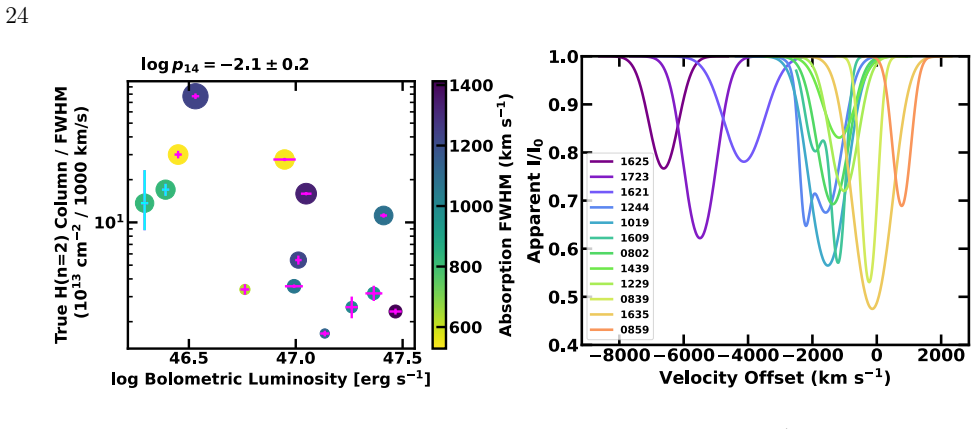
The essential diagnostic is the ratio of Balmer line optical depths. Atomic physics fixes τ(Hβ)/τ(Hα)=0.14 and τ(Hγ)/τ(Hβ)=0.33; observed ratios larger than these signal partial covering of the emission source. The paper uses the F-test to pick the smallest statistically necessary Balmer line, scales its apparent column by a covering fraction from one of three step-function partial-covering scenarios, and forms dN/dv = column density per velocity width as the measure of opacity available for radiative line driving. The companion classifier is the 'loitering outflow FeLoBAL quasar', defined by low outflow speed (|V_off|<2000 km/s) and compact location, which most of the sample inhabits.
What would settle it
Recompute the true H(n=2) column densities for the 14 objects with a power-law partial-covering model instead of a step-function covering fraction; if the dN/dv–luminosity and dN/dv–Eddington anticorrelations do not survive, the result is an artifact of the assumed absorption geometry.
Extended reading notes
Core claim
On the paper's terms, the discovery is that Balmer absorption in FeLoBAL quasars is not a string of individual oddities but a population-level phenomenon concentrated in loitering-outflow FeLoBAL quasars. Fourteen objects show Hα, Hβ, or Hγ absorption; eight of these were not previously known. After accounting for partial covering, which is ubiquitous in BAL quasars and distorts the Balmer optical depth ratios, the authors estimate true H(n=2) column densities from the smallest statistically necessary Balmer line. The resulting differential column density dN/dv is anticorrelated with bolometric luminosity and Eddington ratio, meaning the strongest absorption per unit velocity is found at the
Load-bearing premise
The column density estimates rest on the assumption that step-function partial covering, with the F-test's smallest statistically necessary Balmer line, captures the true absorption geometry; if a more complex geometry (as appears to hold for at least one object) is typical, the quoted column densities and the dN/dv–luminosity anticorrelation could be systematically off.
Editorial extensions
If this is right
- Balmer absorption becomes a practical population diagnostic: most compact-outflow FeLoBAL quasars should show it, and future surveys can target loitering outflows by their FeII morphology.
- The dN/dv anticorrelation implies radiative line driving naturally produces shallow, broad high-velocity troughs and deep, narrow low-velocity troughs, linking absorption depth to the energy cost of acceleration.
- The mass-outflow-rate proxy shows no dependence on luminosity or Eddington ratio while momentum flux and kinetic luminosity do, suggesting acceleration, not mass supply, grows with luminosity.
- Selection effects matter: overlapping-trough quasars may also harbor Balmer absorption that is too broad and shallow to identify, so the sample is biased toward loitering outflows.
- If FeLoBAL quasars and Little Red Dots share a physical phase, LRD Balmer absorption should be accompanied by other FeLoBAL-like properties, such as metastable helium absorption, weak hot dust, and X-ray weakness, in at least some objects.
Reading between the lines
- Beyond the paper: a direct test is to search for metastable helium (He I* λ10830) absorption in Balmer-absorbing Little Red Dots; its presence in FeLoBAL quasars but absence in LRDs would weaken the common-origin story.
- Beyond the paper: the same dN/dv measure could be applied to existing C IV BAL quasar samples; if the anticorrelation with Eddington ratio holds there, it is a general property of BAL winds rather than a FeLoBAL-specific effect.
- Beyond the paper: the ˙Mout–luminosity decoupling predicts that multi-epoch observations of the same absorbing gas should show higher-velocity, roughly constant-column features when luminosity increases, without a dramatic change in mass flux.
- Beyond the paper: because the sample is flux limited, fainter loitering-outflow FeLoBAL quasars at high redshift are underrepresented; deeper spectroscopy of low-luminosity objects should find a higher fraction of Balmer-absorbing outflows than SDSS-selected samples.
Editorial analysis
A structured set of objections, weighed in public.
Referee Report
Summary. This paper presents rest-frame optical/NIR spectra of 14 FeLoBAL quasars exhibiting Balmer absorption, of which 8 are new detections. The authors fit the Balmer lines with Gaussian opacity profiles, measure velocity offsets, widths, and optical depths, and estimate apparent and 'true' H(n=2) column densities under three step-function partial-covering scenarios. They report correlations: a weak anticorrelation between Eddington ratio and outflow speed, several anticorrelations between dN/dv (column per velocity width) and L_Bol/Eddington ratio, and a correlation between absorption FWHM and alpha_oi. They discuss similarities between FeLoBAL quasars and Little Red Dots.
Significance. If the correlations hold, the paper establishes Balmer absorption as a systematic feature of loitering-outflow FeLoBAL quasars and provides a new diagnostic (dN/dv) connecting wind properties to accretion rate. The sample is a significant increase over single-object studies. The authors are transparent about the model dependence of column densities, use robust rank correlations with a one-out sensitivity test, and explicitly plan SimBAL follow-up. The LRD comparison is speculative but clearly framed.
major comments (3)
- [§3.1, Fig. 2, §4.2] The step-function partial-covering model is demonstrably inadequate for SDSS 1635+1439; the power-law covering model fits better and changes the true column density from 96×10^13 cm^-2 to about 8.8×10^13 cm^-2, a factor of ~11. This object is among the lowest-luminosity and highest-dN/dv in the sample, so the claimed anticorrelations in §4.2 and Fig. 5 may depend critically on the covering model. The one-out test removes the object entirely but does not test the effect of correcting its column to the power-law value. The authors should demonstrate that the dN/dv correlations survive recalculation under power-law covering (or with the planned SimBAL models), or temper the abstract's emphasis on these correlations.
- [§3.1, Table 2] The F-test selection of the 'smallest statistically necessary Balmer line' is SNR-dependent. In a flux-limited sample, SNR correlates with luminosity; objects with higher SNR are more likely to have Hβ or Hγ detected and therefore yield larger inferred true columns, while lower-SNR objects may only have Hα and thus lower limits. This could introduce a systematic anticorrelation between dN/dv and luminosity that is not physical. The authors should quantify this bias, e.g., by recomputing the correlations using only Hα apparent columns or by Monte Carlo simulations that vary the F-test outcome with SNR.
- [§4.2 and Fig. 5] The dN/dv anticorrelations are presented as a primary result, but they combine two individually weak correlations: column density with L_Bol/Eddington ratio (p≈0.085–0.18) and FWHM with L_Bol (p<0.05). The stronger correlation of the ratio may partially reflect the mathematical combination of these weak trends. The authors should report partial correlations (e.g., column–L_Bol controlling for FWHM) to establish that dN/dv carries independent information, and otherwise present the result with appropriate caveats.
minor comments (3)
- [§3.1 (text near Fig. 2)] Typo: 'mdoel' should be 'model'.
- [Table 2] The column header 'Statistically Necessary Line Density' is confusing; it should be 'True Column Density (10^13 cm^-2)' with the line used clearly indicated in a separate column or footnote.
- [§3.1 and §6] The text says 'we computed three measures of dN/dv', but the description is ambiguous ('the optical depth or column density divided by the line FWHM'). Please specify that the three measures are τ_max/FWHM, apparent column/FWHM, and true column/FWHM.
Circularity Check
No significant circularity: the detections and correlations are direct measurements, with prior self-citations used only as context.
full rationale
The paper's central claims are the detection of Balmer absorption in 14 FeLoBAL quasars, eight of them new, and the measured correlations involving outflow velocity, dN/dv, luminosity, Eddington ratio, and alpha_oi. The absorption-line measurements (velocity offset, FWHM, optical depth) come from direct spectral fitting (§3), and the H(n=2) column densities are computed from those fits using standard apparent-optical-depth and step-function partial-covering formulae (§3.1). The bolometric luminosity, black hole mass, and Eddington ratio are derived independently from photometry and the Hβ emission-line FWHM following standard relations (§3.2). The dN/dv correlations with L_Bol and Eddington ratio are therefore correlations between independently measured quantities, not quantities fitted to the same data. The reliance on the authors' prior work—e.g., the loitering-outflow class of H. Choi et al. (2022b) and the alpha_oi–Eddington-ratio connection of K. M. Leighly et al. (2024)—is interpretative context and sample classification, not an input to the equations that yield the reported measurements. The paper explicitly acknowledges the modeling uncertainty in partial covering and the ambiguity in interpreting alpha_oi (footnote 12, §3.1, §4), which are caveats about accuracy, not circularity. The eight new detections are direct discoveries from new NIR spectra, independent of any fitted prediction or self-citation chain. No circular step is apparent.
Assumptions & free parameters
free parameters (2)
- Partial covering fraction c_f =
0.45 (SDSS 1125+0029), 0.31 (SDSS 1644+5307), 0.21 (SDSS 1723+5553); others use full covering (FC) or not measured
- Gaussian opacity profile parameters (FWHM, tau_max, velocity offset) =
Reported in Table 2 for each object
assumptions (5)
- standard math Relative Balmer optical depths follow the atomic physics ratios tau_Hb/tau_Ha=0.14 and tau_Hg/tau_Hb=0.33
- ad hoc to paper The three step-function partial covering scenarios (P(C+L), PC, FC+PL) bracket the true absorber geometry
- ad hoc to paper Balmer absorption lines have Gaussian optical depth profiles
- domain assumption The redshift of 12 objects is set by the peak of the H-alpha emission line
- domain assumption Measured column densities can be treated as detections rather than censored lower limits in the correlation analysis
Cite this review
Pith. "Pith review of Balmer Absorption in Iron Low-Ionization Broad Absorption Line Quasars." pith.science (2026). https://pith.science/paper/RC6GWQS3
@misc{pith2026250907611,
  author       = {Pith},
  title        = {Pith review of: Balmer Absorption in Iron Low-Ionization Broad Absorption Line Quasars},
  year         = {2026},
  howpublished = {\url{https://pith.science/paper/RC6GWQS3}},
  note         = {Machine review of arXiv:2509.07611}
}
read the original abstract
While C IV is the most common absorption line in Broad Absorption Line Quasar spectra, Balmer absorption lines are among the rarest. We present analysis of Balmer absorption in a sample of fourteen iron low-ionization BAL quasars (FeLoBALQs); eight are new identifications. We measured velocity offset, width, and apparent optical depth. The partial covering ubiquitous in BAL quasar spectra alters the measured Balmer optical depth ratios; taking that into account, we estimated the true H(n= 2) column density. We found the anticipated correlation between Eddington ratio and outflow speed, but it is weak in this sample because nearly all of the objects have the low outflow speeds characterizing loitering outflow FeLoBAL quasars (H. Choi et al. 2022b), objects that are also found to have low accretion rates (K. M. Leighly et al. 2022; H. Choi et al. 2022a). Measures of dN/dv, the differential column density with respect to the outflow speed, are anticorrelated with the luminosity and Eddington ratio: the strongest absorption is observed at the lowest speeds in the lowest luminosity objects. The absorption line width is correlated with {\alpha}oi, the F{\lambda} point-to-point slope between 5100A and 3 microns. This parameter is strongly correlated with the Eddington ratio among low-redshift quasars (K. M. Leighly et al. 2024). Balmer absorption lines have been recently found in the spectra of Little Red Dots (LRDs), a class of high-redshift objects discovered by JWST. We note suggestive similarities between LRDs and FeLoBAL quasars in the emission line shape, the presence of steep reddening and a scattered blue continuum, the lack of hot dust emission, and X-ray weakness.
Figures


Figures from the paper (3 more)


Forward citations
Cited by 2 Pith papers
-
ATLAS. II. Extremely High Incidence of Balmer Line Absorption with Predominant Blueshifts in LRDs: Statistical Insights through Comparison with Type 1 AGNs
Balmer-line absorption occurs in ~35% (14/40) of JWST little-red-dot AGNs, roughly 850x the rate in SDSS type-1 AGNs, with mostly slow blueshifted absorber velocities.
-
An (in)complete NIRSpec census of Balmer absorption in Type 1 AGN -- radiation-driven outflows in little red dots, quasars and variable stars
About 44% of little red dots have hydrogen-alpha absorption from outflowing gas, implying radiatively driven outflows rather than static atmospheres.
Reference graph
Works this paper leans on
-
[1]
, " * write output.state after.block = add.period write newline
ENTRY address archivePrefix author booktitle chapter doi edition editor eprint howpublished institution journal key month number organization pages publisher school series title misctitle type volume year version url label extra.label sort.label short.list INTEGERS output.state before.all mid.sentence after.sentence after.block FUNCTION init.state.consts ...
-
[2]
write newline
" write newline "" before.all 'output.state := FUNCTION format.url url empty "" new.block "" url * "" * if FUNCTION format.eprint eprint empty "" archivePrefix empty "" archivePrefix "arXiv" = new.block " " eprint * " " * new.block " " eprint * " " * if if if FUNCTION format.doi doi empty "" " " doi * " " * if FUNCTION format.pid doi empty eprint empty ur...
-
[3]
g `ZZ6S( 0kR '<
thebibliography [1] 20pt to REFERENCES 6pt =0pt \@twocolumntrue 12pt -12pt 10pt plus 3pt =0pt =0pt =1pt plus 1pt =0pt =0pt -12pt =13pt plus 1pt =20pt =13pt plus 1pt \@M =10000 =-1.0em =0pt =0pt 0pt =0pt =1.0em @enumiv\@empty 10000 10000 `\.\@m \@noitemerr \@latex@warning Empty `thebibliography' environment \@ifnextchar \@reference \@latexerr Missing key o...
2017
-
[4]
Ahmed , H., Gallagher , S. C., Shemmer , O., et al. 2025, title Exploring the Spectral Energy Distributions of Luminous Broad Absorption Line Quasars at High Redshift , , 985, 207, 10.3847/1538-4357/adca38
-
[5]
Akins , H. B., Casey , C. M., Lambrides , E., et al. 2024, title COSMOS-Web: The over-abundance and physical nature of ``little red dots''--Implications for early galaxy and SMBH assembly , arXiv e-prints, arXiv:2406.10341, 10.48550/arXiv.2406.10341
-
[6]
Aoki , K. 2010, title Broad Balmer-Line Absorption in SDSS J172341.10+555340.5 , , 62, 1333, 10.1093/pasj/62.5.1333
-
[7]
Aoki , K., Iwata , I., Ohta , K., et al. 2006, title Discovery of H Absorption in the Unusual Broad Absorption Line Quasar SDSS J083942.11+380526.3 , , 651, 84, 10.1086/507438
doi:10.1086/507438 2006
-
[8]
Arav , N., Kaastra , J., Kriss , G. A., et al. 2005, title X-Ray/Ultraviolet Campaign on the Mrk 279 AGN Outflow: Constraining Inhomogeneous Absorber Models , , 620, 665, 10.1086/425560
doi:10.1086/425560 2005
Show all 137 references
-
[9]
Baggen , J. F. W., van Dokkum , P., Brammer , G., et al. 2024, title The Small Sizes and High Implied Densities of ``Little Red Dots'' with Balmer Breaks Could Explain Their Broad Emission Lines without an Active Galactic Nucleus , , 977, L13, 10.3847/2041-8213/ad90b8
2024 doi
-
[10]
2015, title On the origins of C IV absorption profile diversity in broad absorption line quasars , , 449, 1593, 10.1093/mnras/stv406
Baskin , A., Laor , A., & Hamann , F. 2015, title On the origins of C IV absorption profile diversity in broad absorption line quasars , , 449, 1593, 10.1093/mnras/stv406
2015 doi
-
[11]
C., Peterson , B
Bentz , M. C., Peterson , B. M., Pogge , R. W., Vestergaard , M., & Onken , C. A. 2006, title The Radius-Luminosity Relationship for Active Galactic Nuclei: The Effect of Host-Galaxy Starlight on Luminosity Measurements , , 644, 133, 10.1086/503537
2006 doi
-
[12]
D., & Payne , D
Blandford , R. D., & Payne , D. G. 1982, title Hydromagnetic flows from accretion disks and the production of radio jets. , , 199, 883, 10.1093/mnras/199.4.883
1982 doi
-
[13]
R., Bershady , M
Blanton , M. R., Bershady , M. A., Abolfathi , B., et al. 2017, title Sloan Digital Sky Survey IV: Mapping the Milky Way, Nearby Galaxies, and the Distant Universe , , 154, 28, 10.3847/1538-3881/aa7567
2017 doi
-
[14]
Boroson , T. A. 2002, title Black Hole Mass and Eddington Ratio as Drivers for the Observable Properties of Radio-loud and Radio-quiet QSOs , , 565, 78, 10.1086/324486
2002 doi
-
[15]
A., & Green , R
Boroson , T. A., & Green , R. F. 1992, title The Emission-Line Properties of Low-Redshift Quasi-stellar Objects , , 80, 109, 10.1086/191661
1992 doi
-
[16]
S., Laurent-Muehleisen , S
Brotherton , M. S., Laurent-Muehleisen , S. A., Becker , R. H., et al. 2005, title Chandra X-Ray Observations of Radio-Loud Broad Absorption Line Quasars , , 130, 2006, 10.1086/496948
2005 doi
-
[17]
S., Tran , H
Brotherton , M. S., Tran , H. D., van Breugel , W., Dey , A., & Antonucci , R. 1997, title Spectropolarimetry of FIRST Broad Absorption Line Quasars , , 487, L113, 10.1086/310898
1997 doi
-
[18]
A., Clayton , G
Cardelli , J. A., Clayton , G. C., & Mathis , J. S. 1988, title The determination of ultraviolet extinction from the optical and near-infrared , , 329, L33
1988
- [19]
-
[20]
Chen , K., Li , Z., Inayoshi , K., & Ho , L. C. 2025, title Dust Budget Crisis in Little Red Dots , arXiv e-prints, arXiv:2505.22600, 10.48550/arXiv.2505.22600
2025 doi
-
[21]
M., Dabbieri , C., et al
Choi , H., Leighly , K. M., Dabbieri , C., et al. 2022 a , title The Physical Properties of Low-redshift FeLoBAL Quasars. III. The Location and Geometry of the Outflows , , 936, 110 (Paper III), 10.3847/1538-4357/ac854c
2022 doi
-
[22]
M., Terndrup , D
Choi , H., Leighly , K. M., Terndrup , D. M., et al. 2022 b , title The Physical Properties of Low-redshift FeLoBAL Quasars. I. Spectral-synthesis Analysis of the Broad Absorption-line (BAL) Outflows Using SimBAL , , 937, 74 (Paper I), 10.3847/1538-4357/ac61d9
2022 doi
-
[23]
M., Terndrup , D
Choi , H., Leighly , K. M., Terndrup , D. M., Gallagher , S. C., & Richards , G. T. 2020, title Discovery of a Remarkably Powerful Broad Absorption-line Quasar Outflow in SDSS J135246.37+423923.5 , , 891, 53, 10.3847/1538-4357/ab6f72
2020 doi
-
[24]
M., & Vestergaard , M
Collin , S., Kawaguchi , T., Peterson , B. M., & Vestergaard , M. 2006, title Systematic effects in measurement of black hole masses by emission-line reverberation of active galactic nuclei: Eddington ratio and inclination , , 456, 75, 10.1051/0004-6361:20064878
2006 doi
-
[25]
C., Vacca , W
Cushing , M. C., Vacca , W. D., & Rayner , J. T. 2004, title Spextool: A Spectral Extraction Package for SpeX, a 0.8-5.5 Micron Cross-Dispersed Spectrograph , , 116, 362, 10.1086/382907
2004 doi
-
[26]
T., & Arav , N
de Kool , M., Korista , K. T., & Arav , N. 2002, title The Effects of Inhomogeneous Absorbers on the Formation of Intrinsic Quasar Absorption Lines , , 580, 54, 10.1086/343107
2002 doi
-
[27]
D'Eugenio , F., Juod z balis , I., Ji , X., et al. 2025, title JADES and BlackTHUNDER: rest-frame Balmer-line absorption and the local environment in a Little Red Dot at z = 5 , arXiv e-prints, arXiv:2506.14870, 10.48550/arXiv.2506.14870
2025 doi
-
[28]
A., Brotherton , M
DiPompeo , M. A., Brotherton , M. S., Becker , R. H., et al. 2010, title Spectropolarimetry of Radio-selected Broad Absorption Line Quasars , , 189, 83, 10.1088/0067-0049/189/1/83
2010 doi
-
[29]
A., Brotherton , M
DiPompeo , M. A., Brotherton , M. S., & De Breuck , C. 2011, title Very Large Telescope Spectropolarimetry of Broad Absorption Line QSOs , , 193, 9, 10.1088/0067-0049/193/1/9
2011 doi
-
[30]
A., Brotherton , M
DiPompeo , M. A., Brotherton , M. S., & De Breuck , C. 2013 a , title The orientation and polarization of broad absorption line quasars , , 428, 1565, 10.1093/mnras/sts137
2013 doi
-
[31]
A., Runnoe , J
DiPompeo , M. A., Runnoe , J. C., Brotherton , M. S., & Myers , A. D. 2013 b , title An Infrared Excess Identified in Radio-loud Broad Absorption Line Quasars , , 762, 111, 10.1088/0004-637X/762/2/111
2013 doi
-
[32]
H., Joyce , R
Elias , J. H., Joyce , R. R., Liang , M., et al. 2006 a , title Design of the Gemini near-infrared spectrograph , in Society of Photo-Optical Instrumentation Engineers (SPIE) Conference Series, Vol. 6269, Ground-based and Airborne Instrumentation for Astronomy, ed. I. S. McLea...
2006 doi
-
[33]
H., Rodgers , B., Joyce , R
Elias , J. H., Rodgers , B., Joyce , R. R., et al. 2006 b , title Performance of the Gemini near-infrared spectrograph , in Society of Photo-Optical Instrumentation Engineers (SPIE) Conference Series, Vol. 6269, Ground-based and Airborne Instrumentation for Astronomy, ed. I. S...
2006 doi
-
[34]
Elitzur , M., & Ho , L. C. 2009, title On the Disappearance of the Broad-Line Region in Low-Luminosity Active Galactic Nuclei , , 701, L91, 10.1088/0004-637X/701/2/L91
2009 doi
-
[35]
2006, title The AGN-obscuring Torus: The End of the ``Doughnut'' Paradigm? , , 648, L101, 10.1086/508158
Elitzur , M., & Shlosman , I. 2006, title The AGN-obscuring Torus: The End of the ``Doughnut'' Paradigm? , , 648, L101, 10.1086/508158
2006 doi
-
[36]
2012, title Direct Evidence for Termination of Obscured Star Formation by Radiatively Driven Outflows in Reddened QSOs , , 745, 178, 10.1088/0004-637X/745/2/178
Farrah , D., Urrutia , T., Lacy , M., et al. 2012, title Direct Evidence for Termination of Obscured Star Formation by Radiatively Driven Outflows in Reddened QSOs , , 745, 178, 10.1088/0004-637X/745/2/178
2012 doi
-
[37]
J., Chatzikos , M., Guzm \'a n , F., et al
Ferland , G. J., Chatzikos , M., Guzm \'a n , F., et al. 2017, title The 2017 Release Cloudy , , 53, 385. 1705.10877
2017 arXiv
-
[38]
Fynbo , J. P. U., Krogager , J. K., Venemans , B., et al. 2013, title Optical/Near-infrared Selection of Red Quasi-stellar Objects: Evidence for Steep Extinction Curves toward Galactic Centers? , , 204, 6, 10.1088/0067-0049/204/1/6
2013 doi
-
[39]
C., Brandt , W
Gallagher , S. C., Brandt , W. N., Chartas , G., & Garmire , G. P. 2002, title X-Ray Spectroscopy of Quasi-Stellar Objects with Broad Ultraviolet Absorption Lines , , 567, 37, 10.1086/338485
2002 doi
-
[40]
C., Brandt , W
Gallagher , S. C., Brandt , W. N., Chartas , G., et al. 2006, title An Exploratory Chandra Survey of a Well-defined Sample of 35 Large Bright Quasar Survey Broad Absorption Line Quasars , , 644, 709, 10.1086/503762
2006 doi
-
[41]
C., Everett , J
Gallagher , S. C., Everett , J. E., Abado , M. M., & Keating , S. K. 2015, title Investigating the structure of the windy torus in quasars , , 451, 2991, 10.1093/mnras/stv1126
2015 doi
-
[42]
C., Hines , D
Gallagher , S. C., Hines , D. C., Blaylock , M., et al. 2007 a , title Radio through X-Ray Spectral Energy Distributions of 38 Broad Absorption Line Quasars , , 665, 157, 10.1086/519438
2007 doi
-
[43]
C., Richards , G
Gallagher , S. C., Richards , G. T., Lacy , M., et al. 2007 b , title An Investigation into the Effects of Luminosity on the Mid-Infrared Spectral Energy Distributions of Radio-quiet Quasars , , 661, 30, 10.1086/513733
2007 doi
-
[44]
S., Cales , S., et al
Ganguly , R., Brotherton , M. S., Cales , S., et al. 2007, title Outflows and the Physical Properties of Quasars , , 665, 990, 10.1086/519759
2007 doi
-
[45]
C., & Churchill , C
Ganguly , R., Eracleous , M., Charlton , J. C., & Churchill , C. W. 1999, title Intrinsic Narrow Absorption Lines in Keck HIRES Spectra of a Sample of Six Quasars , , 117, 2594, 10.1086/300882
1999 doi
-
[46]
R., Brandt , W
Gibson , R. R., Brandt , W. N., Gallagher , S. C., & Schneider , D. P. 2009 a , title X-ray Insights into the Physics of Mini-BAL Quasar Outflows , ApJ, 696, 924, 10.1088/0004-637X/696/1/924
2009 doi
-
[47]
R., Jiang , L., Brandt , W
Gibson , R. R., Jiang , L., Brandt , W. N., et al. 2009 b , title A Catalog of Broad Absorption Line Quasars in Sloan Digital Sky Survey Data Release 5 , , 692, 758, 10.1088/0004-637X/692/1/758
2009 doi
-
[48]
2008, title On the absorption of X-ray bright broad absorption line quasars , A& A, 491, 425, 10.1051/0004-6361:200810363
Giustini , M., Cappi , M., & Vignali , C. 2008, title On the absorption of X-ray bright broad absorption line quasars , A& A, 491, 425, 10.1051/0004-6361:200810363
2008 doi
-
[49]
2019, title A global view of the inner accretion and ejection flow around super massive black holes
Giustini , M., & Proga , D. 2019, title A global view of the inner accretion and ejection flow around super massive black holes. Radiation-driven accretion disk winds in a physical context , , 630, A94, 10.1051/0004-6361/201833810
2019 doi
-
[50]
S., Gallagher , S
Green , K. S., Gallagher , S. C., Leighly , K. M., et al. 2023, title Investigating the Origin of the Absorption-line Variability in the Narrow-line Seyfert 1 Galaxy WPVS 007 , , 953, 186, 10.3847/1538-4357/ace2c4
2023 doi
-
[51]
J., Aldcroft , T
Green , P. J., Aldcroft , T. L., Mathur , S., Wilkes , B. J., & Elvis , M. 2001, title A Chandra Survey of Broad Absorption Line Quasars , , 558, 109, 10.1086/322311
2001 doi
-
[52]
E., Labbe , I., Goulding , A
Greene , J. E., Labbe , I., Goulding , A. D., et al. 2024, title UNCOVER Spectroscopy Confirms the Surprising Ubiquity of Active Galactic Nuclei in Red Sources at z > 5 , ApJ, 964, 39, 10.3847/1538-4357/ad1e5f
2024 doi
-
[53]
2004, title A Complete Sample of Soft X-Ray-selected AGNs
Grupe , D. 2004, title A Complete Sample of Soft X-Ray-selected AGNs. II. Statistical Analysis , , 127, 1799, 10.1086/382516
2004 doi
-
[54]
D., et al
Hagen , S., Done , C., Silverman , J. D., et al. 2024, title Systematic collapse of the accretion disc across the supermassive black hole population , MNRAS, 534, 2803, 10.1093/mnras/stae2272
2024 doi
-
[55]
Hall , P. B. 2007, title A Quasar with Broad Absorption in the Balmer Lines , , 133, 1271, 10.1086/511272
2007 doi
-
[56]
B., Anderson , S
Hall , P. B., Anderson , S. F., Strauss , M. A., et al. 2002, title Unusual Broad Absorption Line Quasars from the Sloan Digital Sky Survey , , 141, 267, 10.1086/340546
2002 doi
-
[57]
1998, title Broad P V Absorption in the QSO PG 1254+047: Column Densities, Ionizations, and Metal Abundances in Broad Absorption Line Winds , , 500, 798, 10.1086/305776
Hamann , F. 1998, title Broad P V Absorption in the QSO PG 1254+047: Column Densities, Ionizations, and Metal Abundances in Broad Absorption Line Winds , , 500, 798, 10.1086/305776
1998 doi
-
[58]
2019, title On the structure and energetics of quasar broad absorption-line outflows , , 483, 1808, 10.1093/mnras/sty2900
Hamann , F., Herbst , H., Paris , I., & Capellupo , D. 2019, title On the structure and energetics of quasar broad absorption-line outflows , , 483, 1808, 10.1093/mnras/sty2900
2019 doi
-
[59]
C., & Foltz , C
Hewett , P. C., & Foltz , C. B. 2003, title The Frequency and Radio Properties of Broad Absorption Line Quasars , , 125, 1784, 10.1086/368392
2003 doi
-
[60]
Hopkins , P. F. 2025, title Multi-Phase Thermal Structure & The Origin of the Broad-Line Region, Torus, and Corona in Magnetically-Dominated Accretion Disks , The Open Journal of Astrophysics, 8, 56, 10.33232/001c.137969
2025 doi
-
[61]
B., Crenshaw , D
Hutchings , J. B., Crenshaw , D. M., Kraemer , S. B., et al. 2002, title Balmer and He I Absorption in the Nuclear Spectrum of NGC 4151 , AJ, 124, 2543, 10.1086/344080
2002 doi
-
[62]
Inayoshi , K., & Maiolino , R. 2025, title Extremely Dense Gas around Little Red Dots and High-redshift Active Galactic Nuclei: A Nonstellar Origin of the Balmer Break and Absorption Features , ApJL, 980, L27, 10.3847/2041-8213/adaebd
2025 doi
-
[63]
P., Richards , G
Jester , S., Schneider , D. P., Richards , G. T., et al. 2005, title The Sloan Digital Sky Survey View of the Palomar-Green Bright Quasar Survey , , 130, 873, 10.1086/432466
2005 doi
-
[64]
2012, title Discovery of Balmer broad absorption lines in the quasar LBQS 1206+1052 , Research in Astronomy and Astrophysics, 12, 369, 10.1088/1674-4527/12/4/002
Ji , T., Wang , T.-G., Zhou , H.-Y., & Wang , H.-Y. 2012, title Discovery of Balmer broad absorption lines in the quasar LBQS 1206+1052 , Research in Astronomy and Astrophysics, 12, 369, 10.1088/1674-4527/12/4/002
2012 doi
-
[65]
2013, title Anomalously Steep Reddening Law in Quasars: An Exceptional Example Observed in IRAS 14026+4341 , , 145, 157, 10.1088/0004-6256/145/6/157
Jiang , P., Zhou , H., Ji , T., et al. 2013, title Anomalously Steep Reddening Law in Quasars: An Exceptional Example Observed in IRAS 14026+4341 , , 145, 157, 10.1088/0004-6256/145/6/157
2013 doi
-
[66]
R., & Cottis , C
Knigge , C., Scaringi , S., Goad , M. R., & Cottis , C. E. 2008, title The intrinsic fraction of broad-absorption line quasars , , 386, 1426, 10.1111/j.1365-2966.2008.13081.x
2008
-
[67]
D., Onoue , M., Inayoshi , K., et al
Kocevski , D. D., Onoue , M., Inayoshi , K., et al. 2023, title Hidden Little Monsters: Spectroscopic Identification of Low-mass, Broad-line AGNs at z > 5 with CEERS , ApJL, 954, L4, 10.3847/2041-8213/ace5a0
2023 doi
-
[68]
D., Finkelstein , S
Kocevski , D. D., Finkelstein , S. L., Barro , G., et al. 2025, title The Rise of Faint, Red Active Galactic Nuclei at z > 4: A Sample of Little Red Dots in the JWST Extragalactic Legacy Fields , ApJ, 986, 126, 10.3847/1538-4357/adbc7d
2025 doi
-
[69]
Konigl , A., & Kartje , J. F. 1994, title Disk-driven Hydromagnetic Winds as a Key Ingredient of Active Galactic Nuclei Unification Schemes , , 434, 446, 10.1086/174746
1994 doi
-
[70]
C ., & Dimitrijevi \'c , M
Kova c evi \'c , J., Popovi \'c , L. C ., & Dimitrijevi \'c , M. S. 2010, title Analysis of Optical Fe II Emission in a Sample of Active Galactic Nucleus Spectra , , 189, 15, 10.1088/0067-0049/189/1/15
2010 doi
-
[71]
M., Richards , G
Krawczyk , C. M., Richards , G. T., Gallagher , S. C., et al. 2015, title Mining for Dust in Type 1 Quasars , , 149, 203, 10.1088/0004-6256/149/6/203
2015 doi
-
[72]
M., Richards , G
Krawczyk , C. M., Richards , G. T., Mehta , S. S., et al. 2013, title Mean Spectral Energy Distributions and Bolometric Corrections for Luminous Quasars , , 206, 4, 10.1088/0067-0049/206/1/4
2013 doi
-
[73]
K., Geier , S., Fynbo , J
Krogager , J. K., Geier , S., Fynbo , J. P. U., et al. 2015, title The High A _ V Quasar Survey: Reddened Quasi-Stellar Objects Selected from Optical/Near-Infrared Photometry II , , 217, 5, 10.1088/0067-0049/217/1/5
2015 doi
-
[74]
Laor , A., & Brandt , W. N. 2002, title The Luminosity Dependence of Ultraviolet Absorption in Active Galactic Nuclei , , 569, 641, 10.1086/339476
2002 doi
-
[75]
J., Almaini , O., et al
Lawrence , A., Warren , S. J., Almaini , O., et al. 2007, title The UKIRT Infrared Deep Sky Survey (UKIDSS) , , 379, 1599, 10.1111/j.1365-2966.2007.12040.x
2007
-
[76]
Leighly , K. M. 2004, title Hubble Space Telescope STIS Ultraviolet Spectral Evidence of Outflow in Extreme Narrow-Line Seyfert 1 Galaxies. II. Modeling and Interpretation , , 611, 125, 10.1086/422089
2004 doi
-
[77]
M., Choi , H., DeFrancesco , C., et al
Leighly , K. M., Choi , H., DeFrancesco , C., et al. 2022, title The Physical Properties of Low-redshift FeLoBAL Quasars. II. The Rest-frame Optical Emission Line Properties , , 935, 92 (Paper II), 10.3847/1538-4357/ac7e50
2022 doi
-
[78]
M., Choi , H., Eracleous , M., et al
Leighly , K. M., Choi , H., Eracleous , M., et al. 2024, title The Physical Properties of Low-redshift FeLoBAL Quasars. IV. Optical Near-IR Spectral Energy Distributions and Near-IR Variability Properties , , 966, 87, 10.3847/1538-4357/ad2f2a
2024 doi
-
[79]
M., Dietrich , M., & Barber , S
Leighly , K. M., Dietrich , M., & Barber , S. 2011, title The Discovery of the First He I 10830 Broad Absorption Line Quasar , , 728, 94
2011
-
[80]
M., Halpern , J
Leighly , K. M., Halpern , J. P., Jenkins , E. B., et al. 2007, title The Intrinsically X-Ray Weak Quasar PHL 1811. I. X-Ray Observations and Spectral Energy Distribution , , 663, 103, 10.1086/518017
2007 doi
-
[81]
M., Hamann , F., Casebeer , D
Leighly , K. M., Hamann , F., Casebeer , D. A., & Grupe , D. 2009, title Emergence of a Broad Absorption Line Outflow in the Narrow-line Seyfert 1 Galaxy WPVS 007 , , 701, 176, 10.1088/0004-637X/701/1/176
2009 doi
-
[82]
M., Kay , L
Leighly , K. M., Kay , L. E., Wills , B. J., Wills , D., & Grupe , D. 1997, title The Optical Polarization and Warm Absorber in IRAS 17020+4544 , , 489, L137, 10.1086/316793
1997 doi
-
[83]
M., Terndrup , D
Leighly , K. M., Terndrup , D. M., Baron , E., et al. 2014, title Evidence for Active Galactic Nucleus Feedback in the Broad Absorption Lines and Reddening of Mrk 231 , , 788, 123, 10.1088/0004-637X/788/2/123
2014 doi
-
[84]
M., Terndrup , D
Leighly , K. M., Terndrup , D. M., Gallagher , S. C., Richards , G. T., & Dietrich , M. 2018, title The z = 0.54 LoBAL Quasar SDSS J085053.12+445122.5. I. Spectral Synthesis Analysis Reveals a Massive Outflow , , 866, 7, 10.3847/1538-4357/aadee6
2018 doi
-
[85]
M., Terndrup , D
Leighly , K. M., Terndrup , D. M., Lucy , A. B., et al. 2019, title The z = 0.54 LoBAL Quasar SDSS J085053.12+445122.5. II. The Nature of Partial Covering in the Broad-absorption-line Outflow , , 879, 27, 10.3847/1538-4357/ab212a
2019 doi
-
[86]
2021, title Feeding the Accretion Disk from the Dusty Torus in a Reddened Quasar , ApJ, 916, 86, 10.3847/1538-4357/ac06c8
Li , G., Shi , X., Tian , Q., et al. 2021, title Feeding the Accretion Disk from the Dusty Torus in a Reddened Quasar , ApJ, 916, 86, 10.3847/1538-4357/ac06c8
2021 doi
-
[87]
Li , Z., Inayoshi , K., Chen , K., Ichikawa , K., & Ho , L. C. 2025, title Little Red Dots: Rapidly Growing Black Holes Reddened by Extended Dusty Flows , ApJ, 980, 36, 10.3847/1538-4357/ada5fb
2025 doi
-
[88]
2015, title A Comprehensive Study of Broad Absorption Line Quasars
Liu , W.-J., Zhou , H., Ji , T., et al. 2015, title A Comprehensive Study of Broad Absorption Line Quasars. I. Prevalence of HeI* Absorption Line Multiplets in Low-ionization Objects , , 217, 11, 10.1088/0067-0049/217/1/11
2015 doi
-
[89]
B., Leighly , K
Lucy , A. B., Leighly , K. M., Terndrup , D. M., Dietrich , M., & Gallagher , S. C. 2014, title Tracing the Outflow of a z = 0.334 FeLoBAL: New Constraints from Low-ionization Absorbers in FBQS J1151+3822 , , 783, 58, 10.1088/0004-637X/783/1/58
2014 doi
-
[90]
R., Wills , B., Greene , J
Ludwig , R. R., Wills , B., Greene , J. E., & Robinson , E. L. 2009, title Strong [O III] Objects Among SDSS Broad-line Active Galaxies , , 706, 995, 10.1088/0004-637X/706/2/995
2009 doi
-
[91]
N., Alexander , D
Luo , B., Brandt , W. N., Alexander , D. M., et al. 2013, title Weak Hard X-Ray Emission from Two Broad Absorption Line Quasars Observed with NuSTAR: Compton-thick Absorption or Intrinsic X-Ray Weakness? , , 772, 153, 10.1088/0004-637X/772/2/153
2013 doi
-
[92]
N., Alexander , D
Luo , B., Brandt , W. N., Alexander , D. M., et al. 2014, title Weak Hard X-Ray Emission from Broad Absorption Line Quasars: Evidence for Intrinsic X-Ray Weakness , , 794, 70, 10.1088/0004-637X/794/1/70
2014 doi
-
[93]
E., Setton , D
Ma , Y., Greene , J. E., Setton , D. J., et al. 2025, title UNCOVER: 404 Error Models Not Found for the Triply Imaged Little Red Dot A2744-QSO1 , ApJ, 981, 191, 10.3847/1538-4357/ada613
2025 doi
-
[94]
2025, title JWST meets Chandra: a large population of Compton thick, feedback-free, and intrinsically X-ray weak AGN, with a sprinkle of SNe , , 538, 1921, 10.1093/mnras/staf359
Maiolino , R., Risaliti , G., Signorini , M., et al. 2025, title JWST meets Chandra: a large population of Compton thick, feedback-free, and intrinsically X-ray weak AGN, with a sprinkle of SNe , , 538, 1921, 10.1093/mnras/staf359
2025 doi
-
[95]
P., Brammer , G., et al
Matthee , J., Naidu , R. P., Brammer , G., et al. 2024, title Little Red Dots: An Abundant Population of Faint Active Galactic Nuclei at z 5 Revealed by the EIGER and FRESCO JWST Surveys , ApJ, 963, 129, 10.3847/1538-4357/ad2345
2024 doi
-
[96]
2016, title Broad-band spectral energy distribution of 3000 A break quasars from the Sloan Digital Sky Survey , , 587, A83, 10.1051/0004-6361/201527277
Meusinger , H., Schalldach , P., Mirhosseini , A., & Pertermann , F. 2016, title Broad-band spectral energy distribution of 3000 A break quasars from the Sloan Digital Sky Survey , , 587, A83, 10.1051/0004-6361/201527277
2016 doi
-
[97]
P., Brandt , W
Miller , B. P., Brandt , W. N., Gibson , R. R., Garmire , G. P., & Shemmer , O. 2009, title A Chandra Survey of the X-ray Properties of Broad Absorption Line Radio-Loud Quasars , ApJ, 702, 911, 10.1088/0004-637X/702/2/911
2009 doi
-
[98]
K., Dai , X., Leighly , K
Morabito , L. K., Dai , X., Leighly , K. M., Sivakoff , G. R., & Shankar , F. 2011, title Suzaku Observations of Three FeLoBAL Quasi-stellar Objects: SDSS J0943+5417, J1352+4239, and J1723+5553 , , 737, 46, 10.1088/0004-637X/737/1/46
2011 doi
-
[99]
2004, title Near-Infrared Spectroscopy of High-Redshift Active Galactic Nuclei
Netzer , H., Shemmer , O., Maiolino , R., et al. 2004, title Near-Infrared Spectroscopy of High-Redshift Active Galactic Nuclei. II. Disappearing Narrow-Line Regions and the Role of Accretion , , 614, 558, 10.1086/423608
2004 doi
-
[100]
M., Cohen , M
Ogle , P. M., Cohen , M. H., Miller , J. S., et al. 1999, title Polarization of Broad Absorption Line QSOS. I. A Spectropolarimetric Atlas , , 125, 1, 10.1086/313272
1999 doi
-
[101]
Osterbrock , D. E. 1981, title Seyfert galaxies with weak broad H alpha emission lines , , 249, 462, 10.1086/159306
1981 doi
-
[102]
L., Lequeux , J., Prevot , L., Maurice , E., & Rocca-Volmerange , B
Prevot , M. L., Lequeux , J., Prevot , L., Maurice , E., & Rocca-Volmerange , B. 1984, title The typical interstellar extinction in the Small Magellanic Cloud , , 132, 389
1984
-
[103]
2020, title PypeIt: The Python Spectroscopic Data Reduction Pipeline , The Journal of Open Source Software, 5, 2308, 10.21105/joss.02308
Prochaska , J., Hennawi , J., Westfall , K., et al. 2020, title PypeIt: The Python Spectroscopic Data Reduction Pipeline , The Journal of Open Source Software, 5, 2308, 10.21105/joss.02308
2020 doi
-
[104]
L., Hewett , P
Rankine , A. L., Hewett , P. C., Banerji , M., & Richards , G. T. 2020, title BAL and non-BAL quasars: continuum, emission, and absorption properties establish a common parent sample , , 492, 4553, 10.1093/mnras/staa130
2020 doi
-
[105]
A., Richards , G
Reichard , T. A., Richards , G. T., Hall , P. B., et al. 2003, title Continuum and Emission-Line Properties of Broad Absorption Line Quasars , , 126, 2594, 10.1086/379293
2003 doi
-
[106]
M., & Hamann , F
Sabra , B. M., & Hamann , F. 2001, title PG 1254+047: An Intrinsically X-Ray Weak, Heavily Absorbed Broad Absorption Line Quasar? , , 563, 555, 10.1086/324043
2001 doi
-
[107]
M., & Hamann , F
Sabra , B. M., & Hamann , F. 2005, title Inhomogeneous Absorbers and Derived Column Densities , ArXiv Astrophysics e-prints
2005
-
[108]
D., & Sembach , K
Savage , B. D., & Sembach , K. R. 1991, title The analysis of apparent optical depth profiles for interstellar absorption lines , , 379, 245, 10.1086/170498
1991 doi
-
[109]
2018, title Discovery of Strong Balmer Line Absorption in Two Luminous LoBAL Quasars at z 1.5 , , 853, 167, 10.3847/1538-4357/aaa7f0
Schulze , A., Misawa , T., Zuo , W., & Wu , X.-B. 2018, title Discovery of Strong Balmer Line Absorption in Two Luminous LoBAL Quasars at z 1.5 , , 853, 167, 10.3847/1538-4357/aaa7f0
2018 doi
-
[110]
Shen , Y., & Ho , L. C. 2014, title The diversity of quasars unified by accretion and orientation , , 513, 210, 10.1038/nature13712
2014 doi
-
[111]
M., et al
Siemiginowska , A., Burke , D., G \"u nther , H. M., et al. 2024, title Sherpa: An Open-source Python Fitting Package , , 274, 43, 10.3847/1538-4365/ad7bab
2024 doi
-
[112]
F., Cutri , R
Skrutskie , M. F., Cutri , R. M., Stiening , R., et al. 2006, title The Two Micron All Sky Survey (2MASS) , , 131, 1163, 10.1086/498708
2006 doi
-
[113]
Sobolev , V. V. 1957, title The Diffusion of L Radiation in Nebulae and Stellar Envelopes. , , 1, 678
1957
-
[114]
Sprayberry , D., & Foltz , C. B. 1992, title Extinction in Low-Ionization Broad Absorption Line Quasi-stellar Objects , ApJ, 390, 39, 10.1086/171257
1992 doi
-
[115]
J., Benford , D
Stern , D., Assef , R. J., Benford , D. J., et al. 2012, title Mid-infrared Selection of Active Galactic Nuclei with the Wide-Field Infrared Survey Explorer. I. Characterizing WISE-selected Active Galactic Nuclei in COSMOS , , 753, 30, 10.1088/0004-637X/753/1/30
2012 doi
-
[116]
2012, title Type 1 AGN at low z - II
Stern , J., & Laor , A. 2012, title Type 1 AGN at low z - II. The relative strength of narrow lines and the nature of intermediate type AGN , MNRAS, 426, 2703, 10.1111/j.1365-2966.2012.21772.x
2012
-
[117]
W., Marziani , P., & Dultzin-Hacyan , D
Sulentic , J. W., Marziani , P., & Dultzin-Hacyan , D. 2000, title Phenomenology of Broad Emission Lines in Active Galactic Nuclei , , 38, 521, 10.1146/annurev.astro.38.1.521
2000 doi
-
[118]
J., Finkelstein , S
Taylor , A. J., Finkelstein , S. L., Kocevski , D. D., et al. 2025, title Broad-line AGNs at 3.5 < z < 6: The Black Hole Mass Function and a Connection with Little Red Dots , ApJ, 986, 165, 10.3847/1538-4357/add15b
2025 doi
-
[119]
J., Rankine , A
Temple , M. J., Rankine , A. L., Banerji , M., et al. 2024, title [O III] emission in z 2 quasars with and without broad absorption lines , MNRAS, 532, 424, 10.1093/mnras/stae1524
2024 doi
-
[120]
H., & Tsvetanov , Z
Tolea , A., Krolik , J. H., & Tsvetanov , Z. 2002, title Broad Absorption Line Quasars in the Early Data Release from the Sloan Digital Sky Survey , , 578, L31, 10.1086/344563
2002 doi
- [121]
-
[122]
R., Hall , P
Trump , J. R., Hall , P. B., Reichard , T. A., et al. 2006, title A Catalog of Broad Absorption Line Quasars from the Sloan Digital Sky Survey Third Data Release , , 165, 1, 10.1086/503834
2006 doi
-
[123]
D., Cushing , M
Vacca , W. D., Cushing , M. C., & Rayner , J. T. 2003, title A Method of Correcting Near-Infrared Spectra for Telluric Absorption , , 115, 389, 10.1086/346193
2003 doi
-
[124]
2004, title The unusual emission line spectrum of I Zw 1 , , 417, 515, 10.1051/0004-6361:20035714
V \'e ron-Cetty , M.-P., Joly , M., & V \'e ron , P. 2004, title The unusual emission line spectrum of I Zw 1 , , 417, 515, 10.1051/0004-6361:20035714
2004 doi
-
[125]
Vestergaard , M., & Peterson , B. M. 2006, title Determining Central Black Hole Masses in Distant Active Galaxies and Quasars. II. Improved Optical and UV Scaling Relationships , , 641, 689, 10.1086/500572
2006 doi
-
[126]
2021, title Analysis of a Sample of High Redshift, High Luminosity FeLoBAL Quasars , in American Astronomical Society Meeting Abstracts, Vol
Voelker , J., Choi , H., Leighly , K., DeFrancesco , C., & Dabbieri , C. 2021, title Analysis of a Sample of High Redshift, High Luminosity FeLoBAL Quasars , in American Astronomical Society Meeting Abstracts, Vol. 53, American Astronomical Society Meeting Abstracts, 337.10
2021
-
[127]
L., et al
Wang , B., de Graaff , A., Davies , R. L., et al. 2025, title RUBIES: JWST/NIRSpec Confirmation of an Infrared-luminous, Broad-line Little Red Dot with an Ionized Outflow , ApJ, 984, 121, 10.3847/1538-4357/adc1ca
2025 doi
-
[128]
Wang , J., & Xu , D. W. 2015, title Identifying AGN Balmer absorptions and stratified narrow emission-line region kinematics in SDSS J112611.63+425246.4 , , 573, A15, 10.1051/0004-6361/201424848
2015 doi
-
[129]
2008, title Strong Narrow Fe II Emission Lines in the Quasar SDSS J102839.11+450009.4 , ApJ, 674, 668, 10.1086/525242
Wang , T., Dai , H., & Zhou , H. 2008, title Strong Narrow Fe II Emission Lines in the Quasar SDSS J102839.11+450009.4 , ApJ, 674, 668, 10.1086/525242
2008 doi
-
[130]
J., Wills , D., Evans , II, N
Wills , B. J., Wills , D., Evans , II, N. J., et al. 1992, title Polarimetry and spectrophotometry of the QSO IRAS 13349+2438 and the unification of active galaxies , , 400, 96, 10.1086/171976
1992 doi
-
[131]
C., Henderson , C
Wilson , J. C., Henderson , C. P., Herter , T. L., et al. 2004, title Mass producing an efficient NIR spectrograph , in Society of Photo-Optical Instrumentation Engineers (SPIE) Conference Series, Vol. 5492, Ground-based Instrumentation for Astronomy, ed. A. F. M. Moorwood & M...
2004 doi
-
[132]
2020, title Exploring the diversity of Type 1 active galactic nuclei identified in SDSS-IV/SPIDERS , , 492, 3580, 10.1093/mnras/staa018
Wolf , J., Salvato , M., Coffey , D., et al. 2020, title Exploring the diversity of Type 1 active galactic nuclei identified in SDSS-IV/SPIDERS , , 492, 3580, 10.1093/mnras/staa018
2020 doi
-
[133]
L., Eisenhardt , P
Wright , E. L., Eisenhardt , P. R. M., Mainzer , A. K., et al. 2010, title The Wide-field Infrared Survey Explorer (WISE): Mission Description and Initial On-orbit Performance , , 140, 1868, 10.1088/0004-6256/140/6/1868
2010 doi
-
[134]
A., & Zakamska , N
Yuan , S., Strauss , M. A., & Zakamska , N. L. 2016, title Spectroscopic identification of type 2 quasars at z < 1 in SDSS-III/BOSS , , 462, 1603, 10.1093/mnras/stw1747
2016 doi
-
[135]
T., et al
Yue , M., Eilers , A.-C., Ananna , T. T., et al. 2024, title Stacking X-Ray Observations of ``Little Red Dots'': Implications for Their Active Galactic Nucleus Properties , ApJL, 974, L26, 10.3847/2041-8213/ad7eba
2024 doi
-
[136]
L., & Greene , J
Zakamska , N. L., & Greene , J. E. 2014, title Quasar feedback and the origin of radio emission in radio-quiet quasars , , 442, 784, 10.1093/mnras/stu842
2014 doi
-
[137]
2015, title Discovery of Extremely Broad Balmer Absorption Lines in SDSS J152350.42+391405.2 , , 815, 113, 10.1088/0004-637X/815/2/113
Zhang , S., Zhou , H., Shi , X., et al. 2015, title Discovery of Extremely Broad Balmer Absorption Lines in SDSS J152350.42+391405.2 , , 815, 113, 10.1088/0004-637X/815/2/113
2015 doi
Reviewed August 4, 2026 · model on record in the stance chip above.
Discussion (0). Sign in to comment.