REVIEW 4 major objections 5 minor 1 cited by
Success rate alone creates a capability illusion for self-evolving agents; sequential token-cost convergence is what separates genuine evolution from pseudo-evolution.
Reviewed by Pith at T0; open to challenge. T0 means a machine referee read the full paper against a public rubric. the ladder, T0–T4 →
T0 review · grok-4.5
2026-07-12 23:35 UTC pith:RCF65HK3
load-bearing objection Useful sequential-agent benchmark with a real efficiency gap, but T-convergence is oversold as architecture-independent proof of evolution when the paper itself blames OpenClaw on prompt bloat. the 4 major comments →
SEA-Eval: A Benchmark for Evaluating Self-Evolving Agents Beyond Episodic Assessment
The pith
A machine-rendered reading of the paper's core claim, the machinery that carries it, and where it could break.
Core claim
Under comparable success rates, token consumption can differ by up to about 31 times across agent frameworks on the same tasks, and the sequential convergence trajectory of token cost—not success rate—is the decisive signal that separates genuine cross-task evolution from pseudo-evolution that merely re-reasons or shortcuts each episode.
What carries the argument
The Evolutionary Flywheel: a closed loop between an Execution Hub and a Cognition Hub that cycles through execution, distillation of experience into reusable priors, and then cheaper augmented re-execution—so overhead should fall as similar tasks recur, and failure of that loop yields non-converging cost.
Load-bearing premise
The load-bearing premise is that falling and stabilizing token use across a sequential task stream is a primary, architecture-independent sign of real learning rather than mainly an artifact of prompt compression, context handling, model choice, or timeouts.
What would settle it
Run the same sequential streams while holding foundation model and timeout policy fixed, and check whether agents that only compress or cache context without real cross-task distillation still show monotonic token convergence, or whether agents that clearly reuse strategies still fail to converge on tokens while improving on independent strategy-transfer probes.
If this is right
- Static success-rate leaderboards will systematically overrate agents that re-solve every task and underrate agents that get cheaper with experience.
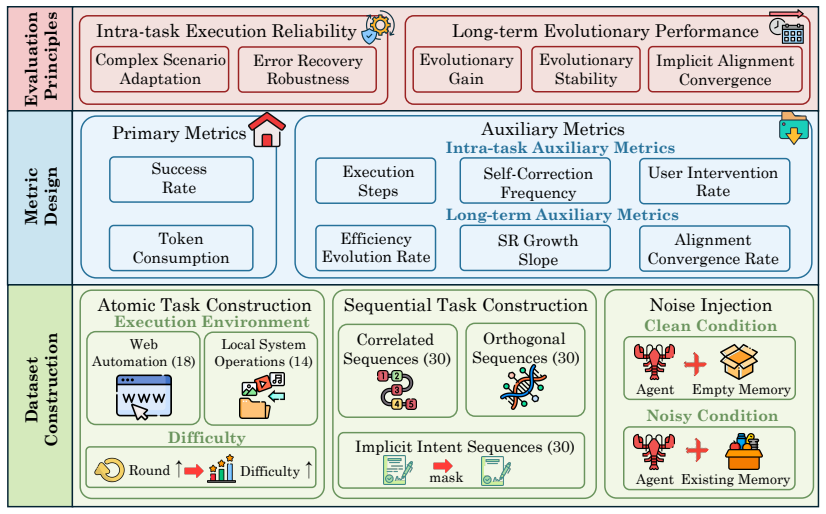
- Benchmarks must use ordered task streams with correlated, orthogonal, and implicit-intent structure if they claim to measure evolution rather than episodic skill.
- Pseudo-evolution can be diagnosed when cost stays flat or rises under interleaved unrelated tasks even when success rate looks fine.
- Design work should treat distillation quality and retrieval robustness as first-class targets, not optional memory add-ons.
- Token trajectory becomes a practical acceptance criterion for systems sold as continuously improving digital workers.
Where Pith is reading between the lines
- If token convergence is accepted as the evolution signal, industrial deployments may start requiring cost-decay SLAs on recurring workflows rather than one-shot accuracy alone.
- The same sequential design could be reused to stress-test whether multi-agent teams share distilled skills or merely parallelize zero-shot effort.
- A natural extension is to ask whether wall-clock latency and error recovery also converge once token cost does, or whether agents trade one efficiency for another.
- The cold-start problem the paper notes later implies a follow-on benchmark: agents that invent their own practice tasks without human stream design.
Editorial analysis
A structured set of objections, weighed in public.
Referee Report
Summary. The paper formalizes Self-Evolving Agents (SEAs) as digitally embodied systems that accumulate experience across task boundaries, proposes the Evolutionary Flywheel (Execution Hub + Cognition Hub; execute–distill–augmented execute) as a minimal architecture, and introduces SEA-Eval, a sequential-stream benchmark with SR and token consumption T as primary metrics. Atomic tasks (Web Automation and Local System Operations) are organized into Easy/Normal/Hard tiers and composed into correlated, orthogonal, and implicit-intent streams under noise conditions. Empirically, five agent frameworks are compared; under comparable success rates on the Easy-Correlated sequence, token use differs by large factors (OpenClaw remaining order-of-magnitude higher than GenericAgent), and only some agents show monotonic T decrease across repeated rounds. The authors conclude that SR alone creates a capability illusion and that sequential convergence of T is the key criterion distinguishing genuine evolution from pseudo-evolution.
Significance. The evaluative gap is real and timely: mainstream agent benchmarks (WebArena, OSWorld, SWE-bench, AgentBench, etc.) are episodic and cannot measure cross-task accumulation. Framing evolution at the architecture level, designing sequential streams with interference and noise controls, and elevating efficiency trajectories alongside success rate are useful contributions if the evidence supports them. The public benchmark intent and the concrete demonstration that high-SR agents can differ sharply in token trajectories are strengths. If the confounds around T are resolved and the full stream suite is reported with comparable rigor, SEA-Eval could become a standard tool for assessing long-horizon agent systems rather than one-shot competence.
major comments (4)
- §5.2 / Table 2 / Figure 3: The central interpretive claim—that sequential T convergence is the key criterion for genuine vs. pseudo-evolution—is not isolated by the reported evidence. Immediately after labeling OpenClaw’s non-converging high T as pseudo-evolution, the text attributes the disparity primarily to “lack of prompt compression” and “redundant context transmission.” That is an implementation/context-management explanation, not a demonstrated distillation or retrieval failure of the Flywheel. If high non-converging T can be produced by verbosity alone while SR remains high (~96.7%), elevating T convergence as architecture-level evidence of evolution overclaims what Easy-Correlated isolates. The paper needs either (i) controls that hold context-management policy fixed (or report compressed vs. uncompressed ablations), or (ii) a substantially qualified claim that T is a joint sign
- §5.1–5.2 experimental confounds undermine cross-agent T trajectories. Codex uses GPT-5.5 while others use Claude Opus 4.6; Hermes, Claude Code, and Codex are run under a 15-minute timeout with incomplete-run annotations. Foundation-model choice and truncated trajectories are free parameters that mix into R1–R3 means in Table 2. For a claim that compares evolutionary quality across frameworks, model assignment and timeout policy must be uniform or factored out (e.g., same backbone where possible; report timeout rates and censoring rules explicitly; sensitivity analysis).
- Abstract / §1 / contributions vs. reported results: The paper claims SEA-Eval quantifies evolutionary gain, evolutionary stability, and implicit alignment convergence via three stream types (correlated, orthogonal, implicit-intent) and noise conditions, yet the fully tabulated sequential analysis is Easy-Correlated only (Table 2, Figure 3). The 31.2× individual-task factor is asserted in the abstract and introduction but is not sourced to a visible table or per-task appendix in the manuscript body. Load-bearing claims about stability under interference, orthogonal transfer, and implicit-intent alignment require the corresponding stream results (or a clear statement that they are deferred), with the same SR/T reporting standard as Easy-Correlated.
- Definitional coupling of “genuine evolution” with T convergence (Abstract; §1; Flywheel-grounded metrics). Genuine evolution is operationalized largely as monotonic sequential decrease of T under the Flywheel story, then T convergence is used to validate genuine evolution and to label non-convergers as pseudo-evolution. This is mild circularity for an empirical benchmark paper, but it becomes load-bearing when failure modes (distillation failure vs. retrieval failure) are claimed without independent diagnostics (e.g., memory content audits, retrieval hit rates, strategy reuse logs). Provide independent process measures, or reframe T as a necessary efficiency signature rather than a sufficient definition of evolution.
minor comments (5)
- Manuscript continuity: large mid-paper gaps appear in the provided text (jumps from §2.3 into incomplete paragraphs, then to §4.3 and §5), which makes it hard to verify the formal SEA/Flywheel definitions and metric equations. Ensure the camera-ready has complete Section 3 formalization and metric definitions with numbered equations.
- Table 2 units and aggregation: clarify whether means are over tasks, runs, or both; define A2/A3 columns; report variance or CIs consistently with Figure 3 boxplots.
- Related work: LifelongAgentBench, EverMemBench, and recent self-evolving agent surveys are cited; a short comparison table (episode vs. stream; SR-only vs. efficiency trajectory; memory reset policy) would sharpen the novelty claim.
- Reproducibility: sandbox images, exact prompts, memory retention/clear rules, and timeout handling should be pinned in the public release; the ethics/safety note on containerization is good and should be mirrored in the experimental checklist.
- Notation: SR and T are primary metrics but T is not formally defined early (tokens per task? cumulative? including failed/timeout runs?). Define T once before Table 2.
Circularity Check
Mild definitional coupling: genuine vs pseudo-evolution is operationalized as sequential T-convergence under Flywheel theory, then T-convergence is presented as the empirical key criterion that distinguishes them.
specific steps
-
self definitional
[Abstract; §1 (Evolutionary Flywheel / metrics)]
"When the flywheel operates effectively, execution overhead converges monotonically as task frequency increases; when it fails, the agent falls into pseudo-evolution, relying on zero-shot reasoning with execution overhead scaling linearly with task frequency. ... Grounded in Flywheel theory, SEA-Eval establishes SR and T as primary metrics ... demonstrating that success rate alone creates a capability illusion and that the sequential convergence of T is the key criterion for distinguishing genuine evolution from pseudo-evolution."
Genuine evolution is defined via the Flywheel as monotonic convergence of execution overhead (T); pseudo-evolution is defined as failure of that convergence. SEA-Eval then takes sequential T-convergence as the primary empirical criterion that distinguishes genuine from pseudo-evolution. The interpretive claim that T-convergence is the key distinguishing criterion is therefore true largely by the paper’s own operational definition, not by an independent reduction. The empirical token trajectories remain real measurements; only the theory↔metric identification is circularly coupled.
full rationale
This is primarily an empirical benchmark paper, not a closed algebraic derivation. The load-bearing measurements (large cross-framework token gaps under comparable SR; divergent sequential T trajectories) are independent experimental observations and do not reduce to fitted inputs or a self-citation uniqueness chain. The residual circularity is definitional, not tautological: §1 and the Abstract define effective Flywheel operation as monotonic convergence of execution overhead and pseudo-evolution as non-converging/linear overhead, then elevate sequential T-convergence as the primary criterion that “demonstrates” genuine vs pseudo-evolution. That couples theory and metric by construction; SR still supplies an external reliability check, and the 31.2× / trajectory findings remain contentful data rather than forced predictions. Self-citation of GenericAgent (overlapping authors) is present and the favorable GA trajectory is highlighted, but it is not a load-bearing uniqueness theorem that forbids alternatives. No fitted-parameter-as-prediction, ansatz-via-citation, or renamed known theorem reductions were found. Score 3.5 reflects mild self-definitional coupling of the central interpretive claim without collapsing the empirical results.
Axiom & Free-Parameter Ledger
free parameters (3)
- 15-minute timeout for Hermes/Claude Code/Codex
- Difficulty-tier and sequence-composition choices (Easy/Normal/Hard; correlated/orthogonal/implicit-intent; noise conditi
- Foundation-model assignment (Claude Opus 4.6 vs GPT-5.5 for Codex)
axioms (4)
- domain assumption Cross-task experience accumulation in open digital environments is the defining property that current episodic benchmarks miss and that SEA evaluation must capture.
- ad hoc to paper SR is the minimum reliability guarantee and sequential convergence of token consumption T is the core signal distinguishing genuine evolution from pseudo-evolution.
- ad hoc to paper The Evolutionary Flywheel (Execution Hub + Cognition Hub; execute–distill–augmented execute) is the minimal sufficient architecture for SEA.
- domain assumption Web automation plus local system operations cover the execution-path space of information-processing digital-embodiment tasks.
invented entities (3)
-
Self-Evolving Agent (SEA) as formalized here
no independent evidence
-
Evolutionary Flywheel
no independent evidence
-
Pseudo-evolution
no independent evidence
read the original abstract
Current LLM-based agents demonstrate strong performance in episodic task execution but remain constrained by static toolsets and episodic amnesia, failing to accumulate experience across task boundaries. This paper formalizes the Self-Evolving Agent (SEA) from the perspective of digital embodiment and continuous cross-task evolution, introduces the Evolutionary Flywheel as its minimal sufficient architecture, and presents SEA-Eval -- the first benchmark designed specifically for evaluating SEAs. Grounded in Flywheel theory, SEA-Eval establishes SR and T as primary metrics and, through sequential task stream design, is designed to quantify evolutionary gain, evolutionary stability, and implicit alignment convergence. Empirical evaluation reveals that, under comparable success rates, token consumption differs by up to 31.2 times between frameworks on individual tasks, with divergent evolutionary trajectories emerging under sequential analysis -- demonstrating that success rate alone creates a capability illusion and that the sequential convergence of $T$ is the key criterion for distinguishing genuine evolution from pseudo-evolution.
Figures



Forward citations
Cited by 1 Pith paper
-
EvoAgentBench: Benchmarking Agent Self-Evolution via Ability Transfer
EvoAgentBench is a multi-domain benchmark for agent self-evolution that guarantees train-side ability support for every test task, revealing that curated skills transfer reliably but automatic methods remain brittle.
Reference graph
Works this paper leans on
-
[1]
Yuhong Cao, Jeric Lew, Jingsong Liang, Jin Cheng, and Guillaume Sartoretti
Building self-evolving agents via experience- driven lifelong learning: A framework and bench- mark.Preprint, arXiv:2508.19005. Yuhong Cao, Jeric Lew, Jingsong Liang, Jin Cheng, and Guillaume Sartoretti. 2025. Dare: Diffusion policy for autonomous robot exploration. In2025 IEEE In- ternational Conference on Robotics and Automation (ICRA), pages 11987–1199...
arXiv 2025
-
[2]
InFind- ings of the Association for Computational Linguistics: ACL 2025, pages 3350–3376
Hammerbench: Fine-grained function-calling evaluation in real mobile assistant scenarios. InFind- ings of the Association for Computational Linguistics: ACL 2025, pages 3350–3376. Lei Wang, Chen Ma, Xueyang Feng, Zeyu Zhang, Hao Yang, Jingsen Zhang, Zhiyuan Chen, Jiakai Tang, Xu Chen, Yankai Lin, and 1 others. 2024. A survey on large language model based ...
Pith/arXiv arXiv 2025
discussion (0)
Sign in with ORCID, Apple, or X to comment. Anyone can read and Pith papers without signing in.