Tests of general relativity at the fourth post-Newtonian order with GW230627 and GW250114
Pith reviewed 2026-06-27 06:25 UTC · model grok-4.3
The pith
Gravitational-wave observations from two events provide the first constraints on general relativity at the fourth post-Newtonian order.
A machine-rendered reading of the paper's core claim, the machinery that carries it, and where it could break.
Core claim
By leveraging the recent extension of the analytical phasing to 4.5PN order, the analysis constrains four dimensionless deviation parameters associated with the 4PN and 4.5PN coefficients. For the selected events with high SNR and long inspiral, the posteriors encompass the GR prediction of zero deviation, establishing the first empirical bounds at these orders.
What carries the argument
Dimensionless deviation parameters δφ_i for the 4PN and 4.5PN coefficients in the parameterized post-Newtonian waveform phasing.
If this is right
- Current and next-generation detectors can achieve higher-precision null tests of GR using these higher PN orders.
- The method provides a framework for incorporating future waveform improvements into GR tests.
- Consistency at 4PN and 4.5PN strengthens the case for GR in the strong-field inspiral regime.
- Additional events will allow joint constraints across multiple PN orders.
Where Pith is reading between the lines
- With more events, the credible intervals could shrink enough to probe potential GR deviations at scales smaller than order 1.
- This baseline enables comparisons with other strong-field tests such as those from black hole mergers at higher frequencies.
- A natural extension is to apply the same deviation parameters to simulated data from detectors with improved sensitivity to predict future constraints.
Load-bearing premise
The 4.5PN waveform model accurately captures the signal without biasing the recovered deviation parameters at the current precision level.
What would settle it
A future gravitational wave event with similar or higher quality data yielding a deviation parameter outside the reported 90% credible intervals would indicate inconsistency with general relativity at the 4PN order.
Figures
read the original abstract
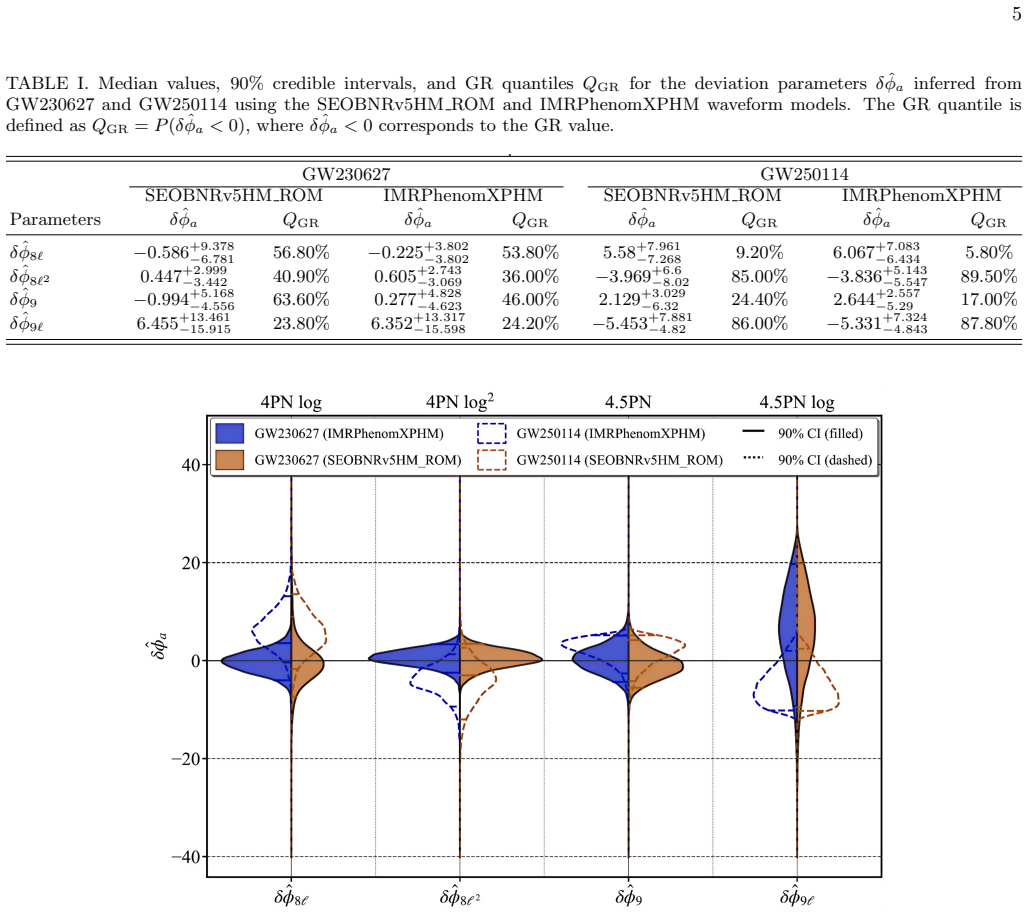
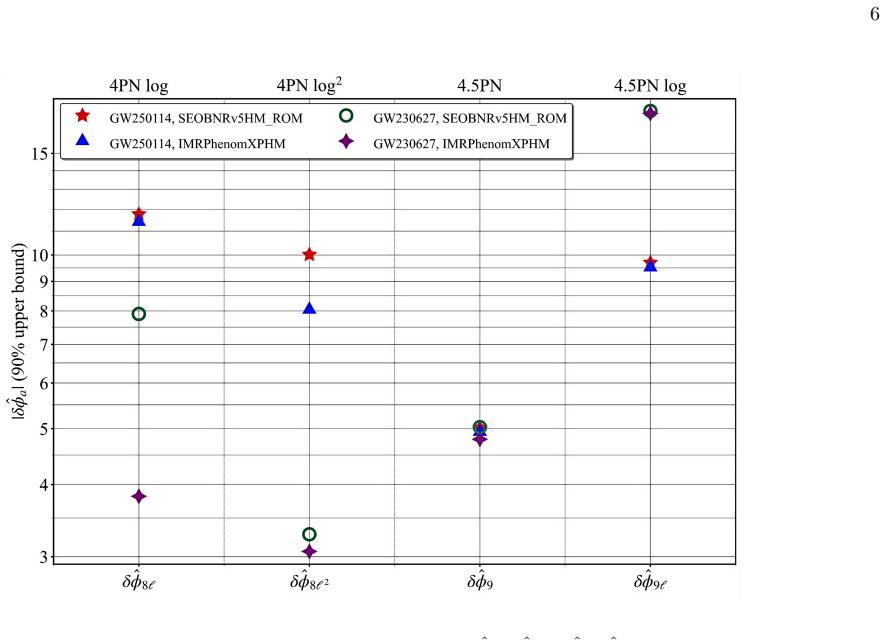
Gravitational wave (GW) observations provide an unprecedented laboratory for testing general relativity (GR) in the strong-field, highly dynamic, and relativistic regimes. Within the parameterized post-Newtonian (PN) formalisms, waveform generation tests have conventionally been limited to constraining inspiral coefficients up to the 3.5PN order. Leveraging the recent theoretical breakthrough that extended the analytical compact binary phasing to the 4.5PN order, we present the first observational constraints on these higher-order effects. Our analysis utilizes two exceptional events detected by the LIGO-Virgo-KAGRA (LVK) network: GW250114\_082203, which boasts the highest signal-to-noise ratio (SNR) recorded to date, and GW230627\_015337, which features a uniquely prolonged inspiral phase and the highest inspiral phase SNR to date. By performing Bayesian inference on the dimensionless deviation parameters ($\delta\phi_i$) associated with the 4PN and 4.5PN coefficients, we find that our results are fully consistent with the predictions of GR. While the current 90\% credible intervals for the four deviation parameters are of order $\mathcal{O}(1) \text{-} \mathcal{O}(10)$, the general relativistic null values ($\delta\hat{\phi}_a= 0$) are entirely encapsulated within the bounds. This investigation establishes the first empirical baseline for 4PN and 4.5PN inspiral tests of GR, paving the way for high-precision null tests of GR with current and next-generation GW detectors.
Editorial analysis
A structured set of objections, weighed in public.
Referee Report
Summary. The paper claims to deliver the first constraints on 4PN and 4.5PN post-Newtonian coefficients in gravitational wave phasing by performing Bayesian parameter estimation on deviation parameters δφ_i for two exceptional LVK events (GW230627_015337 and GW250114_082203). It reports that the 90% credible intervals of O(1)-O(10) fully contain the GR prediction of zero deviation, establishing consistency with general relativity and a baseline for future tests.
Significance. This result, if robust, is significant because it extends PN tests of GR beyond the conventional 3.5PN limit using the newly available 4.5PN phasing. The selection of the highest total SNR and highest inspiral SNR events is a strength, and the direct likelihood-based constraint on deviation parameters provides a clear, falsifiable test. It opens the door to higher-precision null tests with improved detectors.
major comments (1)
- Analysis and results: The insertion of the parameterized post-Newtonian phasing into the likelihood for the two events assumes the 4.5PN model is accurate enough not to bias the δφ_i posteriors at the reported level. This assumption is load-bearing for the consistency claim but lacks supporting checks for waveform systematics or mismatch estimates, as per the weakest assumption identified.
minor comments (2)
- The abstract uses both δφ_i and δ̂φ_a; define the four parameters explicitly and consistently throughout.
- Provide more detail on the data selection criteria and any cuts applied to the two events.
Simulated Author's Rebuttal
We thank the referee for their constructive review and positive evaluation of the significance of our results. We address the single major comment below.
read point-by-point responses
-
Referee: The insertion of the parameterized post-Newtonian phasing into the likelihood for the two events assumes the 4.5PN model is accurate enough not to bias the δφ_i posteriors at the reported level. This assumption is load-bearing for the consistency claim but lacks supporting checks for waveform systematics or mismatch estimates, as per the weakest assumption identified.
Authors: We agree that the accuracy of the 4.5PN waveform model is a key assumption. The phasing formula is taken from the recent first-principles derivation, and the deviation parameters are constructed to recover the GR limit exactly. While the manuscript does not contain explicit mismatch calculations or additional waveform systematics studies for these two events, the truncation error of the PN series at 4.5PN is expected to be small for the mass ratios and frequency ranges of GW230627 and GW250114. In the revised manuscript we will add a dedicated paragraph discussing the expected size of modeling errors, referencing the existing PN accuracy literature. Performing full event-specific mismatch estimates is computationally demanding and is left for future work; we therefore view the addition of this discussion as a partial but sufficient response to the comment. revision: partial
Circularity Check
No circularity; posterior constraints arise directly from data likelihood
full rationale
The paper inserts the parameterized 4PN/4.5PN phasing (with free δφ_i) into the standard Bayesian likelihood for two specific LVK events and reports that the GR null values lie inside the resulting credible intervals. No equation or step equates a fitted quantity to a 'prediction' of itself, no self-citation supplies a load-bearing uniqueness theorem, and the 4.5PN extension is treated as an external theoretical input rather than an internal ansatz. The result is therefore a conventional parameter-estimation outcome, not a reduction to the paper's own inputs.
Axiom & Free-Parameter Ledger
free parameters (1)
- δφ_i (four deviation parameters)
axioms (1)
- domain assumption The parameterized post-Newtonian expansion remains valid and complete through 4.5PN for the selected binary systems
Reference graph
Works this paper leans on
-
[1]
The Confrontation between General Rela- tivity and Experiment,
C. M. Will, “The Confrontation between General Rela- tivity and Experiment,” Living Rev. Rel.17, 4 (2014) [arXiv:1403.7377 [gr-qc]]
Pith/arXiv arXiv 2014
-
[2]
Strong-Field Gravity Tests with the Double Pulsar,
M. Kramer, I. H. Stairs, R. N. Manchester, N. Wex, A. T. Deller, W. A. Coles, M. Ali, M. Burgay, F. Camilo and I. Cognard,et al.“Strong-Field Gravity Tests with the Double Pulsar,” Phys. Rev. X11, no.4, 041050 (2021) [arXiv:2112.06795 [astro-ph.HE]]
arXiv 2021
-
[3]
Gravity experiments with radio pulsars,
P. C. C. Freire and N. Wex, “Gravity experiments with radio pulsars,” Living Rev. Rel.27, no.1, 5 (2024) [arXiv:2407.16540 [gr-qc]]
arXiv 2024
-
[4]
Probes and Tests of Strong-Field Gravity with Observations in the Electromagnetic Spectrum,
D. Psaltis, “Probes and Tests of Strong-Field Gravity with Observations in the Electromagnetic Spectrum,” Living Rev. Rel.11, 9 (2008) [arXiv:0806.1531 [astro- ph]]
Pith/arXiv arXiv 2008
-
[5]
Modified Gravity and Cosmology,
T. Clifton, P. G. Ferreira, A. Padilla and C. Skordis, “Modified Gravity and Cosmology,” Phys. Rept.513, 1- 189 (2012) [arXiv:1106.2476 [astro-ph.CO]]
Pith/arXiv arXiv 2012
-
[6]
Cosmological Tests of Gravity,
P. G. Ferreira, “Cosmological Tests of Gravity,” Ann. Rev. Astron. Astrophys.57, 335-374 (2019) [arXiv:1902.10503 [astro-ph.CO]]
arXiv 2019
-
[7]
Tests of general relativity with GW150914,
B. P. Abbottet al.[LIGO Scientific and Virgo], “Tests of general relativity with GW150914,” Phys. Rev. Lett. 116, no.22, 221101 (2016) [arXiv:1602.03841 [gr-qc]]
Pith/arXiv arXiv 2016
-
[8]
Tests of General Relativity with the Binary Black Hole Signals from the LIGO-Virgo Catalog GWTC-1,
B. P. Abbottet al.[LIGO Scientific and Virgo], “Tests of General Relativity with the Binary Black Hole Signals from the LIGO-Virgo Catalog GWTC-1,” Phys. Rev. D 100, no.10, 104036 (2019) [arXiv:1903.04467 [gr-qc]]
Pith/arXiv arXiv 2019
-
[9]
Tests of General Relativity with GWTC-3,
R. Abbottet al.[LIGO Scientific, VIRGO and KAGRA], “Tests of General Relativity with GWTC-3,” Phys. Rev. D112, no.8, 084080 (2025) [arXiv:2112.06861 [gr-qc]]
Pith/arXiv arXiv 2025
-
[10]
R. Abbottet al.[LIGO Scientific and Virgo], “Tests of general relativity with binary black holes from the second LIGO-Virgo gravitational-wave transient catalog,” Phys. Rev. D103, no.12, 122002 (2021) [arXiv:2010.14529 [gr- qc]]
Pith/arXiv arXiv 2021
-
[11]
Black Hole Spectroscopy and Tests of General Relativity with GW250114,
A. G. Abacet al.[LIGO Scientific, Virgo and KAGRA], “Black Hole Spectroscopy and Tests of General Relativity with GW250114,” Phys. Rev. Lett.136, no.4, 041403 (2026) [arXiv:2509.08099 [gr-qc]]
Pith/arXiv arXiv 2026
-
[12]
GWTC-4.0: Tests of General Relativity. I. Overview and General Tests,
A. G. Abacet al.[LIGO Scientific, VIRGO and KAGRA], “GWTC-4.0: Tests of General Relativity. I. Overview and General Tests,” [arXiv:2603.19019 [gr-qc]]
-
[13]
GWTC-4.0: An Introduction to Version 4.0 of the Gravitational-Wave Transient Catalog,
A. G. Abacet al.[LIGO Scientific, KAGRA and VIRGO], “GWTC-4.0: An Introduction to Version 4.0 of the Gravitational-Wave Transient Catalog,” Astrophys. J. Lett.995, no.1, L18 (2025) [arXiv:2508.18080 [gr-qc]]
Pith/arXiv arXiv 2025
-
[14]
A. G. Abacet al.[LIGO Scientific, VIRGO and KA- GRA], “GWTC-4.0: Updating the Gravitational-Wave Transient Catalog with Observations from the First Part of the Fourth LIGO-Virgo-KAGRA Observing Run,” [arXiv:2508.18082 [gr-qc]]
-
[15]
Ob- servation of Gravitational Waves from a Binary Black Hole Merger,
B. P. Abbottet al.[LIGO Scientific and Virgo], “Ob- servation of Gravitational Waves from a Binary Black Hole Merger,” Phys. Rev. Lett.116, no.6, 061102 (2016) [arXiv:1602.03837 [gr-qc]]
Pith/arXiv arXiv 2016
-
[16]
Theoretical Physics Implications of the Binary Black-Hole Mergers GW150914 and GW151226,
N. Yunes, K. Yagi and F. Pretorius, “Theoretical Physics Implications of the Binary Black-Hole Mergers GW150914 and GW151226,” Phys. Rev. D94, no.8, 084002 (2016) [arXiv:1603.08955 [gr-qc]]
Pith/arXiv arXiv 2016
-
[17]
T. Zhu, W. Zhao, J. M. Yan, Y. Z. Wang, C. Gong and A. Wang, “Constraints on parity and Lorentz violations in gravity from GWTC-3 through a parametrization of modified gravitational wave propagations,” Phys. Rev. D 110, no.6, 064044 (2024) [arXiv:2304.09025 [gr-qc]]
arXiv 2024
-
[18]
Q. Wang, J. M. Yan, T. Zhu and W. Zhao, “Modi- fied gravitational wave propagations in linearized grav- ity with Lorentz and diffeomorphism violations and their gravitational wave constraints,” Phys. Rev. D111, no.8, 8 (2025) [arXiv:2501.11956 [gr-qc]]
arXiv 2025
-
[19]
L. Bian, R. G. Cai, Y. Q. Dong, Q. Gao, Y. Gong, Z. K. Guo, Q. G. Huang, Z. Kang, L. Li and J. Liu, et al.“Gravitational wave cosmology,” Sci. China Phys. Mech. Astron.69, no.1, 210401 (2026) [arXiv:2505.19747 [gr-qc]]
arXiv 2026
-
[20]
[LIGO Scientific, VIRGO and KAGRA], “GWTC- 5.0: Observations from the Second Part of the Fourth LIGO-Virgo-KAGRA Observing Run and Up- dates to the Gravitational-Wave Transient Catalog,” [arXiv:2605.27225 [gr-qc]]
-
[21]
B. P. Abbottet al.[LIGO Scientific and Virgo], “GW170814: A Three-Detector Observation of Grav- itational Waves from a Binary Black Hole Coales- cence,” Phys. Rev. Lett.119, no.14, 141101 (2017) [arXiv:1709.09660 [gr-qc]]
Pith/arXiv arXiv 2017
-
[22]
GW190412: Observation of a Binary-Black-Hole Coa- lescence with Asymmetric Masses,
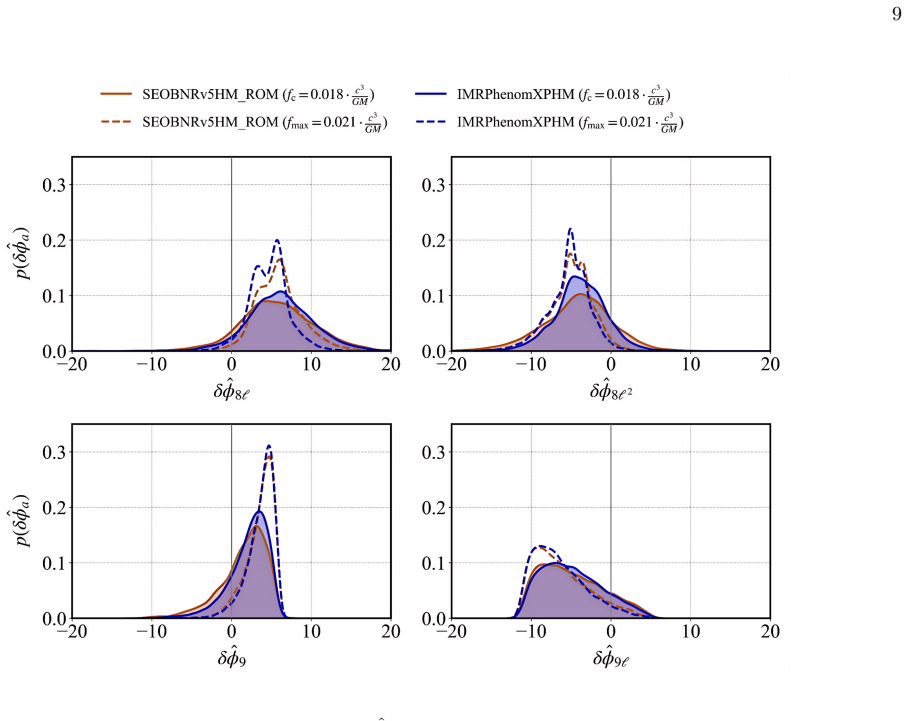
R. Abbottet al.[LIGO Scientific and Virgo], “GW190412: Observation of a Binary-Black-Hole Coa- lescence with Asymmetric Masses,” Phys. Rev. D102, 9 FIG. 3. Posterior distributions of the deviation parametersδ ˆϕa for GW250114 obtained using two differenet cutoff frequencies fc = 0.018c 3/(GM) andf max = 0.021c 3/(GM). no.4, 043015 (2020) [arXiv:2004.08342...
arXiv 2020
-
[23]
R. Abbottet al.[LIGO Scientific and Virgo], “GW190814: Gravitational Waves from the Coalescence of a 23 Solar Mass Black Hole with a 2.6 Solar Mass Com- pact Object,” Astrophys. J. Lett.896, no.2, L44 (2020) [arXiv:2006.12611 [astro-ph.HE]]
Pith/arXiv arXiv 2020
-
[24]
GW190521: A Binary Black Hole Merger with a Total Mass of 150M ⊙,
R. Abbottet al.[LIGO Scientific and Virgo], “GW190521: A Binary Black Hole Merger with a Total Mass of 150M ⊙,” Phys. Rev. Lett.125, no.10, 101102 (2020) [arXiv:2009.01075 [gr-qc]]
arXiv 2020
-
[25]
A. G. Abacet al.[LIGO Scientific, KAGRA and VIRGO], “Observation of Gravitational Waves from the Coales- cence of a 2.5 — 4.5M ⊙ Compact Object and a Neu- tron Star,” Astrophys. J. Lett.970, no.2, L34 (2024) [arXiv:2404.04248 [astro-ph.HE]]
arXiv 2024
-
[26]
GW230814: in- vestigation of a loud gravitational-wave signal observed with a single detector,
[LIGO Scientific, VIRGO and Kagra], “GW230814: in- vestigation of a loud gravitational-wave signal observed with a single detector,” [arXiv:2509.07348 [gr-qc]]
-
[27]
GW250114: Testing Hawking’s Area Law and the Kerr Nature of Black Holes,
A. G. Abacet al.[LIGO Scientific, Virgo and KAGRA], “GW250114: Testing Hawking’s Area Law and the Kerr Nature of Black Holes,” Phys. Rev. Lett.135, no.11, 111403 (2025) [arXiv:2509.08054 [gr-qc]]
Pith/arXiv arXiv 2025
-
[28]
GW231123: A Binary Black Hole Merger with Total Mass 190—265M ⊙,
A. G. Abacet al.[LIGO Scientific, VIRGO and KAGRA], “GW231123: A Binary Black Hole Merger with Total Mass 190—265M ⊙,” Astrophys. J. Lett.993, no.1, L25 (2025) [arXiv:2507.08219 [astro-ph.HE]]
Pith/arXiv arXiv 2025
-
[29]
A. G. Abacet al.[LIGO Scientific, Virgo and KAGRA], “GW241011 and GW241110: Exploring Binary Forma- tion and Fundamental Physics with Asymmetric, High- spin Black Hole Coalescences,” Astrophys. J. Lett.993, no.1, L21 (2025) [arXiv:2510.26931 [astro-ph.HE]]
arXiv 2025
-
[30]
Testing post-Newtonian theory with gravitational wave observations,
K. G. Arun, B. R. Iyer, M. S. S. Qusailah and B. S. Sathyaprakash, “Testing post-Newtonian theory with gravitational wave observations,” Class. Quant. Grav.23, L37-L43 (2006) [arXiv:gr-qc/0604018 [gr-qc]]
Pith/arXiv arXiv 2006
-
[31]
N. Yunes and F. Pretorius, “Fundamental Theoretical Bias in Gravitational Wave Astrophysics and the Param- eterized Post-Einsteinian Framework,” Phys. Rev. D80, 122003 (2009) [arXiv:0909.3328 [gr-qc]]
Pith/arXiv arXiv 2009
-
[32]
J. Meidam, K. W. Tsang, J. Goldstein, M. Agathos, A. Ghosh, C. J. Haster, V. Raymond, A. Samajdar, P. Schmidt and R. Smith,et al.“Parametrized tests of the strong-field dynamics of general relativity us- ing gravitational wave signals from coalescing binary black holes: Fast likelihood calculations and sensitivity of the method,” Phys. Rev. D97, no.4, 044...
Pith/arXiv arXiv 2018
-
[33]
M. Agathos, W. Del Pozzo, T. G. F. Li, C. Van Den Broeck, J. Veitch and S. Vitale, “TIGER: A data analysis pipeline for testing the strong-field dynamics of general relativity with gravitational wave signals from coalescing compact binaries,” Phys. Rev. D89, no.8, 082001 (2014) [arXiv:1311.0420 [gr-qc]]
Pith/arXiv arXiv 2014
-
[34]
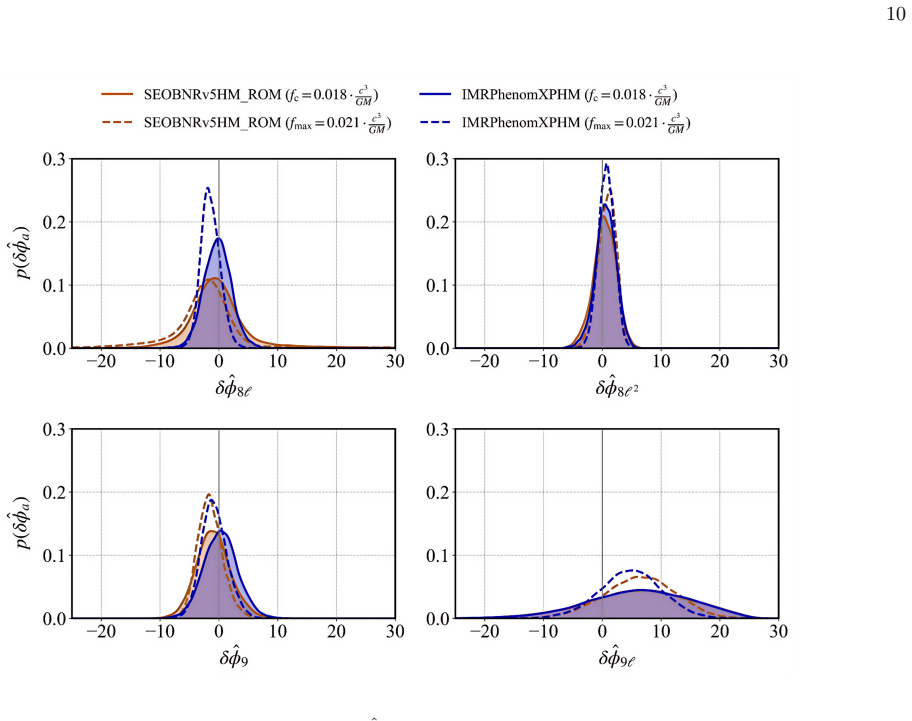
S. Roy, M. Haney, G. Pratten, P. T. H. Pang and C. Van Den Broeck, “Improved parametrized test of general rela- tivity using the IMRPhenomX waveform family: Includ- 10 FIG. 4. Posterior distributions of the deviation parametersδ ˆϕa for GW230627 obtained by using two differenet cutoff frequencies fc = 0.018c 3/(GM) andf max = 0.021c 3/(GM). ing higher har...
arXiv 2026
-
[35]
Parametrized tests of post- Newtonian theory using Advanced LIGO and Ein- stein Telescope,
C. K. Mishra, K. G. Arun, B. R. Iyer and B. S. Sathyaprakash, “Parametrized tests of post- Newtonian theory using Advanced LIGO and Ein- stein Telescope,” Phys. Rev. D82, 064010 (2010) [arXiv:1005.0304 [gr-qc]]
Pith/arXiv arXiv 2010
-
[36]
A. K. Mehta, A. Buonanno, R. Cotesta, A. Ghosh, N. Sennett and J. Steinhoff, “Tests of general relativ- ity with gravitational-wave observations using a flexible theory-independent method,” Phys. Rev. D107, no.4, 044020 (2023) [arXiv:2203.13937 [gr-qc]]
arXiv 2023
-
[37]
L. Blanchet, G. Faye, Q. Henry, F. Larrouturou and D. Trestini, “Gravitational-Wave Phasing of Quasicircu- lar Compact Binary Systems to the Fourth-and-a-Half Post-Newtonian Order,” Phys. Rev. Lett.131, no.12, 121402 (2023) [arXiv:2304.11185 [gr-qc]]
arXiv 2023
-
[38]
L. Blanchet, G. Faye, Q. Henry, F. Larrouturou and D. Trestini, “Gravitational-wave flux and quadrupole modes from quasicircular nonspinning compact binaries to the fourth post-Newtonian order,” Phys. Rev. D108, no.6, 064041 (2023) [arXiv:2304.11186 [gr-qc]]
arXiv 2023
-
[39]
Gravitational-wave tails of memory,
D. Trestini and L. Blanchet, “Gravitational-wave tails of memory,” Phys. Rev. D107, no.10, 104048 (2023) [arXiv:2301.09395 [gr-qc]]
arXiv 2023
-
[40]
D. Trestini, F. Larrouturou and L. Blanchet, “The quadrupole moment of compact binaries to the fourth post-Newtonian order: relating the harmonic and ra- diative metrics,” Class. Quant. Grav.40, no.5, 055006 (2023) [arXiv:2209.02719 [gr-qc]]
arXiv 2023
-
[41]
L. Blanchet, G. Faye and F. Larrouturou, “The quadrupole moment of compact binaries to the fourth post-Newtonian order: from source to canonical mo- ment,” Class. Quant. Grav.39, no.19, 195003 (2022) [arXiv:2204.11293 [gr-qc]]
arXiv 2022
-
[42]
Tests of gen- eral relativity at the fourth post-Newtonian order,
P. Dutta Roy, S. Datta and K. G. Arun, “Tests of gen- eral relativity at the fourth post-Newtonian order,” Phys. Rev. D110, no.6, 064002 (2024) [arXiv:2406.07691 [gr- qc]]
arXiv 2024
-
[43]
GWTC-4.0: Tests of General Relativity. II. Parameter- ized Tests,
A. G. Abacet al.[LIGO Scientific, VIRGO and KAGRA], “GWTC-4.0: Tests of General Relativity. II. Parameter- ized Tests,” [arXiv:2603.19020 [gr-qc]]
-
[44]
No Love for black holes: tightest constraints on tidal Love num- bers of black holes from GW250114,
M. Andr´ es-Carcasona and G. Caneva Santoro, “No Love for black holes: tightest constraints on tidal Love num- bers of black holes from GW250114,” [arXiv:2512.01918 [gr-qc]]
-
[45]
T. Damour, B. R. Iyer and B. S. Sathyaprakash, “Fre- quency domain P approximant filters for time trun- cated inspiral gravitational wave signals from compact binaries,” Phys. Rev. D62, 084036 (2000) [arXiv:gr- qc/0001023 [gr-qc]]
arXiv 2000
-
[46]
C. Cutler and E. E. Flanagan, “Gravitational waves from merging compact binaries: How accurately can one ex- tract the binary’s parameters from the inspiral wave form?,” Phys. Rev. D49, 2658-2697 (1994) [arXiv:gr- qc/9402014 [gr-qc]]. 11
arXiv 1994
-
[47]
Gravitational- wave tail effects to quartic non-linear order,
T. Marchand, L. Blanchet and G. Faye, “Gravitational- wave tail effects to quartic non-linear order,” Class. Quant. Grav.33, no.24, 244003 (2016) [arXiv:1607.07601 [gr-qc]]
Pith/arXiv arXiv 2016
-
[48]
C. R. Galley, A. K. Leibovich, R. A. Porto and A. Ross, “Tail effect in gravitational radiation reaction: Time nonlocality and renormalization group evolution,” Phys. Rev. D93, 124010 (2016) [arXiv:1511.07379 [gr-qc]]
Pith/arXiv arXiv 2016
-
[49]
BayesWave: Bayesian Inference for Gravitational Wave Bursts and Instrument Glitches,
N. J. Cornish and T. B. Littenberg, “BayesWave: Bayesian Inference for Gravitational Wave Bursts and Instrument Glitches,” Class. Quant. Grav.32, no.13, 135012 (2015) [arXiv:1410.3835 [gr-qc]]
Pith/arXiv arXiv 2015
-
[50]
Bayesian infer- ence for spectral estimation of gravitational wave de- tector noise,
T. B. Littenberg and N. J. Cornish, “Bayesian infer- ence for spectral estimation of gravitational wave de- tector noise,” Phys. Rev. D91, no.8, 084034 (2015) [arXiv:1410.3852 [gr-qc]]
Pith/arXiv arXiv 2015
-
[51]
BILBY: A user-friendly Bayesian inference library for gravitational-wave astronomy,
G. Ashton, M. H¨ ubner, P. D. Lasky, C. Talbot, K. Ack- ley, S. Biscoveanu, Q. Chu, A. Divakarla, P. J. Easter and B. Goncharov,et al.“BILBY: A user-friendly Bayesian inference library for gravitational-wave astronomy,” As- trophys. J. Suppl.241, no.2, 27 (2019) [arXiv:1811.02042 [astro-ph.IM]]
Pith/arXiv arXiv 2019
-
[52]
I. M. Romero-Shaw, C. Talbot, S. Biscoveanu, V. D’Emilio, G. Ashton, C. P. L. Berry, S. Cough- lin, S. Galaudage, C. Hoy and M. H¨ ubner,et al. “Bayesian inference for compact binary coalescences with bilby: validation and application to the first LIGO–Virgo gravitational-wave transient catalogue,” Mon. Not. Roy. Astron. Soc.499, no.3, 3295-3319 (2020) [a...
Pith/arXiv arXiv 2020
-
[53]
M. J. Williams, J. Veitch, and C. Messenger, Astro- physics Source Code Library. ascl:2405.002
-
[54]
Nested sampling with normalizing flows for gravitational-wave inference,
M. J. Williams, J. Veitch and C. Messenger, “Nested sampling with normalizing flows for gravitational-wave inference,” Phys. Rev. D103, no.10, 103006 (2021) [arXiv:2102.11056 [gr-qc]]
arXiv 2021
-
[55]
Importance nested sampling with normalising flows,
M. J. Williams, J. Veitch and C. Messenger, “Importance nested sampling with normalising flows,” Mach. Learn. Sci. Tech.4, no.3, 035011 (2023) [arXiv:2302.08526 [astro-ph.IM]]
arXiv 2023
-
[56]
L. Pompili, A. Buonanno, H. Estell´ es, M. Khalil, M. van de Meent, D. P. Mihaylov, S. Ossokine, M. P¨ urrer, A. Ramos-Buades and A. K. Mehta,et al.“Laying the foundation of the effective-one-body waveform models SEOBNRv5: Improved accuracy and efficiency for spin- ning nonprecessing binary black holes,” Phys. Rev. D 108, no.12, 124035 (2023) [arXiv:2303....
arXiv 2023
-
[57]
G. Pratten, C. Garc´ ıa-Quir´ os, M. Colleoni, A. Ramos- Buades, H. Estell´ es, M. Mateu-Lucena, R. Jaume, M. Haney, D. Keitel and J. E. Thompson,et al. “Computationally efficient models for the dominant and subdominant harmonic modes of precessing binary black holes,” Phys. Rev. D103, no.10, 104056 (2021) [arXiv:2004.06503 [gr-qc]]
Pith/arXiv arXiv 2021
-
[58]
Fast frequency-domain gravitational wave- forms for precessing binaries with a new twist,
M. Colleoni, F. A. R. Vidal, C. Garc´ ıa-Quir´ os, S. Ak¸ cay and S. Bera, “Fast frequency-domain gravitational wave- forms for precessing binaries with a new twist,” Phys. Rev. D111, no.10, 104019 (2025) [arXiv:2412.16721 [gr- qc]]
arXiv 2025
-
[59]
LVK Algorithm Library- LAL- Suite,
LIGO Scientific Collaboration, Virgo Collaboration, and KAGRA Collaboration, “LVK Algorithm Library- LAL- Suite, ” Free software (GPL) (2018)
2018
-
[60]
Array program- ming with NumPy,
C. R. Harris, K. J. Millman, S. J. van der Walt, R. Gom- mers, P. Virtanen, D. Cournapeau, E. Wieser, J. Tay- lor, S. Berg and N. J. Smith,et al.“Array program- ming with NumPy,” Nature585, no.7825, 357-362 (2020) [arXiv:2006.10256 [cs.MS]]
Pith/arXiv arXiv 2020
-
[61]
The NumPy Array: A Structure for Efficient Numerical Com- putation,
S. van der Walt, S. C. Colbert and G. Varoquaux, “The NumPy Array: A Structure for Efficient Numerical Com- putation,” Comput. Sci. Eng.13, no.2, 22-30 (2011) [arXiv:1102.1523 [cs.MS]]
Pith/arXiv arXiv 2011
-
[62]
SciPy 1.0– Fundamental Algorithms for Scientific Computing in Python,
P. Virtanen, R. Gommers, T. E. Oliphant, M. Haber- land, T. Reddy, D. Cournapeau, E. Burovski, P. Pe- terson, W. Weckesser and J. Bright,et al.“SciPy 1.0– Fundamental Algorithms for Scientific Computing in Python,” Nature Meth.17, 261 (2020) [arXiv:1907.10121 [cs.MS]]
Pith/arXiv arXiv 2020
-
[63]
Matplotlib: A 2D Graphics Environ- ment,
J. D. Hunter, “Matplotlib: A 2D Graphics Environ- ment,” Comput. Sci. Eng.9, no.3, 90-95 (2007)
2007
discussion (0)
Sign in with ORCID, Apple, or X to comment. Anyone can read and Pith papers without signing in.