Density Profiles and Direct Correlation Functions from Density Functional Theory in Binary Hard-Sphere Crystals: Substitutional Solid and Interstitial Solid Solution
Pith reviewed 2026-05-10 03:34 UTC · model grok-4.3
The pith
The large-large components of the inhomogeneous direct correlation functions in binary hard-sphere crystals scale as one over the vacancy concentration and admit a simple geometric picture.
A machine-rendered reading of the paper's core claim, the machinery that carries it, and where it could break.
Core claim
Using the White Bear II fundamental measure theory functional, the equilibrium density profiles are computed for substitutional and interstitial binary hard-sphere crystals. For substitutional crystals the density profiles consist of narrow Gaussian peaks at fcc lattice sites similar to the one-component case, while for interstitial solid solutions the small species is delocalized in the unit cell. The inhomogeneous two-body direct correlation functions are calculated, revealing that the large-large components are mainly determined by the vacancy concentration and exhibit a characteristic magnitude of approximately 1/n_vac, leading to a proposed simple geometric picture of this function. The
What carries the argument
The species-resolved inhomogeneous two-body direct correlation functions, whose large-large components are controlled by vacancy concentration and admit a geometric interpretation.
If this is right
- Density profiles in substitutional binary crystals remain narrow Gaussian peaks centered on fcc lattice sites.
- Small spheres in interstitial solid solutions occupy a delocalized distribution throughout the unit cell.
- Large-large components of the direct correlation function maintain a magnitude set by one over the vacancy concentration.
- Components of the direct correlation function that involve the small spheres differ substantially between substitutional and interstitial crystals.
- A geometric picture suffices to represent the six-dimensional large-large direct correlation function once vacancy concentration is known.
Where Pith is reading between the lines
- The observed scaling may allow quick estimates of correlation functions in other crystal lattices without repeating the full density-functional calculation.
- The geometric picture could simplify models of how vacancies affect ordering or defect motion in colloidal mixtures.
- Similar vacancy-controlled correlations may appear in systems with continuous size polydispersity rather than two discrete species.
- Direct comparison with molecular-dynamics trajectories of hard spheres could confirm or refute the predicted delocalization of the small species in interstitial solutions.
Load-bearing premise
The White Bear II functional supplies quantitatively accurate density profiles and direct correlation functions for these inhomogeneous binary hard-sphere crystals.
What would settle it
A molecular-dynamics simulation of the identical binary hard-sphere mixture that produces large-large direct correlation functions whose peak heights fail to scale inversely with the vacancy concentration would falsify the central claim.
Figures






read the original abstract
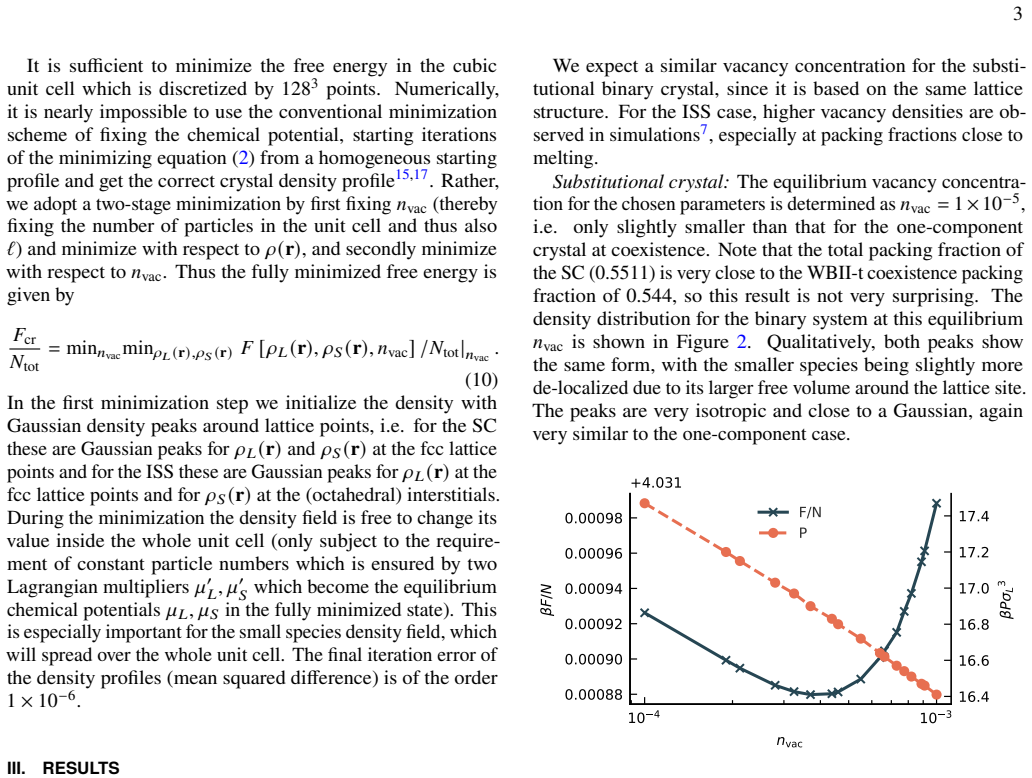
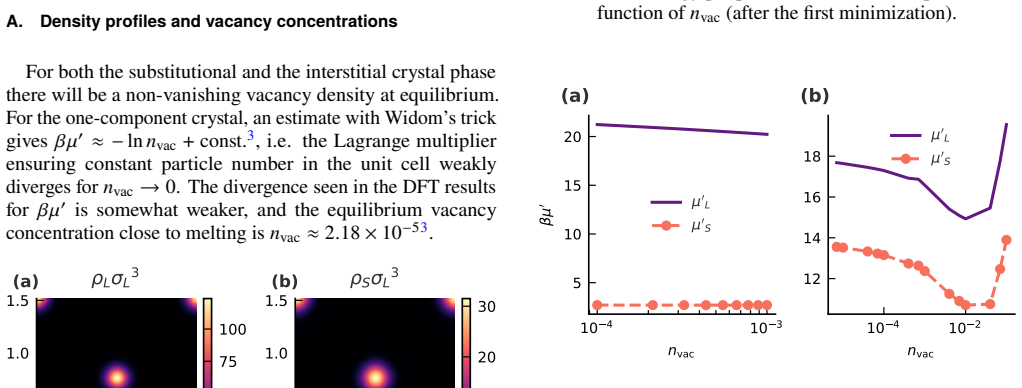
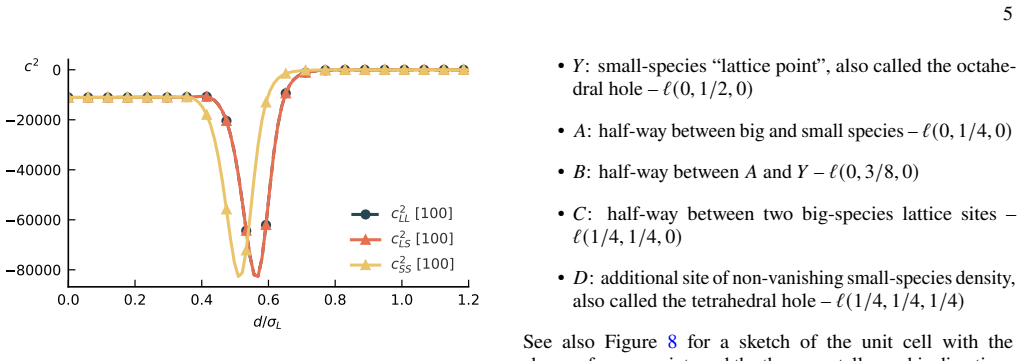
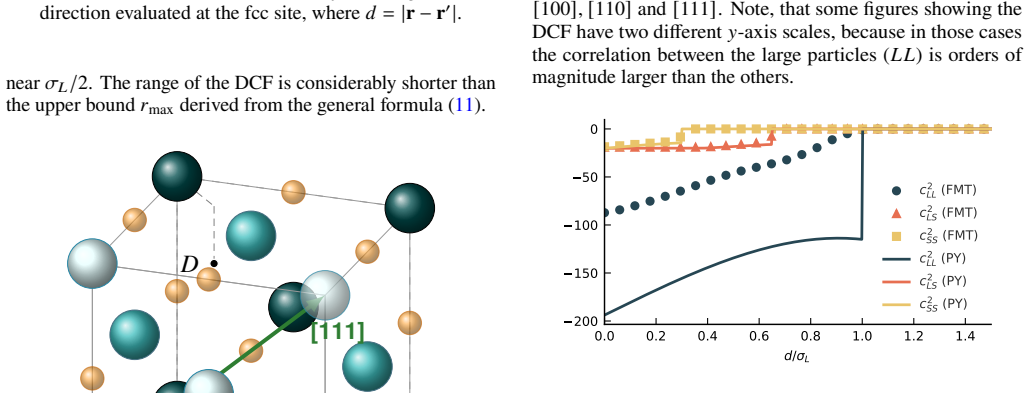
We determine the fully resolved equilibrium density profiles for two binary hard-sphere crystal structures using classical density functional theory through the White Bear II functional from fundamental measure theory. While for the substitutional crystal, in which some hard spheres are replaced by spheres of slightly smaller diameter, the density profiles are rather similar to the single-component case (narrow Gaussian peaks centered at fcc lattice sites), we observe a more complex behavior for the case of interstitial solid solutions, where the small species is fairly delocalized in the unit cell. Further, we compute the species-resolved inhomogeneous two-body direct correlation functions, depending on two three-dimensional vectors, for these two types of binary crystals. The large--large components are mainly determined by the vacancy concentration $n_\text{vac}$ and show a characteristic magnitude $\sim 1/n_\text{vac}$. Based on this observation, we propose a simple geometric picture. The components of the direct correlation function involving the small spheres substantially differ in interstitial solid solutions from those of the substitutional crystal.
Editorial analysis
A structured set of objections, weighed in public.
Referee Report
Summary. The manuscript applies classical density functional theory with the White Bear II functional from fundamental measure theory to compute fully resolved equilibrium density profiles for substitutional and interstitial binary hard-sphere crystals. It then evaluates the species-resolved inhomogeneous two-body direct correlation functions, reporting that the large-large DCF components are primarily determined by the vacancy concentration n_vac with magnitude scaling as ~1/n_vac. A simple geometric picture is proposed for this six-dimensional function, while noting greater delocalization of the small species and differing DCF components in the interstitial case relative to the substitutional solid.
Significance. If the White Bear II results are accurate, the reported scaling of the large-large DCF with n_vac and the associated geometric picture would offer a useful simplification for understanding vacancy effects in binary crystals and could inform approximations in inhomogeneous liquid theory. The distinction between crystal types highlights the impact of species delocalization. Credit is given for the detailed numerical computation of species-resolved density profiles and fully inhomogeneous DCFs in these systems.
major comments (2)
- [Results (DCF analysis)] The central claim that large-large DCF components have magnitude ~1/n_vac and are mainly set by n_vac follows from the second functional derivative of the White Bear II excess free-energy functional after minimization for the equilibrium profiles. The manuscript provides no direct Monte Carlo or molecular-dynamics benchmarks for these inhomogeneous c_ij(r,r') in binary crystals, so any systematic error in predicted vacancy fractions or peak shapes propagates directly into the DCF scaling and geometric picture (see abstract and results on DCF computation).
- [Methods / Computational details] Numerical details on the minimization of the functional, convergence criteria for the density profiles, and specific choices of lattice parameters or n_vac values are not reported. These are load-bearing for assessing whether the ~1/n_vac magnitude is robust or sensitive to discretization and boundary conditions.
minor comments (1)
- [Abstract] The abstract would benefit from specifying the diameter ratios and range of n_vac values examined to give immediate context for the reported behaviors.
Simulated Author's Rebuttal
We thank the referee for their careful reading of the manuscript and for the constructive comments. We respond to each major comment below.
read point-by-point responses
-
Referee: [Results (DCF analysis)] The central claim that large-large DCF components have magnitude ~1/n_vac and are mainly set by n_vac follows from the second functional derivative of the White Bear II excess free-energy functional after minimization for the equilibrium profiles. The manuscript provides no direct Monte Carlo or molecular-dynamics benchmarks for these inhomogeneous c_ij(r,r') in binary crystals, so any systematic error in predicted vacancy fractions or peak shapes propagates directly into the DCF scaling and geometric picture (see abstract and results on DCF computation).
Authors: We acknowledge that the manuscript does not include direct Monte Carlo or molecular-dynamics benchmarks for the inhomogeneous species-resolved direct correlation functions. The White Bear II functional has been validated extensively in the literature for hard-sphere systems, yet we agree that targeted benchmarks for these particular DCFs would provide additional support. Such simulations for the fully inhomogeneous six-dimensional functions are computationally demanding and lie beyond the scope of the present work. In the revised manuscript we have added an explicit discussion of this limitation in the conclusions section. revision: partial
-
Referee: [Methods / Computational details] Numerical details on the minimization of the functional, convergence criteria for the density profiles, and specific choices of lattice parameters or n_vac values are not reported. These are load-bearing for assessing whether the ~1/n_vac magnitude is robust or sensitive to discretization and boundary conditions.
Authors: We thank the referee for highlighting this omission. The revised manuscript now contains a new subsection in the Methods section that specifies the numerical minimization procedure (including the Picard iteration scheme and mixing parameter), the convergence tolerance applied to the density profiles, the lattice constants chosen for the fcc unit cell, and the discrete set of vacancy concentrations n_vac that were examined. These additions confirm that the reported scaling remains stable under the employed discretization and periodic boundary conditions. revision: yes
- Direct Monte Carlo or molecular-dynamics benchmarks for the inhomogeneous c_ij(r,r') in binary crystals
Circularity Check
No circularity in derivation chain; results are direct numerical outputs from established functional
full rationale
The paper minimizes the White Bear II FMT functional to obtain equilibrium density profiles for the two crystal structures, then computes the inhomogeneous DCFs explicitly as the second functional derivative c_ij(r,r') = -δ²F_ex/δρ_i(r)δρ_j(r'). The reported scaling of large-large DCF components with vacancy concentration n_vac (and the subsequent geometric picture) is stated as an observation extracted from these computed values, with n_vac entering as a parameter of the crystal model rather than a post-hoc fit. No load-bearing self-citations, uniqueness theorems, or ansatzes are invoked to force the result; the central claim remains an independent computational finding from the functional's output.
Axiom & Free-Parameter Ledger
free parameters (1)
- vacancy concentration n_vac
axioms (1)
- domain assumption White Bear II functional from fundamental measure theory accurately captures the excess free energy of inhomogeneous binary hard-sphere mixtures.
discussion (0)
Sign in with ORCID, Apple, or X to comment. Anyone can read and Pith papers without signing in.