REVIEW 2 major objections 4 minor 57 references
A general-purpose model, given only a monocular camera and four movement commands, can sustain the full vision-and-language navigation loop on its own, without a navigation-specific policy, map, depth, or memory.
Reviewed by Pith at T0; open to challenge. T0 means a machine referee read the full paper against a public rubric. the ladder, T0–T4 →
T0 review · deepseek-v4-flash
2026-08-04 03:18 UTC pith:RGCY2RZ2
load-bearing objection Solid zero-shot VLN evaluation with unusually honest reporting; the core minimal-interface result is believable, but the title/abstract overreach the trained-policy comparison because it is cross-split on an unvalidated 100-episode subset. the 2 major comments →
Embodied Agents Take Control: Minimal-Interface Zero-Shot Agents Rival Industrial-Scale Policies in Vision-and-Language Navigation
The pith
A machine-rendered reading of the paper's core claim, the machinery that carries it, and where it could break.
Core claim
The paper claims that a general-purpose reasoning model, equipped with only a monocular RGB camera feed and four discrete movement primitives, can sustain the perceive-act-verify-stop loop of vision-and-language navigation by itself—no learned navigation policy, no map, no depth, no explicit memory, and no navigation-specific training. On a shared 100-episode sample of the R2R-CE val-unseen benchmark, replicated default-effort runs of one frontier model average 70.7±3.5% success; a second frontier model reaches 78% at maximum reasoning effort; and when a trained waypoint module is offered as an optional tool alongside the primitives, the same model hits 76.7±0.6% while using about half the e
What carries the argument
The load-bearing object is the minimal-interface probe: a two-tool coding-agent harness—observe(), which returns a 512×512 front-facing RGB frame, and step(), which executes an ordered list of four discrete primitives (forward 0.25 m, turn ±15°, STOP)—with no depth, panorama, pose, map, waypoint candidates, collision feedback, or cross-episode memory. The mechanism is what the paper calls agentic embodied control: the reasoning model directly decides when to observe, move, recover from a mistake, and stop, rather than serving as one stage in a fixed workflow. The harness maintains the session and executes tools; the interface bounds what the model can perceive and do; the model decides the r
Load-bearing premise
The load-bearing premise is that the fixed 100-episode subset used for the headline numbers fairly represents the full R2R-CE val-unseen split; if those episodes are easier or better conditioned than the full distribution, the claim that the agent rivals trained policies loses its foundation, even though the same-subset comparison with another zero-shot agent would still hold.
What would settle it
Run the identical frozen configuration on the full R2R-CE val-unseen split (or on a fresh random 100-episode draw) and measure success rate; a substantial drop from the 70.7–78% range would falsify the cross-split claim of rivaling trained policies. A second, sharper test: collect multiple independent human baselines on the same 100 episodes—if their success consistently clusters near the single reported 94%, the difficulty calibration of the subset remains unresolved.
If this is right
- If correct, zero-shot vision-and-language navigation does not require navigation-specific scaffolding; a frontier general-purpose model with a camera and primitive actions lands in the performance range of recent trained industrial-scale policies.
- Changing only the model—while holding the harness and interface fixed—moves success from 5% to 72–78% SR, so capability sits primarily in the model rather than in the surrounding loop.
- A trained waypoint module is most useful as an optional tool: the hybrid agent adopts a coarse-to-fine strategy, matches near-peak success with roughly half the environment steps and under a quarter of the wall time.
- Imposing waypoints helps the weakest models (gains of 19–38 SR) but can slightly hurt the strongest, suggesting interface design should compensate for model weaknesses rather than uniformly replace primitive control.
- The same frozen loop drops to 26–39% SR on longer-horizon RxR-CE, so the headline result is episode-scale; sustained autonomy would require bounded context, verified motion feedback, and persistent spatial state.
Where Pith is reading between the lines
- Editorial extension: if the fixed 100-episode sample is not representative of the full R2R-CE val-unseen distribution, the abstract-level claim of rivaling trained policies (which were evaluated on the full split) would not be supported; the same-subset comparison against another zero-shot method would still stand.
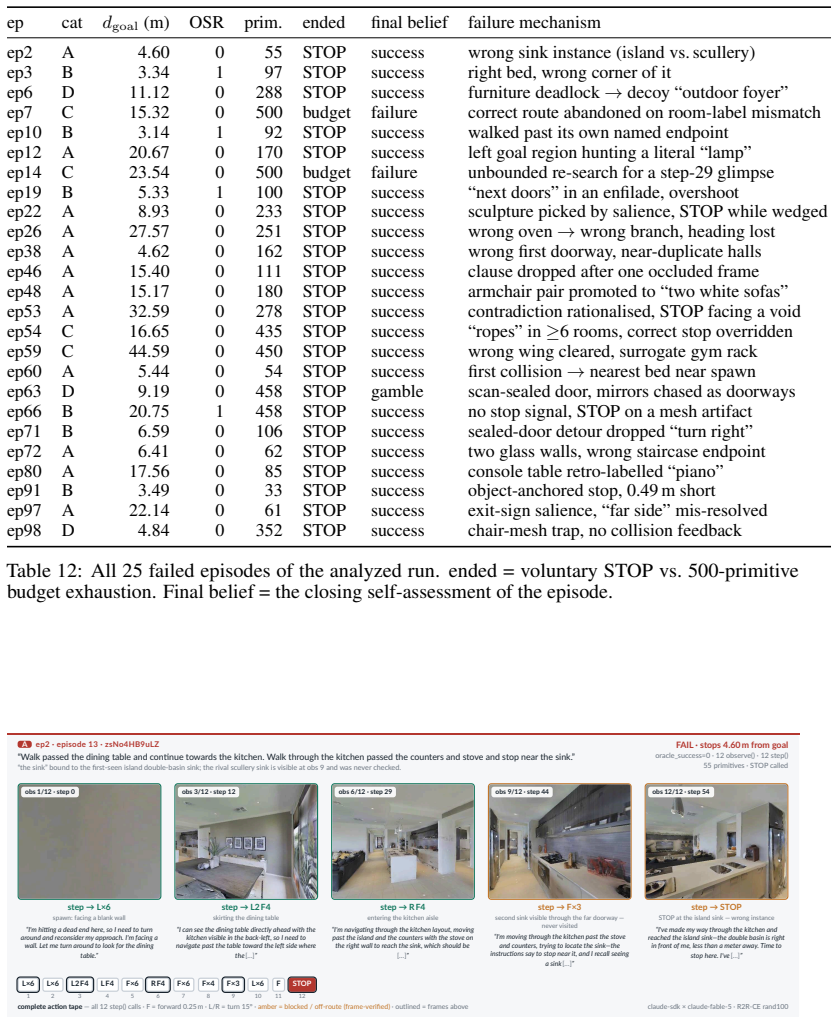
- Editorial extension: the failure audit suggests a cheap, testable intervention—give the agent a backtracking or return-to-last-branch tool and measure whether the 20 of 30 route-level failures shrink; the paper does not test this.
- Editorial extension: the context-growth bottleneck (final-turn contexts reaching 169k tokens) implies that context-windowing or selective memory could be evaluated as a minimal interface change; the paper only conjectures that history dilution is a likely mechanism.
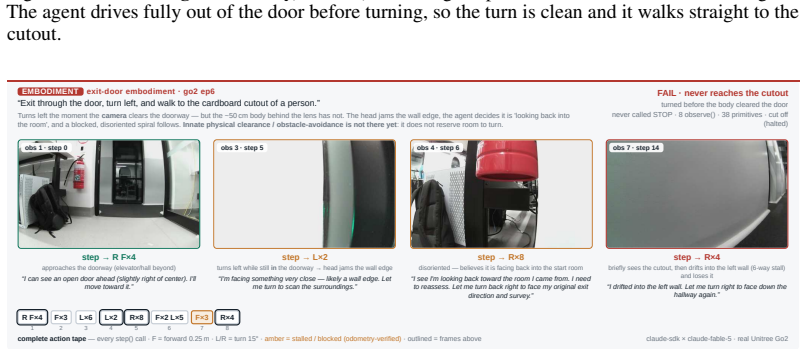
- Editorial extension: the physical-robot results—reasoning transfers but body awareness, motion verification, and spatial memory do not—point to interface design (collision and pose feedback) as a higher-leverage fix for real-world deployment than further model scaling.
Editorial analysis
A structured set of objections, weighed in public.
Referee Report
Summary. The paper proposes "agentic embodied control" and evaluates it through a minimal-interface probe: an off-the-shelf coding-agent harness controls a robotic simulator through two tools, observe() (monocular RGB) and step() (four discrete primitives), with no map, depth, memory, or navigation training. On the fixed 100-episode rand100 subset of R2R-CE val-unseen, replicated default-effort runs reach 70.7±3.5 SR (opus-5) and 68.3±1.5 SR (fable-5); a single max-effort fable-5 run reaches 78 SR; and a hybrid interface with an optional trained waypoint tool reaches 76.7±0.6 SR. The paper compares these numbers with AgenticNav (55 SR on the same subset) and with trained policies on the full val-unseen split, and concludes that navigation-specific scaffolding is not necessary for competitive zero-shot VLN. It also reports effort ablations, long-horizon RxR-CE stress, a two-pass audit of all 30 failures in one run, and a physical Unitree Go2 deployment.
Significance. If the result holds, this is a noteworthy empirical finding: a generic agent loop with only a monocular RGB camera and discrete actions can reach performance levels previously associated with navigation-specific architectures or large-scale training. The paper has real methodological strengths: a frozen-configuration protocol with an anti-override run registry (Table 8), three-run replication for the key default-effort cells, complete episode archives, a two-pass audit of all failures, and a physical-robot deployment. The failure taxonomy in §4.6 and the control-authority taxonomy in Appendix F are also useful. The main weakness is the population validity of the 100-episode subset: the headline comparison to trained industrial policies rests on an unvalidated subset, and the abstract's language outruns the paper's own careful caveats in Table 1.
major comments (2)
- [§4.1, Table 1, Abstract] The headline claim that the minimal-interface probe "rivals industrial-scale policies" rests on comparing rand100 results (68.3–78 SR) with trained-policy results on the full val-unseen split (Qwen-RobotNav 72, ABot-N1 71). Table 1's note correctly says the trained rows are reference-only, but the abstract and title still assert the comparison. The paper never shows that rand100 is representative of full val-unseen. The only difficulty calibration is a single human tester (94 SR, n=1, Table 1), which, if anything, suggests the subset may be easy. Appendix A.1 also states that the rand100 episodes differ from the release in spawn-heading and instruction-token fields; a changed spawn heading alters the initial observation and can change difficulty, so even same-episode comparisons are not automatically transportable. Without distributional statistics (route length, instruction length, goal
- [§4.3, Table 3, Abstract] The abstract's "fable-5 reaches 78% at maximum effort" is based on a single run. Given that the same cell at default effort has a sample standard deviation of 1.5 SR over three runs, and the paper itself cautions that "differences of only a few points are descriptive," the 78% value could be a favorable draw. The max-effort result is not load-bearing for the weaker same-subset claim, but it is used in the abstract as a headline result. Please report replications for the max-effort cell or clearly label it as a single-run exploratory observation and avoid giving it equal weight to the replicated default-effort cells.
minor comments (4)
- [Table 1] The "Human" row should state the number of trials and ideally some variance; a single tester with 94 SR is anecdotal, not a benchmark calibration.
- [Table 4 / §4.3] The phrasing "forced waypoints help weaker models but can hinder stronger ones" is supported by the VLNVerse reversal for sonnet-5 and fable-5, but on R2R-CE the two strongest models still gain slightly with waypoints (+0.7 and +1.3 SR). Consider clarifying that the "hinder" effect is benchmark-specific and mostly visible on VLNVerse.
- [§A.6] The Codex CLI version drift is disclosed, and the paper says no conclusion rests on GPT runs; this is good. To avoid readers over-weighting those rows, a one-sentence repetition of this caveat near Table 2 would help.
- [§4.5] The RxR-CE comparison is appropriately hedged as not isolating cause. Please report the number of RxR-CE episodes used (stated as 100 English episodes) in the main text rather than only in the table caption.
Circularity Check
No significant circularity: the paper is an externally benchmarked evaluation with native metrics, explicit split caveats, and no fitted parameter renamed as a prediction.
full rationale
This is an empirical evaluation paper rather than a derivation, so the circularity patterns mainly reduce to whether any comparison is forced by construction or by self-citation. The headline success rates are measured with Habitat-native metrics computed driver-side, and the agent is explicitly barred from observing its own score: per A.1, 'the shortest-path and oracle sensors present in the raw observation dictionary reach the tool bridge but are discarded there, never forwarded.' The central comparison to trained industrial policies is not hidden: Table 1 states, 'Trained rows use the full val-unseen split, so they serve only as a reference for the performance range,' and section 4.2 says 'The comparison is not controlled because the systems use different models and serving paths.' The same-subset comparison to AgenticNav (55 SR on rand100) is an external result, not a self-citation. The rand100 subset originates from Open-Nav, which shares an author with the present paper, but it is used only as a fixed episode sample; the paper does not invoke Open-Nav's authority to justify the outcome, and the metric itself is standard VLN-CE SR. The waypoint predictor used in the hybrid/waypoint cells comes from the SmartWay lineage with overlapping authorship, but the paper explicitly flags that these cells are not zero-shot ('the waypoint cells are therefore not zero-shot in the strict sense of the main board'), so no zero-shot capability is being claimed through that module. There is no fitted parameter that is later reported as a prediction, no uniqueness theorem imported from prior work, and no ansatz smuggled in by self-citation. The cross-split comparison to Qwen-RobotNav and ABot-N1 on full val-unseen is a genuine validity limitation: if rand100 is easier than the full split, the 'rivals industrial-scale policies' phrasing is unsupported. That is a benchmarking/representativeness concern, not circularity, and the paper's own Table 1 note already downgrades those rows to a 'reference for the performance range.' Under the stated rules, circularity requires quoting a specific reduction to the paper's inputs, and no such reduction is present.
Axiom & Free-Parameter Ledger
free parameters (4)
- rand100 episode subset (episodes 0-99, with modified spawn-heading and instruction-token fields) =
n=100 of R2R-CE val-unseen
- Frozen task briefing (system prompt) =
Verbatim text in A.3
- Budget/effort envelope =
200 LLM calls, 500 primitives, 2400s timeout; vendor-default effort (Claude resolves to 'high')
- Waypoint predictor (SmartWay-lineage RGB-D, depth-driven deployment) =
Depth-driven; RGB branch unwired (zeroed)
axioms (4)
- domain assumption R2R-CE val-unseen with the 3 m geodesic STOP criterion is a meaningful proxy for embodied navigation competence
- domain assumption The closed proprietary models (fable-5, opus-5, gpt-5.5, etc.) exist as described and their serving behavior is stable
- domain assumption External self-reported numbers (AgenticNav 55, Qwen-RobotNav 72/76.7, FAST-EQA 69.2) are accurately transcribed
- domain assumption The 100-episode rand100 subset resembles the full val-unseen distribution
invented entities (2)
-
agentic embodied control
no independent evidence
-
Autonomous Embodied Agent (AutoEA)
no independent evidence
read the original abstract
Autonomous embodied agents must sustain a long decision-making loop that involves perceiving, acting, verifying, and self-correcting over many steps. Current systems sustain this loop through task-specific workflows or embodied policies. However, these fixed workflows and policies offer limited flexibility across environments and often lack effective recovery strategies when execution goes wrong. We find that a general-purpose agent can instead sustain the loop on its own. We term this organization agentic embodied control: the reasoning model directly steers every action, keeping reasoning and control aligned. Using zero-shot navigation as a controlled testbed, we equip three coding-agent harnesses with only a monocular RGB camera and discrete actions. At default effort, replicated opus-5 runs average $70.7\pm3.5$% success, while fable-5 reaches 78% at maximum effort. When a trained waypoint tool is offered alongside primitives, the hybrid fable-5 agent reaches $76.7\pm0.6$% at default effort, using half the environment steps and under a quarter of the wall time. Across the ablations, model choice dominates performance variation. Observed harness differences are modest, and forced waypoints help weaker models but can hinder stronger ones. Although longer horizons, latency, and context growth remain barriers to sustained autonomy, these results show that a general-purpose model can already achieve competitive embodied control without a navigation policy.
Figures






Reference graph
Works this paper leans on
-
[1]
J. Zhang, K. Wang, R. Xu, G. Zhou, Y . Hong, X. Fang, Q. Wu, Z. Zhang, and H. Wang. Navid: Video-based vlm plans the next step for vision-and-language navigation.arXiv preprint arXiv:2402.15852, 2024
Pith/arXiv arXiv 2024
-
[2]
M. Wei, C. Wan, X. Yu, T. Wang, Y . Yang, X. Mao, C. Zhu, W. Cai, H. Wang, Y . Chen, et al. Streamvln: Streaming vision-and-language navigation via slowfast context modeling.arXiv preprint arXiv:2507.05240, 2025
Pith/arXiv arXiv 2025
-
[3]
G. Zhou, Y . Hong, and Q. Wu. Navgpt: Explicit reasoning in vision-and-language navigation with large language models. InProceedings of the AAAI Conference on Artificial Intelligence, volume 38, pages 7641–7649, 2024
2024
-
[4]
J. Chen, B. Lin, R. Xu, Z. Chai, X. Liang, and K.-Y . Wong. Mapgpt: Map-guided prompting with adaptive path planning for vision-and-language navigation. InProceedings of the 62nd Annual Meeting of the Association for Computational Linguistics (Volume 1: Long Papers), pages 9796–9810, 2024
2024
-
[5]
B. Lin, Y . Nie, Z. Wei, J. Chen, S. Ma, J. Han, H. Xu, X. Chang, and X. Liang. Navcot: Boosting llm-based vision-and-language navigation via learning disentangled reasoning.IEEE Transactions on Pattern Analysis and Machine Intelligence, 2025
2025
-
[6]
G. Zhao, G. Li, and Y . Yu. Navgemini: a multi-modal llm agent for vision-and-language navigation.Visual Intelligence, 4(1), 2026
2026
-
[7]
R. Gong, Y . Guo, J. Hu, J. Kong, X. Leng, T. Li, W. Li, F. Liu, Z. Liu, J. Lu, M. Luo, C. Ming, Y . Shen, J. Tao, Z. Wang, M. Yin, et al. ABot-N1: Toward a general visual language navigation foundation model, 2026. URL https://arxiv.org/abs/2607.10383
Pith/arXiv arXiv 2026
-
[8]
M. Wei, C. Wan, J. Peng, X. Yu, Y . Yang, D. Feng, W. Cai, C. Zhu, T. Wang, J. Pang, and X. Liu. Ground slow, move fast: A dual-system foundation model for generalizable vision-and-language navigation, 2025. URL https://arxiv.org/abs/2512.08186
arXiv 2025
-
[9]
S. Yao, J. Zhao, D. Yu, N. Du, I. Shafran, K. Narasimhan, and Y . Cao. ReAct: Synergizing reasoning and acting in language models. InThe Eleventh International Conference on Learning Representations, 2023
2023
-
[10]
C. E. Jimenez, J. Yang, A. Wettig, S. Yao, K. Pei, O. Press, and K. R. Narasimhan. SWE-bench: Can language models resolve real-world github issues? InThe Twelfth International Conference on Learning Representations, 2024. URL https://openreview.net/forum?id=VTF8yNQM66
2024
-
[11]
J. Yang, C. E. Jimenez, A. Wettig, K. Lieret, S. Yao, K. Narasimhan, and O. Press. SWE-agent: Agent-computer interfaces enable automated software engineering. InNeurIPS, 2024
2024
-
[12]
Anderson, Q
P. Anderson, Q. Wu, D. Teney, J. Bruce, M. Johnson, N. Sünderhauf, I. Reid, S. Gould, and A. Van Den Hengel. Vision-and-language navigation: Interpreting visually-grounded navigation instructions in real environments. InProceedings of the IEEE conference on computer vision and pattern recognition, pages 3674–3683, 2018
2018
-
[13]
Krantz, E
J. Krantz, E. Wijmans, A. Majumdar, D. Batra, and S. Lee. Beyond the nav-graph: Vision-and- language navigation in continuous environments. InEuropean Conference on Computer Vision, pages 104–120. Springer, 2020
2020
-
[14]
J. Zhang, G. Zhou, H. Yin, Y . Huang, Z. Lei, Q. Peng, H. Yuan, J. Zhang, X. Guo, X. Chen, A. Yang, F. Huang, J. Lin, D. Liu, J. Zhou, Z. Yu, J. Fan, Z. Liang, P. Lin, Y . Wang, A. Chen, K. Yan, X. Xu, J. Li, L. Hu, M. Zhang, S. Li, W. Xiao, S. Bai, X. Ren, C. Lv, C. Wu, and X.-H. Chen. Qwen-RobotNav technical report: A scalable navigation model designed ...
Pith/arXiv arXiv 2026
- [15]
-
[16]
Driess, F
D. Driess, F. Xia, M. S. M. Sajjadi, C. Lynch, A. Chowdhery, B. Ichter, A. Wahid, J. Tompson, Q. Vuong, T. Yu, W. Huang, Y . Chebotar, P. Sermanet, D. Duckworth, S. Levine, V . Vanhoucke, K. Hausman, M. Toussaint, K. Greff, A. Zeng, I. Mordatch, and P. Florence. PaLM-E: An embodied multimodal language model. InProceedings of the 40th International Confere...
2023
-
[17]
Brohan, N
A. Brohan, N. Brown, J. Carbajal, Y . Chebotar, X. Chen, K. Choromanski, T. Ding, D. Driess, A. Dubey, C. Finn, P. Florence, C. Fu, M. G. Arenas, K. Gopalakrishnan, K. Han, K. Hausman, A. Herzog, J. Hsu, B. Ichter, A. Irpan, N. Joshi, R. Julian, D. Kalashnikov, Y . Kuang, I. Leal, L. Lee, T.-W. E. Lee, S. Levine, Y . Lu, H. Michalewski, I. Mordatch, K. Pe...
2023
-
[18]
M. J. Kim, K. Pertsch, S. Karamcheti, T. Xiao, A. Balakrishna, S. Nair, R. Rafailov, E. Foster, G. Lam, P. Sanketi, Q. Vuong, T. Kollar, B. Burchfiel, R. Tedrake, D. Sadigh, S. Levine, P. Liang, and C. Finn. OpenVLA: An open-source vision-language-action model, 2024
2024
-
[19]
Black, N
K. Black, N. Brown, D. Driess, A. Esmail, M. Equi, C. Finn, N. Fusai, L. Groom, K. Hausman, B. Ichter, S. Jakubczak, T. Jones, L. Ke, S. Levine, A. Li-Bell, M. Mothukuri, S. Nair, K. Pertsch, L. X. Shi, J. Tanner, Q. Vuong, A. Walling, H. Wang, and U. Zhilinsky.π0: A vision-language- action flow model for general robot control, 2024
2024
-
[20]
Y . Qiao, W. Lyu, H. Wang, Z. Wang, Z. Li, Y . Zhang, M. Tan, and Q. Wu. Open-nav: Exploring zero-shot vision-and-language navigation in continuous environment with open-source llms. In 2025 IEEE International Conference on Robotics and Automation (ICRA), pages 6710–6717. IEEE, 2025
2025
-
[21]
X. Shi, Z. Li, W. Lyu, J. Xia, F. Dayoub, Y . Qiao, and Q. Wu. Smartway: Enhanced waypoint prediction and backtracking for zero-shot vision-and-language navigation. In2025 IEEE/RSJ International Conference on Intelligent Robots and Systems (IROS), pages 16923–16930. IEEE, 2025
2025
-
[22]
Y . Long, X. Li, W. Cai, and H. Dong. Discuss before moving: Visual language navigation via multi-expert discussions. In2024 IEEE International Conference on Robotics and Automation (ICRA), pages 17380–17387. IEEE, 2024
2024
-
[23]
Y . Long, W. Cai, H. Wang, G. Zhan, and H. Dong. Instructnav: Zero-shot system for generic instruction navigation in unexplored environment. InConference on Robot Learning, pages 2049–2060. PMLR, 2025
2049
-
[24]
D. Li, W. Chen, and X. Lin. TINA: Think, interaction, and action framework for zero-shot vision language navigation, 2024. URL https://arxiv.org/abs/2403.08833
Pith/arXiv arXiv 2024
-
[25]
S. Jeong, G.-C. Kang, J. Kim, and B.-T. Zhang. Zero-shot vision-and-language navigation with collision mitigation in continuous environment, 2024. URL https://arxiv.org/abs/2410.17267
Pith/arXiv arXiv 2024
-
[26]
H. Li, X. Dong, H. Jiang, Y . Zhou, and X. Ma. CMMR-VLN: Vision-and-language navigation via continual multimodal memory retrieval, 2026. URL https://arxiv.org/abs/2603.07997. 12
arXiv 2026
-
[27]
Z. Li, S. Li, Z. Zhang, B. Li, and S. Zhou. DV-VLN: Dual verification for reliable LLM-based vision-and-language navigation, 2026. URL https://arxiv.org/abs/2601.18492
arXiv 2026
-
[28]
J. Bjorck, Z. Li, Y . Man, J. Wang, A.-C. Cheng, S. Liu, S. Wang, Z. Yu, A. Badki, S. Birchfield, V . Blukis, Y . Chebotar, S. Chen, S. Leng, Y .-C. Chou, T. Ding, B. Li, Z. Luo, H. Su, J. Tremblay, T. Wang, B. Wen, J. Wu, X. Xie, H. Ye, H. Yin, K. R. Zentner, L. Gui, Y .-X. Wang, Y . Zhu, L. Fan, and J. Kautz. Vesta: A generalist embodied reasoning model...
Pith/arXiv arXiv 2026
-
[29]
J. Zhou, S. Lin, J. Li, S. Fu, G. Zhou, and Q. Wu. Automating the design of embodied agent architectures, 2026. URL https://arxiv.org/abs/2606.30111
Pith/arXiv arXiv 2026
-
[30]
mini-swe-agent: The minimal AI software engineering agent
The SWE-agent team. mini-swe-agent: The minimal AI software engineering agent. https: //github.com/SWE-agent/mini-swe-agent, 2025
2025
-
[31]
G. Wang, Y . Xie, Y . Jiang, A. Mandlekar, C. Xiao, Y . Zhu, L. Fan, and A. Anandkumar. V oyager: An open-ended embodied agent with large language models.Transactions on Machine Learning Research, 2024
2024
-
[32]
Y . Li, C. Li, H. Shi, J. Luo, J. Cai, M. Yang, and T. Qin. AgenticNav: Zero-shot vision-and- language navigation as a tool-calling harness, 2026. URL https://arxiv.org/abs/2606.10577
Pith/arXiv arXiv 2026
-
[33]
Savva, A
M. Savva, A. Kadian, O. Maksymets, Y . Zhao, E. Wijmans, B. Jain, J. Straub, J. Liu, V . Koltun, J. Malik, et al. Habitat: A platform for embodied ai research. InProceedings of the IEEE/CVF International Conference on Computer Vision, pages 9339–9347, 2019
2019
-
[34]
A.-C. Cheng, Y . Ji, Z. Yang, Z. Gongye, X. Zou, J. Kautz, E. Bıyık, H. Yin, S. Liu, and X. Wang. NaVILA: Legged robot vision-language-action model for navigation, 2024. URL https://arxiv.org/abs/2412.04453
Pith/arXiv arXiv 2024
-
[35]
Z. Wang, X. Yu, Y . Rao, Y . Ling, Y . Li, O. Wang, M. Gao, Y . Zhou, Y . Liang, Z. Liu, Y . Zhang, R. Huang, X. Xu, B. Yuan, Y . Yuan, X. Tan, H. Zhang, Y . Huang, S. Zhang, H. Wu, H. Hu, and Z. Zhang. Hy-Embodied-VLM-1.0: Efficient physical-world agents, 2026. URL https: //arxiv.org/abs/2607.12894
Pith/arXiv arXiv 2026
-
[36]
R. Dang, J. Guo, B. Hou, S. Leng, K. Li, X. Li, J. Liu, Y . Mao, Z. Wang, Y . Yuan, M. Zhu, X. Lin, Y . Bai, Q. Jiang, Y . Zhao, M. Zeng, J. Gao, Y . Jiang, J. Cen, S. Huang, L. Wang, W. Zhang, C. Liu, J. Yang, S. Lu, and D. Zhao. RynnBrain: Open embodied foundation models,
-
[37]
X. Xue, J. Hu, M. Luo, S. Xie, J. Chen, Z. Xie, K. Quan, W. Guo, M. Xu, and Z. Chu. OmniNav: A unified framework for prospective exploration and visual-language navigation, 2025. URL https://arxiv.org/abs/2509.25687
arXiv 2025
-
[38]
Claude agent SDK
Anthropic. Claude agent SDK. https://docs.anthropic.com/en/api/agent-sdk, 2025
2025
-
[39]
Unrolling the Codex agent loop
OpenAI. Unrolling the Codex agent loop. https://openai.com/index/ unrolling-the-codex-agent-loop/, 2026
2026
-
[40]
S. Lin, Z. Li, X. Zhao, G. Zhou, L. Wang, R. Wei, R. Tang, J. Li, H. Wang, J. Pang, A. van den Hengel, J. Liu, and Q. Wu. VLNVerse: A benchmark for vision-language navigation with versatile, embodied, realistic simulation and evaluation, 2025. URL https://arxiv.org/abs/2512. 19021
2025
-
[41]
Y . Hong, Z. Wang, Q. Wu, and S. Gould. Bridging the gap between learning in discrete and continuous environments for vision-and-language navigation. InProceedings of the IEEE/CVF Conference on Computer Vision and Pattern Recognition, pages 15439–15449, 2022. 13
2022
-
[42]
A. Ku, P. Anderson, R. Patel, E. Ie, and J. Baldridge. Room-across-room: Multilingual vision-and-language navigation with dense spatiotemporal grounding. InProceedings of the 2020 Conference on Empirical Methods in Natural Language Processing (EMNLP), pages 4392–4412, 2020
2020
-
[43]
Ouyang, J
L. Ouyang, J. Wu, X. Jiang, D. Almeida, C. L. Wainwright, P. Mishkin, C. Zhang, S. Agarwal, K. Slama, A. Ray, et al. Training language models to follow instructions with human feedback. Advances in Neural Information Processing Systems, 35:27730–27744, 2022
2022
-
[44]
Z. Shao, P. Wang, Q. Zhu, R. Xu, J. Song, X. Bi, H. Zhang, M. Zhang, Y . K. Li, Y . Wu, and D. Guo. Deepseekmath: Pushing the limits of mathematical reasoning in open language models. arXiv preprint arXiv:2402.03300, 2024
Pith/arXiv arXiv 2024
-
[45]
DeepSeek-AI. Deepseek-r1: Incentivizing reasoning capability in llms via reinforcement learning.arXiv preprint arXiv:2501.12948, 2025
Pith/arXiv arXiv 2025
- [46]
-
[47]
Model context protocol
Anthropic. Model context protocol. https://modelcontextprotocol.io, 2024
2024
-
[48]
LiteLLM documentation
BerriAI. LiteLLM documentation. https://docs.litellm.ai/, 2026
2026
-
[49]
A. Z. Ren, J. Clark, A. Dixit, M. Itkina, A. Majumdar, and D. Sadigh. Explore until confident: Efficient exploration for embodied question answering. InRobotics: Science and Systems (RSS), 2024
2024
-
[50]
{instruction}
H. Zhang, N. Savaliya, F. Siddiqui, and E. Sachdeva. FAST-EQA: Efficient embodied ques- tion answering with global and local region relevancy. InIEEE/CVF Winter Conference on Applications of Computer Vision (WACV), 2026. 14 A Experimental Settings This appendix records the complete experimental configuration. The authoritative source is the released run r...
2026
-
[53]
New goals may interrupt, revise, or depend on earlier ones
Continuous multi-task service.The system accepts successive goals at run time and completes feasible tasks without routine process, session, or environment reset. New goals may interrupt, revise, or depend on earlier ones. Task boundaries do not erase the robot’s operational context
-
[54]
It manages what to retain, forget, or consolidate rather than replaying the complete raw interaction history
Persistent situated state.The system maintains task-relevant state across goals, such as household layout, object locations, user preferences, unfinished work, and prior failures. It manages what to retain, forget, or consolidate rather than replaying the complete raw interaction history. The state may reside in maps, external stores, context, or learned ...
-
[55]
Closed-loop monitoring and recovery.The system checks the effects of its actions rather than assuming successful execution. It detects loss of progress, localization or tool failures, blocked motion, and relevant environmental change, then re-observes, backtracks, or re-plans to restore goal-directed operation. Human rescue is an exceptional response to c...
-
[56]
Resource-bounded self-maintenance.The system operates under explicit budgets for decision latency, compute, model-call rate, retained state and storage, and energy use. Context and retained state are compacted or offloaded before they grow without bound, and the robot manages physical needs such as charging rather than relying on a reset to restore resources
-
[57]
dual-system,
Safe adaptation and escalation.A household is shared with people and changes over time. The system updates its state and plans as users, object locations, and routines change, while respecting operational and safety constraints. It recognizes uncertainty or conditions it cannot safely resolve, stops when necessary, and requests help selectively rather tha...
-
[200]
the route should be around 3 hops with a path length of about 10 meters, but I’ve already traveled 15+
The plain gpt-5.6 identifier is not served to ChatGPT-subscription accounts, so these runs use the account’sgpt-5.6-solvariant. Effort tiers are given in section A.4. A.7 Waypoint interface The waypoint arm of table 4 replaces the primitive action space with three tools. observe() renders a 12-view RGB-D panorama, feeds it to a trained candidate-waypoint ...
2026
-
[2026]
URL https://arxiv.org/abs/2602.14979
discussion (0)
Sign in with ORCID, Apple, or X to comment. Anyone can read and Pith papers without signing in.