REVIEW 4 major objections 5 minor 61 references
SU(4) Heisenberg model on the honeycomb lattice with exchange-frustrated perturbations: implications for twistronics and Mott insulators
T0 review · 4 major / 5 minor · reviewed 2026-08-14 · deepseek-v4-flash
Pith's one-line read The paper claims that a gapless quantum spin-orbital liquid, originally found at the SU(4)-symmetric point of the honeycomb Kugel-Khomskii model, persists over a wide region of parameter space, up to Hund's coupling \(\eta \approx 0.175\)…
desk verdict Solid variational study that probably confirms a wide QSOL region, but the QSOL-NCD boundary rests on an approximation the authors admit fails near the SU(4) point. read the letter →
The pith
A machine-rendered reading of the paper's core claim, the machinery that carries it, and where it could break.
The reading
What carries the argument
The central object is the extended Kugel-Khomskii Hamiltonian \(H(\xi, \eta)\) on the honeycomb lattice, written with spin projectors and bond-dependent orbital operators, where \(\xi = t'/t\) is the orbital-anisotropic hopping ratio and \(\eta = J_H/U\) is the dimensionless Hund's coupling; at \((0,0)\) it reduces to the SU(4) Heisenberg model. The paper's argument runs on energy competition: a Gutzwiller-projected parton wavefunction with \(\pi\) flux per hexagon represents the quantum spin-orbital liquid; linear flavor-wave theory, cross-checked by a variational wavefunction, gives the energy of the ferromagnetic antiferro-orbital state; and variational Monte Carlo with a spin-dimerizing ansatz over a vortex orbital background represents the noncollinear spin-dimer crystal. The machinery identifies which of these states has the lowest energy at each parameter and flags instabilities through complex or negative flavor-wave dispersions.
What would settle it
Evaluate the NCD state at \((\xi, \eta) \approx (0.2, 0.05)\) with a wavefunction that retains spin-orbital entanglement, for example exact diagonalization on a 24-site cluster or a projected entangled-pair state, and compare its energy with the \(\pi\)-flux quantum spin-orbital liquid; if the entangled NCD energy rises above the liquid energy or the dimer order parameter vanishes, the reported QSOL-NCD boundary is an artifact of the decoupling.
Extended reading notes
Core claim
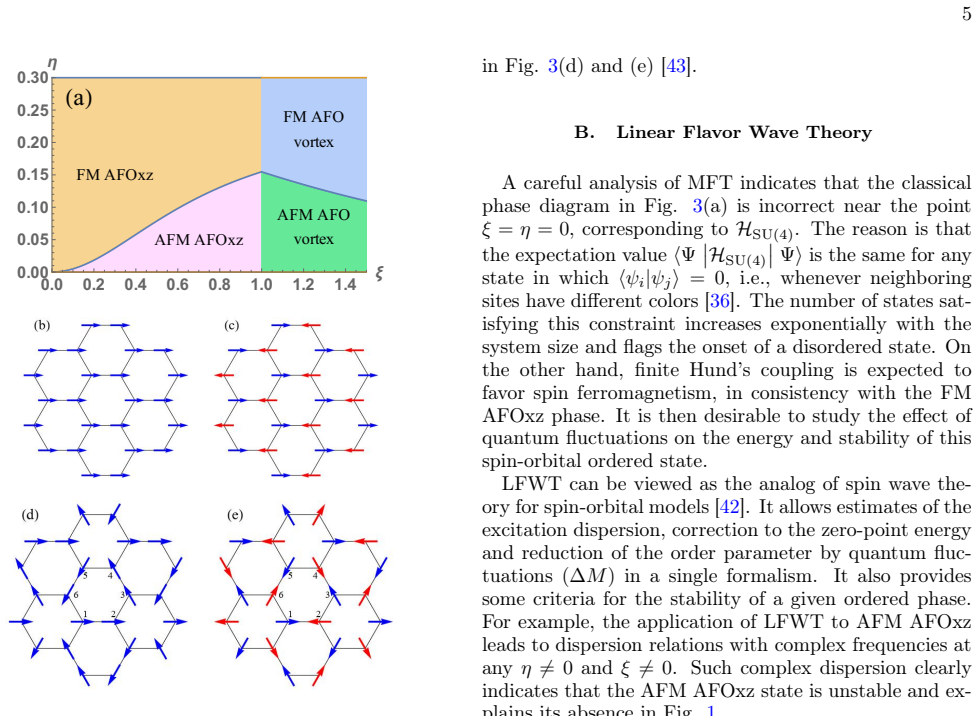
On the paper's own terms, the discovery is that the gapless \(\pi\)-flux quantum spin-orbital liquid, previously proposed as the ground state at the SU(4)-symmetric point, is not destroyed by small or moderate symmetry-breaking interactions. It remains the lowest-energy state over a substantial region of the extended Kugel-Khomskii model's phase diagram, giving way to a ferromagnetic antiferro-orbital ordered state only near \(\eta \approx 0.175\), a boundary that is nearly independent of \(\xi\), and to a noncollinear spin-dimer (NCD) crystal for larger orbital-dependent hopping, near \(\xi \approx 0.2\). The phase diagram is assembled by comparing variational Monte Carlo energies of the spin-orbital liquid and candidate valence-bond states with linear flavor-wave energies of ordered states, and the paper argues that the liquid is additionally stable against tetramerization.
Load-bearing premise
The load-bearing premise is that the mean-field decoupling used to build the noncollinear spin-dimer crystal remains accurate at \(\xi \approx 0.2\), even though the paper states that this decoupling neglects spin-orbital entanglement and should break down close to the SU(4) point.
Editorial extensions
If this is right
- The quantum spin-orbital liquid is stable against tetramerization around the SU(4) point, so a simple valence-bond crystal instability does not preempt the liquid.
- In quarter-filled twisted bilayer graphene, increasing Hund's coupling should drive a transition from the spin-orbital liquid to a spin-polarized antiferro-orbital state, connecting the model to observed spin-polarized states.
- For dominant orbital-dependent hopping, \(\xi \gtrsim 0.2\), the ground state becomes a noncollinear spin-dimer crystal with vortex orbital order.
- The antiferromagnetic antiferro-orbital state is unstable once quantum fluctuations are included, so it does not appear in the final phase diagram.
- The spin-orbital liquid boundary at \(\eta \approx 0.175\) is essentially independent of \(\xi\) for small \(\xi\), meaning the liquid phase is not confined to the high-symmetry point.
Reading between the lines
- Beyond the paper: if the spin-orbital-liquid-to-ferromagnet boundary is nearly vertical in \(\eta\), moiré devices could switch between the liquid and a spin-polarized state by electrostatic tuning of the effective Hund's coupling, a testable knob in twisted bilayer graphene.
- Beyond the paper: because the NCD mean-field decoupling neglects spin-orbital entanglement, the published boundary near \(\xi \approx 0.2\) is only an estimate; a fully entangled treatment could enlarge the spin-orbital liquid region or shift the QSOL-NCD boundary.
- Beyond the paper: the same energy-comparison strategy could be applied to triangular-lattice Kugel-Khomskii models, such as those proposed for trilayer graphene/hBN heterostructures, by replacing the honeycomb \(\pi\)-flux ansatz with the appropriate parton state.
Signed reviews
Editorial analysis
A structured set of objections, weighed in public.
Referee Report
Summary. The paper studies a Kugel-Khomskii model on the honeycomb lattice with an SU(4)-symmetric point, extended by Hund's coupling η and orbital-dependent hopping ξ. Using mean-field theory, linear flavor-wave theory (LFWT), a Huse-Elser variational ansatz, and variational Monte Carlo (VMC), the authors propose the phase diagram in Fig. 1 with three phases: a π-flux quantum spin-orbital liquid (QSOL), a ferromagnetic antiferro-orbital state (FM AFOxz), and a non-collinear spin-dimer state with ferro-orbital vortex order (NCD). The central claim is that the QSOL survives away from the SU(4) point over a wide region, giving way to FM AFOxz at η ≈ 0.175 and to NCD for ξ ≳ 0.2.
Significance. If correct, the paper establishes that a gapless spin-orbital liquid is not an isolated accident of the fine-tuned SU(4) point but survives realistic symmetry-breaking perturbations, which is of direct relevance to candidate materials such as Ba3CuSb2O9 and to models of twisted bilayer graphene. The study combines several standard techniques and includes useful cross-checks: the Huse-Elser variational calculation confirms the LFWT energy of FM AFOxz along ξ = 0, and VMC tests the QSOL against tetramerized and dimerized competitors. However, the phase diagram is ultimately a variational energy comparison over a limited set of trial states, and the manuscript does not report statistical or finite-size extrapolation errors for the VMC energies.
major comments (4)
- [§IV.B, Fig. 6] The NCD state is constructed by a mean-field decoupling that freezes the orbital sector into the ferro-orbital vortex pattern and solves only the spin sector; the authors explicitly state that this approximation 'neglects spin-orbital entanglement' and 'should break down close to the SU(4) point' (Sec. IV.B). The QSOL-NCD boundary is placed at ξ ≈ 0.2 and small η, which is not far from the SU(4) point. If orbital fluctuations and spin-orbital entanglement lower the true NCD energy relative to the frozen-orbital estimate, the NCD state wins at smaller ξ and the advertised QSOL region shrinks toward a narrow sliver around ξ = 0. Because the central quantitative claim is the survival of the QSOL up to η ≈ 0.175 for ξ ≲ 0.2, this uncontrolled approximation on a competing state at the boundary is load-bearing. I recommend either improving the NCD trial state to allow orbital fluctuations or spin-orbital entanglement, or benchmarking the NCD energy near the boundary against exact diagonalization or iPEPS.
- [§IV.A, Fig. 6] The VMC energies in Fig. 6 are presented as single curves with no statistical error bars and no finite-size extrapolation to the thermodynamic limit, although the simulations are done for L = 6, 12, and 18. The phase boundaries, such as the QSOL–FM AFOxz crossing at η ≈ 0.175 for ξ = 0.2 and the QSOL–NCD crossings at ξ = 0.25, are obtained directly from crossings of these curves. At ξ = 0.25 the QSOL and NCD energies appear close over a range of η, and without uncertainties the location or even the existence of some boundaries is not quantitatively established. Reporting standard errors on the energies and showing an L → ∞ extrapolation for at least the crossing points is necessary to support the phase diagram.
- [§III.B, §IV.B] The gray region in Fig. 1 marks an LFWT instability of the FM AFOxz phase, but the authors explicitly state that no competitive VMC candidate is found for this region. The phase diagram is therefore incomplete there, and the summary statement of 'three distinct phases' in Fig. 1 does not describe this part of the parameter space. This does not invalidate the QSOL claim, but the manuscript should prominently state that the ground state in the gray region is unidentified, and ideally extend the variational search to partially polarized or other spin-orbital entangled states, as suggested by Ref. [31].
- [§IV.A] The QSOL trial wavefunction is the SU(4)-symmetric π-flux parton state of Ref. [36]; within the QSOL family, the authors do not consider symmetry-broken parton ansätze, such as those with a staggered chemical potential or bond modulations that break the SU(4) symmetry. The claim that the QSOL 'covers an appreciable portion of the phase diagram' is therefore a statement about this specific variational state. Adding a class of SU(4)-breaking parton states (while keeping the π-flux structure) would strengthen the evidence that the QSOL region is not an artifact of the high symmetry imposed on the trial wavefunction.
minor comments (5)
- [§III.B, Fig. 4] In the text, 'Figure 4(b) shows ωλ(k) for ξ = 0 in solid lines' appears to refer to the ξ = 0 panel; Fig. 4(a) is the ξ = 0 case and Fig. 4(b) is ξ = 0.4. Please correct the cross-reference.
- [§IV.B] The discussion of the tetramerized state says 'we modulate the sign of χ̃ij as in Fig. 5(d)', but Fig. 5 only contains panels (a) and (b); the intended reference is likely Fig. 5(a), the π-flux pattern.
- [§IV.A] The Monte Carlo parameters (∼10^5 sweeps with half discarded) are reported, but no autocorrelation time or number of statistically independent samples is given; adding this information would allow the reader to assess the statistical quality of the VMC energies in Fig. 6 and Fig. 8.
- [§II.B] The statement that the mean-field phase diagram is symmetric under ξ ↦ −ξ is clear for the classical energy, but the full quantum Hamiltonian in Eq. (8) contains terms linear in ξ; please clarify whether the symmetry is an exact property of the model or only of the classical/mean-field energy after an orbital transformation.
- [§IV.B, Fig. 7(c)] For the NCD state, the text refers to a 'Kekulé arrangement' of spin dimers; since there are two inequivalent Kekulé dimer coverings on the honeycomb lattice, please specify which covering is used in Fig. 7(c).
Circularity Check
No significant circularity: the QSOL stability claim rests on VMC energy comparisons against independent trial states over swept Hamiltonian parameters.
full rationale
The paper's central claim, that the π-flux QSOL survives finite Hund's coupling η and orbital-dependent hopping ξ, is established by variational Monte Carlo energy competition among three distinct trial states: the π-flux QSOL taken from the independent prior work of Corboz et al. (Ref. [36]), the FM AFOxz ordered state treated by linear flavor-wave theory and Huse-Elser variational states, and the NCD valence-bond state built from a spin-orbital mean-field decoupling. The Hamiltonian parameters ξ and η are swept, not fitted, and the phase boundaries are energy crossings of these independent trial states. The QSOL ansatz is not constructed from the Hamiltonian's own outputs; it is an externally proposed parton state whose energy is evaluated directly on model (8). Self-citations to Refs. [16, 18, 20] appear only as methodological citations for parton-VMC techniques, not as load-bearing evidence for the survival of the QSOL. The NCD mean-field decoupling is explicitly acknowledged to neglect spin-orbital entanglement and to break down near the SU(4) point (Sec. IV.B), which is a legitimate accuracy limitation affecting the placement of the QSOL-NCD boundary, but it is not a circularity: the NCD energy is still computed independently from the QSOL energy, and the comparison does not reduce to an identity or to the fitted input being renamed as a prediction. No step in the derivation chain defines a predicted quantity in terms of the target result, and no uniqueness theorem or ansatz is smuggled in via self-citation. The result is therefore self-contained against external benchmarks, with any residual concerns belonging to approximation error rather than circularity.
Assumptions & free parameters
assumptions (4)
- domain assumption The effective Hamiltonian Eq. (5) is a faithful strong-coupling expansion of the Hubbard model for t,t' << U,JH.
- domain assumption Each site hosts a spin-1/2 and an orbital-1/2 doublet, and C3 symmetry fixes the hopping matrix to the σ/π form in Eq. (4).
- domain assumption LFWT truncates the Holstein-Primakoff expansion at quadratic order, and the FM AFOxz ground-state energy uses only the λ=1,2 modes, with the other modes stated not to affect the energy.
- domain assumption The variational trial set (π-flux QSOL, FM AFOxz, NCD, tetramer, collinear dimer, partially polarized spins) contains the relevant low-energy states of model (5).
Cite this review
Pith. "Pith review of SU(4) Heisenberg model on the honeycomb lattice with exchange-frustrated perturbations: implications for twistronics and Mott insulators." pith.science (2026). https://pith.science/paper/RIKZSVE6
@misc{pith2026190809224,
  author       = {Pith},
  title        = {Pith review of: SU(4) Heisenberg model on the honeycomb lattice with exchange-frustrated perturbations: implications for twistronics and Mott insulators},
  year         = {2026},
  howpublished = {\url{https://pith.science/paper/RIKZSVE6}},
  note         = {Machine review of arXiv:1908.09224}
}
abstract
The SU(4)-symmetric spin-orbital model on the honeycomb lattice was recently studied in connection to correlated insulators such as the $e_{g}$ Mott insulator Ba$_{3}$CuSb$_{2}$O$_{9}$ and the insulating phase of magic-angle twisted bilayer graphene at quarter filling. Here we provide a unified discussion of these systems by investigating an extended model that includes the effects of Hund's coupling and anisotropic, orbital-dependent exchange interactions. Using a combination of mean-field theory, linear flavor-wave theory, and variational Monte Carlo, we show that this model harbors a quantum spin-orbital liquid over a wide parameter regime around the SU(4)-symmetric point. For large Hund's coupling, a ferromagnetic antiferro-orbital ordered state appears, while a valence-bond crystal combined with a vortex orbital state is stabilized by dominant orbital-dependent exchange interactions.
Figures


Figures from the paper (4 more)


Reference graph
Works this paper leans on
- [31]
-
[36]
Corboz, M
P. Corboz, M. Lajkó, A. M. Läuchli, K. Penc, and F. Mila, Phys. Rev. X2, 041013 (2012)
2012
-
[1]
K. I. Kugel and D. I. Khomskii, Sov. Phys. Usp.25, 231 (1982)
1982
-
[2]
Imada, A
M. Imada, A. Fujimori, and Y. Tokura, Rev. Mod. Phys. 70, 1039 (1998)
1998
-
[3]
Tokura and N
Y. Tokura and N. Nagaosa, Science288, 462 (2000)
2000
- [4]
- [5]
-
[6]
X. Dou, V. N. Kotov, and B. Uchoa, Sci. Rep.6, 31737 (2016)
work page 2016
Show all 61 references
-
[7]
H. Ueda, T. Morimoto, and T. Momoi, Phys. Rev. B98, 045128 (2018)
2018
-
[8]
L. F. Feiner, A. M. Olés, and J. Zaanen, Phys. Rev. Lett. 78, 2799 (1997)
1997
-
[9]
Nussinov and J
Z. Nussinov and J. van den Brink, Reviews of Modern Physics 87, 1 (2015)
2015
-
[10]
Ghorayeb, P
F.Reynaud, D.Mertz, F.Celestini, J.-M.Debierre, A.M. Ghorayeb, P. Simon, A. Stepanov, J. Voiron, and C. Del- mas, Phys. Rev. Lett.86, 3638 (2001)
2001
-
[11]
M. V. Mostovoy and D. I. Khomskii, Phys. Rev. Lett. 89, 227203 (2002)
2002
-
[12]
K. Penc, M. Mambrini, P. Fazekas, and F. Mila, Phys. Rev. B 68, 012408 (2003)
2003
-
[13]
Vernay, K
F. Vernay, K. Penc, P. Fazekas, and F. Mila, Phys. Rev. B 70, 014428 (2004)
2004
-
[14]
A. J. W. Reitsma, L. F. Feiner, and A. M. Oleś, New Journal of Physics7, 121 (2005)
2005
-
[15]
G. Chen, R. Pereira, and L. Balents, Phys. Rev. B82, 174440 (2010)
2010
-
[16]
W. M. H. Natori, E. C. Andrade, E. Miranda, and R. G. Pereira, Phys. Rev. Lett.117, 017204 (2016)
2016
-
[17]
Romhányi, L
J. Romhányi, L. Balents, and G. Jackeli, Phys. Rev. Lett. 118, 217202 (2017)
2017
-
[18]
W. M. H. Natori, M. Daghofer, and R. G. Pereira, Phys. Rev. B 96, 125109 (2017)
2017
-
[19]
M. G. Yamada, M. Oshikawa, and G. Jackeli, Phys. Rev. Lett. 121, 097201 (2018)
2018
-
[20]
W. M. H. Natori, E. C. Andrade, and R. G. Pereira, Phys. Rev. B98, 195113 (2018)
2018
-
[21]
Y. Cao, V. Fatemi, S. Fang, K. Watanabe, T. Taniguchi, E. Kaxiras, and P. Jarillo-Herrero, Nature 556, 43 (2018)
2018
-
[22]
Y. Cao, V. Fatemi, A. Demir, S. Fang, S. L. Tomarken, J. Y. Luo, J. D. Sanchez-Yamagishi, K. Watanabe, T. Taniguchi, E. Kaxiras, R. C. Ashoori, and P. Jarillo- Herrero, Nature 556, 80 (2018)
2018
-
[23]
Xu and L
C. Xu and L. Balents, Phys. Rev. Lett. 121, 087001 (2018)
2018
-
[24]
J. W. F. Venderbos and R. M. Fernandes, Phys. Rev. B 98, 245103 (2018)
2018
-
[25]
N.F.Q.YuanandL.Fu,Phys.Rev.B 98,045103(2018)
2018
-
[26]
Zhang and T
Y.-H. Zhang and T. Senthil, Phys. Rev. B99, 205150 (2019)
2019
-
[27]
Classen, C
L. Classen, C. Honerkamp, and M. M. Scherer, Phys. Rev. B 99, 195120 (2019)
2019
-
[28]
Schrade and L
C. Schrade and L. Fu, Phys. Rev. B100, 035413 (2019)
2019
-
[29]
X.-C. Wu, A. Keselman, C.-M. Jian, K. A. Pawlak, and C. Xu, Phys. Rev. B100, 024421 (2019)
2019
-
[30]
Zhang and D
Y.-H. Zhang and D. Mao, arXiv e-prints , arXiv:1906.10132 (2019), arXiv:1906.10132 [cond- mat.str-el]
2019 arXiv
-
[32]
K. I. Kugel, D. I. Khomskii, A. O. Sboychakov, and S. V. Streltsov, Phys. Rev. B91, 155125 (2015)
2015
-
[33]
Affleck and J
I. Affleck and J. B. Marston, Phys. Rev. B 37, 3774 (1988)
1988
-
[34]
D. P. Arovas and A. Auerbach, Phys. Rev. B38, 316 (1988)
1988
-
[35]
Read and S
N. Read and S. Sachdev, Phys. Rev. Lett. 66, 1773 (1991)
1991
-
[37]
Nakatsuji, K
S. Nakatsuji, K. Kuga, K. Kimura, R. Satake, N. Katayama, E. Nishibori, H. Sawa, R. Ishii, M. Hagi- wara, F. Bridges, T. U. Ito, W. Higemoto, Y. Karaki, M. Halim, A. A. Nugroho, J. A. Rodriguez-Rivera, M. A. Green, and C. Broholm, Science336, 559 (2012)
2012
-
[38]
Nasu and S
J. Nasu and S. Ishihara, Phys. Rev. B88, 094408 (2013)
2013
-
[39]
D. A. Huse and V. Elser, Phys. Rev. Lett. 60, 2531 (1988)
1988
-
[40]
Ferrari, S
F. Ferrari, S. Bieri, and F. Becca, Phys. Rev. B 96, 104401 (2017)
2017
-
[41]
Wu, Phys
C. Wu, Phys. Rev. Lett.100, 200406 (2008)
2008
-
[42]
Joshi, M
A. Joshi, M. Ma, F. Mila, D. N. Shi, and F. C. Zhang, Phys. Rev. B60, 6584 (1999)
1999
-
[43]
Chaloupka and G
J. Chaloupka and G. Khaliullin, Phys. Rev. B92, 024413 (2015)
2015
-
[44]
Gros, Annals of Physics189, 53 (1989)
C. Gros, Annals of Physics189, 53 (1989)
1989
-
[45]
Savary and L
L. Savary and L. Balents, Reports on Progress in Physics 80, 016502 (2017)
2017
-
[46]
Wen, Phys
M.Hermele, T.Senthil, M.P.A.Fisher, P.A.Lee, N.Na- gaosa, and X.-G. Wen, Phys. Rev. B70, 214437 (2004)
2004
-
[47]
Khomskii, Transition Metal Compounds (Cambridge University Press, 2014)
D. Khomskii, Transition Metal Compounds (Cambridge University Press, 2014)
2014
-
[48]
Lajkó and K
M. Lajkó and K. Penc, Phys. Rev. B87, 224428 (2013)
2013
-
[49]
Y. Q. Li, M. Ma, D. N. Shi, and F. C. Zhang, Phys. Rev. Lett. 81, 3527 (1998)
1998
-
[50]
X. Y. Xu, K. T. Law, and P. A. Lee, Phys. Rev. B98, 121406(R) (2018)
2018
-
[51]
J. A. Quilliam, F. Bert, E. Kermarrec, C. Payen, C. Guillot-Deudon, P. Bonville, C. Baines, H. Luetkens, and P. Mendels, Phys. Rev. Lett.109, 117203 (2012)
2012
-
[52]
Katayama, K
N. Katayama, K. Kimura, Y. Han, J. Nasu, N. Drichko, Y. Nakanishi, M. Halim, Y. Ishiguro, R. Satake, E. Nishi- bori, M. Yoshizawa, T. Nakano, Y. Nozue, Y. Wak- abayashi, S. Ishihara, M. Hagiwara, H. Sawa, and S. Nakatsuji, Proc. Natl. Acad. Sci.112, 9305 (2015)
2015
-
[53]
Kang and O
J. Kang and O. Vafek, Phys. Rev. X8, 031088 (2018)
2018
-
[54]
Koshino, N
M. Koshino, N. F. Q. Yuan, T. Koretsune, M. Ochi, K. Kuroki, and L. Fu, Phys. Rev. X8, 031087 (2018)
2018
-
[55]
H. C. Po, L. Zou, A. Vishwanath, and T. Senthil, Phys. Rev. X 8, 031089 (2018)
2018
-
[56]
K. Seo, V. N. Kotov, and B. Uchoa, Phys. Rev. Lett. 122, 246402 (2019)
2019
-
[57]
A. L. Sharpe, E. J. Fox, A. W. Barnard, J. Finney, K. Watanabe, T. Taniguchi, M. A. Kastner, and D. Goldhaber-Gordon, arXiv e-prints , arXiv:1901.03520 11 (2019), arXiv:1901.03520 [cond-mat.mes-hall]
2019 arXiv
-
[58]
Serlin, C
M. Serlin, C. L. Tschirhart, H. Polshyn, Y. Zhang, J. Zhu, K. Watanabe, T. Taniguchi, L. Balents, and A. F. Young, arXiv e-prints , arXiv:1907.00261 (2019), arXiv:1907.00261 [cond-mat.str-el]
2019 arXiv
-
[59]
Kang and O
J. Kang and O. Vafek, Phys. Rev. Lett. 122, 246401 (2019)
2019
-
[60]
Kiese, F
D. Kiese, F. Lasse Buessen, C. Hickey, S. Trebst, and M. M. Scherer, arXiv e-prints , arXiv:1907.09490 (2019), arXiv:1907.09490 [cond-mat.str-el]
2019 arXiv
-
[61]
Ramires and J
A. Ramires and J. L. Lado, Phys. Rev. Lett.121, 146801 (2018)
2018
Reviewed August 14, 2026 · model on record in the stance chip above.
Discussion (0). Continue with ORCID to comment.