Probing tunable Kerr nonlinearity in graphene Josephson junctions
Pith reviewed 2026-05-20 03:10 UTC · model grok-4.3
The pith
Graphene Josephson junctions let the Kerr coefficient be tuned from 300 kHz to 1.2 MHz with gate voltage, temperature, and DC bias.
A machine-rendered reading of the paper's core claim, the machinery that carries it, and where it could break.
Core claim
Graphene Josephson junctions act as nonlinear inductors whose Kerr nonlinearity can be adjusted over a wide range by external parameters; measurements show the coefficient magnitude varies from 300 kHz to 1.2 MHz when gate voltage, temperature, and DC bias are changed.
What carries the argument
The graphene Josephson junction functioning as a tunable nonlinear inductor whose Kerr coefficient is modified by gate voltage, temperature, and DC bias through changes in its Andreev bound states.
If this is right
- A single junction can be set to different nonlinearity strengths for use in parametric amplifiers with adjustable gain.
- Bolometric sensors can operate with optimized nonlinearity at temperatures above 1 K.
- Circuits can remain compatible with applied magnetic fields while the nonlinear element is tuned in place.
- Device designs for circuit quantum electrodynamics can use fewer distinct junction types by relying on in-situ tuning.
Where Pith is reading between the lines
- Real-time adjustment of nonlinearity during circuit operation becomes conceivable if gate or bias lines are kept active.
- Similar tuning might appear in other two-dimensional material junctions, broadening the range of materials usable for nonlinear superconducting elements.
- Integration into larger readout chains could be tested by measuring how the tunable Kerr term affects overall amplifier noise or dynamic range.
Load-bearing premise
The observed shifts in resonance frequency are caused primarily by the intrinsic Kerr nonlinearity of the graphene junction rather than by other circuit elements or measurement effects.
What would settle it
Repeating the microwave measurements after replacing the graphene junction with a conventional aluminum tunnel junction or with no junction present and checking whether comparable frequency shifts still appear when gate and bias are varied.
Figures
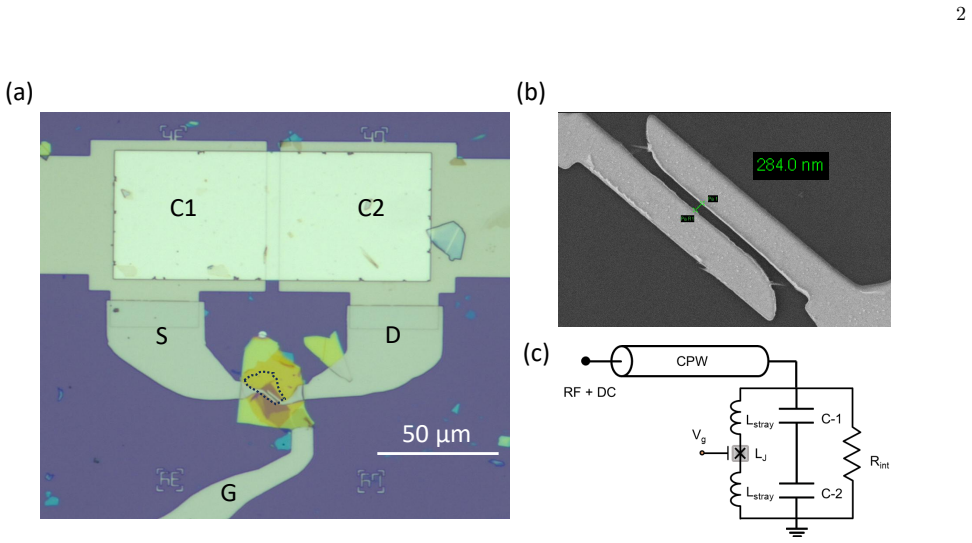


read the original abstract
Josephson junction (JJ) is a key nonlinear element in superconducting devices such as qubits, amplifiers, and bolometers. Recently, gate-tunable JJs based on graphene and semiconductors have gained interest due to their rich Andreev physics and wide applications in circuit quantum electrodynamics devices. In addition to gate tunability, it offers many advantages over conventional JJs, such as exceptional thermal properties for bolometric sensors, magnetic-field compatibility, and operability at elevated temperatures above 1 K. Like conventional Al-AlOx-Al JJs, graphene JJs also act as nonlinear inductors, and at their heart lies the Kerr nonlinearity. Additionally, in graphene JJs, the nonlinearity is tunable via external knobs in a single device. However, a detailed exploration of the tunable Kerr nonlinearity in graphene JJs has never been performed. In this work, we study the dependence of the Kerr nonlinearity on gate voltage, temperature, and DC bias - an interesting knob that has been less explored. Using these parameters, we show that the magnitude of the Kerr coefficient can be tuned over a wide range, from 300 kHz to 1.2 MHz. Our work will be a valuable resource for further understanding of the nonlinearity in graphene JJs and for the design of next-generation amplifiers and sensors, with enhanced performance.
Editorial analysis
A structured set of objections, weighed in public.
Referee Report
Summary. The manuscript reports an experimental study of Kerr nonlinearity in gate-tunable graphene Josephson junctions. Using microwave spectroscopy, the authors extract the Kerr coefficient and demonstrate its magnitude can be tuned from 300 kHz to 1.2 MHz by varying gate voltage, temperature, and DC bias, interpreting the observed frequency shifts as direct signatures of the junction's intrinsic nonlinearity.
Significance. If the central claim holds, the work supplies a systematic characterization of tunable Kerr nonlinearity in graphene JJs, a resource that could aid design of circuit-QED amplifiers, bolometers, and sensors exploiting graphene's gate control, thermal properties, and elevated-temperature operation. The experimental approach follows standard circuit-QED extraction methods once dominance of the intrinsic term is accepted.
minor comments (2)
- [Abstract] The abstract states that DC bias is 'an interesting knob that has been less explored'; adding one or two references to prior DC-bias studies on graphene or semiconductor JJs would better situate the novelty.
- [Figures and Methods] Figure captions and the methods section should explicitly state the fitting procedure, error propagation, and any exclusion criteria used when converting frequency-shift data into the reported Kerr values (300 kHz–1.2 MHz range).
Simulated Author's Rebuttal
We thank the referee for their positive assessment of our work and for recommending minor revision. We appreciate the recognition that our systematic characterization of gate-, temperature-, and bias-tunable Kerr nonlinearity in graphene Josephson junctions provides a useful resource for circuit-QED applications.
Circularity Check
No significant circularity in experimental measurement
full rationale
The paper is an experimental study reporting measured frequency shifts in a graphene Josephson junction as a function of gate voltage, temperature, and DC bias. The Kerr coefficient values (300 kHz to 1.2 MHz) are extracted via standard circuit-QED analysis of the microwave response data. No equations, predictions, or first-principles derivations are presented that reduce the reported tunability result to a fitted parameter or self-citation by construction. The central claim rests on direct experimental observation and interpretation of physical data rather than any self-referential chain, making the derivation self-contained against external benchmarks.
Axiom & Free-Parameter Ledger
Lean theorems connected to this paper
-
IndisputableMonolith/Cost/FunctionalEquation.leanwashburn_uniqueness_aczel unclear?
unclearRelation between the paper passage and the cited Recognition theorem.
Kerr coefficient extracted from linear regression ω(n) = ω0 + Kn; K ∝ c4 − 5c3²/(3c2) with c4 = −(1−3τ/4)p³ for SNS junction
What do these tags mean?
- matches
- The paper's claim is directly supported by a theorem in the formal canon.
- supports
- The theorem supports part of the paper's argument, but the paper may add assumptions or extra steps.
- extends
- The paper goes beyond the formal theorem; the theorem is a base layer rather than the whole result.
- uses
- The paper appears to rely on the theorem as machinery.
- contradicts
- The paper's claim conflicts with a theorem or certificate in the canon.
- unclear
- Pith found a possible connection, but the passage is too broad, indirect, or ambiguous to say the theorem truly supports the claim.
Reference graph
Works this paper leans on
- [1]
-
[2]
M. H. Devoret and R. J. Schoelkopf, Science339, 1169 (2013)
work page 2013
- [3]
-
[4]
Tinkham,Introduction to Superconductivity (McGraw-Hill, 1996)
M. Tinkham,Introduction to Superconductivity (McGraw-Hill, 1996)
work page 1996
-
[5]
K. K. Likharev, Review of Modern Physics51, 101 (1979)
work page 1979
-
[6]
A. A. Golubov, M. Y. Kupriyanov, and E. Il’ichev, Re- views of Modern Physics76, 411 (2004)
work page 2004
-
[7]
A. Wallraff, D. I. Schuster, A. Blais, L. Frunzio, R.-S. Huang, J. Majer, S. Kumar, S. M. Girvin, and R. J. Schoelkopf, Nature431, 162–167 (2004)
work page 2004
-
[8]
I. Siddiqi, R. Vijay, F. Pierre, C. M. Wilson, M. Metcalfe, C. Rigetti, L. Frunzio, and M. H. Devoret, Physical Re- view Letters93, 207002 (2004). 7
work page 2004
-
[9]
T. Yamamoto, K. Inomata, M. Watanabe, K. Matsuba, T. Miyazaki, W. D. Oliver, Y. Nakamura, and J. S. Tsai, Applied Physics Letters93, 042510 (2008)
work page 2008
-
[10]
M. A. Castellanos-Beltran and K. W. Lehnert, Applied Physics Letters91, 083509 (2007)
work page 2007
-
[11]
J. Koch, T. M. Yu, J. Gambetta, A. A. Houck, D. I. Schuster, J. Majer, A. Blais, M. H. Devoret, S. M. Girvin, and R. J. Schoelkopf, Physical Reviews A76, 042319 (2007)
work page 2007
-
[12]
C. Macklin, K. O’Brien, D. Hover, M. E. Schwartz, V. Bolkhovsky, X. Zhang, W. D. Oliver, and I. Siddiqi, Science350, 307 (2015)
work page 2015
-
[13]
N. Bergeal, F. Schackert, M. Metcalfe, R. Vijay, V. E. Manucharyan, L. Frunzio, D. E. Prober, R. J. Schoelkopf, S. M. Girvin, and M. H. Devoret, Nature465, 64–68 (2010)
work page 2010
-
[14]
Z. Hao, J. Cochran, Y.-C. Chang, H. M. Cole, and S. Shankar, Applied Physics Letters128, 014004 (2026)
work page 2026
-
[15]
Zmuidzinas, Annual Review of Condensed Matter Physics3, 169 (2012)
J. Zmuidzinas, Annual Review of Condensed Matter Physics3, 169 (2012)
work page 2012
-
[16]
P. K. Day, H. G. LeDuc, B. A. Mazin, A. Vayonakis, and J. Zmuidzinas, Nature425, 817 (2003)
work page 2003
-
[17]
A. Blais, R.-S. Huang, A. Wallraff, S. M. Girvin, and R. J. Schoelkopf, Physical Reviews A69, 062320 (2004)
work page 2004
- [18]
-
[19]
C. D. English, D. R. Hamilton, C. Chialvo, I. C. Moraru, N. Mason, and D. J. V. Harlingen, Physical Review B 94, 115435 (2016)
work page 2016
-
[20]
S. Messelot, N. Aparicio, E. de Seze, E. Eyraud, J. Coraux, K. Watanabe, T. Taniguchi, and J. Renard, Physical Review Letters133, 106001 (2024)
work page 2024
-
[21]
A. Leblanc, C. Tangchingchai, Z. S. Momtaz, E. Kiyooka, J.-M. Hartmann, F. Gustavo, J.-L. Thomassin, B. Brun, V. Schmitt, S. Zihlmann, R. Maurand, ´E. Dumur, S. D. Franceschi, and F. Lefloch, Nature Communications16, 1010 (2025)
work page 2025
- [22]
-
[23]
New frontiers in quantum science and technology using van der Waals Josephson junctions
J. Sarkar, A. Mukherjee, A. Basu, R. Kundu, A. Kundu, and M. M. Deshmukh, arXiv2604.15276(2026)
work page internal anchor Pith review Pith/arXiv arXiv 2026
-
[24]
A. A. Generalov, K. L. Viisanen, J. Senior, B. R. Ferreira, J. Ma, M. M¨ ott¨ onen, M. Prunnila, and H. Bohuslavskyi, Applied Physics Letters125, 012602 (2024)
work page 2024
- [25]
-
[26]
T. C. White, J. Y. Mutus, I.-C. Hoi, R. Barends, B. Campbell, Y. Chen, Z. Chen, B. Chiaro, A. Dunsworth, E. Jeffrey, J. Kelly, A. Megrant, C. Neill, P. J. J. O’Malley, P. Roushan, D. Sank, A. Vainsencher, J. Wenner, S. Chaudhuri, J. Gao, and J. M. Martinis, Applied Physics Letters106, 242601 (2015)
work page 2015
-
[27]
T. W. Larsen, K. D. Petersson, F. Kuemmeth, T. S. Jes- persen, P. Krogstrup, J. Nyg˚ ard, and C. M. Marcus, Physical Review Letters115, 127001 (2015)
work page 2015
-
[28]
L. Casparis, M. R. Connolly, M. Kjaergaard, N. J. Pear- son, A. Kringhøj, T. W. Larsen, F. Kuemmeth, T. Wang, C. Thomas, S. Gronin, G. C. Gardner, M. J. Manfra, C. M. Marcus, and K. D. Petersson, Nature Nanotech- nology13, 915 (2018)
work page 2018
-
[29]
J. I.-J. Wang, D. Rodan-Legrain, L. Bretheau, D. L. Campbell, B. Kannan, D. Kim, M. Kjaergaard, P. Krantz, G. O. Samach, F. Yan, J. L. Yoder, K. Watan- abe, T. Taniguchi, T. P. Orlando, S. Gustavsson, P. Jarillo-Herrero, and W. D. Oliver, Nature Nanotech- nology14, 120 (2019)
work page 2019
-
[30]
T. W. Larsen, M. E. Gershenson, L. Casparis, A. Kringhøj, N. J. Pearson, R. P. G. McNeil, F. Kuem- meth, P. Krogstrup, K. D. Petersson, and C. M. Marcus, Physics Review Letters125, 056801 (2020)
work page 2020
-
[31]
J. Balgley, J. Park, X. Chu, J. Liu, M. Holbrook, K. Watanabe, T. Taniguchi, A. Kamal, L. Ranzani, M. V. Gustafsson, J. Hone, and K. C. Fong, arXiv 2512.08059(2025)
- [32]
-
[33]
G. Butseraen, A. Ranadive, N. Aparicio, K. Raf- sanjani Amin, A. Juyal, M. Esposito, K. Watanabe, T. Taniguchi, N. Roch, F. Lefloch, and J. Renard, Na- ture Nanotechnology17, 1153 (2022)
work page 2022
-
[34]
D. T. Phan, P. Falthansl-Scheinecker, U. Mishra, W. M. Strickland, D. Langone, J. Shabani, and A. P. Higgin- botham, Physical Review Applied19, 064032 (2023)
work page 2023
-
[35]
Z. Hao, T. Shaw, M. Hatefipour, W. M. Strickland, B. H. Elfeky, D. Langone, J. Shabani, and S. Shankar, Applied Physics Letters124, 254003 (2024)
work page 2024
-
[36]
G.-H. Lee, D. K. Efetov, W. Jung, L. Ranzani, E. D. Walsh, T. A. Ohki, T. Taniguchi, K. Watanabe, P. Kim, D. Englund, and K. C. Fong, Nature586, 42 (2020)
work page 2020
- [37]
- [38]
-
[39]
A. Kringhøj, L. Casparis, M. Hell, T. W. Larsen, F. Kuemmeth, M. Leijnse, K. Flensberg, P. Krogstrup, J. Nyg˚ ard, K. D. Petersson, and C. M. Marcus, Physical Review B97, 060508 (2018)
work page 2018
-
[40]
X. Zhou, V. Schmitt, P. Bertet, D. Vion, W. Wustmann, V. Shumeiko, and D. Esteve, Physical Review B89, 214517 (2014)
work page 2014
-
[41]
J. Bourassa, F. Beaudoin, J. M. Gambetta, and A. Blais, Physical Review A86, 013814 (2012)
work page 2012
- [42]
-
[43]
J. A. Schreier, A. A. Houck, J. Koch, D. I. Schuster, B. R. Johnson, J. M. Chow, J. M. Gambetta, J. Majer, L. Frunzio, M. H. Devoret, S. M. Girvin, and R. J. Schoelkopf, Physical Review B77, 180502 (2008)
work page 2008
- [44]
- [45]
- [46]
- [47]
-
[48]
N. E. Frattini, U. Vool, S. Shankar, A. Narla, K. M. Sliwa, and M. H. Devoret, Applied Physics Letters110, 222603 (2017)
work page 2017
-
[49]
N. E. Frattini, V. V. Sivak, A. Lingenfelter, S. Shankar, and M. H. Devoret, Physical Review Applied10, 054020 (2018)
work page 2018
- [50]
-
[51]
V. Gupta, P. Winkel, N. Thakur, P. van Vlaanderen, Y. Wang, S. Ganjam, L. Frunzio, and R. J. Schoelkopf, Physical Review Applied23, 054067 (2025) 9 Supplementary Information S1. DEVICE F ABRICA TION Josephson junctions (JJs) are used in circuit quan- tum electrodynamics (cQED) to realize nonlinear LC res- onators. For our device geometry, we employ a copl...
work page 2025
-
[52]
The output sig- nal is returned to the VNA at port-2
is sent to the device from port-1. The output sig- nal is returned to the VNA at port-2. The gate voltage (Vg) is applied to the device using a DC voltage source (NI-DAQ). The DC line for the gate passes through a 10 Hz low-pass RC filter, followed by three-stage filtering using low-pass RC filters on different temperature plates of our dilution fridge (r...
-
[53]
Tinkham,Introduction to Superconductivity, 2nd ed
M. Tinkham,Introduction to Superconductivity, 2nd ed. (Dover Publications, New York, 1996)
work page 1996
-
[54]
L. D. Landau and E. M. Lifshitz,Mechanics, Course of Theoretical Physics, Vol. 1, 3rd ed. (Butterworth- Heinemann, 1976)
work page 1976
-
[55]
A. H. Nayfeh,Introduction to Perturbation Techniques (John Wiley & Sons, 1981)
work page 1981
-
[56]
N. E. Frattini, U. Vool, S. Shankar, A. Narla, K. M. Sliwa, and M. H. Devoret,3-wave mixing Josephson dipole element, Appl. Phys. Lett.110, 222603 (2017)
work page 2017
-
[57]
C. W. J. Beenakker,Universal limit of critical-current fluctuations in mesoscopic Josephson junctions, Phys. Rev. Lett.67, 3836 (1991)
work page 1991
-
[58]
A. Furusaki and M. Tsukada,Current-carrying states in Josephson junctions, Phys. Rev. B43, 10164 (1991)
work page 1991
discussion (0)
Sign in with ORCID, Apple, or X to comment. Anyone can read and Pith papers without signing in.