Approximating Feynman integrals using complete monotonicity and Stieltjes properties
Pith reviewed 2026-06-26 03:00 UTC · model grok-4.3
The pith
Scalar Feynman integrals in the Euclidean region are completely monotonic functions, enabling reconstruction from differential equations without boundary data and use of convergent Padé approximants.
A machine-rendered reading of the paper's core claim, the machinery that carries it, and where it could break.
Core claim
Scalar Feynman integrals in the Euclidean region are completely monotonic functions; within a certain range of parameters they are in fact Stieltjes functions. This enables the CM bootstrap to reconstruct integrals from differential equations without explicit boundary data, yielding rigorous bounds, and the use of Padé approximants with provable convergence properties.
What carries the argument
Complete monotonicity and Stieltjes properties of scalar Feynman integrals in the Euclidean region.
If this is right
- Integrals can be reconstructed from their differential equations without supplying boundary values.
- Rigorous numerical bounds follow directly from the sign properties.
- Padé approximants converge in the cut plane, permitting reliable analytic continuation.
- The approach extends to multi-loop integrals including the 20-loop banana integral.
Where Pith is reading between the lines
- The same positivity may allow similar bootstraps for non-scalar integrals once their monotonicity is verified.
- Stieltjes representations could yield new series expansions or integral representations for the same objects.
- The methods may combine with existing differential-equation solvers to reduce the cost of high-precision evaluations.
Load-bearing premise
Scalar Feynman integrals satisfy complete monotonicity (and Stieltjes properties within certain parameter ranges) for the relevant Euclidean kinematics.
What would settle it
A concrete scalar Feynman integral in the Euclidean region whose second or higher derivative changes sign.
Figures

read the original abstract
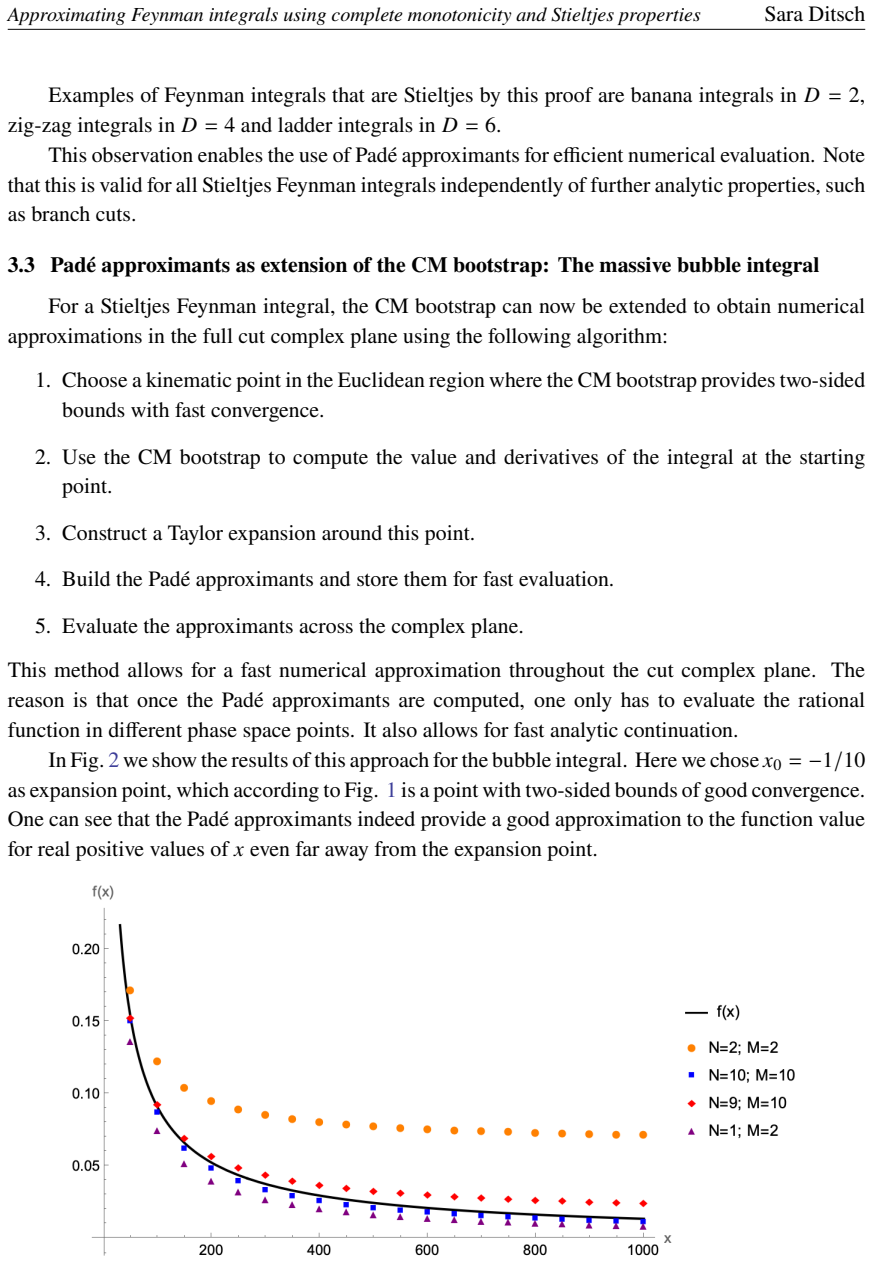
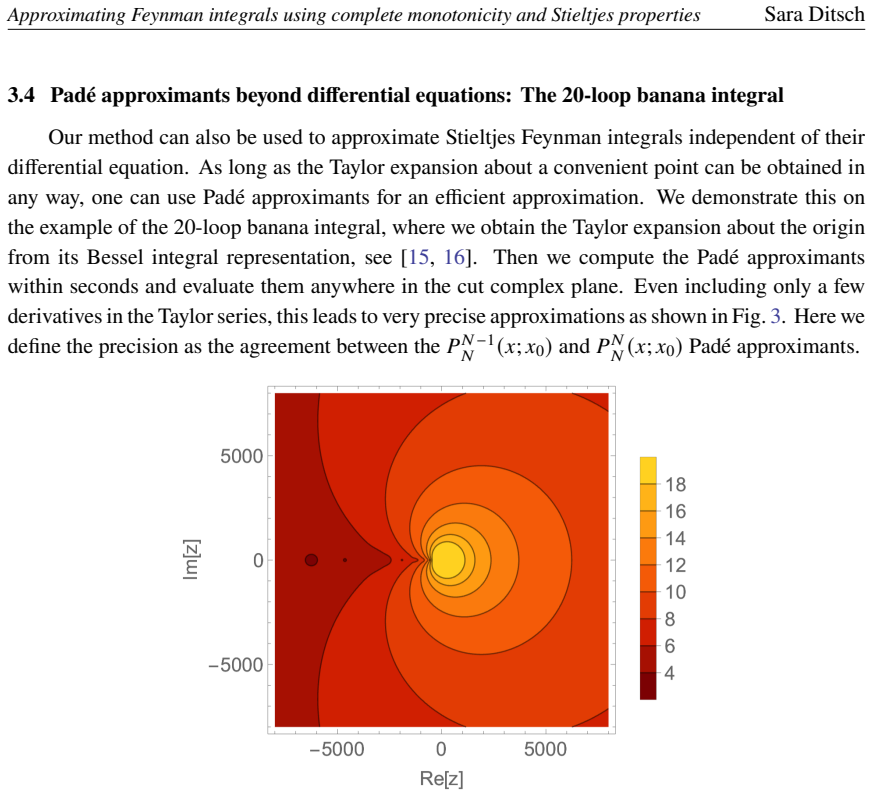
We present two novel approaches for the numerical evaluation of Feynman integrals based on their universal analytic properties related to positivity, namely complete monotonicity (CM) and Stieltjes properties. Building on recent results, we exploit the fact that scalar Feynman integrals in the Euclidean region are completely monotonic functions, meaning that all their derivatives have a fixed sign. Building on this observation, the CM bootstrap allows one to reconstruct integrals from differential equations without explicit boundary data, yielding rigorous bounds. The second method is based on a refinement of CM. We prove that Feynman integrals, within a certain range of parameters, are not only CM but in fact Stieltjes functions. This enables the use of Pad\'e approximants with provable convergence properties in the cut complex plane, providing an efficient method for analytic continuation and fast numerical evaluation. We illustrate the method with simple examples such as the massive bubble integral and discuss applications to multi-loop integrals, including the 20-loop banana integral. Finally, we comment on a number of extensions of these novel avenues for computing Feynman integrals.
Editorial analysis
A structured set of objections, weighed in public.
Referee Report
Summary. The paper claims that scalar Feynman integrals in the Euclidean region are completely monotonic (CM) functions of their kinematic variables. Building on this, it introduces a CM bootstrap method to reconstruct the integrals from differential equations without explicit boundary data, yielding rigorous bounds. It further proves that, within a certain (unspecified) range of parameters, these integrals are Stieltjes functions, which permits the use of Padé approximants with provable convergence properties in the cut plane for analytic continuation and numerical evaluation. The methods are illustrated on the massive bubble integral and applied to the 20-loop banana integral, with comments on extensions.
Significance. If the CM and Stieltjes properties are established with explicit domains, the approach would supply new, positivity-based tools for multi-loop integral evaluation that avoid boundary-value problems and guarantee convergence of approximants. The combination of rigorous bounds from the bootstrap and convergent Padé schemes in the complex plane would be a notable addition to the toolkit for Feynman integrals where traditional sector decomposition or numerical integration scales poorly.
major comments (2)
- [Abstract / Stieltjes theorem statement] Abstract and the section stating the Stieltjes result: the claim that Feynman integrals are Stieltjes functions 'within a certain range of parameters' is load-bearing for both the Padé convergence guarantee and the advertised application to the 20-loop banana integral, yet no explicit conditions on spacetime dimension D, mass values, or external momenta are supplied. Without this domain, it is impossible to verify whether the kinematics of the banana example fall inside the proven range.
- [Application to multi-loop integrals] Section discussing the 20-loop banana: the numerical performance and convergence claims for the banana integral rest on the Stieltjes property holding in that specific case, but the manuscript provides neither the parameter values used nor a verification that they lie inside the 'certain range' where the Stieltjes property is proved.
minor comments (1)
- [Abstract] The abstract refers to 'recent results' for the CM property; a brief citation or one-sentence recap of the precise statement used would improve readability.
Simulated Author's Rebuttal
We thank the referee for the careful reading and constructive comments. We address the two major comments point by point below.
read point-by-point responses
-
Referee: [Abstract / Stieltjes theorem statement] Abstract and the section stating the Stieltjes result: the claim that Feynman integrals are Stieltjes functions 'within a certain range of parameters' is load-bearing for both the Padé convergence guarantee and the advertised application to the 20-loop banana integral, yet no explicit conditions on spacetime dimension D, mass values, or external momenta are supplied. Without this domain, it is impossible to verify whether the kinematics of the banana example fall inside the proven range.
Authors: We agree that explicit conditions on the parameter range are required for the Stieltjes claim to be verifiable. The manuscript will be revised to state the precise domain (in terms of D, masses, and external momenta) under which the proof establishes the Stieltjes property. revision: yes
-
Referee: [Application to multi-loop integrals] Section discussing the 20-loop banana: the numerical performance and convergence claims for the banana integral rest on the Stieltjes property holding in that specific case, but the manuscript provides neither the parameter values used nor a verification that they lie inside the 'certain range' where the Stieltjes property is proved.
Authors: We agree that the specific parameter values for the banana integral and an explicit check against the Stieltjes domain must be supplied. The revised manuscript will include these values together with the verification that the chosen kinematics lie inside the proven range, thereby justifying the convergence statements. revision: yes
Circularity Check
No circularity; analytic properties asserted as independent mathematical facts with explicit proof claim for Stieltjes case
full rationale
The paper states that complete monotonicity follows from recent results and claims to prove the Stieltjes property for Feynman integrals within a certain parameter range. These are presented as universal analytic facts about the integrals themselves rather than quantities fitted or defined in terms of the numerical methods or bootstrap outputs. The CM bootstrap and Padé approximants are downstream applications of these properties; no equations or steps reduce a prediction to a fitted input or self-citation chain by construction. The unspecified domain is an applicability concern but does not create circularity in the derivation.
Axiom & Free-Parameter Ledger
axioms (2)
- domain assumption Scalar Feynman integrals in the Euclidean region are completely monotonic functions
- domain assumption Feynman integrals are Stieltjes functions within a certain range of parameters
Reference graph
Works this paper leans on
- [1]
-
[2]
T. Binoth and G. Heinrich,An automatized algorithm to compute infrared divergent multi-loop integrals,Nucl. Phys. B585(2000) 741 [hep-ph/0004013]
Pith/arXiv arXiv 2000
-
[3]
G. Heinrich, S. P. Jones, M. Kerner, V. Magerya, A. Olsson and J. Schlenk,Numerical scattering amplitudes with pySecDec,Comput. Phys. Commun.295(2024) 108956 [2305.19768]
arXiv 2024
-
[4]
A. V. Smirnov, N. D. Shapurov and L. I. Vysotsky,FIESTA5: numerical high-performance Feynman integral evaluation,2110.11660
-
[5]
M. Borinsky, H. J. Munch and F. Tellander,Tropical Feynman integration in the Minkowski regime,Comput. Phys. Commun.292(2023) 108874 [2302.08955]
arXiv 2023
-
[6]
M. Hidding,DiffExp, a Mathematica package for computing Feynman integrals in terms of one-dimensional series expansions,Comput. Phys. Commun.269(2021) 108125 [2006.05510]
arXiv 2021
-
[7]
T. Armadillo, R. Bonciani, S. Devoto, N. Rana and A. Vicini,Evaluation of Feynman integrals with arbitrary complex masses via series expansions,Comput. Phys. Commun.282 (2023) 108545 [2205.03345]
arXiv 2023
-
[8]
R. M. Prisco, J. Ronca and F. Tramontano,LINE: Loop Integrals Numerical Evaluation, JHEP07(2025) 219 [2501.01943]. 7 Approximating Feynman integrals using complete monotonicity and Stieltjes propertiesSara Ditsch
arXiv 2025
-
[9]
M. Mezzarobba,Rigorous high-precision solution of Fuchsian ODEs and applications, in Dynaverse 2025: Workshop on Dynamics, Algebra, and Particle Physics, (Saarbrücken, Germany), Max Planck Institute for Software Systems, 2025, https://dynaverse2025.mpi-sws.org/schedule/
2025
-
[10]
X. Liu and Y.-Q. Ma,AMFlow: A Mathematica package for Feynman integrals computation via auxiliary mass flow,Comput. Phys. Commun.283(2023) 108565 [2201.11669]
arXiv 2023
-
[11]
J. Henn and P. Raman,Positivity properties of scattering amplitudes,JHEP04(2025) 150 [2407.05755]
arXiv 2025
-
[12]
D. V. Widder,The Laplace Transform, Princeton Mathematical Series. Princeton University Press, 1941
1941
-
[13]
G. A. Baker and P. Graves-Morris,Padé Approximants, Encyclopedia of Mathematics and its Applications, vol. 59. Cambridge University Press, Cambridge, UK, 2nd ed., 1996
1996
-
[14]
C. M. Bender and S. A. Orszag,Advanced Mathematical Methods for Scientists and Engineers I: Asymptotic Methods and Perturbation Theory. Springer, New York, 1999
1999
-
[15]
S. Groote, J. G. Korner and A. A. Pivovarov,On the evaluation of a certain class of Feynman diagrams in x-space: Sunrise-type topologies at any loop order,Annals Phys.322(2007) 2374 [hep-ph/0506286]
Pith/arXiv arXiv 2007
- [16]
discussion (0)
Sign in with ORCID, Apple, or X to comment. Anyone can read and Pith papers without signing in.