REVIEW 4 major objections 4 minor 44 references
Modeling Deontic Modal Logic in ASP
T0 review · 4 major / 4 minor · reviewed 2026-08-06 · deepseek-v4-flash
Pith's one-line read The paper claims that deontic modal logic can be directly implemented in answer set programming by encoding obligations, prohibitions, and permissions as constraints, and that this dissolves its classic paradoxes.
desk verdict Nice concrete idea for deontic operators as ASP denials, but the paradox resolution rests on hand-picked preemption conditions and the paper needs a real derivation rule before that claim holds. read the letter →
The pith
A machine-rendered reading of the paper's core claim, the machinery that carries it, and where it could break.
The reading
What carries the argument
The load-bearing mechanism is the ASP global constraint, also called a denial: a rule of the form ':- not p, Q' that rejects every answer set in which Q is true and p is absent. Linked to it is the odd loop over negation (OLON) rule c :- not p, not c, which lets a violating condition c preempt the obligation; under the stable model semantics the rule is taken out of consideration when c is derivable by other rules, and otherwise acts as a denial forcing p. The mapping rests on treating default negation (not) as modal negation and strong negation (-) as propositional negation, so that the deontic square of opposition is reproduced by combinations of the two negations.
What would settle it
Run the paper's Chisholm encoding in a conventional answer-set solver under the standard stable-model semantics and compare the answer sets with the two worlds claimed in the paper; if the OLON rule is treated as inconsistent or yields additional worlds, the resolution depends on the goal-directed execution behavior rather than on the denial encoding alone.
Extended reading notes
Core claim
The central discovery is that the deontic operators OB, IM, and PE are not primitive modal machinery but shorthand for global constraints on the set of acceptable worlds. In answer set programming, 'it is obligatory that p' becomes the constraint that any answer set not containing p is rejected, written as the denial ':- not p'; 'impermissible that p' becomes ':- not -p'; and 'permitted that p' becomes ':- -p'. Conditional norms of the forms Q -> OBp and OB(Q -> p) both translate to the denial ':- not p, Q'. The paper further claims that when a violating condition c arises, the denial is re-encoded as an odd-loop-over-negation rule c :- not p, not c so that the obligation is dropped exactly when c is derivable, which is how the paradoxes are said to resolve. It also proves that the standard deontic logic axioms D, K, and NEC hold in this representation.
Load-bearing premise
The method presumes that for each obligation one can identify, in advance, the violating condition c that should preempt it, and in the paper these conditions are chosen by hand for each paradox rather than derived by a general procedure.
Editorial extensions
If this is right
- Any Horn deontic formula in the supported fragment can be executed directly by an answer set programming system, making normative reasoning computable.
- The paradoxes of contrary-to-duty reasoning disappear without introducing dyadic operators, sanctions, or preference orderings over models.
- Conditional obligations and prohibitions become conditional constraints, so secondary obligations ('least one can do') can be represented by chained OLON rules.
- Because constraints can be named via OLON rules, separate logic can decide when a norm applies, supporting elaboration-tolerant knowledge representation.
- The approach distinguishes factual detachment from deontic detachment by whether the norm's antecedent is evaluated in the current or accessible world.
Reading between the lines
- An implication the authors leave implicit is that the same constraint-as-denial translation should work for epistemic and temporal modalities, because the distinction between default and strong negation is not specific to deontic operators.
- The paper does not give a general rule for choosing which condition c preempts an obligation; a testable extension would derive c automatically from a proof of violation, which would turn the hand-built paradox resolutions into a system.
- Because the claimed OLON behavior is tied to the goal-directed execution system used in the paper, a natural probe is to run the same encodings on a conventional answer-set solver; if the answer sets differ, the paradox resolution depends on that system's semantics rather than on ASP itself.
Signed reviews
Editorial analysis
A structured set of objections, weighed in public.
Referee Report
Summary. The paper proposes a translation of a fragment of deontic modal logic into answer set programs (ASP). Obligations, impermissibilities, and permissions are represented as global constraints (denials): OBp as `:- not p`, IMp as `:- not -p`, PEp as `:- -p`, with conditional norms handled analogously. The authors further propose preempting an obligation by an OLON rule `c :- not p, not c` when a condition c violates the obligation, and they claim that this mechanism resolves Chisholm's contrary-to-duty paradox and several other classical deontic paradoxes. A theorem asserts that SDL axioms D, K, and NEC are satisfied. The paper also presents a car-borrowing example with executable s(CASP) code and justification trees.
Significance. If the central claim were fully established, the paper would offer a very simple and executable implementation of deontic reasoning in ASP, with a clean mapping between the two negations of modal logic and ASP's default and strong negation, plus a uniform treatment of contrary-to-duty obligations. The concrete encodings are a genuine strength: the Chisholm program has exactly the two admissible worlds reported, the s(CASP) examples in Section 6 are runnable, and the justification trees in Appendix C support reproducibility. However, the paradox-resolution claim is not established because the preemption condition c in Section 4.3 is chosen by hand in each example, and some appendix resolutions depart from the stated translation fragment. As written, the paper is better described as a framework for normative modeling with explicitly user-specified exceptions than as a resolution of the classical deontic paradoxes.
major comments (4)
- [Section 4.3 and Section 5] The preemption condition c is a free parameter with no derivation rule. The paper states that for an obligation OBp and a condition c that violates it, one should encode the OLON rule `c :- not p, not c`, but it never defines how c is obtained from the deontic theory or narrative. In each paradox, c is chosen to produce the intended answer set: c=-go in Chisholm (§5.1 line 1), c=kill in Forrester (§A.1 line 1), c=stay/join in Sartre (§A.2 lines 1-2), and c=broke in Kant (§A.2 line 1). This is load-bearing: replacing the Chisholm OLON rule with `tell :- not go, not tell` (i.e., c=tell) while keeping lines 2-4 and the fact `-go` yields no answer set, so the set of admissible worlds is not determined by the deontic formulas alone. A formal characterization of admissible preemption conditions, or a derivation procedure for c, is required before the claimed 'simple and elegant' resolution of the paradoxes can be assessed.
- [Appendix A.3] The Ross paradox example is not translated within the stated fragment. The premise 'mail -> post∨burn' is encoded as the two ASP rules `post :- mail` and `burn :- mail`, which assert both post and burn, not a disjunction. Since the syntax in Section 4.2 does not admit disjunction, this example does not demonstrate a resolution of Ross's paradox under the proposed encoding; it demonstrates a stronger, hand-chosen normative theory. The paper should either extend the fragment and give a translation of disjunction, or explain why the stronger encoding is the intended representation.
- [Appendix A.4] The Good Samaritan example does not actually resolve the paradox: the encoding `:- not rob` and `:- not help` forces rob and help in every answer set, which yields the very conclusion OBrob that the paradox calls into question. The text says 'in any world in which Smith is robbed, Jones helps him' and concludes the paradox is no longer a paradox, but this is an acceptance of the paradoxical conclusion rather than a resolution. The authors need to explain why conclusion OBrob is acceptable under the proposed semantics, or provide a different encoding that avoids it.
- [Section 4.2, Theorem] The theorem that SDL axioms D, K, and NEC are satisfied is stated more strongly than what is proven. The proof of D shows only that the two denials corresponding to OBp and OB¬p are jointly unsatisfiable via the built-in `:- p,-p`; this is a consistency property, not the derivation of the formula ¬OB¬p. The proof of NEC is not conclusive in the supported fragment: 'τ is a tautology' is not representable as a single atom under the Horn syntax of Section 4.2, and `not τ` is negation-as-failure over an atom, not classical negation of a formula. The theorem should be restated as a property of answer sets, with the scope of the fragment made explicit.
minor comments (4)
- [Section 4.3] The last paragraph says the obligation can be 'even further simplified' as `:- not p, not c`. This is indeed equivalent to the OLON rule, but stating the equivalence explicitly would avoid confusion, since the OLON form also names the exception as a head predicate.
- [Appendix B, Narratives 7 and 8] The explanatory text for Narrative 7 is repeated verbatim for Narrative 8, including the sentence about using classical negation `-financially_broke(jones)`, which is not present in Narrative 8. This appears to be a copy-paste error.
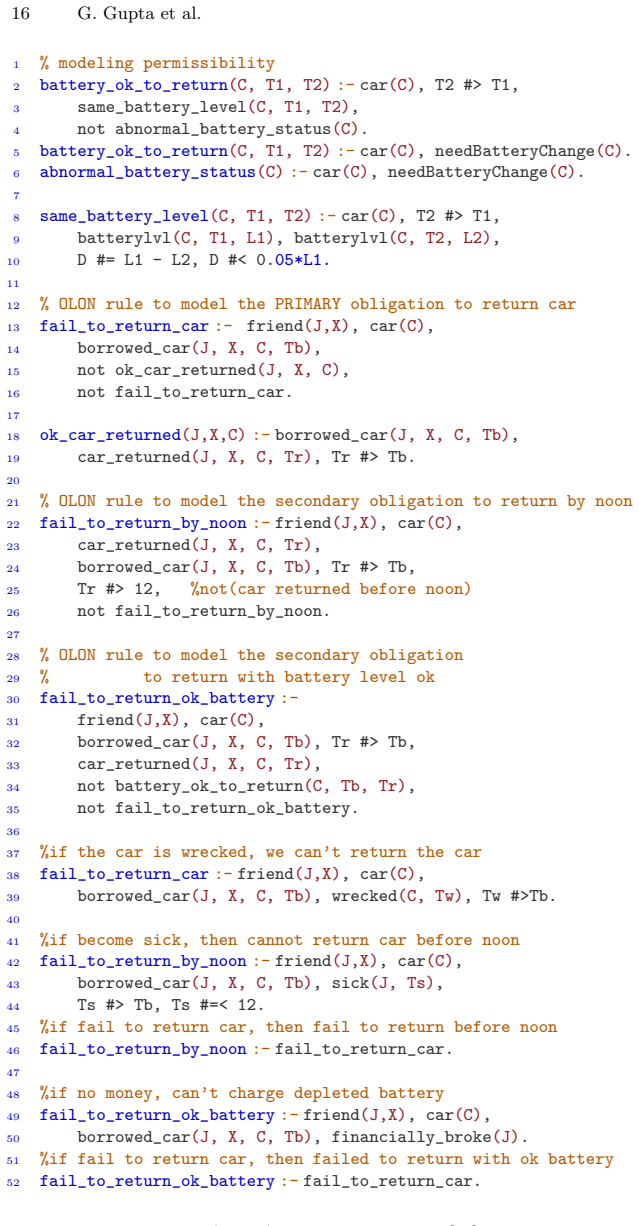
- [Figure 5] Line 24 of Figure 5 reads `same_battery_level(C, Tb, Tr). :-` with an extra period before the neck symbol; this is likely a typo.
- [Section 5.1] The sentence 'we will find that their are only two admissible worlds' contains a typo: 'their' should be 'there'.
Circularity Check
Paradox resolutions rest on hand-picked preemption conditions c, so the central 'resolution' claim reduces by construction to the chosen exceptions.
-
fitted input called prediction
[Section 4.3 (preemption rule); applied in Sections 5.1, A.1, A.2]
"Given an obligation OBp, and a possible condition c that results in its violation, then instead of encoding the obligation as :- not p, we encode it as the OLON rule c :- not p, not c."
Section 4.3 never derives c; it is simply 'given'. In the paradox sections c is selected so that the intended answer set exists: c=-go in Chisholm (5.1), c=kill in Forrester (A.1), c=stay in Sartre and c=broke in Kant (A.2). The paper even simplifies the rule to ':- not p, not c', i.e., OBp is enforced only when the chosen c is absent. Consequently the claimed 'resolution' of each paradox is not a consequence of the deontic-to-ASP encoding of Section 4.2; it is the effect of the hand-written exception literal. The admissible-world outcome changes with c (e.g., taking c=tell in the Chisholm program instead of c=-go leaves lines 2-4 and fact -go with no answer set), so no invariant, c-independent 'resolution' is established.
full rationale
The direct encodings (OBp -> :- not p, IMp -> :- not -p, PEp -> :- -p) and the claim that SDL axioms D, K, NEC are satisfied are definitional verifications of a proposed representation, not circular predictions. The extended car-borrowing example is a self-contained executable benchmark and does not depend on self-citation. The sole circular component is the paradox-resolution claim: Section 4.3 presupposes the violation condition c, and every paradox appendix chooses c by hand to produce the desired answer set. Since the paper gives no criterion for deriving c and no theorem that admissible worlds are invariant under the choice of c, the advertised 'simple and elegant resolution' is, for these cases, equivalent to the hand-fitted exception clauses. This is partial circularity in the central claim, not in the overall framework.
Assumptions & free parameters
free parameters (3)
- preemption condition c per OLON obligation =
-go (Chisholm), stay (Sartre), broke (Kant), fail_to_return_car / fail_to_return_by_noon / fail_to_return_ok_battery…
- abducible declarations =
go, -go, tell, -tell in Chisholm; warning_sign, -warning_sign, dog, -dog in the dog example
- obligation versus OLON split =
in Chisholm only the 'go' obligation is made preemptible; lines 2 and 3 are plain denials
assumptions (5)
- domain assumption Obligations, prohibitions, and permissions are global constraints on accessible worlds rather than truth-bearing declarative sentences.
- domain assumption Deontic formulas are Horn formulas with modal operators only at rule fronts, no nested modalities, no negated modal operators.
- ad hoc to paper Negation next to a proposition maps to strong negation and negation next to a modal operator maps to default negation.
- standard math Standard stable model semantics of ASP and the s(CASP) behavior for OLON rules.
- ad hoc to paper Axiom D is guaranteed by the denial ':- p, -p' asserted by ASP for every predicate p.
invented entities (2)
-
preemptible obligation construct (OLON rule c :- not p, not c)
independent evidence
-
violation and exception predicates (fail_to_return_car, fail_to_return_by_noon, fail_to_return_ok_battery)
independent evidence
Cite this review
Pith. "Pith review of Modeling Deontic Modal Logic in ASP." pith.science (2026). https://pith.science/paper/RSKFFMLH
@misc{pith2026250705519,
  author       = {Pith},
  title        = {Pith review of: Modeling Deontic Modal Logic in ASP},
  year         = {2026},
  howpublished = {\url{https://pith.science/paper/RSKFFMLH}},
  note         = {Machine review of arXiv:2507.05519}
}
read the original abstract
We consider the problem of implementing deontic modal logic. We show how (deontic) modal operators can be elegantly and directly expressed using default negation (negation-as-failure) and strong negation present in answer set programming (ASP). We propose using global constraints of ASP to represent obligations, prohibitions, and permissions in deontic modal logic. We show that our proposed representation results in the various decades-old paradoxes of deontic modal logic being simply and elegantly resolved. Our method also serves as a means for modeling conditional obligations and conditional prohibitions in knowledge representation.
Figures


Figures from the paper (4 more)


Reference graph
Works this paper leans on
-
[1]
Mario Alviano, Sotiris Batsakis & George Baryannis (2021):Modal Logic S5 Satisfiability in Answer Set Programming.Theory Pract. Log. Program.21(5), pp. 527–542, doi:10.1017/S1471068421000247
-
[2]
Andreson (1958):A Reduction of Deontic Logic to Alethic Modal Logic.Mind67, pp
Alan R. Andreson (1958):A Reduction of Deontic Logic to Alethic Modal Logic.Mind67, pp. 100–103. Available athttp://www.jstor.org/stable/2251344
-
[3]
Joaquín Arias, Manuel Carro, Elmer Salazar, Kyle Marple & Gopal Gupta (2018):Constraint an- swer set programming without grounding.Theory and Pract. of Logic Program.18(3-4), pp. 337–354, doi:10.1017/S1471068418000285
-
[4]
Chitta Baral (2003):Knowledge representation, reasoning and declarative problem solving. Cambridge University Press. ISBN:978-0-521-14775-0
work page 2003
-
[5]
Gerhard Brewka, Thomas Eiter & Miroslaw Truszczynski (2011):Answer Set Programming at a Glance. Commun. ACM54, pp. 92–103, doi:10.1145/2043174.2043195
arXiv 2011
-
[6]
Pedro Cabalar, Agata Ciabattoni & Leendert van der Torre (2023):Deontic Equilibrium Logic with eXplicit Negation. In:Proc. 18th JELIA,LNCS14281, Springer, pp. 498–514, doi:10.1007/978-3-031-43619-2_34
-
[7]
Hector-Neri Castaneda (1977):Ought, Time, and the Deontic Paradoxes.Journal of Philosophy74(12), pp. 775–791, doi:10.2307/2025929
-
[8]
J. Van Eck (1982):A System of Temporally Relative Modal and Deontic Predicate Logic and its Philosoph- ical Applications.Logique Et Analyse25(n/a), p. 339. Available athttps://www.jstor.org/stable/ 44084040
work page 1982
Show all 44 references
-
[9]
In:The Stanford Encyclopedia of Philosophy
James Garson (2024):Modal Logic. In:The Stanford Encyclopedia of Philosophy. Available athttps: //plato.stanford.edu/entries/logic-modal/
2024
-
[10]
Cambridge University Press, doi:10.1017/CBO9781139342124
Michael Gelfond & Yulia Kahl (2014):Knowledge representation, reasoning, and the design of intelligent agents: The answer-set programming approach. Cambridge University Press, doi:10.1017/CBO9781139342124
2014 doi
-
[11]
79–88, doi:10.1007/s13218-024-00854-9
Guido Governatori (2024):An ASP Implementation of Defeasible Deontic Logic.Künstliche Intell.38(1), pp. 79–88, doi:10.1007/s13218-024-00854-9
2024 doi
-
[12]
Gupta, E
G. Gupta, E. Salazar, J. Arias & Others (2022):Tutorial: Automating Commonsense Reasoning. In:ICLP Workshop on Goal-directed Execution (GDE’22), 3193, CEUR. Available athttps://ceur-ws.org/ Vol-3193/paper2GDE.pdf
2022
-
[13]
121–147, doi:10.1007/978-94-010-3146-2_5
Bengt Hansson (1971):An Analysis of Some Deontic Logics.Deontic Logic: Introductory and Systematic Readings, pp. 121–147, doi:10.1007/978-94-010-3146-2_5
1971 doi
-
[14]
Christian Hatschka, Agata Ciabattoni & Thomas Eiter (2023):Deontic Paradoxes in ASP with Weak Con- straints. In:Proc. 39th ICLP , Tech. Comm.,EPTCS385, pp. 367–380, doi:10.4204/EPTCS.385.39
2023 doi
-
[15]
Dordrecht: D.Reidel, doi:10.1007/978-94-009-8484-4
Risto Hilpinen (1981):New Studies in Deontic Logic. Dordrecht: D.Reidel, doi:10.1007/978-94-009-8484-4
1981 doi
-
[16]
Risto Hilpinen & Paul McNamara (2013):Deontic Logic: a Historical Survey and Introduction.Handbook of Deontic Logic and Normative Systems, pp. 3–136
2013
-
[17]
Horty (1993):Deontic Logic as Founded on Nonmonotonic Logic.Ann
John F. Horty (1993):Deontic Logic as Founded on Nonmonotonic Logic.Ann. Math. Artif. Intell.9(1-2), pp. 69–91, doi:10.1007/BF01531262
1993 doi
-
[18]
Jørgensen (1937):Imperatives and logic.Erkenntnis7(1), pp
J. Jørgensen (1937):Imperatives and logic.Erkenntnis7(1), pp. 288–296, doi:10.1007/BF00666538
1937 doi
-
[19]
Stig Kanger (1971):New Foundations for Ethical Theory, pp. 36–58. Springer Netherlands, Dordrecht, doi:10.1007/978-94-010-3146-2_2. In: Deontic Logic: Introductory and Systematic Readings. 14Modeling Deontic Modal Logic in ASP
1971 doi
-
[20]
Kowalski (2017):Satisfiability for First-order Logic as a Non-Modal Deontic Logic
Robert A. Kowalski (2017):Satisfiability for First-order Logic as a Non-Modal Deontic Logic. In:Proc. Workshop Bridging 2017 - CogSci, 1994, CEUR, pp. 84–90
2017
-
[21]
Kowalski & Ken Satoh (2018):Obligation as Optimal Goal Satisfaction.J
Robert A. Kowalski & Ken Satoh (2018):Obligation as Optimal Goal Satisfaction.J. Philos. Log.47(4), pp. 579–609, doi:10.1007/s10992-017-9440-3
2018 doi
-
[22]
Norms, Logics and Information Systems, pp
David Makinson (1999):On a fundamental problem of deontic logic.New Studies on Deontic Logic and Computer Science. Norms, Logics and Information Systems, pp. 29–54. ISBN 9051994273
1999
-
[23]
In:The Stanford Encyclopedia of Philoso- phy, Fall 2010 edition, Metaphysics Research Lab, Stanford University
Paul McNamara (2010):A Puzzle Surrounding Kant’s Law. In:The Stanford Encyclopedia of Philoso- phy, Fall 2010 edition, Metaphysics Research Lab, Stanford University. Available athttps://plato. stanford.edu/archives/fall2018/entries/logic-deontic/apuzzle.html
2010
-
[24]
In:The Stanford Encyclopedia of Philosophy, Fall 2017 edition, Metaphysics Research Lab, Stanford University
Paul McNamara (2017):A bit more on Chisolm’s Paradox. In:The Stanford Encyclopedia of Philosophy, Fall 2017 edition, Metaphysics Research Lab, Stanford University. Available athttps://plato.stanford. edu/archives/spr2006/entries/logic-deontic/chisholm.html
2017
-
[25]
In:The Stanford Encyclopedia of Philosophy, Fall 2022 edition, Metaphysics Research Lab, Stanford University
Paul McNamara & Frederik Van De Putte (2022):Deontic Logic. In:The Stanford Encyclopedia of Philosophy, Fall 2022 edition, Metaphysics Research Lab, Stanford University. Available athttps: //plato.stanford.edu/entries/logic-deontic/
2022
-
[26]
91–115, doi:10.1007/BF00370671
Henry Prakken & Marek Sergot (1996):Contrary-to-Duty Obligations.Studia Logica57(1), pp. 91–115, doi:10.1007/BF00370671
1996 doi
-
[27]
In Donald Nute, editor:Defeasible Deontic Logic, Springer, pp
Henry Prakken & Marek Sergot (1997):Dyadic Deontic Logic and Contrary-to-Duty Obligations. In Donald Nute, editor:Defeasible Deontic Logic, Springer, pp. 223–262, doi:10.1007/978-94-015-8851-5_10
1997 doi
-
[28]
1247–1282, doi:10.1007/s11406-018-0036-0
Daniel Ronnedal (2019):Contrary-to-Duty Paradoxes and Counterfactual Deontic Logic.Philosophia47(4), p. 1247–1282, doi:10.1007/s11406-018-0036-0
2019 doi
-
[29]
In:Internat Encyclopedia of Philosophy
Daniel Ronnedal (2024):Contrary-to-Duty Paradox. In:Internat Encyclopedia of Philosophy. Available at https://iep.utm.edu/contrary-to-duty-paradox/
2024
-
[30]
61–80, doi:10.1007/978-3-319-00792-2_12
Christian Strasser (2011):A Deontic Logic Framework Allowing for Factual Detachment.Journal of Applied Logic9(1), pp. 61–80, doi:10.1007/978-3-319-00792-2_12
2011 doi
-
[31]
Thomason (1981):Deontic Logic as Founded on Tense Logic.New Studies in Deontic Logic, pp
Richmond H. Thomason (1981):Deontic Logic as Founded on Tense Logic.New Studies in Deontic Logic, pp. 165–176, doi:10.1007/978-94-009-8484-4_7. Gopal Gupta et al. 15 A Resolving Other Paradoxes of Deontic Logic While the contrary-to-duty or Chisholm’s paradox has consumed much...
1981 doi
-
[32]
It is forbidden for a person to kill, i.e., OB¬kill
-
[33]
But if a person kills, he ought to kill gently, i.e.,kill→OBkill_gently
-
[34]
Then he ought to kill him gently
If a person kills gently, then the person kills, i.e.,kill_gently→kill Suppose that Smith kills Jones. Then he ought to kill him gently. But, by the OB-RM theorem of standard deontic logic((p→q)→(OBp→OBq)), Smith ought to kill Jones, which contradicts the first obligation, tha...
-
[35]
Join the French resistance. i.e. OBjoin
-
[36]
Stay at home and look after his aged mother. i.e. OBstay
-
[37]
i.e.¬(join∧stay)
Joining and staying are incompatible. i.e.¬(join∧stay). The ASP encoding is as follows. It states that staying preempts joining and vice versa./external-link-alt 1join :- not stay, not join. 2stay :- not join, not stay. 3:- stay, join. If we assign all possible combinations of...
-
[38]
I’m obligated to pay you back $10 tonight
-
[39]
encoded as: /external-link-alt 1broke :- not pay, not broke
I can’t pay you back $10 tonight (e.g., just gambled away everything). encoded as: /external-link-alt 1broke :- not pay, not broke. 2:- broke, pay. 3broke. There is implicit knowledge that if a person is broke, they cannot pay, which is encoded as a constraint. That is, in any...
-
[40]
It is obligatory that the letter is mailed
-
[41]
If the letter is mailed, then the letter is posted or the letter is burned
-
[42]
This is encoded as:
Therefore, it is obligatory that the letter is posted or the letter is burned. This is encoded as:
-
[43]
to mail a letter, we post it
OBmail 2.mail→post∨burn. Therefore OB(post∨burn). The paradox arises due to the or-introduction rule: if the statement “to mail a letter, we post it” is true, then “to mail a letter, we post it or burn it” is also true. However, it should be noted that “to mail a letter, we po...
-
[44]
Justifications for goal-directed constraint answer set programming
Arias, J., Carro, M., Chen, Z., and Gupta, G. Justifications for goal-directed constraint answer set programming. In ICLP-TC 2020, volume 325, 59–72. EPTCS
2020
Reviewed August 6, 2026 · model on record in the stance chip above.
Discussion (0). Continue with ORCID to comment.