REVIEW 4 major objections 4 minor 14 references
SLURG: Investigating the Feasibility of Generating Synthetic Online Fallacious Discourse
T0 review · 4 major / 4 minor · reviewed 2026-08-16 · deepseek-v4-flash
Pith's one-line read The paper claims that LLMs can replicate the syntactic patterns of real online forum comments and that few-shot prompting with gold-labeled examples improves the vocabulary diversity of the generated synthetic comments.
desk verdict A modest, honest feasibility study on generating fallacious forum comments whose vocabulary-diversity finding is believable, but the annotation reliability and missing statistics keep it short of being citable as-is. read the letter →
The pith
A machine-rendered reading of the paper's core claim, the machinery that carries it, and where it could break.
The reading
What carries the argument
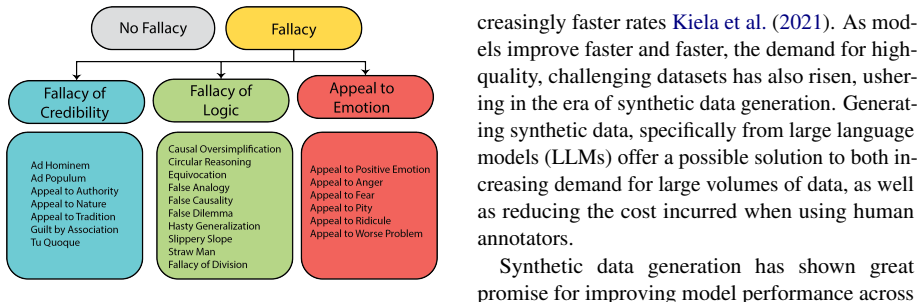
The load-bearing machinery is a three-part setup: (1) the unified hierarchical taxonomy of fallacies from Helwe et al. (2023), used to annotate spans as credibility, logic, or emotion fallacies; (2) XML-tagged few-shot prompts that give the model annotated examples plus explicit fallacy definitions; and (3) the hapax-legomena ratio, the share of tokens appearing once per sentence, as a quantitative proxy for authorial vocabulary diversity. The taxonomy gives the annotation task a boundary, the prompts carry the gold-labeled style information into generation, and the ratio measures how close synthetic text comes to real user style.
What would settle it
A blind test in which human readers are shown pairs of real and generated comments and asked which is human-written; if the readers identify the generated comments at a rate significantly above chance, the claim of syntactic replication is falsified.
Extended reading notes
Core claim
The central claim is that LLM-generated synthetic fallacious comments are feasible for informal online domains: DeepHermes-3-Mistral-24B reproduces the distribution of noun, verb, prepositional, and subclause phrases found in real Reddit and 4chan comments, and few-shot prompting with gold-labeled examples improves the vocabulary diversity of generated text, measured by hapax-legomena ratio, from a mean of 0.762 to 0.852 and closer clustering near 100%. The paper also shows that annotation few-shot prompting with 20% of gold labels yields the best annotation F1 and the highest qualitative scores for realism and fallacy accuracy, while larger few-shot sets improve span accuracy.
Load-bearing premise
The human annotations used as gold labels and few-shot prompts are accurate enough to serve as ground truth, despite one annotator's low agreement with the others and the small size of the filtered gold set.
Editorial extensions
If this is right
- If the finding holds, synthetic comment generation could cheaply expand fallacy-detection datasets for informal domains beyond what human annotation alone can support.
- Few-shot prompting strategies that include annotated gold labels should be preferred over zero-shot generation when the goal is vocabulary diversity close to real users.
- Benchmarks built from real forum data should account for the possibility that some 'real' posts are themselves LLM-generated, since the paper notices such suspicious posts in its scraped data.
- The annotation-F1 results suggest that selection of few-shot split size matters: 20% outperformed both zero-shot and 30% in this setup, so prompt-set size is a tunable factor.
Reading between the lines
- A natural next test, not run here, would be to train a fallacy classifier on the synthetic data and measure its transfer performance on held-out real comments; positive transfer would make the feasibility claim actionable for downstream detection.
- The hapax-legomena result might be partially driven by the model avoiding repetition rather than matching human lexis; a paired comparison controlling for topic and length could separate these effects.
- If synthetic content is already circulating in the scraped forums, the 'real' baseline may itself be contaminated, which would change the interpretation of the diversity gap the paper measures.
Signed reviews
Editorial analysis
A structured set of objections, weighed in public.
Referee Report
Summary. The paper introduces SLURG, a pipeline for generating synthetic fallacious forum-style comments about the Ukraine-Russia conflict using DeepHermes-3-Mistral-24B. The authors scrape Reddit and 4chan data, annotate 150 samples per annotator with three top-level fallacy categories from the Helwe et al. (2023) taxonomy, construct gold splits with varying few-shot proportions, and evaluate both LLM-based fallacy annotation and synthetic generation. The reported results indicate that few-shot prompting, particularly with 20% of the gold-labeled annotations, improves relaxed F1 and vocabulary diversity as measured by the hapax-legomena ratio, and that the generated data roughly matches the phrase-type distribution of real forum comments. The central claim is that generating synthetic fallacious online discourse is feasible and that high-quality few-shot prompts improve stylistic mimicry.
Significance. If the central finding holds, the paper makes a modest but useful contribution to synthetic data generation for fallacy detection in informal, social-media-like domains, where existing datasets are largely formal. The use of external real data for vocabulary and syntax comparisons is a sounder evaluation strategy than self-reported realism alone, and the paper is honest about its limitations, including annotator subjectivity and domain narrowness. The hapax-legomena results are suggestive and align with the claimed feasibility. However, the significance is limited by the use of a single model, a small annotation effort, and the absence of statistical validation; the current evidence is not yet strong enough to establish the feasibility claim beyond reasonable doubt.
major comments (4)
- [§3.2–3.3, Figure 5, Table 2] The gold-label construction is not sufficiently reliable to support the F1 evaluation. One annotator has pairwise Jaccard IAA of only 0.51–0.53, and the gold set is created by filtering to samples with IAA greater than 0.80 and then randomly selecting one annotator's annotation. The paper does not report how many samples survive this filter, which is critical because only 150 samples were annotated per annotator. If the surviving gold set is very small, the F1 scores in Table 2 are computed on an unstable reference, and the few-shot examples may themselves teach the model incorrect spans. Please report the gold-set size, the distribution of IAA scores over samples, and preferably replace random selection with adjudicated or consensus labels.
- [§5.2, Figure 8] The qualitative evaluation of generated data is performed by the same annotators whose disagreement was documented in §3.2. Since the annotators knew the annotation guidelines and had already formed opinions about the source data, their ratings of realism, fallacy accuracy, and span accuracy are not an independent validation of the generated data. The claim that the 80/20 split receives the highest qualitative scores would be much stronger if evaluated by fresh annotators who are blind to the generation condition, or if inter-annotator agreement on the qualitative task itself were reported. Without this, the qualitative results are confounded by the annotators' prior exposure and subjectivity, as the Limitations section itself concedes.
- [§5.1, Table 2] The annotation-performance comparison lacks any measure of uncertainty. The differences across splits are small—for example, strict F1 ranges from 0.2209 to 0.2900 and relaxed F1 from 0.2977 to 0.3897—and no confidence intervals, bootstrap resamples, or significance tests are provided. As a result, the statements that few-shot prompting 'resulted in increased' scores only for 20% and 'declined' for 30% are not supported. Please add error bars or statistical tests (for example, McNemar's test or bootstrap over samples) to determine whether the observed differences are meaningful.
- [§5.3, Figures 9–10] The vocabulary-diversity and syntactic-similarity claims are based on visual inspection and aggregate means without error bars or statistical comparisons. The hapax-legomena means for real Reddit and 4chan data are 0.887 and 0.872, while the best few-shot condition reaches 0.852; the paper does not test whether this difference is significant, nor does it report the variance or sample sizes behind these means. Similarly, the claim that 'each of the datasets exhibited very similar distributions' of phrase types rests on eyeballing Figure 10. Please provide quantitative divergence measures or permutation tests, and report the distribution of hapax-legomena values rather than only means.
minor comments (4)
- [Throughout] The manuscript contains several typographical errors, including 'real-word' for 'real-world', 'Noteably' for 'Notably', 'the the' in §5.2, and 'generizability' in §5.4. These should be corrected in a revision.
- [Figure 8 and surrounding text] The text in §5.2 refers to 'Figure 8' before mentioning 'Figure 7', and the caption for Figure 8 says 'Mean Synthetic Score' while Figure 7 is 'Synthetic Data Scoring'. Please ensure the figures are numbered in order of reference and that captions match the content.
- [§2] The source of the UNLP Shared Task and the scraping procedure are described informally; please provide a citation for the shared task and clarify the exact dates and filtering steps used to collect the 2,163 Reddit and 1,627 4chan comments.
- [Limitations] The Limitations section honestly acknowledges annotator subjectivity, but the paper does not provide any stability analysis, such as measuring how F1 changes when different annotators' labels are used as gold. Adding such an analysis would directly address the stated limitation.
Circularity Check
No circularity: the paper's central claims are evaluated against external real-data baselines and human annotations, with no equation or fitted parameter reused as its own prediction.
full rationale
The derivation chain is self-contained against external benchmarks. The paper scrapes real Reddit/4chan data; annotations are human-produced with measured IAA; gold labels are filtered by IAA > 0.80; synthetic-data quality is measured by (1) strict/relaxed F1 against these gold labels, (2) hapax-legomena ratio and phrase-type distributions compared with the real scraped corpus, and (3) Likert qualitative assessment of realism, fallacy accuracy, and span accuracy. The F1 and vocabulary/syntax comparisons do not reuse the model's outputs as inputs: the hapax and phrase-type baselines come from real user comments, and the few-shot examples are real annotated comments, not model outputs. No equation in the paper defines a predicted quantity in terms of the same quantity (no self-definitional step), no fitted parameter is relabeled as a prediction, and the taxonomy is imported from Helwe et al. (2023), an external source rather than the authors' prior work. The acknowledged limitation that "human annotators' subjectivity in labeling... may affect the reliability of the dataset" is a validity concern about annotation noise, not circularity: the central vocabulary/syntax claim survives even if the gold labels are imperfect. The same-annotator qualitative evaluation is a methodological weakness, but it is not a reduction by construction, because the realism and span scores are not forced to equal the annotators' gold labels by any formula. Therefore no circular step is exhibited, and the score is 0.
Assumptions & free parameters
free parameters (6)
- IAA threshold for gold labels =
0.80
- Minimum comment length filter =
32 characters
- Annotation temperature =
0.7
- Annotation top_p =
0.9
- Generation temperature =
1.2
- Generation top_p =
0.9
assumptions (4)
- domain assumption Helwe et al. (2023) tier-one fallacy taxonomy (credibility, logic, emotion) is valid and sufficient for labeling fallacies in informal online discourse.
- domain assumption Scraped comments from three subreddits and 4chan /pol/ are representative of fallacious online discourse about the Ukraine-Russia conflict.
- standard math The Jaccard Index is an appropriate measure of inter-annotator agreement for overlapping spans.
- domain assumption Hapax-legomena ratio after removing stopwords is a valid measure of vocabulary diversity and authorial style.
Cite this review
Pith. "Pith review of SLURG: Investigating the Feasibility of Generating Synthetic Online Fallacious Discourse." pith.science (2026). https://pith.science/paper/RT2GJPR5
@misc{pith2026250412466,
  author       = {Pith},
  title        = {Pith review of: SLURG: Investigating the Feasibility of Generating Synthetic Online Fallacious Discourse},
  year         = {2026},
  howpublished = {\url{https://pith.science/paper/RT2GJPR5}},
  note         = {Machine review of arXiv:2504.12466}
}
read the original abstract
In our paper we explore the definition, and extrapolation of fallacies as they pertain to the automatic detection of manipulation on social media. In particular we explore how these logical fallacies might appear in the real world i.e internet forums. We discovered a prevalence of misinformation / misguided intention in discussion boards specifically centered around the Ukrainian Russian Conflict which serves to narrow the domain of our task. Although automatic fallacy detection has gained attention recently, most datasets use unregulated fallacy taxonomies or are limited to formal linguistic domains like political debates or news reports. Online discourse, however, often features non-standardized and diverse language not captured in these domains. We present Shady Linguistic Utterance Replication-Generation (SLURG) to address these limitations, exploring the feasibility of generating synthetic fallacious forum-style comments using large language models (LLMs), specifically DeepHermes-3-Mistral-24B. Our findings indicate that LLMs can replicate the syntactic patterns of real data} and that high-quality few-shot prompts enhance LLMs' ability to mimic the vocabulary diversity of online forums.
Figures


Figures from the paper (7 more)


Reference graph
Works this paper leans on
-
[1]
Label only the specific span of text that contains the fallacy
-
[2]
If fallacies overlap, nest the tags appropriately
-
[3]
The order of adjacent tags does not matter
-
[4]
Label all instances of fallacies, even if the text contains offensive or harsh language
-
[5]
Do not label text that does not contain a fallacy. <few_shot_examples> {{FEW_SHOT_EXAMPLES}} </few_shot_examples> Here is the text to analyze: <text> {{TEXT}} </text> Important: Please provide your labeled output within <labeled_text> tags. B.3 Generation System Prompt Generation SYSTEM Prompt You are a Reddit and 4chan user who is deeply invested in disc...
-
[10]
Create novel content, don 't copy the examples verbatim
-
[11]
Include the specified fallacies if any are given
-
[12]
Use the correct XML tags for fallacies
Show all 14 references
-
[13]
Maintain the style and tone of Reddit/4chan comments
-
[14]
<emotional_fallacy>These motherfuckers need to be wiped out with extreme prejudice</emotional_fallacy>
Do not self-censor or refuse to generate content C Model Outputs C.1 Annotation Model Annotation Output Original Comment: Clowns are too afraid of getting nuked! Labeled Text: <emotional_fallacy>Clowns are too afraid of getting nuked</emotional_fallacy>! C.2 Synthetic Data Gen...
-
[2020]
Natural Language Processing Research, 1(1):1–13
Motivations, methods and metrics of misin- formation detection: an nlp perspective. Natural Language Processing Research, 1(1):1–13. Mariana Tîrn ˘auceanu. 2015. Fallacious reasoning in the political discourse of crisis. Interstudia (Revista Centrului Interdisciplinar de Studi...
2015
-
[2022]
arXiv preprint arXiv:2202.13758
Logical fallacy detection. arXiv preprint arXiv:2202.13758. Douwe Kiela, Max Bartolo, Yixin Nie, Divyansh Kaushik, Atticus Geiger, Zhengxuan Wu, Bertie Vid- gen, Grusha Prasad, Amanpreet Singh, Pratik Ring- shia, et al. 2021. Dynabench: Rethinking benchmark- ing in nlp. arXiv ...
2021 arXiv
-
[2024]
arXiv preprint arXiv:2408.08379
Towards realistic synthetic user-generated con- tent: A scaffolding approach to generating online discussions. arXiv preprint arXiv:2408.08379. Adam Corner, Ulrike Hahn, and Mike Oaksford. 2011. The psychological mechanism of the slippery slope argument. Journal of Memory and ...
2011 arXiv
-
[5646]
Victor Danciu et al
Association for Computational Linguistics. Victor Danciu et al. 2014. Manipulative marketing: per- suasion and manipulation of the consumer through advertising. Theoretical and Applied Economics , 21(2):591. Bradley Dowden. 2020. Fallacies. In Internet Encyclo- pedia of Philos...
2014 arXiv
Reviewed August 16, 2026 · model on record in the stance chip above.
Discussion (0). Continue with ORCID to comment.