The Muon and Tau Electric Dipole Moments in the B-L Supersymmetric Standard Model
Pith reviewed 2026-06-27 16:25 UTC · model grok-4.3
The pith
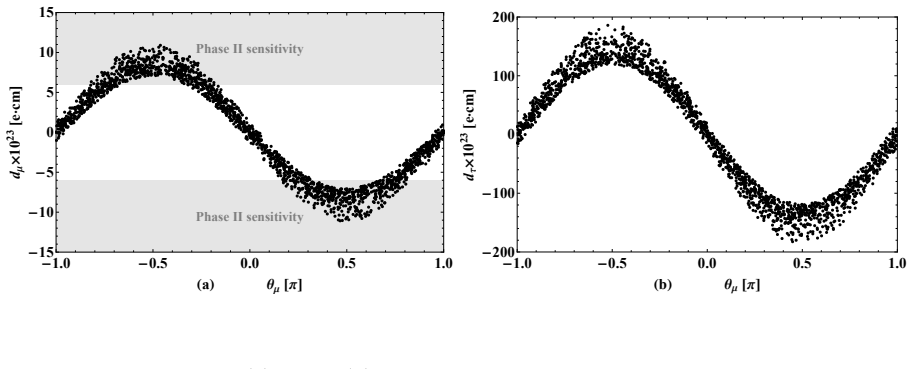
The B-L supersymmetric standard model generates muon EDMs within Phase II experimental sensitivity and tau EDMs up to 10^{-21} e cm.
A machine-rendered reading of the paper's core claim, the machinery that carries it, and where it could break.
Core claim
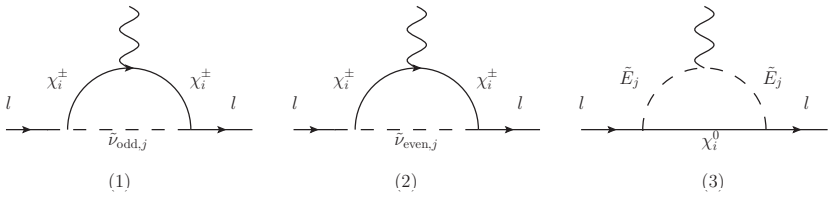
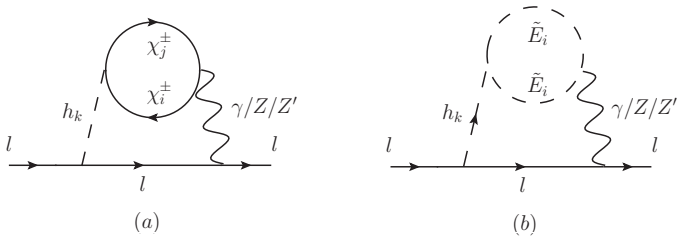
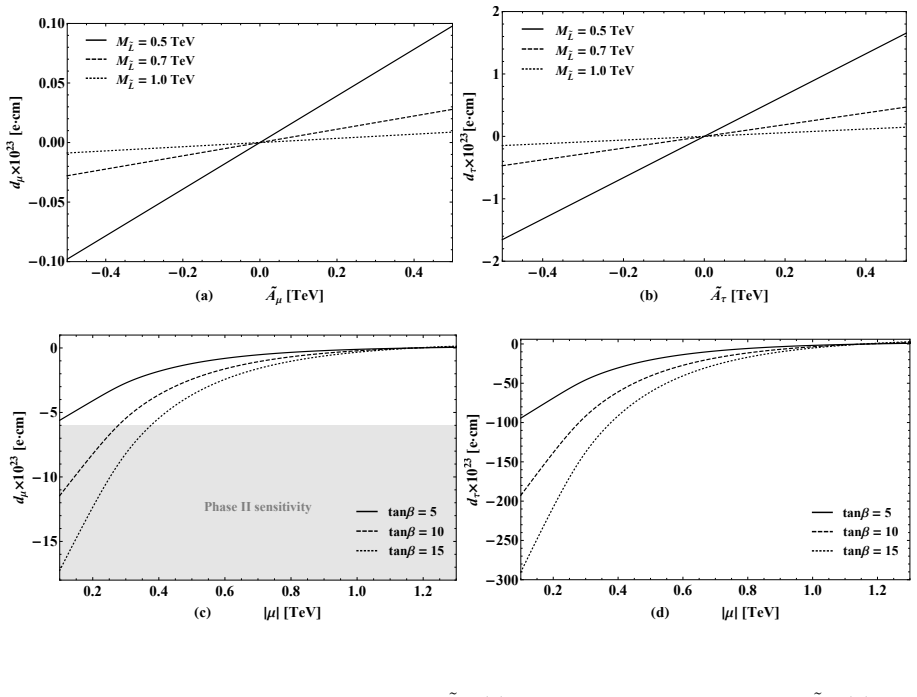
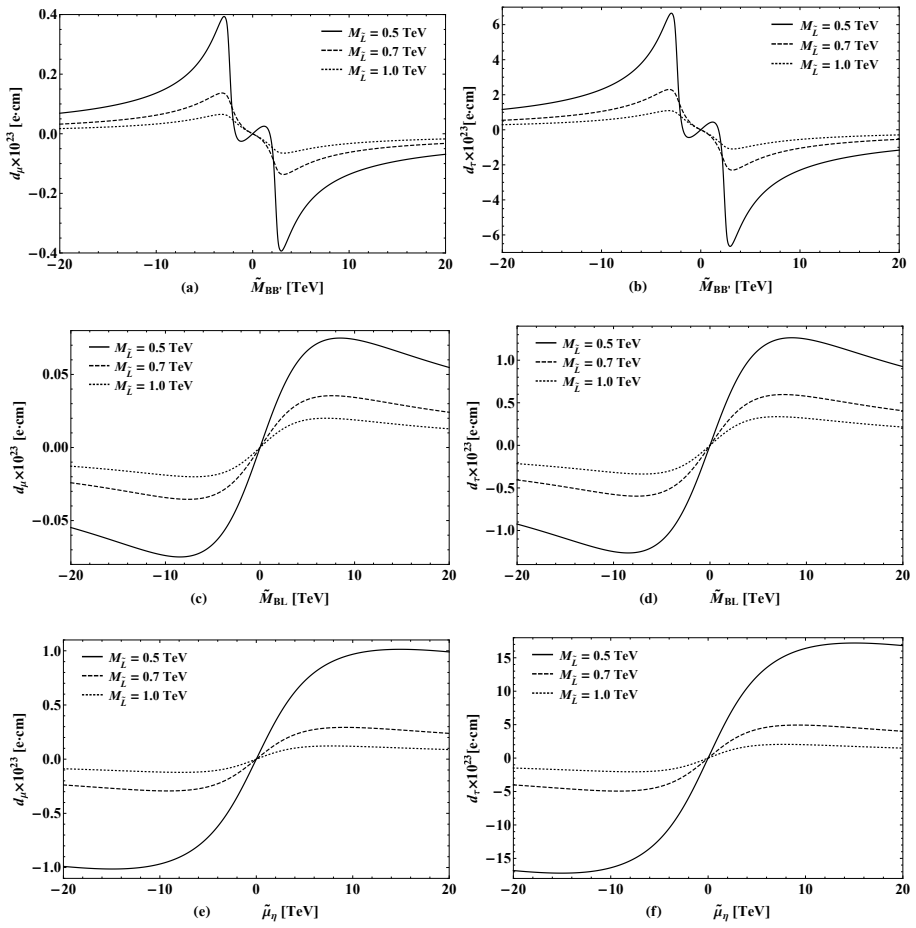
After considering corrections from some two-loop diagrams, the contributions in the B-LSSM to the EDMs of charged leptons are presented analytically in general forms. The numerical results show that the traditional μ-term in most SUSY models makes dominant contributions to d_μ and d_τ, while the B-LSSM specific CPV parameters also induce significant effects. It is found that across a substantial region of the B-LSSM parameter space, d_μ falls well within the projected sensitivity at Phase II of the proposed experiment, and |d_τ| can reach about 10^{-21} e·cm.
What carries the argument
The CP-violating phases associated with the B-LSSM soft terms and the μ parameter, which enter the one- and two-loop Feynman diagrams contributing to lepton EDMs.
If this is right
- The muon EDM lies within the projected sensitivity of Phase II experiments over substantial parameter space.
- The magnitude of the tau EDM can reach approximately 10^{-21} e cm.
- The B-LSSM-specific CP-violating parameters contribute significantly to the EDMs in addition to the standard mu-term.
- These values are achieved while satisfying existing experimental bounds on the model parameters.
Where Pith is reading between the lines
- If the EDMs are measured at the predicted levels, it would favor B-LSSM over minimal supersymmetric models.
- Full consistency with dark matter and flavor constraints may restrict the viable parameter space further.
- Similar calculations could be extended to other leptonic observables or to the electron EDM for comparison.
- Observation of non-zero tau EDM would point to new sources of CP violation beyond the standard model.
Load-bearing premise
The CP-violating phases and soft-breaking parameters in the B-LSSM can be chosen independently while satisfying constraints from flavor-changing neutral currents and dark matter relic density.
What would settle it
If Phase II experiments measure a muon EDM significantly below the lower bound of the predicted values in the B-LSSM scans, or if the tau EDM is found to be much smaller than 10^{-21} e cm, the claim of substantial viable parameter space would be falsified.
Figures
read the original abstract
Recently proposed experiments are expected to significantly improve the measurement sensitivities of the electric dipole moments (EDMs) of muon ($d_\mu$) and tau ($d_\tau$). Given that theoretical predictions for $d_\mu$ and $d_\tau$ typically surpass those for the electron EDM, this work focuses on studying the contributions from the CP-violating (CPV) effects in the B-L supersymmetric (SUSY) standard model (B-LSSM) to $d_\mu$ and $d_\tau$. After considering the corrections from some two-loop diagrams, the contributions in the B-LSSM to the EDMs of charged leptons are presented analytically in general forms. The numerical results show that the traditional $\mu$-term in most SUSY models makes dominant contributions to $d_\mu$ and $d_\tau$, while the B-LSSM specific CPV parameters also induce significant effects. It is found that across a substantial region of the B-LSSM parameter space, $d_\mu$ falls well within the projected sensitivity at Phase II of the proposed experiment, and $|d_\tau|$ can reach about $10^{-21}e\cdot\text{cm}$.
Editorial analysis
A structured set of objections, weighed in public.
Referee Report
Summary. The manuscript derives general analytic expressions for the electric dipole moments of the muon and tau in the B-L supersymmetric standard model (B-LSSM), including contributions from two-loop diagrams. It identifies the conventional μ-term as the dominant source while noting significant additional effects from B-LSSM-specific CP-violating phases and soft-breaking parameters. Numerical scans are presented to show that d_μ lies within the projected sensitivity of Phase II experiments over a substantial region of parameter space and that |d_τ| can reach ~10^{-21} e cm.
Significance. If the numerical results remain valid once all phenomenological constraints are imposed, the work would establish that the B-LSSM can produce observable muon and tau EDMs, furnishing testable predictions for forthcoming experiments and illustrating the phenomenological impact of the model's extra CP-violating phases. The provision of analytic forms that incorporate two-loop corrections is a positive feature that facilitates reproducibility and extension to related models.
major comments (1)
- [Numerical results section] Numerical results section (and abstract claim): The headline statement that d_μ falls within projected Phase-II sensitivity 'across a substantial region of the B-LSSM parameter space' is load-bearing. The text does not demonstrate that the scanned values of the B-LSSM CP-violating phases (e.g., those entering the μ-term and B-L gaugino sectors) simultaneously satisfy constraints from FCNC processes such as μ→eγ and b→sγ or from neutralino relic density. Without explicit verification that a non-empty viable region survives these bounds, the quoted numerical reach cannot be regarded as a robust prediction.
minor comments (1)
- [Abstract] The abstract refers to 'some two-loop diagrams' without naming them; a short parenthetical list or reference to the relevant subsection would improve clarity for readers scanning the abstract.
Simulated Author's Rebuttal
We thank the referee for the thorough review and for highlighting the need to ensure our numerical claims are robust under additional phenomenological constraints. We address the major comment below and will revise the manuscript accordingly.
read point-by-point responses
-
Referee: [Numerical results section] Numerical results section (and abstract claim): The headline statement that d_μ falls within projected Phase-II sensitivity 'across a substantial region of the B-LSSM parameter space' is load-bearing. The text does not demonstrate that the scanned values of the B-LSSM CP-violating phases (e.g., those entering the μ-term and B-L gaugino sectors) simultaneously satisfy constraints from FCNC processes such as μ→eγ and b→sγ or from neutralino relic density. Without explicit verification that a non-empty viable region survives these bounds, the quoted numerical reach cannot be regarded as a robust prediction.
Authors: We agree that the current numerical scans, while illustrative of the EDM contributions from the μ-term and B-LSSM-specific CPV phases, do not explicitly impose the full set of constraints from μ→eγ, b→sγ, and neutralino relic density. The parameter choices were guided by basic consistency with SUSY mass bounds and electroweak symmetry breaking, but a dedicated scan incorporating these observables is required to confirm a viable region. In the revised version we will add an updated numerical section that performs a constrained scan: we will require BR(μ→eγ) < 4.2×10^{-13}, BR(b→sγ) within 3σ of the experimental value, and Ωh² ≈ 0.12, while retaining the two-loop EDM expressions. We will then demonstrate that a non-empty subset of the B-LSSM parameter space still yields d_μ within the projected Phase-II reach. The abstract claim will be qualified to reflect this constrained viable region. revision: yes
Circularity Check
Analytic expressions and parameter scans are independent of inputs
full rationale
The paper first derives general analytic forms for the charged-lepton EDMs from the B-LSSM Lagrangian after including specified two-loop diagrams; these expressions are presented as functions of the model parameters and CP-violating phases. Numerical results are then obtained by scanning the parameter space. No equation reduces a claimed prediction to a fitted input by construction, no load-bearing uniqueness theorem is imported from self-citation, and no ansatz is smuggled via prior work. The derivation chain therefore remains self-contained against external benchmarks.
Axiom & Free-Parameter Ledger
free parameters (1)
- B-LSSM CP-violating phases and soft-breaking parameters
axioms (1)
- domain assumption Standard supersymmetric model assumptions including R-parity and the existence of the B-L gauge symmetry
Reference graph
Works this paper leans on
-
[1]
+ 2gB(gB +g Y B)(u2 η −u 2 ¯η) i +m2 ˜l + 1 2 v2 1YeY † e , m2 ˜lR = 1 8 h (2g2 1 + 2g2 Y B +g BgY B)(v2 2 −v 2
-
[2]
Additionally,Y e is the Yukawa cou- pling matrix of charged leptons
+ 2gB(gB + 2gY B)(u2 ¯η−u 2 η) i +m2 ˜e+ 1 2 v2 1YeY † e .(6) Similar to the MSSM,g 1 andg 2 are the standard gauge coupling constants,v 1, v2 are the VEVs of the Higgs doublets,A l denotes the trilinear coupling constant,µis theµterm cou- pling,m ˜l, m ˜eare the soft SUSY-breaking mass terms. Additionally,Y e is the Yukawa cou- pling matrix of charged le...
-
[3]
+ 2gB(gB +g Y B)(u2 η −u 2 ¯η) i +m 2 ˜l , m2 ˜νodd,evenR = 1 8 h gBgY B(v2 2 −v 2
-
[4]
It is worth noting that all matrix elements of the sneutrinos are real; therefore, they do not significantly affect the numerical results ford µ andd τ
+ 2g2 B(u2 ¯η−u 2 η) i − √ 2 h uηR(AR)− √ 2u2 ηY † RYR i +m2 ˜ν± √ 2u¯ηR(YRµ∗ η).(8) Here, the±signs correspond to CP-odd and CP-even sneutrinos respectively.Rdenotes the real part.Y R is the Majorana coupling matrix of right-handed neutrinos while the Dirac coupling matrix is taken to be zero for simplicity.A ν, A R denote the relevant trilinear coupling...
-
[5]
J. H. Christenson, J. W. Cronin, V. L. Fitch, and R. Turlay, Phys. Rev. Lett.13, 138 (1964)
1964
-
[6]
K. Abeet al.(Belle), Phys. Rev. Lett.87, 091802 (2001), arXiv:hep-ex/0107061
Pith/arXiv arXiv 2001
-
[7]
B. Aubertet al.(BaBar), Phys. Rev. Lett.89, 201802 (2002), arXiv:hep-ex/0207042
Pith/arXiv arXiv 2002
-
[8]
R. Cooke, M. Pettini, R. A. Jorgenson, M. T. Murphy, and C. C. Steidel, Astrophys. J.781, 31 (2014), arXiv:1308.3240 [astro-ph.CO]
Pith/arXiv arXiv 2014
-
[9]
P. A. R. Adeet al.(Planck), Astron. Astrophys.594, A13 (2016), arXiv:1502.01589 [astro- ph.CO]
Pith/arXiv arXiv 2016
-
[10]
M. E. Pospelov and I. B. Khriplovich, Sov. J. Nucl. Phys.53, 638 (1991)
1991
-
[11]
M. Pospelov and A. Ritz, Phys. Rev. D89, 056006 (2014), arXiv:1311.5537 [hep-ph]
Pith/arXiv arXiv 2014
-
[12]
Y. Yamaguchi and N. Yamanaka, Phys. Rev. Lett.125, 241802 (2020), arXiv:2003.08195 [hep-ph]
arXiv 2020
-
[13]
Y. Yamaguchi and N. Yamanaka, Phys. Rev. D103, 013001 (2021), arXiv:2006.00281 [hep-ph]
arXiv 2021
-
[14]
Y. Ema, T. Gao, and M. Pospelov, Phys. Rev. Lett.129, 231801 (2022), arXiv:2202.10524 [hep-ph]
arXiv 2022
-
[15]
J. Engel, M. J. Ramsey-Musolf, and U. van Kolck, Prog. Part. Nucl. Phys.71, 21 (2013), arXiv:1303.2371 [nucl-th]
Pith/arXiv arXiv 2013
-
[16]
T. Chupp, P. Fierlinger, M. Ramsey-Musolf, and J. Singh, Rev. Mod. Phys.91, 015001 (2019), arXiv:1710.02504 [physics.atom-ph]
Pith/arXiv arXiv 2019
-
[17]
S. Abel, S. Khalil, and O. Lebedev, Nucl. Phys. B606, 151 (2001), arXiv:hep-ph/0103320
Pith/arXiv arXiv 2001
-
[18]
T. Ibrahim, Phys. Rev. D64, 035009 (2001), arXiv:hep-ph/0102218. 18
Pith/arXiv arXiv 2001
-
[19]
C. Cesarotti, Q. Lu, Y. Nakai, A. Parikh, and M. Reece, JHEP05, 059 (2019), arXiv:1810.07736 [hep-ph]
arXiv 2019
-
[20]
A. Maiezza and M. Nemevˇ sek, Phys. Rev. D90, 095002 (2014), arXiv:1407.3678 [hep-ph]
Pith/arXiv arXiv 2014
-
[21]
S. Bertolini, A. Maiezza, and F. Nesti, Phys. Rev. D101, 035036 (2020), arXiv:1911.09472 [hep-ph]
arXiv 2020
-
[22]
W. Altmannshofer, S. Gori, N. Hamer, and H. H. Patel, Phys. Rev. D102, 115042 (2020), arXiv:2009.01258 [hep-ph]
arXiv 2020
-
[23]
S. M. Barr and A. Zee, Phys. Rev. Lett.65, 21 (1990), [Erratum: Phys.Rev.Lett. 65, 2920 (1990)]
1990
-
[24]
E. J. Chun, J. Kim, and T. Mondal, JHEP12, 068 (2019), arXiv:1906.00612 [hep-ph]
arXiv 2019
-
[25]
S. F. King, M. Muhlleitner, R. Nevzorov, and K. Walz, Nucl. Phys. B901, 526 (2015), arXiv:1508.03255 [hep-ph]
Pith/arXiv arXiv 2015
-
[26]
D. Chang, W.-F. Chang, M. Frank, and W.-Y. Keung, Phys. Rev. D62, 095002 (2000), arXiv:hep-ph/0004170
Pith/arXiv arXiv 2000
-
[27]
N. Yamanaka, T. Sato, and T. Kubota, Phys. Rev. D85, 117701 (2012), arXiv:1202.0106 [hep-ph]
Pith/arXiv arXiv 2012
-
[28]
N. Yamanaka, Phys. Rev. D86, 075029 (2012), arXiv:1208.4521 [hep-ph]
Pith/arXiv arXiv 2012
-
[29]
N. Yamanaka, T. Sato, and T. Kubota, Phys. Rev. D87, 115011 (2013), arXiv:1212.6833 [hep-ph]
Pith/arXiv arXiv 2013
-
[30]
S. Khalil and H. Okada, Phys. Rev. D79, 083510 (2009), arXiv:0810.4573 [hep-ph]
Pith/arXiv arXiv 2009
-
[31]
A. Elsayed, S. Khalil, and S. Moretti, Phys. Lett. B715, 208 (2012), arXiv:1106.2130 [hep-ph]
Pith/arXiv arXiv 2012
-
[32]
A. Elsayed, S. Khalil, S. Moretti, and A. Moursy, Phys. Rev. D87, 053010 (2013), arXiv:1211.0644 [hep-ph]
Pith/arXiv arXiv 2013
-
[33]
W. Abdallah, A. Hammad, S. Khalil, and S. Moretti, Phys. Rev. D95, 055019 (2017), arXiv:1608.07500 [hep-ph]
Pith/arXiv arXiv 2017
-
[34]
S. Khalil and S. Moretti, Rept. Prog. Phys.80, 036201 (2017), arXiv:1503.08162 [hep-ph]
Pith/arXiv arXiv 2017
-
[35]
L. Delle Rose, S. Khalil, S. J. D. King, S. Kulkarni, C. Marzo, S. Moretti, and C. S. Un, JHEP07, 100 (2018), arXiv:1712.05232 [hep-ph]
Pith/arXiv arXiv 2018
-
[36]
J.-L. Yang, T.-F. Feng, and H.-B. Zhang, J. Phys. G47, 055004 (2020), arXiv:2003.09781 [hep-ph]
arXiv 2020
-
[37]
J.-L. Yang, H.-B. Zhang, C.-X. Liu, X.-X. Dong, and T.-F. Feng, JHEP08, 086 (2021), 19 arXiv:2104.03542 [hep-ph]
arXiv 2021
-
[38]
A. A. Abdelalim, B. Das, S. Khalil, and S. Moretti, Nucl. Phys. B985, 116013 (2022), arXiv:2012.04952 [hep-ph]
arXiv 2022
-
[39]
Khalil, LHEP2023, 454 (2023)
S. Khalil, LHEP2023, 454 (2023)
2023
-
[40]
J.-L. Yang, T.-F. Feng, S.-K. Cui, C.-X. Liu, W. Li, and H.-B. Zhang, JHEP04, 013 (2020), arXiv:1910.05868 [hep-ph]
arXiv 2020
-
[41]
J.-L. Yang, T.-F. Feng, and H.-B. Zhang, Eur. Phys. J. C80, 210 (2020), arXiv:2002.09313 [hep-ph]
arXiv 2020
-
[42]
Inamiet al.(Belle), JHEP04, 110 (2022), arXiv:2108.11543 [hep-ex]
K. Inamiet al.(Belle), JHEP04, 110 (2022), arXiv:2108.11543 [hep-ex]
arXiv 2022
-
[43]
G. W. Bennettet al.(Muon (g-2)), Phys. Rev. D80, 052008 (2009), arXiv:0811.1207 [hep-ex]
Pith/arXiv arXiv 2009
-
[44]
T. S. Roussyet al., Science381, adg4084 (2023), arXiv:2212.11841 [physics.atom-ph]
arXiv 2023
-
[45]
Abeet al.(Belle-II), (2010), arXiv:1011.0352 [physics.ins-det]
T. Abeet al.(Belle-II), (2010), arXiv:1011.0352 [physics.ins-det]
Pith/arXiv arXiv 2010
-
[46]
W. Altmannshoferet al.(Belle-II), PTEP2019, 123C01 (2019), [Erratum: PTEP 2020, 029201 (2020)], arXiv:1808.10567 [hep-ex]
arXiv 2019
-
[47]
Aiharaet al., (2024), arXiv:2406.19421 [hep-ex]
H. Aiharaet al., (2024), arXiv:2406.19421 [hep-ex]
arXiv 2024
-
[48]
M. Ablikimet al.(BESIII), Nucl. Instrum. Meth. A614, 345 (2010), arXiv:0911.4960 [physics.ins-det]
Pith/arXiv arXiv 2010
-
[49]
M. Ablikimet al.(BESIII), Chin. Phys. C44, 040001 (2020), arXiv:1912.05983 [hep-ex]
arXiv 2020
-
[50]
W. Bernreuther, L. Chen, and O. Nachtmann, Phys. Rev. D104, 115002 (2021), arXiv:2108.13106 [hep-ph]
arXiv 2021
-
[51]
Donget al.(CEPC Study Group), (2018), arXiv:1811.10545 [hep-ex]
M. Donget al.(CEPC Study Group), (2018), arXiv:1811.10545 [hep-ex]
Pith/arXiv arXiv 2018
-
[52]
Chenget al.(CEPC Physics Study Group), inSnowmass 2021(2022) arXiv:2205.08553 [hep-ph]
H. Chenget al.(CEPC Physics Study Group), inSnowmass 2021(2022) arXiv:2205.08553 [hep-ph]
arXiv 2021
- [53]
-
[54]
A. Crivellin, M. Hoferichter, and J. M. Roney, Phys. Rev. D106, 093007 (2022), arXiv:2111.10378 [hep-ph]
arXiv 2022
-
[55]
A. Crivellin, M. Hoferichter, and P. Schmidt-Wellenburg, Phys. Rev. D98, 113002 (2018), arXiv:1807.11484 [hep-ph]
Pith/arXiv arXiv 2018
-
[56]
A. Adelmannet al., Eur. Phys. J. C85, 622 (2025), arXiv:2501.18979 [hep-ex]
arXiv 2025
- [57]
-
[58]
Z.-L. Huang, X.-Y. Du, X.-G. He, C.-W. Liu, and Z.-Y. Zou, Chin. Phys. Lett.43, 030201 (2026), arXiv:2510.23348 [hep-ph]
Pith/arXiv arXiv 2026
-
[59]
K. Deka, M. Losada, and Y. Nir, JHEP03, 065 (2026), arXiv:2511.21828 [hep-ph]
arXiv 2026
-
[60]
Minkowski, Phys
P. Minkowski, Phys. Lett. B67, 421 (1977)
1977
-
[61]
Weinberg, Phys
S. Weinberg, Phys. Rev. Lett.43, 1566 (1979)
1979
-
[62]
Yang, Z.-J
J.-L. Yang, Z.-J. Yang, X.-Y. Yang, H.-B. Zhang, and T.-F. Feng, Eur. Phys. J. C83, 1073 (2023)
2023
-
[63]
Holdom, Phys
B. Holdom, Phys. Lett. B166, 196 (1986)
1986
-
[64]
Matsuoka and D
T. Matsuoka and D. Suematsu, Prog. Theor. Phys.76, 901 (1986)
1986
-
[65]
del Aguila, J
F. del Aguila, J. A. Gonzalez, and M. Quiros, Nucl. Phys. B307, 571 (1988)
1988
-
[66]
del Aguila, G
F. del Aguila, G. D. Coughlan, and M. Quiros, Nucl. Phys. B307, 633 (1988), [Erratum: Nucl.Phys.B 312, 751 (1989)]
1988
-
[67]
Foot and X.-G
R. Foot and X.-G. He, Phys. Lett. B267, 509 (1991)
1991
-
[68]
K. S. Babu, C. F. Kolda, and J. March-Russell, Phys. Rev. D57, 6788 (1998), arXiv:hep- ph/9710441
arXiv 1998
-
[69]
J.-L. Yang, M.-H. Guo, W.-H. Zhang, H.-B. Zhang, and T.-F. Feng, (2024), arXiv:2406.01926 [hep-ph]
arXiv 2024
-
[70]
K. Cheung, O. C. W. Kong, and J. S. Lee, JHEP06, 020 (2009), arXiv:0904.4352 [hep-ph]
Pith/arXiv arXiv 2009
- [71]
-
[72]
W. Altmannshofer, P. S. B. Dev, A. Soni, and F. Xu, JHEP01, 153 (2026), arXiv:2507.23722 [hep-ph]
arXiv 2026
-
[73]
Navaset al.(Particle Data Group), Phys
S. Navaset al.(Particle Data Group), Phys. Rev. D110, 030001 (2024)
2024
-
[74]
M. Carena, A. Daleo, B. A. Dobrescu, and T. M. P. Tait, Phys. Rev. D70, 093009 (2004), arXiv:hep-ph/0408098
Pith/arXiv arXiv 2004
-
[75]
G. Cacciapaglia, C. Csaki, G. Marandella, and A. Strumia, Phys. Rev. D74, 033011 (2006), arXiv:hep-ph/0604111
Pith/arXiv arXiv 2006
-
[76]
ATLAS Collaboration, ATLAS-CONF-2016-045 (2016)
2016
-
[77]
L. Basso, Adv. High Energy Phys.2015, 980687 (2015), arXiv:1504.05328 [hep-ph]
Pith/arXiv arXiv 2015
-
[78]
J.-L. Yang, T.-F. Feng, S.-M. Zhao, R.-F. Zhu, X.-Y. Yang, and H.-B. Zhang, Eur. Phys. J. C78, 714 (2018), arXiv:1803.09904 [hep-ph]
Pith/arXiv arXiv 2018
-
[79]
C. S. Un and O. Ozdal, Phys. Rev. D93, 055024 (2016), arXiv:1601.02494 [hep-ph]. 21
Pith/arXiv arXiv 2016
discussion (0)
Sign in with ORCID, Apple, or X to comment. Anyone can read and Pith papers without signing in.