REVIEW 3 major objections 4 minor 67 references
Temperature effects on white dwarfs in modified gravity
T0 review · 3 major / 4 minor · reviewed 2026-08-15 · deepseek-v4-flash
Pith's one-line read The paper shows that a white dwarf at finite temperature is larger at the same mass in three modified-gravity theories, and that at 10^8 K thermal effects can mimic or mask changes in the gravity parameters.
desk verdict A transparent finite-temperature WD study in scalar-tensor theories with a plausible central result but a surface-definition soft spot that needs addressing before the high-T radius claims can be trusted. read the letter →
The pith
A machine-rendered reading of the paper's core claim, the machinery that carries it, and where it could break.
The reading
What carries the argument
The central object is the finite-temperature Chandrasekhar equation of state, built from relativistic Fermi-Dirac integrals $F_k(\eta,\beta)$ with $\beta=k_B T/(m_e c^2)$ and degeneracy parameter $\eta=\mu/(k_B T)$, which replaces the zero-temperature step-function occupancy of the degenerate electron gas. This EOS is coupled to the Einstein-frame scalar-tensor field equations and the hydrostatic equilibrium equation $P' = -(\rho c^2 + P)(\tilde{\varphi}' + \alpha \tilde{\phi}')$, with the scalar field governed by an effective potential set by each theory's conformal factor $A(\tilde{\phi})$ and self-interaction $V(\tilde{\phi})$. The stellar surface is fixed by $P=0$, and the effective gravitational constant is $G_{\mathrm{eff}} = A^2(\tilde{\phi}) G_N$. This machinery carries the argument because it is the temperature-dependent pressure that expands the star while the scalar field modifies the force balance.
What would settle it
Rebuild one of the paper's $10^{8}$ K models, for example the low-mass, large-radius branch near 0.75 solar masses, using a more complete finite-temperature treatment that includes non-degenerate electrons, ions, and a radiative outer envelope; if the radius at the same mass is no longer larger than the $10^{4}$ K model, or the branch disappears, the central claim is falsified.
Extended reading notes
Core claim
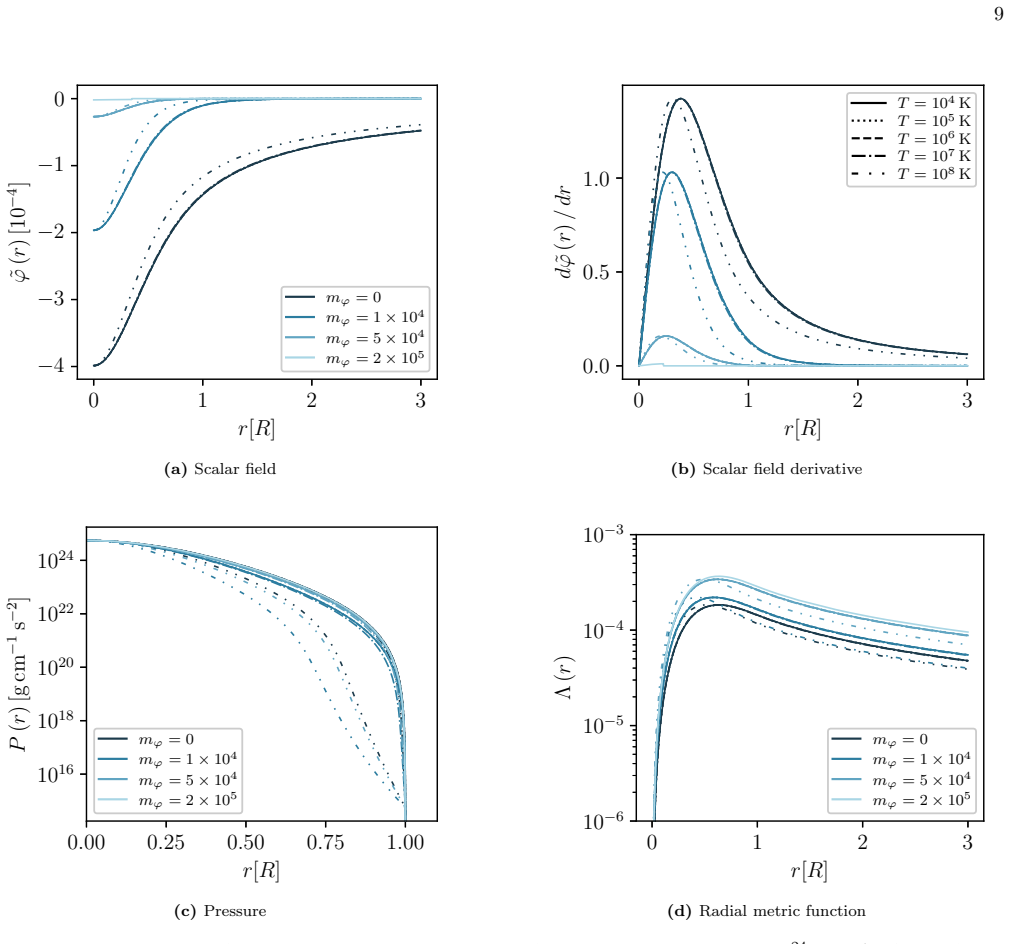
On its own terms, the paper establishes that in all three theories a nonzero temperature shifts the mass-radius relation: at fixed total mass the equilibrium radius increases with temperature while the mass stays essentially unchanged, because thermal pressure adds to degeneracy pressure. Up to about $10^{6}$ K, deviations from zero temperature are very small; at $10^{7}$ K and $10^{8}$ K they become significant. In every theory the effective gravitational constant is weaker at the stellar center than at infinity, with the largest deviations in massive Brans-Dicke and much smaller deviations in the screened theories. At $10^{8}$ K the mass-radius curves of all theories converge at large radii and low masses, which the paper reads as a hint that thermal effects dominate modified-gravity effects in that regime, while noting that the equation of state is starting to lose validity there. The interior radial profiles of the scalar field, pressure, and metric are mostly temperature independent except near $10^{8}$ K.
Load-bearing premise
The load-bearing premise is that the finite-temperature Chandrasekhar equation of state, with energy density dominated by rest mass and electrons treated as a degenerate Fermi gas, remains valid through the entire star up to $10^{8}$ K, including the outer layers where the paper concedes the gas becomes less degenerate and the EOS starts losing validity.
Editorial extensions
If this is right
- For all three theories, a white dwarf of fixed mass has a larger radius at higher temperature, with negligible change below about 10^6 K and significant change above.
- White-dwarf cooling tracks from 10^8 K down to 10^6 K should not assume a constant radius, because the thermal expansion affects the relation between cooling time and observed size.
- Finite temperature produces partial overlaps between different theory-parameter curves in the mass-radius plane, so parameter constraints drawn from observations must include temperature or risk being biased.
- At 10^8 K the mass-radius curves for massive Brans-Dicke, symmetron, and dilaton converge at large radii and low masses, suggesting that temperature effects dominate modified-gravity effects there, subject to the paper's own caveat about equation-of-state validity.
- In all three theories the central effective gravitational constant is smaller than its value at infinity, and temperature leaves this mostly unchanged except for a saturation effect at 10^8 K that the paper attributes to a possible numerical or EOS artifact.
Reading between the lines
- Extending the paper's logic, combining mass-radius data with independent temperature or cooling-rate measurements could lift the degeneracy the paper identifies, because temperature and modified-gravity parameters affect cooling ages differently.
- The high-temperature convergence of all theories at low masses suggests that any modified-gravity interpretation of an unusually large or small white dwarf should first check whether a hot standard model can reproduce the same radius; that check is not performed in the paper.
- A natural next step would be to feed the same finite-temperature EOS into rotating or magnetized white-dwarf models, where thermal expansion could shift the stability boundary relevant to super-Chandrasekhar candidates.
- The paper's own validity caveat implies the 10^8 K results are provisional: replacing the outer layers with a non-degenerate atmosphere and adding neutrino emission or shell burning could either sharpen or erase the apparent degeneracies.
Signed reviews
Editorial analysis
A structured set of objections, weighed in public.
Referee Report
Summary. This manuscript studies the equilibrium structure of white dwarfs at finite temperature in three scalar-tensor gravity theories: massive Brans-Dicke theory, symmetron screening, and dilaton screening. The authors derive a finite-temperature Chandrasekhar equation of state, integrate the spherically symmetric Einstein-frame field equations with a shooting method, and present mass-radius relations, effective gravitational constants, and radial profiles for temperatures up to 10^8 K. The central claim is that a non-zero temperature increases the white dwarf radius while leaving the total mass essentially unchanged, and that this thermal effect can partially mimic or mask modified-gravity signatures. The paper also reports that the T = 10^8 K branches converge to a common large radius across all theories, while repeatedly cautioning that the equation of state loses validity in precisely that regime.
Significance. If the central claim is robust, the paper provides a useful investigation of an under-explored degeneracy between thermal effects and scalar-tensor gravity modifications in white dwarfs, with potential implications for white dwarf cooling models and for interpreting mass-radius observations. The manuscript is transparent about its numerical setup, benchmarks the GR limit against Ref. [19], and explicitly flags the EoS validity limits and an unresolved dilaton parameter conversion. The main reservation is that the radius, the only temperature-sensitive diagnostic in the presented results, is defined by a pressure cutoff in a regime where the EoS is admitted to become invalid; the robustness of the central claim therefore depends on a quantitative treatment of the outer layers and of the thermal energy density that is not currently provided.
major comments (3)
- [Section 4 and Section 5.1] The stellar radius is defined numerically by the pressure cutoff P(r_s) = 10^-10 P_c, with the assertion that demanding more orders of magnitude does not significantly change the radii. At T = 10^8 K the low-density outer layers become non-degenerate, as the authors themselves state in Secs. 5.1 and 6; in this regime the finite-temperature EoS approaches an isothermal ideal-gas form P ∝ ρ, for which hydrostatic equilibrium has no natural surface and r_s shifts with the arbitrary cutoff. Since the T = 10^8 K branches and their convergence to a common large radius are presented as a main result, and since the mass is nearly unchanged by construction, the radius is the only temperature-sensitive diagnostic. Please quantify the cutoff dependence of r_s at T = 10^8 K and, if possible, at T = 10^7 K, or restrict the claimed radius increase to densities and temperatures where the Chandrasekhar EoS remains valid.
- [Section 2.1 and Eq. (15)] The energy density is approximated as rest-mass only, described as 'safely approximated to consist only of this term', but no estimate of the thermal energy contribution is given. The full energy density in Eq. (1b) contains a temperature-dependent part that becomes relatively important at low degeneracy and high temperature. Using only the rest-mass density in the hydrostatic equilibrium equation (15) removes a priori any direct temperature dependence of the energy density that enters the mass integral, so the conclusion that the mass is 'essentially unchanged' is partly an artifact of this approximation. Please quantify the thermal energy density relative to the rest-mass energy density over the full range of densities and temperatures used (especially ρ_c ~ 10^5-10^7 g cm^-3 at T = 10^8 K) and show the corresponding change in the inferred stellar mass.
- [Section 5.1, footnote 1] The dilaton results rely on parameter values that were adopted after an unresolved factor-of-10^-3 discrepancy with the theoretical conversion from Ref. [42]. The authors state that the reported mass-radius relations are recovered only for parameters smaller by this factor than those obtained from the theoretical conversion, and that the source of the discrepancy was not identified. Since the dilaton mass-radius curves and their temperature shifts are part of the quantitative results, this unresolved conversion should be resolved or its effect on the conclusions quantified; as written, the dilaton predictions rest on an empirically adjusted parameter set.
minor comments (4)
- [Abstract and Section 6] The abstract and conclusions state the finite-temperature radius increase without the important caveat, emphasized in Secs. 5.1 and 6, that at T = 10^8 K the equation of state is reaching its validity limit and that realistic models require non-degenerate outer layers. Please qualify the main claim accordingly.
- [Section 4] The statement that lowering the pressure cutoff does not significantly change the radii is not supported by a convergence test. A small figure or table showing r_s as a function of P_cut/P_c for representative models, including at least one T = 10^8 K case, would make the numerical boundary treatment reproducible.
- [Throughout] There are several typographical errors: Sec. 5.2 has 'it's value' instead of 'its value'; Sec. 6 has 'grativational' instead of 'gravitational'; Appendix B has 'mehtod' instead of 'method'; Sec. 5.1 has 'looses' instead of 'loses'. A careful proofreading pass is needed.
- [Section 5.1] The symmetron parameters are adopted from Ref. [42] and are outside the observational bounds quoted from Ref. [44]. The paper states this is intentional for comparison and mechanism illustration, which is acceptable, but the conclusions should explicitly remind the reader that the quantitative mass-radius shifts for the symmetron are not predictions for observationally allowed parameters.
Circularity Check
No significant circularity: the central results are forward numerical integrations from an independently derived finite-temperature Chandrasekhar EoS, with external benchmarks for the GR and dilaton cases.
full rationale
The paper's central claim, that a nonzero temperature increases the white dwarf radius at nearly fixed mass, comes from a direct numerical integration of the scalar-tensor structure equations (14a)-(14c) and (15), closed by the finite-temperature Chandrasekhar EoS (4),(6) derived from kinetic theory in Sec. 2. No parameter in the modified-gravity models is fitted to the mass-radius relations that constitute the main results: the GR benchmark is checked against the independent finite-temperature results of Ref. [19], the symmetron and dilaton parameters are taken from the external literature ([42]) or from the authors' earlier numerical setup ([43]), and the high-temperature T=10^8 K branches are explicitly flagged as approaching the validity limit of the EoS rather than being asserted as robust predictions. The self-citation [43] is limited to the numerical shooting procedure and notation conventions; it does not supply any uniqueness theorem, physical premise, or fitted quantity on which the temperature effect depends. The dilaton footnote reports an unresolved discrepancy with Ref. [42] and adopts parameter values that reproduce that external paper's curves; this is a calibration and benchmarking step, and the finite-temperature radius increase is subsequently computed from the EoS and structure equations rather than imposed by the calibration. The surface convention P(r_s)=10^-10 P_c is a numerical definition, and the paper asserts convergence with respect to it; even if that assertion failed at high temperature, the issue would be numerical robustness or EoS validity, not circularity. No equation in the paper is equivalent to its own output by construction, and no central claim reduces to a fitted parameter or a self-citation chain.
Assumptions & free parameters
free parameters (4)
- Brans-Dicke coupling alpha0 =
1
- Brans-Dicke scalar mass m_phi =
m_phi c^2 in [1.3e-13, 2.7e-12] eV
- Symmetron parameters mu, Mbar_S, lambda =
mu[1]=1.8, 5.4, 9.0e3; Mbar_S=1e-2; sqrt(lambda)=sqrt(2) mu M_P / M_S^2
- Dilaton parameters V0 and a2 =
log10(a2) in [1,4]; V0[1] in 3.3211e-3 to 3.3211
assumptions (5)
- domain assumption Spherically symmetric, static, perfect-fluid stellar model with the Einstein-frame metric of Eq. (13) and hydrostatic equilibrium Eq. (15).
- domain assumption Matter is a carbon-oxygen core described by an ideal degenerate relativistic electron gas, with energy density approximated by rest mass only.
- standard math The boundary value problem can be solved with the scalar field as the only shooting parameter because the temporal metric function enters only through its derivative.
- domain assumption The chosen potentials and conformal factors define the theories: the massive Brans-Dicke quadratic potential, the symmetron symmetry-breaking potential, and the dilaton runaway potential.
- ad hoc to paper The symmetron and dilaton parameter sets from [42] are accepted as representative despite being outside observational bounds or carrying an unresolved conversion issue.
Cite this review
Pith. "Pith review of Temperature effects on white dwarfs in modified gravity." pith.science (2026). https://pith.science/paper/RUJPCTS3
@misc{pith2026260812992,
  author       = {Pith},
  title        = {Pith review of: Temperature effects on white dwarfs in modified gravity},
  year         = {2026},
  howpublished = {\url{https://pith.science/paper/RUJPCTS3}},
  note         = {Machine review of arXiv:2608.12992}
}
read the original abstract
In this article we analyze the effects of a finite temperature equation of state on the equilibrium structure of white dwarfs in massive Brans-Dicke theory as well as the symmetron and dilaton screening mechanisms. We compute and present the numerically obtained mass-radius relation, effective gravitational constant as well as radial profiles of the scalar field, pressure and metric within the star. We show that assuming a non-zero temperature effectively results in a larger radius while leaving the total mass of the star essentially unchanged, and discuss the interplay between the effective gravitational constant, central density, and radius of the star.
Figures


Figures from the paper (2 more)

Reference graph
Works this paper leans on
-
[19]
and have a Mexican hat like potential (20). While the field is driven to zero in high density re- gions, symmetry breaking causes it to converge towards the potential minimum at low densities. In the dilaton case, it is the conformal factor (
-
[42]
Equilibrium structure of white dwarfs at finite temperatures
K. A. Boshkayev, J. A. Rueda, B. A. Zhami, Z. A. Kalymova, and G. S. Balgymbekov, “Equi- librium structure of white dwarfs at finite temperatures,” International Journal of Modern Physics: Conference Serie s 41 (Jan., arXiv:1510.02024
-
[1]
INTRODUCTION White dwarfs are compact stellar remnants formed after the evolution of stars with initial masses below roughly ten solar masses [ 1, 2]. Their interiors are typi- cally composed of carbon and oxygen, although low-mass white dwarfs may possess helium cores, all surrounded by thin outer envelopes of helium and hydrogen. Since thermonuclear rea...
-
[2]
Temperature effects on white dwarfs in modified gravity
In Sec. 3 we introduce the relativistic field equations for a general, conformal STT in Einstein frame together with the hydrostatic equilibrium equa- tion. Hereafter we present all considered models: mas- sive Brans-Dicke theory, symmetron and dilaton screen- ing. We proceed with a brief description of our numerical setup in Sec. 4 and a discussion of our...
work page Pith review arXiv 2026
-
[3]
EQUATION OF STATE The matter inside a WD can be considered to be a degenerate relativistic Fermi gas which can be described analytically by the Chandrasekhar equation of state in- troduced in Ref. [ 5]. From kinetic theory, we can write the number density of a specific particle species n, energy density ε and pressure P of a system, respectively, as n = g ...
-
[4]
HYDROSTATIC EQUILIBRIUM EQUATIONS In the following, we introduce the hydrostatic equi- librium equations for scalar-tensor theories in Einstein frame. This frame is obtained from the physical Jordan frame by a conformal transformation of the metric tensor, written as gµν = A2( ˜ϕ)˜gµν and scalar field redefinition. We refer the reader to Refs. [ 21, 23, 37,...
-
[5]
massive Brans-Dicke theory, symmetron and dilaton screening, at different finite temperatures
RESULTS In this section we present and discuss the obtained mass-radius relations for each considered gravity theory, i.e. massive Brans-Dicke theory, symmetron and dilaton screening, at different finite temperatures. These rela- tions describe the equilibrium configurations for WDs in a specific theory, meaning the configuration for which the pressure exactly...
-
[6]
CONCLUSIONS In this article, we analyzed how a finite temperature Chandrasekhar equation of state for white dwarfs affects their equilibrium and internal structure in modified grav- ity theories. We considered a massive Brans-Dicke theory as well as the symmetron and dilaton screening mecha- nisms. First, we derived the Chandrasekhar equation of state from k...
Show all 67 references
-
[7]
For a more detailed description of our procedure, we refer the reader to our previous work [ 43]
NUMERICAL PRELIMINARIES Here, we briefly describe the numerical setup. For a more detailed description of our procedure, we refer the reader to our previous work [ 43]. The system of differential equations ( 14), ( 15) poses a boundary value problem as the boundary conditions ar...
-
[8]
Type Ia supernovae: their origin and possible applications in cosmology.,
K. Nomoto, K. Iwamoto, and N. Kishimoto, “Type Ia supernovae: their origin and possible applications in cosmology.,” Science 276 (Jan., 1997) 1378–1382 , arXiv:astro-ph/9706007
1997 arXiv
-
[9]
The type Ia supernova SNLS-03D3bb from a super-Chandrasekhar-mass white dwarf star,
D. A. Howell, M. Sullivan, et al. , “The type Ia supernova SNLS-03D3bb from a super-Chandrasekhar-mass white dwarf star,” Nature 443 no. 7109, (Sept., 2006) 308–311 , arXiv:astro-ph/0609616
2006 arXiv
-
[10]
differs from the usual convention used for screening mechanisms, e.g. in Refs. [ 39, 40, 42]. Nevertheless, we maintain our convention for consistency within this arti- cle and with our previous work [ 43]. We refer the reader to the appendix A for the correspondence between th...
-
[11]
(26) We denote the effective gravitational constant at the cen- ter of the star and at spatial infinity by Geff c := Geff ( ˜ϕc) and Geff ∞ := Geff ( ˜ϕ∞) respectively
back to the Jordan frame, we can define an effective gravitational constant that depends on the local value of the scalar field Geff( ˜ϕ) = A2( ˜ϕ)GN . (26) We denote the effective gravitational constant at the cen- ter of the star and at spatial infinity by Geff c := Geff ( ˜ϕc) and ...
-
[12]
Thus, the asymptotic value of the scalar field is set by the potential minimum
to ˜□ ˜ϕ ∝ dV ( ˜ϕ) d ˜ϕ . Thus, the asymptotic value of the scalar field is set by the potential minimum. The radius of the star ˜rs in Einstein frame is the small- est radius that satisfies the condition P (˜rs) = 0, while the physical stellar radius is Rs = A[ ˜ϕ(˜rs)]˜rs. Be...
-
[13]
Hence, Geff c → Geff ∞ and 1 − Geff c /Geff ∞ → 0, which is why we see a drop off to- wards lower densities for all theory parameters in Fig
At lower central densities, the star is less screened so that the central scalar field value goes to its asymptotic value. Hence, Geff c → Geff ∞ and 1 − Geff c /Geff ∞ → 0, which is why we see a drop off to- wards lower densities for all theory parameters in Fig. 3c. On the other s...
-
[14]
Before going to the modified gravity theories, we note that we also computed the mass-radius relations with a temperature dependent equation of state for GR
together with the hy- drostatic equilibrium equation ( 15) and the equation of state ( 4), ( 6) with the corresponding conformal factor, self-interacting potential and boundary conditions for the scalar field. Before going to the modified gravity theories, we note that we also c...
-
[15]
Modified Einstein’s gravity to probe the sub- and super-Chandrasekhar limiting mass white dwarfs: a new perspective to unify under- and over-luminous type Ia supernovae,
S. Kalita and B. Mukhopadhyay, “Modified Einstein’s gravity to probe the sub- and super-Chandrasekhar limiting mass white dwarfs: a new perspective to unify under- and over-luminous type Ia supernovae,” J. Cosmology Astropart. Phys. 2018 no. 9, (Sept., 2018) 007 , arXiv:1805.12550
2018 arXiv
-
[16]
and ( 17) respectively. For the theory pa- rameters, we assume α0 = 1 and dimensionless masses m ˜ϕ[1] ∈ [1 × 10⁴, 2 × 10⁵] which corresponds to m ˜ϕc2 [eV ] ∈ [1.3 × 10⁻¹³, 2.7 × 10⁻¹²] or equivalently m ˜ϕ [g] ∈ [2.4 × 10−46, 4.7 × 10−45]. The numerically ob- tained curves f...
-
[17]
Space - Time - Matter
We observed a qualitatively consis- tent pattern for all considered theories. Deviations from the zero temperature result remain very small for tem- peratures up to ∼ 106K. For T > 106K deviations in- crease significantly and can no longer be neglected. We note that for higher ...
-
[18]
The method follows the following procedure:
-
[20]
For high enough central densities, the density term dominates over µ and the field sits at zero, the potential minimum which no longer depends on the density
of the theory. For high enough central densities, the density term dominates over µ and the field sits at zero, the potential minimum which no longer depends on the density. At this point Geff c = GN and the theory are equivalent to GR. This can also be seen in the mass-radius p...
-
[21]
The score function is a directional measure for how far off we are from our desired target value and ∆ ˜ϕ = 0 means that we exactly hit our target
First, we set the target value of the scalar field at numerical infinity ˜ϕ∞ and the score function ∆ ˜ϕ := ˜ϕ∞ − ˜ϕ(˜r∞) . The score function is a directional measure for how far off we are from our desired target value and ∆ ˜ϕ = 0 means that we exactly hit our target
-
[22]
The potential follows an exponential runaway form ( 23)
that directs the field to its minimum ˜ϕd. The potential follows an exponential runaway form ( 23). After a brief description of our numerical setup, we presented our results starting with the mass-radius rela- tions shown in Fig
-
[23]
We evolve our variables by integrating the differential equations with this guess and the remaining initial conditions
The first iteration takes a random guess for the initial value of the scalar field ˜ ϕ(1) c . We evolve our variables by integrating the differential equations with this guess and the remaining initial conditions. In this way, we find the value of the scalar field at infinity ˜ϕ(1) ...
-
[24]
3 ”Small/large enough” meaning that numerical results will n ot significantly change if these values are decreased/increas ed
In the next step, the code slightly varies the first initial guess to define a second initial guess ˜ ϕ(2) c . 3 ”Small/large enough” meaning that numerical results will n ot significantly change if these values are decreased/increas ed. 12 Again, the variables are evolved using ...
-
[25]
˜ϕ(3) c > ˜ϕ(2) c
Our assumption in the last step means that our third guess should be larger than the previous ones, i.e. ˜ϕ(3) c > ˜ϕ(2) c . Once more, we solve the system with this guess and compute the score function. Let us now assume that sgn(∆ ˜ϕ(3)) ⁄= sgn(∆ ˜ϕ(2)). This means that we a...
-
[26]
correct
By carrying on with this procedure, we can con- tinue to narrow down the correct initial value for the scalar field ˜ϕc that hits the target value at in- finity ˜ϕ∞. Note that numerically speaking, we will never arrive at ∆ ˜ϕ = 0. Instead, we have to set the desired accuracy, e...
-
[27]
S. L. Shapiro and S. A. Teukolsky, Black Holes, White Dwarfs and Neutron Stars: The Physics of Compact Objects. Wiley, 2008
2008
-
[28]
New full evolutionary sequences of H- and He-atmosphere massive white dwarf stars using MESA,
G. R. Lauffer, A. D. Romero, and S. O. Kepler, “New full evolutionary sequences of H- and He-atmosphere massive white dwarf stars using MESA,” MNRAS 480 no. 2, (Oct., 2018) 1547–1562 , arXiv:1807.04774
2018 arXiv
-
[29]
¨Uber die Grenzdichte der Materie und der Energie,
W. Anderson, “ ¨Uber die Grenzdichte der Materie und der Energie,” Zeitschrift f¨ ur Physik56 no. 11-12, (Nov., 1929) 851–856
1929
-
[30]
The Equilibrium of Dense Stars,
E. Stoner, “The Equilibrium of Dense Stars,” Philos. Mag. 9 no. 60, (Jan., 1930) 944–963
1930
-
[31]
The Maximum Mass of Ideal White Dwarfs,
S. Chandrasekhar, “The Maximum Mass of Ideal White Dwarfs,” ApJ 74 (July, 1931) 81
1931
-
[32]
A. R. Choudhuri, Astrophysics for physicists . Cambridge University Press, 2010
2010
-
[33]
A Rigorous Examination of the Chandrasekhar Theory of Stellar Collapse,
E. H. Lieb and H.-T. Yau, “A Rigorous Examination of the Chandrasekhar Theory of Stellar Collapse,” ApJ 323 (Dec., 1987) 140
1987
-
[34]
Super-Chandrasekhar-mass Light Curve Models for the Highly Luminous Type Ia Supernova 2009dc,
Y. Kamiya, M. Tanaka, K. Nomoto, S. I. Blinnikov, E. I. Sorokina, and T. Suzuki, “Super-Chandrasekhar-mass Light Curve Models for the Highly Luminous Type Ia Supernova 2009dc,” ApJ 756 no. 2, (Sept., 2012) 191 , arXiv:1207.4648
2012 arXiv
-
[35]
The Subluminous, Spectroscopically Peculiar Type 1a Supernova 1991bg in the Elliptical Galaxy NGC 4374,
A. V. Filippenko, M. W. Richmond, et al. , “The Subluminous, Spectroscopically Peculiar Type 1a Supernova 1991bg in the Elliptical Galaxy NGC 4374,” AJ 104 (Oct., 1992) 1543
1992
-
[36]
Consistent estimates of 56Ni yields for type Ia supernovae,
M. Stritzinger, P. A. Mazzali, J. Sollerman, and S. Benetti, “Consistent estimates of 56Ni yields for type Ia supernovae,” A&A 460 no. 3, (Dec., 2006) 793–798 , arXiv:astro-ph/0609232
2006 arXiv
-
[37]
Type Ia supernova progenitors: a contemporary view of a long-standing puzzle,
A. J. Ruiter and I. R. Seitenzahl, “Type Ia supernova progenitors: a contemporary view of a long-standing puzzle,” A&A Rev. 33 no. 1, (Dec., 2025) 1 , arXiv:2412.01766
2025 arXiv
-
[38]
Modified Einstein’s gravity as a possible missing link between sub- and super-Chandrasekhar type Ia supernovae,
U. Das and B. Mukhopadhyay, “Modified Einstein’s gravity as a possible missing link between sub- and super-Chandrasekhar type Ia supernovae,” J. Cosmology Astropart. Phys. 2015 no. 5, (May, 2015) 045–045 , arXiv:1411.1515
2015 arXiv
-
[39]
Stability criterion for white dwarfs in Palatini f (R ) gravity,
L. Sarmah, S. Kalita, and A. Wojnar, “Stability criterion for white dwarfs in Palatini f (R ) gravity,” Phys. Rev. D 105 no. 2, (Jan., 2022) 024028 , arXiv:2111.08029
2022 arXiv
-
[40]
Stellar structure models in modified theories of gravity: Lessons and challenges,
G. J. Olmo, D. Rubiera-Garcia, and A. Wojnar, “Stellar structure models in modified theories of gravity: Lessons and challenges,” Phys. Rept. 876 (2020) 1–75 , arXiv:1912.05202
2020 arXiv
-
[41]
White dwarf stars in modified gravity,
A. Wojnar, “White dwarf stars in modified gravity,” International Journal of Geometric Methods in Modern Physi cs 18 (Jan., arXiv:2012.13927
2012 arXiv
-
[43]
Mach’s principle and a relativistic theory of gravitation,
C. Brans and R. H. Dicke, “Mach’s principle and a relativistic theory of gravitation,” Phys. Rev. 124 (1961) 925–935
1961
-
[44]
Tensor multiscalar theories of gravitation,
T. Damour and G. Esposito-Farese, “Tensor multiscalar theories of gravitation,” Class. Quant. Grav. 9 (1992) 2093–2176
1992
-
[45]
CANTATACollaboration, E. N. Saridakis, R. Lazkoz, et al. , Modified Gravity and Cosmology. An Update by the CANTATA Netw ork Springer, 2021. arXiv:2105.12582
2021 arXiv
-
[46]
Spontaneous scalarization,
D. D. Doneva, F. M. Ramazanoˇ glu, H. O. Silva, T. P. Sotiriou, and S. S. Yazadjiev, “Spontaneous scalarization,” 13 Reviews of Modern Physics 96 no. 1, (Mar., 2024) 015004 , arXiv:2211.01766
2024 arXiv
-
[47]
White dwarfs and revelations,
I. D. Saltas, I. Sawicki, and I. Lopes, “White dwarfs and revelations,” J. Cosmology Astropart. Phys. 2018 no. 5, (May, 2018) 028 , arXiv:1803.00541
2018 arXiv
-
[48]
White dwarf cooling via gravity portals,
G. Panotopoulos and I. Lopes, “White dwarf cooling via gravity portals,” Phys. Rev. D 101 no. 2, (Jan., 2020) 023017 , arXiv:2001.06004
2020 arXiv
-
[49]
The relativistic pulsar-white dwarf binary PSR J1738+0333 - II. The most stringent test of scalar-tensor gravity,
P. C. C. Freire, N. Wex, G. Esposito-Far` ese, J. P. W. Verbiest, M. Bailes, B. A. Jacoby, M. Kramer, I. H. Stairs, J. Antoniadis, and G. H. Janssen, “The relativistic pulsar-white dwarf binary PSR J1738+0333 - II. The most stringent test of scalar-tensor gravity,” MNRAS 423 n...
2012 arXiv
-
[50]
White Dwarf Critical Tests for Modified Gravity,
R. K. Jain, C. Kouvaris, and N. G. Nielsen, “White Dwarf Critical Tests for Modified Gravity,” Phys. Rev. Lett. 116 no. 15, (Apr., 2016) 151103 , arXiv:1512.05946
2016 arXiv
-
[51]
Maximal masses of white dwarfs for polytropes in R 2 gravity and theoretical constraints,
A. V. Astashenok, S. D. Odintsov, and V. K. Oikonomou, “Maximal masses of white dwarfs for polytropes in R 2 gravity and theoretical constraints,” Phys. Rev. D 106 no. 12, (Dec., 2022) 124010 , arXiv:2209.13693
2022 arXiv
-
[52]
Vainshtein regime in scalar-tensor gravity: Constraints on degenerate higher-order scalar-tensor theories,
M. Crisostomi, M. Lewandowski, and F. Vernizzi, “Vainshtein regime in scalar-tensor gravity: Constraints on degenerate higher-order scalar-tensor theories,” Phys. Rev. D 100 no. 2, (July, 2019) 024025 , arXiv:1903.11591
2019 arXiv
-
[53]
Binary white dwarfs as laboratories for extreme gravity with LISA,
T. B. Littenberg and N. Yunes, “Binary white dwarfs as laboratories for extreme gravity with LISA,” Classical and Quantum Gravity 36 no. 9, (May, 2019) 095017 , arXiv:1811.01093
2019 arXiv
-
[54]
Evolution of white dwarfs as a probe of theories of gravitation: the case of Brans-Dicke,
O. G. Benvenuto, L. G. Althaus, and D. F. Torres, “Evolution of white dwarfs as a probe of theories of gravitation: the case of Brans-Dicke,” MNRAS 305 no. 4, (May, 1999) 905–919
1999
-
[55]
Primordial black holes from fifth forces,
L. Amendola, J. Rubio, and C. Wetterich, “Primordial black holes from fifth forces,” Phys. Rev. D 97 (Apr, 2018) 081302(R) , arXiv:1711.09915
2018 arXiv
-
[56]
Observational constraints on early coupled quintessence,
L. W. K. Goh, J. Bachs-Esteban, A. G´ omez-Valent, V. Pettorino, and J. Rubio, “Observational constraints on early coupled quintessence,” Phys. Rev. D 109 (Jan, 2024) 023530 , arXiv:2308.06406
2024 arXiv
-
[57]
Growing neutrinos and cosmological selection,
C. Wetterich, “Growing neutrinos and cosmological selection,” Physics Letters B 655 no. 5, (2007) 201–208 , arXiv:0706.4427
2007 arXiv
-
[58]
Dynamics of neutrino lumps in growing neutrino quintessence,
S. Casas, V. Pettorino, and C. Wetterich, “Dynamics of neutrino lumps in growing neutrino quintessence,” Phys. Rev. D 94 (Nov, 2016) 103518 , arXiv:1608.02358
2016 arXiv
-
[59]
C. M. Will, Theory and experiment in gravitational physics . Cambridge University Press, 2 ed., 2018
2018
-
[60]
Rapidly rotating neutron stars in scalar-tensor theories of gravity,
D. D. Doneva, S. S. Yazadjiev, N. Stergioulas, and K. D. Kokkotas, “Rapidly rotating neutron stars in scalar-tensor theories of gravity,” Phys. Rev. D 88 no. 8, (2013) 084060 , arXiv:1309.0605
2013 arXiv
-
[61]
Invariant quantities in the scalar-tensor theories of gravitation,
L. J¨ arv, P. Kuusk, M. Saal, and O. Vilson, “Invariant quantities in the scalar-tensor theories of gravitation,” Phys. Rev. D 91 no. 2, (2015) 024041 , arXiv:1411.1947
2015 arXiv
-
[62]
Screening long-range forces through local symmetry restoration,
K. Hinterbichler and J. Khoury, “Screening long-range forces through local symmetry restoration,” Phys. Rev. Lett. 104 (2010) 231301 , arXiv:1001.4525
2010 arXiv
-
[63]
Dilaton and modified gravity,
P. Brax, C. van de Bruck, A.-C. Davis, and D. Shaw, “Dilaton and modified gravity,” Phys. Rev. D 82 (Sep, 2010) 063519 , arXiv:1005.3735
2010 arXiv
-
[64]
PPN Parameter gamma and Solar System Constraints of Massive Brans-Dicke Theories,
L. Perivolaropoulos, “PPN Parameter gamma and Solar System Constraints of Massive Brans-Dicke Theories,” Phys. Rev. D 81 (2010) 047501 , arXiv:0911.3401
2010 arXiv
-
[65]
Screening mechanisms on white dwarfs: Symmetron and dilaton,
J. Bachs-Esteban, I. Lopes, and J. Rubio, “Screening mechanisms on white dwarfs: Symmetron and dilaton,” Universe 11 no. 5, (2025) 158 , arXiv:2505.05871
2025 arXiv
-
[66]
Crystallized white dwarf stars in scalar-tensor gravity,
S. Vidal, A. Wojnar, L. J¨ arv, and D. Doneva, “Crystallized white dwarf stars in scalar-tensor gravity, ” Phys. Rev. D 111 (2025) 084075 , arXiv:2408.15937
2025 arXiv
-
[67]
Symmetron cosmology,
K. Hinterbichler, J. Khoury, A. Levy, and A. Matas, “Symmetron cosmology,” Phys. Rev. D 84 (Nov, 2011) 103521 , arXiv:1107.2112
2011 arXiv
Reviewed August 15, 2026 · model on record in the stance chip above.
Discussion (0). Continue with ORCID to comment.