REVIEW 4 major objections 4 minor 37 references
Online Synthesis of Control Barrier Functions with Local Occupancy Grid Maps for Safe Navigation in Unknown Environments
T0 review · 4 major / 4 minor · reviewed 2026-08-15 · deepseek-v4-flash
Pith's one-line read This paper claims that solving Laplace's equation over a local occupancy grid map produces a control barrier function that keeps a robot safe in unknown environments and can be recomputed in about 9 milliseconds.
desk verdict A useful engineering paper for real-time CBF synthesis from local grids, but the proof covers an exact global harmonic function rather than the truncated local map actually used, and the unicycle transfer is asserted, not proved. read the letter →
The pith
A machine-rendered reading of the paper's core claim, the machinery that carries it, and where it could break.
The reading
What carries the argument
The load-bearing object is the discrete Laplace equation with a five-point stencil: each transition cell's safety value equals the average of its four neighbors, assembled into the sparse linear system Ah = b, where A has diagonal 4 and off-diagonal entries -1 or 0. Boundary cells are fixed by the Dirichlet condition (10), and interior cells in the safety and obstacle regions are fixed at b and -a. The sparsity lets the system be solved iteratively by GMRES or BiCGSTAB, which is what makes online recomputation at millisecond scale possible. The harmonic nature of the solution supplies the smoothness, maximum principle, and isolated-critical-point properties on which the safety proof rests.
What would settle it
Run the controller in an arena with a thin pole placed just outside the robot's 200 by 200 local map in the direction of travel, so it is not yet in the occupancy grid; if the robot does not brake or deviate before the map expands to reveal the pole, the online safety claim is disproved.
Extended reading notes
Core claim
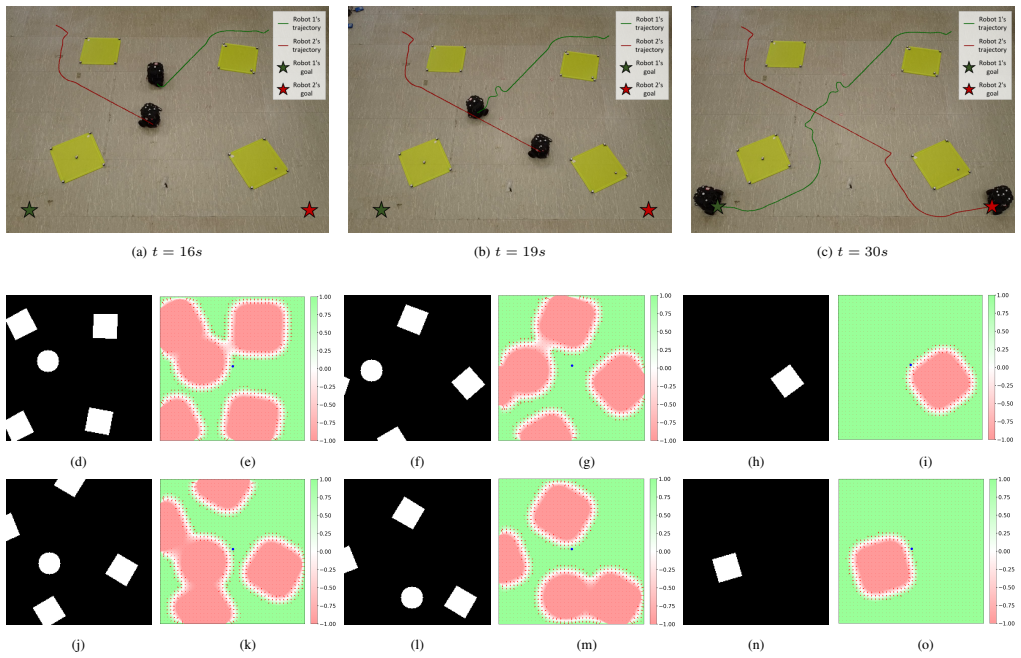
The central claim is that the harmonic function obtained from Laplace's equation, with Dirichlet conditions h = -a on obstacle boundaries and h = b on the safety-region and workspace boundaries, is a control barrier function for the single-integrator model, and that its discrete version over a local occupancy grid map can be solved in real time. The paper defines this as the steady-state thermal field-inspired CBF (SSTF-CBF). Propositions 1 and 3 argue that h is continuously differentiable, that its critical points are isolated, and that even if a robot crosses the h = 0 boundary at a point where the gradient vanishes, it cannot reach an obstacle before leaving the unsafe sublevel set. Experiments with a TurtleBot in simulation and in the lab show the field synthesized in average times around 9 ms on 200 by 200 maps, with safety values remaining positive during navigation.
Load-bearing premise
The safety guarantee rests on the assumption that the local map's outer boundary really is a safe boundary, so anything outside the current sensor range is treated as safe; an obstacle lurking just beyond the map edge is invisible to the computed field.
Editorial extensions
If this is right
- Only one CBF constraint is needed in the safety QP, independent of obstacle count or shape, so the optimization stays small even in cluttered maps.
- The per-cycle synthesis time of about 9 ms on a 200 by 200 grid makes it practical to refresh the safety field as fast as sensor maps are produced, including with dynamic obstacles.
- Because the field is harmonic in the transition region, there is no need for the interpolation or smoothing that signed-distance-function-based CBFs require.
- A robot that momentarily crosses into the h < 0 region is still protected from collisions by Proposition 3, so the filter tolerates temporary violations of the nominal safe set.
- The same construction works with local maps that treat other robots as obstacles, as demonstrated by the two-robot real-world experiment.
Reading between the lines
- A natural next step is to derive a quantitative bound on the error between the local-window harmonic solution and the global harmonic solution; without such a bound the safety certificate formally covers the closed workspace, not a moving sensor window.
- Because the map-to-CBF mapping is linear, the fixed-stencil computation could be shifted almost entirely to a GPU or embedded accelerator, potentially reducing the 9 ms figure further.
- The same harmonic construction could serve as a navigation function, with gradient descent on h used for planning as well as for safety filtering, uniting the two layers in one scalar field.
- For multi-robot operation, the experiments show mutual avoidance, but the proof treats other agents as static obstacles in each local map; a formal treatment of concurrent updates would be needed before claiming pairwise guarantees between moving robots.
Signed reviews
Editorial analysis
A structured set of objections, weighed in public.
Referee Report
Summary. The paper proposes SSTF-CBF, a method for online synthesis of control barrier functions from local occupancy grid maps. The safety function h is obtained by solving Laplace's equation over the grid with Dirichlet boundary conditions: h=-a on obstacle boundaries and h=b on the safety-region and workspace boundaries. The resulting h is used to filter a nominal velocity controller by a quadratic program with the single-integrator CBF constraint. The authors claim that this construction yields a valid CBF (Proposition 1), that critical points of h are isolated (Proposition 2), and that safety is maintained even if the robot enters the zero-sublevel set through a critical boundary point (Proposition 3). Experiments in Gazebo and with two real TurtleBots show millisecond-level synthesis times on 200x200 local OGMs. The computational claim is supported by the sparse linear-system formulation and by Table I.
Significance. The core idea of using the steady-state heat equation to turn a local occupancy map into a smooth safety field is genuinely attractive, and the sparse-matrix formulation is a sensible alternative to SDF-based smoothing or per-obstacle ellipsoidal CBFs. The experiments are informative and the reported computation times support the real-time feasibility claim. I also credit the authors for a construction that is not fitted to make the experiments pass; the parameters a, b, delta, and alpha are user-chosen design parameters. However, the formal safety guarantees stated in Propositions 1 and 3 are proved for an idealized global harmonic solution, not for the truncated local-grid function actually used in Algorithm 1, and the transfer from the single-integrator model to the unicycle experiments is asserted rather than proved. These gaps are load-bearing because the title and abstract promise safe navigation in unknown environments. The underlying approach is promising and the gaps appear addressable in principle, but the manuscript in its current form does not establish its central formal claim.
major comments (4)
- [§IV-A and Algorithm 1, Eq. (10)] The theoretical results in Propositions 1 and 3 concern the harmonic function defined over the full workspace W with Dirichlet data on the true obstacle boundary ∂O and the true outer boundary ∂W. Algorithm 1, however, constructs the same boundary-value problem on a 200x200 local occupancy grid and, per lines 9-13, assigns the artificial map edge the 'safe' value b. Obstacles beyond the current sensor range simply do not appear in the boundary data, and no theorem or error bound relates the local finite-difference solution to the global harmonic solution. Consequently, the formal guarantee established in Propositions 1 and 3 does not cover the online implementation. This is not merely a theoretical nicety: in the no-obstacle branch (Algorithm 1, lines 5-7) the nominal command is executed unfiltered, so a goal-directed controller can drive the robot toward an obstacle that has not yet entered the sensing range. None of the experiments appears to place obstacles at the sensing boundary, so this regime is untested.
- [§V-A, Eq. (19)] The safety filter is designed for the single-integrator model (15), but the experiments use the unicycle model (18). The near-identity transformation (19) is applied to velocity commands, not to the state, and with p defined as the robot center the resulting position dynamics are \dot p = [cos θ; sin θ](cos θ v_x + sin θ v_y), which is not \dot p = [v_x; v_y]ᵀ. Therefore the single-integrator condition L_f h + L_g h u ≥ -α(h) does not automatically imply the corresponding condition for the actual unicycle center dynamics. If p is instead intended to be the offset point used in the Robotarium reference [37], then h is evaluated at that offset point and additional reasoning is needed to conclude safety of the robot center. The paper asserts that safety transfers to the unicycle model but provides no proof; this is a load-bearing gap because the experiments and the claimed experimental safety rely on the unicycle implementation.
- [§IV-B, Proposition 1] The proof of Proposition 1 reduces to the observation that u=0 is admissible in the single-integrator model. For any continuously differentiable function h with 0 in the input constraint set U, condition (6) is satisfied on the safe set C because 0 ≥ -α(h(p)) whenever h(p) ≥ 0. Thus Proposition 1 does not distinguish the proposed SSTF-CBF from any smooth function; the Laplace construction is not needed for the CBF condition itself. The meaningful safety-relevant ingredient is the direction and magnitude of ∇h in the QP constraint (16), and the paper should present the non-vacuous invariance argument for that constraint directly. As written, the theoretical contribution of Section IV-B is overstated.
- [§IV-B, Proposition 3] The proof of Proposition 3 is incomplete. The quantity vmax is defined as the maximum safety value among critical points in Int(I), but no argument is given that such critical points exist; if there are none, the proof cannot proceed. More seriously, the QP (16) is infeasible at any state with h(p)<0 and ∂h/∂p=0, because the constraint becomes 0 ≥ -α(h(p)) with -α(h(p))>0. Proposition 3 does not rule out reaching such a state, and the statement that the robot encounters no critical points between p0 and p(t2) is asserted without proof. The claim that the robot 'will not enter the obstacle region' before exiting Uc is therefore not established by the given argument.
minor comments (4)
- [§IV-A, Eq. (12)] The notation for grid values is inconsistent: the text uses both h_i,j and hij for the same quantity; please unify.
- [Abstract / Introduction] Several typos should be corrected, including 'yeilds' in §IV-A, 'simlified' in §III, and 'the CBFs needs' in the Introduction.
- [§V-B] The text says a target is considered reached when the robot is within 0.5 cm of the destination; given the 3 m x 3 m arena this is likely a typo for 0.5 m. Please clarify.
- [§IV-A, Fig. 3] The caption states 'region O and ∂O are identical,' which is confusing because O is a set of obstacle cells and ∂O is its boundary; please rephrase or explain the discretized convention.
Circularity Check
No significant circularity: the safety function is constructed from declared boundary data, and the CBF property follows from harmonic-function facts plus the zero-control option, not from a fitted or self-cited input.
full rationale
The paper's derivation chain is self-contained and non-circular. The safety function h(p) is defined as the solution of Laplace's equation (11) with explicit Dirichlet boundary conditions (10): h = -a on obstacle boundaries and h = b on the safety-region and workspace boundaries. Proposition 1 then proves the CBF property by invoking harmonic-function smoothness and the fact that for single-integrator dynamics the control input can be chosen as zero, which trivially satisfies the lower bound in Definition 2 because h(p) >= 0 on the safe set. Propositions 2 and 3 use standard harmonic-function facts (isolated critical points, the maximum principle) to handle the zero-gradient case; these are external mathematical facts, not assumptions equivalent to the conclusion. The online algorithm solves the same discrete Laplace system (12)-(13) on the occupancy grid, and Table I reports measured computation times rather than predicted quantities obtained from fitted parameters. The design parameters a, b, delta, and alpha are stated user choices, not calibrated to force the experimental outcomes. The only potentially overlapping citation, reference [25], appears in a related-work comparison and is not load-bearing for any formal claim. The gap between the local truncated occupancy grid and the global workspace boundary is a real correctness limitation of the safety guarantee, but it is not a circularity: no equation or fitted value is used as its own input, and the local map is not used to derive the theorem that is then claimed as a prediction. Therefore the paper should receive a circularity score of 0.
Assumptions & free parameters
free parameters (4)
- a =
1
- b =
1
- delta =
0.15 m
- alpha =
0.15 h
assumptions (5)
- standard math Laplace's equation solutions are infinitely differentiable in the interior (standard elliptic regularity).
- standard math A non-constant harmonic function on a compact set attains extrema on the boundary and has finitely many isolated critical points in compact subsets.
- domain assumption The occupancy grid map Mt accurately represents the obstacle set O, including its boundaries, and the local map boundary can be treated as a safe Dirichlet boundary.
- domain assumption The discrete finite-difference solution of Laplace's equation on the grid is sufficiently close to the continuous harmonic function for the gradient-based CBF constraint to remain valid.
- domain assumption Safety of the single-integrator model transfers to the unicycle model through the transformation in Eq. (19).
Cite this review
Pith. "Pith review of Online Synthesis of Control Barrier Functions with Local Occupancy Grid Maps for Safe Navigation in Unknown Environments." pith.science (2026). https://pith.science/paper/RVQAESY4
@misc{pith2026250511941,
  author       = {Pith},
  title        = {Pith review of: Online Synthesis of Control Barrier Functions with Local Occupancy Grid Maps for Safe Navigation in Unknown Environments},
  year         = {2026},
  howpublished = {\url{https://pith.science/paper/RVQAESY4}},
  note         = {Machine review of arXiv:2505.11941}
}
read the original abstract
Control Barrier Functions (CBFs) have emerged as an effective and non-invasive safety filter for ensuring the safety of autonomous systems in dynamic environments with formal guarantees. However, most existing works on CBF synthesis focus on fully known settings. Synthesizing CBFs online based on perception data in unknown environments poses particular challenges. Specifically, this requires the construction of CBFs from high-dimensional data efficiently in real time. This paper proposes a new approach for online synthesis of CBFs directly from local Occupancy Grid Maps (OGMs). Inspired by steady-state thermal fields, we show that the smoothness requirement of CBFs corresponds to the solution of the steady-state heat conduction equation with suitably chosen boundary conditions. By leveraging the sparsity of the coefficient matrix in Laplace's equation, our approach allows for efficient computation of safety values for each grid cell in the map. Simulation and real-world experiments demonstrate the effectiveness of our approach. Specifically, the results show that our CBFs can be synthesized in an average of milliseconds on a 200 * 200 grid map, highlighting its real-time applicability.
Figures


Figures from the paper (3 more)


Reference graph
Works this paper leans on
-
[37]
The robotarium: Globally impactful opportunities, challenges, and lessons learned in remote-access, distributed control of multirobot systems,
S. Wilson, P. Glotfelter, L. Wang, S. Mayya, G. Notomista, M. Mote, and M. Egerstedt, “The robotarium: Globally impactful opportunities, challenges, and lessons learned in remote-access, distributed control of multirobot systems,” IEEE Control Systems Magazine , vol. 40, no. 1, pp. 26–44, 2020
2020
-
[1]
Real-time obstacle avoidance for manipulators and mobile robots,
O. Khatib, “Real-time obstacle avoidance for manipulators and mobile robots,” The International Journal of Robotics Research , vol. 5, no. 1, pp. 90–98, 1986
1986
-
[2]
The dynamic window approach to collision avoidance,
D. Fox, W. Burgard, and S. Thrun, “The dynamic window approach to collision avoidance,” IEEE Robotics & Automation Magazine , vol. 4, no. 1, pp. 23–33, 1997
1997
-
[3]
Uncertainty- aware visually-attentive navigation using deep neural networks,
H. Nguyen, R. Andersen, E. Boukas, and K. Alexis, “Uncertainty- aware visually-attentive navigation using deep neural networks,” The International Journal of Robotics Research , vol. 43, no. 6, pp. 840– 872, 2024
work page 2024
-
[4]
N-MPC for deep neural network- based collision avoidance exploiting depth images,
M. Jacquet and K. Alexis, “N-MPC for deep neural network- based collision avoidance exploiting depth images,” arXiv preprint arXiv:2402.13038, 2024
arXiv 2024
-
[5]
Control barrier function based quadratic programs for safety critical systems,
A. D. Ames, X. Xu, J. W. Grizzle, and P. Tabuada, “Control barrier function based quadratic programs for safety critical systems,” IEEE Transactions on Automatic Control , vol. 62, no. 8, pp. 3861–3876, 2017
2017
-
[6]
Control barrier functions: Theory and applications,
A. D. Ames, S. Coogan, M. Egerstedt, G. Notomista, K. Sreenath, and P. Tabuada, “Control barrier functions: Theory and applications,” in European Control Conference (ECC) , 2019, pp. 3420–3431
work page 2019
-
[7]
W. Xiao, C. G. Cassandras, and C. Belta, Safe autonomy with control barrier functions: theory and applications . Springer, 2023
work page 2023
Show all 37 references
-
[8]
High-order control barrier functions,
W. Xiao and C. Belta, “High-order control barrier functions,” IEEE Transactions on Automatic Control , vol. 67, no. 7, pp. 3655–3662, 2022
2022
-
[9]
High-order barrier functions: Robustness, safety, and performance-critical control,
X. Tan, W. S. Cortez, and D. V . Dimarogonas, “High-order barrier functions: Robustness, safety, and performance-critical control,” IEEE Transactions on Automatic Control , vol. 67, no. 6, pp. 3021–3028, 2022
2022
-
[10]
Adaptive safety with control barrier functions,
A. J. Taylor and A. D. Ames, “Adaptive safety with control barrier functions,” in American Control Conference (ACC) , 2020, pp. 1399– 1405
2020
-
[11]
Adaptive control barrier functions,
W. Xiao, C. Belta, and C. G. Cassandras, “Adaptive control barrier functions,” IEEE Transactions on Automatic Control , vol. 67, no. 5, pp. 2267–2281, 2022
2022
-
[12]
Robust control barrier functions with sector-bounded uncertainties,
J. Buch, S.-C. Liao, and P. Seiler, “Robust control barrier functions with sector-bounded uncertainties,” IEEE Control Systems Letters , vol. 6, pp. 1994–1999, 2021
1994
-
[13]
Input-to-state safety with control barrier functions,
S. Kolathaya and A. D. Ames, “Input-to-state safety with control barrier functions,” IEEE Control Systems Letters , vol. 3, no. 1, pp. 108–113, 2018
2018
-
[14]
Safe controller synthesis with tunable input-to-state safe control barrier functions,
A. Alan, A. J. Taylor, C. R. He, G. Orosz, and A. D. Ames, “Safe controller synthesis with tunable input-to-state safe control barrier functions,” IEEE Control Systems Letters , vol. 6, pp. 908–913, 2021
2021
-
[15]
Control barrier functions in dynamic uavs for kinematic obstacle avoidance: A colli- sion cone approach,
M. Tayal, R. Singh, J. Keshavan, and S. Kolathaya, “Control barrier functions in dynamic uavs for kinematic obstacle avoidance: A colli- sion cone approach,” in American Control Conference (ACC) , 2024, pp. 3722–3727
2024
-
[16]
Multi-layered safety for legged robots via control barrier functions and model predictive control,
R. Grandia, A. J. Taylor, A. D. Ames, and M. Hutter, “Multi-layered safety for legged robots via control barrier functions and model predictive control,” in IEEE International Conference on Robotics and Automation (ICRA), 2021, pp. 8352–8358
2021
-
[17]
CBFkit: A control barrier function toolbox for robotics applications,
M. Black, G. Fainekos, B. Hoxha, H. Okamoto, and D. Prokhorov, “CBFkit: A control barrier function toolbox for robotics applications,” in IEEE/RSJ International Conference on Intelligent Robots and Systems (IROS), 2024, pp. 12 428–12 434
2024
-
[18]
Safety barrier certificates for collisions-free multirobot systems,
L. Wang, A. D. Ames, and M. Egerstedt, “Safety barrier certificates for collisions-free multirobot systems,” IEEE Transactions on Robotics , vol. 33, no. 3, pp. 661–674, 2017
2017
-
[19]
Synthesis of control barrier functions using a supervised machine learning approach,
M. Srinivasan, A. Dabholkar, S. Coogan, and P. A. Vela, “Synthesis of control barrier functions using a supervised machine learning approach,” in IEEE/RSJ International Conference on Intelligent Robots and Systems (IROS) , 2020, pp. 7139–7145
2020
-
[20]
Safe persis- tent coverage control with control barrier functions based on sparse bayesian learning,
K. Mizuta, Y . Hirohata, J. Yamauchi, and M. Fujita, “Safe persis- tent coverage control with control barrier functions based on sparse bayesian learning,” in IEEE Conference on Control Technology and Applications (CCTA), 2022, pp. 311–318
2022
-
[21]
Lidar-based online control barrier function synthesis for safe navigation in unknown environments,
S. Keyumarsi, M. W. S. Atman, and A. Gusrialdi, “Lidar-based online control barrier function synthesis for safe navigation in unknown environments,” IEEE Robotics and Automation Letters , vol. 9, no. 2, pp. 1043–1050, 2023
2023
-
[22]
Safe control using vision-based control barrier function (V-CBF),
H. Abdi, G. Raja, and R. Ghabcheloo, “Safe control using vision-based control barrier function (V-CBF),” in IEEE International Conference on Robotics and Automation (ICRA) , 2023, pp. 782–788
2023
-
[23]
Learning barrier functions with memory for robust safe navigation,
K. Long, C. Qian, J. Cort ´es, and N. Atanasov, “Learning barrier functions with memory for robust safe navigation,” IEEE Robotics and Automation Letters , vol. 6, no. 3, pp. 4931–4938, 2021
2021
-
[24]
Dynamic control barrier function-based model predictive control to safety-critical obstacle-avoidance of mobile robot,
Z. Jian, Z. Yan, X. Lei, Z. Lu, B. Lan, X. Wang, and B. Liang, “Dynamic control barrier function-based model predictive control to safety-critical obstacle-avoidance of mobile robot,” in IEEE Interna- tional Conference on Robotics and Automation (ICRA) , 2023, pp. 3679–3685
2023
-
[25]
Online efficient safety-critical control for mobile robots in unknown dynamic multi-obstacle environments,
Y . Zhang, G. Tian, L. Wen, X. Yao, L. Zhang, Z. Bing, W. He, and A. Knoll, “Online efficient safety-critical control for mobile robots in unknown dynamic multi-obstacle environments,” arXiv preprint arXiv:2402.16449, 2024
2024 arXiv
-
[26]
Safe control using occupancy grid map-based control barrier function (OGM-CBF),
G. Raja, T. M ¨okk¨onen, and R. Ghabcheloo, “Safe control using occupancy grid map-based control barrier function (OGM-CBF),” arXiv preprint arXiv:2405.10703 , 2024
2024 arXiv
-
[27]
Robust safe learning and control in an unknown environment: An uncertainty-separated control barrier function approach,
J. Li, Q. Liu, W. Jin, J. Qin, and S. Hirche, “Robust safe learning and control in an unknown environment: An uncertainty-separated control barrier function approach,” IEEE Robotics and Automation Letters , vol. 8, no. 10, pp. 6539–6546, 2023
2023
-
[28]
Safety-critical control for autonomous systems: Control barrier functions via reduced-order models,
M. H. Cohen, T. G. Molnar, and A. D. Ames, “Safety-critical control for autonomous systems: Control barrier functions via reduced-order models,” Annual Reviews in Control , vol. 57, p. 100947, 2024
2024
-
[29]
Model-free safety-critical control for robotic systems,
T. G. Molnar, R. K. Cosner, A. W. Singletary, W. Ubellacker, and A. D. Ames, “Model-free safety-critical control for robotic systems,” IEEE Robotics and Automation Letters , vol. 7, no. 2, pp. 944–951, 2021
2021
-
[30]
Safety-critical control with bounded inputs via reduced order models,
T. G. Molnar and A. D. Ames, “Safety-critical control with bounded inputs via reduced order models,” in American Control Conference (ACC), 2023, pp. 1414–1421
2023
-
[31]
Safety-critical controller synthesis with reduced-order models,
M. H. Cohen, N. Csomay-Shanklin, W. D. Compton, T. G. Molnar, and A. D. Ames, “Safety-critical controller synthesis with reduced-order models,” arXiv preprint arXiv:2411.16479 , 2024
2024 arXiv
-
[32]
D. W. Hahn and M. N. ¨Ozisik, Heat conduction. John Wiley & Sons, 2012
2012
-
[33]
Basic properties of harmonic functions,
S. Axler, P. Bourdon, W. Ramey, S. Axler, P. Bourdon, and W. Ramey, “Basic properties of harmonic functions,” Harmonic Function Theory, pp. 1–29, 2001
2001
-
[34]
GMRES: A generalized minimal residual algorithm for solving nonsymmetric linear systems,
Y . Saad and M. H. Schultz, “GMRES: A generalized minimal residual algorithm for solving nonsymmetric linear systems,” SIAM Journal on Scientific and Statistical Computing , vol. 7, no. 3, pp. 856–869, 1986
1986
-
[35]
Bi-CGSTAB: A fast and smoothly converging variant of Bi-CG for the solution of nonsymmetric linear systems,
H. A. Van der V orst, “Bi-CGSTAB: A fast and smoothly converging variant of Bi-CG for the solution of nonsymmetric linear systems,” SIAM Journal on scientific and Statistical Computing , vol. 13, no. 2, pp. 631–644, 1992
1992
-
[36]
p-harmonic functions in the plane,
J. J. Manfredi, “ p-harmonic functions in the plane,” Proceedings of the American Mathematical Society , vol. 103, no. 2, pp. 473–479, 1988
1988
Reviewed August 15, 2026 · model on record in the stance chip above.
Discussion (0). Continue with ORCID to comment.