Boundary Geometry Turns Entanglement into Steering
Pith reviewed 2026-05-21 04:44 UTC · model grok-4.3
The pith
Boundary tangency in the Bloch sphere turns certain entangled two-qubit states into two-way projectively steerable ones.
A machine-rendered reading of the paper's core claim, the machinery that carries it, and where it could break.
Core claim
For two-qubit states with a product vector in the kernel, the boundary contact of Bob's steering ellipsoid to the Bloch sphere is exactly the tangency that prevents any finite-measure local-hidden-state model from reproducing the projective assemblage, thereby converting the entanglement into two-way projective steering. The same boundary minor also witnesses the partial-transpose negativity. The construction extends to arbitrary steering cuts by replacing the Bloch-sphere contact with a rank-deficient trusted conditional state, where support-kernel first-order coherence implies both NPT entanglement and projective steering.
What carries the argument
The local obstruction arising from a projective assemblage that approaches Bloch-sphere boundary contact with first-order tangential displacement but only second-order inward defect, which rules out finite local-hidden-state models.
If this is right
- Every entangled two-qubit rank-two state is two-way projectively steerable.
- Every entangled rank-three two-qubit state whose null space is spanned by a product vector is two-way projectively steerable.
- The tangential coherence at the product-null contact supplies both a steering signal and a compact experimental witness once the contact is verified.
- The boundary mechanism extends to general steering cuts by replacing the Bloch-sphere contact with a rank-deficient trusted conditional state.
- Support-kernel first-order coherence implies both NPT entanglement and projective steering in the generalized setting.
Where Pith is reading between the lines
- Experimental groups could test the claim by preparing rank-two states and checking whether the measured assemblage violates the second-order defect condition.
- The geometric criterion may offer a way to certify steering without full tomography when the product-null tangency can be guaranteed by state preparation.
- Similar first-order versus second-order scaling arguments might apply to steering in higher-dimensional or continuous-variable systems where boundary contact can be defined.
Load-bearing premise
A projective assemblage that touches the Bloch-sphere boundary with first-order tangential displacement but only a second-order inward defect cannot be reproduced by any finite-measure local-hidden-state model.
What would settle it
Explicit construction of a finite local-hidden-state model for an entangled rank-two two-qubit state whose steering ellipsoid is tangent to the Bloch sphere at a product-null point.
Figures

read the original abstract
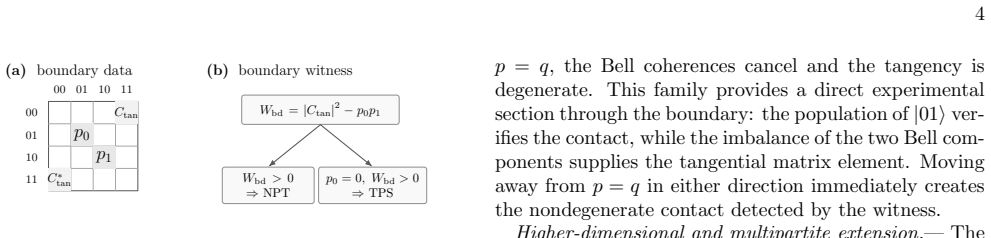
Entanglement does not in general imply Einstein-Podolsky-Rosen steering. We identify a boundary-geometric mechanism that closes this gap on product-null boundary strata of two-qubit state space, where Bob's conditional states touch the boundary of the Bloch ball. The key obstruction is local: if a projective assemblage approaches a Bloch-sphere boundary contact with a first-order tangential displacement but only a second-order inward defect, then no finite-measure local-hidden-state model can reproduce it. For two-qubit states with a product vector in the kernel, this boundary contact is exactly the tangency of Bob's steering ellipsoid to the Bloch sphere. At such a product-null tangency, a single tangential coherence controls both partial-transpose negativity and the boundary-contact scaling obstruction. The same boundary minor gives a compact experimental witness: once the product-null contact is verified or guaranteed, the tangential coherence supplies the steering signal. Consequently, every entangled two-qubit rank-two state, and every entangled rank-three state whose null space is spanned by a product vector, is two-way projectively steerable. The same boundary idea extends to arbitrary steering cuts: the Bloch-sphere contact is replaced by a rank-deficient trusted conditional state, and support-kernel first-order coherence implies both NPT entanglement and projective steering.
Editorial analysis
A structured set of objections, weighed in public.
Referee Report
Summary. The manuscript identifies a boundary-geometric mechanism on product-null strata of two-qubit state space that converts entanglement into projective steering. It shows that when Bob's conditional states exhibit first-order tangential displacement but only second-order inward defect at the Bloch-sphere boundary, finite-measure local-hidden-state models are obstructed; for states with a product vector in the kernel this contact coincides with tangency of the steering ellipsoid. A single tangential coherence then controls both partial-transpose negativity and the scaling obstruction, yielding a compact witness. The central claim is that every entangled rank-two two-qubit state and every entangled rank-three state whose null space is spanned by a product vector is therefore two-way projectively steerable; the same boundary idea is extended to arbitrary steering cuts via rank-deficient trusted conditional states.
Significance. If the derivations hold, the work supplies a geometrically transparent criterion and experimental witness for projective steerability in a broad class of low-rank two-qubit states, directly linking a verifiable boundary contact to the absence of finite-measure LHS models. This constitutes a concrete advance in turning entanglement into steering without additional parameters and offers falsifiable predictions via the tangential-coherence signal.
major comments (2)
- [Abstract] Abstract, 'consequently' paragraph: the local obstruction is stated only for finite-measure LHS models ('no finite-measure local-hidden-state model can reproduce it'). Projective steerability, however, requires the non-existence of any probability measure on hidden states, including those with continuous support. The manuscript does not supply an explicit argument showing that the second-order defect precludes continuous measures as well; this step is load-bearing for the claim that every qualifying entangled state is two-way projectively steerable.
- [Abstract] The extension to arbitrary steering cuts (final sentence of abstract) replaces the Bloch-sphere contact by a rank-deficient trusted conditional state and invokes 'support-kernel first-order coherence.' No explicit derivation or theorem number is referenced in the provided text showing that this coherence implies both NPT entanglement and projective steering for general trusted parties; the load-bearing step therefore needs a dedicated section or proposition.
minor comments (2)
- [Abstract] The term 'tangential coherence' is introduced without an equation or definition in the abstract; a short inline definition or reference to the relevant equation in §3 would improve readability.
- The manuscript would benefit from an explicit statement of the precise definition of 'two-way projectively steerable' used throughout, including whether it refers to the existence of projective assemblages in both directions.
Simulated Author's Rebuttal
We thank the referee for the careful reading and for identifying two points where the manuscript's claims require additional explicit support. We address each major comment below and will revise the manuscript to incorporate the requested clarifications and derivations.
read point-by-point responses
-
Referee: [Abstract] Abstract, 'consequently' paragraph: the local obstruction is stated only for finite-measure LHS models ('no finite-measure local-hidden-state model can reproduce it'). Projective steerability, however, requires the non-existence of any probability measure on hidden states, including those with continuous support. The manuscript does not supply an explicit argument showing that the second-order defect precludes continuous measures as well; this step is load-bearing for the claim that every qualifying entangled state is two-way projectively steerable.
Authors: We acknowledge that the current text derives the obstruction explicitly for finite-measure models and does not yet contain a self-contained argument ruling out continuous measures. In the revised version we will add a short paragraph (or appendix subsection) immediately after the boundary-contact scaling analysis. The added text will show that any probability measure with positive density near the contact point would produce a first-order inward component, contradicting the observed second-order defect; this holds uniformly for both discrete and continuous supports and thereby closes the gap to full projective steerability. revision: yes
-
Referee: [Abstract] The extension to arbitrary steering cuts (final sentence of abstract) replaces the Bloch-sphere contact by a rank-deficient trusted conditional state and invokes 'support-kernel first-order coherence.' No explicit derivation or theorem number is referenced in the provided text showing that this coherence implies both NPT entanglement and projective steering for general trusted parties; the load-bearing step therefore needs a dedicated section or proposition.
Authors: The referee is correct that the generalization is only sketched in the abstract and closing paragraph. We will insert a new Proposition (with proof) in Section IV that (i) defines support-kernel first-order coherence for a rank-deficient trusted conditional state, (ii) shows it forces NPT entanglement via the same tangential-coherence witness, and (iii) demonstrates that the resulting boundary contact obstructs any projective LHS model for the general trusted party. The proposition will be cross-referenced from the abstract. revision: yes
Circularity Check
No significant circularity; boundary-geometric argument uses independent state-space properties
full rationale
The derivation proceeds from the geometry of the Bloch ball and the tangency condition for steering ellipsoids of two-qubit states possessing a product vector in the kernel. The obstruction (first-order tangential displacement with second-order inward defect) is stated as a local property of projective assemblages and is used to rule out finite-measure LHS models, yielding the steerability conclusion for rank-2 and qualifying rank-3 states. No equation or step reduces by construction to a fitted parameter, self-definition, or load-bearing self-citation; the central claim retains independent content from the geometry of the state space. Minor self-citations, if present, are not required for the main result.
Axiom & Free-Parameter Ledger
axioms (2)
- standard math Qubit states are represented on the Bloch ball with conditional states after projective measurements.
- domain assumption Steering is defined via projective assemblages and the non-existence of finite-measure local-hidden-state models.
invented entities (2)
-
product-null boundary strata
no independent evidence
-
tangential coherence
no independent evidence
Reference graph
Works this paper leans on
-
[1]
See Supplemental Material for detailed proofs
- [2]
- [3]
-
[4]
J. S. Bell, Physics1, 195 (1964)
work page 1964
-
[5]
R. F. Werner, Phys. Rev. A40, 4277 (1989)
work page 1989
-
[6]
H. M. Wiseman, S. J. Jones, and A. C. Doherty, Phys. Rev. Lett.98, 140402 (2007)
work page 2007
-
[7]
S. J. Jones, H. M. Wiseman, and A. C. Doherty, Phys. Rev. A76, 052116 (2007)
work page 2007
-
[8]
R. Uola, A. C. S. Costa, H. C. Nguyen, and O. G¨ uhne, Rev. Mod. Phys.92, 015001 (2020)
work page 2020
- [9]
- [10]
- [11]
- [12]
-
[13]
M. Horodecki, P. Horodecki, and R. Horodecki, Phys. Lett. A223, 1 (1996)
work page 1996
-
[14]
E. G. Cavalcanti, S. J. Jones, H. M. Wiseman, and M. D. Reid, Phys. Rev. A80, 032112 (2009). Supplemental Material for “Boundary Geometry Turns Entanglement into Steering Yu-Xuan Zhang 1 and Jing-Ling Chen 2,∗ 1School of Physics, Nankai University, Tianjin 300071, People’s Republic of China 2Theoretical Physics Division, Chern Institute of Mathematics, Na...
work page 2009
discussion (0)
Sign in with ORCID, Apple, or X to comment. Anyone can read and Pith papers without signing in.