REVIEW 2 major objections 6 minor 65 references
A Unified Data Representation Learning for Non-parametric Two-sample Testing
T0 review · 2 major / 6 minor · reviewed 2026-08-12 · deepseek-v4-flash
Pith's one-line read RL-TST, a two-phase framework that first learns inherent representations from the entire unlabeled dataset and then learns discriminative representations on a labeled training split, achieves higher test power than C2ST, C2ST-L, MMD-D…
desk verdict Solid empirical paper: the two-phase pretraining trick plausibly buys real power, but the missing Type-I numbers on the image benchmarks are the one gap standing between this and a clean accept. read the letter →
The pith
A machine-rendered reading of the paper's core claim, the machinery that carries it, and where it could break.
The reading
What carries the argument
The central mechanism is the two-phase RL-TST pipeline, defined in Algorithm 1. Phase 1 learns a featurizer $\phi^*$ by minimizing a reconstruction objective (e.g., autoencoder MSE) on the unlabeled pool $S_{unl}$; these are the inherent representations (IRs). Phase 2 freezes $\phi^*$ and trains either an MLP $g$ on $S_{tr}$ with binary cross-entropy or a deep kernel $k_{\phi^*}$ by maximizing the estimated test-power ratio $\hat{J}_{DR}$ from Eq. (10), producing discriminative representations (DRs). Phase 3 applies a permutation test to any of the three statistics (1), (2), or (3) on the test split. The framework leans on the no-sample-index principle, established in prior work on kernel fusion, which says representation learning on pooled data without labels does not inflate the Type-I error of permutation tests, and on a dimension-versus-sample-size result for kernel two-sample tests to explain why lower-dimensional inherent representations let MMD-based tests detect higher-order distributional differences.
What would settle it
Run RL-TST under the null hypothesis $P=Q$ for many trials (say 500) on a dataset where the autoencoder is trained on the pooled data including test inputs, and measure the empirical rejection rate at $\alpha=0.05$. If the empirical Type-I error is substantially above the nominal level (e.g., $>0.10$) for a large sample size where the test is well powered, the central claim of controlled level fails. As a sharper check, compare the permutation null distribution of the statistic under the full two-phase procedure to the null obtained when the encoder is trained only on the training split; any systematic inflation would indicate the supervised phase distorts the permutation null.
Extended reading notes
Core claim
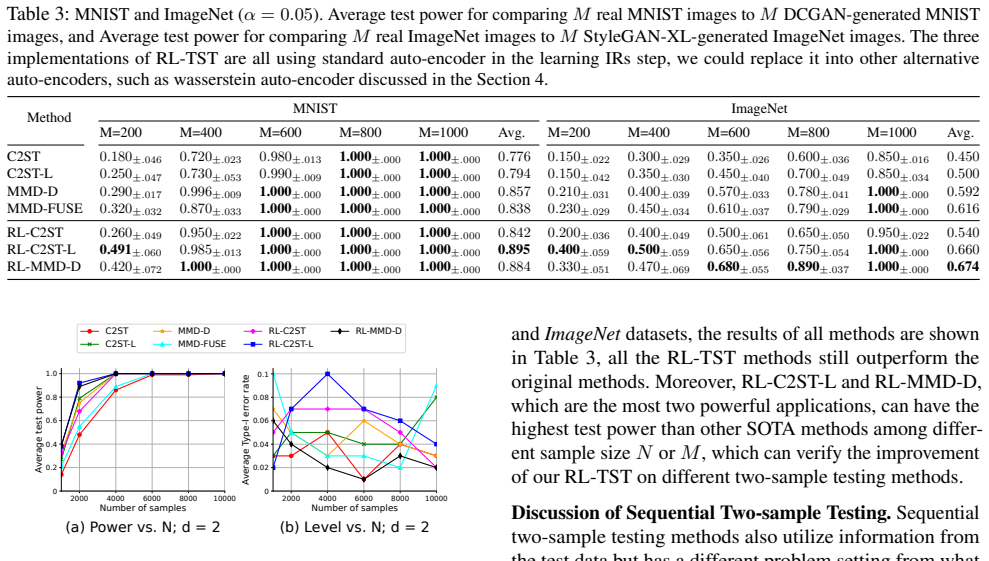
On its own terms, the paper's discovery is that in non-parametric two-sample testing, the unlabeled test split can be safely and profitably used for representation learning: RL-TST first trains an autoencoder on the whole pooled dataset $S_{unl} = S_P \cup S_Q$ to obtain inherent representations (IRs) that reflect the underlying data manifold, then fine-tunes either a classifier $g$ or a deep kernel $k$ on the labeled training split $S_{tr}$ over these IRs to obtain discriminative representations (DRs), and finally runs a permutation test on the held-out test split using the DRs. The paper claims this simultaneously uses the manifold structure of the test data and the discriminative signal of the training data, and reports consistent power gains over C2ST, C2ST-L, MMD-D, and MMD-FUSE on HDGM, MNIST, and ImageNet benchmarks, with Type-I error near $\alpha=0.05$.
Load-bearing premise
The permutation test in Algorithm 1 stays valid when the encoder has been trained on the full unlabeled pool $S_{unl} = S_P \cup S_Q$ that includes the test inputs and then the classifier or kernel is trained on the labeled training split; the paper relies on the no-sample-index principle for the unsupervised phase but does not prove level control for this exact two-phase combination.
Editorial extensions
If this is right
- At a fixed sample size, adding an autoencoder pretraining step on the pooled unlabeled sample before supervised training increases test power for C2ST, C2ST-L, and MMD-D implementations.
- Because the first phase uses the whole dataset without labels, the method avoids the training/test trade-off that comes from splitting scarce data, so less data is needed to reach a given power.
- The framework is modular: any autoencoder-based representation learner can be inserted in Phase 1, and any classifier- or kernel-based test can be wrapped, so future representation learning advances can transfer directly to two-sample testing.
- The empirical results indicate that on real-versus-generated image benchmarks (MNIST, ImageNet), RL-C2ST-L and RL-MMD-D reach full power at smaller sample counts than the fused-kernel baseline.
Reading between the lines
- The paper's level-control story depends on the unsupervised Phase 1 using the test inputs without labels; an untested extension is whether the subsequent supervised Phase 2 on the training split preserves the permutation null, so the Type-I error should be re-checked at larger $N$ and with more permutation trials than the reported 100-trial averages.
- The dimension-versus-sample-size argument suggests that any dimensionality-reducing transformation of the pooled data should improve MMD-based tests; a cheap test of this would replace the autoencoder with PCA or a random projection and compare power, which would separate the benefit of manifold learning from mere dimension reduction.
- The framework's reliance on the manifold assumption implies it could underperform on intrinsically high-dimensional or discrete data; a natural extension is to make the first phase adaptive to the estimated intrinsic dimension of the input space.
Signed reviews
Editorial analysis
A structured set of objections, weighed in public.
Referee Report
Summary. The paper proposes RL-TST, a two-phase representation-learning framework for non-parametric two-sample testing. In Phase 1, an autoencoder is trained on the pooled unlabeled data (SP ∪ SQ) to produce 'inherent representations'; in Phase 2, either a classifier or a deep kernel is trained on a labeled training split applied to these representations to produce 'discriminative representations'; in Phase 3, a permutation test is run on the held-out test split using the resulting statistic (C2ST accuracy, C2ST-L logit distance, or MMD with a deep kernel). The authors argue that using the full unlabeled data is legitimate under the no-sample-index principle and that the manifold assumption justifies the two-phase design. They report experiments on HDGM, MNIST, and ImageNet comparing RL-C2ST, RL-C2ST-L, and RL-MMD-D against C2ST, C2ST-L, MMD-D, and MMD-FUSE, and find that the RL variants often have higher average test power, with Type-I error around 0.05 reported for HDGM-S at d=2.
Significance. If the reported power gains are accompanied by correct Type-I control, RL-TST is practically valuable: it is a simple, model-agnostic pretraining step that can be added to existing classifier- or kernel-based tests, and the gains at small sample sizes on image benchmarks are substantial. The paper's strengths are its broad empirical comparison against current state-of-the-art methods, its inclusion of two autoencoder variants, its check of Type-I error on one HDGM setting, and its explicit comparison with semi-supervised learning alternatives. However, the image-benchmark Type-I evidence is absent, the exact permutation-test validity of the full pipeline is not formally established, and the code link is missing, so the central claim 'higher test power while keeping Type-I near nominal' is not yet fully supported for all benchmarks. I do not see circularity or an internal inconsistency in the empirical comparisons.
major comments (2)
- [Section 4 / Table 3 / Appendix C.1] The empirical Type-I error of RL-TST is never reported for the MNIST and ImageNet benchmarks, and for HDGM it is reported only for d=2 in Figure 4(b). Appendix C.1 states only that 'All methods are tested with a reasonable type-I error rate' for both image benchmarks, without a single number. This is load-bearing because the largest reported power gains occur at small sample sizes on these benchmarks (e.g., RL-C2ST-L 0.491 vs. MMD-D 0.290 at M=200 on MNIST, and RL-C2ST-L 0.400 vs. MMD-FUSE 0.230 at M=200 on ImageNet). If the RL variants reject H0 on real-vs-real or fake-vs-fake data at a rate well above 0.05, those gains would be an artifact of an oversized test. Please report empirical level under H0, with standard errors, for MNIST, ImageNet, and HDGM d=10, or provide a theorem that, for the exact Algorithm 1 pipeline, the permutation test has exact level alpha regardless of the unsupervised Phase 1.
- [Algorithm 1 / Section 3.1] The Type-I validity of the exact two-phase procedure is asserted rather than proven. The paper invokes the no-sample-index principle of Biggs et al. (2023), but that result does not directly cover RL-TST because Phase 2 trains a supervised classifier or kernel on the labeled split Str before the permutation test on Ste. A short conditioning argument would fix this: under H0, conditional on the full pooled feature values and on the Str labels, the Ste labels are exchangeable, so with the model M fixed the permutation test is exact; and Phase 1 is a label-free function of the pooled features, so it does not break exchangeability. Please state this lemma or an equivalent theorem in the main text, since the central claim includes control of Type-I errors.
minor comments (6)
- [Appendix C.8] The reproducibility statement says 'All the reproducible code can be found in the anonymous link' but no link or repository identifier appears in the text; please provide a working URL.
- [Table 2 / Figure 3] Table 2 and Figure 3 report test power without error bars, and the footnote in Table 2 rejects standard deviations because each trial outcome is 0 or 1; that reason is invalid, since a proportion over 100 trials has standard error sqrt(p(1-p)/100).
- [Algorithm 1 / Eq. (6)] In Algorithm 1, line 3 updates only phi ('phi* <- arg min_phi R(fa, X)'), whereas Eq. (6) defines a joint minimization over phi and psi; please align the pseudocode with the objective and state how the decoder is used or discarded.
- [Section 3.1] The sentence 'only holistic approaches, such as BYOL, can effectively capture the IRs of whole data' is an unsupported design claim and should be either cited or qualified.
- [Appendix D.1 / Theorem D.4] Theorem D.4 is not self-contained: it quantifies over 'any arbitrarily small Delta_mu,ml' but then states bounds involving sqrt(ln(4/delta)/(8 mu)) without defining the relationship, and the proof introduces an undefined 's' in 'ln(4s/delta)'; please rewrite the statement and proof or label the section as heuristic.
- [Section 2 / Permutation Testing] The permutation-testing paragraph says the labels are permuted 'for n times', but n already denotes the sample size; use a separate symbol such as nperm for the number of permutations.
Circularity Check
No significant circularity: the central evidence is out-of-sample empirical comparison, and the theoretical motivation rests on external theorems rather than on fitting and re-predicting the same quantities.
full rationale
RL-TST's main claim is empirical: adding an autoencoder-based representation-learning phase before the discriminative phase improves test power while keeping Type-I error controlled. The test powers in Table 3 and Figure 4 are computed on held-out test splits (Ste) after training on Str, so the reported powers are not fitted values renamed as predictions. The Type-I control argument is not derived by assuming the conclusion; Algorithm 1 fixes the model before permuting the test labels, and the paper appeals to Biggs et al. (2023) for the no-sample-index principle, which is an externally published result even though one author overlaps. The Appendix D analysis invokes Balcan and Blum (2010) and standard VC bounds, which are external. The missing Type-I error tables for MNIST/ImageNet are an empirical completeness gap, not a circularity: omitting a number does not make the power comparisons equal to the inputs by construction. No step in the paper defines a quantity in terms of the very outcome it is used to predict, and no fitted parameter is subsequently reported as an independent prediction. Self-citations to Liu et al. (2020) and Biggs et al. (2023) are used as baselines and benchmarks with code and published results, which are independent support rather than circular load-bearing.
Assumptions & free parameters
free parameters (3)
- Autoencoder latent dimension and architecture =
not specified in main text
- Training/test split ratio =
1/2
- Deep kernel and classifier hyperparameters =
not specified
assumptions (4)
- domain assumption Two-sample testing data lie roughly on a low-dimensional manifold.
- domain assumption Learning representations from pooled data without using sample indexes preserves permutation-test validity for the downstream test.
- domain assumption A discriminative model trained on IRs of the training split transfers to the test split and improves test power.
- domain assumption The Yan-Zhang moment detection relationship between dimension and sample size applies to learned representations.
Cite this review
Pith. "Pith review of A Unified Data Representation Learning for Non-parametric Two-sample Testing." pith.science (2026). https://pith.science/paper/S2NVQYGU
@misc{pith2026241200613,
  author       = {Pith},
  title        = {Pith review of: A Unified Data Representation Learning for Non-parametric Two-sample Testing},
  year         = {2026},
  howpublished = {\url{https://pith.science/paper/S2NVQYGU}},
  note         = {Machine review of arXiv:2412.00613}
}
read the original abstract
Learning effective data representations has been crucial in non-parametric two-sample testing. Common approaches will first split data into training and test sets and then learn data representations purely on the training set. However, recent theoretical studies have shown that, as long as the sample indexes are not used during the learning process, the whole data can be used to learn data representations, meanwhile ensuring control of Type-I errors. The above fact motivates us to use the test set (but without sample indexes) to facilitate the data representation learning in the testing. To this end, we propose a representation-learning two-sample testing (RL-TST) framework. RL-TST first performs purely self-supervised representation learning on the entire dataset to capture inherent representations (IRs) that reflect the underlying data manifold. A discriminative model is then trained on these IRs to learn discriminative representations (DRs), enabling the framework to leverage both the rich structural information from IRs and the discriminative power of DRs. Extensive experiments demonstrate that RL-TST outperforms representative approaches by simultaneously using data manifold information in the test set and enhancing test power via finding the DRs with the training set.
Figures


Figures from the paper (1 more)
Reference graph
Works this paper leans on
-
[1]
A discriminative model for semi-supervised learning
Maria-Florina Balcan and Avrim Blum. A discriminative model for semi-supervised learning. Journal of the ACM, 57 0 (3): 0 19:1--19:46, 2010
work page 2010
-
[2]
Model-agnostic out-of-distribution detection using combined statistical tests
Federico Bergamin, Pierre-Alexandre Mattei, Jakob Drachmann Havtorn, Hugo S\'en\'etaire, Hugo Schmutz, Lars Maal e, Soren Hauberg, and Jes Frellsen. Model-agnostic out-of-distribution detection using combined statistical tests. In AISTATS, 2022
work page 2022
-
[3]
MMD - FUSE : Learning and Combining Kernels for Two - Sample Testing Without Data Splitting
Felix Biggs, Antonin Schrab, and Arthur Gretton. MMD - FUSE : Learning and Combining Kernels for Two - Sample Testing Without Data Splitting . In NeurIPS, 2023
work page 2023
-
[4]
Sutherland, Michael Arbel, and Arthur Gretton
Miko aj Bi \'n kowski, Danica J. Sutherland, Michael Arbel, and Arthur Gretton. Demystifying MMD GAN s. In ICLR, 2018
work page 2018
-
[5]
Kernelized cumulants: Beyond kernel mean embeddings
Patric Bonnier, Harald Oberhauser, and Zolt \' a n Szab \' o . Kernelized cumulants: Beyond kernel mean embeddings. In NeurIPS, 2023
work page 2023
-
[6]
A sharp concentration inequality with application
St\' e phane Boucheron, G\' a bor Lugosi, and Pascal Massart. A sharp concentration inequality with application. Random Struct. Algorithms, 16 0 (3): 0 277–292, May 2000. ISSN 1042-9832
work page 2000
-
[7]
Kappa updated ensemble for drifting data stream mining
Alberto Cano and Bartosz Krawczyk. Kappa updated ensemble for drifting data stream mining. Machine Learning, 109 0 (1): 0 175--218, 2020
work page 2020
-
[8]
Olivier Chapelle, Bernhard Schölkopf, and Alexander Zien (eds.). Semi-Supervised Learning. The MIT Press, 2006. ISBN 9780262033589. URL http://dblp.uni-trier.de/db/books/collections/CSZ2006.html
work page 2006
Show all 65 references
-
[9]
Friedman
Hao Chen and Jerome H. Friedman. A new graph-based two-sample test for multivariate and object data. Journal of the American Statistical Association, 112 0 (517): 0 397--409, 2017
2017
-
[10]
Neural tangent kernel maximum mean discrepancy, 2021
Xiuyuan Cheng and Yao Xie. Neural tangent kernel maximum mean discrepancy, 2021
2021
-
[11]
Sutherland
Namrata Deka and Danica J. Sutherland. Mmd-b-fair: Learning fair representations with statistical testing. In AISTATS, 2023
2023
-
[12]
Imagenet: A large-scale hierarchical image database
Jia Deng, Wei Dong, Richard Socher, Li-Jia Li, Kai Li, and Li Fei-Fei. Imagenet: A large-scale hierarchical image database. In 2009 IEEE conference on computer vision and pattern recognition, pp.\ 248--255. Ieee, 2009
2009
-
[13]
Binomial approximation to the Poisson binomial distribution
Werner Ehm. Binomial approximation to the Poisson binomial distribution. Statistics & Probability Letters, 11 0 (1): 0 7--16, 1991
1991
-
[14]
Learning bounds for open-set learning
Zhen Fang, Jie Lu, Anjin Liu, Feng Liu, and Guangquan Zhang. Learning bounds for open-set learning. In ICML, 2021 a
2021
-
[15]
Open set domain adaptation: Theoretical bound and algorithm
Zhen Fang, Jie Lu, Feng Liu, Junyu Xuan, and Guangquan Zhang. Open set domain adaptation: Theoretical bound and algorithm. IEEE Transactions on Neural Networks and Learning Systems, 32 0 (10): 0 4309--4322, 2021 b
2021
-
[16]
Robust hypothesis testing using W asserstein uncertainty sets
Rui Gao, Liyan Xie, Yao Xie, and Huan Xu. Robust hypothesis testing using W asserstein uncertainty sets. In NeurIPS, 2018
2018
-
[17]
Maximum mean discrepancy test is aware of adversarial attacks
Ruize Gao, Feng Liu, Jingfeng Zhang, Bo Han, Tongliang Liu, Gang Niu, and Masashi Sugiyama. Maximum mean discrepancy test is aware of adversarial attacks. In ICML, 2021
2021
-
[18]
Practical methods for graph two-sample testing
Debarghya Ghoshdastidar and Ulrike von Luxburg. Practical methods for graph two-sample testing. In NeurIPS, 2018
2018
-
[19]
Two-sample tests for large random graphs using network statistics
Debarghya Ghoshdastidar, Maurilio Gutzeit, Alexandra Carpentier, and Ulrike von Luxburg. Two-sample tests for large random graphs using network statistics. In COLT, 2017
2017
-
[20]
Domain adaptation with conditional transferable components
Mingming Gong, Kun Zhang, Tongliang Liu, Dacheng Tao, Clark Glymour, and Behrnhard Sch \"o lkopf. Domain adaptation with conditional transferable components. In ICML, 2016
2016
-
[21]
Rasch, Bernhard Sch \" o lkopf, and Alexander J
Arthur Gretton, Karsten M Borgwardt, Malte J. Rasch, Bernhard Sch \" o lkopf, and Alexander J. Smola. A kernel two-sample test. Journal of Machine Learning Research, 13: 0 723--773, 2012 a
2012
-
[22]
Optimal kernel choice for large-scale two-sample tests
Arthur Gretton, Bharath Sriperumbudur, Dino Sejdinovic, Heiko Strathmann, and Massimiliano Pontil. Optimal kernel choice for large-scale two-sample tests. In NeurIPS, 2012 b
2012
-
[23]
Multivariate tests of association based on univariate tests
Ruth Heller and Yair Heller. Multivariate tests of association based on univariate tests. In NeurIPS, 2016
2016
-
[24]
beta-vae: Learning basic visual concepts with a constrained variational framework
Irina Higgins, Loic Matthey, Arka Pal, Christopher Burgess, Xavier Glorot, Matthew Botvinick, Shakir Mohamed, and Alexander Lerchner. beta-vae: Learning basic visual concepts with a constrained variational framework. In ICLR, 2016
2016
-
[25]
Interpretable distribution features with maximum testing power
Wittawat Jitkrittum, Zoltan Szabo, Kacper Chwialkowski, and Arthur Gretton. Interpretable distribution features with maximum testing power. In NeurIPS, 2016
2016
-
[26]
Auto-encoding variational bayes
Diederik P Kingma and Max Welling. Auto-encoding variational bayes. arXiv preprint arXiv:1312.6114, 2013
2013 arXiv
-
[27]
Semi-supervised learning with deep generative models
Durk P Kingma, Shakir Mohamed, Danilo Jimenez Rezende, and Max Welling. Semi-supervised learning with deep generative models. In NeurIPS, 2014
2014
-
[28]
Two-sample testing using deep learning
Matthias Kirchler, Shahryar Khorasani, Marius Kloft, and Christoph Lippert. Two-sample testing using deep learning. In AISTATS, 2020
2020
-
[29]
Kolmogorov
A. Kolmogorov. Sulla determinazione empirica di una legge di distribuzione. G. Ist. Ital. Attuari, 4: 0 83--91, 1933
1933
-
[30]
u bler, Wittawat Jitkrittum, Bernhard Sch\
Jonas M. K\" u bler, Wittawat Jitkrittum, Bernhard Sch\" o lkopf, and Krikamol Muandet. Learning kernel tests without data splitting. In NeurIPS, 2020
2020
-
[31]
u bler, Vincent Stimper, Simon Buchholz, Krikamol Muandet, and Bernhard Sch \
Jonas M. K \" u bler, Vincent Stimper, Simon Buchholz, Krikamol Muandet, and Bernhard Sch \" o lkopf. Automl two-sample test. In NeurIPS, 2022
2022
-
[32]
Kübler, Wittawat Jitkrittum, Bernhard Schölkopf, and Krikamol Muandet
Jonas M. Kübler, Wittawat Jitkrittum, Bernhard Schölkopf, and Krikamol Muandet. A Witness Two - Sample Test . In AISTATS, 2022
2022
-
[33]
Gradient-based learning applied to document recognition
Yann LeCun, L \'e on Bottou, Yoshua Bengio, Patrick Haffner, et al. Gradient-based learning applied to document recognition. Proceedings of the IEEE, 86 0 (11): 0 2278--2324, 1998
1998
-
[34]
Pseudo-label: The simple and efficient semi-supervised learning method for deep neural networks
Dong-Hyun Lee et al. Pseudo-label: The simple and efficient semi-supervised learning method for deep neural networks. In Workshop on challenges in representation learning, ICML, volume 3, pp.\ 896. Atlanta, 2013
2013
-
[35]
E. L. Lehmann and Joseph P. Romano. Testing statistical hypotheses. Springer Texts in Statistics. Springer, New York, third edition, 2005. ISBN 0-387-98864-5
2005
-
[36]
MONK outlier-robust mean embedding estimation by median-of-means
Matthieu Lerasle, Zolt \' a n Szab \' o , Timoth \' e e Mathieu, and Guillaume Lecu \' e . MONK outlier-robust mean embedding estimation by median-of-means. In ICML, 2019
2019
-
[37]
Sutherland
Feng Liu, Wenkai Xu, Jie Lu, Guangquan Zhang, Arthur Gretton, and Danica J. Sutherland. Learning deep kernels for non-parametric two-sample tests. In ICML, 2020
2020
-
[38]
Sutherland
Feng Liu, Wenkai Xu, Jie Lu, and Danica J. Sutherland. Meta Two - Sample Testing : Learning Kernels for Testing with Limited Data . In NeurIPS, 2021
2021
-
[39]
Revisiting Classifier Two - Sample Tests , March 2018 a
David Lopez-Paz and Maxime Oquab. Revisiting Classifier Two - Sample Tests , March 2018 a . URL http://arxiv.org/abs/1610.06545. arXiv:1610.06545 [stat]
2018 arXiv
-
[40]
Revisiting classifier two-sample tests, 2018 b
David Lopez-Paz and Maxime Oquab. Revisiting classifier two-sample tests, 2018 b
2018
-
[41]
Exploiting MMD and S inkhorn divergences for fair and transferable representation learning
Luca Oneto, Michele Donini, Giulia Luise, Carlo Ciliberto, Andreas Maurer, and Massimiliano Pontil. Exploiting MMD and S inkhorn divergences for fair and transferable representation learning. In NeurIPS, 2020
2020
-
[42]
Naesseth, and Patrick Forré
Teodora Pandeva, Tim Bakker, Christian A. Naesseth, and Patrick Forré. E-valuating classifier two-sample tests, 2022. URL https://arxiv.org/abs/2210.13027
2022 arXiv
-
[43]
Unsupervised representation learning with deep convolutional generative adversarial networks
Alec Radford, Luke Metz, and Soumith Chintala. Unsupervised representation learning with deep convolutional generative adversarial networks. In ICLR, 2016
2016
-
[44]
On W asserstein two-sample testing and related families of nonparametric tests
Aaditya Ramdas, Nicol \'a s Garc \'i a Trillos, and Marco Cuturi. On W asserstein two-sample testing and related families of nonparametric tests. Entropy, 19 0 (2): 0 47, January 2017
2017
-
[45]
Stylegan-xl: Scaling stylegan to large diverse datasets
Axel Sauer, Katja Schwarz, and Andreas Geiger. Stylegan-xl: Scaling stylegan to large diverse datasets. In ACM SIGGRAPH 2022 conference proceedings, pp.\ 1--10, 2022
2022
-
[46]
MMD Aggregated Two - Sample Test
Antonin Schrab, Ilmun Kim, Melisande Albert, Beatrice Laurent, Benjamin Guedj, and Arthur Gretton. MMD Aggregated Two - Sample Test . Journal of Machine Learning Research, 2023
2023
-
[47]
Approximation theorems of mathematical statistics
Robert J Serfling. Approximation theorems of mathematical statistics. John Wiley & Sons, 2009
2009
-
[48]
N. Smirnov. Table for Estimating the Goodness of Fit of Empirical Distributions . The Annals of Mathematical Statistics, 19 0 (2): 0 279 -- 281, 1948
1948
-
[49]
Fixmatch: Simplifying semi-supervised learning with consistency and confidence
Kihyuk Sohn, David Berthelot, Nicholas Carlini, Zizhao Zhang, Han Zhang, Colin A Raffel, Ekin Dogus Cubuk, Alexey Kurakin, and Chun-Liang Li. Fixmatch: Simplifying semi-supervised learning with consistency and confidence. Advances in neural information processing systems, 33: ...
2020
-
[50]
A segment-based drift adaptation method for data streams
Yiliao Song, Jie Lu, Anjin Liu, Haiyan Lu, and Guangquan Zhang. A segment-based drift adaptation method for data streams. IEEE Transactions on Neural Networks and Learning Systems, Early Access, 2021 a . doi:10.1109/TNNLS.2021.3062062
2021
-
[51]
Graph-based semi-supervised learning: A comprehensive review, 2021 b
Zixing Song, Xiangli Yang, Zenglin Xu, and Irwin King. Graph-based semi-supervised learning: A comprehensive review, 2021 b
2021
-
[52]
Carbonell, and Kun Zhang
Petar Stojanov, Mingming Gong, Jaime G. Carbonell, and Kun Zhang. Data-driven approach to multiple-source domain adaptation. In AISTATS, 2019
2019
-
[53]
Sutherland, Hsiao-Yu Tung, Heiko Strathmann, Soumyajit De, Aaditya Ramdas, Alex Smola, and Arthur Gretton
Danica J. Sutherland, Hsiao-Yu Tung, Heiko Strathmann, Soumyajit De, Aaditya Ramdas, Alex Smola, and Arthur Gretton. Generative models and model criticism via optimized maximum mean discrepancy. In ICLR, 2017
2017
-
[54]
Sz \' e kely and Maria L
G \' a bor J. Sz \' e kely and Maria L. Rizzo. Energy statistics: A class of statistics based on distances. Journal of Statistical Planning and Inference, 143 0 (8): 0 1249--1272, 2013
2013
-
[55]
Driftsurf: Stable-state/reactive-state learning under concept drift
Ashraf Tahmasbi, Ellango Jothimurugesan, Srikanta Tirthapura, and Phillip B Gibbons. Driftsurf: Stable-state/reactive-state learning under concept drift. In ICML, 2021
2021
-
[56]
Blanchet, Daniel Kuhn, and Viet Anh Nguyen
Bahar Taskesen, Man - Chung Yue, Jose H. Blanchet, Daniel Kuhn, and Viet Anh Nguyen. Sequential domain adaptation by synthesizing distributionally robust experts. In ICML, 2021
2021
-
[57]
Recent advances in autoencoder-based representation learning
Michael Tschannen, Olivier Bachem, and Mario Lucic. Recent advances in autoencoder-based representation learning. arXiv preprint arXiv:1812.05069, 2018 a
2018 arXiv
-
[58]
Recent Advances in Autoencoder - Based Representation Learning
Michael Tschannen, Olivier Bachem, and Mario Lucic. Recent Advances in Autoencoder - Based Representation Learning . In NeurIPS 2018 Workshop on Bayesian Deep Learning, 2018 b
2018
-
[59]
Unsupervised data augmentation for consistency training
Qizhe Xie, Zihang Dai, Eduard Hovy, Thang Luong, and Quoc Le. Unsupervised data augmentation for consistency training. Advances in neural information processing systems, 33: 0 6256--6268, 2020
2020
-
[60]
A survey on deep semi-supervised learning
Xiangli Yang, Zixing Song, Irwin King, and Zenglin Xu. A survey on deep semi-supervised learning. IEEE Transactions on Knowledge and Data Engineering, 35 0 (9): 0 8934--8954, 2023. doi:10.1109/TKDE.2022.3220219
2023
-
[61]
How does the combined risk affect the performance of unsupervised domain adaptation approaches? In AAAI, 2021
Li Zhong, Zhen Fang, Feng Liu, Jie Lu, Bo Yuan, and Guangquan Zhang. How does the combined risk affect the performance of unsupervised domain adaptation approaches? In AAAI, 2021
2021
-
[62]
write newline
" write newline "" before.all 'output.state := FUNCTION n.dashify 't := "" t empty not t #1 #1 substring "-" = t #1 #2 substring "--" = not "--" * t #2 global.max substring 't := t #1 #1 substring "-" = "-" * t #2 global.max substring 't := while if t #1 #1 substring * t #2 gl...
-
[63]
@esa (Ref
\@ifxundefined[1] #1\@undefined \@firstoftwo \@secondoftwo \@ifnum[1] #1 \@firstoftwo \@secondoftwo \@ifx[1] #1 \@firstoftwo \@secondoftwo [2] @ #1 \@temptokena #2 #1 @ \@temptokena \@ifclassloaded agu2001 natbib The agu2001 class already includes natbib coding, so you should ...
-
[64]
\@lbibitem[] @bibitem@first@sw\@secondoftwo \@lbibitem[#1]#2 \@extra@b@citeb \@ifundefined br@#2\@extra@b@citeb \@namedef br@#2 \@nameuse br@#2\@extra@b@citeb \@ifundefined b@#2\@extra@b@citeb @num @parse #2 @tmp #1 NAT@b@open@#2 NAT@b@shut@#2 \@ifnum @merge>\@ne @bibitem@firs...
-
[65]
rg] ( sx&ziC0 6=E! !hP3 R * t z Iym p 4+@D N6: S3£yON gG [4 F
@open @close @open @close and [1] URL: #1 \@ifundefined chapter * \@mkboth \@ifxundefined @sectionbib * \@mkboth * \@mkboth\@gobbletwo \@ifclassloaded amsart * \@ifclassloaded amsbook * \@ifxundefined @heading @heading NAT@ctr thebibliography [1] @ \@biblabel @NAT@ctr \@bibset...
Reviewed August 12, 2026 · model on record in the stance chip above.
Discussion (0). Continue with ORCID to comment.