Helicity effects in the dynamically assisted Schwinger mechanism
Pith reviewed 2026-05-20 10:06 UTC · model grok-4.3
The pith
In bichromatic rotating electric fields, the ratio of opposite-helicity pair distributions depends mainly on polar angle.
A machine-rendered reading of the paper's core claim, the machinery that carries it, and where it could break.
Core claim
Within the quantum-kinetic framework applied to a spatially uniform bichromatic electric field, dynamical assistance from the weak high-frequency component enhances both the pair yield and the helicity asymmetry; right- and left-handed electrons preferentially populate opposite momentum half-spaces, and the ratio of their momentum distributions is governed predominantly by the polar angle while depending only weakly on magnitude and azimuthal angle.
What carries the argument
Helicity-resolved momentum distributions computed in the quantum-kinetic framework for the bichromatic field; the ratio of opposite-helicity spectra serves as the observable that isolates the polar-angle dependence.
If this is right
- Dynamical assistance increases both total pair yield and helicity asymmetry.
- Right- and left-handed electrons occupy opposite momentum half-spaces.
- The helicity asymmetry becomes more pronounced as the weak-field frequency rises.
- The polar-angle dependence supplies a compact characterization of the helicity-resolved spectra.
Where Pith is reading between the lines
- The angular dominance could serve as an experimental discriminator between the dynamically assisted regime and pure multiphoton or tunneling regimes.
- Testing the same observables in spatially inhomogeneous or pulsed fields would check how robust the polar-angle control remains.
- Helicity-resolved detection might allow inference of the relative strength or frequency of the assisting field component from angular distributions alone.
Load-bearing premise
The external background is modeled as a spatially uniform bichromatic electric field without significant spatial inhomogeneity or magnetic components.
What would settle it
Measure the momentum distributions of produced electrons at fixed polar angles across a range of magnitudes and azimuthal angles; the opposite-helicity ratio should stay nearly constant if the reported angular dominance holds.
Figures



read the original abstract
We study vacuum electron-positron pair production in a spatially uniform bichromatic electric field within the quantum-kinetic framework for fermions. The external background models the superposition of two counterpropagating circularly polarized laser pulses and combines a strong slowly varying component with a weak rapidly oscillating one. We analyze the weak-field multiphoton regime, the strong-field tunneling regime, and their combination corresponding to the dynamically assisted Schwinger effect. Our main focus is on helicity-resolved observables. We show that dynamical assistance enhances not only the total yield but also the helicity asymmetry: right- and left-handed electrons preferentially populate opposite momentum half-spaces. Most importantly, within the parameter range considered here, the ratio of the momentum distributions for opposite helicities is governed predominantly by the polar angle with respect to the propagation axis and depends only weakly on the momentum magnitude and azimuthal angle. The corresponding asymmetry becomes more pronounced as the weak-field frequency is increased. These results identify a clear helicity signature of the dynamically assisted Schwinger effect in rotating strong-field backgrounds and provide a compact characterization of the associated helicity-resolved spectra.
Editorial analysis
A structured set of objections, weighed in public.
Referee Report
Summary. The manuscript studies vacuum electron-positron pair production in a spatially uniform bichromatic electric field that models the superposition of two counterpropagating circularly polarized laser pulses, within the quantum-kinetic framework for fermions. It analyzes the multiphoton, tunneling, and dynamically assisted regimes, with emphasis on helicity-resolved momentum distributions. The central claim is that dynamical assistance enhances both the total yield and the helicity asymmetry, such that right- and left-handed electrons preferentially occupy opposite momentum half-spaces; moreover, within the considered parameter range the ratio of opposite-helicity distributions is governed predominantly by the polar angle with respect to the propagation axis and depends only weakly on momentum magnitude and azimuthal angle, with the asymmetry becoming more pronounced as the weak-field frequency increases.
Significance. If the reported angular dominance of the helicity asymmetry is robust, the work supplies a compact, falsifiable signature of the dynamically assisted Schwinger effect in rotating strong-field backgrounds. The quantum-kinetic treatment yields concrete numerical predictions for helicity-resolved spectra that could guide experimental searches at high-intensity laser facilities. The absence of free parameters in the central ratio claim and the focus on observable angular dependence are strengths that would elevate the result above purely qualitative statements.
major comments (2)
- [Field modeling (abstract and §2)] The external background is modeled as a spatially uniform bichromatic electric field (abstract and the field-definition section). For counterpropagating circularly polarized pulses the plane-wave relation requires magnetic components of magnitude comparable to the electric ones (|B| ≈ |E|). The calculation omits these magnetic contributions and any associated spatial inhomogeneity; if they alter the effective vector potential or the helicity-mixing terms in the Dirac equation, the extracted polar-angle dominance of the helicity ratio could change even at fixed peak intensities and frequencies. This approximation is load-bearing for the central claim.
- [Helicity-ratio results (likely §4)] The statement that the helicity ratio depends only weakly on momentum magnitude and azimuthal angle rests on numerical solutions of the quantum-kinetic equations. No error estimates, convergence tests with respect to momentum-grid discretization, or parameter-scan tables are referenced in the results; without these the quantitative claim that the dependence is “weak” cannot be assessed and remains unverified.
minor comments (2)
- [Figures] Figure captions should explicitly state the numerical values of the strong- and weak-field frequencies and amplitudes used for each panel to allow direct comparison with the text.
- [Notation] Notation for right- and left-handed helicities should be defined once at the beginning and used consistently in both text and plots.
Simulated Author's Rebuttal
We thank the referee for the careful reading of our manuscript and the constructive comments. We address each major point below and have revised the manuscript to incorporate clarifications and additional numerical details where feasible.
read point-by-point responses
-
Referee: [Field modeling (abstract and §2)] The external background is modeled as a spatially uniform bichromatic electric field (abstract and the field-definition section). For counterpropagating circularly polarized pulses the plane-wave relation requires magnetic components of magnitude comparable to the electric ones (|B| ≈ |E|). The calculation omits these magnetic contributions and any associated spatial inhomogeneity; if they alter the effective vector potential or the helicity-mixing terms in the Dirac equation, the extracted polar-angle dominance of the helicity ratio could change even at fixed peak intensities and frequencies. This approximation is load-bearing for the central claim.
Authors: We acknowledge that modeling the background as a spatially uniform electric field is an approximation that neglects the magnetic components and spatial dependence inherent to counterpropagating pulses. This choice follows the standard approach in quantum-kinetic treatments of the Schwinger effect, allowing focus on the essential non-perturbative pair-production dynamics. To address the concern, we have added a dedicated paragraph in Section 2 discussing the approximation's scope, its justification via comparison to literature on uniform-field limits, and a note that magnetic contributions could quantitatively modify the helicity ratio while preserving the qualitative angular dominance. We agree this is a limitation and have flagged full electromagnetic treatments as future work. revision: partial
-
Referee: [Helicity-ratio results (likely §4)] The statement that the helicity ratio depends only weakly on momentum magnitude and azimuthal angle rests on numerical solutions of the quantum-kinetic equations. No error estimates, convergence tests with respect to momentum-grid discretization, or parameter-scan tables are referenced in the results; without these the quantitative claim that the dependence is “weak” cannot be assessed and remains unverified.
Authors: We thank the referee for highlighting the need for supporting numerical evidence. In the revised version we have added convergence tests with respect to momentum-grid discretization in Section 4 and a new appendix. These tests show that the helicity ratio varies by less than 5% under successive grid refinements, consistent with our claim of weak dependence on magnitude and azimuth. A brief summary of parameter scans across the considered frequency and intensity ranges has also been included to substantiate the robustness of the polar-angle dominance. revision: yes
Circularity Check
Derivation self-contained; no circular reductions identified
full rationale
The paper presents results from direct numerical solution of the quantum-kinetic equations for a prescribed spatially uniform bichromatic electric field. The central claim—that the helicity ratio is governed predominantly by polar angle—is reported as an output of that integration over the considered parameter range, not as a fitted parameter or a quantity defined in terms of itself. No load-bearing step reduces by construction to an input, self-citation, or ansatz smuggled from prior work by the same authors; the derivation remains independent of the reported observables.
Axiom & Free-Parameter Ledger
axioms (1)
- domain assumption The external field can be treated as a classical, spatially uniform, time-dependent electric background.
Reference graph
Works this paper leans on
-
[1]
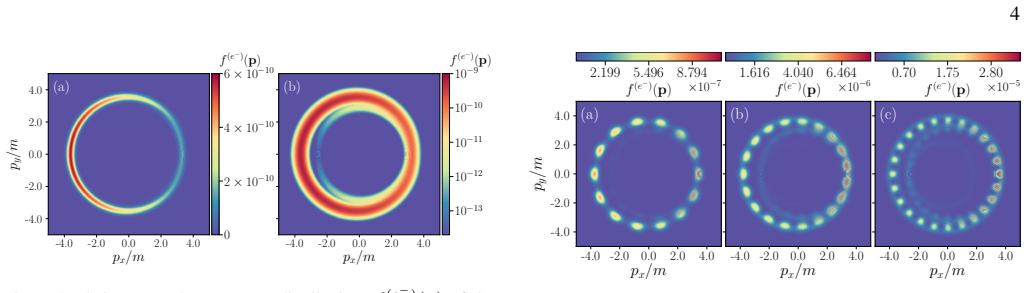
Weak field only: multiphoton ring structure We first consider pair creation by the weak, rapidly oscillat- ing pulse alone, i.e., we setE 1 = 0. Sinceγ 2 ≫1for the fre- quencies used below, the production mechanism is perturba- tive and the spectrum is expected to exhibit multiphoton reso- nances. Figure 1 shows the spin-summed densityf(e−)(p)for three re...
-
[2]
Strong field only: tunneling regime and turning-point mapping We next switch off the weak component (E2 = 0) and con- sider the strong, slowly varying pulse alone withE1 = 0.2Ec. The corresponding spectrum is shown in Fig. 2 in both linear and logarithmic scales. In contrast to the multiphoton case, the distribution is comparatively smooth, reflecting the...
-
[3]
Momentum distributions for the combined field We now consider the combined field withE 1 = 0.2Ec and E2 = 0.04E c. Since the total field strength is large, we ex- pect the semiclassical picture outlined above to remain qual- itatively valid. Once the weak component is added, the time dependence ofE(t)becomes considerably richer, because the field acquires...
-
[4]
In the present setup, helicity effects are most clearly visible in momentum planes withp z ̸= 0
Fixed-helicity momentum spectra Throughout this subsection, we fix the frequency of the fast (weak) component toω= 0.6mand present helicity-resolved spectra for the weak field only, the strong field only, and the combined field. In the present setup, helicity effects are most clearly visible in momentum planes withp z ̸= 0. We there- fore discuss the asym...
-
[5]
Hereθis the polar angle measured from the zaxis, whileφis the azimuthal angle in thexyplane
Azimuthal distributions For the analysis of helicity effects it is convenient to use spherical coordinates(|p|, θ, φ)for the asymptotic kinetic momentump. Hereθis the polar angle measured from the zaxis, whileφis the azimuthal angle in thexyplane. Since the external electric field rotates in thexyplane, thezaxis plays the role of the distinguished directi...
-
[6]
Dependence of helicity asymmetry on the polar angleθ We now investigate how the proportionality coefficientP depends onθat fixed field parameters. In Fig. 10 we present the ratio of the spectra for positive and negative helicity as a function of the angleΘ≡π/2−θ, which measures the de- viation ofθfrom90 ◦, for the weak field, the strong field, and the com...
-
[7]
LCFA for circularly polarized fields As discussed in Sec. IV A, semiclassical arguments already provide valuable qualitative information about the structure of the momentum spectra of the produced particles. A natu- ral generalization of this picture is the locally constant field approximation (LCFA), where the spacetime dependence of the external field i...
-
[8]
LCFA for linearly polarized fields We now briefly discuss linearly polarized fields, corre- sponding toδ 1 =δ 2 = 0in Eq. (1). Figure 15 shows the asymptotic distribution of particles created by the strong field, computed both from the exact QKE solution and within the LCFA. As noted above, the chosen field parameters do not fully justify the LCFA, so the...
-
[9]
F. Sauter, Über das Verhalten eines Elektrons im homoge- nen elektrischen Feld nach der relativistischen Theorie Diracs, Z. Phys.69, 742 (1931). 12 -4.0 -2.0 0.0 2.0 4.0 px/m -1.5 0.0 1.5 py/m (a) -4.0 -2.0 0.0 2.0 4.0 px/m -1.5 0.0 1.5 py/m (b) -4.0 -2.0 0.0 2.0 4.0 px/m -1.5 0.0 1.5 py/m (c) -4.0 -2.0 0.0 2.0 4.0 px/m -1.5 0.0 1.5 py/m (d) -4.0 -2.0 0.0...
work page 1931
-
[10]
W. Heisenberg and H. Euler, Folgerungen aus der Diracschen Theorie des Positrons, Z. Phys.98, 714 (1936)
work page 1936
-
[11]
Schwinger, On gauge invariance and vacuum polarization, Phys
J. Schwinger, On gauge invariance and vacuum polarization, Phys. Rev.82, 664 (1951)
work page 1951
-
[12]
B. S. Xie, Z. L. Li, and S. Tang, Electron-positron pair produc- tion in ultrastrong laser fields, Matter Radiat. Extremes2, 225 (2017)
work page 2017
-
[13]
A. Gonoskov, T. G. Blackburn, M. Marklund, and S. S. Bu- lanov, Charged particle motion and radiation in strong electro- magnetic fields, Rev. Mod. Phys.94, 045001 (2022)
work page 2022
-
[14]
A. Fedotov, A. Ilderton, F. Karbstein, B. King, D. Seipt, H. Taya, and G. Torgrimsson, Advances in QED with intense background fields, Phys. Rep.1010, 1 (2023)
work page 2023
-
[15]
R. Schützhold, H. Gies, and G. Dunne, Dynamically assisted Schwinger mechanism, Phys. Rev. Lett.101, 130404 (2008)
work page 2008
-
[16]
M. Orthaber, F. Hebenstreit, and R. Alkofer, Momentum spec- tra for dynamically assisted Schwinger pair production, Phys. Lett. B698, 80 (2011)
work page 2011
- [17]
-
[18]
A. Nuriman, B. S. Xie, Z. L. Li, and D. Sayipjamal, Enhanced electron-positron pair creation by dynamically assisted combi- national fields, Phys. Lett. B717, 465 (2012)
work page 2012
-
[19]
C. Kohlfürst, M. Mitter, G. von Winckel, F. Hebenstreit, and R. Alkofer, Optimizing the pulse shape for Schwinger pair pro- duction, Phys. Rev. D88, 045028 (2013)
work page 2013
-
[20]
I. Akal, S. Villalba-Chávez, and C. Müller, Electron-positron pair production in a bifrequent oscillating electric field, Phys. Rev. D90, 113004 (2014)
work page 2014
-
[21]
F. Hebenstreit and F. Fillion-Gourdeau, Optimization of Schwinger pair production in colliding laser pulses, Phys. Lett. B739, 189 (2014)
work page 2014
-
[22]
M. F. Linder, C. Schneider, J. Sicking, N. Szpak, and R. Schützhold, Pulse shape dependence in the dynamically assisted Sauter-Schwinger effect, Phys. Rev. D92, 085009 (2015)
work page 2015
-
[23]
A. Otto, D. Seipt, D. Blaschke, B. Kämpfer, and S. A. Smolyan- sky, Assisted dynamical Schwinger effect: pair production in a pulsed bifrequent field, Phys. Lett. B740, 335 (2015)
work page 2015
-
[24]
A. Otto, D. Seipt, D. Blaschke, S. A. Smolyansky, and B. Kämpfer, Assisted vacuum decay by time-dependent elec- tric fields, Phys. Rev. D91, 105018 (2015)
work page 2015
-
[25]
I. A. Aleksandrov, G. Plunien, and V . M. Shabaev, Dynami- cally assisted Schwinger effect beyond the spatially-uniform- field approximation, Phys. Rev. D97, 116001 (2018)
work page 2018
-
[26]
L. J. Li, M. Mohamedsedik, and B. S. Xie, Enhanced dynami- cally assisted pair production in spatial inhomogeneous electric fields with the frequency chirping, Phys. Rev. D104, 036015 (2021)
work page 2021
-
[27]
G. Torgrimsson, C. Schneider, and R. Schützhold, Dynami- cally assisted Sauter-Schwinger effect — non-perturbative ver- sus perturbative aspects, J. High Energy Phys. 06 (2017) 043
work page 2017
-
[28]
Torgrimsson, Perturbative methods for assisted nonperturba- tive pair production, Phys
G. Torgrimsson, Perturbative methods for assisted nonperturba- tive pair production, Phys. Rev. D99, 096002 (2019)
work page 2019
-
[29]
G. V . Dunne, H. Gies, and R. Schützhold, Catalysis of Schwinger vacuum pair production, Phys. Rev. D80, 111301(R) (2009)
work page 2009
-
[30]
C. Schneider and R. Schützhold, Dynamically assisted Sauter- Schwinger effect in inhomogeneous electric fields, J. High En- ergy Phys. 02 (2016) 164
work page 2016
-
[31]
H. Taya, Dynamically assisted Schwinger mechanism and chi- rality production in parallel electromagnetic field, Phys. Rev. Res.2, 023257 (2020)
work page 2020
-
[32]
C. Kohlfürst, F. Queisser, and R. Schützhold, Dynamically assisted tunneling in the impulse regime, Phys. Rev. Res.3, 033153 (2021)
work page 2021
-
[33]
Y . Ren, C. Luo, and I. Sitiwaldi, Dynamically assisted Schwinger mechanism in spatially separated electric fields, Phys. Rev. A107, 012210 (2023)
work page 2023
-
[34]
N. Z. Chen, O. Amat, L. N. Hu, H. H. Fan, and B. S. Xie, 13 Asymmetric pulse effects on pair production in chirped electric fields, Phys. Rev. D109, 076015 (2024)
work page 2024
-
[35]
I. A. Aleksandrov, D. G. Sevostyanov, and V . M. Shabaev, Schwinger particle production: Rapid switch off of the external field versus dynamical assistance, Phys. Rev. D111, 016010 (2025)
work page 2025
- [36]
-
[37]
A. Jangir and A. Ahmed, Carrier-envelope phase and pulse- shape effects on vacuum pair production in asymmetric electric fields with bell-shaped envelopes, Phys. Rev. D113, 096002 (2026)
work page 2026
-
[38]
A. Wöllert, H. Bauke, and C. H. Keitel, Spin polarized electron- positron pair production via elliptical polarized laser fields, Phys. Rev. D91, 125026 (2015)
work page 2015
-
[39]
A. Blinne and E. Strobel, Comparison of semiclassical and Wigner function methods in pair production in rotating fields, Phys. Rev. D93, 025014 (2016)
work page 2016
-
[40]
Z. L. Li, Y . J. Li, and B. S. Xie, Momentum vortices on pairs production by two counter-rotating fields, Phys. Rev. D96, 076010 (2017)
work page 2017
-
[41]
X. G. Huang, M. Matsuo, and H. Taya, Spontaneous generation of spin current from the vacuum by strong electric fields, Prog. Theor. Exp. Phys.2019, 113B02 (2019)
work page 2019
- [42]
-
[43]
Kohlfürst, Spin states in multiphoton pair production for cir- cularly polarized light, Phys
C. Kohlfürst, Spin states in multiphoton pair production for cir- cularly polarized light, Phys. Rev. D99, 096017 (2019)
work page 2019
-
[44]
Z. L. Li, B. S. Xie, and Y . J. Li, Boson pair production in arbitrarily polarized electric fields, Phys. Rev. D100, 076018 (2019)
work page 2019
- [45]
-
[46]
L. N. Hu, O. Amat, L. Wang, A. Sawut, H. H. Fan, and B. S. Xie, Momentum spirals in multiphoton pair production revisited, Phys. Rev. D107, 116010 (2023)
work page 2023
-
[47]
Yu, Evolution of chirality in a multiphoton pair production process, Phys
C. Yu, Evolution of chirality in a multiphoton pair production process, Phys. Rev. D108, 116009 (2023)
work page 2023
-
[48]
L. N. Hu, H. H. Fan, O. Amat, S. Tang, and B. S. Xie, Spin effect induced momentum spiral and asymmetry degree in pair production, Phys. Rev. D110, 056013 (2024)
work page 2024
-
[49]
M. M. Majczak, K. Krajewska, J. Z. Kami ´nski, and A. Bech- ler, Scattering matrix approach to dynamical Sauter-Schwinger process: Spin- and helicity-resolved momentum distributions, Phys. Rev. D110, 116025 (2024)
work page 2024
-
[50]
I. A. Aleksandrov and A. Kudlis, Pair production in rotating electric fields via quantum kinetic equations: Resolving helicity states, Phys. Rev. D110, L011901 (2024)
work page 2024
- [51]
-
[52]
Kohlfürst, Pair production in circularly polarized waves, Phys
C. Kohlfürst, Pair production in circularly polarized waves, Phys. Rev. D110, L111903 (2024)
work page 2024
-
[53]
Z. Y . Chen, O. Amat, J. H. Bai, and M. A. Bake, Spin effect in vacuum pair production under two-color rotating electric fields, Phys. Rev. D111, 116005 (2025)
work page 2025
-
[54]
M. A. Bake and O. Olugh, Vacuum pair production in spatially asymmetric time-oscillating electric fields, Phys. Rev. D112, 016030 (2025)
work page 2025
-
[55]
I. A. Aleksandrov, A. Kudlis, and A. I. Klochai, Kinetic theory of vacuum pair production in uniform electric fields revisited, Phys. Rev. Res.6, 043009 (2024)
work page 2024
-
[56]
V . N. Pervushin and V . V . Skokov, Kinetic description of fermion production in the oscillator representation, Acta Phys. Pol. B37, 2587 (2006)
work page 2006
- [57]
- [58]
-
[59]
A. G. Tkachev, I. A. Aleksandrov, and V . M. Shabaev, Schwinger pair production in counterpropagating laser pulses: Identifying volume factors, Phys. Rev. A111, 053121 (2025)
work page 2025
-
[60]
C. Kohlfürst, H. Gies, and R. Alkofer, Effective mass signatures in multiphoton pair production, Phys. Rev. Lett.112, 050402 (2014)
work page 2014
-
[61]
I. A. Aleksandrov, G. Plunien, and V . M. Shabaev, Locally- constant field approximation in studies of electron-positron pair production in strong external fields, Phys. Rev. D99, 016020 (2019)
work page 2019
-
[62]
D. G. Sevostyanov, I. A. Aleksandrov, G. Plunien, and V . M. Shabaev, Total yield of electron-positron pairs produced from vacuum in strong electromagnetic fields: Validity of the locally constant field approximation, Phys. Rev. D104, 076014 (2021)
work page 2021
-
[63]
I. A. Aleksandrov, D. G. Sevostyanov, and V . M. Shabaev, Par- ticle production in strong electromagnetic fields and local ap- proximations, Symmetry14, 2444 (2022)
work page 2022
- [64]
-
[65]
A. Blinne and H. Gies, Pair production in rotating electric fields, Phys. Rev. D89, 085001 (2014)
work page 2014
-
[66]
I. A. Aleksandrov and C. Kohlfürst, Pair production in tempo- rally and spatially oscillating fields, Phys. Rev. D101, 096009 (2020)
work page 2020
-
[67]
A. I. Nikishov, Pair production by a constant external field, Zh. Eksp. Teor. Fiz.57, 1210 (1969) [Sov. Phys. JETP30, 660 (1970)]
work page 1969
discussion (0)
Sign in with ORCID, Apple, or X to comment. Anyone can read and Pith papers without signing in.