REVIEW 3 major objections 4 minor 2 cited by
Testing the Rossby Paradigm: Weakened Magnetic Braking in early K-type Stars
T0 review · 3 major / 4 minor · reviewed 2026-08-09 · deepseek-v4-flash
Pith's one-line read For six K dwarfs, stellar wind braking shuts off at the same Rossby number as hotter stars.
desk verdict A careful extension of the torque-reconstruction program to K dwarfs with real new data, but the 'same Ro_crit' claim leans on an activity-based Ro calibration whose systematic uncertainties are not propagated. read the letter →
The pith
A machine-rendered reading of the paper's core claim, the machinery that carries it, and where it could break.
The reading
What carries the argument
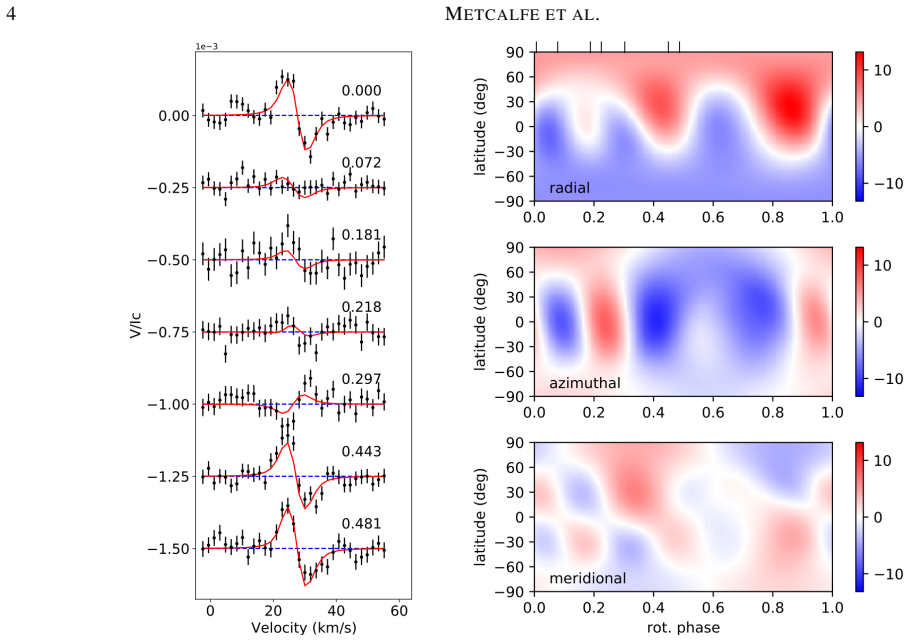
The central object is the Finley and Matt (2018) wind-braking torque formula, which converts the large-scale dipole, quadrupole, and octupole polar field strengths (Bd, Bq, Bo), the mass-loss rate, stellar mass, radius, and rotation period into a spin-down torque. Zeeman-Doppler Imaging maps are converted into equivalent polar field components; mass-loss rates come from the X-ray surface flux relation of Wood et al. (2021) or from direct Ly-alpha astrospheric absorption; radii and masses come from SED fits with Gaia parallaxes; and Rossby numbers are computed with an extended convective-overturn calibration from Metcalfe et al. (2024a). For two stars without a ZDI map, the paper conservatively assumes all polarization signal is an axisymmetric dipole, which maximizes the resulting torque estimate.
What would settle it
Measure the wind braking torque of a K dwarf with Rossby number clearly above Rocrit (for example HD 166620) using direct Ly-alpha or radio astrospheric observations and independent MHD wind models of its ZDI map; if that torque is not more than an order of magnitude below the standard spin-down curve, the claimed Rossby-number transition fails.
Extended reading notes
Core claim
Using the torque prescription of Finley and Matt (2018), the paper estimates wind braking torques for six K dwarfs spanning a factor of roughly 700 in torque. The key result is that the torque drops abruptly — by more than an order of magnitude — at Ro/Ro_sun near 0.9, the same critical value previously inferred for late F- and G-type stars. Because the K dwarfs cross this threshold at rotation periods of 31–43 days rather than 21–23 days, the agreement in critical Rossby number is not an artifact of rotation period: it identifies the Rossby number as the global stellar predictor of weakened magnetic braking. All six stars show activity cycles, including those in the weakened-braking regime, which the paper interprets as evidence that the transition coincides with a subcritical stellar dynamo rather than the total loss of large-scale organization.
Load-bearing premise
The torque model of Finley and Matt (2018), built on a polytropic Parker wind that is acknowledged to be inaccurate for the solar wind, must give unbiased relative torque estimates across the full range of activity in the sample; if its bias changes with activity, the claimed abrupt drop could be partly an artifact of the model.
Editorial extensions
If this is right
- If the Rossby number is the universal switch, K dwarfs enter weakened magnetic braking near Ro/Ro_sun approximately 0.9, which corresponds to ages around 7–9 Gyr rather than the younger ages typical of solar analogs.
- Stars just past the transition rotate with periods of 31–43 days, so rotation-period surveys that treat period alone as an age indicator will misclassify post-transition K dwarfs.
- The torque drop in the standard spin-down regime is dominated by declining field strength, while the drop in the weakened-braking regime is dominated by a shift in magnetic morphology — a change that can be checked with time-series spectropolarimetry.
- Activity cycles can persist on both sides of the transition, so the presence of a cycle does not imply that full-strength magnetic braking is operating.
- On K-dwarf timescales the transition begins only after roughly 7 Gyr, so the oldest K dwarfs are just entering the new regime and the full population of partially braked stars may still be forming.
Reading between the lines
- A direct test would be to measure mass-loss rates from Ly-alpha astrospheric absorption for sigma Dra and HD 166620 (planned HST observations) and recompute the torques; if the order-of-magnitude drop survives, it is less likely to be an artifact of the X-ray-based mass-loss calibration.
- Because the torque prescription uses a polytropic Parker wind model that the authors themselves flag as inaccurate for the solar wind, the same method applied across very different activity levels could imprint a torque drop that is partly model-driven; independent MHD wind torques on the same ZDI maps would settle this.
- A broader implication is that if Rocrit is universal across spectral type, then convective overturn timescales must be accurately known for each star, and systematic errors in tau_c translate directly into errors in the predicted transition age.
- The morphology shift seen between sigma Dra and HD 219134 suggests that time-series ZDI of a K dwarf deep in the weakened-braking regime (for example HD 166620) should reveal a strongly non-axisymmetric, complex field; this can be checked with a sustained observing campaign.
Editorial analysis
A structured set of objections, weighed in public.
Referee Report
Summary. The paper tests whether weakened magnetic braking (WMB) in early K-type stars sets in at the same Rossby number as in hotter stars. Using spectropolarimetry (two new LBT snapshots and two new ZDI maps from archival data), X-ray and Ly-alpha mass-loss estimates, SED-based radii and masses, and literature rotation periods, the authors compute wind braking torques for six K dwarfs with the Finley & Matt (2018) prescription. They report an order-of-magnitude drop in the torque near Ro/Ro_sun ~ 0.9, matching the critical Rossby number previously inferred for F and G stars, and they interpret this as evidence that the Rossby number, rather than rotation period alone, controls the onset of WMB. The paper also proposes that activity cycles in these K dwarfs may be powered by a subcritical dynamo.
Significance. If the central claim holds, the paper provides a valuable extension of the WMB paradigm to cooler, longer-period stars and strengthens the case that Ro_crit is a universal stellar predictor rather than a mass- or period-dependent quantity. The new LBT Stokes V observations, the ZDI reconstructions for sigma Dra and 107 Psc, and the uniform SED-based stellar parameters are useful observational contributions in their own right. The paper is also commendably transparent: it releases the torque code repository, discusses asteroseismic nondetections, and includes an explicit footnote acknowledging the known limitations of the Finley & Matt (2018) wind model. The main risk is not the internal consistency of the torque calculation, which is independent of Ro, but the calibration of the K-dwarf Rossby numbers and the propagation of systematic errors in the mass-loss and torque estimates.
major comments (3)
- [Section 3.2, Table 1] The Rossby numbers for all six K dwarfs are derived from the Metcalfe et al. (2024a) activity-based calibration, which estimates Ro/Ro_sun from the inverse of mean activity relative to the Sun, because the asteroseismic Corsaro et al. (2021) relation does not cover the relevant colors. The Table 1 uncertainties of ±0.01–0.02 are purely formal. The central claim that WMB onset occurs at the same Ro_crit as in hotter stars requires the K-dwarf Ro values to be on the same absolute scale as the asteroseismic values used for the hotter samples. Since activity also enters the torque estimates through the X-ray-based mass-loss rates and the ZDI-derived field strengths, an apparent torque drop at Ro ≈ 0.9 could in principle be a drop at a particular activity level, with the numerical Ro_crit set by the calibration zero-point. The authors should propagate the systematic uncertainty of the Metcalfe et al. (2024a) calibration (zero point, slope, and any color dependence) into Figure 5, or alternatively present the K-dwarf Ro_crit as a separate determination rather than asserting it coincides with the hotter-star value.
- [Footnote 3, Sections 2.2.2 and 4] The paper's own footnote 3 concedes that the Finley & Matt (2018) torque model uses a polytropic Parker wind "known to be an inaccurate representation of the physics driving the solar wind." The manuscript does not quantify how this model bias varies with activity level, mass-loss rate, or magnetic morphology. This matters because the claimed order-of-magnitude drop spans exactly the range where the model is extrapolated far from its calibration. In addition, four of six mass-loss rates come from the Wood et al. (2021) X-ray surface flux relation, for which the paper itself notes (footnote 2) scatter up to two orders of magnitude at high activity. The quoted mass-loss uncertainties in Table 1 appear to propagate only the factor-of-two Ly-alpha systematic and X-ray statistical errors, not the full scatter of the empirical relation. The authors should fold the full systematic scatter into the torque uncertainties, or explicitly restrict the "abrupt drop" claim to the two Ly-alpha targets and demonstrate that the remaining stars do not move relative to the transition once the Wood et al. (2021) scatter is included.
- [Section 3.2, HD 103095 and HD 166620] For HD 103095 and HD 166620 the paper assumes that all of the large-scale magnetic field is in an axisymmetric dipole, which the authors state is a conservative assumption that maximizes the torque. This means the torques for these two stars are formal upper limits if the true fields contain quadrupolar or octupolar components. The statement in Section 4 that the magnetic contribution in the WMB regime is dominated by a morphology shift (-49%) rests almost entirely on the single ZDI-mapped target HD 219134, since the two dipole-only stars cannot constrain morphology. This does not invalidate the main Ro_crit claim, but the morphology interpretation should be explicitly qualified in the abstract or conclusions as resting on one star.
minor comments (4)
- [Table 1 and Section 2.2.2] The mass-loss rate column header and in-text values (e.g., "30 +30 -15" and "9.9+10.5 -5.6 Mdot_sun") do not specify the units; they appear to be in units of 10^-12 solar masses per year but this should be stated explicitly in the table and text.
- [Section 2.2] The word "Röngtensatelit" is a typo for "Röntgensatellit" (ROSAT).
- [Figure 5] The x-axis label "Ro/Ro" should read "Ro/Ro_sun" for consistency with the text, and the light gray shaded region denoting systematic uncertainty in Ro/Ro_sun should be defined in the figure caption rather than only in the main text.
- [Section 2.1.2, 2.1.3] The instrument name "NARV AL" should be written as "NARVAL" throughout; the current spacing appears to be an artifact of the LaTeX source.
Circularity Check
Activity-calibrated Rossby numbers make the K-dwarf 'same Ro_crit' claim partly circular: both axes of the torque–Ro plot are derived from activity diagnostics.
-
fitted input called prediction
[Section 3.2, Figure 5; Section 2.2.2]
"The extended relation is nearly linear between 0.55 < GBP − GRP < 1.2, and allows us to estimate Ro/Ro_sun from the inverse of the mean activity level relative to the solar value from Egeland et al. (2017). For consistency with previous results, we use this formulation to estimate Ro/Ro_sun for the early K-type stars in our sample. ... we use the coronal heating rate (as inferred from X-ray luminosities) to estimate the mass-loss rates."
On the x-axis of Figure 5, Ro/Ro_sun is constructed from the inverse of each star's mean activity level, while on the y-axis the torque is constructed from inputs that are themselves activity diagnostics: the mass-loss rate comes from the X-ray surface flux via Wood et al. (2021), and the magnetic field strength comes from ZDI. The claimed abrupt decline in torque at Ro ≈ 0.9 is therefore, to first order, a decline in torque against activity, with the numerical value of Ro_crit fixed by the zero-point of the activity calibration rather than by an independent measurement of convective overturn time. Reporting this as the onset of WMB at a universal Rossby number is a coordinate transformation of the activity–torque relation, not an independent prediction.
-
self citation load bearing
[Section 3.2 and Section 4]
"Metcalfe et al. (2024a) recently extended the relation to redder colors, using measured rotation periods and mean activity levels from the Mount Wilson survey to estimate the convective overturn times. ... the empirical value of Rocrit for the onset of WMB in solar analogs (Metcalfe et al. 2022). ... The onset of WMB occurs at the same Ro_crit as the threshold for hotter stars."
The load-bearing calibration for the K-dwarf Rossby numbers is the authors' own Metcalfe et al. (2024a) extension, and the reference Rocrit is the authors' own Metcalfe et al. (2022) value. The conclusion that K dwarfs share the same Ro_crit therefore inherits the zero-point of a same-author chain: the activity–Ro mapping is not independently validated for the K-dwarf color range, and the calibration assumes the same activity–Ro relation that the paper claims to be testing. Without an external anchor for τc on these colors, the 'same Ro_crit' claim is supported by self-citation rather than by new independent measurement.
full rationale
The torque estimates themselves are built from new or archival observational inputs (ZDI maps, X-ray and Ly-alpha mass-loss proxies, SED radii) and an external torque prescription, so the numerical torque values have independent content. However, the central claim that WMB turns on at the same Rossby number in early K dwarfs as in hotter stars depends on the K-dwarf Rossby numbers, which are not measured from asteroseismic overturn times but are computed from the inverse of activity levels using a same-group calibration. Since the torque inputs (mass-loss rate, magnetic field) are also activity-driven, the key panel of the paper is largely an activity–activity correlation recast in Rossby coordinates. This is a partial circularity: the period measurements and the long rotation periods (31–43 days) are independent facts, but the quantitative coincidence at Ro_crit ≈ 0.9 is not an independent test of the Rossby paradigm. The Finley–Matt torque model limitations noted in the paper's footnote are a correctness concern, not a circularity concern; the circularity is concentrated in the activity-based construction of the Rossby scale and its self-referential calibration.
Assumptions & free parameters
free parameters (3)
- Convective overturn timescale calibration (Metcalfe et al. 2024a) =
activity-based relation for tau_c
- Critical Rossby number Ro_crit =
~0.9 Ro_sun
- X-ray surface flux to mass-loss relation =
Mdot proportional to F_X^0.77
assumptions (5)
- domain assumption Finley & Matt (2018) torque prescription accurately describes wind braking for K dwarfs
- domain assumption Wood et al. (2021) X-ray flux to mass-loss relation holds for all sample stars
- domain assumption ZDI and dipole snapshot modeling recover the large-scale magnetic field
- domain assumption The rotational evolution model of Saunders et al. (2024) correctly describes spin-down with WMB
- domain assumption Metcalfe et al. (2024a) extension of convective overturn timescales to redder colors is accurate
Cite this review
Pith. "Pith review of Testing the Rossby Paradigm: Weakened Magnetic Braking in early K-type Stars." pith.science (2026). https://pith.science/paper/S3QBDVKO
@misc{pith2026250119169,
  author       = {Pith},
  title        = {Pith review of: Testing the Rossby Paradigm: Weakened Magnetic Braking in early K-type Stars},
  year         = {2026},
  howpublished = {\url{https://pith.science/paper/S3QBDVKO}},
  note         = {Machine review of arXiv:2501.19169}
}
read the original abstract
There is an intricate relationship between the organization of large-scale magnetic fields by a stellar dynamo and the rate of angular momentum loss due to magnetized stellar winds. An essential ingredient for the operation of a large-scale dynamo is the Coriolis force, which imprints organizing flows on the global convective patterns and inhibits the complete cancellation of bipolar magnetic regions. Consequently, it is natural to expect a rotational threshold for large-scale dynamo action and for the efficient angular momentum loss that it mediates through magnetic braking. Here we present new observational constraints on magnetic braking for an evolutionary sequence of six early K-type stars. To determine the wind braking torque for each of our targets, we combine spectropolarimetric constraints on the large-scale magnetic field, Ly-alpha or X-ray constraints on the mass-loss rate, as well as uniform estimates of the stellar rotation period, mass, and radius. As identified previously from similar observations of hotter stars, we find that the wind braking torque decreases abruptly by more than an order of magnitude at a critical value of the stellar Rossby number. Given that all of the stars in our sample exhibit clear activity cycles, we suggest that weakened magnetic braking may coincide with the operation of a subcritical stellar dynamo.
Figures


Figures from the paper (3 more)


Forward citations
Cited by 2 Pith papers
-
Anchoring Stellar Age Indicators: A Cross-Calibration of [C/N] and Gyrochronology Ages via the Age-Velocity-Dispersion Relation
After anchoring gyrochronology and [C/N] ages to the same age-velocity-dispersion relation, the two methods give consistent ages once small offsets are subtracted, and their valid parameter spaces are mapped.
-
K-dwarf Radius Inflation and a 10-Gyr Spin-down Clock Unveiled through Asteroseismology of HD 219134 from the Keck Planet Finder
HD 219134 yields the first asteroseismic age for a dwarf cooler than 5000 K, alongside a 4% radius discrepancy with interferometry.
Reference graph
Works this paper leans on
-
[1]
Amard, L., Roquette, J., & Matt, S. P. 2020, MNRAS, 499, 3481, doi: 10.1093/mnras/staa3038 Aurière, M. 2003, in EAS Publications Series, V ol. 9, EAS Publications Series, ed. J. Arnaud & N. Meunier, 105
-
[2]
1996, ApJL, 457, L99, doi: 10.1086/309891
Baliunas, S., Sokoloff, D., & Soon, W. 1996, ApJL, 457, L99, doi: 10.1086/309891
doi:10.1086/309891 1996
-
[3]
Baliunas, S. L., Donahue, R. A., Soon, W. H., et al. 1995, ApJ, 438, 269, doi: 10.1086/175072
doi:10.1086/175072 1995
-
[4]
Basu, S., & Antia, H. M. 1995, MNRAS, 276, 1402, doi: 10.1093/mnras/276.4.1402
-
[5]
Baum, A. C., Wright, J. T., Luhn, J. K., & Isaacson, H. 2022, AJ, 163, 183, doi: 10.3847/1538-3881/ac5683
-
[6]
Bellotti, S., Morin, J., Lehmann, L. T., et al. 2024, A&A, 686, A66, doi: 10.1051/0004-6361/202348043 Boro Saikia, S., Lueftinger, T., Jeffers, S. V ., et al. 2018, A&A, 620, L11, doi: 10.1051/0004-6361/201834347
-
[7]
Bowler, B. P., Tran, Q. H., Zhang, Z., et al. 2023, AJ, 165, 164, doi: 10.3847/1538-3881/acbd34
-
[8]
Breton, S. N., García, R. A., Ballot, J., Delsanti, V ., & Salabert, D. 2022, A&A, 663, A118, doi: 10.1051/0004-6361/202243330
Show all 91 references
-
[9]
M., Fischer, D
Brewer, J. M., Fischer, D. A., Valenti, J. A., & Piskunov, N. 2016, ApJS, 225, 32, doi: 10.3847/0067-0049/225/2/32
2016 doi
-
[10]
Brown, T. M. 2014, ApJ, 789, 101, doi: 10.1088/0004-637X/789/2/101
2014 doi
-
[11]
S., Strugarek, A., Noraz, Q., et al
Brun, A. S., Strugarek, A., Noraz, Q., et al. 2022, ApJ, 926, 21, doi: 10.3847/1538-4357/ac469b
2022 doi
-
[12]
Buzasi, D. L. 1997, ApJ, 484, 855, doi: 10.1086/304374
1997 doi
-
[13]
Cao, L., & Pinsonneault, M. H. 2022, MNRAS, 517, 2165, doi: 10.1093/mnras/stac2706
2022 doi
-
[14]
2003, in Asteroseismology Across the HR Diagram, ed
Carrier, F., Bouchy, F., & Eggenberger, P. 2003, in Asteroseismology Across the HR Diagram, ed. M. J. Thompson, M. S. Cunha, & M. J. P. F. G. Monteiro, V ol. 284, 311–314
2003
-
[15]
2022, The Journal of Open Source Software, 7, 3331, doi: 10.21105/joss.03331
Chontos, A., Huber, D., Sayeed, M., & Yamsiri, P. 2022, The Journal of Open Source Software, 7, 3331, doi: 10.21105/joss.03331
2022 doi
-
[16]
2020, A&A, 636, A49, doi: 10.1051/0004-6361/201936479
Coffaro, M., Stelzer, B., Orlando, S., et al. 2020, A&A, 636, A49, doi: 10.1051/0004-6361/201936479
2020 doi
-
[17]
2021, A&A, 652, L2, doi: 10.1051/0004-6361/202141395
Corsaro, E., Bonanno, A., Mathur, S., et al. 2021, A&A, 652, L2, doi: 10.1051/0004-6361/202141395
2021 doi
-
[18]
L., Agüeros, M
Curtis, J. L., Agüeros, M. A., Douglas, S. T., & Meibom, S. 2019, ApJ, 879, 49, doi: 10.3847/1538-4357/ab2393
2019 doi
-
[19]
L., Agüeros, M
Curtis, J. L., Agüeros, M. A., Matt, S. P., et al. 2020, ApJ, 904, 140, doi: 10.3847/1538-4357/abbf58
2020 doi
-
[20]
J., Angus, R., Curtis, J
David, T. J., Angus, R., Curtis, J. L., et al. 2022, ApJ, 933, 114, doi: 10.3847/1538-4357/ac6dd3 do Nascimento, J. D., Barnes, S. A., Saar, S. H., et al. 2023, ApJ, 958, 57, doi: 10.3847/1538-4357/acfc1a
2022 doi
-
[21]
1997, MNRAS, 291, 658, doi: 10.1093/mnras/291.4.658
Cameron, A. 1997, MNRAS, 291, 658, doi: 10.1093/mnras/291.4.658
1997 doi
-
[22]
F., Howarth, I
Donati, J. F., Howarth, I. D., Jardine, M. M., et al. 2006, MNRAS, 370, 629, doi: 10.1111/j.1365-2966.2006.10558.x
2006
-
[23]
2017, ApJ, 840, 99, doi: 10.3847/1538-4357/aa6d10
Dotter, A., Conroy, C., Cargile, P., & Asplund, M. 2017, ApJ, 840, 99, doi: 10.3847/1538-4357/aa6d10
2017 doi
-
[24]
R., & Latour, J
Durney, B. R., & Latour, J. 1978, Geophysical and Astrophysical Fluid Dynamics, 9, 241, doi: 10.1080/03091927708242330
1978 doi
-
[25]
2017, ApJ, 835, 25, doi: 10.3847/1538-4357/835/1/25
Egeland, R., Soon, W., Baliunas, S., et al. 2017, ApJ, 835, 25, doi: 10.3847/1538-4357/835/1/25
2017 doi
-
[26]
R., & Pinsonneault, M
Epstein, C. R., & Pinsonneault, M. H. 2014, ApJ, 780, 159, doi: 10.1088/0004-637X/780/2/159
2014 doi
-
[27]
J., & Matt, S
Finley, A. J., & Matt, S. P. 2018, ApJ, 854, 78, doi: 10.3847/1538-4357/aaaab5
2018 doi
-
[28]
J., Matt, S
Finley, A. J., Matt, S. P., & See, V . 2018, ApJ, 864, 125, doi: 10.3847/1538-4357/aad7b6
2018 doi
-
[29]
P., Fossati, L., Wood, B
Folsom, C. P., Fossati, L., Wood, B. E., et al. 2018a, MNRAS, 481, 5286, doi: 10.1093/mnras/sty2494
-
[30]
P., Bouvier, J., Petit, P., et al
Folsom, C. P., Bouvier, J., Petit, P., et al. 2018b, MNRAS, 474, 4956, doi: 10.1093/mnras/stx3021
-
[31]
2023, A&A, 672, A149, doi: 10.1051/0004-6361/202245201 Gaia Collaboration, Brown, A
Fuhrmeister, B., Coffaro, M., Stelzer, B., et al. 2023, A&A, 672, A149, doi: 10.1051/0004-6361/202245201 Gaia Collaboration, Brown, A. G. A., Vallenari, A., et al. 2021, A&A, 649, A1, doi: 10.1051/0004-6361/202039657 García, R. A., Ceillier, T., Salabert, D., et al. 2014, A&A,...
2023 doi
-
[32]
J., & Cohen, O
Garraffo, C., Drake, J. J., & Cohen, O. 2016, A&A, 595, A110, doi: 10.1051/0004-6361/201628367
2016 doi
-
[33]
J., Dotter, A., et al
Garraffo, C., Drake, J. J., Dotter, A., et al. 2018, ApJ, 862, 90, doi: 10.3847/1538-4357/aace5d
2018 doi
-
[34]
J., Davies, G
Hall, O. J., Davies, G. R., van Saders, J., et al. 2021, Nature Astronomy, 5, 707, doi: 10.1038/s41550-021-01335-x
2021 doi
- [35]
-
[36]
2024, ApJ, 975, 147, doi: 10.3847/1538-4357/ad76a9
Hon, M., Huber, D., Li, Y ., et al. 2024, ApJ, 975, 147, doi: 10.3847/1538-4357/ad76a9
2024 doi
-
[37]
V ., Petit, P., Marsden, S
Jeffers, S. V ., Petit, P., Marsden, S. C., et al. 2014, A&A, 569, A79, doi: 10.1051/0004-6361/201423725
2014 doi
-
[38]
C., Endl, M., Cochran, W
Johnson, M. C., Endl, M., Cochran, W. D., et al. 2016, ApJ, 821, 74, doi: 10.3847/0004-637X/821/2/74
2016 doi
-
[39]
Kawaler, S. D. 1988, ApJ, 333, 236, doi: 10.1086/166740
1988 doi
-
[40]
2010, A&A, 524, A5, doi: 10.1051/0004-6361/201015429
Kochukhov, O., Makaganiuk, V ., & Piskunov, N. 2010, A&A, 524, A5, doi: 10.1051/0004-6361/201015429
2010 doi
-
[41]
Kurucz, R. L. 1993, in Astronomical Society of the Pacific Conference Series, V ol. 44, IAU Colloq. 138: Peculiar versus Normal Phenomena in A-type and Related Stars, ed. M. M
1993
- [42]
-
[43]
2024, AJ, 167, 159, doi: 10.3847/1538-3881/ad28b9
Lu, Y ., Angus, R., Foreman-Mackey, D., & Hattori, S. 2024, AJ, 167, 159, doi: 10.3847/1538-3881/ad28b9
2024 doi
-
[44]
L., Angus, R., Curtis, J
Lu, Y . L., Angus, R., Curtis, J. L., David, T. J., & Kiman, R. 2021, AJ, 161, 189, doi: 10.3847/1538-3881/abe4d6
2021 doi
-
[45]
L., Curtis, J
Lu, Y . L., Curtis, J. L., Angus, R., David, T. J., & Hattori, S. 2022, AJ, 164, 251, doi: 10.3847/1538-3881/ac9bee
2022 doi
-
[46]
K., Wright, J
Luhn, J. K., Wright, J. T., Henry, G. W., Saar, S. H., & Baum, A. C. 2022, ApJL, 936, L23, doi: 10.3847/2041-8213/ac8b13
2022 doi
-
[47]
2022, ApJ, 937, 94, doi: 10.3847/1538-4357/ac8d58
Masuda, K. 2022, ApJ, 937, 94, doi: 10.3847/1538-4357/ac8d58
2022 doi
-
[48]
2014, ApJS, 211, 24, doi: 10.1088/0067-0049/211/2/24
McQuillan, A., Mazeh, T., & Aigrain, S. 2014, ApJS, 211, 24, doi: 10.1088/0067-0049/211/2/24
2014 doi
-
[49]
Mermilliod, J. C. 2006, VizieR Online Data Catalog, II/168
2006
-
[50]
Saders, J. L. 2024a, RNAAS, 8, 260, doi: 10.3847/2515-5172/ad8566
-
[51]
S., Kochukhov, O., Ilyin, I
Metcalfe, T. S., Kochukhov, O., Ilyin, I. V ., et al. 2019, ApJL, 887, L38, doi: 10.3847/2041-8213/ab5e48
2019 doi
-
[52]
S., Townsend, R
Metcalfe, T. S., Townsend, R. H. D., & Ball, W. H. 2023a, RNAAS, 7, 164, doi: 10.3847/2515-5172/acebef
-
[53]
S., & van Saders, J
Metcalfe, T. S., & van Saders, J. 2017, SoPh, 292, 126, doi: 10.1007/s11207-017-1157-5
2017 doi
-
[54]
S., Buccino, A
Metcalfe, T. S., Buccino, A. P., Brown, B. P., et al. 2013, ApJL, 763, L26, doi: 10.1088/2041-8205/763/2/L26
2013 doi
-
[55]
S., Creevey, O
Metcalfe, T. S., Creevey, O. L., Do˘gan, G., et al. 2014, ApJS, 214, 27, doi: 10.1088/0067-0049/214/2/27
2014 doi
-
[56]
S., van Saders, J
Metcalfe, T. S., van Saders, J. L., Basu, S., et al. 2020, ApJ, 900, 154, doi: 10.3847/1538-4357/aba963 —. 2021, ApJ, 921, 122, doi: 10.3847/1538-4357/ac1f19
2020 doi
-
[57]
S., Finley, A
Metcalfe, T. S., Finley, A. J., Kochukhov, O., et al. 2022, ApJL, 933, L17, doi: 10.3847/2041-8213/ac794d
2022 doi
-
[58]
S., Strassmeier, K
Metcalfe, T. S., Strassmeier, K. G., Ilyin, I. V ., et al. 2023b, ApJL, 948, L6, doi: 10.3847/2041-8213/acce38
-
[59]
S., Buzasi, D., Huber, D., et al
Metcalfe, T. S., Buzasi, D., Huber, D., et al. 2023c, AJ, 166, 167, doi: 10.3847/1538-3881/acf1f7
-
[60]
S., Strassmeier, K
Metcalfe, T. S., Strassmeier, K. G., Ilyin, I. V ., et al. 2024b, ApJL, 960, L6, doi: 10.3847/2041-8213/ad0a95
-
[61]
S., van Saders, J
Metcalfe, T. S., van Saders, J. L., Huber, D., et al. 2024c, ApJ, 974, 31, doi: 10.3847/1538-4357/ad6dd6
-
[62]
2012, A&A, 537, A30, doi: 10.1051/0004-6361/201117352
Mosser, B., Elsworth, Y ., Hekker, S., et al. 2012, A&A, 537, A30, doi: 10.1051/0004-6361/201117352
2012 doi
-
[63]
B., Ball, W
Nielsen, M. B., Ball, W. H., Standing, M. R., et al. 2020, A&A, 641, A25, doi: 10.1051/0004-6361/202037461
2020 doi
-
[64]
Vaughan, A. H. 1984, ApJ, 279, 763, doi: 10.1086/161945
1984 doi
-
[65]
2015, A&A, 580, A23, doi: 10.1051/0004-6361/201526413
Paunzen, E. 2015, A&A, 580, A23, doi: 10.1051/0004-6361/201526413
2015 doi
-
[66]
2014, PASP, 126, 469, doi: 10.1086/676976
Petit, P., Louge, T., Théado, S., et al. 2014, PASP, 126, 469, doi: 10.1086/676976
2014 doi
-
[67]
P., Donati, J
Petit, P., Folsom, C. P., Donati, J. F., et al. 2021, A&A, 648, A55, doi: 10.1051/0004-6361/202040027
2021 doi
-
[68]
H., Kawaler, S
Pinsonneault, M. H., Kawaler, S. D., Sofia, S., & Demarque, P. 1989, ApJ, 338, 424, doi: 10.1086/167210
1989 doi
-
[69]
Pevtsov, A. A. 2018, ApJ, 855, 75, doi: 10.3847/1538-4357/aaaae3
2018 doi
-
[70]
J., et al
Reiners, A., Shulyak, D., Käpylä, P. J., et al. 2022, A&A, 662, A41, doi: 10.1051/0004-6361/202243251
2022 doi
-
[71]
L., et al
Ryabchikova, T., Piskunov, N., Kurucz, R. L., et al. 2015, PhyS, 90, 054005, doi: 10.1088/0031-8949/90/5/054005
2015 doi
-
[72]
Santos, A. R. G., García, R. A., Mathur, S., et al. 2019, ApJS, 244, 21, doi: 10.3847/1538-4365/ab3b56
2019 doi
-
[73]
L., Lyttle, A
Saunders, N., van Saders, J. L., Lyttle, A. J., et al. 2024, ApJ, 962, 138, doi: 10.3847/1538-4357/ad1516
2024 doi
-
[74]
A., et al
See, V ., Jardine, M., Vidotto, A. A., et al. 2016, MNRAS, 462, 4442, doi: 10.1093/mnras/stw2010
2016 doi
-
[75]
1972, ApJ, 171, 565, doi: 10.1086/151310
Skumanich, A. 1972, ApJ, 171, 565, doi: 10.1086/151310
1972 doi
-
[76]
Spada, F., & Lanzafame, A. C. 2020, A&A, 636, A76, doi: 10.1051/0004-6361/201936384
2020 doi
-
[77]
G., Collins, K
Stassun, K. G., Collins, K. A., & Gaudi, B. S. 2017, AJ, 153, 136, doi: 10.3847/1538-3881/aa5df3
2017 doi
-
[78]
G., Corsaro, E., Pepper, J
Stassun, K. G., Corsaro, E., Pepper, J. A., & Gaudi, B. S. 2018, AJ, 155, 22, doi: 10.3847/1538-3881/aa998a
2018 doi
-
[79]
G., & Torres, G
Stassun, K. G., & Torres, G. 2016, ApJL, 831, L6, doi: 10.3847/2041-8205/831/1/L6 —. 2021, ApJL, 907, L33, doi: 10.3847/2041-8213/abdaad
2016 doi
-
[80]
G., Ilyin, I., Järvinen, A., et al
Strassmeier, K. G., Ilyin, I., Järvinen, A., et al. 2015, Astronomische Nachrichten, 336, 324, doi: 10.1002/asna.201512172
2015 doi
-
[81]
Suzuki, T. K. 2013, Astronomische Nachrichten, 334, 81, doi: 10.1002/asna.201211751
2013 doi
-
[82]
R., Huber, D., & van Saders, J
Tayar, J., Claytor, Z. R., Huber, D., & van Saders, J. 2022, ApJ, 927, 31, doi: 10.3847/1538-4357/ac4bbc
2022 doi
-
[83]
A., Bahcall, J
Thoul, A. A., Bahcall, J. N., & Loeb, A. 1994, ApJ, 421, 828, doi: 10.1086/173695
1994 doi
-
[84]
2010, A&A Rv, 18, 67, doi: 10.1007/s00159-009-0025-1
Torres, G., Andersen, J., & Giménez, A. 2010, A&A Rv, 18, 67, doi: 10.1007/s00159-009-0025-1
2010 doi
-
[85]
2021, MNRAS, 506, L50, doi: 10.1093/mnrasl/slab035
Tripathi, B., Nandy, D., & Banerjee, S. 2021, MNRAS, 506, L50, doi: 10.1093/mnrasl/slab035
2021 doi
-
[86]
A., & Fischer, D
Valenti, J. A., & Fischer, D. A. 2005, ApJS, 159, 141, doi: 10.1086/430500 van Saders, J. L., Ceillier, T., Metcalfe, T. S., et al. 2016, Nature, 529, 181, doi: 10.1038/nature16168 van Saders, J. L., & Pinsonneault, M. H. 2013, ApJ, 776, 67, doi: 10.1088/0004-637X/776/2/67 van...
2005 doi
-
[87]
A., Gregory, S
Vidotto, A. A., Gregory, S. G., Jardine, M., et al. 2014, MNRAS, 441, 2361, doi: 10.1093/mnras/stu728
2014 doi
-
[88]
J., & Davis, Leverett, J
Weber, E. J., & Davis, Leverett, J. 1967, ApJ, 148, 217, doi: 10.1086/149138
1967 doi
-
[89]
Wood, B. E. 2018, in Journal of Physics Conference Series, V ol. 1100, Journal of Physics Conference Series, 012028
2018
-
[90]
E., Müller, H
Wood, B. E., Müller, H. R., Zank, G. P., Linsky, J. L., & Redfield, S. 2005b, ApJL, 628, L143, doi: 10.1086/432716
-
[91]
E., Müller, H.-R., Redfield, S., et al
Wood, B. E., Müller, H.-R., Redfield, S., et al. 2021, ApJ, 915, 37, doi: 10.3847/1538-4357/abfda5
2021 doi
Reviewed August 9, 2026 · model on record in the stance chip above.
Discussion (0). Continue with ORCID to comment.