REVIEW 4 major objections 4 minor 30 references
Enhancing IoT Network Security through Adaptive Curriculum Learning and XAI
T0 review · 4 major / 4 minor · reviewed 2026-08-10 · deepseek-v4-flash
Pith's one-line read Curriculum learning with LIME-guided feature removal reaches 97–98% accuracy on IoT attack datasets.
desk verdict A plausible curriculum-learning pipeline for IoT intrusion detection, but the pre-split LDA/scaling makes the reported accuracies unreliable as evidence of generalization. read the letter →
The pith
A machine-rendered reading of the paper's core claim, the machinery that carries it, and where it could break.
The reading
What carries the argument
The load-bearing mechanism is the staged curriculum loop: at each of several hand-designed stages (normal data, then simple, medium, and complex attacks), the shared neural network is trained, LIME is run on a fraction of the staged data, features whose importance falls below a threshold ($-0.01$) are removed, and the model is retrained on the remaining features. This 'feature un-learning' is what ties XAI to the curriculum, letting the model discard low-relevance inputs as it progresses to harder attacks. The neural backbone—GRU and LSTM layers plus self-attention and residual connections—captures both short- and long-term temporal dependencies in sequential IoT data, and the final stacking ensemble with Random Forest and XGBoost adds a small but consistent generalization gain. The architecture is kept edge-deployable by pruning and quantization, yielding 94,051 parameters.
What would settle it
Train and test the framework on CIC-IoV-2024 using a time-ordered split—earliest 80% of messages for training, latest 20% for testing—instead of the paper's random 80-20 split, and compare the accuracy. If it drops well below 98%, the reported result depends on random splitting of sequential CAN-bus traffic and would not transfer to real deployments.
Extended reading notes
Core claim
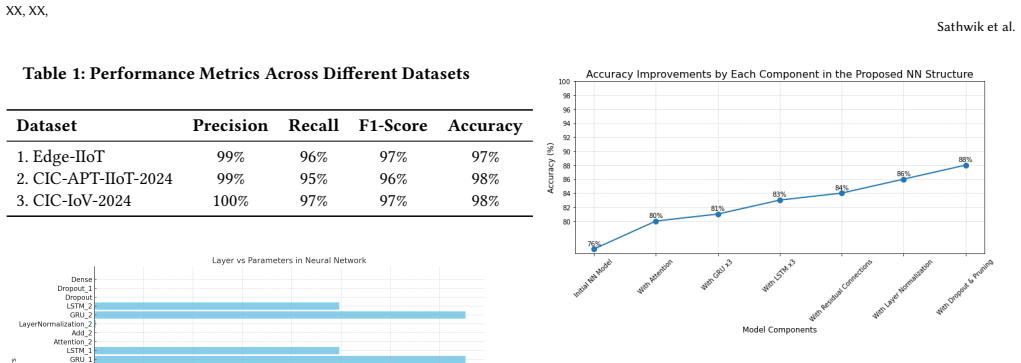
The paper's central claim is that a neural network built from GRU, LSTM, and attention layers, trained in curriculum stages ordered by attack complexity and refined by LIME-based feature un-learning, then combined into a stacking ensemble, achieves 98% accuracy on CIC-IoV-2024 and CIC-APT-IIoT-2024 and 97% on Edge-IIoT. The framework uses an adaptive feature mask layer, a dynamic convolutional layer for short-term dependencies, an attention-based temporal encoder for long-term dependencies, residual connections, and normalization, and is pruned and quantized to 94,051 parameters (367.39 KB). The paper reports an ablation on CIC-IoV-2024 in which the base network scores 88%; adding curriculum learning gives 94%, LIME integration and feature un-learning give 97%, and the stacking ensemble gives 98%. It also reports 99–100% precision, 95–97% recall, and F1-scores of 96–99% across the three datasets.
Load-bearing premise
Everything rests on assuming that randomly splitting each dataset into 80% train and 20% test keeps temporally ordered IoT and CAN-bus traffic from leaking between the two, and that the hand-chosen curriculum stages and a LIME cutoff of $-0.01$ will also work on attack types the model has not seen.
Editorial extensions
If this is right
- If the reported accuracies hold, a single 367 KB model can serve as an intrusion detector on edge devices for vehicular (CAN-bus), general IoT, and industrial IoT traffic, with no cloud round-trip.
- The ablation implies that each design choice—curriculum ordering, LIME-based feature removal, and ensemble stacking—pays a measurable accuracy dividend (6, 3, and 1 points respectively on CIC-IoV-2024), so the framework's performance is not attributable to one component alone.
- Because LIME explanations are attached to each prediction, a security analyst can see which features (e.g., arp.opcode, dns.retransmission) drove an attack decision, which is the transparency the paper argues is missing from other IoT intrusion detection approaches.
- The lightweight footprint suggests the framework could be further quantized or combined with federated learning, which the paper lists as future work for privacy-preserving distributed training.
Reading between the lines
- A natural stress test the authors did not run: replace the random 80-20 split with a time-ordered split on CIC-IoV-2024's CAN-bus stream. If accuracy drops, the random split may be letting the model see temporally adjacent attack traffic in both train and test, which would overstate real-world performance.
- The LIME threshold of $-0.01$ is a fixed scalar chosen by inspection. An extension would be to make feature removal adaptive per stage, for example by keeping the top-k features by LIME weight, and to test whether the 3% XAI gain persists across thresholds.
- Because curriculum stage groupings were hand-crafted per dataset (4 stages for Edge-IIoT, 2 for CIC-APT-IIoT, 3 for CIC-IoV-2024), a skeptic would want to see whether an automatic curriculum, with difficulty scored by model loss or confidence, reproduces the gains without hand-tuning.
Editorial analysis
A structured set of objections, weighed in public.
Referee Report
Summary. The paper proposes a curriculum learning framework for IoT/IIoT intrusion detection, combining a GRU/LSTM/attention neural network with a LIME-based feature un-learning mechanism, edge-oriented quantization/pruning, and a stacking ensemble of the staged model with Random Forest and XGBoost. The authors evaluate the framework on Edge-IIoT, CIC-APT-IIoT-2024, and CIC-IoV-2024, reporting accuracies of 97%, 98%, and 98%, respectively, with a lightweight model of 94,051 parameters, and present an ablation study attributing accuracy gains to curriculum learning, XAI integration, and stacking. The central claim is that this combination yields accurate, transparent, and lightweight intrusion detection for diverse IoT networks.
Significance. If the reported results were sound, the paper would offer a practically relevant contribution: a compact temporal model with explicit parameter counts and deployment-oriented techniques, evaluated on three recent IoT/IIoT security datasets. The use of CIC-IoV-2024 and CIC-APT-IIoT-2024 is timely, and the explicit ablation breakdown in Table 2 is a useful organizing device. However, the empirical core is not currently reproducible or verifiable: no code, seeds, or hyperparameters are provided, and the preprocessing description in Section 4.1 indicates a supervised dimensionality-reduction step before the train/test split. The significance of the central accuracy claim therefore depends on fixes that are within the scope of a revision.
major comments (4)
- [Section 4.1, Table 1] The preprocessing description states that StandardScaler and Linear Discriminant Analysis (LDA) are applied before the 80-20 split: 'This processed data gets split up into training and testing data by an 80-20 split.' Since LDA is a supervised projection that uses class labels and StandardScaler uses full-data statistics, the test set has already influenced the feature space, making the accuracies in Table 1 optimistically biased. Please move all preprocessing inside a cross-validation or nested-split pipeline, or explicitly state that the scaler and LDA were fit only on the training portion; providing code or detailed pseudo-code for the split would also allow verification.
- [Section 5, Table 1] The reported F1-score for CIC-IoV-2024 is internally inconsistent: the text states 'F1-Score 99%' while Table 1 reports 97%, and precision 100% with recall 97% implies F1 approximately 98.5%. These numbers cannot all be correct. Please recompute and harmonize all metrics, and report the exact formulas used for precision, recall, and F1.
- [Section 5, Table 2] The ablation study reports single-point accuracy increments (+6% for curriculum learning, +3% for XAI/LIME un-learning, +1% for stacking) without standard deviations, repeated seeds, or statistical tests. Moreover, the LIME-based un-learning removes features based on the model's own explanations, so the +3% could be an in-sample artifact if the LIME importance scores are computed on the full dataset or if the stage-wise retraining is not nested within the training split. Please clarify which data are used to compute LIME importances, and report mean and variance over multiple runs.
- [Section 5, Tables 1 and 2] The paper does not compare the proposed method against any existing intrusion-detection baselines on the same datasets, even though Section 3 cites related work reporting high accuracies on Edge-IIoT (e.g., CNN-GRU and ensemble methods). Without such comparisons, the claim that the curriculum/XAI/ensemble framework 'further enhances generalization' is not empirically established. Please add comparisons to at least the strongest prior methods on each dataset, ideally from the references cited in Section 3.
minor comments (4)
- [Title page and template metadata] The manuscript contains ACM template placeholders that should be removed before submission, including 'Make sure to enter the correct conference title from your rights confirmation email', 'XX, XX', and the placeholder DOI and ISBN lines.
- [Section 4.1] The text refers to 'LDA plots or Random Forest feature importance plots' and 'log scaling and binning' but none of these feature-engineering artifacts are shown or described with concrete settings; please either present them or remove the unsupported details.
- [Section 5, Figure 4] The hyperparameter-importance figure is presented without any description of how the importance values were obtained; please specify the sensitivity-analysis procedure, including the ranges of hyperparameters tested.
- [Throughout] The manuscript needs careful copyediting for grammar and style; for example, 'The motivation for this research is that the IoT devices are getting more and more mainstream' and 'it’s scalability' are unclear or incorrect. Also, table and figure references should be consistent (e.g., Table 2 is introduced after a paragraph that says 'the table 2 above').
Circularity Check
No significant circularity: external benchmarks carry the accuracy claims; the LIME un-learning step is an empirical ablation, not a construction.
full rationale
The paper's central accuracy claims (97% on Edge-IIoT, 98% on CIC-APT-IIoT-2024 and CIC-IoV-2024) are evaluated against external benchmark datasets and are not derived from the model's own definitions or from a self-citation chain. The reference list contains no prior work by the present authors, and no uniqueness theorem or prior result is invoked to force the proposed choice. The LIME-based feature un-learning in Section 4.2 is self-referential in the sense that the model's own explanations determine which features are removed, but the reported +3% improvement in Table 2 is an empirical ablation result, not a quantity that equals its input by construction; it could in principle have been negative. The pre-split StandardScaler and LDA described in Section 4.1 create a real risk of test information leaking into preprocessing, which would bias the reported accuracies, but evaluation leakage is a correctness concern rather than circularity. No quoted equation or fitted parameter is renamed as a prediction, so no circular step meets the specific-reduction bar required for a positive finding.
Assumptions & free parameters
free parameters (4)
- LIME relevance threshold =
-0.01
- Curriculum stage groupings =
hand-crafted per dataset
- Neural network hyperparameters =
not reported
- LDA dimensionality =
not specified
assumptions (5)
- domain assumption Random 80-20 stratified split without temporal separation is a valid generalization test for time-ordered intrusion data
- domain assumption LIME feature importance is a reliable guide for deleting features across curriculum stages
- domain assumption Curriculum ordering from normal to simple to complex attacks improves generalization
- domain assumption Benchmark labels and features are correct and representative
- ad hoc to paper Features with LIME importance below -0.01 are unimportant and safe to remove
Cite this review
Pith. "Pith review of Enhancing IoT Network Security through Adaptive Curriculum Learning and XAI." pith.science (2026). https://pith.science/paper/S6GTXGDL
@misc{pith2026250111618,
  author       = {Pith},
  title        = {Pith review of: Enhancing IoT Network Security through Adaptive Curriculum Learning and XAI},
  year         = {2026},
  howpublished = {\url{https://pith.science/paper/S6GTXGDL}},
  note         = {Machine review of arXiv:2501.11618}
}
read the original abstract
To address the critical need for secure IoT networks, this study presents a scalable and lightweight curriculum learning framework enhanced with Explainable AI (XAI) techniques, including LIME, to ensure transparency and adaptability. The proposed model employs novel neural network architecture utilized at every stage of Curriculum Learning to efficiently capture and focus on both short- and long-term temporal dependencies, improve learning stability, and enhance accuracy while remaining lightweight and robust against noise in sequential IoT data. Robustness is achieved through staged learning, where the model iteratively refines itself by removing low-relevance features and optimizing performance. The workflow includes edge-optimized quantization and pruning to ensure portability that could easily be deployed in the edge-IoT devices. An ensemble model incorporating Random Forest, XGBoost, and the staged learning base further enhances generalization. Experimental results demonstrate 98% accuracy on CIC-IoV-2024 and CIC-APT-IIoT-2024 datasets and 97% on EDGE-IIoT, establishing this framework as a robust, transparent, and high-performance solution for IoT network security.
Figures


Figures from the paper (1 more)

Reference graph
Works this paper leans on
-
[1]
Madakam, S., Ramaswamy, R. & Tripathi, S. Internet of Things (IoT): A literature review. Journal Of Computer And Communications . 3, 164-173 (2015)
work page 2015
-
[2]
Gurunath, R., Agarwal, M., Nandi, A. & Samanta, D. An overview: security issue in IoT network. 2018 2nd International Conference On I-SMAC (IoT In Social, Mobile, Analytics And Cloud)(I-SMAC) I-SMAC (IoT In Social, Mobile, Analytics And Cloud)(I-SMAC), 2018 2nd International Conference On . pp. 104-107 (2018)
work page 2018
-
[3]
IoT Network Security: Requirements, Threats, and Countermeasures
Hamza, A., Gharakheili, H. & Sivaraman, V. IoT network security: requirements, threats, and countermeasures. ArXiv Preprint ArXiv:2008.09339. (2020)
work page Pith review arXiv 2020
-
[4]
Chaabouni, N., Mosbah, M., Zemmari, A., Sauvignac, C. & Faruki, P. Network intrusion detection for IoT security based on learning techniques. IEEE Commu- nications Surveys & Tutorials. 21, 2671-2701 (2019)
work page 2019
- [5]
- [6]
-
[7]
Hassija, V., Chamola, V., Saxena, V., Jain, D., Goyal, P. & Sikdar, B. A survey on IoT security: application areas, security threats, and solution architectures. IEEe Access. 7 pp. 82721-82743 (2019)
work page 2019
-
[8]
Pamarthi, S. & Narmadha, R. Literature review on network security in Wireless Mobile Ad-hoc Network for IoT applications: network attacks and detection mechanisms. International Journal Of Intelligent Unmanned Systems . 10, 482-506 (2022)
work page 2022
Show all 30 references
-
[9]
& Zanna, P
Wang, S., Gomez, K., Sithamparanathan, K. & Zanna, P. Software defined net- work security framework for IoT based smart home and city applications. 2019 13th International Conference On Signal Processing And Communication Systems (ICSPCS). pp. 1-8 (2019) XX, XX, Sathwik et al....
2019
-
[10]
& Sebe, N
Soviany, P., Ionescu, R., Rota, P. & Sebe, N. Curriculum learning: A survey. Inter- national Journal Of Computer Vision . 130, 1526-1565 (2022)
2022
-
[11]
& Weston, J
Bengio, Y., Louradour, J., Collobert, R. & Weston, J. Curriculum learning.Proceed- ings Of The 26th Annual International Conference On Machine Learning . pp. 41-48 (2009)
2009
-
[12]
& Weinshall, D
Hacohen, G. & Weinshall, D. On the power of curriculum learning in training deep networks. International Conference On Machine Learning . pp. 2535-2544 (2019)
2019
-
[13]
& Sutskever, I
Polu, S., Han, J., Zheng, K., Baksys, M., Babuschkin, I. & Sutskever, I. Formal mathematics statement curriculum learning. ArXiv Preprint ArXiv:2202.01344. (2022)
2022 arXiv
-
[14]
& Bilmes, J
Zhou, T., Wang, S. & Bilmes, J. Curriculum learning by optimizing learning dynamics. International Conference On Artificial Intelligence And Statistics . pp. 433-441 (2021)
2021
-
[15]
& Taher, F
Zhang, Z., Al Hamadi, H., Damiani, E., Yeun, C. & Taher, F. Explainable artificial intelligence applications in cyber security: State-of-the-art in research. IEEE Access. 10 pp. 93104-93139 (2022)
2022
-
[16]
& Zhang, Z
Charmet, F., Tanuwidjaja, H., Ayoubi, S., Gimenez, P., Han, Y., Jmila, H., Blanc, G., Takahashi, T. & Zhang, Z. Explainable artificial intelligence for cybersecurity: a literature survey. Annals Of Telecommunications. 77, 789-812 (2022)
2022
-
[17]
& Kirrane, S
Dieber, J. & Kirrane, S. Why model why? Assessing the strengths and limitations of LIME. ArXiv Preprint ArXiv:2012.00093. (2020)
2020 arXiv
-
[18]
& Rajkumar, C
Nagaraj, P., Muneeswaran, V., Dharanidharan, A., Balananthanan, K., Arunkumar, M. & Rajkumar, C. A prediction and recommendation system for diabetes mellitus using XAI-based lime explainer. 2022 International Conference On Sustainable Computing And Data Communication Systems (...
2022
-
[19]
& Trigka, M
Dritsas, E. & Trigka, M. A Survey on Cybersecurity in IoT. Future Internet. 17, 30 (2025)
2025
-
[20]
& Kurkowski, M
Szymoniak, S., Pitkowski, J. & Kurkowski, M. Defense and Security Mechanisms in the Internet of Things: A Review. Applied Sciences. 15, 499 (2025)
2025
-
[21]
& Goktas, P
Yagiz, M. & Goktas, P. LENS-XAI: Redefining Lightweight and Explainable Net- work Security through Knowledge Distillation and Variational Autoencoders for Scalable Intrusion Detection in Cybersecurity. ArXiv Preprint ArXiv:2501.00790. (2025)
2025 arXiv
-
[22]
& Hosseini, S
Maazalahi, M. & Hosseini, S. Machine learning and metaheuristic optimization algorithms for feature selection and botnet attack detection. Knowledge And Information Systems. pp. 1-49 (2025)
2025
-
[23]
& Tessier, R
El Bouazzati, M., Tanguy, P., Gogniat, G. & Tessier, R. Diwall: A Lightweight Host Intrusion Detection System Against Jamming and Packet Injection Attacks. ACM Transactions On Embedded Computing Systems . (2025)
2025
-
[24]
& Kathriarachchi, R
Hamza, N., Lakmal, H., Maduranga, M. & Kathriarachchi, R. Malware Detection of IoT Networks Using Machine Learning: An Experimental Study with Edge IIoT Dataset.. 30th Annual Technical Conference-IET Sri Lanka Network, Colombo, Sri Lanka. (2023)
2023
-
[25]
& Moreira, F
Laiq, F., Al-Obeidat, F., Amin, A. & Moreira, F. DDoS Attack Detection in Edge- IIoT Network Using Ensemble Learning. Journal Of Physics: Complexity . (2024)
2024
-
[26]
& Aliouat, Z
Saadouni, R., Khacha, A., Harbi, Y., Gherbi, C., Harous, S. & Aliouat, Z. Secure IIoT networks with hybrid CNN-GRU model using Edge-IIoTset. 2023 15th Inter- national Conference On Innovations In Information Technology (IIT) . pp. 150-155 (2023)
2023
-
[27]
& Saad, M
Aslam, S., Alshoweky, M. & Saad, M. Binary and Multiclass Classification of At- tacks in Edge IIoT Networks.2024 Advances In Science And Engineering Technology International Conferences (ASET). pp. 01-05 (2024)
2024
-
[28]
& Ghorbani, A
Neto, E., Taslimasa, H., Dadkhah, S., Iqbal, S., Xiong, P., Rahman, T. & Ghorbani, A. CICIoV2024: Advancing realistic IDS approaches against DoS and spoofing attack in IoV CAN bus. Internet Of Things. 26 pp. 101209 (2024)
2024
-
[29]
& Janicke, H
Ferrag, M., Friha, O., Hamouda, D., Maglaras, L. & Janicke, H. Edge-IIoTset: A new comprehensive realistic cyber security dataset of IoT and IIoT applications for centralized and federated learning. IEEE Access. 10 pp. 40281-40306 (2022)
2022
-
[30]
& Ghorbani, A
Ghiasvand, E., Ray, S., Iqbal, S., Dadkhah, S. & Ghorbani, A. CICAPT-IIOT: A provenance-based APT attack dataset for IIoT environment. ArXiv Preprint ArXiv:2407.11278. (2024)
2024 arXiv
Reviewed August 10, 2026 · model on record in the stance chip above.
Discussion (0). Continue with ORCID to comment.