REVIEW 3 major objections 6 minor 66 references
SEReDeEP: Hallucination Detection in Retrieval-Augmented Models via Semantic Entropy and Context-Parameter Fusion
T0 review · 3 major / 6 minor · reviewed 2026-08-15 · deepseek-v4-flash
Pith's one-line read Trading token-level scores for semantic-entropy probes makes RAG hallucination detection 3-10% more accurate than the ReDeEP and SEP baselines, on the paper's own evaluation.
desk verdict A plausible incremental idea whose central claim is contradicted by the paper's own Table 1, and whose evaluation cannot rule out train/test leakage. read the letter →
The pith
A machine-rendered reading of the paper's core claim, the machinery that carries it, and where it could break.
The reading
What carries the argument
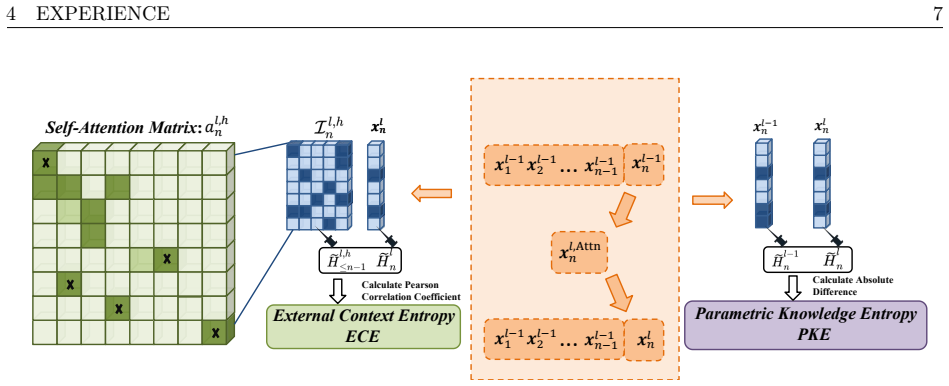
The load-bearing object is the semantic entropy probe: a logistic-regression classifier, trained on hidden states from a single forward pass, that maps a representation to the probability that the eventual response has high semantic entropy, with the training threshold chosen by a one-dimensional clustering objective. Semantic entropy itself clusters sampled responses by bidirectional entailment, so the probe inherits invariance to paraphrase. The paper uses these probes in place of ReDeEP's cosine-similarity ECS and LogitLens-based PKS: ECE is the Z-Score of the current token's probe output against the probe outputs of highly attended context tokens, and PKE is the absolute difference of probe outputs across the FFN. The regression coefficients $\alpha$ and $\beta$, and the choice of copy heads and FFN layers, are selected per model and per dataset, and probes are only applied at layers after the 9th, where semantic representations are rich enough for probe accuracy.
What would settle it
Train the probes and fix $\alpha$, $\beta$, and the head/layer choices using only RAGTruth, then evaluate frozen on HalluRAG (and vice versa), or on a third RAG hallucination corpus never used for training; if the reported improvement of over 3% over ReDeEP shrinks or reverses, the gains are specific to the per-dataset tuning rather than to semantic-entropy measurement.
Extended reading notes
Core claim
SEReDeEP keeps ReDeEP's regression-decoupling insight — that RAG hallucinations emerge from a disequilibrium between external context E and internal parametric knowledge P — but rebuilds how each is measured. External Context Entropy (ECE) runs a trained semantic-entropy probe over the hidden states of the current token and of the attention-attended context tokens, then z-scores the current token's entropy against the context distribution; Parametric Knowledge Entropy (PKE) takes the absolute difference of probe predictions on the residual stream just before and just after the feed-forward network. A linear regression $R(r) = \sum_{l \in F} \alpha \cdot P_n^l - \sum_{l,h \in A} \beta \cdot E_{n}^{l,h}$ then combines the two into the final hallucination score. The paper reports that on RAGTruth and HalluRAG across LLaMA3-7B, Mistral-7B, and Qwen2.5-7B, this version outperforms ReDeEP by over 3% and SEP by over 10% in prediction accuracy, and its correlation analysis shows ECE scores negatively correlated and PKE scores positively correlated with hallucination labels, as expected.
Load-bearing premise
The load-bearing premise is that semantic entropy probes trained on the RAGTruth and HalluRAG response corpora, together with regression coefficients and head/layer selections tuned per dataset, still deliver an unbiased measure of hallucination-detection accuracy when evaluated on those same two datasets.
Editorial extensions
If this is right
- Hallucination scores in RAG become insensitive to paraphrase: answers that mean the same thing but differ in wording receive similar scores, closing the reported more-than-50% score divergence for semantically identical outputs.
- Detection runs in a single forward pass: probes replace multi-sample generation, so hallucination monitoring costs are orders of magnitude below sampling-based methods like SelfCheckGPT or INSIDE.
- The decoupled ECE/PKE view keeps the causal story of ReDeEP: one can still attribute a detected hallucination to under-used retrieved context or over-relied parametric knowledge, and the same intervention machinery (attention boosting, FFN suppression) applies.
- The method transfers across decoder-only architectures of the 7B class, with the reported gains consistent across three different model families.
- Because probe training needs only answer texts and entailment labels, the approach can be retargeted to new domains or languages without architectural changes.
Reading between the lines
- The gains are measured with per-dataset regression coefficients and per-dataset head/layer selections; a sterner test would fix these once on a training split and evaluate on unseen datasets, since the reported numbers leave open how much of the 3-10% reflects the semantic probes versus fitting to dataset idiosyncrasies.
- Probe training and evaluation share the same two corpora (RAGTruth and HalluRAG); comparing against a corpus not used for probe training would separate genuine semantic-entropy transfer from corpus-specific calibration.
- The Z-score ECE construction suggests a natural extension: replacing the scalar entropy of each context token with its full entropy distribution, or weighting context tokens by attention mass, might sharpen context-usage quantification further.
- If the qualitative correlation results (ECE negative, PKE positive with hallucination) hold, the same probes could be inverted as an intervention signal — layer- and head-resolved entropy readouts could drive targeted suppression, not just a final score.
Signed reviews
Editorial analysis
A structured set of objections, weighed in public.
Referee Report
Summary. The paper proposes SEReDeEP, a modification of the ReDeEP hallucination detector for retrieval-augmented generation. It replaces ReDeEP's External Context Score (ECS) and Parametric Knowledge Score (PKS) with semantic-entropy-probe-derived External Context Entropy (ECE) and Parametric Knowledge Entropy (PKE), then combines them through linear regression. The authors evaluate on RAGTruth and HalluRAG across LLaMA3-7B, Mistral-7B, and Qwen2.5-7B, reporting accuracy, AUC, F1, and recall against ten baselines, and claim hallucination-prediction accuracy improvements exceeding 3% over ReDeEP and surpassing 10% over SEP.
Significance. The conceptual direction is reasonable and potentially useful: semantic entropy probes are cheap, and making ReDeEP's mechanistic scores semantically robust is a sensible goal. If the gains were validated out-of-sample, this would be a practical contribution to RAG hallucination detection. However, the paper's own numbers contradict the headline improvement claim, and the evaluation protocol is in-sample: the probes are trained on the same datasets used for evaluation, and coefficients, copy heads, and FFN layers are selected separately per dataset. The reported results therefore do not establish the claimed advantage.
major comments (3)
- [Abstract and Section 4.3, Table 1] The central quantitative claim is not supported by Table 1. Direct ACC deltas of SEReDeEP over ReDeEP are: LLaMA3-7B RAGTruth +2.78% (0.8601 vs 0.8323); LLaMA3-7B HalluRAG -1.18% (0.8478 vs 0.8596); Mistral-7B RAGTruth +2.00% (0.8257 vs 0.8057); Mistral-7B HalluRAG +2.40% (0.8697 vs 0.8457); Qwen2.5-7B RAGTruth +1.51% (0.8135 vs 0.7984); Qwen2.5-7B HalluRAG +2.73% (0.8598 vs 0.8325). None of these reaches the claimed 'exceeding 3%', and one is negative; on LLaMA3-7B HalluRAG the AUC is also essentially unchanged (0.7631 vs 0.7623). The abstract's '3%-10%' and Section 4.3's 'exceeding 3%' are therefore contradicted by the paper's own reported results.
- [Sections 4.1 and 4.2] The evaluation is in-sample. Section 4.1 states that RAGTruth and HalluRAG 'original outputs served as critical training material for our semantic entropy probes', and Section 4.2 selects regression coefficients (alpha, beta) and copy-head/FFN-layer configurations separately for each model-dataset pair, e.g., LLaMA3-7B top 2 vs top 10 FFN layers, Mistral-7B beta 1.0 vs 1.6, and Qwen2.5-7B beta 0.8 vs 1.2. Because the same dataset labels inform probe training, coefficient fitting, and architectural-component selection, Table 1 measures fitted in-sample behavior rather than predictive accuracy. An out-of-sample evaluation with cross-validation or a held-out test split and fixed hyperparameters is required before any improvement claim can be supported.
- [Section 4.3] The text asserts 'statistically significant performance improvements' but reports no confidence intervals, standard errors, significance tests, or repeated-run variability. Given that several accuracy deltas are small (some below 0.005 in absolute terms, e.g., LLaMA3-7B RAGTruth AUC is 0.7824 for SEReDeEP versus 0.7829 for ReDeEP), this assertion is unverifiable from the data presented and should be removed or replaced with proper uncertainty quantification.
minor comments (6)
- [Section 4.6] There is a typo: 'SEDeDeEP' should be 'SEReDeEP'.
- [Figure 4 captions] The figure captions contain raw unicode artifacts (e.g., '/uni00000014/...'), making part of the text unreadable; these should be repaired.
- [Table 2] The ablation rows use unexplained symbols '!' and '%' without a legend; please state explicitly which symbol corresponds to PKE and which to ECE.
- [Section 4.1] The text contains a sentence fragment: 'Beyond their primary evaluation function.Neither RAGtruth nor HalluRAG...' should be two complete sentences.
- [Section 4.4] The notation 'ECE11' and 'PKE12' is used without defining the numeric subscripts; clarify whether these refer to layer indices.
- [References] Reference [52] attributes Qwen2.5 to 'Mistral AI team'; the correct attribution should be to the Qwen team, and the reference format should be made consistent.
Circularity Check
Reported gains over ReDeEP are in-sample: SEP probes are trained on RAGTruth/HalluRAG and the per-dataset regression is evaluated on the same corpora.
-
fitted input called prediction
[Section 4.1, Datasets / Semantic Entropy Probes]
"These datasets' original outputs served as critical training material for our semantic entropy probes[28]."
The probe training corpus is drawn from the same RAGTruth and HalluRAG responses that Table 1 evaluates, and no held-out split is described. Since the probes' predictions feed directly into ECE/PKE and the final hallucination score, the reported ACC/F1 numbers measure fit to the training corpora rather than out-of-sample prediction. The advertised improvement over ReDeEP and SEP is therefore partly forced by training on the evaluation set.
-
fitted input called prediction
[Section 3, Eq. (13), and Section 4.2, Implementation Details]
"where α and β represent regression coefficients optimized for the specific model architecture and dataset characteristics."
Eq. (13) defines the final hallucination score whose accuracy is reported in Table 1. Section 4.2 then fixes separate α, β values and separate copy-head/FFN-layer selections for RAGTruth versus HalluRAG for each model (e.g., LLaMA3-7B β=0.2 on RAGTruth vs β=0.4 on HalluRAG; top-2 vs top-10 FFN layers). Because the regression is optimized per dataset and evaluated on that same dataset, the reported improvements reduce to in-sample fitted behavior. No held-out validation or cross-dataset transfer is presented to show the coefficients predict rather than memorize.
full rationale
Score 7. The central claimed result is closed-loop. Section 4.1 states that the RAGTruth and HalluRAG original outputs were used as training material for the semantic entropy probes, and the same two datasets provide the ACC/AUC/F1 numbers in Table 1. Section 3's Eq. (13) uses 'regression coefficients optimized for the specific model architecture and dataset characteristics,' and Section 4.2 lists different coefficients and head/layer selections for RAGTruth vs HalluRAG for every model. Therefore both the probe and the final regression are fitted on the very corpora against which SEReDeEP is measured; the 'prediction accuracy improvements' are in-sample fitted values, not independent forecasts. This is the dominant circular pattern: fitted input called prediction. Separately, the paper's own Table 1 does not support the advertised >3% gain: exact deltas are LLaMA3-7B +2.78% and -1.18%, Mistral-7B +2.00% and +2.40%, Qwen2.5-7B +1.51% and +2.73%, one negative and none above 3%. That is a correctness or verification failure rather than a circularity, but it compounds the evaluation-leakage concern. There is no load-bearing self-citation: SEP [28] and ReDeEP [50] are external works, and the paper does not invoke a same-author uniqueness theorem. The residual external grounding, namely the SEP probe method from Kossen et al., is real but does not rescue the in-sample evaluation of SEReDeEP's own scores. A fair score is therefore 7: substantial circular content in the central evaluation, with some external grounding from the SEP probe literature.
Assumptions & free parameters
free parameters (6)
- Regression coefficient beta for ECE =
LLaMA3: 0.2, 0.4; Mistral: 1.0, 1.6; Qwen2.5: 0.8, 1.2 (per dataset)
- Regression coefficient alpha for PKE =
1 (fixed in all configurations)
- Number of copy heads selected =
1, 3, 5, or 10 depending on model and dataset
- Number of FFN layers selected =
2, 7, 10, or 15
- Top-k% attention tokens =
k = 10
- Semantic entropy probe threshold gamma* =
Not reported
assumptions (5)
- domain assumption RAG hallucinations decompose into external context E and internal parametric knowledge P, measurable through attention (copy heads) and FFN modules.
- domain assumption A linear probe on hidden states estimates semantic entropy from a single forward pass.
- domain assumption Bidirectional entailment judgments from DeepSeek-R1 and Claude-3.7-Sonnet provide reliable semantic entropy labels.
- domain assumption The linear regression decoupling R = sum(alpha*P) - sum(beta*E) predicts hallucination.
- domain assumption Hidden layers after layer 9 carry semantic entropy and external context information.
Cite this review
Pith. "Pith review of SEReDeEP: Hallucination Detection in Retrieval-Augmented Models via Semantic Entropy and Context-Parameter Fusion." pith.science (2026). https://pith.science/paper/S7TOXBWH
@misc{pith2026250507528,
  author       = {Pith},
  title        = {Pith review of: SEReDeEP: Hallucination Detection in Retrieval-Augmented Models via Semantic Entropy and Context-Parameter Fusion},
  year         = {2026},
  howpublished = {\url{https://pith.science/paper/S7TOXBWH}},
  note         = {Machine review of arXiv:2505.07528}
}
read the original abstract
Retrieval-Augmented Generation (RAG) models frequently encounter hallucination phenomena when integrating external information with internal parametric knowledge. Empirical studies demonstrate that the disequilibrium between external contextual information and internal parametric knowledge constitutes a primary factor in hallucination generation. Existing hallucination detection methodologies predominantly emphasize either the external or internal mechanism in isolation, thereby overlooking their synergistic effects. The recently proposed ReDeEP framework decouples these dual mechanisms, identifying two critical contributors to hallucinations: excessive reliance on parametric knowledge encoded in feed-forward networks (FFN) and insufficient utilization of external information by attention mechanisms (particularly copy heads). ReDeEP quantitatively assesses these factors to detect hallucinations and dynamically modulates the contributions of FFNs and copy heads to attenuate their occurrence. Nevertheless, ReDeEP and numerous other hallucination detection approaches have been employed at logit-level uncertainty estimation or language-level self-consistency evaluation, inadequately address the semantic dimensions of model responses, resulting in inconsistent hallucination assessments in RAG implementations. Building upon ReDeEP's foundation, this paper introduces SEReDeEP, which enhances computational processes through semantic entropy captured via trained linear probes, thereby achieving hallucination assessments that more accurately reflect ground truth evaluations.
Figures


Figures from the paper (2 more)


Reference graph
Works this paper leans on
-
[1]
Anthropic. Claude 3.7 sonnet: Hybrid reasoning model, state-of-the-art coding skills, computer use, and 200k context window, 2025. URLhttps://www.anthropic.com/claude/sonnet/
work page 2025
-
[2]
The internal state of an llm knows when it’s lying.arXiv preprint arXiv:2304.13734, 2023
Amos Azaria and Tom Mitchell. The internal state of an llm knows when it’s lying.arXiv preprint arXiv:2304.13734, 2023
arXiv 2023
-
[3]
Audio chord recognition with recurrent neural networks
Nicolas Boulanger-Lewandowski, Yoshua Bengio, and Pascal Vincent. Audio chord recognition with recurrent neural networks. InISMIR, pages 335–340. Curitiba, 2013
work page 2013
-
[4]
Leo Breiman, Jerome Friedman, Richard A Olshen, and Charles J Stone.Classification and regression trees. Routledge, 2017
work page 2017
-
[5]
Chao Chen, Kai Liu, Ze Chen, Yi Gu, Yue Wu, Mingyuan Tao, Zhihang Fu, and Jieping Ye. Inside: Llms’ internal states retain the power of hallucination detection.arXiv preprint arXiv:2402.03744, 2024
arXiv 2024
-
[6]
ChromaDB: AI-native open-source embedding database
Chroma. ChromaDB: AI-native open-source embedding database. PyPI, 2025. URLhttps://pypi. org/project/chromadb/. Version 0.6.3 (Accessed: 2025-01-15)
work page 2025
-
[7]
Darya Chyzhyk, Gaël Varoquaux, Michael Milham, and Bertrand Thirion. How to remove or control confounds in predictive models, with applications to brain biomarkers.GigaScience, 11:giac014, 2022
work page 2022
-
[8]
DeepSeek-AI. Deepseek-r1 release, 2025. URLhttps://api-docs.deepseek.com/news/news250120
work page 2025
Show all 66 references
-
[9]
A mathematical framework for transformer circuits
Nelson Elhage, Neel Nanda, Catherine Olsson, Tom Henighan, Nicholas Joseph, Ben Mann, Amanda Askell, Yuntao Bai, Anna Chen, Tom Conerly, et al. A mathematical framework for transformer circuits. Transformer Circuits Thread, 1(1):12, 2021. REFERENCES 12
2021
-
[10]
Ragas: Automated evaluation of retrieval augmented generation
Shahul Es, Jithin James, Luis Espinosa Anke, and Steven Schockaert. Ragas: Automated evaluation of retrieval augmented generation. InProceedings of the 18th Conference of the European Chapter of the Association for Computational Linguistics: System Demonstrations, pages 150–158, 2024
2024
-
[11]
A survey on rag meeting llms: Towards retrieval-augmented large language models
Wenqi Fan, Yujuan Ding, Liangbo Ning, Shijie Wang, Hengyun Li, Dawei Yin, Tat-Seng Chua, and Qing Li. A survey on rag meeting llms: Towards retrieval-augmented large language models. InProceedings of the 30th ACM SIGKDD Conference on Knowledge Discovery and Data Mining, pages ...
2024
-
[12]
Detecting hallucinations in large language models using semantic entropy.Nature, 630(8017):625–630, 2024
Sebastian Farquhar, Jannik Kossen, Lorenz Kuhn, and Yarin Gal. Detecting hallucinations in large language models using semantic entropy.Nature, 630(8017):625–630, 2024
2024
-
[13]
Information flow routes: Automatically interpreting language models at scale
Javier Ferrando and Elena Voita. Information flow routes: Automatically interpreting language models at scale. arXiv preprint arXiv:2403.00824, 2024
2024 arXiv
-
[14]
A primer on the inner workings of transformer-based language models
Javier Ferrando, Gabriele Sarti, Arianna Bisazza, and Marta Costa-jussà. A primer on the inner workings of transformer-based language models. 2024
2024
-
[15]
Costa-jussà
Javier Ferrando, Gabriele Sarti, Arianna Bisazza, and Marta R. Costa-jussà. A primer on the inner workings of transformer-based language models, 2024
2024
-
[16]
The chronicles of rag: The retriever, the chunk and the generator.arXiv preprint arXiv:2401.07883, 2024
Paulo Finardi, Leonardo Avila, Rodrigo Castaldoni, Pedro Gengo, Celio Larcher, Marcos Piau, Pablo Costa, and Vinicius Caridá. The chronicles of rag: The retriever, the chunk and the generator.arXiv preprint arXiv:2401.07883, 2024
2024 arXiv
-
[17]
Peer review of gpt-4 technical report and systems card.PLOS digital health, 3(1):e0000417, 2024
Jack Gallifant, Amelia Fiske, Yulia A Levites Strekalova, Juan S Osorio-Valencia, Rachael Parke, Rogers Mwavu, Nicole Martinez, Judy Wawira Gichoya, Marzyeh Ghassemi, Dina Demner-Fushman, et al. Peer review of gpt-4 technical report and systems card.PLOS digital health, 3(1):e...
2024
-
[18]
Transformer feed-forward layers are key-value memories.arXiv preprint arXiv:2012.14913, 2020
Mor Geva, Roei Schuster, Jonathan Berant, and Omer Levy. Transformer feed-forward layers are key-value memories.arXiv preprint arXiv:2012.14913, 2020
2012 arXiv
-
[19]
The llama 3 herd of models
Aaron Grattafiori, Abhimanyu Dubey, Abhinav Jauhri, Abhinav Pandey, Abhishek Kadian, Ahmad Al-Dahle, Aiesha Letman, Akhil Mathur, Alan Schelten, Alex Vaughan, et al. The llama 3 herd of models. arXiv preprint arXiv:2407.21783, 2024
2024 arXiv
-
[20]
Sequence transduction with recurrent neural networks.arXiv preprint arXiv:1211.3711, 2012
Alex Graves. Sequence transduction with recurrent neural networks.arXiv preprint arXiv:1211.3711, 2012
2012 arXiv
-
[21]
Inspecting and editing knowledge representations in language models
Evan Hernandez, Belinda Z Li, and Jacob Andreas. Inspecting and editing knowledge representations in language models. arXiv preprint arXiv:2304.00740, 2023
2023 arXiv
-
[22]
A survey on hallucination in large language models: Principles, taxonomy, challenges, and open questions.ACM Transactions on Information Systems, 43 (2):1–55, 2025
Lei Huang, Weijiang Yu, Weitao Ma, Weihong Zhong, Zhangyin Feng, Haotian Wang, Qianglong Chen, Weihua Peng, Xiaocheng Feng, Bing Qin, et al. A survey on hallucination in large language models: Principles, taxonomy, challenges, and open questions.ACM Transactions on Information...
2025
-
[23]
To trust or not to trust? enhancing large language models’ situated faithfulness to external contexts
Yukun Huang, Sanxing Chen, Hongyi Cai, and Bhuwan Dhingra. To trust or not to trust? enhancing large language models’ situated faithfulness to external contexts. 2024. URLhttps://api.semanticscholar. org/CorpusID:273482717
2024
-
[24]
Language models (mostly) know what they know.arXiv preprint arXiv:2207.05221, 2022
Saurav Kadavath, Tom Conerly, Amanda Askell, Tom Henighan, Dawn Drain, Ethan Perez, Nicholas Schiefer, Zac Hatfield-Dodds, Nova DasSarma, Eli Tran-Johnson, et al. Language models (mostly) know what they know.arXiv preprint arXiv:2207.05221, 2022
2022 arXiv
-
[25]
Control of confounding in the analysis phase–an overview for clinicians.Clinical epidemiology, pages 195–204, 2017
Johnny Kahlert, Sigrid Bjerge Gribsholt, Henrik Gammelager, Olaf M Dekkers, and George Luta. Control of confounding in the analysis phase–an overview for clinicians.Clinical epidemiology, pages 195–204, 2017
2017
-
[26]
Calibrated language models must hallucinate
Adam Tauman Kalai and Santosh S Vempala. Calibrated language models must hallucinate. In Proceedings of the 56th Annual ACM Symposium on Theory of Computing, pages 160–171, 2024. REFERENCES 13
2024
-
[27]
Incorporating residual and normalization layers into analysis of masked language models.arXiv preprint arXiv:2109.07152, 2021
Goro Kobayashi, Tatsuki Kuribayashi, Sho Yokoi, and Kentaro Inui. Incorporating residual and normalization layers into analysis of masked language models.arXiv preprint arXiv:2109.07152, 2021
2021 arXiv
-
[28]
Semantic entropy probes: Robust and cheap hallucination detection in llms.arXiv preprint arXiv:2406.15927, 2024
Jannik Kossen, Jiatong Han, Muhammed Razzak, Lisa Schut, Shreshth Malik, and Yarin Gal. Semantic entropy probes: Robust and cheap hallucination detection in llms.arXiv preprint arXiv:2406.15927, 2024
2024 arXiv
-
[29]
Evaluating the factual consistency of abstractive text summarization.arXiv preprint arXiv:1910.12840, 2019
Wojciech Kryściński, Bryan McCann, Caiming Xiong, and Richard Socher. Evaluating the factual consistency of abstractive text summarization.arXiv preprint arXiv:1910.12840, 2019
1910 arXiv
-
[30]
Semantic uncertainty: Linguistic invariances for uncertainty estimation in natural language generation.arXiv preprint arXiv:2302.09664, 2023
Lorenz Kuhn, Yarin Gal, and Sebastian Farquhar. Semantic uncertainty: Linguistic invariances for uncertainty estimation in natural language generation.arXiv preprint arXiv:2302.09664, 2023
2023 arXiv
-
[31]
Langchain is a framework for developing applications powered by large language models (llms).,
lang.ai. Langchain is a framework for developing applications powered by large language models (llms).,
-
[32]
Look within, why llms hallucinate: A causal perspective
He Li, Haoang Chi, Mingyu Liu, and Wenjing Yang. Look within, why llms hallucinate: A causal perspective. arXiv preprint arXiv:2407.10153, 2024
2024 arXiv
-
[33]
Inference-time intervention: Eliciting truthful answers from a language model
Kenneth Li, Oam Patel, Fernanda Viégas, Hanspeter Pfister, and Martin Wattenberg. Inference-time intervention: Eliciting truthful answers from a language model. Advances in Neural Information Processing Systems, 36:41451–41530, 2023
2023
-
[34]
Deepseek-v3 technical report.arXiv preprint arXiv:2412.19437, 2024
Aixin Liu, Bei Feng, Bing Xue, Bingxuan Wang, Bochao Wu, Chengda Lu, Chenggang Zhao, Chengqi Deng, Chenyu Zhang, Chong Ruan, et al. Deepseek-v3 technical report.arXiv preprint arXiv:2412.19437, 2024
2024 arXiv
-
[35]
Attention-guided self- reflection for zero-shot hallucination detection in large language models.arXiv preprint arXiv:2501.09997, 2025
Qiang Liu, Xinlong Chen, Yue Ding, Shizhen Xu, Shu Wu, and Liang Wang. Attention-guided self- reflection for zero-shot hallucination detection in large language models.arXiv preprint arXiv:2501.09997, 2025
2025 arXiv
-
[36]
Large language models as foundations for next-gen dense retrieval: A comprehensive empirical assessment.arXiv preprint arXiv:2408.12194, 2024
Kun Luo, Minghao Qin, Zheng Liu, Shitao Xiao, Jun Zhao, and Kang Liu. Large language models as foundations for next-gen dense retrieval: A comprehensive empirical assessment.arXiv preprint arXiv:2408.12194, 2024
2024 arXiv
-
[37]
Selfcheckgpt: Zero-resource black-box hallucination detection for generative large language models.arXiv preprint arXiv:2303.08896, 2023
Potsawee Manakul, Adian Liusie, and Mark JF Gales. Selfcheckgpt: Zero-resource black-box hallucination detection for generative large language models.arXiv preprint arXiv:2303.08896, 2023
2023 arXiv
-
[38]
Llama 2: open source, free for research and commercial use, 2023
Meta. Llama 2: open source, free for research and commercial use, 2023. URLhttps://www.llama. com/llama2/
2023
-
[39]
Introducing Meta Llama 3: The most capable openly available LLM to date, 2024
Meta. Introducing Meta Llama 3: The most capable openly available LLM to date, 2024. URL https://ai.meta.com/blog/meta-llama-3/
2024
-
[40]
Factscore: Fine-grained atomic evaluation of factual precision in long form text generation.arXiv preprint arXiv:2305.14251, 2023
Sewon Min, Kalpesh Krishna, Xinxi Lyu, Mike Lewis, Wen-tau Yih, Pang Wei Koh, Mohit Iyyer, Luke Zettlemoyer, and Hannaneh Hajishirzi. Factscore: Fine-grained atomic evaluation of factual precision in long form text generation.arXiv preprint arXiv:2305.14251, 2023
2023 arXiv
-
[41]
Overcoming semantic dilution in transformer-based next frame prediction.arXiv preprint arXiv:2501.16753, 2025
Hy Nguyen, Srikanth Thudumu, Hung Du, Rajesh Vasa, and Kon Mouzakis. Overcoming semantic dilution in transformer-based next frame prediction.arXiv preprint arXiv:2501.16753, 2025
2025 arXiv
-
[42]
RAGTruth: A hallucination corpus for developing trustworthy retrieval-augmented language models
Cheng Niu, Yuanhao Wu, Juno Zhu, Siliang Xu, KaShun Shum, Randy Zhong, Juntong Song, and Tong Zhang. RAGTruth: A hallucination corpus for developing trustworthy retrieval-augmented language models. In Lun-Wei Ku, Andre Martins, and Vivek Srikumar, editors,Proceedings of the 62...
2024 doi
-
[43]
Train short, test long: Attention with linear biases enables input length extrapolation.arXiv preprint arXiv:2108.12409, 2021
Ofir Press, Noah A Smith, and Mike Lewis. Train short, test long: Attention with linear biases enables input length extrapolation.arXiv preprint arXiv:2108.12409, 2021. REFERENCES 14
2021 arXiv
-
[44]
Improving language under- standing by generative pre-training
Alec Radford, Karthik Narasimhan, Tim Salimans, Ilya Sutskever, et al. Improving language under- standing by generative pre-training. 2018
2018
-
[45]
The hallurag dataset: Detecting closed-domain hallucinations in rag applications using an llm’s internal states.arXiv preprint arXiv:2412.17056, 2024
Fabian Ridder and Malte Schilling. The hallurag dataset: Detecting closed-domain hallucinations in rag applications using an llm’s internal states.arXiv preprint arXiv:2412.17056, 2024
2024 arXiv
-
[46]
Trust me, i’m wrong: High-certainty hallucinations in llms.arXiv preprint arXiv:2502.12964, 2025
Adi Simhi, Itay Itzhak, Fazl Barez, Gabriel Stanovsky, and Yonatan Belinkov. Trust me, i’m wrong: High-certainty hallucinations in llms.arXiv preprint arXiv:2502.12964, 2025
2025 arXiv
-
[47]
Extracting latent steering vectors from pretrained language models.arXiv preprint arXiv:2205.05124, 2022
Nishant Subramani, Nivedita Suresh, and Matthew E Peters. Extracting latent steering vectors from pretrained language models.arXiv preprint arXiv:2205.05124, 2022
2022 arXiv
-
[48]
Augmenting self-attention with persistent memory.arXiv preprint arXiv:1907.01470, 2019
Sainbayar Sukhbaatar, Edouard Grave, Guillaume Lample, Herve Jegou, and Armand Joulin. Augmenting self-attention with persistent memory.arXiv preprint arXiv:1907.01470, 2019
1907 arXiv
-
[49]
Transformer layers as painters.arXiv preprint arXiv:2407.09298, 2024
Qi Sun, Marc Pickett, Aakash Kumar Nain, and Llion Jones. Transformer layers as painters.arXiv preprint arXiv:2407.09298, 2024
2024 arXiv
-
[50]
Redeep: Detecting hallucination in retrieval-augmented generation via mechanistic interpretability
Zhongxiang Sun, Xiaoxue Zang, Kai Zheng, Yang Song, Jun Xu, Xiao Zhang, Weijie Yu, and Han Li. Redeep: Detecting hallucination in retrieval-augmented generation via mechanistic interpretability. arXiv preprint arXiv:2410.11414, 2024
-
[51]
Sequence to sequence learning with neural networks
Ilya Sutskever, Oriol Vinyals, and Quoc V Le. Sequence to sequence learning with neural networks. Advances in neural information processing systems, 27, 2014
2014
-
[52]
Qwen2.5: A party of foundation models!, 2024
Mistral AI team. Qwen2.5: A party of foundation models!, 2024. URLhttps://qwenlm.github.io/ blog/qwen2.5/
2024
-
[53]
The best 7b model to date, apache 2.0, 2024
Mistral AI team. The best 7b model to date, apache 2.0, 2024. URLhttps://mistral.ai/news/ announcing-mistral-7b/
2024
-
[54]
A stitch in time saves nine: Detecting and mitigating hallucinations of llms by validating low-confidence generation.arXiv preprint arXiv:2307.03987, 2023
Neeraj Varshney, Wenlin Yao, Hongming Zhang, Jianshu Chen, and Dong Yu. A stitch in time saves nine: Detecting and mitigating hallucinations of llms by validating low-confidence generation.arXiv preprint arXiv:2307.03987, 2023
2023 arXiv
-
[55]
Attention is all you need.Advances in neural information processing systems, 30, 2017
Ashish Vaswani, Noam Shazeer, Niki Parmar, Jakob Uszkoreit, Llion Jones, Aidan N Gomez, Łukasz Kaiser, and Illia Polosukhin. Attention is all you need.Advances in neural information processing systems, 30, 2017
2017
-
[56]
Analyzing multi-head self- attention: Specialized heads do the heavy lifting, the rest can be pruned.arXiv preprint arXiv:1905.09418, 2019
Elena Voita, David Talbot, Fedor Moiseev, Rico Sennrich, and Ivan Titov. Analyzing multi-head self- attention: Specialized heads do the heavy lifting, the rest can be pruned.arXiv preprint arXiv:1905.09418, 2019
1905 arXiv
-
[57]
Wise: Rethinking the knowledge memory for lifelong model editing of large language models
Peng Wang, Zexi Li, Ningyu Zhang, Ziwen Xu, Yunzhi Yao, Yong Jiang, Pengjun Xie, Fei Huang, and Huajun Chen. Wise: Rethinking the knowledge memory for lifelong model editing of large language models. Advances in Neural Information Processing Systems, 37:53764–53797, 2024
2024
-
[58]
Retrieval head mechanistically explains long-context factuality.arXiv preprint arXiv:2404.15574, 2024
Wenhao Wu, Yizhong Wang, Guangxuan Xiao, Hao Peng, and Yao Fu. Retrieval head mechanistically explains long-context factuality.arXiv preprint arXiv:2404.15574, 2024
2024 arXiv
-
[59]
Ragtruth: A hallucination corpus for developing trustworthy retrieval-augmented language models, 2023
Yuanhao Wu, Juno Zhu, Siliang Xu, Kashun Shum, Cheng Niu, Randy Zhong, Juntong Song, and Tong Zhang. Ragtruth: A hallucination corpus for developing trustworthy retrieval-augmented language models, 2023
2023
-
[60]
Knowledge conflicts for llms: A survey.arXiv preprint arXiv:2403.08319, 2024
Rongwu Xu, Zehan Qi, Zhijiang Guo, Cunxiang Wang, Hongru Wang, Yue Zhang, and Wei Xu. Knowledge conflicts for llms: A survey.arXiv preprint arXiv:2403.08319, 2024
2024 arXiv
-
[61]
Cognitive mirage: A review of hallucinations in large language models.arXiv preprint arXiv:2309.06794, 2023
Hongbin Ye, Tong Liu, Aijia Zhang, Wei Hua, and Weiqiang Jia. Cognitive mirage: A review of hallucinations in large language models.arXiv preprint arXiv:2309.06794, 2023. A TECHNICAL BACKGROUND OF RETRIEVAL-AUGMENTED MODEL (RAG) DECODER 15
2023 arXiv
-
[62]
Interro- gatellm: Zero-resource hallucination detection in llm-generated answers.arXiv preprint arXiv:2403.02889, 2024
Yakir Yehuda, Itzik Malkiel, Oren Barkan, Jonathan Weill, Royi Ronen, and Noam Koenigstein. Interro- gatellm: Zero-resource hallucination detection in llm-generated answers.arXiv preprint arXiv:2403.02889, 2024
2024 arXiv
-
[63]
Explainability for large language models: A survey.ACM Transactions on Intelligent Systems and Technology, 15(2):1–38, 2024
Haiyan Zhao, Hanjie Chen, Fan Yang, Ninghao Liu, Huiqi Deng, Hengyi Cai, Shuaiqiang Wang, Dawei Yin, and Mengnan Du. Explainability for large language models: A survey.ACM Transactions on Intelligent Systems and Technology, 15(2):1–38, 2024
2024
-
[64]
Self-adjust softmax.arXiv preprint arXiv:2502.18277, 2025
Chuanyang Zheng, Yihang Gao, Guoxuan Chen, Han Shi, Jing Xiong, Xiaozhe Ren, Chao Huang, Xin Jiang, Zhenguo Li, and Yu Li. Self-adjust softmax.arXiv preprint arXiv:2502.18277, 2025
2025 arXiv
-
[65]
chunking
Andy Zou, Long Phan, Sarah Chen, James Campbell, Phillip Guo, Richard Ren, Alexander Pan, Xuwang Yin, Mantas Mazeika, Ann-Kathrin Dombrowski, et al. Representation engineering: A top-down approach to ai transparency.arXiv preprint arXiv:2310.01405, 2023. A Technical Background...
-
[2025]
URL https://pypi.org/project/langchain/
Reviewed August 15, 2026 · model on record in the stance chip above.
Discussion (0). Continue with ORCID to comment.