Noise-induced Simulability Transition from Operator Scrambling
Pith reviewed 2026-05-20 11:03 UTC · model grok-4.3
The pith
Local noise above a critical rate per cycle keeps evolving operators from fully scrambling into many Pauli strings.
A machine-rendered reading of the paper's core claim, the machinery that carries it, and where it could break.
Core claim
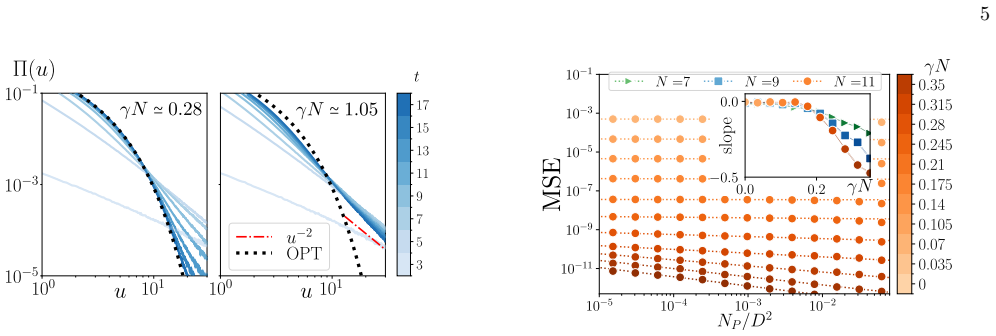
For random quantum circuits the finite-depth Pauli spectrum approaches the fully scrambled state hierarchically: low-order moments equilibrate after short depths while higher moments, which probe rare large-amplitude coefficients, require much greater depth. When local noise is added, scrambling competes with an effective suppression of spreading; above a critical error per cycle of order one over system size the spectrum never reaches the uniform distribution and remains supported on a sparse subset of Pauli strings, while below this scale the authors prove that classical simulation remains exponentially hard.
What carries the argument
Moments of the Pauli spectrum extracted from operator stabilizer Rényi entropies, which quantify the distribution of operator weight across Pauli strings and track the competition between circuit-induced spreading and noise-induced suppression.
If this is right
- Classical truncation algorithms for the Pauli expansion become efficient once noise exceeds the critical scale.
- Finite noise alone does not suffice to prove classical simulability; the noise must exceed the identified threshold.
- In the noiseless case the approach to full scrambling occurs at parametrically different depths for different moments.
- The transition marks a boundary between dynamics whose operator complexity grows exponentially and those whose complexity stays polynomially bounded.
Where Pith is reading between the lines
- Similar noise-induced sparsity transitions could appear in non-random circuits or different noise channels if the competition between spreading and suppression is preserved.
- The result indicates that maintaining quantum simulation hardness in open systems requires keeping the effective error per cycle below the constant threshold.
- Numerical checks of the Rényi entropy hierarchy in small systems could directly test the predicted separation of equilibration timescales.
Load-bearing premise
The local noise model is assumed to affect operator spreading only through changes in the moments of the Pauli spectrum without introducing extra correlations that would alter the observed sparsity transition.
What would settle it
Compute the higher-order stabilizer Rényi entropies for a random circuit of moderate size at depths near the critical noise threshold and check whether they saturate to the fully scrambled value below threshold but remain strictly below it above threshold.
Figures


read the original abstract
The complexity of simulating quantum many-body dynamics, or quantum computations, in the Heisenberg picture is governed by the scrambling of initially simple operators into superpositions of exponentially many Pauli strings. The corresponding expansion coefficients define the Pauli spectrum, whose structure controls the performance of classical algorithms based on truncating Pauli expansions. Here we determine the finite-depth Pauli spectrum of random quantum circuits, both in the noiseless case and in the presence of local noise, through its moments, given by the operator stabilizer R\'enyi entropies. In noiseless circuits, we uncover a hierarchy in the approach to the fully scrambled regime: low moments equilibrate at relatively short depths, while higher moments, which are sensitive to rare, large-amplitude Pauli coefficients, require parametrically larger depths. In noisy circuits, scrambling competes with an effective suppression of operator spreading. Above a critical error per cycle $\gamma_c N=\mathcal{O}(1)$, the operator fails to reach the fully scrambled distribution and remains supported on an atypically sparse subset of Pauli strings. Conversely, below this scale, we rigorously show that classical simulation remains exponentially hard, demonstrating that finite noise does not automatically imply classical simulability. The resulting noise-induced transition in operator complexity therefore delineates the boundary between intrinsically hard quantum dynamics and those that remain classically accessible.
Editorial analysis
A structured set of objections, weighed in public.
Referee Report
Summary. The manuscript claims that in random quantum circuits, the finite-depth Pauli spectrum is determined via its moments given by operator stabilizer Rényi entropies. In the noiseless case a hierarchy exists where low moments equilibrate faster than higher ones sensitive to rare large coefficients. With local noise, a transition occurs at critical error per cycle γ_c N = O(1): above threshold the operator remains supported on an atypically sparse Pauli subset (facilitating simulation), while below threshold the authors rigorously prove that classical simulation remains exponentially hard as the spectrum scrambles to exponential support.
Significance. If the claims hold, the result is significant for showing that finite noise does not automatically imply classical simulability of quantum dynamics, instead delineating a precise noise-induced boundary in operator complexity. The approach of tracking Pauli spectrum moments through the Rényi hierarchy, including the identified equilibration hierarchy, provides a useful analytic tool. The rigorous hardness proof below threshold strengthens understanding of when noisy circuits retain intrinsic hardness, with implications for simulation algorithms and quantum error correction.
major comments (2)
- [§4.3] §4.3 (hardness proof below threshold): the argument that growth of stabilizer Rényi entropies (particularly Rényi-2) implies exponential support and thus exponential hardness for Pauli-truncation simulation assumes this controls the full distribution. However, if the coefficient mass concentrates on a small number of atypically large amplitudes (not ruled out by the moment hierarchy alone), efficient truncation could remain possible even with large moments; the manuscript must provide the explicit bound or lemma showing the Rényi hierarchy suffices to bound the truncation error without higher cumulants or tail control.
- [§3] §3 (noisy circuit analysis): the derivation of the critical point γ_c N = O(1) from competition between local noise suppression and operator spreading assumes the noise model introduces no additional correlations that would alter the sparsity transition or Pauli spectrum moments; this assumption is load-bearing for the claimed transition and should be justified with a concrete check against possible non-local noise effects.
minor comments (2)
- [§2] Notation in §2: the definition of the Pauli spectrum and its relation to stabilizer Rényi entropies would benefit from an explicit early equation to improve readability for readers unfamiliar with the mapping.
- [Figures] Figure captions: several figures plotting moment growth or spectrum support could more explicitly reference the corresponding Rényi entropy definitions and the truncation error bound discussed in the text.
Simulated Author's Rebuttal
We thank the referee for their thorough review and constructive comments, which help clarify key aspects of the hardness result and noise model. We respond point-by-point to the major comments below.
read point-by-point responses
-
Referee: [§4.3] §4.3 (hardness proof below threshold): the argument that growth of stabilizer Rényi entropies (particularly Rényi-2) implies exponential support and thus exponential hardness for Pauli-truncation simulation assumes this controls the full distribution. However, if the coefficient mass concentrates on a small number of atypically large amplitudes (not ruled out by the moment hierarchy alone), efficient truncation could remain possible even with large moments; the manuscript must provide the explicit bound or lemma showing the Rényi hierarchy suffices to bound the truncation error without higher cumulants or tail control.
Authors: We thank the referee for highlighting this point. The proof in §4.3 establishes exponential hardness by showing that the growth of the stabilizer Rényi-2 entropy lower-bounds the effective support size of the Pauli spectrum. Using the relation between Rényi-2 and the collision probability, combined with a Markov inequality on the coefficient distribution, we bound the truncation error: the contribution from any tail of small coefficients is controlled directly by the second moment, precluding efficient simulation even if a few large amplitudes exist. To make this fully explicit, we have added Lemma 4.1 in the revised manuscript, which derives the truncation-error bound from the Rényi hierarchy alone without invoking higher cumulants. This addresses the concern while preserving the original rigorous argument. revision: yes
-
Referee: [§3] §3 (noisy circuit analysis): the derivation of the critical point γ_c N = O(1) from competition between local noise suppression and operator spreading assumes the noise model introduces no additional correlations that would alter the sparsity transition or Pauli spectrum moments; this assumption is load-bearing for the claimed transition and should be justified with a concrete check against possible non-local noise effects.
Authors: The analysis in §3 employs strictly local noise channels applied independently after each layer, as defined in the model section. This locality ensures that additional correlations are generated only through the unitary spreading itself. The critical scaling γ_c N = O(1) arises from the per-qubit competition between noise suppression and operator growth in the random-circuit average. We agree that a more general discussion strengthens the presentation; the revision adds a paragraph in §3 explaining that non-local noise terms would typically increase decoherence rates and thus cannot remove the transition at this scaling. A brief analytic argument shows the leading-order critical point remains unchanged. revision: partial
Circularity Check
Derivation of Pauli spectrum moments and simulability transition is self-contained
full rationale
The paper computes moments of the Pauli spectrum via stabilizer Rényi entropies directly from the random circuit ensemble definitions, both noiseless and with local noise. The critical error scale γ_c N = O(1) emerges from the competition between operator spreading and noise-induced suppression in these moments. The claim of exponential hardness below threshold follows from the growth of these moments implying exponential support size, which is derived from the model rather than fitted or renamed from prior results. No load-bearing step reduces by construction to a self-citation, ansatz, or input parameter; the analysis remains independent of the target simulability conclusion.
Axiom & Free-Parameter Ledger
axioms (2)
- domain assumption Random quantum circuits generate operator spreading whose moments are captured by stabilizer Rényi entropies
- domain assumption Local noise acts as an effective suppression mechanism that competes with scrambling
Lean theorems connected to this paper
-
IndisputableMonolith/Cost/FunctionalEquation.leanwashburn_uniqueness_aczel unclear?
unclearRelation between the paper passage and the cited Recognition theorem.
We obtain the full Pauli spectrum of operators in random quantum circuits... through its moments, given by the operator stabilizer Rényi entropies.
-
IndisputableMonolith/Foundation/AlexanderDuality.leanalexander_duality_circle_linking unclear?
unclearRelation between the paper passage and the cited Recognition theorem.
the statistical mechanical Ising-like model... permutation variables σ ∈ S_{2k} interacting via three-body interactions on a triangular lattice.
What do these tags mean?
- matches
- The paper's claim is directly supported by a theorem in the formal canon.
- supports
- The theorem supports part of the paper's argument, but the paper may add assumptions or extra steps.
- extends
- The paper goes beyond the formal theorem; the theorem is a base layer rather than the whole result.
- uses
- The paper appears to rely on the theorem as machinery.
- contradicts
- The paper's claim conflicts with a theorem or certificate in the canon.
- unclear
- Pith found a possible connection, but the passage is too broad, indirect, or ambiguous to say the theorem truly supports the claim.
Reference graph
Works this paper leans on
-
[1]
P. Calabrese and J. Cardy, Evolution of entanglement entropy in one-dimensional systems, Journal of Statisti- cal Mechanics: Theory and Experiment2005, P04010 (2005)
work page 2005
- [2]
-
[3]
A. I. Larkin and Y. N. Ovchinnikov, Quasiclassical method in the theory of superconductivity, Journal of Experimental and Theoretical Physics (1969)
work page 1969
-
[4]
S. H. Shenker and D. Stanford, Black holes and the but- terfly effect, Journal of High Energy Physics2014, 67 (2014)
work page 2014
-
[5]
B. Swingle, G. Bentsen, M. Schleier-Smith, and P. Hay- den, Measuring the scrambling of quantum information, Phys. Rev. A94, 040302 (2016)
work page 2016
- [6]
-
[7]
C. W. von Keyserlingk, T. Rakovszky, F. Pollmann, and S. L. Sondhi, Operator hydrodynamics, otocs, and en- tanglement growth in systems without conservation laws, Phys. Rev. X8, 021013 (2018)
work page 2018
-
[8]
M. P. Fisher, V. Khemani, A. Nahum, and S. Vijay, Random quantum circuits, Annual Review of Condensed Matter Physics14, 335 (2023)
work page 2023
-
[9]
T. Prosen and M. Znidarič, Is the efficiency of classical simulations of quantum dynamics related to integrabil- ity?, Phys. Rev. E75, 015202(R) (2007)
work page 2007
-
[10]
D. A. Roberts and B. Swingle, Lieb-robinson bound and the butterfly effect in quantum field theories, Phys. Rev. Lett.117, 091602 (2016)
work page 2016
-
[11]
J. Dubail, Entanglement scaling of operators: a confor- mal field theory approach, with a glimpse of simulability of long-time dynamics in 1..+..1d, Journal of Physics A: Mathematical and Theoretical50, 234001 (2017)
work page 2017
-
[12]
V. Alba, J. Dubail, and M. Medenjak, Operator entan- glement in interacting integrable quantum systems: The case of the rule 54 chain, Phys. Rev. Lett.122, 250603 (2019)
work page 2019
-
[13]
N. Dowling, P. Kos, and K. Modi, Scrambling Is Neces- sary but Not Sufficient for Chaos, Physical Review Let- ters131, 180403 (2023)
work page 2023
-
[14]
Srednicki, Chaos and quantum thermalization, Phys
M. Srednicki, Chaos and quantum thermalization, Phys. Rev. E50, 888 (1994)
work page 1994
-
[15]
J. M. Deutsch, Quantum statistical mechanics in a closed system, Phys. Rev. A43, 2046 (1991)
work page 2046
- [16]
- [17]
- [18]
-
[19]
L. Daguerre, R. Blume-Kohout, N. C. Brown, D. Hayes, and I. H. Kim, Experimental demonstration of high- fidelity logical magic states from code switching (2025), arXiv:2506.14169
-
[20]
M. Liu, R. Shaydulin, P. Niroula, M. DeCross, S.-H. Hung, W. Y. Kon, E. Cervero-Martín, K. Chakraborty, O. Amer, S. Aaronson, A. Acharya, Y. Alexeev, K. J. Berg, S. Chakrabarti, F. J. Curchod, J. M. Dreiling, N. Erickson, C. Foltz, M. Foss-Feig, D. Hayes, T. S. Humble, N. Kumar, J. Larson, D. Lykov, M. Mills, S. A. Moses, B. Neyenhuis, S. Eloul, P. Siegfr...
work page 2025
-
[21]
Z. Yin, I. Agresti, G. de Felice, D. Brown, A. Toumi, C. Pentangelo, S. Piacentini, A. Crespi, F. Ceccarelli, R. Osellame, B. Coecke, and P. Walther, Experimen- tal quantum-enhanced kernel-based machine learning on a photonic processor, Nature Photonics 10.1038/s41566- 025-01682-5 (2025)
-
[22]
Digital quantum magnetism on a trapped-ion quantum computer
R. Haghshenas, E. Chertkov, M. Mills, W. Kadow, S.- H. Lin, Y.-H. Chen, C. Cade, I. Niesen, T. Begušić, M. S. Rudolph, C. Cirstoiu, K. Hemery, C. M. Keever, M. Lubasch, E. Granet, C. H. Baldwin, J. P. Bartolotta, M. Bohn, J. Cline, M. DeCross, J. M. Dreiling,et al., Digital quantum magnetism at the frontier of classical simulations (2025), arXiv:2503.20870
work page internal anchor Pith review Pith/arXiv arXiv 2025
-
[23]
L. Shirizly, G. Misguich, and H. Landa, Dissipative dy- namics of graph-state stabilizers with superconducting qubits, Phys. Rev. Lett.132, 010601 (2024)
work page 2024
-
[24]
M. C. Smith, A. D. Leu, K. Miyanishi, M. F. Gely, and D. M. Lucas, Single-qubit gates with errors at the10−7 level, Phys. Rev. Lett.134, 230601 (2025)
work page 2025
-
[25]
B. Rost, L. Del Re, N. Earnest, A. F. Kemper, B. Jones, and J. K. Freericks, Long-time error-mitigating simulation of open quantum systems on near term quantum computers, npj Quantum Information11, 10.1038/s41534-025-00964-8 (2025)
-
[26]
M. Ringbauer, M. Hinsche, T. Feldker, P. K. Faehrmann, J. Bermejo-Vega, C. L. Edmunds, L. Postler, R. Stricker, C. D. Marciniak, M. Meth, I. Pogorelov, R. Blatt, 13 P. Schindler, J. Eisert, T. Monz, and D. Hangleiter, Verifiable measurement-based quantum random sam- pling with trapped ions, Nature Communications16, 10.1038/s41467-024-55342-3 (2025)
-
[27]
G. Q. AI and Collaborators, Observation of constructive interference at the edge of quantum ergodicity, Nature 646, 825 (2025)
work page 2025
-
[28]
H. J. Manetsch, G. Nomura, E. Bataille, X. Lv, K. H. Leung,andM.Endres,Atweezerarraywith6, 100highly coherent atomic qubits, Nature647, 60–67 (2025)
work page 2025
-
[29]
D. Aharonov, X. Gao, Z. Landau, Y. Liu, and U. Vazi- rani, A polynomial-time classical algorithm for noisy ran- dom circuit sampling, inProceedings of the 55th Annual ACM Symposium on Theory of Computing, STOC 2023 (Association for Computing Machinery, 2023) pp. 945– 957, arXiv:2211.03999 [quant-ph]
-
[30]
T. Schuster, C. Yin, X. Gao, and N. Y. Yao, A polynomial-time classical algorithm for noisy quantum circuits, Phys. Rev. X15, 041018 (2025)
work page 2025
-
[31]
T. Rakovszky, C. W. von Keyserlingk, and F. Poll- mann,Dissipation-assistedoperatorevolutionmethodfor capturing hydrodynamic transport, Phys. Rev. B105, 075131 (2022)
work page 2022
-
[32]
T. Begusic and G. K.-L. Chan, Real-time operator evo- lution in two and three dimensions via sparse pauli dy- namics, PRX Quantum6, 020302 (2025)
work page 2025
-
[33]
A. Angrisani, A. Schmidhuber, M. S. Rudolph, M. Cerezo, Z. Holmes, and H.-Y. Huang, Classically es- timating observables of noiseless quantum circuits, Phys. Rev. Lett.135, 170602 (2025)
work page 2025
- [34]
-
[35]
Simulating quantum circuits with arbitrary local noise using Pauli Propagation
A. Angrisani, A. A. Mele, M. S. Rudolph, M. Cerezo, and Z. Holmes, Simulating quantum circuits with arbi- trary local noise using pauli propagation, arXiv preprint (2025), arXiv:2501.13101 [quant-ph]
work page internal anchor Pith review Pith/arXiv arXiv 2025
-
[36]
V. Martinez, A. Angrisani, E. Pankovets, O. Fawzi, and D. Stilck França, Efficient simulation of parametrized quantum circuits under nonunital noise through pauli backpropagation, Phys. Rev. Lett.134, 250602 (2025)
work page 2025
-
[37]
A. A. Mele, A. Angrisani, S. Ghosh, S. Khatri, J. Eisert, D. Stilck França, and Y. Quek, Noise-induced shallow cir- cuits and the absence of barren plateaus, Nature Physics 22, 751 (2026)
work page 2026
-
[38]
A. Sauliere, G. Lami, C. Boyer, J. D. Nardis, and A. D. Luca,Universalityintheanticoncentrationofnoisyquan- tum circuits at finite depths (2025), arXiv:2508.14975 [quant-ph]
- [39]
- [40]
-
[41]
N. Dowling, P. Kos, and X. Turkeshi, Magic resources of the heisenberg picture, Phys. Rev. Lett.135, 050401 (2025)
work page 2025
-
[42]
C. E. Porter and R. G. Thomas, Fluctuations of nuclear reaction widths, Phys. Rev.104, 483 (1956)
work page 1956
-
[43]
X. Turkeshi, A. Dymarsky, and P. Sierant, Pauli spec- trum and nonstabilizerness of typical quantum many- body states, Phys. Rev. B111, 054301 (2025)
work page 2025
- [44]
-
[45]
G. González-García, J. I. Cirac, and R. Trivedi, Pauli path simulations of noisy quantum circuits beyond av- erage case, Quantum9, 1730 (2025), arXiv:2407.16068 [quant-ph]
-
[46]
E. Fontana, M. S. Rudolph, R. Duncan, I. Rungger, and C. Cîrstoiu, Classical simulations of noisy varia- tional quantum circuits, npj Quantum Information11, 90 (2025), arXiv:2306.05400 [quant-ph]
-
[47]
N. Dowling, Classical simulability from operator entan- glement scaling (2026), arXiv:2603.05656 [quant-ph]
-
[48]
G. Lami, J. De Nardis, and X. Turkeshi, Anticoncentra- tion and state design of random tensor networks, Phys. Rev. Lett.134, 010401 (2025)
work page 2025
-
[49]
B. Collins and P. Sniady, Integration with Respect to the Haar Measure on Unitary, Orthogonal and Symplectic Group, Communications in Mathematical Physics264, 773 (2006)
work page 2006
-
[50]
Köstenberger, Weingarten Calculus (2021), arXiv:2101.00921 [math.PR]
G. Köstenberger, Weingarten Calculus (2021), arXiv:2101.00921 [math.PR]
-
[51]
B. Collins, S. Matsumoto, and J. Novak, The Weingarten Calculus, Notices of the American Mathematical Society 69, 1 (2022)
work page 2022
-
[52]
G. Vidal, Efficient simulation of one-dimensional quan- tum many-body systems, Physical Review Letters93, 040502 (2004)
work page 2004
-
[53]
A. M. Dalzell, N. Hunter-Jones, and F. G. S. L. Bran- dao, Random quantum circuits transform local noise into global white noise, Communications in Mathemati- cal Physics405, 10.1007/s00220-024-04958-z (2024)
- [54]
-
[55]
T. Zhou and A. Nahum, Emergent statistical mechanics of entanglement in random unitary circuits, Phys. Rev. B99, 174205 (2019)
work page 2019
-
[56]
T. Zhou and A. Nahum, Entanglement membrane in chaotic many-body systems, Phys. Rev. X10, 031066 (2020)
work page 2020
-
[57]
A. Chan, A. De Luca, and J. Chalker, Spectral statis- tics in spatially extended chaotic quantum many-body systems, Physical Review Letters121, 060601 (2018)
work page 2018
-
[58]
V. Khemani, A. Vishwanath, and D. A. Huse, Operator spreading and the emergence of dissipative hydrodynam- ics under unitary evolution with conservation laws, Phys. Rev. X8, 031057 (2018)
work page 2018
-
[59]
Y. Bao, S. Choi, and E. Altman, Theory of the phase transition in random unitary circuits with measurements, Physical Review B101, 10.1103/physrevb.101.104301 (2020)
- [60]
-
[61]
Hangleiter, Has quantum advantage been achieved? (2026), arXiv:2603.09901
D. Hangleiter, Has quantum advantage been achieved? (2026), arXiv:2603.09901
- [62]
-
[63]
Zanardi, Entanglement of quantum evolutions, Phys
P. Zanardi, Entanglement of quantum evolutions, Phys. Rev. A63, 040304(R) (2001)
work page 2001
-
[64]
N. Dowling, K. Modi, and G. A. L. White, Bridging en- tanglement and magic resources within operator space, Phys. Rev. Lett.135, 160201 (2025)
work page 2025
- [65]
-
[66]
The Heisenberg Representation of Quantum Computers
D. Gottesman, The heisenberg representation of quan- tum computers (1998), arXiv:quant-ph/9807006 [quant- ph]
work page internal anchor Pith review Pith/arXiv arXiv 1998
-
[67]
S. Aaronson and D. Gottesman, Improved simulation of stabilizer circuits, Phys. Rev. A70, 052328 (2004)
work page 2004
- [68]
- [69]
-
[70]
X. Turkeshi, E. Tirrito, and P. Sierant, Magic spread- ing inrandom quantum circuits, NatureCommunications 16, 2575 (2025)
work page 2025
-
[71]
C. D. White, C. Cao, and B. Swingle, Conformal field theories are magical, Phys. Rev. B103, 075145 (2021)
work page 2021
-
[72]
P. Niroula, C. D. White, Q. Wang, S. Johri, D. Zhu, C. Monroe, C. Noel, and M. J. Gullans, Phase transition in magic with random quantum circuits, Nature Physics 20, 1786 (2024)
work page 2024
-
[73]
B. Eastin and E. Knill, Restrictions on transversal en- coded quantum gate sets, Phys. Rev. Lett.102, 110502 (2009)
work page 2009
-
[74]
B. Fefferman, S. Ghosh, M. Gullans, K. Kuroiwa, and K. Sharma, Effect of nonunital noise on random-circuit sampling, PRX Quantum5, 030317 (2024)
work page 2024
-
[75]
G.A.L.White, P.Jurcevic, C.D.Hill,andK.Modi,Uni- fying non-markovian characterization with an efficient and self-consistent framework, Phys. Rev. X15, 021047 (2025)
work page 2025
discussion (0)
Sign in with ORCID, Apple, or X to comment. Anyone can read and Pith papers without signing in.