REVIEW 4 major objections 5 minor 48 references
Moderating the Generalization of Score-based Generative Model
T0 review · 4 major / 5 minor · reviewed 2026-08-11 · deepseek-v4-flash
Pith's one-line read The paper claims that score-based generative models can be made to unlearn unwanted data by steering the score function away from it, beating the retrain-on-filtered-data baseline, which leaves the score almost unchanged.
desk verdict A genuinely new score-based unlearning loss with real empirical results, but the retraining claim is overstated and the mechanism lacks a global guarantee; worth serious review after revisions. read the letter →
The pith
A machine-rendered reading of the paper's core claim, the machinery that carries it, and where it could break.
The reading
What carries the argument
The score function $\nabla_x\log p_t(x)$, the gradient of the log-density of the noisy data field that the reverse SDE follows during generation, carries the argument. MSGM's core mechanism is a per-time unlearning loss on the dot product between the model score $s_\theta(x_f(t),t)$ and the conditional score $\nabla_{x_f(t)}\log p_{0t}(x_f(t)\mid x_f(0))$ of the unwanted data: the orthogonal variant pushes this product to zero and the obtuse variant pushes it below zero, while the total objective $\alpha L_g + (1-\alpha)L_f$ keeps the SFG score-matching term active. This deforms the score field so the stochastic process circumvents the NSFG high-density region rather than merely reweighting the training set.
What would settle it
Train MSGM on the paper's mixture-of-Gaussians setup with the middle component as NSFG, then draw a large batch of samples and estimate the density at that component; if the density does not drop sharply relative to the retrained model, the claim that score redirection suppresses generation probability is not supported.
Extended reading notes
Core claim
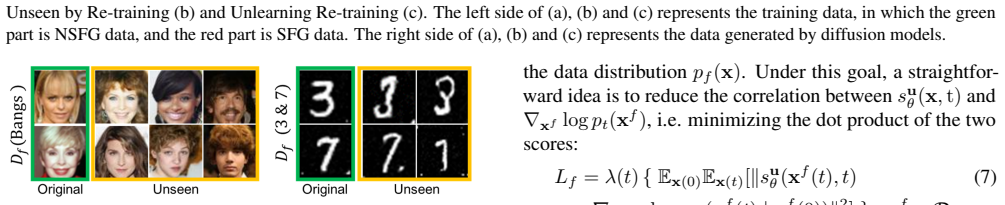
The paper's central claim is that unlearning in score-based generative models must act on the score function, not on the training set. It reports that retraining an SGM on data with the unwanted class removed leaves the learned score $\nabla_x\log p_t(x)$ almost unchanged, so the reverse SDE keeps sampling the unwanted region; this is why the accepted 'Unseen by Re-training' gold standard fails. MSGM instead minimizes a dot-product loss between the model's score and the conditional score of the NSFG data at each diffusion time, either forcing the dot product to zero (Orthogonal-MSGM) or forcing it negative (Obtuse-MSGM), while keeping the standard score-matching loss on SFG data. The claimed effect is that sampling is steered away from the high-density region of unwanted data and toward wanted data, lowering unlearning ratios and raising the negative log-likelihood of NSFG data while preserving visual quality.
Load-bearing premise
The load-bearing assumption is that changing the direction of the model's score relative to the unwanted data's score actually moves generated samples away from that unwanted data; if a score can point away from the unwanted region yet sampling still lands there, the method fails.
Editorial extensions
If this is right
- A single unlearning objective covers VE SDE, VP SDE, DDPM, and latent diffusion models, so the method is not tied to one architecture.
- The two variants give a practical choice: Orthogonal-MSGM works best when unwanted and retained classes are separable, while Obtuse-MSGM handles closely overlapping features such as facial attributes.
- MSGM can unlearn from an already trained model by fine-tuning, avoiding the cost of full retraining.
- In text-to-image experiments, MSGM removes the target class without needing a pseudo-label replacement, avoiding a known failure mode when the substitute class is semantically similar.
- The unlearned models transfer zero-shot to inpainting and reconstruction: restored unwanted-content images lose their target semantics, while restored retained-content images keep theirs.
Reading between the lines
- Editorial inference: because the method's loss operates on score directions, one could read off a continuous suppression angle between the model score and the unwanted-data score; a natural test would be to sweep that angle and measure how quickly the NSFG generation rate falls.
- Editorial inference: the result that retraining leaves the score nearly unchanged implies that deleting data from an SGM's training set is not the same as deleting it from the model, so deletion certifications based on retraining may need a generation-level test.
- Editorial inference: the success without pseudo-labels in the text-to-image experiment suggests the approach could extend to concept erasure at scale, where finding a semantically distinct replacement class is often the failure mode.
Editorial analysis
A structured set of objections, weighed in public.
Referee Report
Summary. The paper addresses machine unlearning in score-based generative models (SGMs). It argues that the standard 'Unseen by Re-training' baseline is ineffective for SGMs because retraining on filtered data leaves the learned score function almost unchanged, and it supports this with a 2D Gaussian toy experiment and with class/attribute forgetting experiments on MNIST, CIFAR-10, STL-10, and CelebA. The authors then propose the Moderated Score-based Generative Model (MSGM), which adds an unlearning loss to the standard score-matching objective: Orthogonal-MSGM minimizes the squared dot product between the model score and the NSFG conditional score, while Obtuse-MSGM minimizes (makes negative) the dot product itself. The final objective is a weighted combination of the SFG score-matching loss and the NSFG unlearning loss. Experiments cover VE SDE, VP SDE, DDPM, and Stable Diffusion, with unconditional and conditional generation, and also report zero-shot inpainting and reconstruction results on the unlearned models.
Significance. If the central claims are validated, the paper would be a useful first step toward unlearning in continuous-time score-based models, offering a simple plug-in loss that is compatible with several diffusion architectures and with pre-trained models. The broad experimental scope, including attribute unlearning on CelebA and concept erasure in Stable Diffusion, is a strength. However, the current manuscript does not yet support the strength of the claims: the toy setup contains an invalid mixture, the 'gold standard does not work' conclusion is partially contradicted by the paper's own unlearning-ratio numbers, the mechanism connecting the local score constraint to reduced generation probability is not established, and the evaluation lacks error bars and a full description of the NLL estimator. These issues are fixable, but they are central to the paper's message.
major comments (4)
- [Sec. 3.2, toy mixture definition] The toy data distribution is defined as pdata = 4/5 N((-2,-2), I) + 2/5 N((0,0), I) + 4/5 N((2,2), I). The mixture weights sum to 10/5 = 2, so pdata is not a probability density. This invalidates the synthetic experiment as written and, since this experiment is the primary evidence for the claim that retraining 'does not work,' the conclusion must be re-verified after correcting the weights (e.g., to 0.4, 0.2, 0.4).
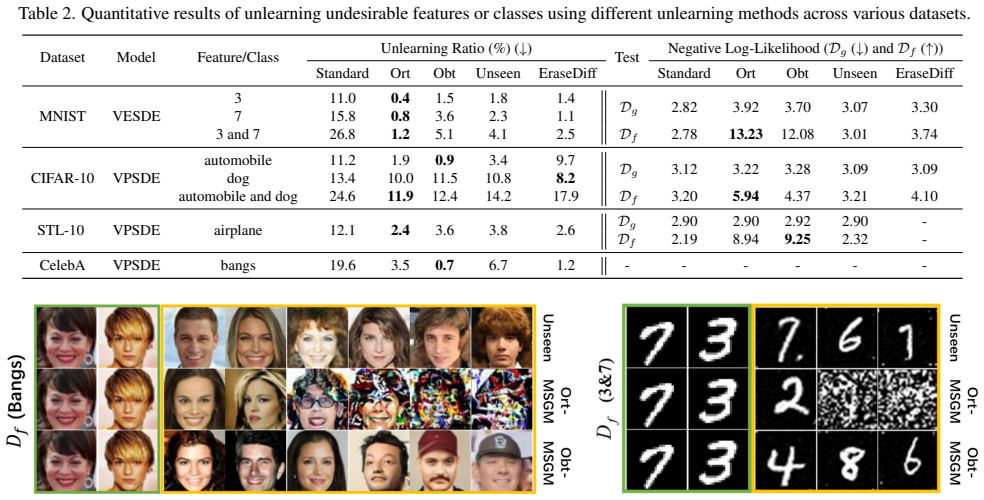
- [Sec. 3.2 and Tab. 2] The claim that Unseen by Re-training 'does not work' is overstated and is contradicted by the paper's own numbers in Tab. 2: Unseen achieves UR of 1.8% on MNIST digit 3, 2.3% on digit 7, 3.4% on CIFAR-10 automobile, and 10.8% on dog, which are close to several MSGM results (e.g., CIFAR-10 dog: 10.0% for Ort, 11.5% for Obt). The NLL values do show that Df likelihood remains close to Dg (MNIST Df 3.01 vs Dg 3.07), but the paper should state precisely which definition of forgetting is being used and reconcile the low UR with the high NLL. In addition, the 'score function almost unchanged' claim in Sec. 3.2 is supported only by visual inspection of Fig. 1; a quantitative distance between the score functions of Standard and Unseen should be reported.
- [Sec. 3.3, Eqs. (7)-(9), and Sec. 4.5, Fig. 8] The central mechanism--that making the model score orthogonal or negatively correlated with the NSFG conditional score at noised Df samples will reduce the probability of generating Df--is not proven and is not obviously implied by the loss. The loss constrains the score only on the forward-noised Df training samples, whereas sampling integrates the score field globally from pure noise. The qualitative results show that Orthogonal-MSGM replaces the forgotten feature with noise (Fig. 4) and reconstructs Df as noisy images (Fig. 8), which is consistent with local score destruction or network collapse rather than a genuine global density shift. The reported NLL increases and low UR values could therefore be artifacts of the network being unable to satisfy both losses. Please provide a theoretical argument linking the score constraint to path probabilities, or a diagnostic experiment (e.g., probability-flow ODE NLL of Df, or trajectories initialized near Df and shown to be repelled) that rules out the artifact interpretation.
- [Sec. 4.1 and evaluation protocol] The evaluation omits error bars and repeated runs for every table. Many of the reported differences are small (e.g., Tab. 5 FID 3.08 vs 3.09; Tab. 6 ACC on Dg 75.5 vs 75.8), so the claimed superiority of MSGM over baselines is not statistically established. Furthermore, the manuscript states that NLL can be 'accurately calculated' for SGMs but does not describe the estimator (e.g., probability-flow ODE, importance sampling, or exact likelihood) or the number of samples used; the toy NLL values in Tab. 1 (e.g., 10.91 for a 2D Gaussian mixture) are also implausibly high for a two-dimensional distribution and need clarification.
minor comments (5)
- [Sec. 3.2] The dataset citations are inconsistent: Sec. 3.2 cites CELEBA as [1] and MNIST as [24], while Sec. 4.1 cites MNIST as [1] and CelebA as [24]; please correct the references.
- [Sec. 4.5] In the inpainting paragraph, the sentence 'altering the source semantics on Dg' should presumably read 'altering the source semantics on Df', given the reported accuracy decrease on Df.
- [Tab. 4] The column header 'Unlearning' in Tab. 4 is not defined among the compared methods, and 'Unseen' appears twice; please fix the header and ensure each baseline is described.
- [Eq. (7)] Equation (7) applies the squared norm to a scalar dot product; the notation is redundant and should be replaced by a squared scalar or clarified.
- [Sec. 4.6] The ablation of the hyperparameter alpha is reported only for MNIST with Orthogonal-MSGM; a sensitivity analysis on other datasets or for Obtuse-MSGM would strengthen the claim that alpha=0.99 is a generally valid default.
Circularity Check
No significant circularity: MSGM's unlearning loss and its evaluation metrics are distinct, and the central claim is benchmarked against external baselines.
full rationale
MSGM's derivation does not reduce to its own inputs. The unlearning objectives in Eqs. (7)-(9) directly penalize the dot product between the learned score and the NSFG conditional score, but the reported evaluations (NLL, UR, FID, CLIP/PSNR/SSIM, downstream accuracy) are separate functionals of the resulting model, measured with external classifiers and standard benchmarks. The claim that 'Unseen by Re-training' leaves the score function essentially unchanged is an empirical observation supported by Fig. 1 and Tab. 1, not an assumption imported from prior work. No load-bearing self-citation appears: the cited baselines and diffusion-model foundations (Song et al., Ho et al., Thudi et al., Gandikota et al., Wu et al.) are external prior work, and the present authors do not cite their own previous papers as justification for the method. The NLL increase on Df is partly expected because the loss manipulates the learned score on noised Df samples, but NLL is not the training target, and the qualitative results, FID, and classifier-based UR provide independent evidence. No specific equation is equivalent by construction to the reported prediction, and no fitted parameter is renamed as a prediction. The paper is self-contained against external benchmarks and baselines, so no circular step is identified.
Assumptions & free parameters
free parameters (1)
- alpha =
0.99
assumptions (3)
- standard math The reverse SDE with an accurate score estimate generates samples from the data distribution.
- standard math The conditional score ∇ log p_{0t}(x(t)|x(0)) is analytically known for the VE/VP SDEs used.
- ad hoc to paper Orthogonalizing or making obtuse the model score relative to the NSFG conditional score suppresses NSFG generation.
Cite this review
Pith. "Pith review of Moderating the Generalization of Score-based Generative Model." pith.science (2026). https://pith.science/paper/SBVW6CYS
@misc{pith2026241207229,
  author       = {Pith},
  title        = {Pith review of: Moderating the Generalization of Score-based Generative Model},
  year         = {2026},
  howpublished = {\url{https://pith.science/paper/SBVW6CYS}},
  note         = {Machine review of arXiv:2412.07229}
}
read the original abstract
Score-based Generative Models (SGMs) have demonstrated remarkable generalization abilities, e.g. generating unseen, but natural data. However, the greater the generalization power, the more likely the unintended generalization, and the more dangerous the abuse. Research on moderated generalization in SGMs remains limited. To fill this gap, we first examine the current 'gold standard' in Machine Unlearning (MU), i.e., re-training the model after removing the undesirable training data, and find it does not work in SGMs. Further analysis of score functions reveals that the MU 'gold standard' does not alter the original score function, which explains its ineffectiveness. Based on this insight, we propose the first Moderated Score-based Generative Model (MSGM), which introduces a novel score adjustment strategy that redirects the score function away from undesirable data during the continuous-time stochastic differential equation process. Extensive experimental results demonstrate that MSGM significantly reduces the likelihood of generating undesirable content while preserving high visual quality for normal image generation. Albeit designed for SGMs, MSGM is a general and flexible MU framework that is compatible with diverse diffusion architectures (SGM and DDPM) and training strategies (re-training and fine-tuning), and enables zero-shot transfer of the pre-trained models to downstream tasks, e.g. image inpainting and reconstruction. The code will be shared upon acceptance.
Figures


Figures from the paper (4 more)


Reference graph
Works this paper leans on
-
[1]
A minimal subset of fea- tures using feature selection for handwritten digit recognition
Areej Alsaafin and Ashraf Elnagar. A minimal subset of fea- tures using feature selection for handwritten digit recognition. Journal of Intelligent Learning Systems and Applications, 9 (04):55–68, 2017. 3, 5
work page 2017
-
[2]
Gradient surgery for one-shot unlearning on generative model.arXiv preprint arXiv:2307.04550, 2023
Seohui Bae, Seoyoon Kim, Hyemin Jung, and Woohyung Lim. Gradient surgery for one-shot unlearning on generative model.arXiv preprint arXiv:2307.04550, 2023. 2
arXiv 2023
-
[3]
Extracting training data from diffusion models
Nicolas Carlini, Jamie Hayes, Milad Nasr, Matthew Jagielski, Vikash Sehwag, Florian Tramer, Borja Balle, Daphne Ippolito, and Eric Wallace. Extracting training data from diffusion models. In32nd USENIX Security Symposium (USENIX Security 23), pages 5253–5270, 2023. 1
work page 2023
-
[4]
Sampling is as easy as learning the score: theory for diffusion models with minimal data assumptions
Sitan Chen, Sinho Chewi, Jerry Li, Yuanzhi Li, Adil Salim, and Anru R Zhang. Sampling is as easy as learning the score: theory for diffusion models with minimal data assumptions. InInternational Conference on Learning Representations,
-
[5]
Score-based diffusion models for accelerated mri.Medical image analysis, 80: 102479, 2022
Hyungjin Chung and Jong Chul Ye. Score-based diffusion models for accelerated mri.Medical image analysis, 80: 102479, 2022. 2
work page 2022
-
[6]
An analysis of single-layer networks in unsupervised feature learning
Adam Coates, Andrew Ng, and Honglak Lee. An analysis of single-layer networks in unsupervised feature learning. In Proceedings of the fourteenth international conference on artificial intelligence and statistics, pages 215–223. JMLR Workshop and Conference Proceedings, 2011. 5
2011
-
[7]
Den- sity estimation using real nvp
Laurent Dinh, Jascha Sohl-Dickstein, and Samy Bengio. Den- sity estimation using real nvp. In5th International Conference on Learning Representations, ICLR 2017, 2017. 1
work page 2017
-
[8]
Chongyu Fan, Jiancheng Liu, Yihua Zhang, Dennis Wei, Eric Wong, and Sijia Liu. Salun: Empowering machine unlearning via gradient-based weight saliency in both image classifica- tion and generation. InInternational Conference on Learning Representations, 2024. 1, 2, 3
work page 2024
Show all 48 references
-
[9]
Video predic- tion using score-based conditional density estimation.arXiv preprint arXiv:2411.00842, 2024
Pierre- ´Etienne H Fiquet and Eero P Simoncelli. Video predic- tion using score-based conditional density estimation.arXiv preprint arXiv:2411.00842, 2024. 2
2024 arXiv
-
[10]
Erasing concepts from diffusion models
Rohit Gandikota, Joanna Materzynska, Jaden Fiotto- Kaufman, and David Bau. Erasing concepts from diffusion models. InProceedings of the IEEE/CVF International Con- ference on Computer Vision, pages 2426–2436, 2023. 1, 2, 5, 7
2023
-
[11]
Unified concept editing in diffusion models
Rohit Gandikota, Hadas Orgad, Yonatan Belinkov, Joanna Materzy´nska, and David Bau. Unified concept editing in diffusion models. InProceedings of the IEEE/CVF Winter Conference on Applications of Computer Vision, pages 5111– 5120, 2024
2024
-
[12]
Reliable and efficient concept erasure of text- to-image diffusion models.arXiv preprint arXiv:2407.12383,
Chao Gong, Kai Chen, Zhipeng Wei, Jingjing Chen, and Yu-Gang Jiang. Reliable and efficient concept erasure of text- to-image diffusion models.arXiv preprint arXiv:2407.12383,
-
[13]
Generative adversarial nets.Advances in neural information processing systems, 27, 2014
Ian Goodfellow, Jean Pouget-Abadie, Mehdi Mirza, Bing Xu, David Warde-Farley, Sherjil Ozair, Aaron Courville, and Yoshua Bengio. Generative adversarial nets.Advances in neural information processing systems, 27, 2014. 1
2014
-
[14]
Continual learning for forgetting in deep generative models
Alvin Heng and Harold Soh. Continual learning for forgetting in deep generative models. 2023. 1, 2
2023
-
[15]
Selective amnesia: A continual learning approach to forgetting in deep generative models
Alvin Heng and Harold Soh. Selective amnesia: A continual learning approach to forgetting in deep generative models. Advances in Neural Information Processing Systems, 36, 2024. 1, 2
2024
-
[16]
Gans trained by a two time-scale update rule converge to a local nash equilibrium
Martin Heusel, Hubert Ramsauer, Thomas Unterthiner, Bern- hard Nessler, and Sepp Hochreiter. Gans trained by a two time-scale update rule converge to a local nash equilibrium. Advances in neural information processing systems, 30, 2017. 5
2017
-
[17]
Denoising diffu- sion probabilistic models.Advances in neural information processing systems, 33:6840–6851, 2020
Jonathan Ho, Ajay Jain, and Pieter Abbeel. Denoising diffu- sion probabilistic models.Advances in neural information processing systems, 33:6840–6851, 2020. 1, 2, 5
2020
-
[18]
Fastai: a layered api for deep learning.Information, 11(2):108, 2020
Jeremy Howard and Sylvain Gugger. Fastai: a layered api for deep learning.Information, 11(2):108, 2020. 5, 7
2020
-
[19]
Score-based physics-informed neu- ral networks for high-dimensional fokker-planck equations
Zheyuan Hu, Zhongqiang Zhang, George Em Karniadakis, and Kenji Kawaguchi. Score-based physics-informed neu- ral networks for high-dimensional fokker-planck equations. arXiv preprint arXiv:2402.07465, 2024. 2
2024 arXiv
-
[20]
Kingma and Max Welling
Diederik P. Kingma and Max Welling. Auto-encoding varia- tional bayes. In2nd International Conference on Learning Representations, ICLR 2014, Banff, AB, Canada, April 14-16, 2014, Conference Track Proceedings, 2014. 1
2014
-
[21]
Data redaction from pre-trained gans
Zhifeng Kong and Kamalika Chaudhuri. Data redaction from pre-trained gans. In2023 IEEE Conference on Secure and Trustworthy Machine Learning (SaTML), pages 638–677. IEEE, 2023. 2
2023
-
[22]
Learning multiple layers of features from tiny images
Alex Krizhevsky, Geoffrey Hinton, et al. Learning multiple layers of features from tiny images. 2009. 5
2009
-
[23]
Ablating concepts in text-to-image diffusion models
Nupur Kumari, Bingliang Zhang, Sheng-Yu Wang, Eli Shecht- man, Richard Zhang, and Jun-Yan Zhu. Ablating concepts in text-to-image diffusion models. InProceedings of the IEEE/CVF International Conference on Computer Vision, pages 22691–22702, 2023. 1, 2
2023
-
[24]
Deep learning face attributes in the wild
Ziwei Liu, Ping Luo, Xiaogang Wang, and Xiaoou Tang. Deep learning face attributes in the wild. InProceedings of the IEEE international conference on computer vision, pages 3730–3738, 2015. 3, 5
2015
-
[25]
Mace: Mass concept erasure in diffusion 9 models
Shilin Lu, Zilan Wang, Leyang Li, Yanzhu Liu, and Adams Wai-Kin Kong. Mace: Mass concept erasure in diffusion 9 models. InProceedings of the IEEE/CVF Conference on Computer Vision and Pattern Recognition, pages 6430–6440,
-
[26]
Estimating high order gradients of the data distribution by de- noising.Advances in Neural Information Processing Systems, 34:25359–25369, 2021
Chenlin Meng, Yang Song, Wenzhe Li, and Stefano Ermon. Estimating high order gradients of the data distribution by de- noising.Advances in Neural Information Processing Systems, 34:25359–25369, 2021. 2
2021
-
[27]
Feature unlearning for pre-trained gans and vaes
Saemi Moon, Seunghyuk Cho, and Dongwoo Kim. Feature unlearning for pre-trained gans and vaes. InProceedings of the AAAI Conference on Artificial Intelligence, pages 21420– 21428, 2024. 2
2024
-
[28]
Improved denoising diffusion probabilistic models
Alexander Quinn Nichol and Prafulla Dhariwal. Improved denoising diffusion probabilistic models. InInternational conference on machine learning, pages 8162–8171. PMLR,
-
[29]
Editing implicit assumptions in text-to-image diffusion models
Hadas Orgad, Bahjat Kawar, and Yonatan Belinkov. Editing implicit assumptions in text-to-image diffusion models. In Proceedings of the IEEE/CVF International Conference on Computer Vision, pages 7053–7061, 2023. 1
2023
-
[30]
Efficient learning of generative models via finite-difference score matching.Advances in Neural Information Processing Systems, 33:19175–19188, 2020
Tianyu Pang, Kun Xu, Chongxuan Li, Yang Song, Stefano Ermon, and Jun Zhu. Efficient learning of generative models via finite-difference score matching.Advances in Neural Information Processing Systems, 33:19175–19188, 2020. 3
2020
-
[31]
Generative ai, ex- plainability, and score-based natural language processing in benefits administration.Journal of Cross-disciplinary Re- search in Computational Law, 2(2), 2024
Frank Pasquale and Gianclaudio Malgieri. Generative ai, ex- plainability, and score-based natural language processing in benefits administration.Journal of Cross-disciplinary Re- search in Computational Law, 2(2), 2024. 2
2024
-
[32]
Learning transferable visual models from natural language supervi- sion
Alec Radford, Jong Wook Kim, Chris Hallacy, Aditya Ramesh, Gabriel Goh, Sandhini Agarwal, Girish Sastry, Amanda Askell, Pamela Mishkin, Jack Clark, et al. Learning transferable visual models from natural language supervi- sion. InInternational conference on machine learning, p...
2021
-
[33]
Red-teaming the stable diffusion safety filter.arXiv preprint arXiv:2210.04610, 2022
Javier Rando, Daniel Paleka, David Lindner, Lennard Heim, and Florian Tram`er. Red-teaming the stable diffusion safety filter.arXiv preprint arXiv:2210.04610, 2022. 1, 2
2022 arXiv
-
[34]
High-resolution image synthesis with latent diffusion models
Robin Rombach, Andreas Blattmann, Dominik Lorenz, Patrick Esser, and Bj ¨orn Ommer. High-resolution image synthesis with latent diffusion models. InProceedings of the IEEE/CVF conference on computer vision and pattern recognition, pages 10684–10695, 2022. 5, 7
2022
-
[35]
Raising the cost of malicious ai-powered image editing.arXiv preprint arXiv:2302.06588,
Hadi Salman, Alaa Khaddaj, Guillaume Leclerc, Andrew Ilyas, and Aleksander Madry. Raising the cost of malicious ai-powered image editing.arXiv preprint arXiv:2302.06588,
-
[36]
Safe latent diffusion: Mitigating inappro- priate degeneration in diffusion models
Patrick Schramowski, Manuel Brack, Bj¨orn Deiseroth, and Kristian Kersting. Safe latent diffusion: Mitigating inappro- priate degeneration in diffusion models. InProceedings of the IEEE/CVF Conference on Computer Vision and Pattern Recognition, pages 22522–22531, 2023. 1, 2
2023
-
[37]
Exploring the landscape of ma- chine unlearning: A survey and taxonomy.arXiv preprint arXiv:2305.06360, 2023
Thanveer Shaik, Xiaohui Tao, Haoran Xie, Lin Li, Xi- aofeng Zhu, and Qing Li. Exploring the landscape of ma- chine unlearning: A survey and taxonomy.arXiv preprint arXiv:2305.06360, 2023. 2
2023 arXiv
-
[38]
Glaze: Protecting artists from style mimicry by text-to-image models.arXiv preprint arXiv:2302.04222, 2023
Shawn Shan, Jenna Cryan, Emily Wenger, Haitao Zheng, Rana Hanocka, and Ben Y Zhao. Glaze: Protecting artists from style mimicry by text-to-image models.arXiv preprint arXiv:2302.04222, 2023. 1, 2
2023 arXiv
-
[39]
Generative modeling by estimating gradients of the data distribution.Advances in neural information processing systems, 32, 2019
Yang Song and Stefano Ermon. Generative modeling by estimating gradients of the data distribution.Advances in neural information processing systems, 32, 2019. 2
2019
-
[40]
Improved techniques for training score-based generative models.Advances in neural information processing systems, 33:12438–12448, 2020
Yang Song and Stefano Ermon. Improved techniques for training score-based generative models.Advances in neural information processing systems, 33:12438–12448, 2020. 2
2020
-
[41]
Sliced score matching: A scalable approach to density and score estimation
Yang Song, Sahaj Garg, Jiaxin Shi, and Stefano Ermon. Sliced score matching: A scalable approach to density and score estimation. InUncertainty in Artificial Intelligence, pages 574–584. PMLR, 2020. 3
2020
-
[42]
Kingma, Ab- hishek Kumar, Stefano Ermon, and Ben Poole
Yang Song, Jascha Sohl-Dickstein, Diederik P. Kingma, Ab- hishek Kumar, Stefano Ermon, and Ben Poole. Score-based generative modeling through stochastic differential equations. InInternational Conference on Learning Representations, ICLR 2021, 2021. 1, 2, 3, 5
2021
-
[43]
Generative adversarial networks unlearning.arXiv preprint arXiv:2308.09881, 2023
Hui Sun, Tianqing Zhu, Wenhan Chang, and Wanlei Zhou. Generative adversarial networks unlearning.arXiv preprint arXiv:2308.09881, 2023. 2
2023 arXiv
-
[44]
On the necessity of auditable algorithmic definitions for machine unlearning
Anvith Thudi, Hengrui Jia, Ilia Shumailov, and Nicolas Pa- pernot. On the necessity of auditable algorithmic definitions for machine unlearning. In31st USENIX Security Symposium (USENIX Security 22), pages 4007–4022, 2022. 2, 3
2022
-
[45]
Erasediff: Erasing data influence in diffusion models.arXiv preprint arXiv:2401.05779, 2024
Jing Wu, Trung Le, Munawar Hayat, and Mehrtash Harandi. Erasediff: Erasing data influence in diffusion models.arXiv preprint arXiv:2401.05779, 2024. 1, 2, 5, 7
2024 arXiv
-
[46]
Scoredec: A phase-preserving high- fidelity audio codec with a generalized score-based diffusion post-filter
Yi-Chiao Wu, Dejan Markovi´c, Steven Krenn, Israel D Gebru, and Alexander Richard. Scoredec: A phase-preserving high- fidelity audio codec with a generalized score-based diffusion post-filter. InICASSP 2024-2024 IEEE International Confer- ence on Acoustics, Speech and Signal P...
2024
-
[47]
Machine unlearning: Solutions and challenges.IEEE Transactions on Emerging Topics in Computational Intelligence, 2024
Jie Xu, Zihan Wu, Cong Wang, and Xiaohua Jia. Machine unlearning: Solutions and challenges.IEEE Transactions on Emerging Topics in Computational Intelligence, 2024. 3
2024
-
[48]
Forget-me-not: Learning to forget in text-to- image diffusion models
Gong Zhang, Kai Wang, Xingqian Xu, Zhangyang Wang, and Humphrey Shi. Forget-me-not: Learning to forget in text-to- image diffusion models. InProceedings of the IEEE/CVF Conference on Computer Vision and Pattern Recognition, pages 1755–1764, 2024. 1, 2 10
2024
Reviewed August 11, 2026 · model on record in the stance chip above.
Discussion (0). Continue with ORCID to comment.