REVIEW 4 major objections 5 minor 59 references
Fast and Interpretable Mixed-Integer Linear Program Solving by Learning Model Reduction
T0 review · 4 major / 5 minor · reviewed 2026-08-10 · deepseek-v4-flash
Pith's one-line read This paper claims that many similar mixed-integer linear programs can be solved in milliseconds by learning a reduced model per instance—the tight constraints and the optimal integer values—then solving the small resulting linear program.
desk verdict Solid empirical results on learning MILP reductions, but the central exact-equivalence claim is false and should be reframed as an approximate method with tolerances. read the letter →
The pith
A machine-rendered reading of the paper's core claim, the machinery that carries it, and where it could break.
The reading
What carries the argument
The load-bearing object is the optimal strategy $s^*(\theta) = (T(\theta), x^*_I(\theta))$: the pair consisting of the constraints that are equalities at the optimum and the integer variables pinned to their optimal values. Predicting this strategy is the intermediate step that lets the solver replace the MILP with a small continuous LP. The preference machinery is the reward $r(\theta_i, s_j) = -\log(p(\theta_i, s_j) + d(\theta_i, s_j))$, which induces a full ordering of candidate strategies per instance; an attention encoder that treats each instance–strategy pair as a token learns this ordering, and two losses—a pairwise preference loss $L_p$ and a reward-difference loss $L_d$—train it to keep the best strategy at the top of the ranking. A greedy SetCover algorithm on the instance–strategy bipartite graph prunes the candidate strategies to a minimal set that covers all training instances, keeping the label count under control.
What would settle it
Take a held-out instance, solve the full MILP exactly, then apply the model's predicted strategy to the reduced LP and compare: if a non-negligible fraction of test instances have reduced-LP solutions that violate a deleted constraint by more than $\epsilon_p$ or miss the true optimum objective by more than $\epsilon_d$, the lossless-reduction premise fails and the reported accuracy numbers cannot be reproduced.
Extended reading notes
Core claim
Formally, for a parameterized MILP with parameters $\theta = \langle A, c, b \rangle$, let $x^*(\theta)$ be an optimal solution. The optimal strategy of model reduction is $s^*(\theta) = (T(\theta), x^*_I(\theta))$, where $T(\theta) = \{i \mid g_i(A_i, x^*(\theta)) = b_i\}$ is the set of tight constraints and $x^*_I(\theta)$ is the integer variables fixed at their optimal values. The reduced model is the LP that keeps only the constraints in $T(\theta)$, fixes $x_I = x^*_I(\theta)$, and leaves the remaining variables continuous. The paper's central claim is that a preference-based learner can predict such a strategy $s^*(\theta)$ from the instance parameters with enough accuracy that solving the reduced LP recovers a feasible, near-optimal solution, and that this is much faster than solving the original MILP. The preference signal is $r(\theta_i, s_j) = -\log(p(\theta_i, s_j) + d(\theta_i, s_j))$, where $p$ is the normalized infeasibility of the reduced solution and $d$ is its relative suboptimality; ranking candidate strategies by these rewards is what the attention encoder learns.
Load-bearing premise
The load-bearing premise is that keeping only the tight constraints and fixing the integer variables to the strategy's values produces a linear program whose solution is still the true MILP optimum, or at least falls within the small tolerance thresholds the method uses to accept near-feasible solutions.
Editorial extensions
If this is right
- Operators of a family of structurally similar MILPs can replace an exact solver call with one forward pass of the preference model plus one small LP solve, bringing per-instance online time down to milliseconds.
- Because the chosen reduction is the set of active constraints plus an integer assignment, the decision is interpretable: the active constraints identify which operating mode the instance is in, which can help engineers audit the solution.
- SetCover pruning bounds the number of labels independently of the number of training instances, so adding more instances does not force the classifier to learn a proportionally larger strategy set.
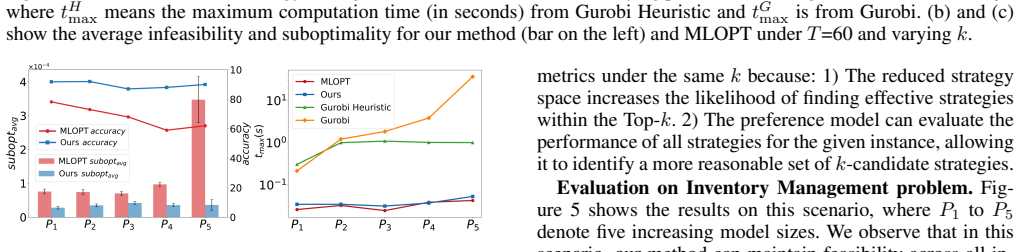
- On the paper's benchmarks, ranked preferences yield nearly 20% better solution accuracy than the prior model-reduction baseline, and the gap widens on the largest instances.
- The reported speedups of two to four orders of magnitude over a commercial solver hold across problem scales, including inventory-management models with hundreds of thousands of constraints.
Reading between the lines
- If the lossless-reduction premise is weakened, the method still functions as a very fast warm-start heuristic: solve the reduced LP, check all original constraints, and repair any violations; the speed advantage would survive, but the reduced model would be near-equivalent rather than equivalent.
- The same preference-ranking scheme should transfer to other structured optimization classes—mixed-integer quadratic programs, conic programs, or nonlinear programs with a definable active set—by replacing the reduced LP with the corresponding continuous problem.
- A production deployment would likely append a feasibility-check-and-repair step, since real applications often require exact constraint satisfaction rather than tolerance-bounded infeasibility; that step would still be far cheaper than a full MILP solve.
- The accuracy of the learned reduction on out-of-distribution parameters remains an open question; the reported experiments draw train and test instances from the same parameter-generation ball.
Editorial analysis
A structured set of objections, weighed in public.
Referee Report
Summary. The paper proposes a learning-based approach to accelerate the solution of repeated, structurally similar MILP instances. Instead of predicting full solutions, it learns a "reduced model" consisting of the tight constraints at the optimum and the optimal values of the integer variables. Solving the resulting smaller LP is claimed to recover the original MILP optimum, yielding large speedups. The authors introduce a preference-based learning framework with an attention encoder, and a SetCover-based pruning scheme to limit the number of reduced-model labels. Experiments on MIPLIB, Fuel Cell Energy Management, and Inventory Management problems report improved accuracy over the MLOPT baseline and reported speedups of two to four orders of magnitude over Gurobi.
Significance. If the proposed reduction were exact and the learned strategies accurate, the approach would offer a practical way to solve parametric families of MILPs in milliseconds, with interpretable "modes of operation" given by active constraints and integer decisions. The preference-based formulation and the SetCover pruning are useful ideas, and the experiments cover several realistic benchmark families. However, the central equivalence claim is neither proved nor true in general, and the evaluation metric does not directly assess the suboptimality of the final selected solution. These issues are load-bearing for the paper's main claims, so the current version requires substantial revision before the contribution can be considered sound.
major comments (4)
- [The Strategy of Model Reduction, Eqs. (4)-(7)] The assertion that once the tight constraints T(theta) and optimal integer values x*_I(theta) are known, "all other constraints in the MILP model are redundant and can be removed" is not proved and is false in general. Deleting non-tight constraints can enlarge the feasible region of the fixed-integer LP. A concrete counterexample is min y subject to y <= 1, y >= 0, z = 0, z in Z, whose optimum is (z,y)=(0,0); here y >= 0 is tight and y <= 1 is not, but the reduced LP min y subject to y >= 0 is unbounded below. Thus solving Eqs. (5)-(7) does not necessarily recover the original optimum. The paper must either state and prove a condition under which the reduction is exact (e.g., nondegeneracy and a uniqueness assumption) or explicitly reframe the method as an approximate heuristic and validate the approximation on the target distributions.
- [Online Strategy Inference, Eq. (21)] The selection rule in Eq. (21), which chooses the candidate strategy with the lowest infeasibility p(theta_i, s_j), does not control suboptimality. A strategy can have very small constraint violation while producing a solution whose objective is far from optimal, and the threshold epsilon_2 in the accuracy metric is only applied at evaluation time, not during selection. Since the paper claims "solution accuracy" and near-optimality, this is a load-bearing gap. The method should either select on a combined criterion such as p+d, or explicitly guarantee that the selected strategy's suboptimality is below the claimed tolerance.
- [Computation Time and Experiments] The reported "two to four orders of magnitude" speedups compare only the online reduced-LP solve against Gurobi's complete MILP solve. The offline costs of generating strategies, computing labels with Gurobi, constructing the SetCover, and training the preference model are not included. A fair comparison for the claimed end-to-end benefit should report the full pipeline time or clearly state that the speedup is for online inference only. The current wording in the Abstract and Introduction does not make this distinction and is therefore misleading.
- [Equations (8)-(9) and Strategy Pruning] The thresholds epsilon_p, epsilon_d and later epsilon_1, epsilon_2 are free parameters that effectively admit that the reduction is approximate. No values are reported for epsilon_p and epsilon_d, and no sensitivity analysis is given. Since the entire method is built on these tolerances, the paper should report them, justify the specific choices, and show that the main accuracy and speedup claims are robust to their variation.
minor comments (5)
- [Strategy Generation and Pruning] "Good-Turning estimator" should be "Good-Turing estimator."
- [Throughout] The spacing in "S ETCOVER" appears to be a typesetting error; it should read "SetCover."
- [Evaluation Metrics, Eq. (8)] The normalization by ||b|| in Eq. (8) is not well defined when constraint parameters have mixed units or different magnitudes; a precise normalization convention would improve reproducibility.
- [Experiments, MIPLIB] The six selected MIPLIB scenarios are not enumerated in the main text or appendix; listing them and their sizes would strengthen the evaluation.
- [Appendix Table 1] In Table 1, at T=30 the average suboptimality of the proposed method is 14.33399 while RF is 0.04398; the claim that this is due to a few isolated instances should be supported by reporting quantiles or by showing the distribution.
Circularity Check
No circular derivation: strategy labels and evaluation are both computed from held-out Gurobi solutions, which is standard supervised learning; the unproven 'redundant constraints' claim is a correctness risk, not a circular step.
full rationale
The paper's derivation chain is supervised rather than circular. Training strategies s*(θ) are extracted from Gurobi optimal solutions of training instances and used to train the preference model R_ϕ; evaluation then measures infeasibility p and suboptimality d on held-out instances relative to Gurobi. This is the standard oracle-labeling setup, and neither the thresholds (ε_p, ε_d) nor the network parameters are fitted to the test set. The reward r(θ_i, s_j) = −log(p + d) in Eq. (10) is aligned with the accuracy metric, but that is objective alignment, not a reduction of the empirical speedup or accuracy claims to their own inputs. The self-citations that appear (e.g., Li et al. 2024; Li et al. 2021) are application/context references and are not load-bearing for the method. The genuine mathematical weakness is the unproven assertion in 'The Strategy of Model Reduction' that 'all other constraints in the MILP model are redundant and can be removed'; deleting non-tight constraints can enlarge the feasible region of the fixed-integer LP, so the reduced model is not generally equivalent to the original MILP. This is an omitted proof and a correctness risk, not a circular step, because the later empirical method explicitly tolerates small violations through p and d rather than relying on a proven equivalence. No step was found that reduces by construction to its own inputs, so the circularity score is 0.
Assumptions & free parameters
free parameters (7)
- infeasibility tolerance epsilon_p =
tiny, unspecified
- suboptimality tolerance epsilon_d =
tiny, unspecified
- accuracy tolerances epsilon_1, epsilon_2 =
1e-4
- loss weights lambda_1, lambda_2 =
0.8 to 0.9 depending on scenario
- Top-k candidate count =
varied across experiments
- parameter perturbation radius r =
dataset-specific ranges
- Good-Turing stopping threshold =
tiny, unspecified
assumptions (6)
- domain assumption Training and test instances are drawn i.i.d. from a fixed distribution of parameterized MILPs with similar structure.
- domain assumption A strategy of tight constraints plus optimal integer values recovers the optimal solution after solving the reduced LP.
- ad hoc to paper The thresholds epsilon_p and epsilon_d are small enough that near-feasible reduced solutions remain useful.
- domain assumption Gurobi's optimal solutions used for labels and evaluation are correct.
- standard math Preference rewards are scalar, so preferences are transitive and a total order over strategies exists for each instance.
- domain assumption The learned attention model generalizes from the training distribution to unseen instances.
Cite this review
Pith. "Pith review of Fast and Interpretable Mixed-Integer Linear Program Solving by Learning Model Reduction." pith.science (2026). https://pith.science/paper/SEY7RLHR
@misc{pith2026250100307,
  author       = {Pith},
  title        = {Pith review of: Fast and Interpretable Mixed-Integer Linear Program Solving by Learning Model Reduction},
  year         = {2026},
  howpublished = {\url{https://pith.science/paper/SEY7RLHR}},
  note         = {Machine review of arXiv:2501.00307}
}
read the original abstract
By exploiting the correlation between the structure and the solution of Mixed-Integer Linear Programming (MILP), Machine Learning (ML) has become a promising method for solving large-scale MILP problems. Existing ML-based MILP solvers mainly focus on end-to-end solution learning, which suffers from the scalability issue due to the high dimensionality of the solution space. Instead of directly learning the optimal solution, this paper aims to learn a reduced and equivalent model of the original MILP as an intermediate step. The reduced model often corresponds to interpretable operations and is much simpler, enabling us to solve large-scale MILP problems much faster than existing commercial solvers. However, current approaches rely only on the optimal reduced model, overlooking the significant preference information of all reduced models. To address this issue, this paper proposes a preference-based model reduction learning method, which considers the relative performance (i.e., objective cost and constraint feasibility) of all reduced models on each MILP instance as preferences. We also introduce an attention mechanism to capture and represent preference information, which helps improve the performance of model reduction learning tasks. Moreover, we propose a SetCover based pruning method to control the number of reduced models (i.e., labels), thereby simplifying the learning process. Evaluation on real-world MILP problems shows that 1) compared to the state-of-the-art model reduction ML methods, our method obtains nearly 20% improvement on solution accuracy, and 2) compared to the commercial solver Gurobi, two to four orders of magnitude speedups are achieved.
Figures


Figures from the paper (4 more)



Reference graph
Works this paper leans on
-
[1]
Achterberg, T.; and Wunderling, R. 2013. Mixed integer programming: Analyzing 12 years of progress. In Facets of combinatorial optimization: Festschrift for martin gr \"o tschel , 449--481. Springer
work page 2013
-
[2]
Balcan, M.; Dick, T.; Sandholm, T.; and Vitercik, E. 2024. Learning to Branch: Generalization Guarantees and Limits of Data-Independent Discretization. J. ACM , 71(2): 13:1--13:73
work page 2024
-
[3]
Bengio, Y.; Lodi, A.; and Prouvost, A. 2021. Machine learning for combinatorial optimization: A methodological tour d'horizon. Eur. J. Oper. Res., 290(2): 405--421
work page 2021
-
[4]
Bertsimas, D.; and Kim, C. W. 2023. A Prescriptive Machine Learning Approach to Mixed-Integer Convex Optimization. INFORMS J. Comput. , 35(6): 1225--1241
work page 2023
-
[5]
Bertsimas, D.; and Stellato, B. 2021. The voice of optimization. Machine Learning, 110(2): 249--277
work page 2021
-
[6]
Bertsimas, D.; and Stellato, B. 2022. Online mixed-integer optimization in milliseconds. INFORMS Journal on Computing, 34(4): 2229--2248
work page 2022
-
[7]
Boyd, S. P.; and Vandenberghe, L. 2014. Convex Optimization. Cambridge University Press
work page 2014
-
[8]
Cai, S.; and Su, K. 2013. Local search for boolean satisfiability with configuration checking and subscore. Artificial Intelligence, 204: 75--98
work page 2013
Show all 59 references
-
[9]
Chao, X.; Jasin, S.; and Miao, S. 2024. Adaptive Lagrangian Policies for a Multiwarehouse, Multistore Inventory System with Lost Sales. Operations Research, 0(0): 1--22
2024
-
[10]
Chen, Z.; Liu, J.; Wang, X.; and Yin, W. 2023. On Representing Mixed-Integer Linear Programs by Graph Neural Networks. In ICLR'23
2023
-
[11]
M.; Khalil, E
Chi, C.; Aboussalah, A. M.; Khalil, E. B.; Wang, J.; and Sherkat - Masoumi, Z. 2022. A Deep Reinforcement Learning Framework for Column Generation. In NeurIPS'22
2022
-
[12]
F.; Leike, J.; Brown, T
Christiano, P. F.; Leike, J.; Brown, T. B.; Martic, M.; Legg, S.; and Amodei, D. 2017. Deep reinforcement learning from human preferences. In NIPS'17, 4302--4310
2017
-
[13]
Ding, J.; Zhang, C.; Shen, L.; Li, S.; Wang, B.; Xu, Y.; and Song, L. 2020. Accelerating Primal Solution Findings for Mixed Integer Programs Based on Solution Prediction. In AAAI'20, 1452--1459
2020
-
[14]
L.; Rolnick, D.; and Kolter, J
Donti, P. L.; Rolnick, D.; and Kolter, J. Z. 2021. DC3: A learning method for optimization with hard constraints. In ICLR’21
2021
-
[15]
Frick, D.; Domahidi, A.; and Morari, M. 2015. Embedded optimization for mixed logical dynamical systems. Computers & Chemical Engineering, 72: 21--33
2015
-
[16]
Geng, Z.; Li, X.; Wang, J.; Li, X.; Zhang, Y.; and Wu, F. 2023 a . A deep instance generative framework for milp solvers under limited data availability. Advances in Neural Information Processing Systems, 36: 26025--26047
2023
-
[17]
Geng, Z.; Wang, J.; Liu, Z.; Xu, S.; Tang, Z.; Yuan, M.; Jianye, H.; Zhang, Y.; and Wu, F. 2024. Reinforcement Learning within Tree Search for Fast Macro Placement. In Forty-first International Conference on Machine Learning
2024
-
[18]
Geng, Z.; Xie, S.; Xia, Y.; Wu, L.; Qin, T.; Wang, J.; Zhang, Y.; Wu, F.; and Liu, T.-Y. 2023 b . De Novo Molecular Generation via Connection-aware Motif Mining. In The Eleventh International Conference on Learning Representations
2023
-
[19]
Gleixner, A.; Hendel, G.; Gamrath, G.; Achterberg, T.; Bastubbe, M.; Berthold, T.; Christophel, P.; Jarck, K.; Koch, T.; Linderoth, J.; et al. 2021. MIPLIB 2017: data-driven compilation of the 6th mixed-integer programming library. Mathematical Programming Computation, 13(3): 443--490
2021
-
[20]
Gurobi Optimization, L. 2021. Gurobi optimizer reference manual
2021
-
[21]
Han, Q.; Yang, L.; Chen, Q.; Zhou, X.; Zhang, D.; Wang, A.; Sun, R.; and Luo, X. 2023. A GNN-Guided Predict-and-Search Framework for Mixed-Integer Linear Programming. In ICLR'23
2023
-
[22]
He, H.; Daum \' e , H.; and Eisner, J. 2014. Learning to Search in Branch and Bound Algorithms. In NeurIPS'14, 3293--3301
2014
-
[23]
V.; and Dalmeijer, K
Hentenryck, P. V.; and Dalmeijer, K. 2024. AI4OPT: AI Institute for Advances in Optimization. AI Mag. , 45(1): 42--47
2024
-
[24]
Huang, Z.; Chen, W.; Zhang, W.; Shi, C.; Liu, F.; Zhen, H.-L.; Yuan, M.; Hao, J.; Yu, Y.; and Wang, J. 2022. Branch Ranking for Efficient Mixed-Integer Programming via Offline Ranking-Based Policy Learning. In Joint European Conference on Machine Learning and Knowledge Discove...
2022
-
[25]
B.; Dai, H.; Zhang, Y.; Dilkina, B.; and Song, L
Khalil, E. B.; Dai, H.; Zhang, Y.; Dilkina, B.; and Song, L. 2017. Learning Combinatorial Optimization Algorithms over Graphs. In NIPS'17, 6348--6358
2017
-
[26]
Khuller, S.; Moss, A.; and Naor, J. S. 1999. The budgeted maximum coverage problem. Information Processing Letters, 70(1): 39--45
1999
-
[27]
Kuang, Y.; Li, X.; Wang, J.; Zhu, F.; Lu, M.; Wang, Z.; Zeng, J.; Li, H.; Zhang, Y.; and Wu, F. 2023. Accelerate presolve in large-scale linear programming via reinforcement learning. arXiv preprint arXiv:2310.11845
2023 arXiv
-
[28]
Li, X.; Han, X.; Zhou, Z.; Yuan, M.; Zeng, J.; and Wang, J. 2021. Grassland: A Rapid Algebraic Modeling System for Million-variable Optimization. In CIKM’21, 3925–3934
2021
-
[29]
Li, Y.; Wang, W.; Xu, W.; Deng, Y.; and Wu, W. 2024. Factor Graph Neural Network Meets Max-Sum: A Real-Time Route Planning Algorithm for Massive-Scale Trips. In Proceedings of the 23rd International Conference on Autonomous Agents and Multiagent Systems, 1165--1173
2024
-
[30]
Lin, J.; Zhu, J.; Wang, H.; and Zhang, T. 2022. Learning to branch with Tree-aware Branching Transformers. Knowledge-Based Systems, 252: 109455
2022
-
[31]
Ling, H.; Wang, Z.; and Wang, J. 2024. Learning to Stop Cut Generation for Efficient Mixed-Integer Linear Programming. In AAAI'24, 20759--20767
2024
-
[32]
Liu, C.; Dong, Z.; Ma, H.; Luo, W.; Li, X.; Pang, B.; Zeng, J.; and Yan, J. 2024 a . L2P-MIP: Learning to Presolve for Mixed Integer Programming. In ICLR'24
2024
-
[33]
Liu, H.; Kuang, Y.; Wang, J.; Li, X.; Zhang, Y.; and Wu, F. 2023. Promoting generalization for exact solvers via adversarial instance augmentation. arXiv preprint arXiv:2310.14161
2023 arXiv
-
[34]
Liu, H.; Wang, J.; Zhang, W.; Geng, Z.; Kuang, Y.; Li, X.; Li, B.; Zhang, Y.; and Wu, F. 2024 b . MILP-StuDio: MILP Instance Generation via Block Structure Decomposition. In The Thirty-eighth Annual Conference on Neural Information Processing Systems
2024
-
[35]
Lowalekar, M.; Varakantham, P.; and Jaillet, P. 2018. Online spatio-temporal matching in stochastic and dynamic domains. Artif. Intell., 261: 71--112
2018
-
[36]
Lowalekar, M.; Varakantham, P.; and Jaillet, P. 2021. Zone pAth Construction (ZAC) based Approaches for Effective Real-Time Ridesharing. J. Artif. Intell. Res., 70: 119--167
2021
-
[37]
Misra, S.; Roald, L.; and Ng, Y. 2022. Learning for Constrained Optimization: Identifying Optimal Active Constraint Sets. INFORMS J. Comput. , 34(1): 463--480
2022
-
[38]
M.; and Ramos, A
Morales-España, G.; Latorre, J. M.; and Ramos, A. 2013. Tight and Compact MILP Formulation for the Thermal Unit Commitment Problem. IEEE Transactions on Power Systems, 28(4): 4897--4908
2013
-
[39]
Nair, V.; Alizadeh, M.; et al. 2020. Neural large neighborhood search. In Learning Meets Combinatorial Algorithms at NeurIPS2020
2020
-
[40]
Nair, V.; Bartunov, S.; Gimeno, F.; Von Glehn, I.; Lichocki, P.; Lobov, I.; O'Donoghue, B.; Sonnerat, N.; Tjandraatmadja, C.; Wang, P.; et al. 2020. Solving mixed integer programs using neural networks. arXiv preprint arXiv:2012.13349
2020 arXiv
-
[41]
Nocedal, J.; and Wright, S. 2006. Numerical Optimization. Springer Science & Business Media
2006
-
[42]
Park, S.; and Hentenryck, P. V. 2023. Self-Supervised Primal-Dual Learning for Constrained Optimization. In AAAI'23, 4052--4060
2023
-
[43]
Qi, M.; Wang, M.; and Shen, Z.-J. 2021. Smart feasibility pump: Reinforcement learning for (mixed) integer programming. arXiv preprint arXiv:2102.09663
2021 arXiv
-
[44]
Rosemarin, H.; Rosenfeld, A.; and Kraus, S. 2019. Emergency Department Online Patient-Caregiver Scheduling. In AAAI'19, 695--701
2019
-
[45]
Song, J.; Lanka, R.; Yue, Y.; and Dilkina, B. 2020 a . A General Large Neighborhood Search Framework for Solving Integer Linear Programs. In NeurIPS'20
2020
-
[46]
Song, J.; Yue, Y.; Dilkina, B.; et al. 2020 b . A general large neighborhood search framework for solving integer linear programs. Advances in Neural Information Processing Systems, 33: 20012--20023
2020
-
[47]
Wang, C.; Yu, Z.; McAleer, S.; Yu, T.; and Yang, Y. 2024 a . ASP: Learn a Universal Neural Solver! IEEE Transactions on Pattern Analysis and Machine Intelligence
2024
-
[48]
Wang, J.; Wang, Z.; Li, X.; Kuang, Y.; Shi, Z.; Zhu, F.; Yuan, M.; Zeng, J.; Zhang, Y.; and Wu, F. 2024 b . Learning to Cut via Hierarchical Sequence/Set Model for Efficient Mixed-Integer Programming. IEEE Transactions on Pattern Analysis and Machine Intelligence, 1--17
2024
-
[49]
Wang, Z.; Chen, L.; Wang, J.; Bai, Y.; Li, X.; Li, X.; Yuan, M.; Jianye, H.; Zhang, Y.; and Wu, F. 2024 c . A Circuit Domain Generalization Framework for Efficient Logic Synthesis in Chip Design. In Forty-first International Conference on Machine Learning
2024
-
[50]
Wang, Z.; Li, X.; Wang, J.; Kuang, Y.; Yuan, M.; Zeng, J.; Zhang, Y.; and Wu, F. 2023. Learning Cut Selection for Mixed-Integer Linear Programming via Hierarchical Sequence Model. In The Eleventh International Conference on Learning Representations
2023
-
[51]
Wang, Z.; Wang, J.; Zhou, Q.; Li, B.; and Li, H. 2022. Sample-efficient reinforcement learning via conservative model-based actor-critic. In Proceedings of the AAAI Conference on Artificial Intelligence, volume 36, 8612--8620
2022
-
[52]
Wang, Z.; Wang, J.; Zuo, D.; Yunjie, J.; Xia, X.; Ma, Y.; Jianye, H.; Yuan, M.; Zhang, Y.; and Wu, F. 2024 d . A Hierarchical Adaptive Multi-Task Reinforcement Learning Framework for Multiplier Circuit Design. In Forty-first International Conference on Machine Learning
2024
-
[53]
Wu, Y.; Song, W.; Cao, Z.; and Zhang, J. 2021. Learning large neighborhood search policy for integer programming. Advances in Neural Information Processing Systems, 34: 30075--30087
2021
-
[54]
Ye, H.; Xu, H.; and Wang, H. 2024. Light-MILPopt: Solving Large-scale Mixed Integer Linear Programs with Small-scale Optimizer and Small Training Dataset. In ICLR'24
2024
-
[55]
Ye, H.; Xu, H.; Wang, H.; Wang, C.; and Jiang, Y. 2023. GNN&GBDT-guided fast optimizing framework for large-scale integer programming. In International Conference on Machine Learning, 39864--39878. PMLR
2023
-
[56]
Ye, M.; Kuang, Y.; Wang, J.; Rui, Y.; Zhou, W.; Li, H.; and Wu, F. 2024. State sequences prediction via fourier transform for representation learning. Advances in Neural Information Processing Systems, 36
2024
-
[57]
Zhang, J.; Liu, C.; Li, X.; Zhen, H.; Yuan, M.; Li, Y.; and Yan, J. 2023. A survey for solving mixed integer programming via machine learning. Neurocomputing, 519: 205--217
2023
-
[58]
, " * write output.state after.block = add.period write newline
ENTRY address archivePrefix author booktitle chapter edition editor eid eprint howpublished institution isbn journal key month note number organization pages publisher school series title type volume year label extra.label sort.label short.list INTEGERS output.state before.all...
-
[59]
write newline
" write newline "" before.all 'output.state := FUNCTION n.dashify 't := "" t empty not t #1 #1 substring "-" = t #1 #2 substring "--" = not "--" * t #2 global.max substring 't := t #1 #1 substring "-" = "-" * t #2 global.max substring 't := while if t #1 #1 substring * t #2 gl...
Reviewed August 10, 2026 · model on record in the stance chip above.
Discussion (0). Continue with ORCID to comment.