Enhanced Temperature Sensitivity in Ensemble NV Centers through Improved Optically Detected Magnetic Resonance Spectral Modeling
Pith reviewed 2026-05-20 16:35 UTC · model grok-4.3
The pith
Ensemble NV ODMR spectra near resonance are well approximated by a single Lorentzian plus background term, improving temperature sensing.
A machine-rendered reading of the paper's core claim, the machinery that carries it, and where it could break.
Core claim
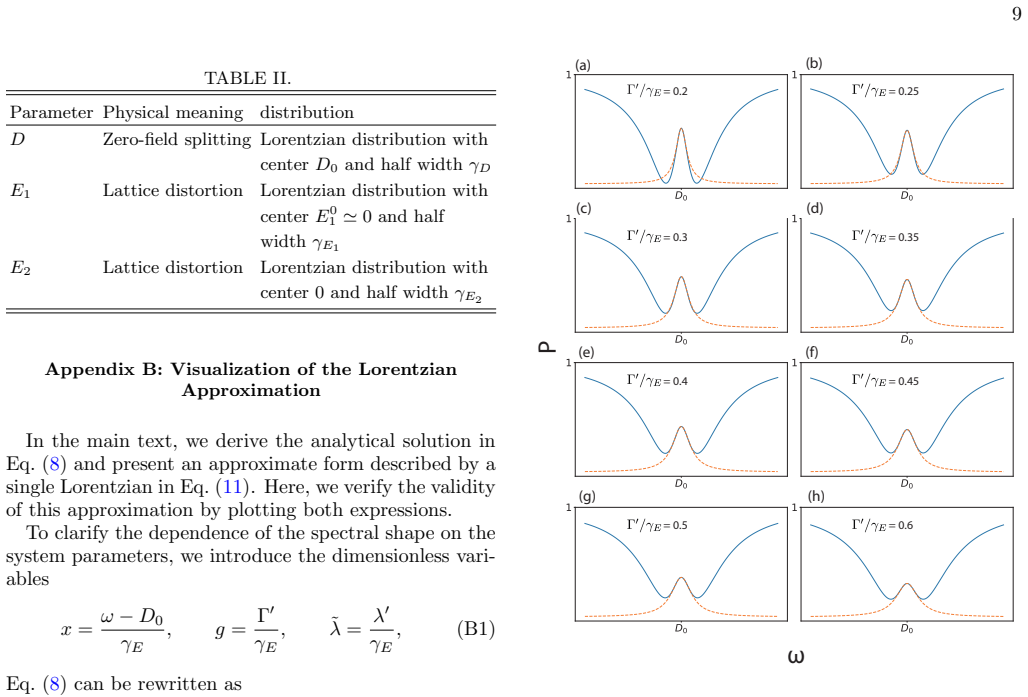
Starting from a physical model of ensemble cw-ODMR spectra as a convolution of single-NV responses with distributed zero-field splitting and strain, the spectral feature near resonance is accurately approximated by a single Lorentzian function with a background term. This approximation enables the dip-peak fitting method to extract the resonance frequency more faithfully than conventional models, allowing faster and more accurate temperature sensing under weaker microwave excitation, as confirmed by experiments on fluorescent nanodiamond ensembles.
What carries the argument
Dip-peak fitting, which uses a single Lorentzian with background term to model the near-resonance feature in ensemble cw-ODMR spectra derived from convolving distributed single-NV responses.
If this is right
- Resonance frequency can be extracted more accurately from the spectra.
- Temperature estimation precision increases for ensemble NV sensors.
- Measurements can be performed with weaker microwave excitation.
- Data acquisition can be faster while maintaining accuracy.
Where Pith is reading between the lines
- Similar modeling approaches could improve sensitivity in other distributed quantum sensor ensembles.
- This fitting method might reduce the required microwave power, lowering heating effects in biological applications.
- Extending the model to include more distributions could further refine fits for specific diamond samples.
Load-bearing premise
That the convolution of single-NV responses with distributions of zero-field splitting and strain results in a spectrum near resonance that is accurately captured by one Lorentzian plus a background term.
What would settle it
Compare the root-mean-square fitting residual or the standard deviation of extracted resonance frequencies between the proposed model and conventional Lorentzian/Voigt fits on the same set of experimental ensemble cw-ODMR spectra; if the new model does not yield lower errors, the approximation does not hold.
Figures

read the original abstract
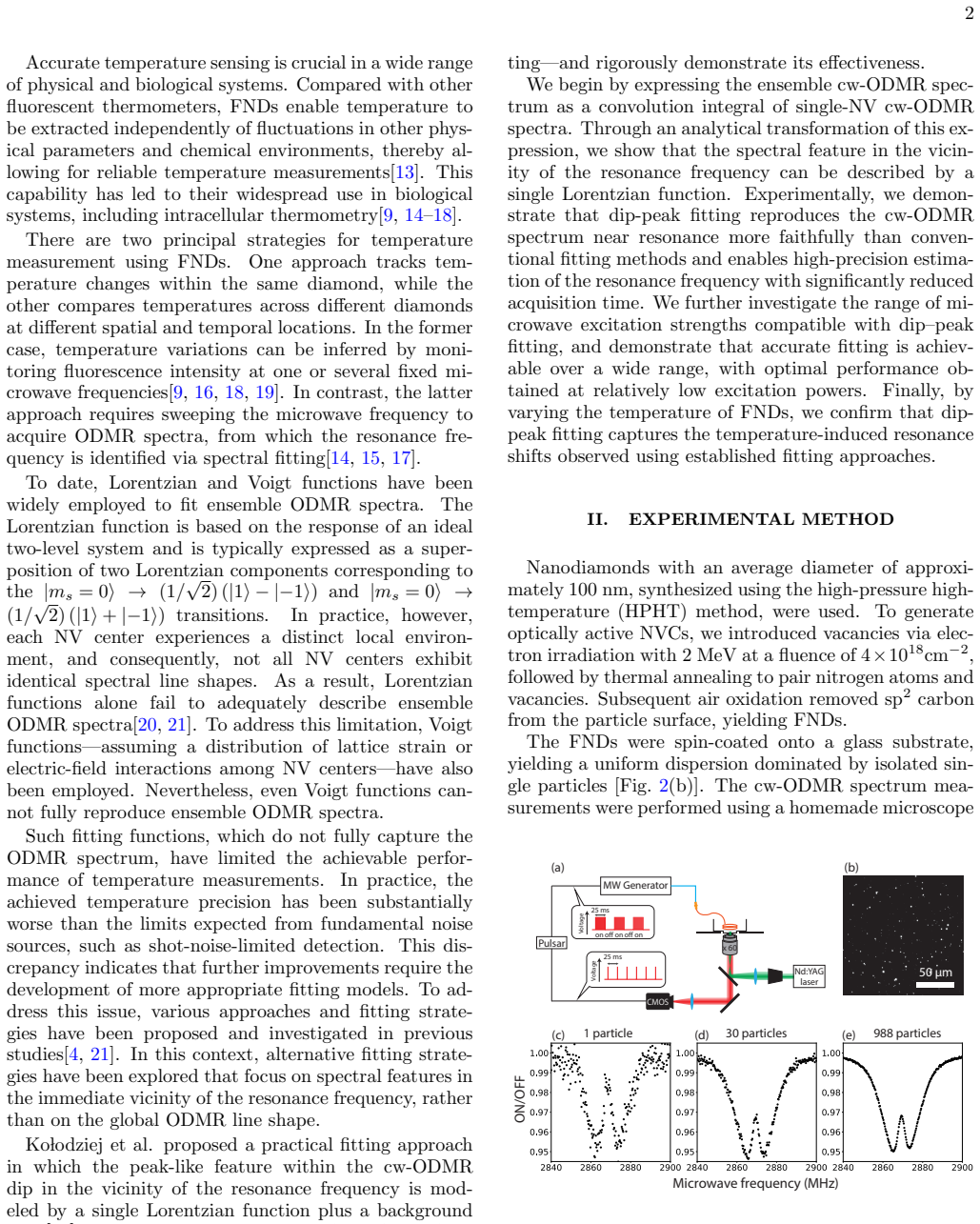
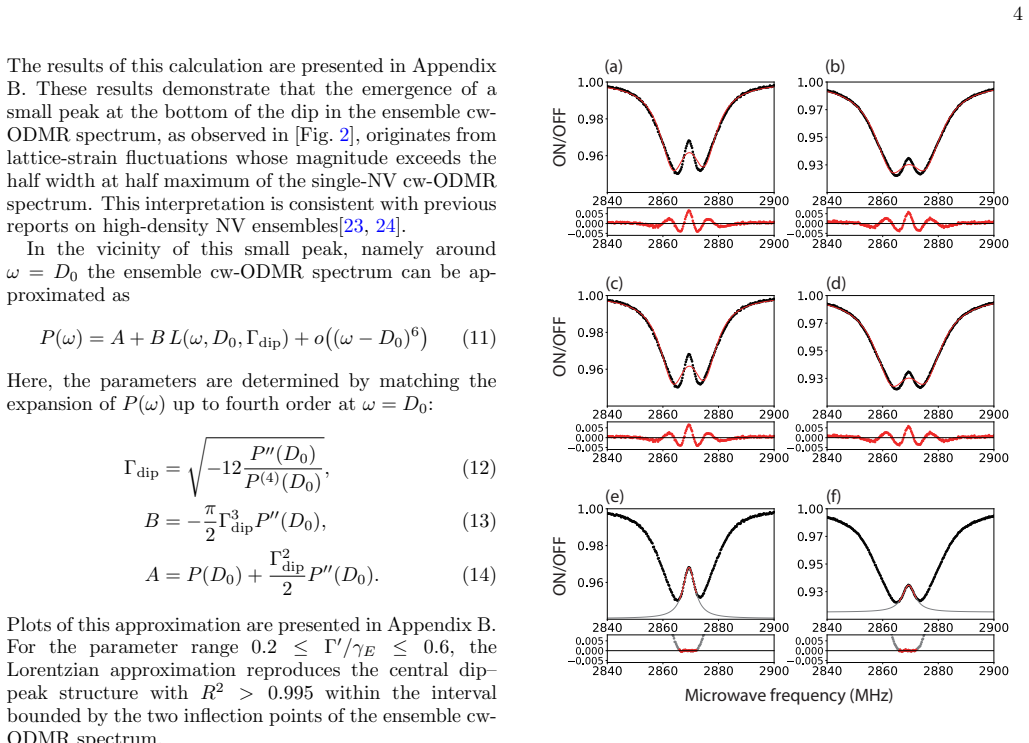
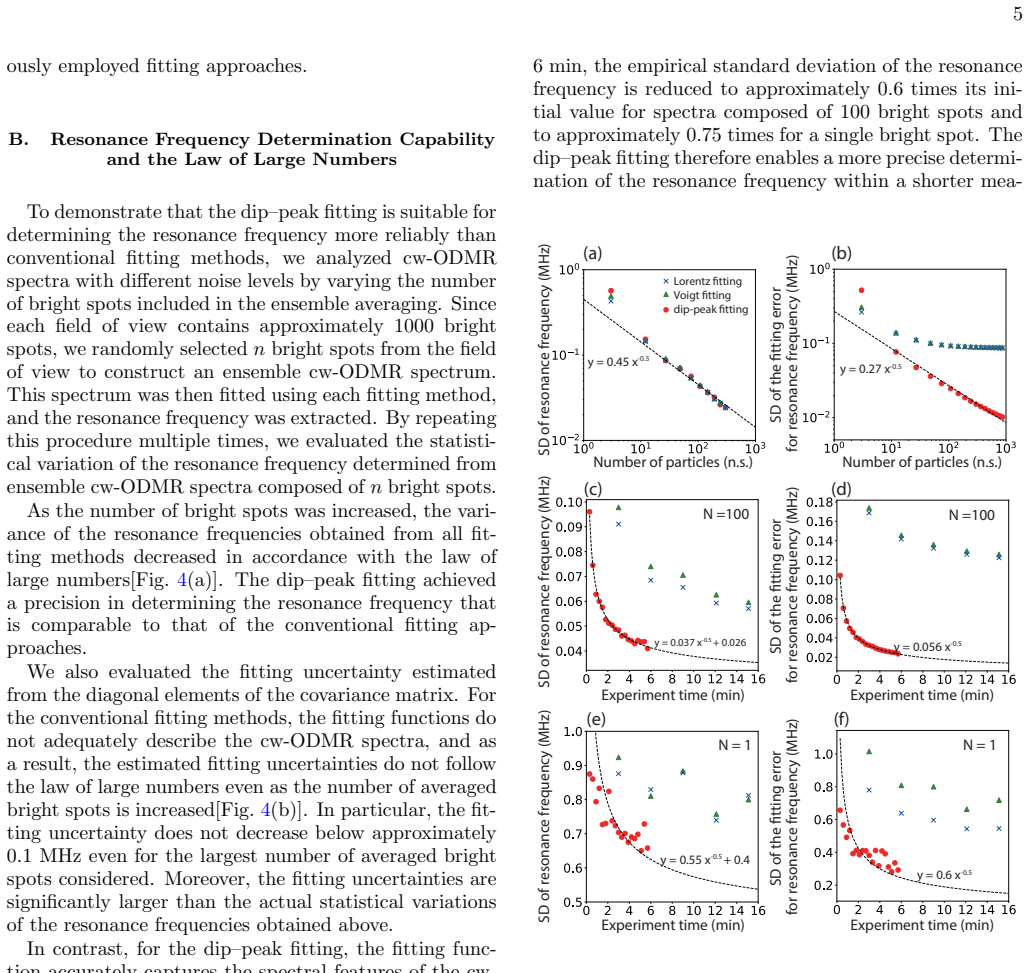
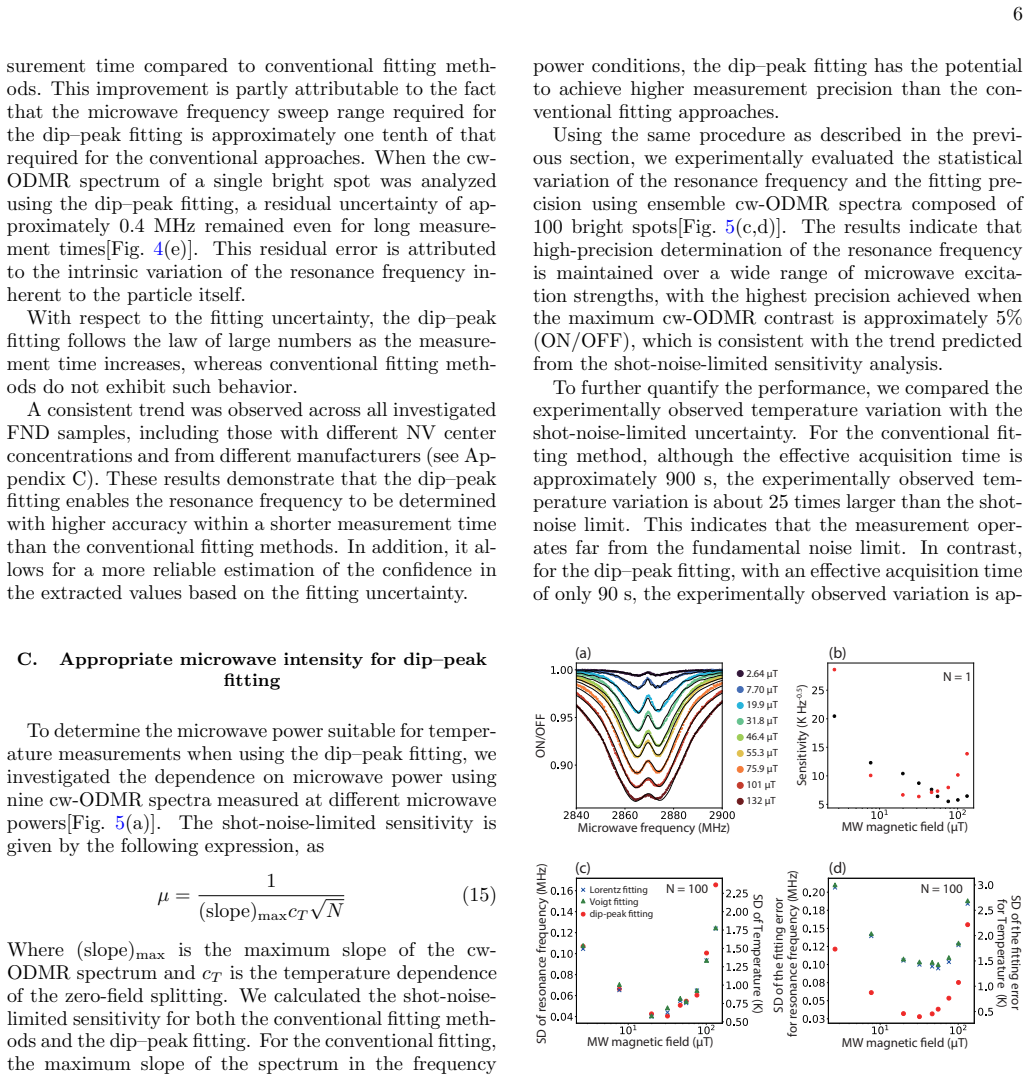
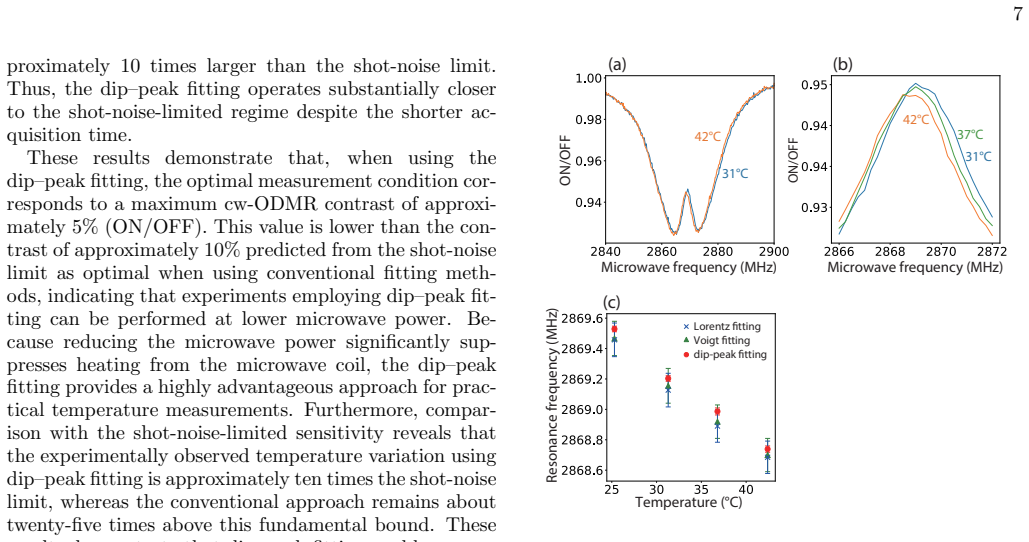
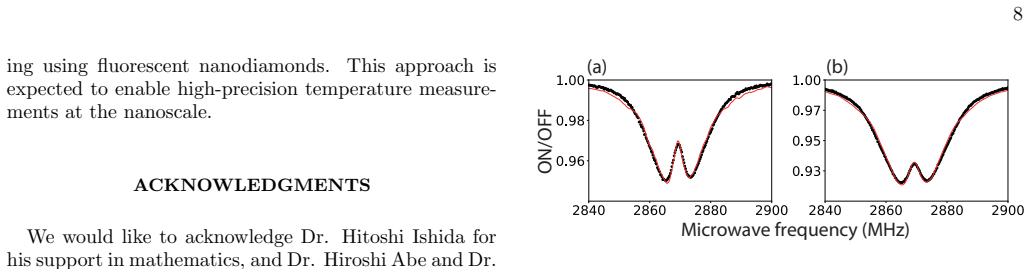
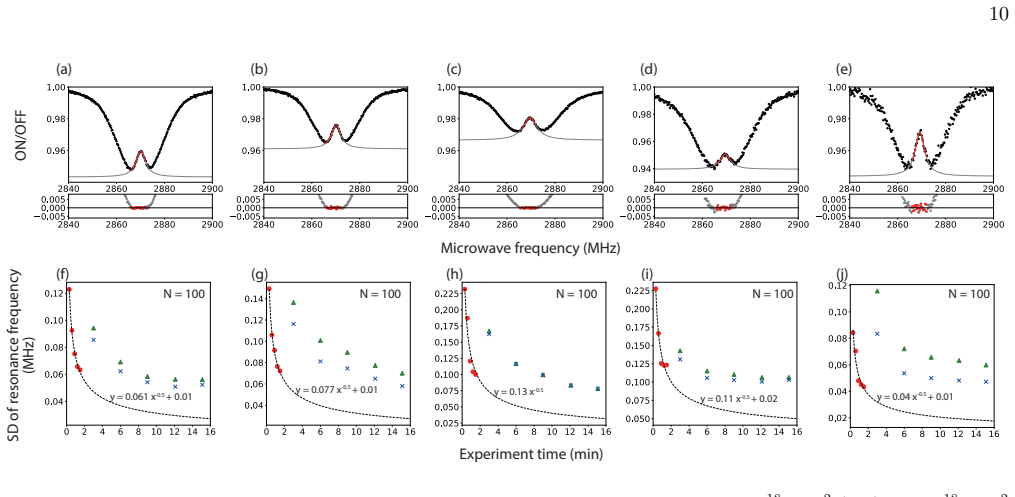
Nitrogen-vacancy (NV) center ensembles provide a powerful platform for high-precision temperature sensing, with ongoing efforts to further enhance their measurement performance. In ensemble NV optically detected magnetic resonance (ODMR) spectra, commonly used Lorentzian and Voigt fitting models fail to accurately describe the spectral shape near the resonance frequency, leading to degraded precision in resonance-frequency determination and, consequently, temperature estimation. In this work, we analytically establish a new fitting method, termed dip-peak fitting, for extracting the resonance frequency from ensemble cw-ODMR spectra. Starting from a physical model that describes ensemble cw-ODMR spectra as a convolution of single-NV responses with distributed zero-field splitting and strain, we show that the spectral feature near resonance can be accurately approximated by a single Lorentzian function with a background term. The proposed fitting model reproduces the cw-ODMR spectrum around resonance more faithfully than conventional approaches, enabling faster and more accurate resonance-frequency determination under weaker microwave excitation. Experiments using fluorescent nanodiamond ensembles confirm the robustness and applicability of this method for high-precision temperature sensing.
Editorial analysis
A structured set of objections, weighed in public.
Referee Report
Summary. The manuscript proposes a 'dip-peak fitting' method for extracting resonance frequencies from ensemble NV-center cw-ODMR spectra to improve temperature sensing precision. Starting from a physical convolution model of single-NV responses with distributed zero-field splitting and strain, the authors claim that the near-resonance spectral feature is accurately approximated by a single Lorentzian plus background term. This is asserted to outperform standard Lorentzian and Voigt fits, enabling better performance at weaker microwave excitation, with experimental confirmation reported on fluorescent nanodiamond ensembles.
Significance. If the claimed approximation holds over the relevant parameter range and demonstrably improves resonance-frequency precision, the work could meaningfully advance practical ensemble NV temperature sensors by reducing required microwave power while maintaining or increasing sensitivity. The experimental component on nanodiamonds provides a useful test bed, but the absence of explicit equations, validity bounds, and quantitative error analysis in the presented material limits the immediate assessed impact.
major comments (2)
- [Abstract] Abstract (paragraph on derivation): The central claim that the convolution of single-NV responses with ZFS/strain distributions yields a near-resonance feature accurately fit by one Lorentzian plus background is load-bearing, yet the text provides neither the explicit functional forms of the distributions nor the integration steps that produce the claimed Lorentzian approximation. Without these, it is impossible to verify the regime of validity (e.g., rms strain ≪ linewidth) or to confirm that the result remains single-peaked and symmetric inside the fitting window.
- [Abstract] Abstract and experimental section: No quantitative comparison of resonance-frequency extraction errors, temperature sensitivity figures of merit, or statistical uncertainties is supplied between the proposed dip-peak fit and conventional Lorentzian/Voigt models. This omission prevents assessment of whether the reported improvement is statistically significant or merely visual.
minor comments (2)
- The term 'dip-peak fitting' is introduced without a clear definition of the background functional form or how the peak and dip components are parameterized; a short equation or diagram would remove ambiguity.
- The manuscript would benefit from a brief statement of the microwave power levels used in the 'weaker excitation' regime and the corresponding ODMR contrast values.
Simulated Author's Rebuttal
We thank the referee for their careful and constructive review of our manuscript. We have addressed each major comment below and will revise the manuscript accordingly to improve clarity, provide missing details, and strengthen the quantitative analysis.
read point-by-point responses
-
Referee: [Abstract] Abstract (paragraph on derivation): The central claim that the convolution of single-NV responses with ZFS/strain distributions yields a near-resonance feature accurately fit by one Lorentzian plus background is load-bearing, yet the text provides neither the explicit functional forms of the distributions nor the integration steps that produce the claimed Lorentzian approximation. Without these, it is impossible to verify the regime of validity (e.g., rms strain ≪ linewidth) or to confirm that the result remains single-peaked and symmetric inside the fitting window.
Authors: We agree that the abstract does not contain the explicit functional forms or integration steps. The full manuscript derives the approximation from a convolution of single-NV Lorentzian responses with Gaussian distributions for zero-field splitting and strain; the near-resonance feature reduces to a Lorentzian plus linear background when the rms strain is much smaller than the linewidth. To make this self-contained, we will revise the abstract to include a concise statement of the assumed distributions (Gaussian with given rms values), the key steps of the integration, and the validity condition (rms strain ≪ linewidth) that preserves single-peaked symmetry within the fitting window. revision: yes
-
Referee: [Abstract] Abstract and experimental section: No quantitative comparison of resonance-frequency extraction errors, temperature sensitivity figures of merit, or statistical uncertainties is supplied between the proposed dip-peak fit and conventional Lorentzian/Voigt models. This omission prevents assessment of whether the reported improvement is statistically significant or merely visual.
Authors: We acknowledge that quantitative metrics are required to substantiate the claimed improvement. In the revised manuscript we will add a dedicated comparison subsection (or supplementary figure) reporting root-mean-square errors in extracted resonance frequencies, temperature sensitivity figures of merit (e.g., in mK/√Hz), and statistical uncertainties obtained from repeated measurements for the dip-peak, Lorentzian, and Voigt models. These data will allow direct evaluation of statistical significance. revision: yes
Circularity Check
No circularity: derivation proceeds from external physical convolution model to analytical approximation
full rationale
The paper starts from a stated physical model of ensemble cw-ODMR spectra as the convolution of single-NV responses with distributed zero-field splitting and strain, then analytically shows that the near-resonance feature can be approximated by a single Lorentzian plus background. This is a forward mathematical reduction from an independent physical description rather than a self-definitional loop, a fitted parameter renamed as prediction, or a load-bearing self-citation. No equations or steps in the provided abstract reduce the claimed approximation to the target temperature or resonance data by construction; the fitting form is presented as derived rather than tuned directly to the spectra being analyzed. The derivation is therefore self-contained against the external physical model and receives the default non-circularity finding.
Axiom & Free-Parameter Ledger
axioms (1)
- domain assumption Ensemble cw-ODMR spectra can be modeled as a convolution of single-NV responses with distributed zero-field splitting and strain
Lean theorems connected to this paper
-
IndisputableMonolith/Cost/FunctionalEquation.leanwashburn_uniqueness_aczel unclear?
unclearRelation between the paper passage and the cited Recognition theorem.
Starting from a physical model that describes ensemble cw-ODMR spectra as a convolution of single-NV responses with distributed zero-field splitting and strain, we show that the spectral feature near resonance can be accurately approximated by a single Lorentzian function with a background term.
-
IndisputableMonolith/Foundation/AlphaCoordinateFixation.leancostAlphaLog_high_calibrated_iff unclear?
unclearRelation between the paper passage and the cited Recognition theorem.
P = 1−λ′ ∫ dD dE1 dE2 L(E1,0,γE1) L(E2,0,γE2) L(D,D0,γD) [L(ω,D+√(E1²+E2²),Γ) + L(ω,D−√(E1²+E2²),Γ)]
What do these tags mean?
- matches
- The paper's claim is directly supported by a theorem in the formal canon.
- supports
- The theorem supports part of the paper's argument, but the paper may add assumptions or extra steps.
- extends
- The paper goes beyond the formal theorem; the theorem is a base layer rather than the whole result.
- uses
- The paper appears to rely on the theorem as machinery.
- contradicts
- The paper's claim conflicts with a theorem or certificate in the canon.
- unclear
- Pith found a possible connection, but the passage is too broad, indirect, or ambiguous to say the theorem truly supports the claim.
Reference graph
Works this paper leans on
-
[1]
(|1⟩ − |−1⟩) and|m s = 0⟩ → (1/ √
-
[2]
(|1⟩+|−1⟩) transitions. In practice, however, each NV center experiences a distinct local environ- ment, and consequently, not all NV centers exhibit identical spectral line shapes. As a result, Lorentzian functions alone fail to adequately describe ensemble ODMR spectra[20, 21]. To address this limitation, Voigt functions—assuming a distribution of latti...
-
[3]
(|1⟩+|−1⟩), and|D⟩= (1/ √
-
[4]
(|1⟩ − |−1⟩). The time evolution of the density matrixρunder this Hamiltonian is analyzed using the Lindblad master equation to incorporate decoherence ef- fects. dρ(t) dt =− i ℏ H, ρ(t) + 4X j=1 γj[2Ljρ(t)L† j (A8) −L† jLjρ(t)−ρ(t)L † jLj].(A9) whereL 1 =|B⟩ ⟨D|, L 2 =|D⟩ ⟨B|, L 3 =|B⟩ ⟨0|, and L4 =|D⟩ ⟨0|. The corresponding decay rates are taken asγ 1 =...
- [5]
-
[6]
M. W. Doherty, N. B. Manson, P. Delaney, F. Jelezko, J. Wrachtrup, and L. C. Hollenberg, The nitrogen- vacancy colour centre in diamond, Physics Reports528, 1 (2013)
work page 2013
-
[7]
R. Schirhagl, K. Chang, M. Loretz, and C. L. Degen, Nitrogen-Vacancy Centers in Diamond: Nanoscale Sen- sors for Physics and Biology, Annual Review of Physical Chemistry65, 83 (2014)
work page 2014
-
[8]
K. Hayashi, Y. Matsuzaki, T. Taniguchi, T. Shimo- Oka, I. Nakamura, S. Onoda, T. Ohshima, H. Mor- ishita, M. Fujiwara, S. Saito, and N. Mizuochi, Opti- mization of Temperature Sensitivity Using the Optically Detected Magnetic-Resonance Spectrum of a Nitrogen- Vacancy Center Ensemble, Physical Review Applied10, 034009 (2018)
work page 2018
-
[9]
G. Balasubramanian, I. Y. Chan, R. Kolesov, M. Al- Hmoud, J. Tisler, C. Shin, C. Kim, A. Wojcik, P. R. Hem- mer, A. Krueger, T. Hanke, A. Leitenstorfer, R. Brats- chitsch, F. Jelezko, and J. Wrachtrup, Nanoscale imaging magnetometry with diamond spins under ambient condi- tions, Nature455, 648 (2008)
work page 2008
-
[10]
J. R. Maze, P. L. Stanwix, J. S. Hodges, S. Hong, J. M. Taylor, P. Cappellaro, L. Jiang, M. V. G. Dutt, E. Togan, A. S. Zibrov, A. Yacoby, R. L. Walsworth, and M. D. Lukin, Nanoscale magnetic sensing with an individual electronic spin in diamond, Nature455, 644 (2008)
work page 2008
- [11]
-
[12]
F. Dolde, M. W. Doherty, J. Michl, I. Jakobi, B. Nay- denov, S. Pezzagna, J. Meijer, P. Neumann, F. Jelezko, N. B. Manson, and J. Wrachtrup, Nanoscale Detection of a Single Fundamental Charge in Ambient Conditions Us- ing the NV - Center in Diamond, Physical Review Letters 112, 097603 (2014)
work page 2014
- [13]
-
[14]
Gali,Ab initiotheory of the nitrogen-vacancy center in diamond, Nanophotonics8, 1907 (2019)
´A. Gali,Ab initiotheory of the nitrogen-vacancy center in diamond, Nanophotonics8, 1907 (2019)
work page 1907
-
[15]
V. M. Acosta, E. Bauch, M. P. Ledbetter, A. Waxman, L.-S. Bouchard, and D. Budker, Temperature Depen- dence of the Nitrogen-Vacancy Magnetic Resonance in Diamond, Physical Review Letters104, 070801 (2010)
work page 2010
-
[16]
M. C. Cambria, G. Thiering, A. Norambuena, H. T. Di- nani, A. Gardill, I. Kemeny, V. Lordi, ´A. Gali, J. R. Maze, and S. Kolkowitz, Physically motivated analytical 11 expression for the temperature dependence of the zero- field splitting of the nitrogen-vacancy center in diamond, Physical Review B108, L180102 (2023)
work page 2023
-
[17]
T. Sekiguchi, S. Sotoma, and Y. Harada, Fluorescent nanodiamonds as a robust temperature sensor inside a single cell, Biophysics and Physicobiology15, 229 (2018)
work page 2018
- [18]
-
[19]
S. Chuma, K. Kiyosue, T. Akiyama, M. Kinoshita, Y. Shimazaki, S. Uchiyama, S. Sotoma, K. Okabe, and Y. Harada, Implication of thermal signaling in neuronal differentiation revealed by manipulation and measure- ment of intracellular temperature, Nature Communica- tions15, 3473 (2024)
work page 2024
-
[20]
K. Wu, Q. Lu, Y. Ren, P. Balasubramanian, K. Ebadi Jalal, H. Klug, M. Klein, T. Bohn, T. Bopp, F. Jelezko, Y. Wu, and T. Weil, Single-Cell Hyperther- mia: Diamond Quantum Thermometry Reveals Thermal Control of Macrophage Polarization, Advanced Materials 38, e17076 (2026)
work page 2026
-
[21]
Y. Lee, K. Kim, D. Kim, and J. S. Lee, Organelle- Specific Quantum Thermometry Using Fluorescent Nan- odiamonds: Insights into Cellular Metabolic Thermody- namics, Journal of the American Chemical Society147, 13180 (2025)
work page 2025
-
[22]
F. T.-K. So, N. Hariki, M. Nemoto, A. I. Shames, M. Liu, A. Tsurui, T. Yoshikawa, Y. Makino, M. Ohori, M. Fuji- wara, E. D. Herbschleb, N. Morioka, I. Ohki, M. Shi- rakawa, R. Igarashi, M. Nishikawa, and N. Mizuochi, Small multimodal thermometry with detonation-created multi-color centers in detonation nanodiamond, APL Materials12, 051102 (2024)
work page 2024
-
[23]
M. Fujiwara, A. Dohms, K. Suto, Y. Nishimura, K. Os- himi, Y. Teki, K. Cai, O. Benson, and Y. Shikano, Real-time estimation of the optically detected magnetic resonance shift in diamond quantum thermometry to- ward biological applications, Physical Review Research 2, 043415 (2020)
work page 2020
-
[24]
Y. Kubo, F. R. Ong, P. Bertet, D. Vion, V. Jacques, D. Zheng, A. Dr´ eau, J.-F. Roch, A. Auffeves, F. Jelezko, J. Wrachtrup, M. F. Barthe, P. Bergonzo, and D. Es- teve, Strong Coupling of a Spin Ensemble to a Supercon- ducting Resonator, Physical Review Letters105, 140502 (2010)
work page 2010
-
[25]
K. Yamamoto, K. Ogawa, M. Tsukamoto, Y. Ashida, K. Sasaki, and K. Kobayashi, Nanodiamond quantum thermometry assisted with machine learning, Applied Physics Express18, 025001 (2025)
work page 2025
-
[26]
T. Ko lodziej, M. Mr´ ozek, S. Sengottuvel, M. J. G lowacki, M. Ficek, W. Gawlik, Z. Rajfur, and A. M. Woj- ciechowski, Multimodal analysis of traction forces and the temperature dynamics of living cells with a diamond- embedded substrate, Biomedical Optics Express15, 4024 (2024)
work page 2024
-
[27]
Y. Matsuzaki, H. Morishita, T. Shimooka, T. Tashima, K. Kakuyanagi, K. Semba, W. J. Munro, H. Yamaguchi, N. Mizuochi, and S. Saito, Optically detected magnetic resonance of high-density ensemble of NV- centers in dia- mond, Journal of Physics: Condensed Matter28, 275302 (2016)
work page 2016
-
[28]
T. Mittiga, S. Hsieh, C. Zu, B. Kobrin, F. Machado, P. Bhattacharyya, N. Rui, A. Jarmola, S. Choi, D. Bud- ker, and N. Yao, Imaging the Local Charge Environment of Nitrogen-Vacancy Centers in Diamond, Physical Re- view Letters121, 246402 (2018)
work page 2018
-
[29]
X. Zhu, Y. Matsuzaki, R. Ams¨ uss, K. Kakuyanagi, T. Shimo-Oka, N. Mizuochi, K. Nemoto, K. Semba, W. J. Munro, and S. Saito, Observation of dark states in a su- perconductor diamond quantum hybrid system, Nature Communications5, 3524 (2014)
work page 2014
discussion (0)
Sign in with ORCID, Apple, or X to comment. Anyone can read and Pith papers without signing in.