REVIEW 5 major objections 6 minor 28 references
Phase-dependent kink collisions and dual critical-velocity branches in the complex sine-Gordon model
T0 review · 5 major / 6 minor · reviewed 2026-08-02 · deepseek-v4-flash
Pith's one-line read The paper establishes that the relative phase between two complex sine-Gordon kinks controls whether collisions scatter or trap them, and that the critical velocity has two opposite branches.
desk verdict The red critical-velocity branch is a genuinely new and plausible kink phenomenology claim, but the paper's unstated capture criterion and finite-time labels keep it from being fully established. read the letter →
The pith
A machine-rendered reading of the paper's core claim, the machinery that carries it, and where it could break.
The reading
What carries the argument
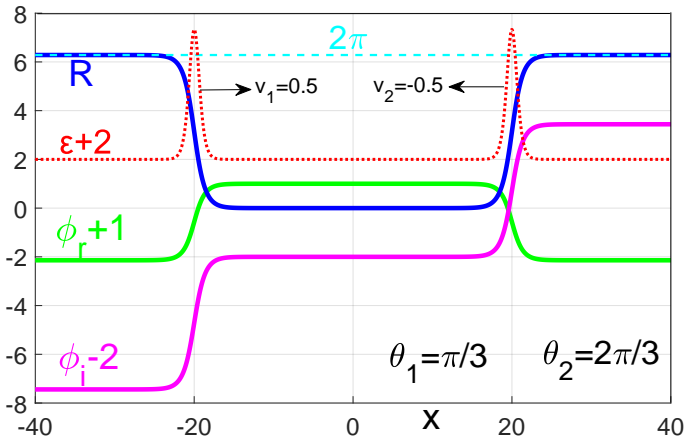
The central object is the complex kink solution φ_v = |4 arctan(e^{γ(x-vt-a)})| e^{iθ}, carrying a fixed internal phase θ; collisions are controlled by the relative phase θ = θ2 − θ1 because of global U(1) symmetry. The phase makes each component (real and imaginary) a sub-kink or sub-antikink, giving the kink an internal structure absent in real sine-Gordon theory. The critical-velocity map in (θ, v) space—two branches, red and blue—is the mechanism that organizes all outcomes: scattering, capture, bion formation, breather-like states, and radiation.
What would settle it
Run a red-branch collision, e.g., θ=0.2π at v=0.6, for a substantially longer time than the reported simulations (say t≳1000) and watch the central energy density; if it trends to zero after a long plateau, the 'capture' is delayed annihilation, not capture, and the red branch's meaning changes. The same check should be applied to the velocity just above v_c at θ=0.3π, where the paper locates v≈0.249.
Extended reading notes
Core claim
The central claim is that out-of-phase complex kink collisions in the complex sine-Gordon model exhibit two distinct branches of critical velocity. For relative phases roughly between 0.16π and 0.5π, the critical velocity is a red branch: initial velocities above v_c lead to capture (bion or breather formation), while slower collisions scatter. For phases roughly between 0.55π and π, the blue branch has the conventional behavior: velocities above v_c scatter. In-phase collisions reproduce the elastic real sine-Gordon dynamics. The paper supports this by scanning the (θ, v) plane numerically and using emitted radiation energy and central energy-density extrema as outcome diagnostics.
Load-bearing premise
The load-bearing premise is that a collision labeled 'capture' or 'scattering' within the simulated time window reflects what would happen over arbitrarily long times; the authors themselves note that bions can later radiate all their energy and vanish, so this premise can fail.
Editorial extensions
If this is right
- The relative phase becomes a usable control knob: for phases in the red branch, tuning initial velocity upward crosses from scattering into capture, the reverse of the usual kink-collision rule.
- Out-of-phase collisions always emit radiative profiles; in capture events the radiated energy can exceed the initial kinetic energy, meaning part of the kink rest energy is converted to radiation and kink regeneration is impossible.
- Captured states are not homogeneous: long-lived breather-like states coexist with bions that radiate energy slowly and can annihilate, with two distinct oscillation periods that depend on phase and velocity.
- Extremal values of the energy density, kinetic energy, and field modulus at the collision center jump at red critical velocities, offering sensitive diagnostics; gradient-energy jumps occur only at red-type critical velocities.
- The regularity of the branches suggests a possible analytic or collective-coordinate relation between v_c and phase, which the paper proposes as future work.
Reading between the lines
- Because the paper does not state the quantitative capture criterion or its convergence in time, the red branch's 'capture' should be read as 'capture within the computed horizon'; longer runs may convert some bions into delayed annihilation, turning the two-outcome map into three outcomes.
- If confirmed, the phase-controlled inversion may be a generic feature of soliton collisions with continuous internal moduli; an obvious probe is to add a U(1) phase to kinks in other multi-component models and search for red branches.
- The radiative-energy ratio E_r/K, with its threshold near unity separating capture from scattering, could be automated into a robust order parameter for locating critical velocities in future scans.
- The phase may be a more sensitive control than velocity: the extremal-value plots show discontinuities in phase at fixed velocity, suggesting phase scans could reveal critical lines missed by velocity scans.
Editorial analysis
A structured set of objections, weighed in public.
Referee Report
Summary. The paper studies collisions of complex kinks in the complex sine-Gordon (CSG) model by numerical simulation, focusing on how the outcome depends on initial velocity and relative phase. The authors report that, unlike real sine-Gordon kinks, out-of-phase complex kinks can scatter, capture, form bions or breather-like states, and emit radiative profiles. Their central claim is that the critical velocity separating scattering from capture has two distinct phase-dependent branches: a 'red' branch where velocities above the critical value promote capture, and a 'blue' branch where higher velocities restore scattering. They also analyze the energy carried by radiative profiles and several extreme quantities at the collision center, reporting sharp transitions at the critical velocities. The paper is primarily a numerical survey, with the main novelty being the proposed dual-branch critical-velocity structure.
Significance. If the dual-branch critical-velocity claim is correct, it would be a genuinely novel phenomenon for scalar-field kink models: the relative phase would act as an internal degree of freedom that can invert the usual scattering/capture ordering with velocity. This would motivate further analytical work via collective-coordinate methods and would enrich the phenomenology of soliton collisions in non-integrable field theories. The paper also usefully documents radiation emission, bion/breather formation, and the time dependence of radiative energy in CSG collisions. However, the headline claim currently rests on a capture/scattering classification that is not operationally defined, and the paper itself acknowledges that some 'capture' states can annihilate on longer timescales. Thus the significance is conditional on a more rigorous definition of the outcome classification and on convergence checks with simulation time and numerical resolution.
major comments (5)
- [Sec. 5.1, Fig. 2] The central claim—two branches of critical velocity—lacks an operational definition of the capture/scattering classification. The text never states the quantitative criterion used to label a simulation as 'capture' versus 'scattering', nor the time window over which the outcome is judged, nor the velocity resolution used to locate v_c. Without these, the red and blue curves in Fig. 2 are not reproducible and the 'two-branch' structure is an assertion relative to unstated conventions. This is load-bearing because the entire paper's headline depends on this map.
- [Sec. 5.2, Sec. 7] The finite-time issue is acknowledged in the text: bions can radiate nearly all their energy and vanish, and 'annihilation occurs at relatively high collision velocities when capture is present.' Thus a run classified as 'capture' within the simulated window may become pair annihilation on longer evolutions, a third outcome outside the scattering/capture dichotomy. Since the red branch consists precisely of high-velocity runs labeled as capture, the red branch may be a finite-time artifact unless the authors show that the capture classification is stable over much longer times or distinguish true capture from slow annihilation. The paper provides no such convergence test.
- [Sec. 5.3, Fig. 9] The radiative-energy ratio E_r/K is used both as a diagnostic of capture (ratio > 1 'confirms that capture has occurred') and as a tool to locate critical velocities, while the capture classification is measured on the same runs. This is circular: the classification of a run as capture/scattering is not independently defined, so the ratio cannot validate the classification. The paper needs an independent outcome criterion—e.g., the long-time behavior of the central field modulus or the separation between kink centers—before using E_r/K as a diagnostic.
- [Fig. 2] The phase interval 0.5π < θ < 0.55π is absent from the numerical data, and the paper states that 'numerical determination of v_c is hindered' there. The two-branch claim is therefore made without evidence for roughly 10% of the phase domain. The gap may be a genuine numerical difficulty, but the paper must at least show why the branches terminate or how the transition between them behaves, or explicitly caveat that the dual-branch structure is only conjectured in this interval.
- [Sec. 4, Eq. (26)] The numerical method section gives only h=0.02, k=0.019, and initial separation. There are no convergence tests in h and k, no statement of the spatial domain size or boundary handling beyond 'wide enough', and no error estimates for v_c, periods, or radiative energies. Given that the paper reports a detailed phase–velocity diagram with sharp transitions, resolution and convergence are essential to ensure the observed jumps are not numerical artifacts. I recommend adding convergence tests and at least a coarse error bar or resolution estimate for the reported v_c values.
minor comments (6)
- [Fig. 2] The figure contains what appear to be leftover MATLAB data-tip annotations ('x 55 y 0.999', 'X 16 Y 0.81', 'X 40 Y 0.075'). These should be removed or replaced with proper axis labels/annotations.
- [Eq. (14)] The notation |φ_v| is overloaded: φ_v is real and can take negative values for certain N, so the absolute value should be made explicit and the branch of arctan clarified. Also, the phrase 'in-phase complex kink pairs (θ=0 or θ=π)' is confusing because θ=0 and θ=π correspond to different subfield structures; clarify what 'in-phase' means in terms of the relative sign of sub-kinks.
- [Sec. 5.3] The statement that 'Moderate variations of this threshold do not qualitatively modify the obtained results' is vague. Provide a quantitative test of the threshold dependence, e.g., show the radiative-energy curves for two or three threshold values.
- [Sec. 6] The extreme-value plots (Figs. 10 and 11) are hard to read because many curves overlap and the legend entries are abbreviated. Consider plotting selected representative phases/velocities in separate panels or using clearer styles.
- [General] The paper uses 'complex kink' for a solution whose modulus is a real sine-Gordon kink multiplied by a constant phase. This is a valid Ansatz, but the relation to the known exact solutions of the CSG model (e.g., in Ref. [19]) should be stated explicitly, since the CSG equation is not simply the real SG equation for the modulus.
- [References] Some references are incomplete or inconsistently formatted (e.g., Ref. [17] includes 'Physical Review D' with an extra comma). Please check the bibliography against the journal style.
Circularity Check
No significant circularity: the paper is a direct numerical study whose central critical-velocity branches are empirical classifications, not outputs of a derivation that reduces to its own inputs.
full rationale
The paper's derivation chain is self-contained in the relevant sense: the CSG field equation (7) is written down from the Lagrangian (6), the complex kink ansatz (14) is explicitly given and is an exact solution by construction from the real SG kink, and the numerical scheme (26) is a direct discretization of that equation. The central claim—two phase-dependent branches of critical velocity—is an observational classification of simulation outcomes, not a quantity derived from a fitted parameter or from an imported theorem. The red/blue distinction is a descriptive statement about the direction of the scattering-to-capture transition at the measured threshold, and the existence of such thresholds is a numerical finding. The radiative-energy ratio Er/K in Sec. 5.3 is introduced as a diagnostic that 'confirms that capture has occurred,' but capture itself is identified by the temporal behavior of the central energy density (Sec. 5.2), so the ratio is a consistency check, not the defining criterion. The only self-citation, ref. [19] by one of the present authors, is used for background statements about radiative excitations and general properties; it is not load-bearing for the critical-velocity branches, and no uniqueness theorem or ansatz is smuggled in through it. The manuscript does contain passages that weaken confidence in the red branch: Sec. 5.2 concedes that bions 'may either radiate nearly all their energy and vanish (pair annihilation)' and that 'annihilation occurs at relatively high collision velocities when capture is present,' and Sec. 5.3 concedes that 'high-velocity curves should therefore be interpreted with caution.' These are robustness limitations about finite-time classification, not circularity: the capture label is not defined by the quantity being predicted, and no equation is shown to be equivalent to its own input. Accordingly, no circular step meets the evidentiary bar of quoting a specific reduction, and the circularity score is 0.
Assumptions & free parameters
free parameters (3)
- radiative-profile detection threshold =
|R−2π| < 0.001
- bion remnant spatial window =
[−10,10]
- radiative energy evaluation times =
t = 20/v + 100 and t = 20/v + 220
assumptions (5)
- domain assumption The discretized equation (26) with h=0.02, k=0.019 (CFL≈0.95) faithfully approximates the PDE (7) over simulated times
- domain assumption Initial condition (25), a linear superposition plus constant shift with separation 2a=40, faithfully represents two isolated complex kinks with well-defined relative phase
- standard math The constant-phase real SG kink (14) and the modulus-nπ traveling waves (18)-(20) are exact solutions of the CSG equation (7)
- domain assumption Collision outcome depends only on the phase difference θ2−θ1 and is even under θ→−θ
- ad hoc to paper Regions with |R−2π|<0.001 outside the collision core contain the emitted radiation and no appreciable kink-tail energy
Cite this review
Pith. "Pith review of Phase-dependent kink collisions and dual critical-velocity branches in the complex sine-Gordon model." pith.science (2026). https://pith.science/paper/SMJ36WY4
@misc{pith2026260708752,
  author       = {Pith},
  title        = {Pith review of: Phase-dependent kink collisions and dual critical-velocity branches in the complex sine-Gordon model},
  year         = {2026},
  howpublished = {\url{https://pith.science/paper/SMJ36WY4}},
  note         = {Machine review of arXiv:2607.08752}
}
read the original abstract
The complex sine-Gordon (CSG) model contains an internal phase degree of freedom that strongly modifies the dynamics of its solitary-wave solutions. We present a numerical study of complex kink--kink collisions and determine how the final state depends jointly on the initial velocity and relative phase. In contrast with the elastic collisions of the real sine-Gordon model, the CSG system exhibits scattering, capture, long-lived bion formation, breather-like states, and emission of radiative profiles. The simulations reveal two distinct phase-dependent branches of critical velocity. In one branch, increasing the initial velocity promotes capture, whereas in the other it restores scattering. This dual structure highlights the rich velocity--phase dependence of the collision dynamics. We also compute the energy carried by radiative profiles and examine extreme values of the energy density, kinetic and gradient contributions, and field modulus at the collision center. These quantities show sharp transitions at critical points and provide sensitive diagnostics of phase-controlled dynamics. These results suggest that the relative phase behaves as an effective internal degree of freedom that plays an important role in the collision dynamics of complex solitons.
Figures


Figures from the paper (8 more)


Reference graph
Works this paper leans on
-
[1]
Vachaspati,Kinks and Domain Walls: An Introduction to Classical and Quantum Solitons(Cambridge University Press, Cambridge, 2006)
T. Vachaspati,Kinks and Domain Walls: An Introduction to Classical and Quantum Solitons(Cambridge University Press, Cambridge, 2006)
2006
-
[2]
Vilenkin and E
A. Vilenkin and E. P. S. Shellard,Cosmic Strings and Other Topological Defects (Cambridge University Press, Cambridge, 1994)
1994
-
[3]
Manton and P
N. Manton and P. Sutcliffe,Topological Solitons(Cambridge University Press, Cam- bridge, 2004)
2004
-
[4]
Dauxois and M
T. Dauxois and M. Peyrard,Physics of Solitons(Cambridge University Press, Cam- bridge, 2006)
2006
-
[5]
O. M. Braun and Y. S. Kivshar, Phys. Rep.306, 1 (1998)
1998
-
[6]
G. P. Agrawal,Nonlinear Fiber Optics(Academic Press, San Diego, 1995)
1995
-
[7]
L. V. Yakushevich,Nonlinear Physics of DNA(Wiley, Weinheim, 2006). 24
2006
-
[8]
D. K. Campbell, J. F. Schonfeld, and C. A. Wingate, Physica D9, 1 (1983)
1983
Show all 28 references
-
[9]
Anninos, S
P. Anninos, S. Oliveira, and R. A. Matzner, Phys. Rev. D44, 1147 (1991)
1991
-
[10]
R. H. Goodman and R. Haberman, SIAM J. Appl. Dyn. Syst.4, 1195 (2005)
2005
-
[11]
Dorey, K
P. Dorey, K. Mersh, T. Romanczukiewicz, and Y. Shnir, Phys. Rev. Lett.107, 091602 (2011)
2011
-
[12]
V. A. Gani and A. E. Kudryavtsev, Phys. Rev. E60, 3305 (1999)
1999
-
[13]
E. R. C. Abraham and P. K. Townsend, Phys. Lett. B291, 85 (1992)
1992
-
[14]
R. A. Leese, Nucl. Phys. B366, 283 (1991)
1991
-
[15]
M. Eto, T. Fujimori, S. B. Gudnason, K. Konishi, T. Nagashima, M. Nitta, K. Ohashi, and W. Vinci, J. High Energy Phys.06, 004 (2009)
2009
-
[16]
M. Eto, Y. Hirono, M. Nitta, and S. Yasui, Prog. Theor. Exp. Phys.2014, 012D01 (2014)
2014
-
[17]
Nitta, Physical Review D,105(10)(2022), 105006
M. Nitta, Physical Review D,105(10)(2022), 105006
2022
-
[18]
Tong, TASI Lectures on Solitons [arXiv:hep-th/0509216]
D. Tong, TASI Lectures on Solitons [arXiv:hep-th/0509216]
-
[19]
Mohammadi and N
M. Mohammadi and N. Riazi, Prog. Theor. Exp. Phys.2014, 023A03 (2014)
2014
-
[20]
M. I. Tsumagari, E. J. Copeland, and P. M. Saffin, Phys. Rev. D78, 065021 (2008)
2008
-
[21]
Bowcock, D
P. Bowcock, D. Foster, and P. Sutcliffe, J. Phys. A: Math. Theor.42, 085403 (2009)
2009
-
[22]
Mohammadi, Phys
M. Mohammadi, Phys. Scr.95, 045302 (2020)
2020
-
[23]
Saadatmand, S
D. Saadatmand, S. V. Dmitriev, and P. G. Kevrekidis, Phys. Rev. D92, 056005 (2015)
2015
-
[24]
A. M. Marjaneh, A. Askari, D. Saadatmand, and S. V. Dmitriev, Eur. Phys. J. B 91, 22 (2018). 25
2018
-
[25]
V. A. Gani, A. M. Moradi Marjaneh, and D. Saadatmand, Eur. Phys. J. C79, 620 (2019)
2019
-
[26]
Moradi Marjaneh, D
A. Moradi Marjaneh, D. Saadatmand, K. Zhou, S. V. Dmitriev, and M. E. Zomor- rodian, Commun. Nonlinear Sci. Numer. Simul.49, 30 (2017)
2017
-
[27]
Mohammadi and E
M. Mohammadi and E. Momeni, Chaos Solitons Fractals165, 112834 (2022)
2022
-
[28]
Moradi Marjaneh, V
A. Moradi Marjaneh, V. A. Gani, D. Saadatmand, S. V. Dmitriev, and K. Javidan, J. High Energy Phys.07, 028 (2017). 26
2017
Reviewed August 2, 2026 · model on record in the stance chip above.
Discussion (0). Continue with ORCID to comment.