Charged kaon and proton multiplicities in semi-inclusive deep-inelastic scattering with 11 GeV electrons
Pith reviewed 2026-06-26 18:26 UTC · model grok-4.3
The pith
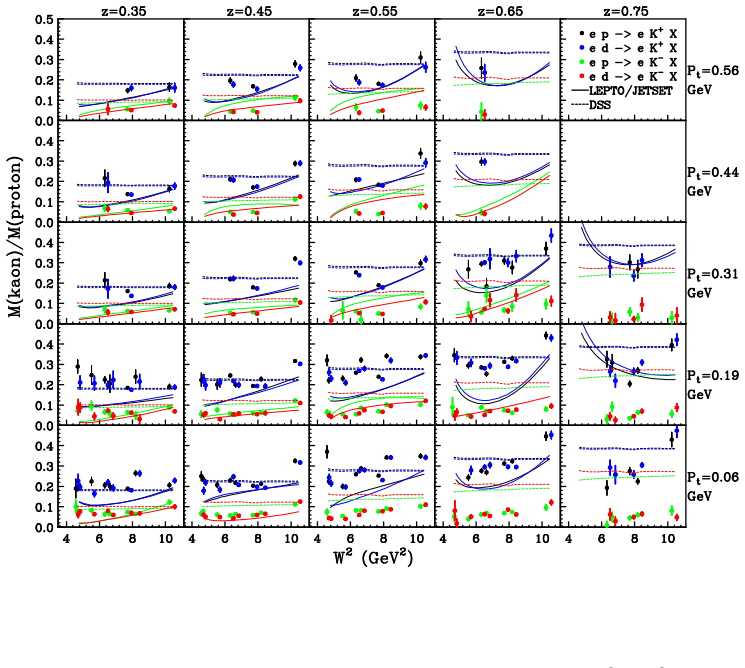
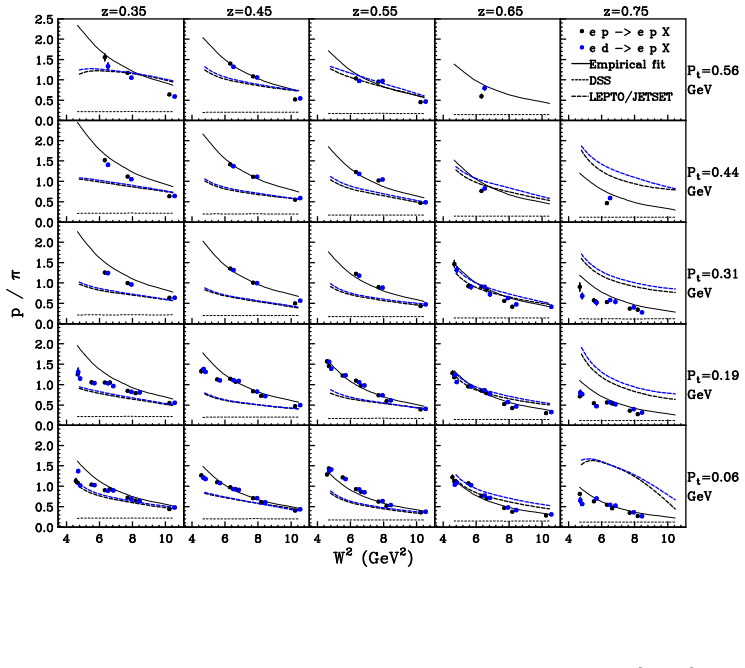
Kaon-to-pion multiplicity ratios agree with DSS fragmentation functions for K+ but lie well below for K-, while proton-to-pion ratios exceed TMD predictions especially at low W squared.
A machine-rendered reading of the paper's core claim, the machinery that carries it, and where it could break.
Core claim
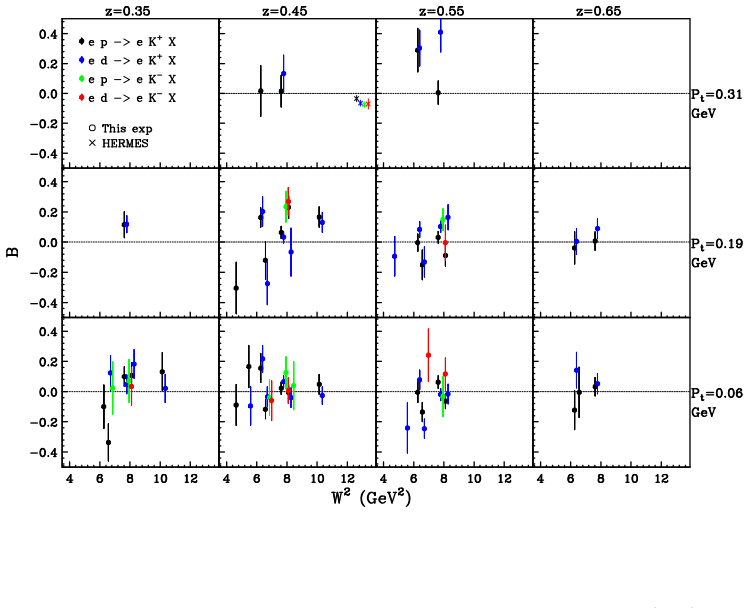
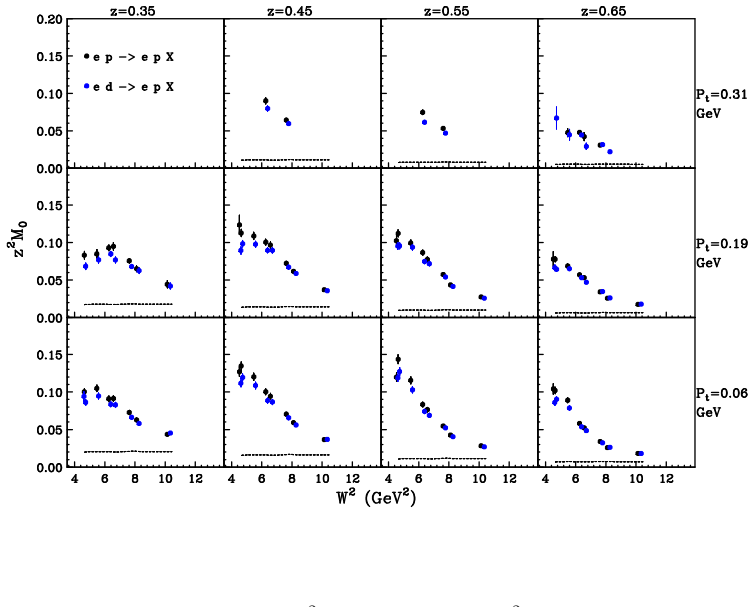
The experiment measures SIDIS multiplicities for K+, K- and protons on a grid of x, Q2, z, Pt, fitting each bin to M0[1 + A cos(φ*) + B cos(2φ*)]. Kaon-to-pion ratios of M0 match DSS for K+ but are mostly below for K-. Proton-to-pion ratios start over an order of magnitude above TMD predictions at lowest W2 and decrease to a factor of two at highest W2, with no target difference and positive average A ~0.01 while B~0. These trends match Lund MC.
What carries the argument
The three-term azimuthal fit M0[1 + A cos(φ*) + B cos(2φ*)] that extracts the unpolarized multiplicity and modulations from the data in each kinematic bin.
If this is right
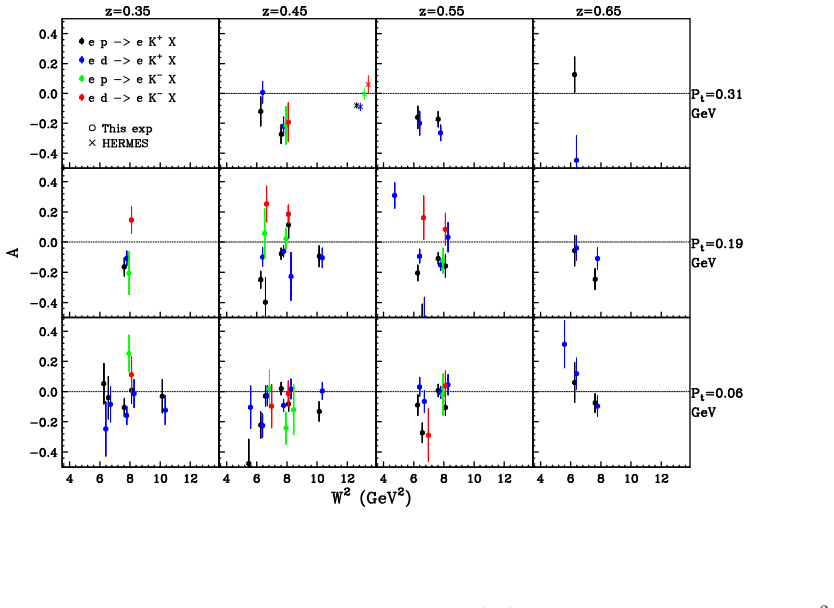
- The kaon azimuthal modulations A and B are consistent with zero.
- Proton values of A are positive with average ~0.01, B consistent with zero.
- Trends in proton-to-pion ratios are consistent with Lund Monte Carlo predictions.
- No significant difference between proton and deuteron targets for the ratios.
Where Pith is reading between the lines
- The results suggest that TMD factorization may not fully apply in the soft central region for protons.
- Improved fragmentation functions or additional mechanisms may be needed to describe negative kaon production.
- Further data at higher W2 could test the approach to TMD regime.
Load-bearing premise
The chosen kinematic cuts and the three-term azimuthal fit sufficiently isolate the intended SIDIS signal without substantial contamination from other processes in the soft central region.
What would settle it
A measurement showing proton-to-pion ratios matching TMD predictions at low W2 or significant differences between proton and deuteron targets would contradict the reported trends.
Figures



read the original abstract
Measurements of SIDIS multiplicities for charged kaons and protons from proton and deuteron targets are reported on a grid of hadron kinematic variables $0.3<z<0.7$ and $P_{t}<0.6$ GeV for leptonic variables $0.3<x<0.6$ and $3<Q^2<6$ GeV$^2$. Data were acquired in 2018-2019 at Jefferson Lab Hall C with 10.2 and 10.6~GeV electron beams impinging on 10-cm-long liquid hydrogen and deuterium targets. Electrons (hadrons) were detected in the HMS (SHMS) spectrometers. Multiplicities were fitted for each bin in $(x,~Q^2,~z,~P_{t})$ as $M_0[1+A\cos(\phi^*)+B\cos(2\phi^*)]$. The kaon kinematic range spans the regions where transverse-momentum-dependent factorization can be applied in SIDIS, and a `soft' central region where other processes are of critical importance. The kaon to pion ratios of $M_0$ are in reasonable agreement with predictions using the DSS fragmentation functions for $K^+$, but are mostly well below them for $K^-$. The kaon azimuthal modulations are consistent with zero. The kinematic range for protons is centered on the `soft' central region. The proton-to-pion multiplicity ratios are more than an order-of-magnitude larger than TMD predictions at the lowest value of $W^2$, decreasing to as little as a factor of two at the highest value of $W^2$. No significant difference is observed between proton and deuteron targets. These trends are consistent with Lund Monte Carlo predictions. The proton values of $A$ are consistently positive, with an average value of approximately 0.01, while $B$ is consistent with zero.
Editorial analysis
A structured set of objections, weighed in public.
Referee Report
Summary. The paper reports measurements of charged kaon and proton multiplicities in semi-inclusive deep-inelastic scattering (SIDIS) from proton and deuteron targets using 10.2 and 10.6 GeV electron beams at Jefferson Lab Hall C. Multiplicities are extracted in bins of x (0.3-0.6), Q² (3-6 GeV²), z (0.3-0.7), and Pt (<0.6 GeV) as the constant term M0 from the three-term azimuthal fit M0[1 + A cos(φ*) + B cos(2φ*)]. Kaon-to-pion M0 ratios are compared to DSS fragmentation functions (reasonable agreement for K+, below for K-), while proton-to-pion ratios exceed TMD predictions (by >10x at low W², down to ~2x at high W²), show no proton-deuteron difference, and align with Lund Monte Carlo; proton A is ~0.01 on average and B is consistent with zero. Kaon azimuthal modulations are consistent with zero.
Significance. If the extraction is robust, the data provide new constraints on kaon fragmentation functions in the valence region at moderate Q² and low Pt, and demonstrate the breakdown of TMD applicability for protons in the soft regime, with Lund MC offering a better description. This is useful for model development at JLab energies. The explicit consistency checks with external models are a strength, but the absence of detailed uncertainty quantification reduces the immediate utility for quantitative tuning.
major comments (2)
- [Multiplicity extraction and proton results] The proton kinematic range is centered on the soft central region where the manuscript states other processes are of critical importance, yet multiplicities are obtained solely as M0 from the assumed three-term fit form. No validation, alternative extraction, or test of azimuthal structure from non-SIDIS contributions is described, which is load-bearing for the central claim that proton-to-pion ratios exceed TMD predictions and match Lund MC (see abstract description of proton results and the fit procedure).
- [Results and comparisons] The reported results and model comparisons (including kaon-to-pion and proton-to-pion ratios) lack quantitative error bars, systematic uncertainty breakdown, background subtraction details, or acceptance correction information. This prevents assessment of whether the stated agreements and discrepancies are statistically significant (see abstract and all result statements).
minor comments (1)
- The title states '11 GeV electrons' while the text specifies 10.2 and 10.6 GeV beams; a clarifying note on the nominal vs. actual energy would improve precision.
Simulated Author's Rebuttal
We thank the referee for their careful review and for acknowledging the potential utility of these new SIDIS multiplicity measurements for kaon fragmentation functions and TMD applicability studies. We address the two major comments point by point below.
read point-by-point responses
-
Referee: [Multiplicity extraction and proton results] The proton kinematic range is centered on the soft central region where the manuscript states other processes are of critical importance, yet multiplicities are obtained solely as M0 from the assumed three-term fit form. No validation, alternative extraction, or test of azimuthal structure from non-SIDIS contributions is described, which is load-bearing for the central claim that proton-to-pion ratios exceed TMD predictions and match Lund MC (see abstract description of proton results and the fit procedure).
Authors: The three-term azimuthal fit is the standard method employed in SIDIS analyses to extract the azimuthally averaged multiplicity M0 while accounting for leading modulations. The Lund Monte Carlo, which models a variety of processes active in the soft region, provides a consistent description of the observed proton-to-pion ratios. We agree, however, that explicit validation of the extraction procedure would strengthen the presentation. The revised manuscript will include additional Monte Carlo studies testing the stability of M0 against alternative fit forms and assessing potential biases from non-SIDIS contributions in the proton channel. revision: yes
-
Referee: [Results and comparisons] The reported results and model comparisons (including kaon-to-pion and proton-to-pion ratios) lack quantitative error bars, systematic uncertainty breakdown, background subtraction details, or acceptance correction information. This prevents assessment of whether the stated agreements and discrepancies are statistically significant (see abstract and all result statements).
Authors: Statistical uncertainties are reported on the multiplicities and ratios in the manuscript. We acknowledge that a full breakdown of systematic uncertainties, background subtraction procedures (primarily from target walls and particle misidentification), and acceptance corrections was not presented with sufficient detail. The revised version will expand the experimental methods and results sections to include quantitative error bars on all figures, a tabulated systematic uncertainty breakdown, and explicit descriptions of the background subtraction and acceptance correction techniques derived from simulation. revision: yes
Circularity Check
No circularity: experimental measurements compared to external models
full rationale
The paper reports direct experimental extraction of multiplicities M0 via azimuthal fits to data and compares the resulting ratios to independent external models (DSS fragmentation functions, TMD predictions, Lund Monte Carlo). No theoretical derivation chain exists, no parameters are fitted to a subset and then presented as predictions, and no self-citations form a load-bearing justification for any result. The work is self-contained against external benchmarks.
Axiom & Free-Parameter Ledger
Reference graph
Works this paper leans on
-
[1]
A. Bacchetta, F. Delcarro, C. Pisano, M. Radici, and A. Signori, JHEP06, 081 (2017), [Erratum: JHEP 06, 051 (2019)], arXiv:1703.10157 [hep-ph]. 18
Pith/arXiv arXiv 2017
-
[2]
E. L. Berger, inNPAS Workshop on Electronuclear Physics with Internal Targets(1987) pp. 82–91
1987
-
[3]
M. Boglione, J. Collins, L. Gamberg, J. O. Gonzalez-Hernandez, T. C. Rogers, and N. Sato, Phys. Lett. B766, 245 (2017), arXiv:1611.10329 [hep-ph]
Pith/arXiv arXiv 2017
-
[4]
M. Boglione, A. Dotson, L. Gamberg, S. Gordon, J. O. Gonzalez-Hernandez, A. Prokudin, T. C. Rogers, and N. Sato, JHEP10, 122 (2019), arXiv:1904.12882 [hep-ph]
arXiv 2019
-
[5]
M. Boglione, M. Diefenthaler, S. Dolan, L. Gamberg, W. Melnitchouk, D. Pitonyak, A. Prokudin, N. Sato, and Z. Scalyer (Jefferson Lab Angular Momentum (JAM)), JHEP 04, 084 (2022), arXiv:2201.12197 [hep-ph]
arXiv 2022
-
[6]
Bostedet al.(Hall C SIDIS), Phys
P. Bostedet al.(Hall C SIDIS), Phys. Rev. C113, 035205 (2026), arXiv:2510.03562 [hep-ex]
Pith/arXiv arXiv 2026
-
[7]
Airapetianet al.(HERMES), Phys
A. Airapetianet al.(HERMES), Phys. Rev. D87, 074029 (2013), arXiv:1212.5407 [hep-ex]
Pith/arXiv arXiv 2013
-
[8]
Airapetianet al.(HERMES), Phys
A. Airapetianet al.(HERMES), Phys. Rev. D87, 012010 (2013), arXiv:1204.4161 [hep-ex]
Pith/arXiv arXiv 2013
-
[9]
C. Adolphet al.(COMPASS), Phys. Lett. B767, 133 (2017), arXiv:1608.06760 [hep-ex]
Pith/arXiv arXiv 2017
-
[10]
Bhattet al., Physics Letters B865, 139485 (2025)
H. Bhattet al., Physics Letters B865, 139485 (2025)
2025
-
[11]
Hornet al., Nucl
T. Hornet al., Nucl. Inst. and Meth. A842, 28 (2017)
2017
-
[12]
deFlorian, R
D. deFlorian, R. Sassot, M. Epele, R. J. Hern´ andez-Pinto, and M. Stratmann, Phys. Rev. D 91, 014035 (2015)
2015
-
[13]
Studies of the L-T Separated Kaon Electroproduction Cross Section from 5-11 GeV,
P. M. T. Horn, G. Huberet al., “Studies of the L-T Separated Kaon Electroproduction Cross Section from 5-11 GeV,” Jefferson Lab experiment E12-09-011
-
[14]
Kuhlmann, Nuclear Physics B - Proceedings Supplements79, 108 (1999), proceedings of the 7th International Workshop on Deep Inelastic Scattering and QCD
S. Kuhlmann, Nuclear Physics B - Proceedings Supplements79, 108 (1999), proceedings of the 7th International Workshop on Deep Inelastic Scattering and QCD
1999
-
[15]
G. Ingelman, A. Edin, and J. Rathsman, Comput. Phys. Commun.101, 108 (1997), arXiv:hep-ph/9605286
Pith/arXiv arXiv 1997
-
[16]
Sjostrand and M
T. Sjostrand and M. Bengtsson, Comput. Phys. Commun.43, 367 (1987)
1987
-
[17]
Hall C SIDIS results,https://hallcweb.jlab.org/experiments/HALLC_SIDIS/ 19
discussion (0)
Sign in with ORCID, Apple, or X to comment. Anyone can read and Pith papers without signing in.