REVIEW 3 major objections 3 minor 1 cited by
MV-GMN: State Space Model for Multi-View Action Recognition
T0 review · 3 major / 3 minor · reviewed 2026-08-10 · deepseek-v4-flash
Pith's one-line read The paper reports that its Multi-View Graph Mamba network (MV-GMN) outperforms existing state-of-the-art multi-view action-recognition models on NTU RGB+D 60/120 and PKU-MMD while keeping the linear inference complexity of state-space…
desk verdict First Mamba-based multi-view action recognition architecture, with competitive accuracy numbers, but the headline linear-complexity claim is contradicted by the paper's own graph construction (rule-based edges are quadratic in V and T, and KNN is quadratic in VT). read the letter →
The pith
A machine-rendered reading of the paper's core claim, the machinery that carries it, and where it could break.
The reading
What carries the argument
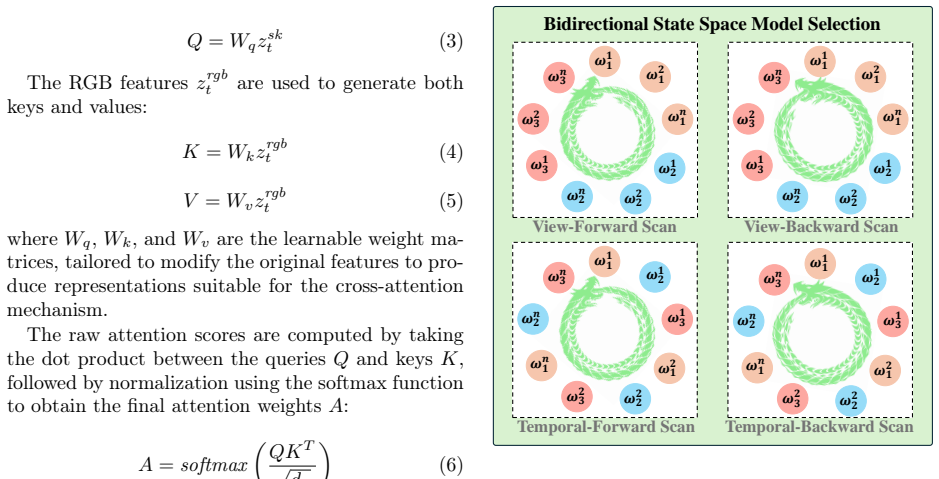
The load-bearing object is the Multi-View Graph Mamba block, made of a Bidirectional State Space Block and a GCN block. The state-space block flattens fused RGB-skeleton features in four orders and passes each through a 1D convolution followed by a selective state-space model (SSM/Mamba), giving the linear-cost recurrence; the GCN block creates a graph whose vertices are the $V \times T$ view-time tokens, with rule-based edges connecting same-view tokens across time and same-time tokens across views, plus KNN edges connecting the most similar tokens, then propagates features with the symmetric normalized graph-convolution rule. The four scan orders are what let the SSM capture both view and time dependencies, and the graph edges are what let information move between any viewpoints at any moment.
What would settle it
Instrument the full model and double the number of viewpoints while holding the temporal length fixed: if the nearest-neighbor edge construction is exact, wall-clock inference time should grow roughly with the square of the token count, contradicting the linear-complexity claim; a profile of the graph-building step alone would show the same quadratic term.
Extended reading notes
Core claim
The central claim is that the Multi-View Graph Mamba network achieves state-of-the-art multi-modal, multi-view, multi-temporal action recognition while keeping the inference complexity of a state-space model. The architecture fuses skeleton-guided RGB features via cross-attention, forms a grid of $V \times T$ view-time tokens, runs four bidirectional state-space scans (view-forward, view-backward, time-forward, time-backward), and then applies graph convolution over a combined edge set of time-consistent edges, view-consistent edges, and KNN-similarity edges. On NTU RGB+D 60 the View-Time variant reports 98.2% cross-subject and 99.7% cross-view; on NTU RGB+D 120 it reports 97.3% and 96.7%; on PKU-MMD it reports 98.0% and 99.1%.
Load-bearing premise
The strongest efficiency claim depends on the assumption that total inference time grows only linearly with the number of view-time tokens, yet the nearest-neighbor graph-building step compares every token with every other token, and the paper does not describe an approximate method to avoid that quadratic cost.
Editorial extensions
If this is right
- If MV-GMN's reported numbers hold, a state-space backbone can replace a Transformer for multi-view action recognition without sacrificing accuracy across the three tested benchmarks.
- Because the SSM core processes tokens in a single pass, its per-token cost does not grow with the number of view-time tokens the way attention's pairwise comparisons do, which is the basis for the paper's linear-inference-complexity claim.
- The ablation results indicate that both ingredients matter: KNN edges outperform rule-based edges alone, and adding the state-space block on top of KNN-GCN improves accuracy with fewer parameters than the Transformer-based version.
- View-prioritized scanning consistently beats time-prioritized scanning, suggesting that ordering tokens by viewpoint before applying the bidirectional scan captures more of the cross-view dependencies.
Reading between the lines
- The 'linear inference complexity' the paper advertises is a property of the state-space layers; the KNN graph construction over all $V \times T$ vertices costs $O((VT)^2)$ distance computations with exact search, so the complexity claim should be read as covering the SSM core unless approximate neighbor search is used.
- The same block design -- bidirectional selective scans over a view-time token grid plus graph edges -- is a template for other multi-view or multi-sensor sequence tasks, such as multi-camera video understanding or multi-view video prediction; testing it there would show whether the benefit transfers beyond action recognition.
- Because view-prioritized ordering consistently beat time-prioritized ordering in the reported ablations, a natural next experiment is to vary the number of cameras or shuffle camera order at test time; the paper suggests that cross-view structure is the dependency the model learns first.
Editorial analysis
A structured set of objections, weighed in public.
Referee Report
Summary. The paper proposes MV-GMN, a multi-view action recognition model that combines a bidirectional state-space (Mamba) block with a graph convolutional network. Features from RGB and skeleton streams are fused via cross-attention, and view-time relationships are modeled through rule-based and KNN-based graph edges. The model is evaluated on NTU RGB+D 60, NTU RGB+D 120, and PKU-MMD, reporting state-of-the-art or competitive Top-1 accuracies, and the paper claims the full model has linear inference complexity.
Significance. If the reported accuracies are reproducible, MV-GMN is a competitive multi-view action recognition method and a useful early example of applying state-space models to multi-view multi-temporal fusion. The paper provides a substantial set of ablations (view/time priority, fusion strategies, KNN and block counts) and compares against several recent baselines. Its main weakness is that the central efficiency claim is not backed by a correct complexity analysis of the graph module, and several reported numbers are internally inconsistent. The contribution is therefore promising but needs a major revision before the claims can be accepted.
major comments (3)
- [Section 3.3, Eqs. (17)–(19) and (21); Abstract; Figure 1; Conclusion] The claimed linear inference complexity is not supported. The rule-based edges in Eq. (17) generate O(VT^2) edges and Eq. (18) generates O(TV^2) edges; graph propagation in Eq. (21) is linear in the number of edges, so the rule-based GCN alone is O(VT^2 + TV^2). In addition, the KNN construction in Eq. (19) requires pairwise distance computation across all V×T vertices unless an approximate neighbor-search method is specified; with exact KNN this is O((VT)^2) and no approximation is described. Table 5 reports a single timing point at roughly 48 view-time tokens, which cannot distinguish linear from quadratic scaling. Please provide an asymptotic analysis that includes graph construction and propagation, or revise the complexity claim to apply only to the SSM sequence component.
- [Section 4.1, Table 2; Abstract] The NTU RGB+D 120 cross-view accuracy is inconsistent across the paper: the abstract and Table 2 give 96.7%, while the results text states 96.4% and claims an improvement of 0.7% over Cheng et al. (2024). From Table 2, Cheng et al.'s cross-view accuracy is 95.6%, making the gap 1.1 percentage points if MV-GMN indeed scores 96.7%. These numbers must be reconciled, and all increment claims should be recomputed from the final tables.
- [Section 4.2, Table 4 and prose] The ablation discussion for RGB-skeleton fusion contradicts Table 4. The text says 'the averaging method outperforms the linear approach by 2.2% and 0.9% in cross-subject scenarios', but Table 4 shows Linear Fusion with 95.1% (CS) and 95.8% (CV), both higher than Mean Fusion's 94.9% and 95.6%. Please correct either the text or the table so that the reported comparison matches the data.
minor comments (3)
- [Throughout] There are several typos and formatting errors: 'propsed' (Conclusion), 'acrion' (Section 3.3), 'Abaltion Studies' (Section 4.2 heading), 'M ambahaving' (Section 3.2), 'MV-GMA blocks' (Implementation Details), and 'T-KNN-GCT' (Section 4.2, should be T-KNN-GCN).
- [References and model names] The citation 'DeiTTouvron et al. (2021)' is malformed; the DeiT model should be attributed to Touvron et al. (2021). Similarly, 'Sparse-MSSTNetCheng et al. (2024)' is missing a space before the citation. Also, Implementation Details says 'Deit-B' but Table 4 lists 'Deit-S'; please clarify which backbone is used.
- [Section 4.2, Table 5] The timing experiments would benefit from a description of the hardware and inference settings (e.g., batch size, whether the timing includes feature extraction or only the fusion module, and the number of view-time tokens V×T used). The current single number per model is insufficient to support scaling claims.
Circularity Check
No circular derivation found: benchmark accuracies are external evaluations, and the linear-complexity claim is under-supported rather than self-fulfilling.
full rationale
The paper's central claims are empirical accuracies on held-out test splits (NTU RGB+D 60/120, PKU-MMD), which are external benchmarks and not constructed from the model's outputs. The KNN graph construction in Eq. (19) uses the model's own embeddings to define edges, but this is standard data-dependent graph construction, not a prediction of those embeddings from the graph itself. No parameter is fitted to the test set and then reported as a prediction. The 'linear inference complexity' claim is asserted for the full model in the abstract, Figure 1, and conclusion, but the manuscript does not analyze the computational cost of the rule-based edge enumeration in Eqs. (17)-(18) or the KNN search in Eq. (19); under exact nearest-neighbor search these steps are quadratic in V x T. This is a rigor gap in the complexity argument, not circularity: the claim does not reduce to the method's definition, it is simply under-supported. Self-citations (e.g., Gao et al. 2024, Lu et al. 2023) appear only in literature-review sentences and are not load-bearing for the model design or the reported results. A minor internal inconsistency (NTU-120 cross-view 96.7% in the abstract and Table 2 vs. 96.4% in the results text) is a reporting error, not a circular dependency. Therefore no circular step is present, and the paper is self-contained with respect to external benchmark evaluation.
Assumptions & free parameters
free parameters (5)
- Number of KNN neighbors (k) =
3
- Number of MV-GMN blocks =
4
- SSM state expansion factor =
64
- Number of RGB segments =
8
- Number of skeleton segments =
16
assumptions (4)
- domain assumption Cross-attention between frozen skeleton and RGB features yields sufficient fusion for downstream view-time modeling.
- domain assumption The four Mamba scanning sequences can be processed independently and their outputs combined without loss of view-time dependencies.
- domain assumption Graph convolution with rule-based and KNN edges effectively propagates view and time information.
- standard math Standard GCN propagation (Kipf and Welling) is applicable to view-time vertices.
Cite this review
Pith. "Pith review of MV-GMN: State Space Model for Multi-View Action Recognition." pith.science (2026). https://pith.science/paper/SSV3YN4A
@misc{pith2026250113829,
  author       = {Pith},
  title        = {Pith review of: MV-GMN: State Space Model for Multi-View Action Recognition},
  year         = {2026},
  howpublished = {\url{https://pith.science/paper/SSV3YN4A}},
  note         = {Machine review of arXiv:2501.13829}
}
read the original abstract
Recent advancements in multi-view action recognition have largely relied on Transformer-based models. While effective and adaptable, these models often require substantial computational resources, especially in scenarios with multiple views and multiple temporal sequences. Addressing this limitation, this paper introduces the MV-GMN model, a state-space model specifically designed to efficiently aggregate multi-modal data (RGB and skeleton), multi-view perspectives, and multi-temporal information for action recognition with reduced computational complexity. The MV-GMN model employs an innovative Multi-View Graph Mamba network comprising a series of MV-GMN blocks. Each block includes a proposed Bidirectional State Space Block and a GCN module. The Bidirectional State Space Block introduces four scanning strategies, including view-prioritized and time-prioritized approaches. The GCN module leverages rule-based and KNN-based methods to construct the graph network, effectively integrating features from different viewpoints and temporal instances. Demonstrating its efficacy, MV-GMN outperforms the state-of-the-arts on several datasets, achieving notable accuracies of 97.3\% and 96.7\% on the NTU RGB+D 120 dataset in cross-subject and cross-view scenarios, respectively. MV-GMN also surpasses Transformer-based baselines while requiring only linear inference complexity, underscoring the model's ability to reduce computational load and enhance the scalability and applicability of multi-view action recognition technologies.
Figures


Figures from the paper (2 more)


Forward citations
Cited by 1 Pith paper
-
Hypergraph Mamba for Efficient Whole Slide Image Understanding
WSI-HGMamba integrates hypergraph convolution with bidirectional Mamba sequence modeling, reporting accurate whole-slide classification at lower FLOPs than transformer baselines.
Reference graph
Works this paper leans on
-
[1]
Ahn, D., Kim, S., Hong, H., and Ko, B. C. (2023). Star-transformer: a spatio-temporal cross attention transformer for human action recognition. In Proceedings of the IEEE/CVF winter conference on applications of computer vision , pages 3330--3339
work page 2023
-
[2]
Asghari-Esfeden, S., Sznaier, M., and Camps, O. (2020). Dynamic motion representation for human action recognition. In Proceedings of the IEEE/CVF winter conference on applications of computer vision , pages 557--566
work page 2020
-
[3]
Baradel, F., Wolf, C., and Mille, J. (2017). Human action recognition: Pose-based attention draws focus to hands. In Proceedings of the IEEE International conference on computer vision workshops , pages 604--613
work page 2017
-
[4]
Behrouz, A. and Hashemi, F. (2024). Graph mamba: Towards learning on graphs with state space models. arXiv preprint arXiv:2402.08678
arXiv 2024
-
[5]
Bian, C., Feng, W., Meng, F., and Wang, S. (2023). Global--local contrastive multiview representation learning for skeleton-based action recognition. Computer Vision and Image Understanding , 229:103655
work page 2023
-
[6]
Bruce, X., Liu, Y., and Chan, K. C. (2021). Multimodal fusion via teacher-student network for indoor action recognition. In Proceedings of the AAAI Conference on Artificial Intelligence , volume 35, pages 3199--3207
work page 2021
-
[7]
Bruce, X., Liu, Y., Zhang, X., Zhong, S.-h., and Chan, K. C. (2022). Mmnet: A model-based multimodal network for human action recognition in rgb-d videos. IEEE Transactions on Pattern Analysis and Machine Intelligence , 45(3):3522--3538
work page 2022
-
[8]
Caetano, C., Sena, J., Br \'e mond, F., Dos Santos, J. A., and Schwartz, W. R. (2019). Skelemotion: A new representation of skeleton joint sequences based on motion information for 3d action recognition. In IEEE international conference on advanced video and signal based surveillance (AVSS) , pages 1--8
work page 2019
Show all 58 references
-
[9]
and Zisserman, A
Carreira, J. and Zisserman, A. (2017). Quo vadis, action recognition? a new model and the kinetics dataset. In proceedings of the IEEE Conference on Computer Vision and Pattern Recognition , pages 6299--6308
2017
-
[10]
Chen, Y., Zhang, Z., Yuan, C., Li, B., Deng, Y., and Hu, W. (2021). Channel-wise topology refinement graph convolution for skeleton-based action recognition. In Proceedings of the IEEE/CVF international conference on computer vision , pages 13359--13368
2021
-
[11]
Cheng, Q., Cheng, J., Liu, Z., Ren, Z., and Liu, J. (2024). A dense-sparse complementary network for human action recognition based on rgb and skeleton modalities. Expert Systems with Applications , 244:123061
2024
-
[12]
and Gu, A
Dao, T. and Gu, A. (2024). Transformers are ssms: Generalized models and efficient algorithms through structured state space duality. arXiv preprint arXiv:2405.21060
2024 arXiv
-
[13]
Das, S., Dai, R., Koperski, M., Minciullo, L., Garattoni, L., Bremond, F., and Francesca, G. (2019). Toyota smarthome: Real-world activities of daily living. In Proceedings of the IEEE/CVF international conference on computer vision , pages 833--842
2019
-
[14]
Das, S., Dai, R., Yang, D., and Bremond, F. (2021). Vpn++: Rethinking video-pose embeddings for understanding activities of daily living. IEEE Transactions on Pattern Analysis and Machine Intelligence , 44(12):9703--9717
2021
-
[15]
Das, S., Sharma, S., Dai, R., Bremond, F., and Thonnat, M. (2020). Vpn: Learning video-pose embedding for activities of daily living. In European Conference on Computer Vision (ECCV) , pages 72--90
2020
-
[16]
and Yin, K
Davoodikakhki, M. and Yin, K. (2020). Hierarchical action classification with network pruning. In Advances in Visual Computing: 15th International Symposium, ISVC 2020, San Diego, CA, USA, October 5--7, 2020, Proceedings, Part I 15 , pages 291--305
2020
-
[17]
Dong, W., Zhu, H., Lin, S., Luo, X., Shen, Y., Liu, X., Zhang, J., Guo, G., and Zhang, B. (2024). Fusion-mamba for cross-modality object detection. arXiv preprint arXiv:2404.09146
2024 arXiv
-
[18]
Duan, H., Zhao, Y., Chen, K., Lin, D., and Dai, B. (2022). Revisiting skeleton-based action recognition. In Proceedings of the IEEE/CVF conference on computer vision and pattern recognition , pages 2969--2978
2022
-
[19]
Elharrouss, O., Almaadeed, N., Al-Maadeed, S., Bouridane, A., and Beghdadi, A. (2021). A combined multiple action recognition and summarization for surveillance video sequences. Applied Intelligence , 51:690--712
2021
-
[20]
Gao, Y., Lu, J., Li, S., Li, Y., and Du, S. (2024). Hypergraph-based multi-view action recognition using event cameras. IEEE Transactions on Pattern Analysis and Machine Intelligence
2024
-
[21]
Gao, Y., Lu, J., Li, S., Ma, N., Du, S., Li, Y., and Dai, Q. (2023). Action recognition and benchmark using event cameras. IEEE Transactions on Pattern Analysis and Machine Intelligence
2023
-
[22]
and Dao, T
Gu, A. and Dao, T. (2023). Mamba: Linear-time sequence modeling with selective state spaces. arXiv preprint arXiv:2312.00752
2023 arXiv
-
[23]
Hernandez Ruiz, A., Porzi, L., Rota Bul \`o , S., and Moreno-Noguer, F. (2017). 3d cnns on distance matrices for human action recognition. In Proceedings of the 25th ACM international conference on Multimedia , pages 1087--1095
2017
-
[24]
and Iva s i \'c -Kos, M
Host, K. and Iva s i \'c -Kos, M. (2022). An overview of human action recognition in sports based on computer vision. Heliyon , 8(6)
2022
-
[25]
Kim, S., Ahn, D., and Ko, B. C. (2023). Cross-modal learning with 3d deformable attention for action recognition. In Proceedings of the IEEE/CVF international conference on computer vision , pages 10265--10275
2023
-
[26]
Kipf, T. N. and Welling, M. (2016). Semi-supervised classification with graph convolutional networks. arXiv preprint arXiv:1609.02907
2016 arXiv
-
[27]
Kong, Y., Ding, Z., Li, J., and Fu, Y. (2017). Deeply learned view-invariant features for cross-view action recognition. IEEE Transactions on Image Processing , 26(6):3028--3037
2017
-
[28]
Li, B., Li, X., Zhang, Z., and Wu, F. (2019a). Spatio-temporal graph routing for skeleton-based action recognition. In Proceedings of the AAAI conference on artificial intelligence , volume 33, pages 8561--8568
2019
-
[29]
Li, K., Li, X., Wang, Y., He, Y., Wang, Y., Wang, L., and Qiao, Y. (2024a). Videomamba: State space model for efficient video understanding. arXiv preprint arXiv:2403.06977
2024 arXiv
-
[30]
Li, M., Chen, S., Chen, X., Zhang, Y., Wang, Y., and Tian, Q. (2019b). Actional-structural graph convolutional networks for skeleton-based action recognition. In Proceedings of the IEEE/CVF conference on computer vision and pattern recognition , pages 3595--3603
2019
-
[31]
Li, S., Li, W., Cook, C., Zhu, C., and Gao, Y. (2018). Independently recurrent neural network (indrnn): Building a longer and deeper rnn. In Proceedings of the IEEE conference on computer vision and pattern recognition , pages 5457--5466
2018
-
[32]
Li, W., Zhou, H., Song, Z., and Yang, W. (2024b). Coupled mamba: Enhanced multi-modal fusion with coupled state space model. arXiv preprint arXiv:2405.18014
2024 arXiv
-
[33]
Li, Z., Pan, H., Zhang, K., Wang, Y., and Yu, F. (2024c). Mambadfuse: A mamba-based dual-phase model for multi-modality image fusion. arXiv preprint arXiv:2404.08406
2024 arXiv
-
[34]
Liu, C., Hu, Y., Li, Y., Song, S., and Liu, J. (2017). Pku-mmd: A large scale benchmark for continuous multi-modal human action understanding. arXiv preprint arXiv:1703.07475
2017 arXiv
-
[35]
Liu, J., Ding, R., Wen, Y., Dai, N., Meng, F., Zhao, S., and Liu, M. (2024a). Explore human parsing modality for action recognition. arXiv preprint arXiv:2401.02138
2024 arXiv
-
[36]
Liu, J., Shahroudy, A., Perez, M., Wang, G., Duan, L.-Y., and Kot, A. C. (2019). Ntu rgb+ d 120: A large-scale benchmark for 3d human activity understanding. IEEE transactions on pattern analysis and machine intelligence , 42(10):2684--2701
2019
-
[37]
and Yuan, J
Liu, M. and Yuan, J. (2018). Recognizing human actions as the evolution of pose estimation maps. In Proceedings of the IEEE conference on computer vision and pattern recognition , pages 1159--1168
2018
-
[38]
Liu, Y., Tian, Y., Zhao, Y., Yu, H., Xie, L., Wang, Y., Ye, Q., and Liu, Y. (2024b). Vmamba: Visual state space model. arXiv preprint arXiv:2401.10166
2024 arXiv
-
[39]
Lu, J., Wan, H., Li, P., Zhao, X., Ma, N., and Gao, Y. (2023). Exploring high-order spatio--temporal correlations from skeleton for person re-identification. IEEE Transactions on Image Processing , 32:949--963
2023
-
[40]
Lv, Z., Poiesi, F., Dong, Q., Lloret, J., and Song, H. (2022). Deep learning for intelligent human--computer interaction. Applied Sciences , 12(22):11457
2022
-
[41]
Patro, B. N. and Agneeswaran, V. S. (2024). Simba: Simplified mamba-based architecture for vision and multivariate time series. arXiv preprint arXiv:2403.15360
2024 arXiv
-
[42]
and Das, S
Reilly, D. and Das, S. (2024). Just add?! pose induced video transformers for understanding activities of daily living. In Proceedings of the IEEE/CVF Conference on Computer Vision and Pattern Recognition , pages 18340--18350
2024
-
[43]
P., de Melo, C
Shah, K., Shah, A., Lau, C. P., de Melo, C. M., and Chellappa, R. (2023). Multi-view action recognition using contrastive learning. In Proceedings of the IEEE/CVF Winter Conference on Applications of Computer Vision , pages 3381--3391
2023
-
[44]
Shahroudy, A., Liu, J., Ng, T.-T., and Wang, G. (2016). Ntu rgb+ d: A large scale dataset for 3d human activity analysis. In Proceedings of the IEEE conference on computer vision and pattern recognition , pages 1010--1019
2016
-
[45]
Siddiqui, N., Tirupattur, P., and Shah, M. (2024). Dvanet: Disentangling view and action features for multi-view action recognition. In Proceedings of the AAAI Conference on Artificial Intelligence , volume 38, pages 4873--4881
2024
-
[46]
Song, S., Lan, C., Xing, J., Zeng, W., and Liu, J. (2018). Skeleton-indexed deep multi-modal feature learning for high performance human action recognition. In IEEE International Conference on Multimedia and Expo (ICME) , pages 1--6
2018
-
[47]
Touvron, H., Cord, M., Douze, M., Massa, F., Sablayrolles, A., and J \'e gou, H. (2021). Training data-efficient image transformers & distillation through attention. In International conference on machine learning , pages 10347--10357
2021
-
[48]
Wang, C., Tsepa, O., Ma, J., and Wang, B. (2024). Graph-mamba: Towards long-range graph sequence modeling with selective state spaces. arXiv preprint arXiv:2402.00789
2024 arXiv
-
[49]
Wang, L., Xiong, Y., Wang, Z., Qiao, Y., Lin, D., Tang, X., and Van Gool, L. (2018). Temporal segment networks for action recognition in videos. IEEE transactions on pattern analysis and machine intelligence , 41(11):2740--2755
2018
-
[50]
T., and Yuan, J
Wang, Y., Xiao, Y., Xiong, F., Jiang, W., Cao, Z., Zhou, J. T., and Yuan, J. (2020). 3dv: 3d dynamic voxel for action recognition in depth video. In Proceedings of the IEEE/CVF conference on computer vision and pattern recognition , pages 511--520
2020
-
[51]
Yan, S., Xiong, Y., and Lin, D. (2018). Spatial temporal graph convolutional networks for skeleton-based action recognition. In Proceedings of the AAAI conference on artificial intelligence , volume 32
2018
-
[52]
Zhang, S., Yang, Y., Xiao, J., Liu, X., Yang, Y., Xie, D., and Zhuang, Y. (2018). Fusing geometric features for skeleton-based action recognition using multilayer lstm networks. IEEE Transactions on Multimedia , 20(9):2330--2343
2018
-
[53]
Zhao, R., Ali, H., and Van der Smagt, P. (2017). Two-stream rnn/cnn for action recognition in 3d videos. In 2017 IEEE/RSJ International Conference on Intelligent Robots and Systems (IROS) , pages 4260--4267
2017
-
[54]
T., and Jin, Q
Zhou, X., Liang, W., Kevin, I., Wang, K., Wang, H., Yang, L. T., and Jin, Q. (2020). Deep-learning-enhanced human activity recognition for internet of healthcare things. IEEE Internet of Things Journal , 7(7):6429--6438
2020
-
[55]
Zhu, L., Liao, B., Zhang, Q., Wang, X., Liu, W., and Wang, X. (2024). Vision mamba: Efficient visual representation learning with bidirectional state space model. arXiv preprint arXiv:2401.09417
2024 arXiv
-
[56]
L., Sedaghat, N., and Brox, T
Zolfaghari, M., Oliveira, G. L., Sedaghat, N., and Brox, T. (2017). Chained multi-stream networks exploiting pose, motion, and appearance for action classification and detection. In Proceedings of the IEEE International Conference on Computer Vision , pages 2904--2913
2017
-
[57]
, " * write output.state after.block = add.period write newline
ENTRY address archivePrefix author booktitle chapter edition editor eid eprint howpublished institution isbn journal key month note number organization pages publisher school series title type volume year label extra.label sort.label short.list INTEGERS output.state before.all...
-
[58]
write newline
" write newline "" before.all 'output.state := FUNCTION n.dashify 't := "" t empty not t #1 #1 substring "-" = t #1 #2 substring "--" = not "--" * t #2 global.max substring 't := t #1 #1 substring "-" = "-" * t #2 global.max substring 't := while if t #1 #1 substring * t #2 gl...
Reviewed August 10, 2026 · model on record in the stance chip above.
Discussion (0). Continue with ORCID to comment.