Quark-Lepton Color-Flavor Unification
Pith reviewed 2026-06-29 06:21 UTC · model grok-4.3
The pith
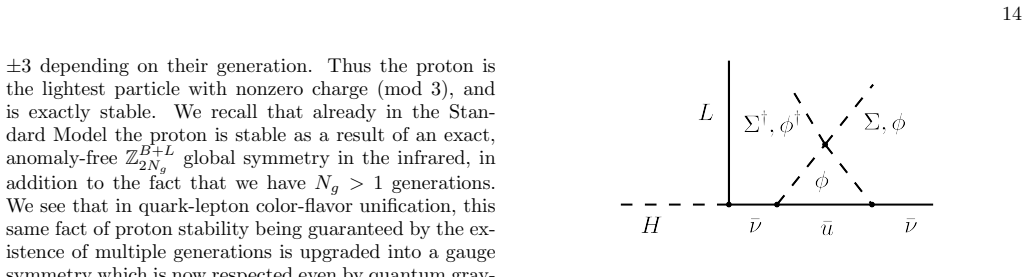
An SU(12) model unifies quark color-flavor with lepton flavor, generating bottom and tau masses via instantons from a shared up-neutrino Yukawa while a discrete gauge symmetry stabilizes the proton.
A machine-rendered reading of the paper's core claim, the machinery that carries it, and where it could break.
Core claim
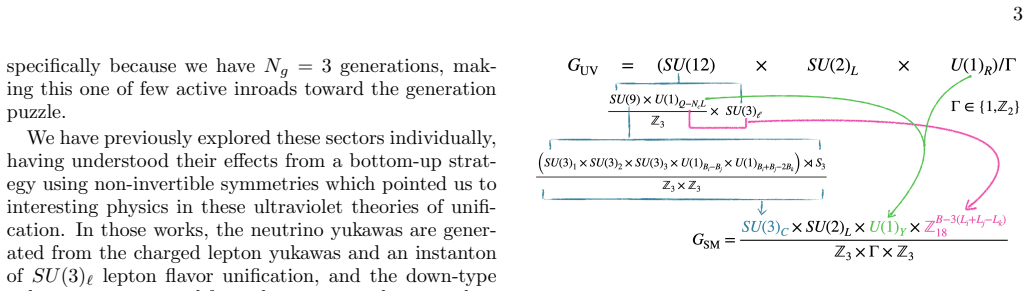
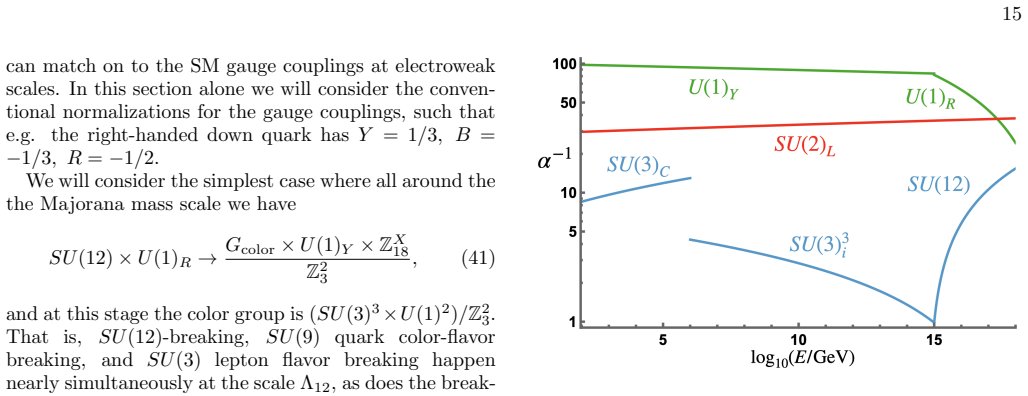
The central claim is that an SU(12) × SU(2)_L × U(1)_R theory unifies SU(9) quark color-flavor with SU(3) lepton flavor starting from a single Yukawa shared by up-type quarks and neutrinos; gauged instantons dynamically generate the bottom and tau Yukawas, only two new scalar representations are required for the breaking chain that includes color-flavor deconstruction followed by infrared reunification, and the low-energy gauge group emerges as G_SM equal to the quotient of SU(3)_C × SU(2)_L × U(1)_Y × Z^X_18 by Z_3 × Γ × Z_3 where the discrete gauge symmetry X = B − 3(L_i + L_j − L_k) absolutely stabilizes the proton.
What carries the argument
The SU(12) gauge group that unifies SU(9) quark color-flavor with SU(3) lepton flavor, together with instanton-generated Yukawa splittings and the discrete gauge symmetry X that supplies proton stability.
If this is right
- Bottom and tau Yukawas arise dynamically from the single shared up-neutrino Yukawa via instantons.
- A massless up quark solves the strong CP problem without an axion.
- Neutrino masses are generated through a flavored type-I seesaw.
- Only two new scalar representations are needed to complete the full symmetry-breaking chain to the Standard Model.
- Non-invertible chiral symmetry breaking produces a spectrum of emergent generalized symmetries and topological defects.
Where Pith is reading between the lines
- The model’s emphasis on color-flavor deconstruction followed by reunification suggests similar patterns could be applied to other partial unification schemes.
- The discrete symmetry X may constrain additional baryon-number-violating operators beyond those already forbidden by the proton-stability mechanism.
- Future collider searches for the two new scalars could directly test the minimal breaking content required by the unification.
- The shared quotient between continuous and discrete groups at low energies may link one-form and two-form global symmetries in ways testable through lattice studies of the Standard Model.
Load-bearing premise
The assumption that gauged quark color-flavor and lepton flavor instantons dynamically generate the bottom and tau Yukawas from a single shared Yukawa for up-type quarks and neutrinos with no further new fermions.
What would settle it
Observation of proton decay at any scale would falsify the absolute stability provided by the discrete gauge symmetry X.
Figures

read the original abstract
We present an $SU(12) \times SU(2)_L \times U(1)_R$ model unifying $SU(9)$ quark color-flavor with $SU(3)$ lepton flavor as a flavorful alternative to conventional theories of unification. We begin in the ultraviolet with a single yukawa shared by the unified up-type quarks and neutrinos, and no further new fermions. We show that gauged quark color-flavor and lepton flavor instantons dynamically generate the bottom and tau yukawas, which implements a massless quark solution to the strong CP problem and sets up a flavored type-I seesaw mechanism. Only two new scalar irreps are needed for the symmetry-breaking steps, which include quark color-flavor deconstruction and then infrared reunification, and the Standard Model gauge group in this theory emerges as \[G_{\rm SM} = \frac{SU(3)_C \times SU(2)_L \times U(1)_Y \times \mathbb{Z}^X_{18}}{\mathbb{Z}_{3} \times \Gamma \times \mathbb{Z}_3},\] where $\Gamma \in \lbrace 1, \mathbb{Z}_2 \rbrace$ is the electroweak global structure and there is a discrete gauge symmetry $X = B - 3(L_i + L_j - L_k)$ which brings additional $\mathbb{Z}_3$ global structure to the SM. This gauge symmetry acts as a flavorful upgrade of the $\mathbb{Z}^{B+L}_{18}$ anomaly-free global symmetry of the SM and stabilizes the proton absolutely. Non-invertible chiral symmetry-breaking is crucial to our model, and we discuss the rich spectrum of emergent generalized symmetries and topological defects appearing at various stages. In the infrared, the novel shared quotient between continuous and discrete groups links the one-form and two-form global symmetries of the Standard Model.
Editorial analysis
A structured set of objections, weighed in public.
Referee Report
Summary. The paper presents an SU(12) × SU(2)_L × U(1)_R model that unifies SU(9) quark color-flavor with SU(3) lepton flavor. It begins with a single UV Yukawa coupling shared by up-type quarks and neutrinos (no additional fermions), relies on gauged instantons in the color-flavor and lepton-flavor sectors to dynamically generate the bottom and tau Yukawas, implements a massless up-quark solution to strong CP, and sets up a flavored type-I seesaw. Symmetry breaking uses only two new scalar irreps and proceeds via quark color-flavor deconstruction followed by infrared reunification. The SM gauge group emerges as the quotient G_SM = (SU(3)_C × SU(2)_L × U(1)_Y × Z^X_18) / (Z_3 × Γ × Z_3) with discrete gauge symmetry X = B − 3(L_i + L_j − L_k) that stabilizes the proton absolutely; the construction also invokes non-invertible chiral symmetry breaking and emergent generalized symmetries.
Significance. If the central instanton mechanism is shown to produce operators of the correct flavor structure and magnitude, the construction would offer a minimal-fermion flavorful unification alternative with absolute proton stability, a strong-CP solution via a massless up quark, and a novel link between continuous/discrete quotients and one-/two-form global symmetries. The restriction to two new scalars and the explicit discrete gauge symmetry X are concrete strengths.
major comments (1)
- [Abstract] Abstract, paragraph 2: the claim that gauged SU(9) color-flavor and SU(3) lepton-flavor instantons dynamically generate the bottom and tau Yukawas from the single shared up/neutrino Yukawa (without further new fermions) is load-bearing for minimality, the strong-CP solution, and the subsequent seesaw; no explicit instanton-induced operators, suppression factors, or texture-matching calculation is supplied to confirm that the required down-type and charged-lepton structures arise at the correct scale while leaving the up quark massless.
minor comments (2)
- The quotient expression for G_SM is written with a mixture of continuous and discrete factors; the precise embedding of Z^X_18 and the action of Γ should be stated explicitly in a dedicated section on the infrared gauge group.
- Notation for the discrete symmetry X = B − 3(L_i + L_j − L_k) should include a brief table or paragraph clarifying its action on the three lepton generations to make the proton-stabilization argument self-contained.
Simulated Author's Rebuttal
We thank the referee for their careful reading and for highlighting both the potential strengths of the construction and the need for further substantiation of the central instanton mechanism. We address the single major comment below.
read point-by-point responses
-
Referee: [Abstract] Abstract, paragraph 2: the claim that gauged SU(9) color-flavor and SU(3) lepton-flavor instantons dynamically generate the bottom and tau Yukawas from the single shared up/neutrino Yukawa (without further new fermions) is load-bearing for minimality, the strong-CP solution, and the subsequent seesaw; no explicit instanton-induced operators, suppression factors, or texture-matching calculation is supplied to confirm that the required down-type and charged-lepton structures arise at the correct scale while leaving the up quark massless.
Authors: We agree that the explicit form of the instanton-induced operators, their suppression factors, and the resulting flavor textures are essential to validate the load-bearing claims. While the manuscript outlines the qualitative mechanism and its consequences for minimality and the strong-CP solution, it does not supply the detailed operator derivations or numerical matching. In the revised manuscript we will add a dedicated subsection that computes the leading instanton-generated effective operators in the SU(9) color-flavor and SU(3) lepton-flavor sectors, estimates the exponential suppression, and verifies that the resulting down-type and charged-lepton textures are consistent with observation while leaving the up quark massless. revision: yes
Circularity Check
No significant circularity; derivation self-contained
full rationale
The paper constructs an SU(12) × SU(2)_L × U(1)_R UV model starting from a single shared Yukawa for up-type quarks and neutrinos, then claims to demonstrate via gauged instanton effects that bottom and tau Yukawas are generated dynamically. This is presented as a non-perturbative derivation rather than a fit or self-definition. The emergence of G_SM with the discrete X symmetry and the two-scalar breaking chain are stated as consequences of the gauge structure and symmetry breaking steps. No equations or claims in the abstract reduce a prediction to a fitted input by construction, invoke self-citations as load-bearing uniqueness theorems, or rename known results. The instanton step is a dynamical claim whose validity is external to the construction itself. The derivation chain therefore remains independent of its target outputs.
Axiom & Free-Parameter Ledger
axioms (1)
- domain assumption Gauged instantons from the new color-flavor and lepton flavor groups dynamically generate the bottom and tau Yukawas
invented entities (1)
-
SU(12) gauge group with two new scalar irreps
no independent evidence
Reference graph
Works this paper leans on
-
[1]
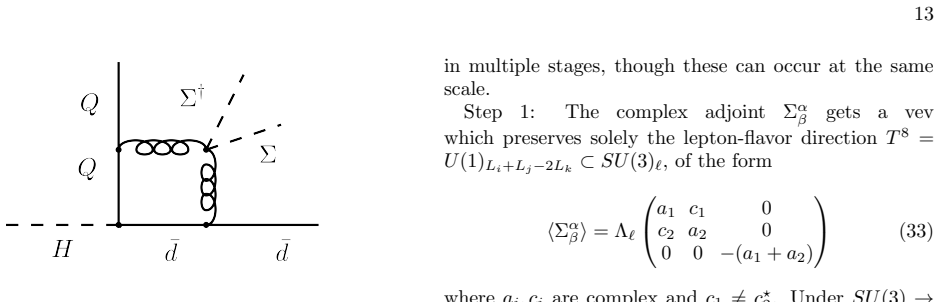
This could be a problem if we wanted to generate onlyy τ ≪y b, but in fact they are not so different and so the higher-dimensional operators are not dangerous. 9 An important difference from the original massless quark solu- tion and from our earlier massless quark solution in quark color- flavor unification [36] is that the dynamics here take place at a ...
-
[2]
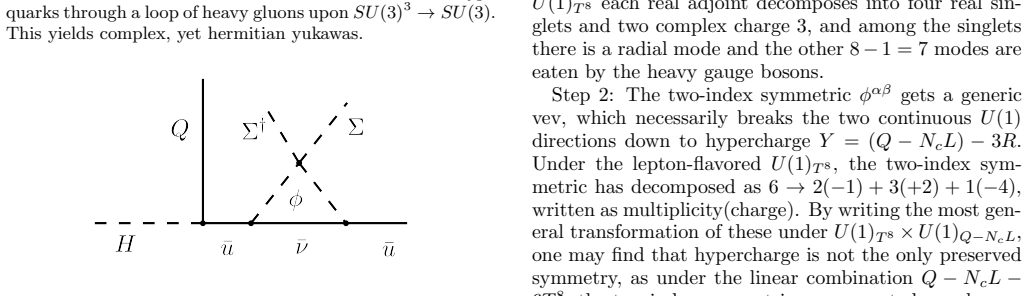
Step 2: The two-index symmetricϕ αβ gets a generic vev, which necessarily breaks the two continuousU(1) directions down to hyperchargeY= (Q−N cL)−3R
UnderSU(3)→ U(1) T 8 each real adjoint decomposes into four real sin- glets and two complex charge 3, and among the singlets there is a radial mode and the other 8−1 = 7 modes are eaten by the heavy gauge bosons. Step 2: The two-index symmetricϕ αβ gets a generic vev, which necessarily breaks the two continuousU(1) directions down to hyperchargeY= (Q−N cL...
-
[3]
theory and implementing the quotient by gauging theZ (1) 3 electric one-form symmetry which acts on both the hypercharge and the discrete gauge sectors as a shift of the gauge fields AX µ →A X µ + Λµ, A Y µ →A Y µ + Λµ with∂ [νΛµ] = 0. This construction can be thought of in two steps: First, we couple the theory to a background two-form gauge field Cµν tr...
-
[4]
Georgi and S
H. Georgi and S. L. Glashow, Unity of All Elementary Particle Forces, Phys. Rev. Lett.32, 438 (1974)
1974
-
[5]
On the possibility of unifying the electromagnetic and the gravitational fields
G. Nordstrom, On the possibility of unifying the elec- tromagnetic and the gravitational fields, Phys. Z.15, 504 (1914), arXiv:physics/0702221
work page internal anchor Pith review Pith/arXiv arXiv 1914
-
[6]
On the Unification Problem in Physics
T. Kaluza, Zum Unit¨ atsproblem der Physik, Sitzungs- ber. Preuss. Akad. Wiss. Berlin (Math. Phys. )1921, 966 (1921), arXiv:1803.08616 [physics.hist-ph]
work page internal anchor Pith review Pith/arXiv arXiv 1921
-
[7]
Klein, Quantum Theory and Five-Dimensional The- ory of Relativity
O. Klein, Quantum Theory and Five-Dimensional The- ory of Relativity. (In German and English), Z. Phys.37, 895 (1926)
1926
-
[8]
K. Abeet al.(Super-Kamiokande), Search for pro- ton decay viap→e +π0 andp→µ +π0 in 0.31 megaton·years exposure of the Super-Kamiokande wa- ter Cherenkov detector, Phys. Rev. D95, 012004 (2017), arXiv:1610.03597 [hep-ex]. 19
work page internal anchor Pith review Pith/arXiv arXiv 2017
-
[9]
S. Koren and A. Martin, Fractionally charged particles at the energy frontier: The SM gauge group and one- form global symmetry, SciPost Phys.18, 004 (2025), arXiv:2406.17850 [hep-ph]
-
[10]
S. Koren and A. Martin, Phenomenology of fractionally charged particles: Two reps are better than one, Nucl. Phys. B1021, 117196 (2025), arXiv:2507.16900 [hep- ph]
- [11]
-
[12]
H.-L. Li and L.-X. Xu, Understanding the SM gauge group from SMEFT, JHEP07, 199, arXiv:2404.04229 [hep-ph]
-
[13]
C. Cordova, S. Hong, and L.-T. Wang, Axion domain walls, small instantons, and non-invertible symmetry breaking, JHEP05, 325, arXiv:2309.05636 [hep-ph]
-
[14]
Reece, Axion-gauge coupling quantization with a twist, JHEP10, 116, arXiv:2309.03939 [hep-ph]
M. Reece, Axion-gauge coupling quantization with a twist, JHEP10, 116, arXiv:2309.03939 [hep-ph]
- [15]
-
[16]
P. Agrawal, M. Nee, and M. Reig, Axion couplings in grand unified theories, JHEP10, 141, arXiv:2206.07053 [hep-ph]
-
[17]
P. Agrawal, M. Nee, and M. Reig, Axion couplings in heterotic string theory, JHEP02, 188, arXiv:2410.03820 [hep-ph]
-
[18]
P. Agrawal, M. Nee, and M. Reig, Axion couplings in Orbifold GUTs, (2025), arXiv:2511.21830 [hep-ph]
- [19]
-
[20]
M. Reig and T. Weigand, Testing the heterotic string with the axion-photon coupling, JHEP01, 006, arXiv:2509.08042 [hep-th]
-
[21]
Koren,A Note on Proton Stability in the Standard Model,Universe8(2022) 308, [arXiv:2204.01741]
S. Koren, A Note on Proton Stability in the Standard Model, Universe8, 308 (2022), arXiv:2204.01741 [hep- ph]
- [22]
-
[23]
J. C. Pati and A. Salam, Lepton Number as the Fourth Color, Phys. Rev. D10, 275 (1974), [Erratum: Phys.Rev.D 11, 703–703 (1975)]
1974
-
[24]
De R´ ujula, H
A. De R´ ujula, H. Georgi, and S. Glashow, Trinification of all elementary particle forces, inFifth workshop on grand unification, Vol. 7 (World Scientific, Singapore, 1984)
1984
-
[25]
Fritzsch and P
H. Fritzsch and P. Minkowski, Unified Interactions of Leptons and Hadrons, Annals Phys.93, 193 (1975)
1975
-
[26]
Georgi, H
H. Georgi, H. R. Quinn, and S. Weinberg, Hierarchy of Interactions in Unified Gauge Theories, Phys. Rev. Lett.33, 451 (1974)
1974
-
[27]
Amaldi, W
U. Amaldi, W. de Boer, and H. Furstenau, Comparison of grand unified theories with electroweak and strong coupling constants measured at LEP, Phys. Lett. B260, 447 (1991)
1991
-
[28]
Giunti, C
C. Giunti, C. W. Kim, and U. W. Lee, Running coupling constants and grand unification models, Mod. Phys. Lett. A6, 1745 (1991)
1991
-
[29]
Langacker and M.-x
P. Langacker and M.-x. Luo, Implications of precision electroweak experiments forM t,ρ 0, sin 2 θW and grand unification, Phys. Rev. D44, 817 (1991)
1991
-
[30]
Georgi, Towards a Grand Unified Theory of Flavor, Nucl
H. Georgi, Towards a Grand Unified Theory of Flavor, Nucl. Phys. B156, 126 (1979)
1979
-
[31]
Z. G. Berezhiani, Horizontal Symmetry and Quark - Lepton Mass Spectrum: The SU(5) x SU(3)-h Model, Phys. Lett. B150, 177 (1985)
1985
-
[32]
Z. G. Berezhiani, Grand unification of fermion masses, inSummer Institute: From Particle Physics to Cosmol- ogy(1993) arXiv:hep-ph/9312222
work page internal anchor Pith review Pith/arXiv arXiv 1993
- [33]
-
[34]
J. Davighi and J. Tooby-Smith, Electroweak flavour uni- fication, JHEP09, 193, arXiv:2201.07245 [hep-ph]
-
[35]
Kuo and N
T.-K. Kuo and N. Nakagawa, The Generation Prob- lem and the Symplectic Group, Nucl. Phys. B250, 641 (1985)
1985
-
[36]
Kuo and N
T.-K. Kuo and N. Nakagawa, An Sp(6) - Left X U(1) Hypercharge Extension of the Electroweak The- ory, Phys. Rev. D30, 2011 (1984)
2011
-
[37]
Koren, A
S. Koren, A. Martin, and P. Sesma, Proton Stability in Electroweak Flavour Unification, In preparation
-
[38]
C. Cordova, S. Hong, S. Koren, and K. Ohmori, Neu- trino Masses from Generalized Symmetry Breaking, Phys. Rev. X14, 031033 (2024), arXiv:2211.07639 [hep- ph]
-
[39]
C. Cordova, S. Hong, and S. Koren, Noninvertible Peccei-Quinn Symmetry and the Massless Quark Solu- tion to the Strong CP Problem, Phys. Rev. X15, 031011 (2025), arXiv:2402.12453 [hep-ph]
-
[40]
A. Delgado and S. Koren, Non-invertible Peccei-Quinn symmetry, natural 2HDM alignment, and the visible ax- ion, JHEP02, 178, arXiv:2412.05362 [hep-ph]
- [41]
-
[42]
K. S. Babu, I. Gogoladze, and K. Wang, Gauged baryon parity and nucleon stability, Phys. Lett. B570, 32 (2003), arXiv:hep-ph/0306003
work page internal anchor Pith review Pith/arXiv arXiv 2003
-
[43]
J. Davighi, A. Greljo, and A. E. Thomsen, Leptoquarks with exactly stable protons, Phys. Lett. B833, 137310 (2022), arXiv:2202.05275 [hep-ph]
-
[44]
’t Hooft, Naturalness, chiral symmetry, and sponta- neous chiral symmetry breaking, NATO Sci
G. ’t Hooft, Naturalness, chiral symmetry, and sponta- neous chiral symmetry breaking, NATO Sci. Ser. B59, 135 (1980)
1980
- [45]
-
[46]
C. Cs´ aki, R. Ovadia, O. Telem, J. Terning, and S. Yankielowicz, Abelian instantons and monopole scat- tering, JHEP11, 165, arXiv:2406.13738 [hep-th]
-
[47]
Dyon Loops and Abelian Instantons
I. Garcia Garcia, M. Kongsore, and K. Van Tilburg, Dyon Loops and Abelian Instantons, (2025), arXiv:2506.14867 [hep-th]
work page internal anchor Pith review Pith/arXiv arXiv 2025
-
[48]
I. Garcia Garcia and E. Maderazo, Black Holes and Abelian Instantons, (2025), arXiv:2512.13833 [hep-th]
- [49]
- [50]
-
[51]
C. Cordova and K. Ohmori, Noninvertible Chiral Sym- metry and Exponential Hierarchies, Phys. Rev. X13, 011034 (2023), arXiv:2205.06243 [hep-th]
- [52]
- [53]
- [54]
-
[55]
C. C´ ordova and S. Koren, Higher Flavor Symmetries in the Standard Model, Annalen Phys.535, 2300031 (2023), arXiv:2212.13193 [hep-ph]
-
[56]
N. Craig and M. Kongsore, High-quality axions from higher-form symmetries in extra dimensions, Phys. Rev. D111, 015047 (2025), arXiv:2408.10295 [hep-ph]
-
[57]
Generalized symmetries and emergence in axion effective field theories
D. Sehayek and N. Craig, Generalized symmetries and emergence in axion effective field theories, (2026), arXiv:2604.11877 [hep-th]
work page internal anchor Pith review Pith/arXiv arXiv 2026
- [58]
- [59]
-
[60]
M. van Beest, P. Boyle Smith, D. Delmastro, Z. Komar- godski, and D. Tong, Monopoles, scattering, and gen- eralized symmetries, JHEP03, 014, arXiv:2306.07318 [hep-th]
-
[61]
M. van Beest, P. Boyle Smith, D. Delmastro, R. Mouland, and D. Tong, Fermion-monopole scat- tering in the Standard Model, JHEP08, 004, arXiv:2312.17746 [hep-th]
-
[62]
J. Davighi, B. Gripaios, and N. Lohitsiri, Global anoma- lies in the Standard Model(s) and Beyond, JHEP07, 232, arXiv:1910.11277 [hep-th]
-
[63]
J. Davighi, A. Greljo, and N. Selimovic, Topological Portal to the Dark Sector, Phys. Rev. Lett.134, 111804 (2025), arXiv:2401.09528 [hep-ph]
-
[64]
J. Davighi and N. Lohitsiri, WZW terms with- out anomalies: Generalised symmetries in chi- ral Lagrangians, SciPost Phys.17, 168 (2024), arXiv:2407.20340 [hep-th]
-
[65]
J. Davighi, S. Moldovsky, H. Murayama, C. Scherb, and N. Selimovic, Topological freeze-out by semi- annihilation, JHEP02, 133, arXiv:2506.05468 [hep-ph]
- [66]
- [67]
-
[68]
M. Suzuki and R. Yokokura, Lazarides-Shafi ax- ion models as Dijkgraaf-Witten theories, (2026), arXiv:2602.12345 [hep-th]
- [69]
-
[70]
Kaloper, General relativity on the multiverse and nature’s hierarchies, Phys
N. Kaloper, General relativity on the multiverse and nature’s hierarchies, Phys. Rev. D106, 044023 (2022), arXiv:2202.08860 [hep-th]
-
[71]
E. Garc´ ıa-Valdecasas, M. Reece, and M. Suzuki, Monopole breaking of Chern-Weil symmetries, SciPost Phys.18, 162 (2025), arXiv:2408.00067 [hep-th]
-
[72]
S. Hong, S. Kim, and S. Koren, Non-invertible Symme- try, Dirac Neutrino Masses, and Deconstucting B-L, In preparation
-
[73]
T. W. B. Kibble, Topology of Cosmic Domains and Strings, J. Phys. A9, 1387 (1976)
1976
-
[74]
C. G. Callan, Jr., Dyon-Fermion Dynamics, Phys. Rev. D26, 2058 (1982)
2058
-
[75]
V. A. Rubakov, Adler-Bell-Jackiw Anomaly and Fermion Number Breaking in the Presence of a Mag- netic Monopole, Nucl. Phys. B203, 311 (1982)
1982
-
[76]
C. Cs´ aki, R. T. D’Agnolo, E. Kuflik, and M. Ruhdorfer, Instanton NDA and applications to axion models, JHEP 04, 074, arXiv:2311.09285 [hep-ph]
-
[77]
P. Sesma, A functional treatment of small instanton-induced axion potentials, JHEP03, 026, arXiv:2411.00101 [hep-ph]
-
[78]
A three-site gauge model for flavor hierarchies and flavor anomalies
M. Bordone, C. Cornella, J. Fuentes-Martin, and G. Isidori, A three-site gauge model for flavor hierarchies and flavor anomalies, Phys. Lett. B779, 317 (2018), arXiv:1712.01368 [hep-ph]
work page internal anchor Pith review Pith/arXiv arXiv 2018
-
[79]
J. Davighi and G. Isidori, Non-universal gauge interac- tions addressing the inescapable link between Higgs and flavour, JHEP07, 147, arXiv:2303.01520 [hep-ph]
-
[80]
A. S. Schwarz, Field Theories With No Local Conser- vation Of The Electric Charge, Nucl. Phys. B208, 141 (1982)
1982
discussion (0)
Sign in with ORCID, Apple, or X to comment. Anyone can read and Pith papers without signing in.