REVIEW 4 major objections 4 minor 46 references
Multimodal Techniques for Malware Classification
T0 review · 4 major / 4 minor · reviewed 2026-08-10 · deepseek-v4-flash
Pith's one-line read By training separate models on PE headers and PE sections and feeding their probability outputs to a final SVM, the paper reports malware classification accuracy of 0.9930, up from 0.9835 for the best single-model baseline.
desk verdict A clean but statistically fragile stacking experiment; the claimed multimodal gain is about four test samples from one split, and the abstract overstates it. read the letter →
The pith
A machine-rendered reading of the paper's core claim, the machinery that carries it, and where it could break.
The reading
What carries the argument
The central mechanism is a two-stage stacking scheme. In the first stage, each component model outputs a five-class probability vector for a PE file; a header-based model and a section-based model are trained independently. In the second stage, the two probability vectors are concatenated into a ten-dimensional feature vector, and an SVM is trained on those vectors to produce the final classification. The PE file's natural division into headers and sections is what makes the two modalities distinct, and the probability vector is the carrier of information between the stages.
What would settle it
Compute the final SVM's accuracy using out-of-fold probabilities: generate header- and section-model probabilities on held-out folds, train the stacking SVM only on those held-out predictions, and compare against the reported 0.9930. If the gap over the 0.9835 baseline disappears or reverses, the multimodal gain is an artifact of training the stack on probabilities from the component models' own training data.
Extended reading notes
Core claim
On the paper's own terms, the central discovery is that a multimodal stacking setup—one model trained on PE-header bytes, one model trained on PE-section bytes, and a final SVM trained on the concatenated output-layer probability vectors of the two—outperforms any single model trained on one part or on the entire file. The best results are (LSTM, CNN) → SVM at 0.9929 and (CNN, CNN) → SVM at 0.9930, versus 0.9835 for the best baseline, which is an SVM trained on section histograms. The paper reads this as evidence that training separate models on distinct parts of PE files can be advantageous: the probability vectors of the component models act as engineered features that preserve information lost when one model sees only part of the file, and the final SVM learns to combine them.
Load-bearing premise
The central result assumes the probability features fed to the final SVM come from samples that were not used to train the header and section models; if those probabilities were computed on the same training data, the reported accuracy gain could be inflated.
Editorial extensions
If this is right
- Training existing classifiers separately on PE headers and PE sections and combining their probabilities with an SVM can improve accuracy by roughly one percentage point over the best single-model baseline.
- The benefit is not tied to a single architecture: the two top combinations, (LSTM, CNN) → SVM and (CNN, CNN) → SVM, both beat every baseline.
- At these accuracy levels, moving from 0.9835 to 0.9930 means the best multimodal model misclassifies about half as many samples as the best baseline.
- The method treats the component models as trainable feature extractors, so any classifier that emits probabilities can be plugged into the second-stage SVM.
Reading between the lines
- A natural extension the paper leaves implicit is testing whether the stacking gain persists on a larger, more balanced PE dataset; with 2,114 samples across five heavily imbalanced families, the reported one-point gain is a point estimate from a single split.
- The design implies that the gain should grow when the two component models' errors are complementary and shrink when the two modalities are redundant; this could be tested by measuring error correlation between header and section predictions.
- The same probability-vector stacking recipe should transfer to other structured binary formats, such as ELF files, though the paper only demonstrates it on Windows PE files.
Signed reviews
Editorial analysis
A structured set of objections, weighed in public.
Referee Report
Summary. The paper applies SVM, LSTM, and CNN models to features extracted from PE headers, PE sections, and entire PE files, and then trains an SVM on the concatenated output probabilities of one header-based and one section-based model for each of nine combinations. On a 2,114-sample Malicia subset with five malware families, it reports that the best multimodal models, (LSTM, CNN)→SVM and (CNN, CNN)→SVM, reach accuracies of 0.9929 and 0.9930, respectively, versus 0.9835 for the best baseline (SVM on sections). From this the abstract concludes that it can be advantageous to train separate models on distinct parts of Windows PE files.
Significance. If the reported comparison were statistically robust, this would be a modest but useful empirical data point: probability stacking of simple models yields about a one-percent accuracy gain, halving the error rate, on a public dataset. The paper is clearly written, the experimental pipeline is transparent, and the use of an external dataset (Malicia) is a strength. However, the headline gain corresponds to roughly four test samples from a single 80-20 split, with no confidence intervals, repeated seeds, or significance tests, and the stacking protocol in Section 4.5 does not state whether out-of-fold probabilities were used. As presented, the evidence is too fragile to support the abstract's conclusion.
major comments (4)
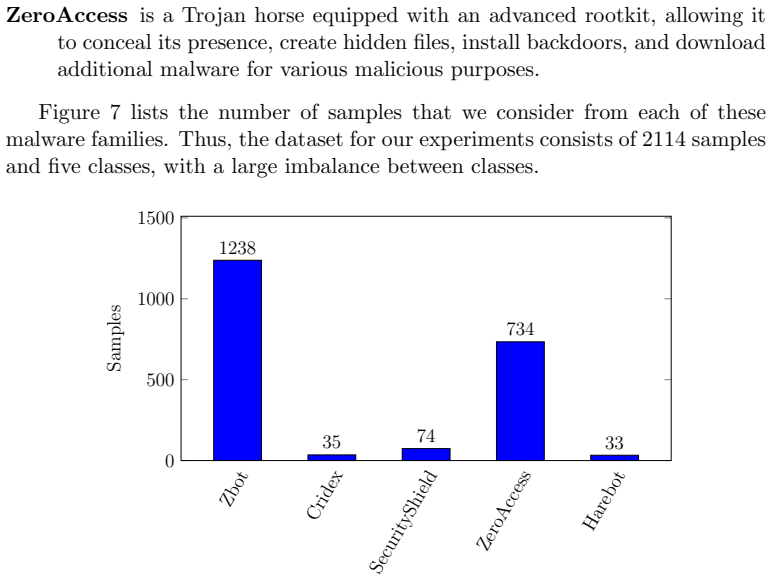
- [Section 4.5 and Figure 11] The central comparative claim rests on a single 80-20 split with no repeated runs, confidence intervals, or significance tests. The reported gap between the best multimodal accuracy (0.9930) and the best baseline (0.9835) is about four test samples out of roughly 423, and with Zbot and ZeroAccess accounting for 93% of the dataset (Figure 7), the difference could be driven by one family. The authors should provide repeated stratified cross-validation or bootstrap confidence intervals, and a paired significance test such as McNemar's test for the comparison of interest, with multiple-comparison control over the nine multimodal combinations.
- [Section 4.5, stacking protocol] The manuscript does not state whether the probability vectors used as features for the final SVM were produced out-of-fold or on the same training data used to fit the component models. If the latter, the meta-SVM is trained on optimistically biased features, and part of the reported 1% gain could be an artifact. The authors must specify the protocol and, if it is not out-of-fold, rerun the experiments with out-of-fold or nested cross-validation.
- [Section 5 (Conclusion and Future Work)] The conclusion acknowledges that testing on a larger, more diverse, and more challenging dataset is needed 'to more accurately quantify the effectiveness' of the approach. This self-identified limitation directly undercuts the abstract's categorical claim that the results 'indicating that it can be advantageous' to train separate models on distinct PE parts. The conclusion should be rephrased to match the strength of the current evidence, and the paper should state the uncertainty associated with the reported accuracies.
- [Section 4.2, hyperparameter selection] The SVM hyperparameter grid search is described as being performed 'using the header features' (Table 2), but the text does not state whether the selected hyperparameters were then used for all SVM variants (sections, entire file, and the meta-SVM) and whether the grid search was conducted entirely within the training partition. This should be clarified, as tuning on the full dataset or on the test portion would bias the reported accuracies.
minor comments (4)
- [Section 1, Introduction] There is a duplicated word and an unclosed parenthesis in the sentence beginning 'While copious previous research has trained trained a wide variety learning models...'; the sentence should be rewritten for clarity.
- [Section 2.1] In the description of the .reloc section, 'session' should be 'section'; the sentence reads 'The .reloc session contains the relocation table...'.
- [Section 2.2 and Section 4.4] Minor typographical and grammatical issues include 'introduces the machine learning that are used' and 'these results demonstrates the efficacy'; these should be corrected.
- [Figure 11 and Appendix Figure A.1] The bar charts would be more informative if they included error bars or the number of test samples per family; given the class imbalance, this would help readers judge the reliability of the accuracy differences.
Circularity Check
No significant circularity: the multimodal result is an empirical comparison on an external dataset, not a derivation forced by its own inputs.
full rationale
The paper's central claim is empirical: the best stacked multimodal model (CNN, CNN) -> SVM reaches 0.9930 accuracy versus 0.9835 for the best single-model baseline, and Section 4.5 describes training the meta-SVM on concatenated output-layer probability vectors of the component models. This is the experimental protocol, not a definitional equivalence: the accuracy numbers are not computed from the inputs by construction, and the baseline models are independent classifiers on the same external Malicia subset. The nine multimodal combinations are tested and the best selected, which is a multiple-comparison and winner's-curse concern rather than a circularity concern. Self-citations appear in related work and background (e.g., [6, 9, 17, 27, 31, 35, 43]), but none carries the load of the central claim; no uniqueness theorem or fitted parameter is imported from the authors' prior work. The Section 4.5 omission of whether the probability features for the meta-SVM are out-of-fold is a potential information-leakage or soundness issue, and the single 80/20 split with no confidence interval is a statistical fragility, but neither makes the result equivalent to its inputs. Section 5's call for a larger, more diverse dataset is an ordinary limitation statement, not an admission of circularity. The paper is therefore not circular; the relevant criticisms fall under experimental soundness, not circular derivation.
Assumptions & free parameters
free parameters (4)
- SVM hyperparameters (C, gamma, kernel) =
not stated in text (boldface in Table 2)
- LSTM input sequence length =
324 (header), 1000 and 2000 (sections/entire)
- CNN image dimensions =
16x16 header, 32x32 sections/entire
- LSTM architecture hyperparameters =
64 units, 10 epochs, batch 30, sigmoid activation
assumptions (5)
- domain assumption PE header is represented by the first 324 bytes
- domain assumption The Malicia ground truth labels for the five selected families are correct
- domain assumption svm.SVC(probability=True) yields reliable probability estimates for stacking
- domain assumption Static byte-level features are sufficient to separate these malware families
- domain assumption A single 80-20 split is representative of model performance
Cite this review
Pith. "Pith review of Multimodal Techniques for Malware Classification." pith.science (2026). https://pith.science/paper/STKR22AO
@misc{pith2026250110956,
  author       = {Pith},
  title        = {Pith review of: Multimodal Techniques for Malware Classification},
  year         = {2026},
  howpublished = {\url{https://pith.science/paper/STKR22AO}},
  note         = {Machine review of arXiv:2501.10956}
}
read the original abstract
The threat of malware is a serious concern for computer networks and systems, highlighting the need for accurate classification techniques. In this research, we experiment with multimodal machine learning approaches for malware classification, based on the structured nature of the Windows Portable Executable (PE) file format. Specifically, we train Support Vector Machine (SVM), Long Short-Term Memory (LSTM), and Convolutional Neural Network (CNN) models on features extracted from PE headers, we train these same models on features extracted from the other sections of PE files, and train each model on features extracted from the entire PE file. We then train SVM models on each of the nine header-sections combinations of these baseline models, using the output layer probabilities of the component models as feature vectors. We compare the baseline cases to these multimodal combinations. In our experiments, we find that the best of the multimodal models outperforms the best of the baseline cases, indicating that it can be advantageous to train separate models on distinct parts of Windows PE files.
Figures


Figures from the paper (8 more)




Reference graph
Works this paper leans on
-
[1]
Evolution of mal- ware threats and techniques: A review
Mohammad Nasser Alenezi, Haneen Khalid Alabdulrazzaq, Abdullah Ab- dulhai Alshaher, and Mubarak Mohammad Alkharang. Evolution of mal- ware threats and techniques: A review. International Journal of Commu- nication Networks and Information Security , 12(3):326–337, 2020. 20
work page 2020
-
[2]
Hyrum S. Anderson and Phil Roth. EMBER: An open dataset for training static PE malware machine learning models. https://arxiv.org/abs/ 1804.04637, 2018
arXiv 2018
-
[3]
Arnab Barua, Mobyen Uddin Ahmed, and Shahina Begum. A systematic literature review on multimodal machine learning: Applications, challenges, gaps and future directions. IEEE Access, 11:14804–14831, 2023
work page 2023
-
[4]
Kristin P. Bennett and Colin Campbell. Support vector machines: Hype or hallelujah? SIGKDD Explorations, 2(2):1–13, 2000
work page 2000
- [5]
-
[6]
A comparison of word2vec, hmm2vec, and pca2vec for malware classification
Aniket Chandak, Wendy Lee, and Mark Stamp. A comparison of word2vec, hmm2vec, and pca2vec for malware classification. In Mark Stamp, Mamoun Alazab, and Andrii Shalaginov, editors, Malware Analysis Using Artificial Intelligence and Deep Learning , pages 287–320. Springer, 2021
work page 2021
-
[7]
An intuitive guide to convolutional neural net- works
Daphne Cornelisse. An intuitive guide to convolutional neural net- works. https://medium.freecodecamp.org/an-intuitive-guide-to- convolutional-neural-networks-260c2de0a050, 2018
work page 2018
-
[8]
Cridex malware. Computer Hope. https://www.computerhope.com/ jargon/c/cridex-malware.htm, 2017
work page 2017
Show all 46 references
-
[9]
Austin, and Mark Stamp
Anusha Damodaran, Fabio Di Troia, Corrado Aaron Visaggio, Thomas H. Austin, and Mark Stamp. A comparison of static, dynamic, and hybrid analysis for malware detection. Journal of Computer Virology and Hacking Techniques, 13(1):1–12, 2015
2015
-
[10]
A comprehensive guide to PE structure, the layman’s way
Satyajit Daulaguphu. A comprehensive guide to PE structure, the layman’s way. https://tech-zealots.com/malware-analysis/pe- portable-executable-structure-malware-analysis-part-2/#: ~: text=And%20PE%20file%20format%20is,scr%2C%20and%20
-
[11]
A beginner’s guide to understanding convolutional neu- ral networks
Adit Deshpande. A beginner’s guide to understanding convolutional neu- ral networks. https://adeshpande3.github.io/A-Beginner%27s-Guide- To-Understanding-Convolutional-Neural-Networks/ , 2018
2018
-
[12]
Machine learning for windows malware detection and classi- fication: Methods, challenges, and ongoing research
Daniel Gibert. Machine learning for windows malware detection and classi- fication: Methods, challenges, and ongoing research. In Dimitris Gritzalis, Kim-Kwang Raymond Choo, and Constantinos Patsakis, editors, Malware: Handbook of Prevention and Detection , pages 143–173. Spri...
2025
-
[13]
Steunebrink, and J¨ urgen Schmidhuber
Klaus Greff, Rupesh Kumar Srivastava, Jan Koutn´ ik, Bas R. Steunebrink, and J¨ urgen Schmidhuber. LSTM: A search space odyssey. IEEE Transac- tions on Neural Networks and Learning Systems , 28(10):2222–2232, 2017. https://arxiv.org/pdf/1503.04069.pdf
2017 arXiv
-
[14]
MDENet: Multi-modal dual-embedding networks for malware open-set recognition
Jingcai Guo, Yuanyuan Xu, Wenchao Xu, Yufeng Zhan, Yuxia Sun, and Song Guo. MDENet: Multi-modal dual-embedding networks for malware open-set recognition. https://arxiv.org/abs/2305.01245, 2023. 21
2023 arXiv
-
[15]
Alexa blogs: How Alexa is learning to converse more naturally
Arpit Gupta. Alexa blogs: How Alexa is learning to converse more naturally. https://developer.amazon.com/blogs/alexa/post/15bf7d2a-5e5c- 4d43-90ae-c2596c9cc3a6/how-alexa-is-learning-to-converse- more-naturally, 2018
2018
-
[16]
Long short-term memory
Sepp Hochreiter and J¨ urgen Schmidhuber. Long short-term memory. Neural Computation, 9(8):1735–1780, 1997. http://www.bioinf.jku.at/ publications/older/2604.pdf
1997
-
[17]
Convolutional neu- ral networks and extreme learning machines for malware classification.Jour- nal of Computer Virology and Hacking Techniques , 16(3):229–244, 2020
Mugdha Jain, William Andreopoulos, and Mark Stamp. Convolutional neu- ral networks and extreme learning machines for malware classification.Jour- nal of Computer Virology and Hacking Techniques , 16(3):229–244, 2020
2020
-
[18]
Modeling visual neurons with convolutional neural net- works
Ioannis Kalfas. Modeling visual neurons with convolutional neural net- works. https://towardsdatascience.com/modeling-visual-neurons- with-convolutional-neural-networks-e9c01ddfdfa7 , 2018
2018
-
[19]
Convolutional neural networks for visual recognition
Andrej Karpathy. Convolutional neural networks for visual recognition. http://cs231n.github.io/convolutional-networks/, 2018
2018
-
[20]
The number of new malicious files detected every day increases by 5.2% to 360,000 in 2020
Kaspersky. The number of new malicious files detected every day increases by 5.2% to 360,000 in 2020. https://www.kaspersky.com/about/press- releases/the-number-of-new-malicious-files-detected-every- day-increases-by-52-to-360000-in-2020 , 2020
2020
-
[21]
Virus Bulletin: Inside the PE file format
Sanjay Katkar. Virus Bulletin: Inside the PE file format. https://www.virusbulletin.com/virusbulletin/2006/06/inside- pe-file-format/, 2006
2006
-
[22]
Swarm optimization and machine learning applied to pe malware detection towards cyber threat intelligence
Santosh Jhansi Kattamuri, Ravi Kiran Varma Penmatsa, Sujata Chakravarty, and Venkata Sai Pavan Madabathula. Swarm optimization and machine learning applied to pe malware detection towards cyber threat intelligence. Electronics, 12(2), 2023
2023
-
[23]
Google AI blog: Chat smarter with Allo
Pranav Khaitan. Google AI blog: Chat smarter with Allo. https://ai. googleblog.com/2016/05/chat-smarter-with-allo.html, 2016
2016
-
[24]
Robust IoT malware detection and classification using opcode cat- egory features on machine learning
Hyunjong Lee, Sooin Kim, Dongheon Baek, Donghoon Kim, and Doosung Hwang. Robust IoT malware detection and classification using opcode cat- egory features on machine learning. IEEE Access, 11:18855–18867, 2023
2023
-
[25]
The iBrain is here—and it’s already inside your phone
Steven Levy. The iBrain is here—and it’s already inside your phone. Wired. https://www.wired.com/2016/08/an-exclusive-look-at-how- ai-and-machine-learning-work-at-apple/ , 2016
2016
-
[26]
Lecture 10: Recurrent neu- ral networks
Fei-Fei Li, Justin Johnson, and Serena Yeung. Lecture 10: Recurrent neu- ral networks. http://cs231n.stanford.edu/slides/2017/cs231n_2017_ lecture10.pdf, 2017
2017
-
[27]
A comparison of graph neural networks for malware classification
Vrinda Malhotra, Katerina Potika, and Mark Stamp. A comparison of graph neural networks for malware classification. Journal of Computer Virology and Hacking Techniques, 20:53–69, 2024. 22
2024
-
[28]
Zubair Rafique, and Juan Caballero
Antonio Nappa, M. Zubair Rafique, and Juan Caballero. The MALICIA dataset: Identification and analysis of drive-by download operations. Inter- national Journal of Information Security , 14(1):15–33, 2015
2015
-
[29]
Carbonell
George Philipp, Dawn Song, and Jaime G. Carbonell. The exploding gradi- ent problem demystified — Definition, prevalence, impact, origin, tradeoffs, and solutions. https://arxiv.org/pdf/1712.05577.pdf, 2018
2018 arXiv
-
[30]
https://pillow.readthedocs.io/en/stable/, 2011
Pillow. https://pillow.readthedocs.io/en/stable/, 2011
2011
-
[31]
An empirical analysis of image- based learning techniques for malware classification
Pratikkumar Prajapati and Mark Stamp. An empirical analysis of image- based learning techniques for malware classification. In Mark Stamp, Mamoun Alazab, and Andrii Shalaginov, editors, Malware Analysis Using Artificial Intelligence and Deep Learning , pages 411–435. Springer, 2021
2021
-
[32]
Nicholas
Edward Raff, Jon Barker, Jared Sylvester, Robert Brandon, Bryan Catan- zaro, and Charles K. Nicholas. Malware detection by eating a whole EXE. In The Workshops of the The Thirty-Second AAAI Conference on Artificial Intelligence, volume WS-18 of AAAI Technical Report, pages 268...
2018
-
[33]
Moss´ e Cyber Security Institute
Reverse engineering portable executables PE — part 2. Moss´ e Cyber Security Institute. https://library.mosse-institute.com/articles/ 2022/05/reverse-engineering-portable-executables-pe-part- 2/reverse-engineering-portable-executables-pe-part-2.html , 2022
2022
-
[34]
A PE header-based method for malware detection using clustering and deep embedding tech- niques
Tina Rezaei, Farnoush Manavi, and Ali Hamzeh. A PE header-based method for malware detection using clustering and deep embedding tech- niques. Journal of Information Security and Applications , 60:102876, 2021
2021
-
[35]
Darknet traffic clas- sification and adversarial attacks using machine learning
Nhien Rust-Nguyen, Shruti Sharma, and Mark Stamp. Darknet traffic clas- sification and adversarial attacks using machine learning. Computers & Security, 127:103098, 2023. https://www.sciencedirect.com/science/ article/pii/S0167404823000081
2023
-
[36]
Microsoft Security Intelligence
SecurityShield. Microsoft Security Intelligence. https://www. microsoft.com/en-us/wdsi/threats/malware-encyclopedia- description?Name=SecurityShield, 2019
2019
-
[37]
ModCGAN: A multimodal approach to detect new malware
Shobhit and Padmalochan Bera. ModCGAN: A multimodal approach to detect new malware. In 2021 International Conference on Cyber Situational Awareness, Data Analytics and Assessment , CyberSA, pages 1–2, 2021
2021
-
[38]
Introduction to the PE file format
Skr1x. Introduction to the PE file format. https://skr1x.github.io/ portable-executable-format/, 2020
2020
-
[39]
Support vector machine algorithm in machine learning
Qiyu Wang. Support vector machine algorithm in machine learning. In 2022 IEEE International Conference on Artificial Intelligence and Computer Ap- plications, ICAICA, pages 750–756, 2022
2022
-
[40]
Qiaokun Wen and K.P. Chow. CNN based zero-day malware detection using small binary segments. Forensic Science International: Digital Investiga- tion, 38:301128, 2021. 23
2021
-
[41]
Microsoft Security Intelligence
Win32/Zbot. Microsoft Security Intelligence. https://www.microsoft. com/en-us/wdsi/threats/malware-encyclopedia-description?Name= Win32/Zbot, 2017
2017
-
[42]
Google’s neural machine translation system: Bridging the gap between human and machine translation
Yonghui Wu et al. Google’s neural machine translation system: Bridging the gap between human and machine translation. https://arxiv.org/ abs/1609.08144, 2016
2016 arXiv
-
[43]
Deep learning versus gist descriptors for image-based malware classi- fication
Sravani Yajamanam, Vikash Raja Samuel Selvin, Fabio Di Troia, and Mark Stamp. Deep learning versus gist descriptors for image-based malware classi- fication. In Paolo Mori, Steven Furnell, and Olivier Camp, editors, Proceed- ings of the 4th International Conference on Informat...
2018
-
[44]
Byte-level malware classification based on Markov images and deep learning
Baoguo Yuan, Junfeng Wang, Dong Liu, Wen Guo, Peng Wu, and Xuhua Bao. Byte-level malware classification based on Markov images and deep learning. Computers & Security , 92:101740, 2020
2020
-
[45]
ODTC: An online darknet traffic classification model based on multi- modal self-attention chaotic mapping features
Jiangtao Zhai, Haoxiang Sun, Chengcheng Xu, and Wenqian Sun. ODTC: An online darknet traffic classification model based on multi- modal self-attention chaotic mapping features. Electronic Research Archive, 31(8):5056–5082, 2023
2023
-
[46]
EnigmaSoft: Rootkit.HareBot
ZulaZuza. EnigmaSoft: Rootkit.HareBot. https://www.enigmasoftware. com/rootkitharebot-removal/, n.d. Appendix The results of all multimodal combinations tested are given in Figure A.1. For additional details on the multimodal experiments used to generate these results, see Sec...
Reviewed August 10, 2026 · model on record in the stance chip above.
Discussion (0). Continue with ORCID to comment.