REVIEW 4 major objections 5 minor 74 references
WIR3D: Visually-Informed and Geometry-Aware 3D Shape Abstraction
T0 review · 4 major / 5 minor · reviewed 2026-08-15 · deepseek-v4-flash
Pith's one-line read WIR3D turns 3D shapes into sparse, meaningful 3D curves that stay faithful from every viewing angle.
desk verdict WIR3D is a solid methods paper with real contributions, but its arbitrary-view fidelity claim outruns the 0–30° elevation evaluation. read the letter →
The pith
A machine-rendered reading of the paper's core claim, the machinery that carries it, and where it could break.
The reading
What carries the argument
The load-bearing mechanism is the localized keypoint loss. Given a set of 3D keypoints, either user-selected or automatically detected by back-projecting CLIP features and clustering, each keypoint is projected into the current view and converted into a Gaussian weight map $I_{\mathrm{weight}}$; this map is downsampled and multiplied into the per-pixel difference between CLIP intermediate activation maps of the curve render and the target render, so that optimization effort concentrates around the keypoint. The loss also includes a mean-pooled weight applied to the global CLIP cosine distance and an LPIPS term. Supporting it are a two-stage optimization, with CLIP RN101 for geometry on Freestyle contour renders and CLIP RN50x64 for texture on surface renders, a neural SDF loss $L_{\mathrm{SDF}}$ that penalizes curve samples away from the zero level set, an NDC regularization keeping curves inside the frame, and differentiable rasterization of projected 3D Bezier control points.
What would settle it
Run the stage-II optimization on the same shape twice, once with keypoints on a salient feature and once with the same number of keypoints on a flat, featureless region, keeping all other settings fixed; if the two abstractions are indistinguishable by user ranking or by L2 distance between curve sets, then the localized loss is not doing spatial work. A stronger quantitative version is to take ground-truth keypoint positions, project them into views, and check whether the argmax of the CLIP intermediate activation difference, or the recovered center of the weight map, falls within a few pixels of the projected keypoint; chance-level localization would falsify the paper's central mechanism.
Extended reading notes
Core claim
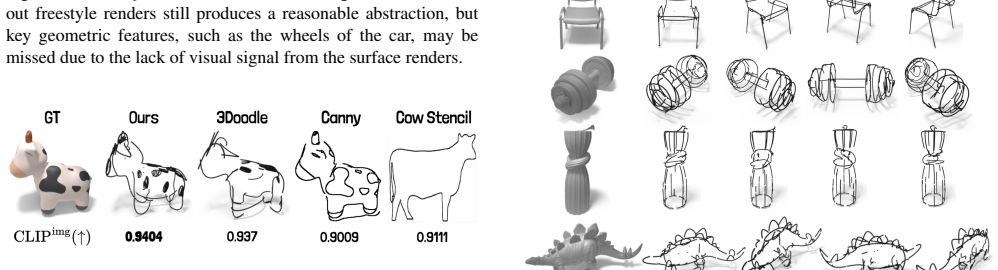
The central claim is that a set of cubic Bezier curves optimized against spatially weighted CLIP activations yields a 3D abstraction that is simultaneously sparse, view-consistent, and semantically faithful. In the paper's own framing, WIR3D 'can abstract a myriad of shapes from different domains with various visual concepts, geometric structures, and textures,' and the abstractions 'maintain high fidelity across arbitrary views.' The novel component is the localized keypoint loss: 3D keypoints are projected into each sampled view, a Gaussian weight map is constructed around them, and this map multiplies the difference between CLIP intermediate activations of the rendered curves and of the target shape, focusing optimization on the feature at the keypoint. The method also anchors curves to the surface with a neural SDF loss, so the optimized strokes are not just decorative but can serve as deformation handles. The authors demonstrate the claim qualitatively across textured and untextured shapes, on messy in-the-wild reconstructions, and with user studies favoring WIR3D over the 3Doodle baseline in 88% of pairwise comparisons.
Load-bearing premise
The texture stage and feature-control application rest on the assumption that the internal feature maps of CLIP are spatially correlated with the input image, so that a weight map built around projected keypoints actually concentrates the optimization on the intended feature; if CLIP's activations do not localize that way, the localized loss collapses to the unweighted loss and keypoint control stops working.
Editorial extensions
If this is right
- Because the strokes are defined as 3D Bezier curves, the abstraction is view-consistent by construction and avoids the flickering that plagues per-view occluding contours.
- The level of abstraction is controlled simply by the number of curves; adding strokes automatically adds finer detail, as shown in the paper's Fig. 6.
- Users can add or refine detail interactively by selecting keypoints, with refinement completing in roughly a minute.
- The curves' adherence to the surface lets them act as deformation handles; a user study found WIR3D-based deformations preferable to ARAP-based deformation 80% of the time.
- The method needs no clean input mesh and produces meaningful abstractions even from photo-reconstructed models with boundary and non-manifold edges.
Reading between the lines
- A direct test of the localization assumption would be to measure whether CLIP intermediate activation maps predict the projected positions of known keypoints; the paper only tests this indirectly through the random-keypoint ablation, so the spatial-precision claim is the least-supported link.
- The same spatially weighted CLIP supervision could be applied to abstractions in other modalities, such as video frames or multi-object scenes, where the keypoints would enforce temporal or spatial consistency.
- Because the curves are bound to the surface through the SDF loss, they could serve as a general rigging primitive; skinning weights derived from curve distance might extend beyond the proof-of-concept deformation shown here.
- The automatic keypoint detector inherits the biases of the CLIP features used for back-projection, so the method's notion of 'salient feature' may silently be CLIP's notion of salience rather than a universal one.
Signed reviews
Editorial analysis
A structured set of objections, weighed in public.
Referee Report
Summary. The paper introduces WIR3D, a method that abstracts a 3D shape into a sparse set of 3D cubic Bezier curves intended to represent both geometry and salient texture from arbitrary viewpoints. The method optimizes the curves with a two-stage procedure: stage I captures coarse geometry using CLIP semantic losses supervised by Freestyle renders, and stage II adds curves for texture using a novel localized keypoint loss that weights CLIP intermediate feature differences around projected 3D keypoints. An SDF regularization encourages curve adherence to the surface, and the authors demonstrate applications in interactive feature refinement and curve-based deformation. The evaluation includes qualitative results on textured and untextured shapes, quantitative comparisons with 3Doodle and NEF using LPIPS, CLIP image similarity, user preference, and a Chamfer-based coverage metric, plus ablation studies and two user studies.
Significance. If the central claims hold, WIR3D would be a useful contribution to 3D sketch abstraction, addressing a gap left by occlusion-contour methods and by dataset-dependent reconstruction approaches. The two-stage optimization, the localized keypoint weighting, and the SDF-based surface anchoring are reasonable and potentially transferable ideas. The paper's strengths include the breadth of qualitative results across varied shapes, the inclusion of two user studies that provide partially independent evidence, and the use of established baselines (3Doodle, NEF). The automatic keypoint detection via back-projection and clustering is also a sensible mechanism. However, the quantitative evidence is weaker than the narrative suggests: the headline metrics overlap in family with the optimization losses, no variance information is reported for stochastic optimization, and the 'arbitrary views' claim is not tested outside the training elevation band. These issues need to be addressed before the contribution can be fully assessed.
major comments (4)
- [Sec. 3.2 and Sec. 4.2, Table 1] The quantitative comparison is partly circular. The optimization losses in Eq. (2) and Eq. (4) use cosine similarity on global CLIP embeddings plus L2 distances on intermediate CLIP features, with ResNet CLIP variants (RN101 and RN50x16), and the LPIPS term uses the VGG variant (supplemental Sec. C). The headline evaluation in Table 1 uses CLIP ViT/B-32 image similarity and AlexNet LPIPS. The architecture split reduces but does not eliminate the concern: Table 1 still measures the same family of perceptual losses that the method is explicitly trained against, so the reported superiority over 3Doodle on LPIPS and CLIP image similarity is partly an artifact of optimizing objectives of the same type. I do not regard this as fatal because the user study (N=96) is independent and is the strongest evidence in the paper, but the claim that WIR3D 'outperforms' baselines on the first two metrics is not independent confirmation. Please report per-shape results, metrics obtained from unrelated evaluators (e.g., human judgment already available), or at least discuss this limitation quantitatively.
- [Sec. 4, paragraphs 1-2; Table 1 and Table 2] No variance or confidence information is reported for any quantitative result. The optimization is stochastic: one random view is sampled per iteration, random initializations are used, and the CLIP supervision is augmented (supplemental Sec. G). Tables 1 and 2 report only point estimates. Consequently, small differences such as LPIPS 0.227 vs 0.229 (No SDF) or CLIP image similarity 0.909 vs 0.904 cannot be interpreted as meaningful, and even the larger apparent gains over 3Doodle lack error bars. Please report means with standard deviations or confidence intervals across multiple optimization runs and across views, and state the number of runs used.
- [Sec. 4, first paragraph; Sec. 4.1; Fig. 16] The central claim that abstractions 'maintain high fidelity across arbitrary views' is not supported by the evaluation. All optimization views are sampled from elevations 0-30 degrees and azimuth 0-360 degrees, and no held-out or high-elevation evaluation is reported. Table 1 averages over novel views without a per-view breakdown, and the qualitative multi-view evidence (Fig. 16 and the supplemental) appears to demonstrate azimuthal rotation rather than a full sphere of viewpoints. Since there is no explicit multi-view consistency loss beyond the shared 3D curve parameters, it remains possible that the curves satisfy the training view distribution while misrepresenting the shape at high elevations. Please either add quantitative evaluation on held-out elevation bands (e.g., 30-60 and 60-90 degrees) and per-view error statistics, or soften the 'arbitrary views' claim to match the evaluated range.
- [Sec. 3.2, Eq. (4) and Sec. 3.3] The localized keypoint loss rests on the assumption that CLIP intermediate activations carry spatial information that can be meaningfully localized through a Gaussian weight map. The paper cites Shomron and Weiser [51] for this, but that reference studies spatial correlation in CNN activations generally for value prediction, not CLIP feature localization specifically, and no experiment in the paper directly validates that CLIP layers 3 and 4 provide the required spatial resolution for the proposed weighting. This is load-bearing because the texture stage and the user-control application both depend on the localization. The 'No Local' ablation and the noisy-keypoint experiment in Fig. 9 show robustness and overall utility, but they do not establish that the keypoint projections correlate with the features being emphasized. Please provide a direct spatial-localization check, for example by visualizing CLIP activation maps at keypoint locations or by comparing optimization outcomes with keypoints placed on different features against ground-truth feature regions.
minor comments (5)
- [Fig. 6 caption] Typo: 'progressvely' should be 'progressively'.
- [Sec. 4.2 and Sec. H] The paper uses inconsistent capitalization: 'Wir3D' appears in the user-study passages and in Fig. 24, while the method name is 'WIR3D' elsewhere. Please standardize.
- [Supplemental Sec. A] The term 'Janusing artifacts' should likely be 'Janus artifacts', and reference [54] on generative AI is an unusual citation for this graphics-specific phenomenon; please use a more standard reference.
- [Sec. 4.2, Table 1] The metric named 'Coverage' is a one-direction Chamfer distance from surface samples to curves. This measures proximity rather than coverage in the sense of how much of the surface is represented; please either rename the metric or add an explicit justification that this quantity captures coverage.
- [Sec. 1 and Data Availability] The paper states that code will be released 'in the near future' but no code is provided. Given that the method is an optimization with several tuned hyperparameters, releasing the code would substantially aid reproducibility; please state in the final version where and when the code will be available.
Circularity Check
No significant circularity: WIR3D is an optimization method validated by independent user studies and by evaluation metrics that are architecture-split from the training losses.
full rationale
WIR3D is an optimization method rather than a fitted predictor, so the standard circularity patterns do not apply. The Bezier curves are optimized from furthest-point initialization against CLIP, LPIPS, SDF, and NDC losses; no quantity is fitted to a subset of data and then reported as a prediction of the same quantity. The closest candidate, using perceptual metrics in Table 1 that resemble the semantic losses in Eq. (2) and Eq. (4), is mitigated by the paper's explicit architecture split (ResNet CLIP for optimization vs ViT/B-32 for CLIP img; VGG LPIPS for optimization vs AlexNet for evaluation) and by independent user studies (88% preference over 3Doodle and 80% preference over ARAP). The coverage metric is not identical to the SDF loss: the SDF loss only requires curve samples to lie near the surface, while coverage measures whether surface points are near the curve set, so the metric is not forced by the loss. The automatic keypoint detection uses CLIP features, but this is a design choice rather than a circular derivation, since the claims about visual salience are validated by human raters rather than by CLIP alone. The discussion of arbitrary views is an evaluation-scope concern, not a circularity. No load-bearing argument is justified by a self-citation; the GeoCode and PointGMM citations are related-work only.
Assumptions & free parameters
free parameters (4)
- CLIP architecture split =
RN101 (stage 1), RN50x64 (stage 2; supplementary says RN50x16)
- Stage 2 loss weights and Gaussian scale =
lambda_fc=75, lambda_lpips=0.1, sigma=0.1
- Curve count =
20 geometry curves and 20 texture curves
- Keypoint count k =
Set to the stage 2 curve count (20)
assumptions (4)
- domain assumption Theorem 1 from 3Doodle: with a sufficiently distant camera, optimizing 3D Bezier curves and projecting them is equivalent to optimizing 2D rational Bezier curves.
- domain assumption CLIP intermediate activations are spatially correlated with input image locations.
- ad hoc to paper Freestyle renders isolate geometric structure and serve as an appropriate target for stage 1.
- domain assumption The fitted neural SDF MLP accurately approximates the true distance field of the shape.
Cite this review
Pith. "Pith review of WIR3D: Visually-Informed and Geometry-Aware 3D Shape Abstraction." pith.science (2026). https://pith.science/paper/SWZYTMU3
@misc{pith2026250504813,
  author       = {Pith},
  title        = {Pith review of: WIR3D: Visually-Informed and Geometry-Aware 3D Shape Abstraction},
  year         = {2026},
  howpublished = {\url{https://pith.science/paper/SWZYTMU3}},
  note         = {Machine review of arXiv:2505.04813}
}
read the original abstract
In this work we present WIR3D, a technique for abstracting 3D shapes through a sparse set of visually meaningful curves in 3D. We optimize the parameters of Bezier curves such that they faithfully represent both the geometry and salient visual features (e.g. texture) of the shape from arbitrary viewpoints. We leverage the intermediate activations of a pre-trained foundation model (CLIP) to guide our optimization process. We divide our optimization into two phases: one for capturing the coarse geometry of the shape, and the other for representing fine-grained features. Our second phase supervision is spatially guided by a novel localized keypoint loss. This spatial guidance enables user control over abstracted features. We ensure fidelity to the original surface through a neural SDF loss, which allows the curves to be used as intuitive deformation handles. We successfully apply our method for shape abstraction over a broad dataset of shapes with varying complexity, geometric structure, and texture, and demonstrate downstream applications for feature control and shape deformation.
Figures


Figures from the paper (19 more)




Reference graph
Works this paper leans on
-
[51]
Spatial correlation and value prediction in convolutional neural networks
Gil Shomron and Uri Weiser. Spatial correlation and value prediction in convolutional neural networks. IEEE Comput. Archit. Lett., 18(1):10–13, 2019. 4
work page 2019
-
[1]
Edmond Boyer and Marie-Odile Berger. 3D Surface Reconstruction Using Occluding Contours.Interna- tional Journal of Computer Vision, 22(3):219–233,
-
[2]
Pierre B ´enard and Aaron Hertzmann. Line Draw- ings from 3D Models: A Tutorial.Foundations and Trends® in Computer Graphics and Vision, 11(1-2): 1–159, 2019. 2
work page 2019
-
[3]
John Canny. A Computational Approach to Edge Detection.IEEE Transactions on Pattern Analy- sis and Machine Intelligence, PAMI-8(6):679–698,
-
[4]
Li Cao, Yike Xu, Jianwei Guo, and Xiaoping Liu. WireframeNet: A novel method for wireframe gener- ation from point cloud.Computers & Graphics, 115: 226–235, 2023. 3
work page 2023
-
[5]
Algebraic Smooth Occluding Con- tours
Ryan Capouellez, Jiacheng Dai, Aaron Hertzmann, and Denis Zorin. Algebraic Smooth Occluding Con- tours. InACM SIGGRAPH 2023 Conference Proceed- ings, pages 1–10, 2023. 1, 2
work page 2023
-
[6]
Example- based facial sketch generation with non-parametric sampling
Hong Chen, Ying-Qing Xu, Heung-Yeung Shum, Song-Chun Zhu, and Nan-Ning Zheng. Example- based facial sketch generation with non-parametric sampling. InProceedings Eighth IEEE International Conference on Computer Vision. ICCV 2001, pages 433–438 vol.2, 2001. 3
work page 2001
-
[7]
Changwoon Choi, Jaeah Lee, Jaesik Park, and Young Min Kim. 3Doodle: Compact Abstraction of Objects with 3D Strokes.ACM Transactions on Graphics (TOG), 43(4):1–13, 2024. 3, 4, 6
work page 2024
Show all 74 references
-
[8]
Online 3D Edge Reconstruction of Wiry Struc- tures From Monocular Image Sequences.IEEE Robotics and Automation Letters, 8(11):7479–7486,
Hyelim Choi, Minji Lee, Jiseock Kang, and Dongjun Lee. Online 3D Edge Reconstruction of Wiry Struc- tures From Monocular Image Sequences.IEEE Robotics and Automation Letters, 8(11):7479–7486,
-
[9]
Ro- bust fairing via conformal curvature flow.ACM Trans- actions on Graphics (TOG), 32(4):1–10, 2013
Keenan Crane, Ulrich Pinkall, and Peter Schr¨oder. Ro- bust fairing via conformal curvature flow.ACM Trans- actions on Graphics (TOG), 32(4):1–10, 2013. 5
2013
-
[10]
Suggestive contours for conveying shape.ACM Trans
Doug DeCarlo, Adam Finkelstein, Szymon Rusinkiewicz, and Anthony Santella. Suggestive contours for conveying shape.ACM Trans. Graph., 22(3):848–855, 2003. 2
2003
-
[11]
Suggestive Contours for Conveying Shape
Doug DeCarlo, Adam Finkelstein, Szymon Rusinkiewicz, and Anthony Santella. Suggestive Contours for Conveying Shape. InSeminal Graphics Papers: Pushing the Boundaries, Volume 2, pages 401–408. ACM New York, NY , USA, 2023. 1
2023
-
[12]
Cvxnet: Learnable Convex Decomposition
Boyang Deng, Kyle Genova, Soroosh Yazdani, Sofien Bouaziz, Geoffrey Hinton, and Andrea Tagliasacchi. Cvxnet: Learnable Convex Decomposition. InPro- ceedings of the IEEE/CVF conference on computer vision and pattern recognition (CVPR), pages 31–44,
-
[13]
CLIP- Draw: Exploring Text-to-Drawing Synthesis through Language-Image Encoders.Advances in Neural In- formation Processing Systems, 35:5207–5218, 2022
Kevin Frans, Lisa Soros, and Olaf Witkowski. CLIP- Draw: Exploring Text-to-Drawing Synthesis through Language-Image Encoders.Advances in Neural In- formation Processing Systems, 35:5207–5218, 2022. 3
2022
-
[14]
iWIRES: An analyze-and-edit approach to shape manipulation.ACM Transactions on Graphics (proceedings of ACM SIGGRAPH), 28(3):33:1–33:10,
Ran Gal, Olga Sorkine, Niloy Mitra, and Daniel Cohen-Or. iWIRES: An analyze-and-edit approach to shape manipulation.ACM Transactions on Graphics (proceedings of ACM SIGGRAPH), 28(3):33:1–33:10,
-
[15]
Breathing Life Into Sketches Using Text-to-Video Pri- ors
Rinon Gal, Yael Vinker, Yuval Alaluf, Amit Bermano, Daniel Cohen-Or, Ariel Shamir, and Gal Chechik. Breathing Life Into Sketches Using Text-to-Video Pri- ors. In2024 IEEE/CVF Conference on Computer Vi- sion and Pattern Recognition (CVPR), pages 4325– 4336, Seattle, W A, USA, 2...
2024
-
[16]
Semantic Abstrac- tion: Open-World 3D Scene Understanding from 2D Vision-Language Models, 2022
Huy Ha and Shuran Song. Semantic Abstrac- tion: Open-World 3D Scene Understanding from 2D Vision-Language Models, 2022. arXiv:2207.11514 [cs]. 2
2022 arXiv
-
[17]
Hennessey, Han Liu, Holger Winnem ¨oller, Mira Dontcheva, and Niloy J
James W. Hennessey, Han Liu, Holger Winnem ¨oller, Mira Dontcheva, and Niloy J. Mitra. How2sketch: Generating easy-to-follow tutorials for sketching 3d objects.Symposium on Interactive 3D Graphics and Games, 2017. 3
2017
-
[18]
MEASURING HUMAN-CLIP ALIGNMENT AT DIFFERENT ABSTRACTION LEVELS
Pablo Hernandez-Camara and Jorge Vila-Tomas. MEASURING HUMAN-CLIP ALIGNMENT AT DIFFERENT ABSTRACTION LEVELS. 2024. 2
2024
-
[19]
PointGMM: a Neural GMM Network for Point Clouds
Amir Hertz, Rana Hanocka, Raja Giryes, and Daniel Cohen-Or. PointGMM: a Neural GMM Network for Point Clouds. InProceedings of the IEEE/CVF Con- ference on Computer Vision and Pattern Recognition (CVPR), pages 12054–12063, 2020. 2
2020
-
[20]
SPAGHETTI: Edit- ing Implicit Shapes Through Part Aware Generation
Amir Hertz, Or Perel, Raja Giryes, Olga Sorkine- Hornung, and Daniel Cohen-Or. SPAGHETTI: Edit- ing Implicit Shapes Through Part Aware Generation. ACM Transactions on Graphics (TOG), 41(4):1–20,
-
[21]
New insights in smooth occluding contours for nonphotorealistic rendering.IEEE Com- puter Graphics and Applications, 44(1):76–85, 2024
Aaron Hertzmann. New insights in smooth occluding contours for nonphotorealistic rendering.IEEE Com- puter Graphics and Applications, 44(1):76–85, 2024. 1, 2
2024
-
[22]
Multi-view Wire Art.ACM Transactions on Graphics (TOG), 37(6):1–11, 2018
Kai-Wen Hsiao, Jia-Bin Huang, and Hung-Kuo Chu. Multi-view Wire Art.ACM Transactions on Graphics (TOG), 37(6):1–11, 2018. 3
2018
-
[23]
Mitra, and Adrien Bousseau
Felix H ¨ahnlein, Changjian Li, Niloy J. Mitra, and Adrien Bousseau. CAD2Sketch: Generating Concept Sketches from CAD Sequences.ACM Transactions on Graphics, 41(6):1–18, 2022. 3
2022
-
[24]
SHRED: 3D Shape Region Decomposition with Learned Local Operations.ACM Transactions on Graphics (TOG), 41(6):1–11, 2022
R Kenny Jones, Aalia Habib, and Daniel Ritchie. SHRED: 3D Shape Region Decomposition with Learned Local Operations.ACM Transactions on Graphics (TOG), 41(6):1–11, 2022. 2
2022
-
[25]
What does the occluding contour tell us about solid shape?Perception, 13(3):321–330,
Jan J Koenderink. What does the occluding contour tell us about solid shape?Perception, 13(3):321–330,
-
[26]
3D Neu- ral Edge Reconstruction
Lei Li, Songyou Peng, Zehao Yu, Shaohui Liu, Remi Pautrat, Xiaochuan Yin, and Marc Pollefeys. 3D Neu- ral Edge Reconstruction. In2024 IEEE/CVF Con- ference on Computer Vision and Pattern Recogni- tion (CVPR), pages 21219–21229, Seattle, W A, USA,
-
[27]
Photo-sketching: Inferring con- tour drawings from images.WACV, 2019
Mengtian Li, Zhe Lin, Radom´ır Mˇ ech, , Ersin Yumer, and Deva Ramanan. Photo-sketching: Inferring con- tour drawings from images.WACV, 2019. 3
2019
-
[28]
Differentiable vector graph- ics rasterization for editing and learning.ACM Trans
Tzu-Mao Li, Michal Luk ´aˇc, Gharbi Micha ¨el, and Jonathan Ragan-Kelley. Differentiable vector graph- ics rasterization for editing and learning.ACM Trans. Graph. (Proc. SIGGRAPH Asia), 39(6):193:1–193:15,
-
[29]
ConTesse: Accurate Occluding Contours for Subdivision Surfaces.ACM Transactions on Graphics, 42(1):1–16, 2023
Chenxi Liu, Pierre B ´enard, Aaron Hertzmann, and Shayan Hoshyari. ConTesse: Accurate Occluding Contours for Subdivision Surfaces.ACM Transactions on Graphics, 42(1):1–16, 2023. 1
2023
-
[30]
Neural Contours: Learning to Draw Lines from 3D Shapes
Difan Liu, Mohamed Nabail, Aaron Hertzmann, and Evangelos Kalogerakis. Neural Contours: Learning to Draw Lines from 3D Shapes. InProceedings of the IEEE/CVF Conference on Computer Vision and Pat- tern Recognition (CVPR), pages 5428–5436, 2020. 2
2020
-
[31]
Neural Strokes: Stylized Line Drawing of 3d Shapes
Difan Liu, Matthew Fisher, Aaron Hertzmann, and Evangelos Kalogerakis. Neural Strokes: Stylized Line Drawing of 3d Shapes. InProceedings of the IEEE/CVF International Conference on Computer Vi- sion (CVPR), pages 14204–14213, 2021. 1, 2
2021
-
[32]
Lingjie Liu, Duygu Ceylan, Cheng Lin, Wenping Wang, and Niloy J. Mitra. Image-based reconstruc- tion of wire art.ACM SIGGRAPH 2017, 2017. 3
2017
-
[33]
Lingjie Liu, Nenglun Chen, Duygu Ceylan, Christian Theobalt, Wenping Wang, and Niloy J. Mitra. Curve- fusion: Reconstructing thin structures from rgbd se- quences.ACM Trans. Graph., 37(6):218:1–218:12,
-
[34]
Marching-Primitives: Shape Abstraction from Signed Distance Function
Weixiao Liu, Yuwei Wu, Sipu Ruan, and Gregory S Chirikjian. Marching-Primitives: Shape Abstraction from Signed Distance Function. InProceedings of the IEEE/CVF Conference on Computer Vision and Pat- tern Recognition (CVPR), pages 8771–8780, 2023. 2
2023
-
[35]
Least squares quantization in pcm.IEEE transactions on information theory, 28(2):129–137,
Stuart Lloyd. Least squares quantization in pcm.IEEE transactions on information theory, 28(2):129–137,
-
[36]
Real-World Textured Things: A repository of textured models generated with modern photo-reconstruction tools.Computer Aided Geometric Design, 83:101943, 2020
Andrea Maggiordomo, Federico Ponchio, Paolo Cignoni, and Marco Tarini. Real-World Textured Things: A repository of textured models generated with modern photo-reconstruction tools.Computer Aided Geometric Design, 83:101943, 2020. 6
2020
-
[37]
Analysis of Occluding Contour.Proceed- ings of the Royal Society of London
David Marr. Analysis of Occluding Contour.Proceed- ings of the Royal Society of London. Series B. Biolog- ical Sciences, 197(1129):441–475, 1977. 2
1977
-
[38]
Abstraction of man-made shapes
Ravish Mehra, Qingnan Zhou, Jeremy Long, Alla Sheffer, Amy Gooch, and Niloy J Mitra. Abstraction of man-made shapes. InACM SIGGRAPH Asia 2009 papers, pages 1–10. ACM New York, NY , USA, 2009. 3
2009
-
[39]
Shadow Art.ACM Transactions on Graphics, 28(5):156–1, 2009
Niloy J Mitra and Mark Pauly. Shadow Art.ACM Transactions on Graphics, 28(5):156–1, 2009. 3
2009
-
[40]
Axis-Aligned Height-Field Block Decomposition of 3D Shapes
Alessandro Muntoni, Marco Livesu, Riccardo Scateni, Alla Sheffer, and Daniele Panozzo. Axis-Aligned Height-Field Block Decomposition of 3D Shapes. ACM Transactions on Graphics (TOG), 37(5):1–15,
-
[41]
Aria dig- ital twin: A new benchmark dataset for egocentric 3d machine perception, 2023
Xiaqing Pan, Nicholas Charron, Yongqian Yang, Scott Peters, Thomas Whelan, Chen Kong, Omkar Parkhi, Richard Newcombe, and Carl Yuheng Ren. Aria dig- ital twin: A new benchmark dataset for egocentric 3d machine perception, 2023. 5, 4
2023
-
[42]
Juxtaform: interactive visual summarization for ex- ploratory shape design.ACM Trans
Karran Pandey, Fanny Chevalier, and Karan Singh. Juxtaform: interactive visual summarization for ex- ploratory shape design.ACM Trans. Graph., 42(4): 52:1–52:14, 2023. 3
2023
-
[43]
SketchGen: Generating Constrained CAD Sketches
Wamiq Para, Shariq Bhat, Paul Guerrero, Tom Kelly, Niloy Mitra, Leonidas J Guibas, and Peter Wonka. SketchGen: Generating Constrained CAD Sketches. InAdvances in Neural Information Processing Sys- tems, pages 5077–5088. Curran Associates, Inc.,
-
[44]
Neural Parts: Learn- ing Expressive 3D Shape Abstractions with Invertible Neural Networks
Despoina Paschalidou, Angelos Katharopoulos, An- dreas Geiger, and Sanja Fidler. Neural Parts: Learn- ing Expressive 3D Shape Abstractions with Invertible Neural Networks. InProceedings of the IEEE/CVF Conference on Computer Vision and Pattern Recogni- tion (CVPR), pages 3204–...
2021
-
[45]
GeoCode: Interpretable Shape Programs.arXiv preprint arXiv:2212.11715, 2022
Ofek Pearl, Itai Lang, Yuhua Hu, Raymond A Yeh, and Rana Hanocka. GeoCode: Interpretable Shape Programs.arXiv preprint arXiv:2212.11715, 2022. 2
2022 arXiv
-
[46]
SketchLattice: Lat- ticed Representation for Sketch Manipulation
Yonggang Qi, Guoyao Su, Pinaki Nath Chowdhury, Mingkang Li, and Yi-Zhe Song. SketchLattice: Lat- ticed Representation for Sketch Manipulation. In2021 IEEE/CVF International Conference on Computer Vi- sion (ICCV), pages 933–941, Montreal, QC, Canada,
-
[47]
Wired Perspectives: Multi-View Wire Art Embraces Generative AI
Zhiyu Qu, Lan Yang, Honggang Zhang, Tao Xiang, Kaiyue Pang, and Yi-Zhe Song. Wired Perspectives: Multi-View Wire Art Embraces Generative AI. In Proceedings of the IEEE/CVF Conference on Com- puter Vision and Pattern Recognition, pages 6149– 6158, 2024. 3
2024
-
[48]
Learning Transferable Visual Models from Nat- ural Language supervision
Alec Radford, Jong Wook Kim, Chris Hallacy, Aditya Ramesh, Gabriel Goh, Sandhini Agarwal, Girish Sas- try, Amanda Askell, Pamela Mishkin, Jack Clark, et al. Learning Transferable Visual Models from Nat- ural Language supervision. InInternational Confer- ence on Machine Learnin...
2021
-
[49]
Viewpoint from Occluding Contour.CVGIP: Image Understanding, 55(2):198–211, 1992
W Brent Seales and Charles R Dyer. Viewpoint from Occluding Contour.CVGIP: Image Understanding, 55(2):198–211, 1992. 2
1992
-
[50]
Tianjia Shao, Wilmot Li, Kun Zhou, Weiwei Xu, Baining Guo, and Niloy J. Mitra. Interpreting con- cept sketches.ACM Transactions on Graphics, 32(4),
-
[52]
Hospedales
Jifei Song, Kaiyue Pang, Yi-Zhe Song, Tao Xiang, and Timothy M. Hospedales. Learning to Sketch with Shortcut Cycle Consistency. In2018 IEEE/CVF Con- ference on Computer Vision and Pattern Recognition, pages 801–810, Salt Lake City, UT, 2018. IEEE. 3
2018
-
[53]
As-rigid-as-possible surface modeling
Olga Sorkine and Marc Alexa. As-rigid-as-possible surface modeling. InProceedings of the fifth Euro- graphics symposium on Geometry processing, pages 109–116, Goslar, DEU, 2007. Eurographics Associa- tion. 8, 6
2007
-
[54]
The Janus Effect of Genera- tive AI: Charting the Path for Responsible Conduct of Scholarly Activities in Information Systems.Infor- mation Systems Research, 34(2):399–408, 2023
Anjana Susarla, Ram Gopal, Jason Bennett Thatcher, and Suprateek Sarker. The Janus Effect of Genera- tive AI: Charting the Path for Responsible Conduct of Scholarly Activities in Information Systems.Infor- mation Systems Research, 34(2):399–408, 2023. Pub- lisher: INFORMS. 1
2023
-
[55]
Sphere-Meshes: shape approximation using spherical quadric error metrics.ACM Transactions on Graphics, 32(6):1–12, 2013
Jean-Marc Thiery, ´Emilie Guy, and Tamy Boubekeur. Sphere-Meshes: shape approximation using spherical quadric error metrics.ACM Transactions on Graphics, 32(6):1–12, 2013. 2
2013
-
[56]
Modern Evolution Strate- gies for Creativity: Fitting Concrete Images and Ab- stract Concepts
Yingtao Tian and David Ha. Modern Evolution Strate- gies for Creativity: Fitting Concrete Images and Ab- stract Concepts. InArtificial Intelligence in Music, Sound, Art and Design: 11th International Confer- ence, EvoMUSART 2022, Held as Part of EvoStar 2022, Madrid, Spain, Ap...
2022
-
[57]
Fabricable 3D Wire Art
Kenji Tojo, Ariel Shamir, Bernd Bickel, and Nobuyuki Umetani. Fabricable 3D Wire Art. InSpecial Interest Group on Computer Graphics and Interactive Tech- niques Conference Conference Papers ’24, pages 1– 11, Denver CO USA, 2024. ACM. 3
2024
-
[58]
Eyes Wide Shut? Exploring the Visual Shortcomings of Multimodal LLMs, 2024
Shengbang Tong, Zhuang Liu, Yuexiang Zhai, Yi Ma, Yann LeCun, and Saining Xie. Eyes Wide Shut? Exploring the Visual Shortcomings of Multimodal LLMs, 2024. arXiv:2401.06209 [cs]. 6
2024 arXiv
-
[59]
Learning Shape Abstractions by Assembling V olumetric Primitives
Shubham Tulsiani, Hao Su, Leonidas J Guibas, Alexei A Efros, and Jitendra Malik. Learning Shape Abstractions by Assembling V olumetric Primitives. In Proceedings of the IEEE Conference on Computer Vision and Pattern Recognition, pages 2635–2643,
-
[60]
Prior knowledge for part correspondence
Oliver van Kaick, Andrea Tagliasacchi, Oana Sidi, Hao Zhang, Daniel Cohen-Or, Lior Wolf, and Ghassan Hamarneh. Prior knowledge for part correspondence. Computer Graphics Forum, 30(2):553–562, 2011. 5
2011
-
[61]
CLIPasso: Semantically-Aware Object Sketching
Yael Vinker, Ehsan Pajouheshgar, Jessica Y Bo, Roman Christian Bachmann, Amit Haim Bermano, Daniel Cohen-Or, Amir Zamir, and Ariel Shamir. CLIPasso: Semantically-Aware Object Sketching. ACM Transactions on Graphics (TOG), 41(4):1–11,
-
[62]
CLIPascene: Scene Sketching with Different Types and Levels of Abstraction
Yael Vinker, Yuval Alaluf, Daniel Cohen-Or, and Ariel Shamir. CLIPascene: Scene Sketching with Different Types and Levels of Abstraction. In2023 IEEE/CVF International Conference on Computer Vi- sion (ICCV), pages 4123–4133, Paris, France, 2023. IEEE. 2, 3
2023
-
[63]
Exploring clip for assessing the look and feel of im- ages
Jianyi Wang, Kelvin CK Chan, and Chen Change Loy. Exploring clip for assessing the look and feel of im- ages. InAAAI, 2023. 6
2023
-
[64]
Vid2Curve: simultaneous camera motion estimation and thin structure reconstruction from an RGB video
Peng Wang, Lingjie Liu, Nenglun Chen, Hung- Kuo Chu, Christian Theobalt, and Wenping Wang. Vid2Curve: simultaneous camera motion estimation and thin structure reconstruction from an RGB video. ACM Trans. Graph., 39(4):132:132:1–132:132:12,
-
[65]
Diffusion Feedback Helps CLIP See Better, 2024
Wenxuan Wang, Quan Sun, Fan Zhang, Yepeng Tang, Jing Liu, and Xinlong Wang. Diffusion Feedback Helps CLIP See Better, 2024. arXiv:2407.20171 [cs]. 6
2024 arXiv
-
[66]
Back to 3d: Few-shot 3d keypoint detection with back-projected 2d features
Thomas Wimmer, Peter Wonka, and Maks Ovs- janikov. Back to 3d: Few-shot 3d keypoint detection with back-projected 2d features. InProceedings of the IEEE/CVF Conference on Computer Vision and Pat- tern Recognition, 2024. 5, 1
2024
-
[67]
Primitive-based Shape Abstraction via Nonparametric Bayesian Inference
Yuwei Wu, Weixiao Liu, Sipu Ruan, and Gregory S Chirikjian. Primitive-based Shape Abstraction via Nonparametric Bayesian Inference. InEuropean Con- ference on Computer Vision (ECCV), pages 479–495. Springer, 2022. 2
2022
-
[68]
WireRoom: model-guided explorative design of ab- stract wire art.ACM Transactions on Graphics, 40(4): 1–13, 2021
Zhijin Yang, Pengfei Xu, Hongbo Fu, and Hui Huang. WireRoom: model-guided explorative design of ab- stract wire art.ACM Transactions on Graphics, 40(4): 1–13, 2021. 3
2021
-
[69]
NEF: Neural Edge Fields for 3D Parametric Curve Reconstruction from Multi-view Images
Yunfan Ye, Renjiao Yi, Zhirui Gao, Chenyang Zhu, Zhiping Cai, and Kai Xu. NEF: Neural Edge Fields for 3D Parametric Curve Reconstruction from Multi-view Images. InProceedings of the IEEE/CVF Conference on Computer Vision and Pattern Recognition (CVPR), pages 8486–8495, 2023. 2, 6
2023
-
[70]
The unreasonable ef- fectiveness of deep features as a perceptual metric
Richard Zhang, Phillip Isola, Alexei A Efros, Eli Shechtman, and Oliver Wang. The unreasonable ef- fectiveness of deep features as a perceptual metric. In CVPR, 2018. 4, 6
2018
-
[71]
flattening
Yibo Zhang, Lihong Wang, Changqing Zou, Tieru Wu, and Rui Ma. Diff3DS: Generating View- Consistent 3D Sketch via Differentiable Curve Ren- dering.arXiv preprint arXiv:2405.15305, 2024. 3 WIR3D: Visually-Informed and Geometry-Aware 3D Shape Abstraction Supplementary Material A....
2024 arXiv
-
[74]
Sketch1/Sketch2
Transformations to each curve can then be automatically mapped to the surface through these skinning weights, and Figure 21.Additional textured results.We show additional tex- tured results from the Meta DTC dataset [41]. the procedure can be performed at interactive speeds. W...
-
[1986]
Conference Name: IEEE Transactions on Pat- tern Analysis and Machine Intelligence. 6, 2
-
[2023]
Conference Name: IEEE Robotics and Automa- tion Letters. 3
Reviewed August 15, 2026 · model on record in the stance chip above.
Discussion (0). Continue with ORCID to comment.