REVIEW 3 major objections 5 minor 163 references
A SPectroscopic survey of biased halos In the Reionization Era (ASPIRE): Spectroscopically Complete Census of Obscured Cosmic Star Formation Rate Density at $z=4-6$
T0 review · 3 major / 5 minor · reviewed 2026-08-11 · deepseek-v4-flash
Pith's one-line read Using 25 independent quasar sightlines, the ASPIRE program measures the dust-obscured star-formation rate density at $z=4$–$6$ and finds that $66\pm7\%$ of cosmic star formation at $z\sim5$ is hidden by dust.
desk verdict First spectroscopically complete IR luminosity function at z=4-6: small sample, careful completeness, real result, but the absolute SFRD scale still leans on one ALMA band and a dust-temperature prior. read the letter →
The pith
A machine-rendered reading of the paper's core claim, the machinery that carries it, and where it could break.
The reading
What carries the argument
The machinery is the pairing of two survey instruments over the same footprints: ALMA 1.2 mm continuum mosaics find the dust emission, and JWST/NIRCam slitless grism spectra in F356W (3.1–4.0 $\mu$m) catch H$\alpha$ or [O III] emission lines that pin each source's redshift spectroscopically. Eight such sources at $z=4$–$6$, six of them confirmed by at least a second line, form a sample whose selection is claimed to be spectroscopically complete down to $L_{\rm IR}\sim 2\times10^{11}\,L_\odot$. The analysis then applies a $1/V_{\rm max}$ estimator to build the infrared luminosity function, fits it with a double-power-law model with a free faint-end slope, and integrates the fitted function to obtain the obscured star-formation rate density.
What would settle it
Observe the eight ASPIRE DSFGs in a second ALMA band on the Rayleigh-Jeans tail (for example at 2 mm or 870 $\mu$m) to measure their dust temperatures directly, then recompute $L_{\rm IR}$ from the measured SEDs; if the resulting obscured star-formation rate density at $z=4$–$6$ differs from $\log\rho_{\rm SFR,IR} = -1.52$ by more than the quoted uncertainty, the energy-balance assumption is the reason.
Extended reading notes
Core claim
On its own terms, the paper establishes that the infrared luminosity function at $z=4$–$6$ is flatter at the faint end than previously modeled (power-law slope $\alpha = 0.59^{+0.39}_{-0.45}$), so luminous and ultra-luminous infrared galaxies ($L_{\rm IR}\sim 10^{11}$–$10^{13}\,L_\odot$) carry most of the obscured star formation. Integrating this function down to $L_{\rm IR}=10^{10}\,L_\odot$ gives an obscured star-formation rate density about five times the value inferred from the ASPECS/HUDF-based backward modeling and consistent with the ALPINE-based and lensing-cluster measurements. The authors attribute the earlier low values to cosmic variance: the Hubble Ultra Deep Field happens to sit in a void of $z>4$ dusty galaxies, while the 25 independent ASPIRE sightlines average out such fluctuations. They conclude that at $z\sim5$ the majority of cosmic star formation, $66\pm7\%$, is dust-obscured, so the total star-formation rate density at this epoch is close to or above the canonical total-SFRD curve.
Load-bearing premise
Everything rests on the infrared luminosities, and those come from an energy-balance model that fits the UV-to-millimeter photometry with only one far-infrared data point; if the dust is patchy or the dust temperature falls outside the assumed 30–50 K range, the luminosity scale and the reported obscured star-formation rate density move with it.
Editorial extensions
If this is right
- The obscured star-formation rate density at $z\sim5$ is about 0.3 dex higher than the canonical total-SFRD curve at that redshift, meaning the broadly used Madau–Dickinson curve may undercount early star formation.
- Previous deep single-field millimeter surveys (notably ASPECS in the Hubble Ultra Deep Field) can miss the $z=4$–$6$ dusty population entirely because of cosmic variance; multi-field surveys are necessary at this epoch.
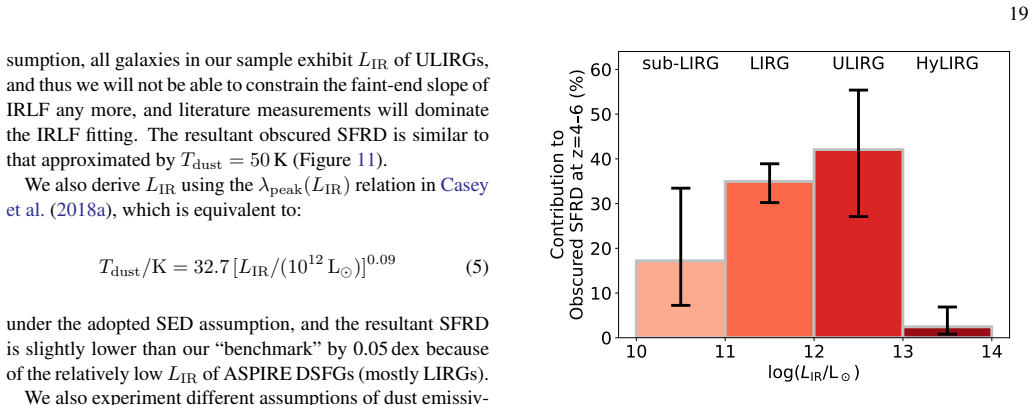
- Luminous and ultra-luminous infrared galaxies with $L_{\rm IR}$ between $10^{11}$ and $10^{13}\,L_\odot$ contribute about $81\%$ of the obscured star-formation rate density at $z=4$–$6$, so future surveys must cover enough volume to sample the bright end of the luminosity function.
- Because the faint-end slope of the infrared luminosity function is flat ($\alpha\approx0.6$), the integrated obscured star-formation rate density does not depend strongly on the exact low-luminosity cutoff, making the measurement robust to survey depth.
- Future JWST NIRCam grism surveys over much larger volumes can spectroscopically constrain the bright end of the $z=4$–$6$ infrared luminosity function, resolving the main remaining uncertainty in the obscured star-formation history.
Reading between the lines
- Editorial inference: the survey targets quasar sightlines, so the eight DSFGs could trace overdense environments around already rare quasars; the authors estimate cosmic variance is small, but a blank-field analog survey would be the clean test of whether this averaged obscured star-formation rate density applies to typical fields.
- Editorial inference: the F356W grism has a redshift desert near $z\approx5.0$–$5.3$ where neither H$\alpha$ nor [O III] falls in the band; the paper corrects for it statistically, but redder F444W grism data covering that gap would directly test whether a population of $z\approx5.2$ dusty galaxies is being missed.
- Editorial inference: because $L_{\rm IR}$ is derived from an energy-balance fit with a single far-infrared photometric point, the quoted star-formation rate density scales roughly as $T_{\rm dust}^4$; if future high-frequency ALMA observations show these galaxies are warmer than the assumed $\sim33$ K, the obscured star-formation rate density would rise by roughly 0.1–0.2 dex, strengthening the pa
Editorial analysis
A structured set of objections, weighed in public.
Referee Report
Summary. The paper presents a measurement of the dust-obscured cosmic star formation rate density (SFRD) at z=4-6 using the ASPIRE JWST Cycle-1 and ALMA Cycle-9 surveys along 25 quasar sightlines. Eight dusty star-forming galaxies (DSFGs) are identified at z=4-6 through NIRCam WFSS detections of Ha or [O III], and their infrared luminosities are derived from CIGALE energy-balance SED fitting using three NIRCam bands plus a single ALMA 1.2 mm continuum point. From these sources the authors construct a 1/Vmax infrared luminosity function (IRLF), fit it with a double power law, integrate to obtain log rho_SFR,IR = -1.52+0.14/-0.13 (M_sun/yr/Mpc^3), and conclude that 66 +/- 7% of cosmic star formation at z~5 is obscured by dust. The paper also reports a flattened faint-end IRLF slope alpha = 0.59+0.39/-0.45 and discusses systematic effects from dust temperature, the bright-end IRLF, and AGN contamination.
Significance. If correct, this is a valuable direct measurement: it provides spectroscopic redshifts for DSFGs at z=4-6, a redshift range where photometric redshifts are notoriously unreliable, and uses 25 independent sightlines to suppress cosmic variance. The resulting SFRD is higher than ASPECS-based estimates and close to ALPINE/ALCS values, supporting a picture in which a majority of star formation at z~5 is obscured. The paper is transparent about its main assumptions, includes detailed completeness simulations, a lensing correction, and a systematic exploration of dust temperature, and it places the result in the context of existing literature. However, the headline claims of a 'spectroscopically complete census' and the 66% obscured fraction rest on two assumptions that are acknowledged but not fully quantified in the quoted uncertainties: the coverage gap in NIRCam WFSS at z~5.0-5.3, and the energy-balance SED modeling from a single far-IR photometric point. These issues, if unaddressed, weaken the precision of the central result even though the measurement itself is credible.
major comments (3)
- [Section 4.2, Section 4.3, Eq. (2)] The title and abstract claim a 'spectroscopically complete' DSFG sample at z=4-6, but the text in Section 4.2 explicitly states that 'the full ASPIRE DSFG sample is not spectroscopically complete across all redshifts' because of the NIRCam F356W gap at z~5.0-5.3 where neither Ha nor [O III] falls in the grism bandpass. The correction for this 'redshift desert' is described only as an argument that the true number density 'should be close to our measurement, or just slightly higher' rather than a quantitative correction. The 1/Vmax method in Eq. (2) is not specified as to whether Vmax excludes the redshift gap; if Vmax includes the gap, the LF is underestimated, and if it excludes it, the SFRD integral over z=4-6 assumes the LF is identical in the gap. The authors should state precisely how Vmax is computed over the gap and provide a quantitative upper/lower bound on the IRLF and SFRD from this assumption. Without this, the word 'complete' in the title overstates the actual selection.
- [Section 3.2, Section 5.1, Section 4.4] The central SFRD value and the 66% obscured fraction depend on L_IR values derived from CIGALE energy-balance fitting with only one ALMA 1.2 mm point constraining the rest-frame far-IR SED. Section 5.1 tests dust temperature variations and finds a 0.12 dex shift for Tdust=50 K, which is comparable to the quoted +0.14/-0.13 dex error, and it also tests beta and lambda_thick variations. However, this does not bound the energy-balance assumption itself, which the paper identifies as questionable: J0244m5008.C03 is poorly fit in F115W, and HDF850.1 is cited as a case where UV photon leakage breaks the energy-balance picture. The quoted error bars in Section 4.4 appear to be purely statistical/MCMC and do not include a systematic term for energy-balance violations. The authors should either estimate the magnitude of this systematic (e.g., by fitting L_IR directly from the ALMA flux with a range of dust temperatures and beta values and comparing SFRD, or by explicitly modeling a UV-leakage component for J0244m5008.C03) or clearly state that the headline rho_SFR,IR value is conditional on the energy-balance assumption. This is load-bearing because a ~0.2 dex shift in L_IR would move the obscured fraction toward 50% and change the paper's main qualitative conclusion.
- [Section 5.2, Table 3] The SFRD integral is not determined purely by the ASPIRE sample: the bright end of the IRLF (L > L* ~ 10^12.6 L_sun) is constrained by literature measurements that are not spectroscopically complete, with their uncertainties artificially increased by sqrt(2) to account for photometric redshifts. The contribution from ULIRGs (10^12-10^13 L_sun) to the obscured SFRD is 44 +/- 14%, so the quoted SFRD accuracy depends partly on the assumed literature LF. The authors should state explicitly what fraction of the quoted uncertainty on log rho_SFR,IR comes from the literature-anchored bright end versus the ASPIRE data alone, and report an ASPIRE-only SFRD if possible. This would make the contribution of the new data to the headline result more transparent.
minor comments (5)
- [Abstract and Section 4.2] The abstract's 'spectroscopically complete DSFG sample at z=4-6' should be qualified, e.g., 'complete for DSFGs with Ha or [O III] in the F356W bandpass' or 'complete over the redshift intervals z=4.0-5.0 and z=5.3-6.0', to match the statement in Section 4.2.
- [Section 3.2, Table 2] For J0244m5008.C03, the poorly fitted F115W point is noted in Section 5.1 but not flagged in Table 2 or Figure 5; adding a note or a different symbol for this source would help the reader see the energy-balance issue directly.
- [Section 4.2] The sentence describing the correction for the redshift desert gives no formula or magnitude; a short description of the assumed correction (e.g., 'we divide by the fractional redshift coverage' or 'we add a 10% systematic') would clarify the method.
- [Section 3.1, Figure 4] The two single-line redshifts (conf=2) are well argued, but the caption of Figure 4 does not mention the confidence level; adding 'conf=2' in the caption would avoid confusion with the six secure redshifts.
- [Section 5.1] The authors quote the Tdust=50 K shift as 0.12 dex but do not quote the resulting SFRD for Tdust=30 K; reporting both bounds in Figure 11 or in the text would make the direction and magnitude of the SED systematic clearer.
Circularity Check
No significant circularity: the IRLF and obscured SFRD are standard model-based estimates from original JWST/ALMA data, not re-used inputs.
full rationale
I walked the derivation chain. The DSFG sample is selected by independent ALMA 1.2-mm detections plus JWST/NIRCam grism redshifts; L_IR values are obtained with CIGALE energy-balance SED fitting from four photometric bands (Section 3.2), a standard inference whose one-band far-IR constraint is acknowledged and tested in Section 5.1. The IRLF is built with the 1/V_max estimator (Eq. 2) from the sample's L_IR; the double-power-law fit (Eq. 3) uses these points plus literature measurements with inflated errors, and the SFRD (Section 4.4) is the integral of that fitted LF. This is a standard model-based estimate, not a hidden re-use of the target: the fitted LF parameters (alpha = 0.59, log L* = 12.58) are not defined in terms of rho_SFR,IR, and rho_SFR,IR is not an input to the fit. The 66% obscured fraction combines this integral with an independent UV SFRD fit to literature photometry. Self-citations occur for ASPIRE survey design and data reduction (Wang et al. 2023; Yang et al. 2023) and for the HDF850.1 comparison (Sun et al. 2024), but they are not load-bearing for the central SFRD result: the cited papers do not supply the IRLF, the SFRD value, or any uniqueness theorem. The paper itself flags the main systematic caveat (L_IR rests on energy balance with a single far-IR point and a Tdust = 30-50 K prior), but a stated assumption is not circular equivalence. No equation reduces to its input by construction, and no fitted parameter is renamed as a prediction. Verdict: no significant circularity.
Assumptions & free parameters
free parameters (5)
- Dust temperature Tdust in Casey (2012) SED =
30-50 K flat prior, effective benchmark ~33 K
- Dust emissivity beta_em =
1.8 (fixed)
- Mid-IR power-law slope alpha_MIR =
2.0 (fixed)
- Wavelength where dust optical depth is unity, lambda_thick =
100 um (fixed)
- IRLF double-power-law parameters (log Phi*, log L*, alpha, beta) =
-4.52, 12.58, 0.59, 3.24
assumptions (7)
- domain assumption Energy balance: absorbed UV-optical stellar light is re-emitted in the infrared, so CIGALE can infer LIR from a simultaneous fit to stellar and dust emission.
- domain assumption The far-IR SEDs of z=4-6 DSFGs follow the Casey (2012) modified blackbody with Tdust=30-50 K, beta_em=1.8, and alpha_MIR=2.0.
- domain assumption The z=4-6 IRLF follows a double power law, and literature points above LIR~1e12.6 Lsun can be combined with ASPIRE points, with literature uncertainties inflated by sqrt(2).
- domain assumption The 25 quasar sightlines provide a representative average of the field at z=4-6, with negligible cosmic variance and no residual bias from quasar environments.
- ad hoc to paper The sample is spectroscopically complete at z=4-6 because Halpha or [OIII] luminosities are above the NIRCam WFSS detection limit, except for the z=5.0-5.3 redshift desert where the number density is assumed to be close to the measured value.
- domain assumption ALMA continuum peaks with S/N>=5 in native images or S/N>=4 in tapered images, after rejecting positive peaks without JWST counterparts, form a complete DSFG sample.
- domain assumption The Chabrier IMF and the Kennicutt (1998) SFR-to-LIR conversion apply at z~5.
Cite this review
Pith. "Pith review of A SPectroscopic survey of biased halos In the Reionization Era (ASPIRE): Spectroscopically Complete Census of Obscured Cosmic Star Formation Rate Density at $z=4-6$." pith.science (2026). https://pith.science/paper/SYA5E3W6
@misc{pith2026241206894,
  author       = {Pith},
  title        = {Pith review of: A SPectroscopic survey of biased halos In the Reionization Era (ASPIRE): Spectroscopically Complete Census of Obscured Cosmic Star Formation Rate Density at $z=4-6$},
  year         = {2026},
  howpublished = {\url{https://pith.science/paper/SYA5E3W6}},
  note         = {Machine review of arXiv:2412.06894}
}
abstract
We present a stringent measurement of the dust-obscured star-formation rate density (SFRD) at $z=4-6$ from the ASPIRE JWST Cycle-1 medium and ALMA Cycle-9 large program. We obtained JWST/NIRCam grism spectroscopy and ALMA 1.2-mm continuum map along 25 independent quasar sightlines, covering a total survey area of $\sim$35 arcmin$^2$ where we search for dusty star-forming galaxies (DSFGs) at $z = 0 - 7$. We identify eight DSFGs in seven fields at $z=4-6$ through the detection of H$\alpha$ or [O III] $\lambda$5008 lines, including fainter lines such as H$\beta$, [O III] $\lambda$4960, [N II] $\lambda$6585, [S II] $\lambda\lambda$6718,6733 for six sources. With this spectroscopically complete DSFG sample at $z=4-6$ and negligible impact from cosmic variance (shot noise), we measure the infrared luminosity function (IRLF) down to $L_\mathrm{IR} \sim 2\times10^{11}$ $L_\odot$. We find flattening of IRLF at $z=4-6$ towards the faint end (power-law slope $\alpha = 0.59_{-0.45}^{+0.39}$). We determine the dust-obscured cosmic SFRD at this epoch as $\log[\rho_\mathrm{SFR,IR} / (\mathrm{M}_\odot\,\mathrm{yr}^{-1}\,\mathrm{Mpc}^{-3})] = -1.52_{-0.13}^{+0.14}$. This is significantly higher than previous determination using ALMA data in the Hubble Ultra Deep Field, which is void of DSFGs at $z=4-6$ because of strong cosmic variance (shot noise). We conclude that the majority ($66\pm7$%) of cosmic star formation at $z \sim 5$ is still obscured by dust. We also discuss the uncertainty of SFRD propagated from far-IR spectral energy distribution and IRLF at the bright end, which will need to be resolved with future ALMA and JWST observations.
Figures


Figures from the paper (9 more)


Reference graph
Works this paper leans on
-
[1]
Abbott, T. M. C., Adam´ow, M., Aguena, M., et al. 2021, ApJS, 255, 20, doi: 10.3847/1538-4365/ac00b3
-
[2]
2024, A&A, 685, A1, doi: 10.1051/0004-6361/202348407
Adscheid, S., Magnelli, B., Liu, D., et al. 2024, A&A, 685, A1, doi: 10.1051/0004-6361/202348407
-
[3]
2016, ApJ, 832, 56, doi: 10.3847/0004-637X/832/1/56 Alcalde Pampliega, B., P´erez-Gonz´alez, P
Alavi, A., Siana, B., Richard, J., et al. 2016, ApJ, 832, 56, doi: 10.3847/0004-637X/832/1/56 Alcalde Pampliega, B., P´erez-Gonz´alez, P. G., Barro, G., et al. 2019, ApJ, 876, 135, doi: 10.3847/1538-4357/ab14f2
-
[4]
Algera, H. S. B., Inami, H., Oesch, P. A., et al. 2023, MNRAS, 518, 6142, doi: 10.1093/mnras/stac3195
-
[5]
2020, arXiv e-prints, arXiv:2006.04284
Aravena, M., Boogaard, L., G´onzalez-L´opez, J., et al. 2020, arXiv e-prints, arXiv:2006.04284. https://arxiv.org/abs/2006.04284
arXiv 2020
-
[6]
Armus, L., Mazzarella, J. M., Evans, A. S., et al. 2009, PASP, 121, 559, doi: 10.1086/600092
doi:10.1086/600092 2009
-
[7]
Arnouts, S., & Ilbert, O. 2011, LePHARE: Photometric Analysis for Redshift Estimate, Astrophysics Source Code Library, record ascl:1108.009 Astropy Collaboration, Robitaille, T. P., Tollerud, E. J., et al. 2013, A&A, 558, A33, doi: 10.1051/0004-6361/201322068 Astropy Collaboration, Price-Whelan, A. M., Sip˝ocz, B. M., et al. 2018, AJ, 156, 123, doi: 10.38...
-
[8]
2024, arXiv e-prints, arXiv:2404.08052, doi: 10.48550/arXiv.2404.08052
Barrufet, L., Oesch, P., Marques-Chaves, R., et al. 2024, arXiv e-prints, arXiv:2404.08052, doi: 10.48550/arXiv.2404.08052
Show all 163 references
-
[9]
E., Alexander, D
Bauer, F. E., Alexander, D. M., Brandt, W. N., et al. 2004, AJ, 128, 2048, doi: 10.1086/424859 B´ethermin, M., Wu, H.-Y ., Lagache, G., et al. 2017, A&A, 607, A89, doi: 10.1051/0004-6361/201730866 B´ethermin, M., Fudamoto, Y ., Ginolfi, M., et al. 2020, A&A, 643, A2, doi: 10.1...
2004 doi
-
[10]
2024, A&A, 686, A3, doi: 10.1051/0004-6361/202348845
Bik, A., ´Alvarez-M´arquez, J., Colina, L., et al. 2024, A&A, 686, A3, doi: 10.1051/0004-6361/202348845
2024 doi
-
[11]
A., Gillman, S., Melinder, J., et al
Boogaard, L. A., Gillman, S., Melinder, J., et al. 2024, ApJ, 969, 27, doi: 10.3847/1538-4357/ad43e5
2024 doi
-
[12]
2019, A&A, 622, A103, doi: 10.1051/0004-6361/201834156
Boquien, M., Burgarella, D., Roehlly, Y ., et al. 2019, A&A, 622, A103, doi: 10.1051/0004-6361/201834156
2019 doi
-
[13]
2020, ApJ, 902, 112, doi: 10.3847/1538-4357/abb830
Bouwens, R., Gonz´alez-L´opez, J., Aravena, M., et al. 2020, ApJ, 902, 112, doi: 10.3847/1538-4357/abb830
2020 doi
-
[14]
J., Illingworth, G
Bouwens, R. J., Illingworth, G. D., Oesch, P. A., et al. 2015, ApJ, 811, 140, doi: 10.1088/0004-637X/811/2/140
2015 doi
-
[15]
2024, astropy/photutils: 1.12.0, 1.12.0, Zenodo, doi: 10.5281/zenodo.10967176
Bradley, L., Sip˝ocz, B., Robitaille, T., et al. 2024, astropy/photutils: 1.12.0, 1.12.0, Zenodo, doi: 10.5281/zenodo.10967176
2024 doi
-
[16]
2003, MNRAS, 344, 1000, doi: 10.1046/j.1365-8711.2003.06897.x
Bruzual, G., & Charlot, S. 2003, MNRAS, 344, 1000, doi: 10.1046/j.1365-8711.2003.06897.x
2003
-
[17]
2013, A&A, 554, A70, doi: 10.1051/0004-6361/201321651
Burgarella, D., Buat, V ., Gruppioni, C., et al. 2013, A&A, 554, A70, doi: 10.1051/0004-6361/201321651
2013 doi
-
[18]
2023, JWST Calibration Pipeline, 1.10.2, Zenodo, doi: 10.5281/zenodo.7829329
Bushouse, H., Eisenhamer, J., Dencheva, N., et al. 2023, JWST Calibration Pipeline, 1.10.2, Zenodo, doi: 10.5281/zenodo.7829329
2023 doi
- [19]
-
[20]
2021, MNRAS, 502, 4558, doi: 10.1093/mnras/staa4037
Calvi, R., Dannerbauer, H., Arrabal Haro, P., et al. 2021, MNRAS, 502, 4558, doi: 10.1093/mnras/staa4037
2021 doi
-
[21]
1997, in American Institute of Physics Conference
Calzetti, D. 1997, in American Institute of Physics Conference
1997
-
[22]
408, The ultraviolet universe at low and High redshift, ed
Series, V ol. 408, The ultraviolet universe at low and High redshift, ed. W. H. Waller (AIP), 403–412, doi: 10.1063/1.53764
-
[23]
C., et al
Calzetti, D., Armus, L., Bohlin, R. C., et al. 2000, ApJ, 533, 682, doi: 10.1086/308692
2000 doi
-
[24]
I., Dunlop, J
Caputi, K. I., Dunlop, J. S., McLure, R. J., et al. 2012, ApJL, 750, L20, doi: 10.1088/2041-8205/750/1/L20 CASA Team, Bean, B., Bhatnagar, S., et al. 2022, PASP, 134, 114501, doi: 10.1088/1538-3873/ac9642
2012 doi
-
[25]
Casey, C. M. 2012, MNRAS, 425, 3094, doi: 10.1111/j.1365-2966.2012.21455.x
2012
-
[26]
M., Hodge, J., Zavala, J
Casey, C. M., Hodge, J., Zavala, J. A., et al. 2018a, ApJ, 862, 78, doi: 10.3847/1538-4357/aacd11
-
[27]
M., Narayanan, D., & Cooray, A
Casey, C. M., Narayanan, D., & Cooray, A. 2014a, PhR, 541, 45, doi: 10.1016/j.physrep.2014.02.009
2014 doi
-
[28]
M., Chen, C.-C., Cowie, L
Casey, C. M., Chen, C.-C., Cowie, L. L., et al. 2013, MNRAS, 436, 1919, doi: 10.1093/mnras/stt1673
2013 doi
-
[29]
M., Scoville, N
Casey, C. M., Scoville, N. Z., Sanders, D. B., et al. 2014b, ApJ, 796, 95, doi: 10.1088/0004-637X/796/2/95
-
[30]
M., Zavala, J
Casey, C. M., Zavala, J. A., Spilker, J., et al. 2018b, ApJ, 862, 77, doi: 10.3847/1538-4357/aac82d
-
[31]
M., Zavala, J
Casey, C. M., Zavala, J. A., Aravena, M., et al. 2019, ApJ, 887, 55, doi: 10.3847/1538-4357/ab52ff
2019 doi
-
[32]
M., Zavala, J
Casey, C. M., Zavala, J. A., Manning, S. M., et al. 2021, ApJ, 923, 215, doi: 10.3847/1538-4357/ac2eb4
2021 doi
-
[33]
2003, PASP, 115, 763, doi: 10.1086/376392
Chabrier, G. 2003, PASP, 115, 763, doi: 10.1086/376392
2003 doi
- [34]
- [35]
-
[36]
2001, ApJ, 556, 562, doi: 10.1086/321609 24
Chary, R., & Elbaz, D. 2001, ApJ, 556, 562, doi: 10.1086/321609 24
2001 doi
-
[37]
2022, ApJ, 929, 159, doi: 10.3847/1538-4357/ac61df
Chen, C.-C., Liao, C.-L., Smail, I., et al. 2022, ApJ, 929, 159, doi: 10.3847/1538-4357/ac61df
2022 doi
-
[38]
J., Zwaan, M
Chen, J., Ivison, R. J., Zwaan, M. A., et al. 2023, MNRAS, 518, 1378, doi: 10.1093/mnras/stac2989
2023 doi
-
[39]
2023, A&A, 673, L6, doi: 10.1051/0004-6361/202346535
Colina, L., Crespo G´omez, A., ´Alvarez-M´arquez, J., et al. 2023, A&A, 673, L6, doi: 10.1051/0004-6361/202346535
2023 doi
- [40]
-
[41]
L., Garmire, G
Cowie, L. L., Garmire, G. P., Bautz, M. W., et al. 2002, ApJL, 566, L5, doi: 10.1086/339545
2002 doi
-
[42]
2012, A&A, 539, A31, doi: 10.1051/0004-6361/201118010 da Cunha, E., Groves, B., Walter, F., et al
Cucciati, O., Tresse, L., Ilbert, O., et al. 2012, A&A, 539, A31, doi: 10.1051/0004-6361/201118010 da Cunha, E., Groves, B., Walter, F., et al. 2013, ApJ, 766, 13, doi: 10.1088/0004-637X/766/1/13 da Cunha, E., Walter, F., Smail, I. R., et al. 2015, ApJ, 806, 110, doi: 10.1088/...
2012 doi
-
[43]
P., et al
Decarli, R., Walter, F., Venemans, B. P., et al. 2017, Nature, 545, 457, doi: 10.1038/nature22358
2017 doi
-
[44]
J., Lang, D., et al
Dey, A., Schlegel, D. J., Lang, D., et al. 2019, AJ, 157, 168, doi: 10.3847/1538-3881/ab089d
2019 doi
-
[45]
M., & Casey, C
Drew, P. M., & Casey, C. M. 2022, arXiv e-prints, arXiv:2203.16655. https://arxiv.org/abs/2203.16655
2022 arXiv
-
[46]
P., & Robotham, A
Driver, S. P., & Robotham, A. S. G. 2010, MNRAS, 407, 2131, doi: 10.1111/j.1365-2966.2010.17028.x Dudzeviˇci¯ut˙e, U., Smail, I., Swinbank, A. M., et al. 2020, MNRAS, 494, 3828, doi: 10.1093/mnras/staa769
2010
-
[47]
S., McLure, R
Dunlop, J. S., McLure, R. J., Biggs, A. D., et al. 2017, MNRAS, 466, 861, doi: 10.1093/mnras/stw3088
2017 doi
-
[48]
2022, ApJ, 927, 204, doi: 10.3847/1538-4357/ac51ca
Enia, A., Talia, M., Pozzi, F., et al. 2022, ApJ, 927, 204, doi: 10.3847/1538-4357/ac51ca
2022 doi
-
[49]
L., Fudamoto, Y ., Oesch, P
Faisst, A. L., Fudamoto, Y ., Oesch, P. A., et al. 2020, MNRAS, 498, 4192, doi: 10.1093/mnras/staa2545
2020 doi
-
[50]
L., Ryan, Russell E., J., Papovich, C., et al
Finkelstein, S. L., Ryan, Russell E., J., Papovich, C., et al. 2015, ApJ, 810, 71, doi: 10.1088/0004-637X/810/1/71
2015 doi
-
[51]
W., Lang, D., & Goodman, J
Foreman-Mackey, D., Hogg, D. W., Lang, D., & Goodman, J. 2013, PASP, 125, 306, doi: 10.1086/670067
2013 doi
-
[52]
2018, A&A, 620, A152, doi: 10.1051/0004-6361/201832928
Franco, M., Elbaz, D., B´ethermin, M., et al. 2018, A&A, 620, A152, doi: 10.1051/0004-6361/201832928
2018 doi
-
[53]
A., Faisst, A., et al
Fudamoto, Y ., Oesch, P. A., Faisst, A., et al. 2020, A&A, 643, A4, doi: 10.1051/0004-6361/202038163
2020 doi
-
[54]
A., Schouws, S., et al
Fudamoto, Y ., Oesch, P. A., Schouws, S., et al. 2021, Nature, 597, 489, doi: 10.1038/s41586-021-03846-z
2021 doi
-
[55]
2016, ApJS, 222, 1, doi: 10.3847/0067-0049/222/1/1
Fujimoto, S., Ouchi, M., Ono, Y ., et al. 2016, ApJS, 222, 1, doi: 10.3847/0067-0049/222/1/1
2016 doi
-
[56]
2023, arXiv e-prints, arXiv:2303.01658, doi: 10.48550/arXiv.2303.01658 Gaia Collaboration, Vallenari, A., Brown, A
Fujimoto, S., Kohno, K., Ouchi, M., et al. 2023, arXiv e-prints, arXiv:2303.01658, doi: 10.48550/arXiv.2303.01658 Gaia Collaboration, Vallenari, A., Brown, A. G. A., et al. 2023, A&A, 674, A1, doi: 10.1051/0004-6361/202243940 Garc´ıa-Mar´ın, M., Colina, L., & Arribas, S. 2009,...
-
[57]
P., Mather, J
Gardner, J. P., Mather, J. C., Abbott, R., et al. 2023, PASP, 135, 068001, doi: 10.1088/1538-3873/acd1b5
2023 doi
-
[58]
E., Dunlop, J
Geach, J. E., Dunlop, J. S., Halpern, M., et al. 2017, MNRAS, 465, 1789, doi: 10.1093/mnras/stw2721
2017 doi
-
[59]
1986, ApJ, 303, 336, doi: 10.1086/164079 Gim´enez-Arteaga, C., Brammer, G
Gehrels, N. 1986, ApJ, 303, 336, doi: 10.1086/164079 Gim´enez-Arteaga, C., Brammer, G. B., Marchesini, D., et al. 2022, ApJS, 263, 17, doi: 10.3847/1538-4365/ac958c G´omez-Guijarro, C., Elbaz, D., Xiao, M., et al. 2022, A&A, 658, A43, doi: 10.1051/0004-6361/202141615 Gonz´alez...
1986 arXiv
-
[60]
Wolff, M. J. 2003, ApJ, 594, 279, doi: 10.1086/376774
2003 doi
-
[61]
A., et al
Gottumukkala, R., Barrufet, L., Oesch, P. A., et al. 2024, MNRAS, 530, 966, doi: 10.1093/mnras/stae754
2024 doi
-
[62]
2013, MNRAS, 432, 23, doi: 10.1093/mnras/stt308
Gruppioni, C., Pozzi, F., Rodighiero, G., et al. 2013, MNRAS, 432, 23, doi: 10.1093/mnras/stt308
2013 doi
-
[63]
2020, A&A, 643, A8, doi: 10.1051/0004-6361/202038487
Gruppioni, C., B´ethermin, M., Loiacono, F., et al. 2020, A&A, 643, A8, doi: 10.1051/0004-6361/202038487
2020 doi
-
[64]
2018, PASJ, 70, 105, doi: 10.1093/pasj/psy104
Hatsukade, B., Kohno, K., Yamaguchi, Y ., et al. 2018, PASJ, 70, 105, doi: 10.1093/pasj/psy104
2018 doi
- [65]
-
[66]
A., & da Cunha, E
Hodge, J. A., & da Cunha, E. 2020, Royal Society Open Science, 7, 200556, doi: 10.1098/rsos.200556
2020 doi
-
[67]
1986, PASP, 98, 609, doi: 10.1086/131801
Horne, K. 1986, PASP, 98, 609, doi: 10.1086/131801
1986 doi
-
[68]
S., Zheng, X
Huang, J. S., Zheng, X. Z., Rigopoulou, D., et al. 2011, ApJL, 742, L13, doi: 10.1088/2041-8205/742/1/L13
2011 doi
-
[69]
H., Serjeant, S., Dunlop, J., et al
Hughes, D. H., Serjeant, S., Dunlop, J., et al. 1998, Nature, 394, 241, doi: 10.1038/28328
1998 doi
-
[70]
R., et al
Hyun, M., Im, M., Smail, I. R., et al. 2023, ApJS, 264, 19, doi: 10.3847/1538-4365/ac9bf4
2023 doi
-
[71]
2019a, ApJS, 244, 33, doi: 10.3847/1538-4365/ab3bfe
Jin, J.-J., Zhu, Y .-N., Wu, H., et al. 2019a, ApJS, 244, 33, doi: 10.3847/1538-4365/ab3bfe
-
[72]
E., et al
Jin, S., Daddi, E., Magdis, G. E., et al. 2019b, ApJ, 887, 144, doi: 10.3847/1538-4357/ab55d6
- [73]
- [74]
-
[75]
P., Limousin, M., et al
Jullo, E., Kneib, J. P., Limousin, M., et al. 2007, New Journal of Physics, 9, 447, doi: 10.1088/1367-2630/9/12/447
2007 doi
-
[76]
1998, ARA&A, 36, 189, doi: 10.1146/annurev.astro.36.1.189
Kennicutt, Robert C., J. 1998, ARA&A, 36, 189, doi: 10.1146/annurev.astro.36.1.189
1998 doi
-
[77]
A., Tsutsumi, T., Brogan, C
Kepley, A. A., Tsutsumi, T., Brogan, C. L., et al. 2020, PASP, 132, 024505, doi: 10.1088/1538-3873/ab5e14 25
2020 doi
-
[78]
2021, A&A, 649, A152, doi: 10.1051/0004-6361/202038944
Khusanova, Y ., Bethermin, M., Le F`evre, O., et al. 2021, A&A, 649, A152, doi: 10.1051/0004-6361/202038944
2021 doi
- [79]
-
[80]
2022, ApJS, 263, 38, doi: 10.3847/1538-4365/ac9909
Kokorev, V ., Brammer, G., Fujimoto, S., et al. 2022, ApJS, 263, 38, doi: 10.3847/1538-4365/ac9909
2022 doi
-
[81]
P., Dunlop, J
Koprowski, M. P., Dunlop, J. S., Michałowski, M. J., et al. 2017, MNRAS, 471, 4155, doi: 10.1093/mnras/stx1843
2017 doi
-
[82]
Lagos, C. d. P., da Cunha, E., Robotham, A. S. G., et al. 2020, MNRAS, 499, 1948, doi: 10.1093/mnras/staa2861 Le F`evre, O., B´ethermin, M., Faisst, A., et al. 2020, A&A, 643, A1, doi: 10.1051/0004-6361/201936965
2020 doi
-
[83]
2020, ApJ, 889, 80, doi: 10.3847/1538-4357/ab607f
Lim, C.-F., Wang, W.-H., Smail, I., et al. 2020, ApJ, 889, 80, doi: 10.3847/1538-4357/ab607f
2020 doi
- [84]
-
[85]
2018, ApJ, 853, 172, doi: 10.3847/1538-4357/aaa600
Liu, D., Daddi, E., Dickinson, M., et al. 2018, ApJ, 853, 172, doi: 10.3847/1538-4357/aaa600
2018 doi
-
[86]
Lyu, J., & Rieke, G. H. 2018, ApJ, 866, 92, doi: 10.3847/1538-4357/aae075
2018 doi
-
[87]
H., & Shi, Y
Lyu, J., Rieke, G. H., & Shi, Y . 2017, ApJ, 835, 257, doi: 10.3847/1538-4357/835/2/257
2017 doi
-
[88]
2014, ARA&A, 52, 415, doi: 10.1146/annurev-astro-081811-125615
Madau, P., & Dickinson, M. 2014, ARA&A, 52, 415, doi: 10.1146/annurev-astro-081811-125615
2014 doi
-
[89]
2014, A&A, 561, A86, doi: 10.1051/0004-6361/201322217
Magnelli, B., Lutz, D., Saintonge, A., et al. 2014, A&A, 561, A86, doi: 10.1051/0004-6361/201322217
2014 doi
- [90]
-
[91]
M., Casey, C
Manning, S. M., Casey, C. M., Zavala, J. A., et al. 2022, ApJ, 925, 23, doi: 10.3847/1538-4357/ac366a
2022 doi
-
[92]
P., et al
Mazzucchelli, C., Decarli, R., Farina, E. P., et al. 2019, ApJ, 881, 163, doi: 10.3847/1538-4357/ab2f75
2019 doi
-
[93]
C., Rosenthal, L
McKinney, J., Hayward, C. C., Rosenthal, L. J., et al. 2021, ApJ, 921, 55, doi: 10.3847/1538-4357/ac185f
2021 doi
-
[94]
M., Cooper, O
McKinney, J., Manning, S. M., Cooper, O. R., et al. 2023a, ApJ, 956, 72, doi: 10.3847/1538-4357/acf614
-
[95]
M., et al
McKinney, J., Finnerty, L., Casey, C. M., et al. 2023b, ApJL, 946, L39, doi: 10.3847/2041-8213/acc322
- [96]
-
[97]
P., Waters, B., Schiebel, D., Young, W., & Golap, K
McMullin, J. P., Waters, B., Schiebel, D., Young, W., & Golap, K. 2007, in Astronomical Society of the Pacific Conference Series, V ol. 376, Astronomical Data Analysis Software and Systems XVI, ed. R. A. Shaw, F. Hill, & D. J. Bell, 127
2007
-
[98]
2017, ApJ, 838, 29, doi: 10.3847/1538-4357/aa6259
Mehta, V ., Scarlata, C., Rafelski, M., et al. 2017, ApJ, 838, 29, doi: 10.3847/1538-4357/aa6259
2017 doi
-
[99]
R., Heckman, T
Meurer, G. R., Heckman, T. M., & Calzetti, D. 1999, ApJ, 521, 64, doi: 10.1086/307523
1999 doi
- [100]
-
[101]
2003, ApJ, 588, 696, doi: 10.1086/374335
Moretti, A., Campana, S., Lazzati, D., & Tagliaferri, G. 2003, ApJ, 588, 696, doi: 10.1086/374335
2003 doi
-
[102]
P., Somerville, R
Moster, B. P., Somerville, R. S., Newman, J. A., & Rix, H.-W. 2011, ApJ, 731, 113, doi: 10.1088/0004-637X/731/2/113
2011 doi
-
[103]
2020, MNRAS, 494, 1894, doi: 10.1093/mnras/staa706
Moutard, T., Sawicki, M., Arnouts, S., et al. 2020, MNRAS, 494, 1894, doi: 10.1093/mnras/staa706
2020 doi
-
[104]
T., Schulz, B., Levenson, L., et al
Nguyen, H. T., Schulz, B., Levenson, L., et al. 2010, A&A, 518, L5, doi: 10.1051/0004-6361/201014680
2010 doi
-
[105]
2009, A&A, 507, 1793, doi: 10.1051/0004-6361/200912497
Noll, S., Burgarella, D., Giovannoli, E., et al. 2009, A&A, 507, 1793, doi: 10.1051/0004-6361/200912497
2009 doi
-
[106]
A., Stiavelli, M., Carollo, C
Oesch, P. A., Stiavelli, M., Carollo, C. M., et al. 2007, ApJ, 671, 1212, doi: 10.1086/522423
2007 doi
- [107]
- [108]
-
[109]
2013, A&A, 554, L3, doi: 10.1051/0004-6361/201321478
Oteo, I., Cepa, J., Bongiovanni, ´A., et al. 2013, A&A, 554, L3, doi: 10.1051/0004-6361/201321478
2013 doi
-
[110]
Y ., Ho, L
Peng, C. Y ., Ho, L. C., Impey, C. D., & Rix, H.-W. 2010, AJ, 139, 2097, doi: 10.1088/0004-6256/139/6/2097
2010 doi
-
[111]
2012, ApJ, 759, 28, doi: 10.1088/0004-637X/759/1/28
Penner, K., Dickinson, M., Pope, A., et al. 2012, ApJ, 759, 28, doi: 10.1088/0004-637X/759/1/28
2012 doi
-
[112]
2015, A&A, 577, A78, doi: 10.1051/0004-6361/201425359
Pereira-Santaella, M., Alonso-Herrero, A., Colina, L., et al. 2015, A&A, 577, A78, doi: 10.1051/0004-6361/201425359
2015 doi
-
[113]
D., Sivaramakrishnan, A., Lajoie, C.-P., et al
Perrin, M. D., Sivaramakrishnan, A., Lajoie, C.-P., et al. 2014, in Society of Photo-Optical Instrumentation Engineers (SPIE) Conference Series, V ol. 9143, Space Telescopes and Instrumentation 2014: Optical, Infrared, and Millimeter Wave, ed. J. Oschmann, Jacobus M., M. Clamp...
2014 doi
-
[114]
2020, ApJ, 891, 135, doi: 10.3847/1538-4357/ab76c0
Popping, G., Walter, F., Behroozi, P., et al. 2020, ApJ, 891, 135, doi: 10.3847/1538-4357/ab76c0
2020 doi
-
[115]
2020, The Journal of Open Source Software, 5, 2308, doi: 10.21105/joss.02308
Prochaska, J., Hennawi, J., Westfall, K., et al. 2020, The Journal of Open Source Software, 5, 2308, doi: 10.21105/joss.02308
2020 doi
-
[116]
D., Egami, E., Bussmann, R
Rawle, T. D., Egami, E., Bussmann, R. S., et al. 2014, ApJ, 783, 59, doi: 10.1088/0004-637X/783/1/59
2014 doi
-
[117]
A., & Steidel, C
Reddy, N. A., & Steidel, C. C. 2009, ApJ, 692, 778, doi: 10.1088/0004-637X/692/1/778
2009 doi
-
[118]
D., Spilker, J
Reuter, C., Vieira, J. D., Spilker, J. S., et al. 2020, ApJ, 902, 78, doi: 10.3847/1538-4357/abb599
2020 doi
-
[119]
A., Bradford, C
Riechers, D. A., Bradford, C. M., Clements, D. L., et al. 2013, Nature, 496, 329, doi: 10.1038/nature12050
2013 doi
-
[120]
A., Hodge, J
Riechers, D. A., Hodge, J. A., Pavesi, R., et al. 2020, ApJ, 895, 81, doi: 10.3847/1538-4357/ab8c48
2020 doi
-
[121]
H., Alonso-Herrero, A., Weiner, B
Rieke, G. H., Alonso-Herrero, A., Weiner, B. J., et al. 2009, ApJ, 692, 556, doi: 10.1088/0004-637X/692/1/556
2009 doi
-
[122]
J., Kelly, D
Rieke, M. J., Kelly, D. M., Misselt, K., et al. 2023, PASP, 135, 028001, doi: 10.1088/1538-3873/acac53
2023 doi
-
[123]
2016, MNRAS, 461, 1100, doi: 10.1093/mnras/stw1169
Rowan-Robinson, M., Oliver, S., Wang, L., et al. 2016, MNRAS, 461, 1100, doi: 10.1093/mnras/stw1169
2016 doi
-
[124]
1968, ApJ, 151, 393, doi: 10.1086/149446 26
Schmidt, M. 1968, ApJ, 151, 393, doi: 10.1086/149446 26
1968 doi
-
[125]
2018, A&A, 609, A30, doi: 10.1051/0004-6361/201731506
Schreiber, C., Elbaz, D., Pannella, M., et al. 2018, A&A, 609, A30, doi: 10.1051/0004-6361/201731506
2018 doi
- [126]
-
[127]
2020, MNRAS, 498, 5065, doi: 10.1093/mnras/staa2621
Shim, H., Kim, Y ., Lee, D., et al. 2020, MNRAS, 498, 5065, doi: 10.1093/mnras/staa2621
2020 doi
-
[128]
M., Smail, I., Swinbank, A
Simpson, J. M., Smail, I., Swinbank, A. M., et al. 2015, ApJ, 799, 81, doi: 10.1088/0004-637X/799/1/81 —. 2019, ApJ, 880, 43, doi: 10.3847/1538-4357/ab23ff
2015 doi
-
[129]
L., Weiss, A., Vieira, J
Strandet, M. L., Weiss, A., Vieira, J. D., et al. 2016, ApJ, 822, 80, doi: 10.3847/0004-637X/822/2/80
2016 doi
-
[130]
G., et al
Sun, F., Egami, E., P´erez-Gonz´alez, P. G., et al. 2021, ApJ, 922, 114, doi: 10.3847/1538-4357/ac2578
2021 doi
-
[131]
2022, ApJ, 932, 77, doi: 10.3847/1538-4357/ac6e3f
Sun, F., Egami, E., Fujimoto, S., et al. 2022, ApJ, 932, 77, doi: 10.3847/1538-4357/ac6e3f
2022 doi
-
[132]
2023a, ApJ, 953, 53, doi: 10.3847/1538-4357/acd53c
Sun, F., Egami, E., Pirzkal, N., et al. 2023a, ApJ, 953, 53, doi: 10.3847/1538-4357/acd53c
-
[133]
M., Egami, E., et al
Sun, F., Helton, J. M., Egami, E., et al. 2024, ApJ, 961, 69, doi: 10.3847/1538-4357/ad07e3
2024 doi
- [134]
-
[135]
M., Page, M
Symeonidis, M., Giblin, B. M., Page, M. J., et al. 2016, MNRAS, 459, 257, doi: 10.1093/mnras/stw667
2016 doi
- [136]
-
[137]
2021, ApJ, 909, 23, doi: 10.3847/1538-4357/abd6e3
Talia, M., Cimatti, A., Giulietti, M., et al. 2021, ApJ, 909, 23, doi: 10.3847/1538-4357/abd6e3
2021 doi
-
[138]
2024, A&A, 681, A118, doi: 10.1051/0004-6361/202347048
Traina, A., Gruppioni, C., Delvecchio, I., et al. 2024, A&A, 681, A118, doi: 10.1051/0004-6361/202347048
2024 doi
-
[139]
2020, MNRAS, 491, 3937, doi: 10.1093/mnras/stz3234
Obreschkow, D. 2020, MNRAS, 491, 3937, doi: 10.1093/mnras/stz3234
2020 doi
-
[140]
2008, ApJ, 676, 767, doi: 10.1086/528674
Trenti, M., & Stiavelli, M. 2008, ApJ, 676, 767, doi: 10.1086/528674
2008 doi
-
[141]
2024, arXiv e-prints, arXiv:2406.09890, doi: 10.48550/arXiv.2406.09890 ¨Ubler, H., F¨orster Schreiber, N
Tsujita, A., Kohno, K., Huang, S., et al. 2024, arXiv e-prints, arXiv:2406.09890, doi: 10.48550/arXiv.2406.09890 ¨Ubler, H., F¨orster Schreiber, N. M., Genzel, R., et al. 2017, ApJ, 842, 121, doi: 10.3847/1538-4357/aa7558 ¨Ubler, H., D’Eugenio, F., Perna, M., et al. 2024, arXi...
-
[142]
2024, A&A, 685, A138, doi: 10.1051/0004-6361/202348128
Valentino, F., Fujimoto, S., Gim´enez-Arteaga, C., et al. 2024, A&A, 685, A138, doi: 10.1051/0004-6361/202348128
2024 doi
-
[143]
P., Neeleman, M., Walter, F., et al
Venemans, B. P., Neeleman, M., Walter, F., et al. 2019, ApJL, 874, L30, doi: 10.3847/2041-8213/ab11cc
2019 doi
-
[144]
P., Wilkins, S
Vijayan, A. P., Wilkins, S. M., Lovell, C. C., et al. 2022, MNRAS, 511, 4999, doi: 10.1093/mnras/stac338
2022 doi
-
[145]
2024, arXiv e-prints, arXiv:2407.09681
Villanueva, V ., Herrera-Camus, R., Gonzalez-Lopez, J., et al. 2024, arXiv e-prints, arXiv:2407.09681. https://arxiv.org/abs/2407.09681
2024 arXiv
-
[146]
2012, Nature, 486, 233, doi: 10.1038/nature11073
Walter, F., Decarli, R., Carilli, C., et al. 2012, Nature, 486, 233, doi: 10.1038/nature11073
2012 doi
-
[147]
2016, ApJ, 833, 67, doi: 10.3847/1538-4357/833/1/67
Walter, F., Decarli, R., Aravena, M., et al. 2016, ApJ, 833, 67, doi: 10.3847/1538-4357/833/1/67
2016 doi
-
[148]
F., et al
Wang, F., Yang, J., Hennawi, J. F., et al. 2023, ApJL, 951, L4, doi: 10.3847/2041-8213/accd6f
2023 doi
-
[149]
J., Cowley, W., et al
Wang, L., Pearson, W. J., Cowley, W., et al. 2019a, A&A, 624, A98, doi: 10.1051/0004-6361/201834093
-
[150]
2016, ApJ, 816, 84, doi: 10.3847/0004-637X/816/2/84
Wang, T., Elbaz, D., Schreiber, C., et al. 2016, ApJ, 816, 84, doi: 10.3847/0004-637X/816/2/84
2016 doi
-
[151]
2019b, Nature, 572, 211, doi: 10.1038/s41586-019-1452-4
Wang, T., Schreiber, C., Elbaz, D., et al. 2019b, Nature, 572, 211, doi: 10.1038/s41586-019-1452-4
-
[152]
2017, ApJ, 850, 37, doi: 10.3847/1538-4357/aa911b Weiß, A., De Breuck, C., Marrone, D
Wang, W.-H., Lin, W.-C., Lim, C.-F., et al. 2017, ApJ, 850, 37, doi: 10.3847/1538-4357/aa911b Weiß, A., De Breuck, C., Marrone, D. P., et al. 2013, ApJ, 767, 88, doi: 10.1088/0004-637X/767/1/88
2017 doi
-
[153]
E., Pope, A., Cybulski, R., et al
Whitaker, K. E., Pope, A., Cybulski, R., et al. 2017, ApJ, 850, 208, doi: 10.3847/1538-4357/aa94ce
2017 doi
-
[154]
C., Labbe, I., Spilker, J., et al
Williams, C. C., Labbe, I., Spilker, J., et al. 2019, ApJ, 884, 154, doi: 10.3847/1538-4357/ab44aa
2019 doi
-
[155]
C., Alberts, S., Ji, Z., et al
Williams, C. C., Alberts, S., Ji, Z., et al. 2024, ApJ, 968, 34, doi: 10.3847/1538-4357/ad3f17
2024 doi
-
[156]
2023, ApJL, 956, L40, doi: 10.3847/2041-8213/acfee3
Wu, Y ., Wang, F., Cai, Z., et al. 2023, ApJL, 956, L40, doi: 10.3847/2041-8213/acfee3
2023 doi
- [157]
-
[158]
Y ., Elbaz, D., G´omez-Guijarro, C., et al
Xiao, M. Y ., Elbaz, D., G´omez-Guijarro, C., et al. 2023b, A&A, 672, A18, doi: 10.1051/0004-6361/202245100
-
[159]
2019, ApJ, 878, 73, doi: 10.3847/1538-4357/ab0d22
Yamaguchi, Y ., Kohno, K., Hatsukade, B., et al. 2019, ApJ, 878, 73, doi: 10.3847/1538-4357/ab0d22
2019 doi
-
[160]
2021, ApJ, 923, 262, doi: 10.3847/1538-4357/ac2b32 —
Yang, J., Wang, F., Fan, X., et al. 2021, ApJ, 923, 262, doi: 10.3847/1538-4357/ac2b32 —. 2023, ApJL, 951, L5, doi: 10.3847/2041-8213/acc9c8
2021 doi
-
[161]
A., Casey, C
Zavala, J. A., Casey, C. M., Manning, S. M., et al. 2021, ApJ, 909, 165, doi: 10.3847/1538-4357/abdb27
2021 doi
-
[162]
T., Narayanan, D., Whitaker, K
Zimmerman, D. T., Narayanan, D., Whitaker, K. E., & Dav´e, R. 2024, ApJ, 973, 146, doi: 10.3847/1538-4357/ad6844
2024 doi
-
[163]
2024, ApJL, 963, L28, doi: 10.3847/2041-8213/ad23e7 All Authors and Affiliations FENGWU SUN ,1 FEIGE WANG ,2, 3 JINYI YANG ,2, 3 JACLYN B
Zou, S., Cai, Z., Wang, F., et al. 2024, ApJL, 963, L28, doi: 10.3847/2041-8213/ad23e7 All Authors and Affiliations FENGWU SUN ,1 FEIGE WANG ,2, 3 JINYI YANG ,2, 3 JACLYN B. C HAMPAGNE ,3 ROBERTO DECARLI ,4 XIAOHUI FAN ,3 EDUARDO BA ˜NADOS ,5 ZHENG CAI ,6 LUIS COLINA ,7 EIICHI...
2024 doi
Reviewed August 11, 2026 · model on record in the stance chip above.
Discussion (0). Continue with ORCID to comment.