Collision-resistant multi-channel M-ASPM configurations with shared single detection channel
Pith reviewed 2026-06-26 02:57 UTC · model grok-4.3
The pith
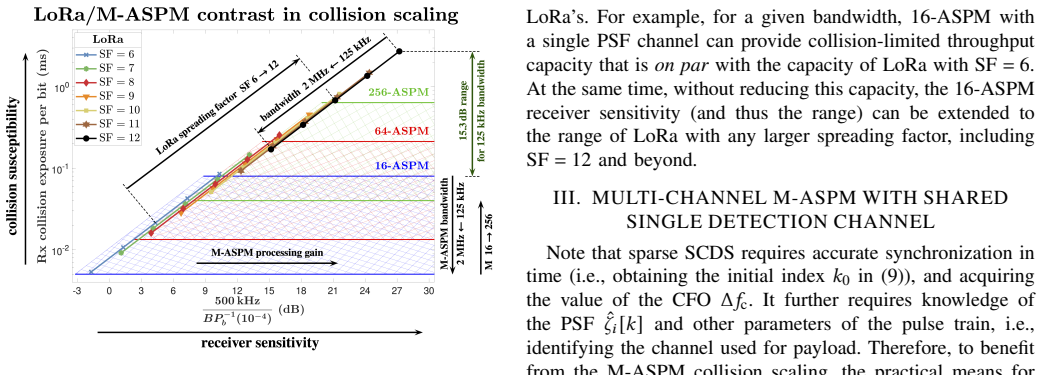
M-ASPM uses short front segments as a shared detection channel to raise LPWAN sensitivity without increasing collisions.
A machine-rendered reading of the paper's core claim, the machinery that carries it, and where it could break.
Core claim
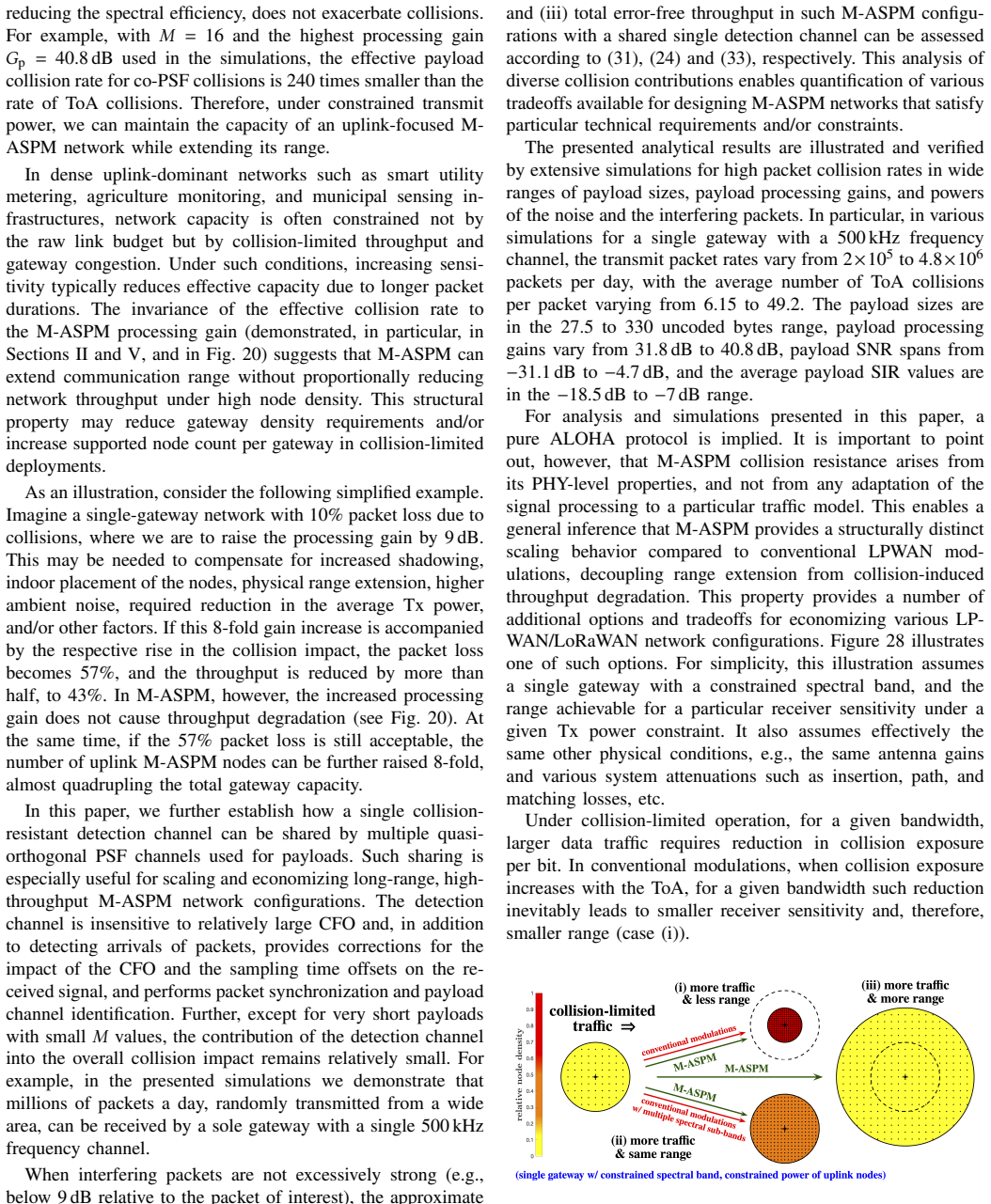
M-ASPM provides a structurally distinct scaling behavior compared to conventional LPWAN modulations, decoupling range extension from collision-induced throughput degradation. Short front portions of packets serve as a collision-resistant detection channel that performs asynchronous detection, synchronization, and CFO acquisition with required precision; payload information is then extracted at raised processing gains without expanding the sample window per symbol. Multi-channel configurations allow numerous quasi-orthogonal payload channels to share the single detection channel, which additionally performs payload channel identification and selection.
What carries the argument
Short front portions of M-ASPM packets as a collision-resistant detection channel that obtains CFO and identifies shared payload channels.
If this is right
- Receiver sensitivity can increase without exacerbating packet collisions or reducing throughput under collision-limited operation.
- Processing gain can vary over a wide range without impacting the effective packet collision rate.
- Multiple quasi-orthogonal payload channels can share one detection channel for identification and selection.
- Network scaling and economization become feasible under diverse technical constraints while maintaining performance at high collision rates.
Where Pith is reading between the lines
- Dense LPWAN deployments could extend range while preserving capacity, reducing the need for additional gateways.
- The shared-channel pattern might apply to other asynchronous spread-spectrum systems that require precise per-packet frequency correction.
- Hardware validation under real interference could confirm whether CFO precision holds across dynamic environments.
Load-bearing premise
Short front portions of M-ASPM packets can reliably serve as a collision-resistant detection channel that obtains CFO for each packet with required precision while allowing subsequent payload extraction without expanding the sample window per symbol.
What would settle it
A test or simulation in which raising processing gain in M-ASPM produces a proportional rise in effective collision rate and throughput loss, matching the behavior of conventional modulations.
Figures






read the original abstract
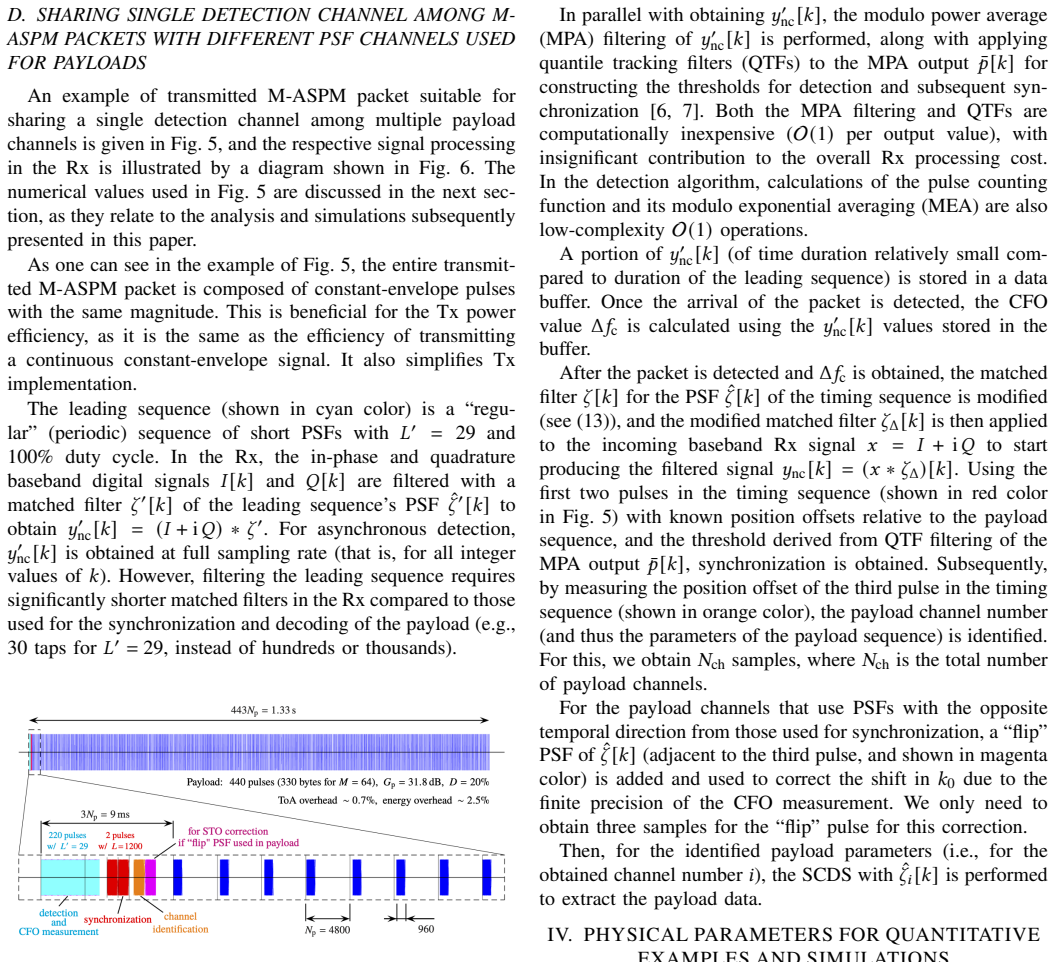
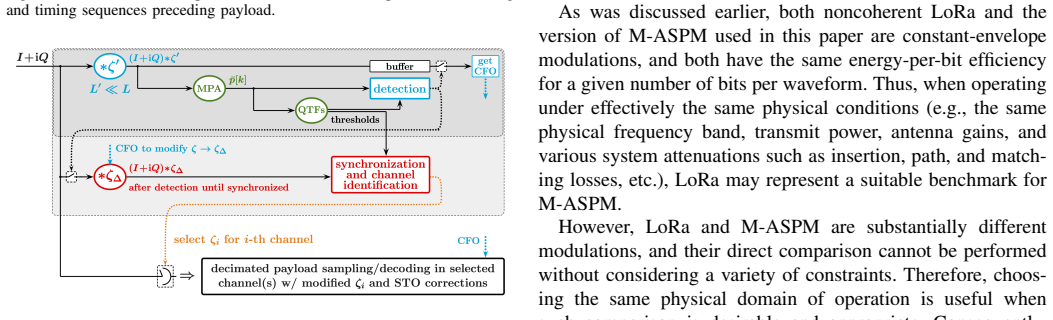
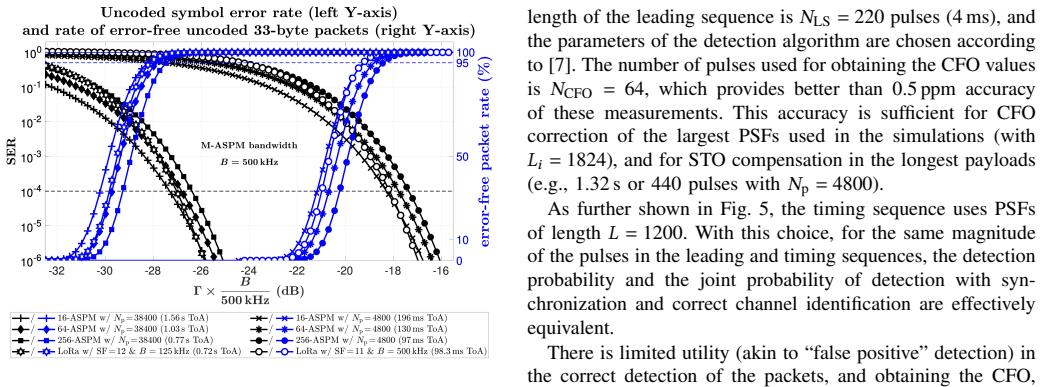
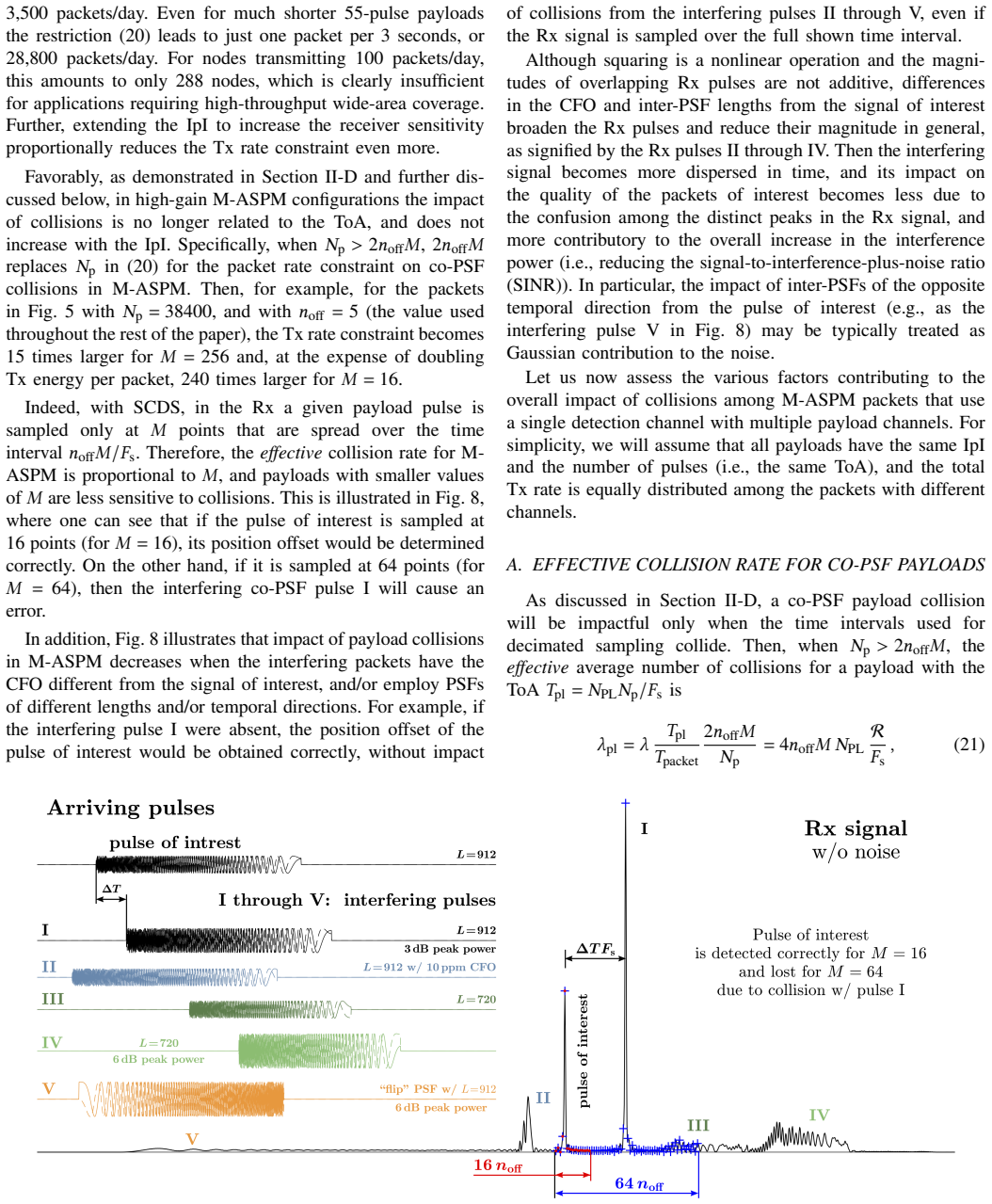
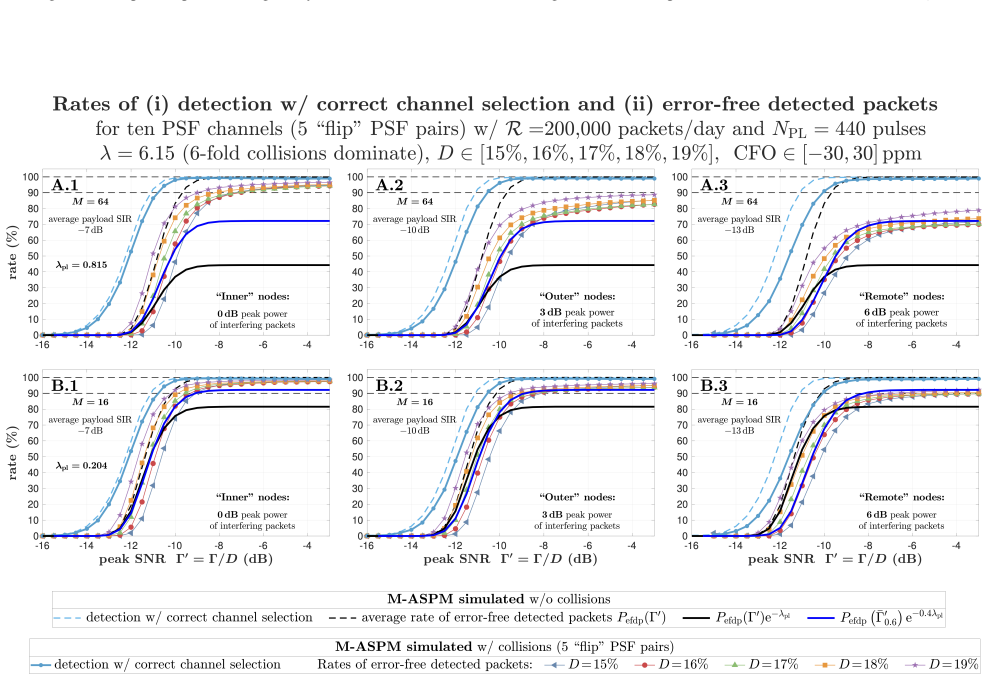
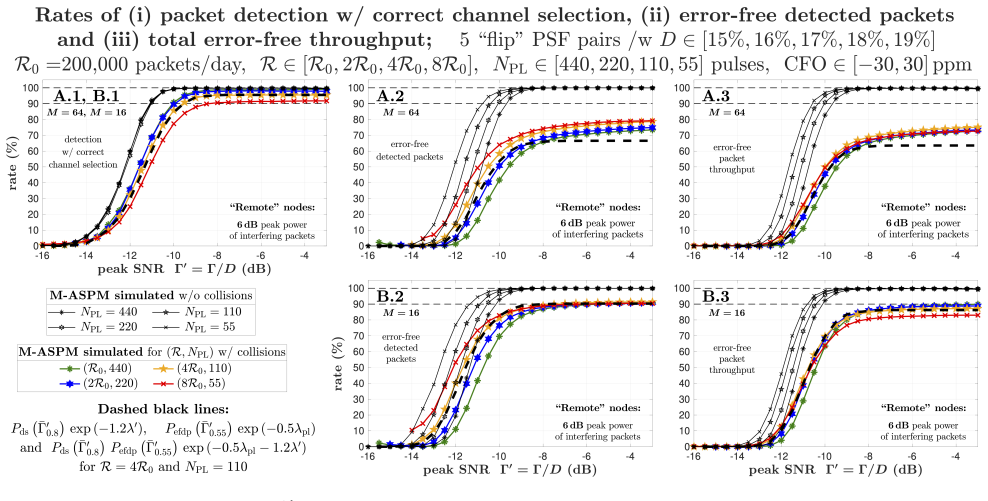
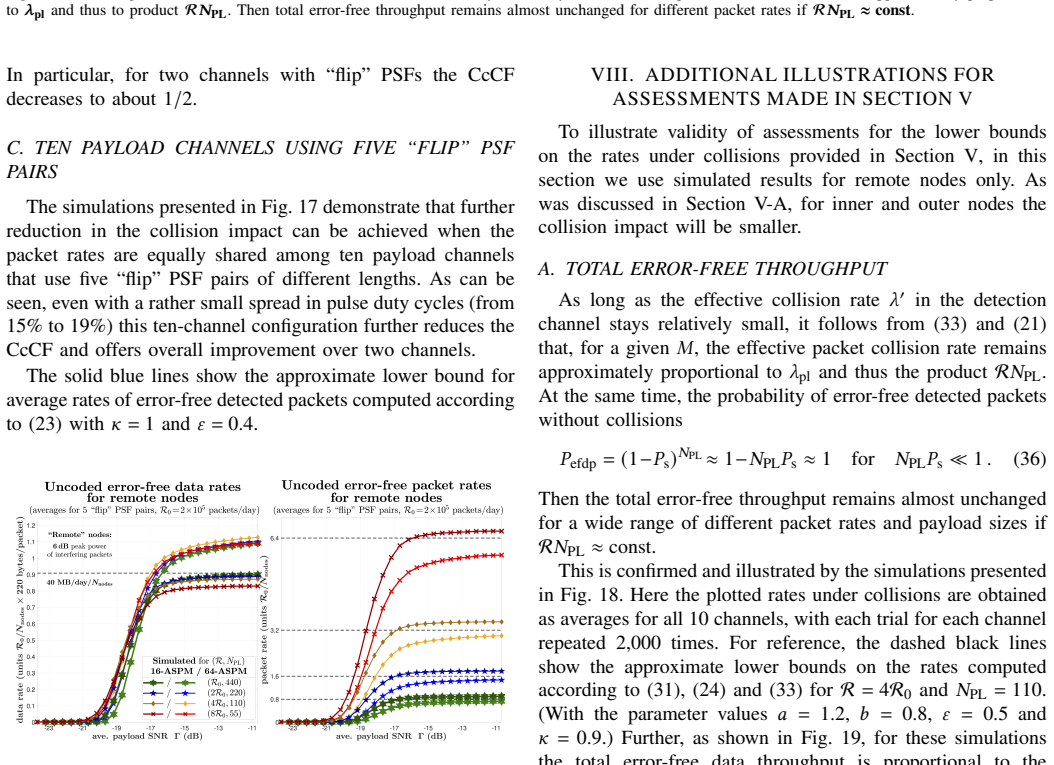
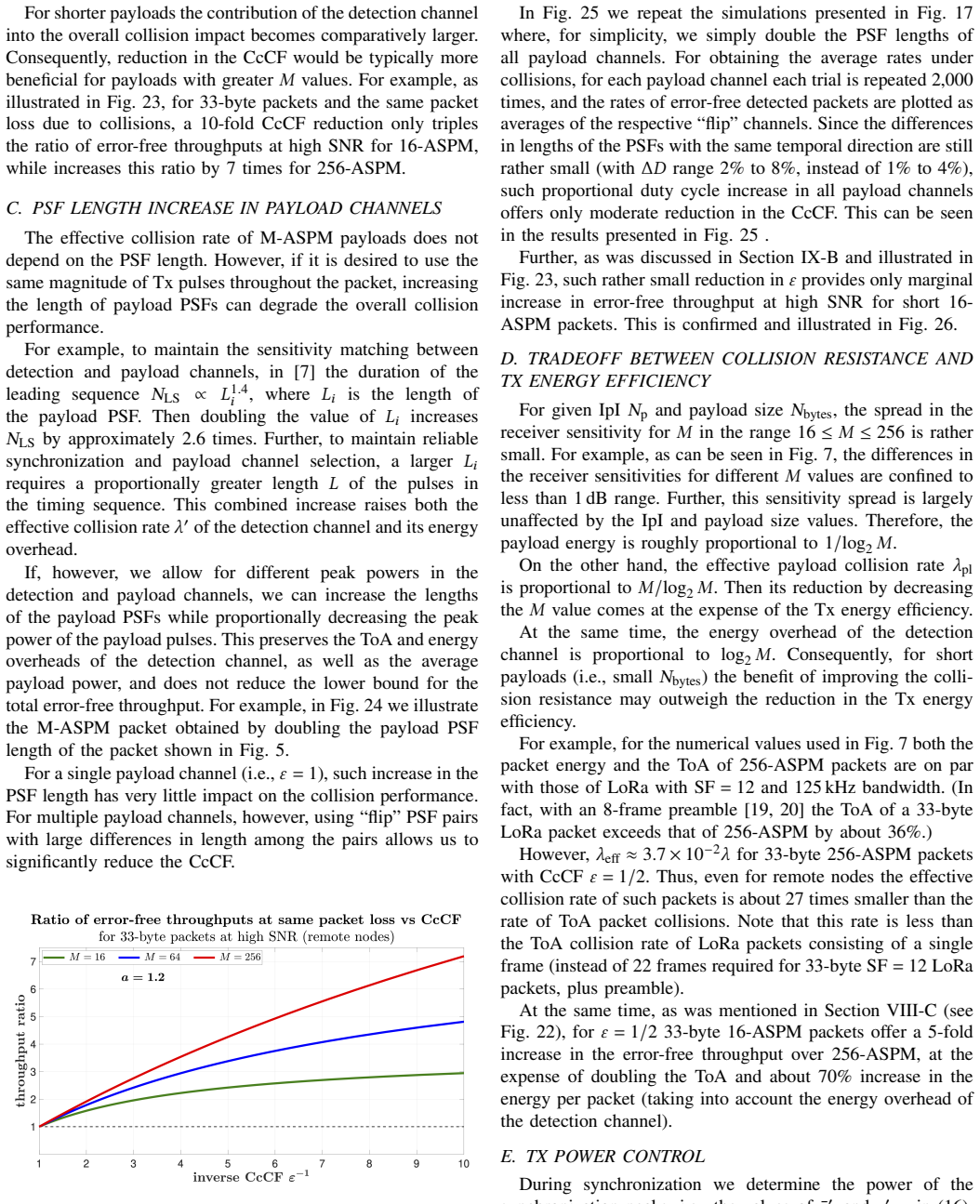
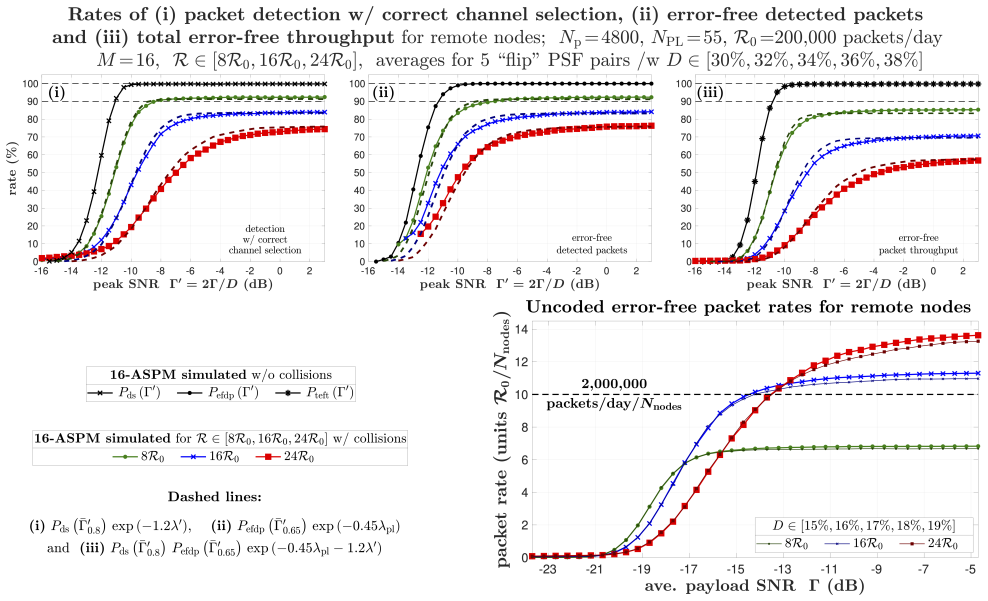
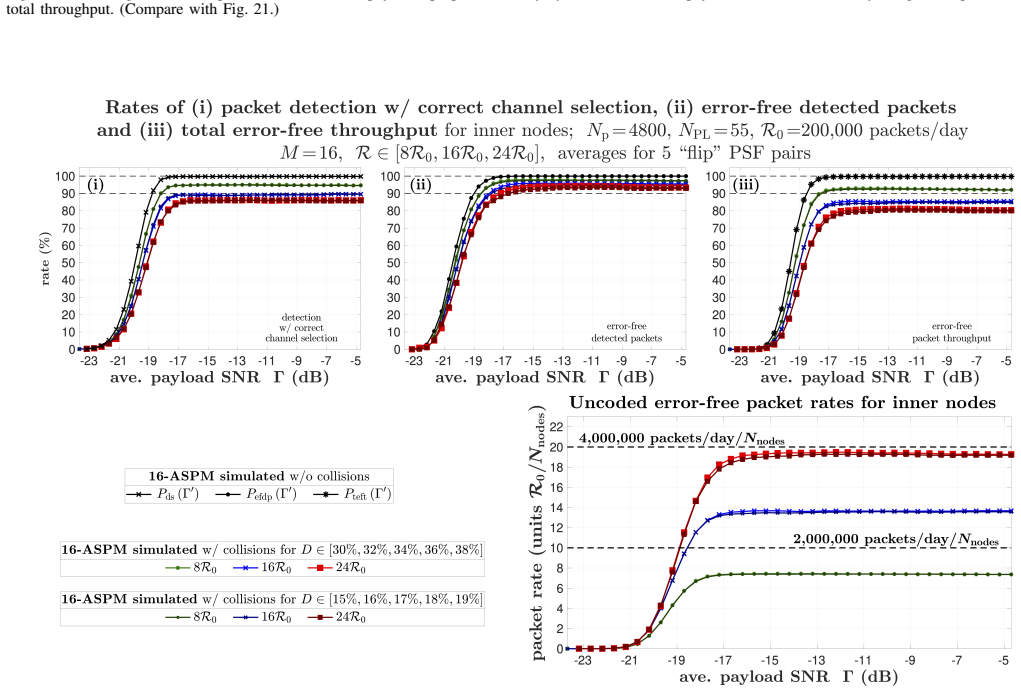
M-ary Aggregate Spread Pulse Modulation (M-ASPM) is a physical layer (PHY) modulation technique that offers several advantages for low-power wide-area networks (LPWANs). For instance, in conventional LPWAN modulations increasing receiver sensitivity by extending symbol duration - thereby proportionally increasing the time-on-air (ToA) - exacerbates collision exposure. In contrast, M-ASPM payload processing gain can vary over a wide range without impacting the effective packet collision rate. In particular, in this work we demonstrate how short front portions of M-ASPM packets can serve as a separate collision-resistant detection channel that, in addition to performing asynchronous packet detection and synchronization, obtains the carrier frequency offset (CFO) for each packet within a desired range and with the required precision. Then, while raising processing gain, the subsequent payload information can be extracted without expanding the sample window per symbol. Consequently, the receiver sensitivity can be significantly increased without exacerbating packet collisions and thus without reducing network throughput under collision-limited operation. We further establish a multi-channel configuration in which numerous quasi-orthogonal payload channels share a single detection channel that additionally performs payload channel identification and selection. Such sharing is especially useful for scaling and economizing LPWAN deployments under diverse technical requirements and constraints. The presented analysis is validated via extensive simulations under high packet collision rates in wide ranges of payload sizes and processing gains, and for varying noise and interference power levels. The results signify that M-ASPM provides a structurally distinct scaling behavior compared to conventional LPWAN modulations, decoupling range extension from collision-induced throughput degradation.
Editorial analysis
A structured set of objections, weighed in public.
Referee Report
Summary. The manuscript proposes M-ary Aggregate Spread Pulse Modulation (M-ASPM) for LPWANs. Short front portions of packets serve as a collision-resistant detection channel performing asynchronous detection, synchronization, and CFO estimation with required precision. This enables raising payload processing gain without expanding the per-symbol sample window or increasing effective collision rate. A multi-channel configuration is introduced in which multiple quasi-orthogonal payload channels share one detection channel that also performs channel identification. The central claim is that this yields a structurally distinct scaling behavior decoupling range extension from collision-induced throughput degradation. Validation is stated to rest on extensive simulations across collision rates, payload sizes, processing gains, and noise/interference levels.
Significance. If the mechanism and simulation results hold, the work identifies a concrete way to break the conventional sensitivity-versus-collision trade-off in LPWANs, which is practically relevant for dense deployments. The shared-detection-channel architecture additionally offers an economical route to multi-channel scaling. The breadth of the reported simulation campaign (high collision rates, wide ranges of payload and gain parameters) is a positive feature of the validation approach.
major comments (2)
- [validation and mechanism description] The decoupling claim rests on the assertion that short front portions reliably deliver CFO estimates of sufficient precision while leaving the payload symbol window unchanged. No quantitative characterization of CFO estimation error, required precision threshold, or failure rate under the simulated collision conditions is supplied, which directly affects whether the payload extraction step remains viable.
- [multi-channel configuration] The multi-channel sharing result likewise depends on the detection channel correctly identifying and selecting among quasi-orthogonal payload channels. No analysis or simulation metric is given for mis-identification probability as a function of the number of payload channels or interference level, which is load-bearing for the scaling claim.
minor comments (2)
- [validation section] The abstract and main text repeatedly use the phrase 'extensive simulations' without specifying the simulation framework, number of Monte-Carlo trials, or statistical error bars on the reported throughput or sensitivity figures.
- [introduction] Notation for processing gain, time-on-air, and collision rate should be introduced with explicit definitions or references to prior LPWAN literature to improve readability.
Simulated Author's Rebuttal
We thank the referee for the constructive feedback and for recognizing the potential significance of the M-ASPM approach. We address each major comment below and will revise the manuscript to incorporate the requested quantitative characterizations.
read point-by-point responses
-
Referee: [validation and mechanism description] The decoupling claim rests on the assertion that short front portions reliably deliver CFO estimates of sufficient precision while leaving the payload symbol window unchanged. No quantitative characterization of CFO estimation error, required precision threshold, or failure rate under the simulated collision conditions is supplied, which directly affects whether the payload extraction step remains viable.
Authors: We agree that explicit quantitative metrics on CFO estimation would strengthen the validation of the decoupling claim. While the reported simulations show successful payload extraction across tested collision rates (implying that CFO estimates met practical requirements), we did not include intermediate statistics such as CFO error distributions, the specific precision threshold, or conditional failure rates. In the revised manuscript we will add a new subsection with figures and tables reporting these metrics under the simulated conditions. revision: yes
-
Referee: [multi-channel configuration] The multi-channel sharing result likewise depends on the detection channel correctly identifying and selecting among quasi-orthogonal payload channels. No analysis or simulation metric is given for mis-identification probability as a function of the number of payload channels or interference level, which is load-bearing for the scaling claim.
Authors: We acknowledge that mis-identification probabilities are central to the multi-channel scaling claim. Our simulations included multi-channel operation with overall performance results that presuppose correct channel selection, but we did not report explicit mis-identification rates versus number of channels or interference levels. We will add new simulation results and corresponding plots of identification accuracy in the revised manuscript. revision: yes
Circularity Check
No significant circularity identified
full rationale
The provided abstract and description contain no equations, derivations, or self-citations. Claims of distinct scaling behavior and collision-resistant detection are presented as validated by extensive simulations across collision rates, payload sizes, processing gains, and noise levels, without any reduction of predictions to fitted inputs or load-bearing self-references. The central decoupling of range extension from throughput degradation is described as a structural property of the modulation, with no internal steps that reduce by construction to the paper's own inputs.
Axiom & Free-Parameter Ledger
Reference graph
Works this paper leans on
-
[1]
A. V . Nikitin and R. L. Davidchack, “Pulsed waveforms and intermittently nonlinear filtering in synthesis of low-SNR and covert communications,”IEEE Access, vol. 8, pp. 173 250– 173 266, 2020, doi: 10.1109/ACCESS.2020.3024978
-
[2]
M-ary aggregate spread pulse modulation in LPW ANs for IoT applications,
——, “M-ary aggregate spread pulse modulation in LPW ANs for IoT applications,” inProc. 2021 IEEE Global Commun. Conf. (GLOBECOM 2021), Madrid, Spain, 7-11 Dec. 2021, pp. 1–7, doi: 10.1109/GLOBECOM46510.2021.9685345
-
[3]
M-ary aggregate spread pulse modulation for robust and scalable low-power wireless networks,
——, “M-ary aggregate spread pulse modulation for robust and scalable low-power wireless networks,”IEEE Access, vol. 10, pp. 96 652–96 671, 2022, doi: 10.1109/ACCESS.2022.3205009
-
[4]
Communications method and apparatus,
A. V . Nikitin, “Communications method and apparatus,” US patents 11,671,290 (June 6, 2023) and 2,445,3288 (Oct. 14, 2025), US patent publication US20260031851A1 (Jan. 21, 2026)
2023
-
[5]
A. V . Nikitin and R. L. Davidchack, “M-ary aggregate spread pulse modulation with pulse-shaping power control for highly scalable LPW ANs,”IEEE Access, vol. 11, pp. 25 642–25 661, 2023, doi: 10.1109/ACCESS.2023.3256888
-
[6]
——, “Implementation framework for robust detection, synchro- nization, and decoding of M-ASPM communications,”IEEE Access, vol. 12, pp. 4370–4386, 2024, doi: 10.1109/ACCESS. 2023.3346316
-
[7]
——, “Benchmark algorithm for asynchronous detection of M-ASPM packets combined with measuring carrier frequency offset,”IEEE Access, vol. 13, pp. 152914–152933, 2025, doi:10. 1109/ACCESS.2025.3604244. 24
arXiv 2025
-
[8]
Frequency shift chirp modulation: The LoRa modulation,
L. Vangelista, “Frequency shift chirp modulation: The LoRa modulation,”IEEE Signal Process. Lett., vol. 24, no. 12, pp. 1818–1821, Dec 2017, doi: 10.1109/LSP.2017.2762960
-
[9]
Error probability performance of chirp modulation in uncoded and coded LoRa systems,
G. Baruffa, L. Rugini, L. Germani, and F. Frescura, “Error probability performance of chirp modulation in uncoded and coded LoRa systems,”Digital Signal Processing, vol. 106, p. 102828, 2020, doi: 10.1016/j.dsp.2020.102828
-
[10]
D. E. Knuth, “Two notes on notation,”American Mathematical Monthly, vol. 99, no. 5, pp. 403–422, May 1992, doi: 10.1080/ 00029890.1992.11995869
arXiv 1992
-
[11]
Generating precision nonlinear FM chirp waveforms,
A. W. Doerry, “Generating precision nonlinear FM chirp waveforms,” inRadar Sensor Technology XI, J. L. Kurtz and R. J. Tan, Eds., vol. 6547, International Society for Optics and Photonics. SPIE, 2007, p. 65470D. [Online]. Available: https://doi.org/10.1117/12.717796
-
[12]
R. N. Bracewell,The Fourier transform and its applications, 3rd ed. New York: McGraw-Hill, 2000
2000
-
[13]
Discrete Hilbert trans- form. Numeric algorithms,
G. Todoran, R. Holonec, and C. Iakab, “Discrete Hilbert trans- form. Numeric algorithms,”Acta Electroteh., vol. 49, no. 4, pp. 485–490, 2008
2008
-
[14]
D. Gabor, “Theory of communication,”Journal of the Institution of Electrical Engineers, vol. 93, no. 26, pp. 429–457, 1946, doi: 10.1049/ji-3-2.1946.0074
-
[15]
Vetterli and J
M. Vetterli and J. Kova ˇcevic,Wavelets and subband coding. Prentice-Hall, 1995
1995
-
[16]
J. G. Proakis and D. G. Manolakis,Digital signal processing: Principles, algorithms, and applications, 4th ed. Prentice Hall, 2006
2006
-
[17]
Performance of unslotted ALOHA with capture and multiple collisions in LoRaW AN,
M. Heusse, C. Caillouet, and A. Duda, “Performance of unslotted ALOHA with capture and multiple collisions in LoRaW AN,” IEEE Internet of Things Journal, vol. 10, no. 20, pp. 17 824– 17 838, 2023, doi: 10.1109/JIOT.2023.3280393
-
[18]
The ALOHA system: Another alternative for computer communications,
N. Abramson, “The ALOHA system: Another alternative for computer communications,” inAFIPS ’70 (Fall): Proceedings of the November 17-19, 1970, fall joint computer conference, Houston, TX, 17-19 Nov. 1970, pp. 281–285, doi: 10.1145/ 1478462.1478502
arXiv 1970
-
[19]
A maximum-likelihood-based two-user re- ceiver for LoRa chirp spread-spectrum modulation,
M. Xhonneux, J. Tapparel, A. Balatsoukas-Stimming, A. Burg, and O. Afisiadis, “A maximum-likelihood-based two-user re- ceiver for LoRa chirp spread-spectrum modulation,”IEEE Inter- net of Things Journal, vol. 9, no. 22, pp. 22 993–23 007, 2022, doi: 10.1109/JIOT.2022.3186732
-
[20]
A tutorial on chirp spread spectrum modulation for LoRaW AN: Basics and key advances,
A. Maleki, H. H. Nguyen, E. Bedeer, and R. Barton, “A tutorial on chirp spread spectrum modulation for LoRaW AN: Basics and key advances,”IEEE Open Journal of the Communications Society, vol. 5, pp. 4578–4612, 2024, doi: 10.1109/OJCOMS. 2024.3433502. 25
discussion (0)
Sign in with ORCID, Apple, or X to comment. Anyone can read and Pith papers without signing in.