REVIEW 1 major objections 5 minor
SN 2022erq's extreme brightness was powered by a massive hydrogen shell whose mass-loss rate rose an order of magnitude in the decades before explosion.
Reviewed by Pith at T0; open to challenge. T0 means a machine referee read the full paper against a public rubric. the ladder, T0–T4 →
T0 review · grok-4.5
2026-07-13 06:52 UTC pith:TA6TZGYU
load-bearing objection Solid new Ia-CSM dataset with a useful dual reconstruction of escalating mass loss; the absolute Ṁ numbers scale with a fixed ε≈50% energy budget, but the qualitative surge and the early spectroscopy are real advances. the 1 major comments →
SN 2022erq: A Superluminous Thermonuclear Supernova with Escalating Preexplosion Mass Loss
The pith
A machine-rendered reading of the paper's core claim, the machinery that carries it, and where it could break.
Core claim
By combining H-alpha diagnostics of the outer unshocked wind with bolometric modeling of the interaction-powered light curve, the authors show that the pre-explosion mass-loss rate of SN 2022erq escalated by an order of magnitude over the final decades, rising from about 0.04 to about 0.6 solar masses per year and producing a roughly 3-solar-mass hydrogen-rich CSM shell out to about 3.5 times 10^16 cm, consistent with a white-dwarf plus intermediate-mass companion progenitor.
What carries the argument
Joint inversion of narrow H-alpha luminosity (outer, unshocked CSM) and bolometric luminosity under a shock-interaction model (inner CSM density at the cold dense shell) that yields a steep density profile rho_CSM proportional to r to the -3.6 and the time-dependent mass-loss rate.
Load-bearing premise
The conversion of shock kinetic energy into radiation is fixed at about 50 percent by comparing the total radiated energy to an assumed total kinetic energy of a standard Chandrasekhar-mass explosion; that single efficiency sets the absolute scale of the derived density and mass-loss history.
What would settle it
High-resolution spectroscopy or multi-wavelength monitoring that independently measures either the kinetic-to-radiative efficiency or the total CSM mass (for example via free-free radio continuum or X-ray luminosity) and finds a value inconsistent with the 50 percent efficiency and the ~3 solar-mass shell required by the light-curve inversion.
Editorial analysis
A structured set of objections, weighed in public.
Referee Report
Summary. The manuscript presents a comprehensive photometric and spectroscopic analysis of SN 2022erq, establishing it as a superluminous Ia-CSM event. Early spectra show IGE-dominated, IME-weak features consistent with efficient thermonuclear burning, while persistent narrow Balmer lines and a slow light-curve decline demonstrate long-lived interaction with a massive H-rich CSM. Combining multi-component Hα diagnostics with bolometric light-curve inversion, the authors reconstruct a pre-explosion mass-loss history that escalates from ~0.04 to ~0.6 M☉ yr⁻¹ over the final decades, yielding a ~3 M☉ CSM shell extending to ~3.5×10¹⁶ cm. The young (~100 Myr), low-metallicity host environment is used to favor a white-dwarf plus intermediate-mass companion progenitor that experienced enhanced late-stage mass loss.
Significance. If the reconstructed mass-loss history holds, SN 2022erq provides one of the most detailed empirical constraints on the CSM density structure and pre-explosion evolution of an Ia-CSM progenitor. The dense early-to-late spectral sequence (from +1.8 d), multi-band photometry including NIR, and joint Hα/bolometric modeling constitute a high-value observational dataset for the rare Ia-CSM class. The qualitative conclusion of escalating mass loss and a massive extended CSM is robust and places useful pressure on steady-wind single-degenerate models, while the quantitative rates and total mass offer a concrete target for binary-evolution calculations.
major comments (1)
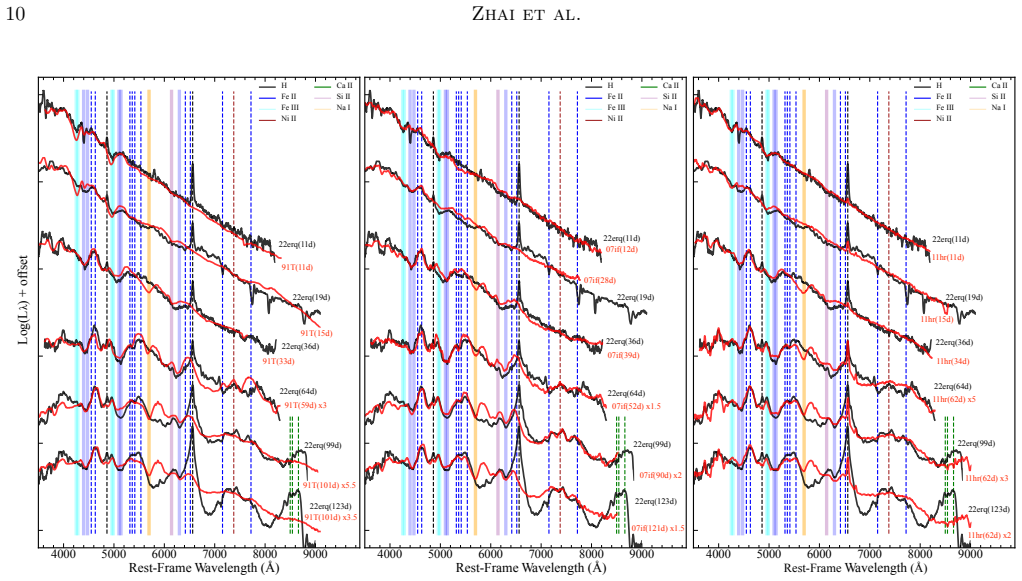
- Section 5.3, Eqs. (1)–(2): the absolute CSM density profile (and therefore the claimed surge from ~0.04 to ~0.6 M☉ yr⁻¹ and M_CSM~3 M☉) is obtained by inverting L=2πε ρ_CSM r_sh^{2} v_sh^{3} with a fixed ε≈50%. That efficiency is set by dividing the integrated radiated energy (~0.7 foe) by an assumed total shock kinetic energy of ~1.4 foe for a canonical Chandrasekhar ejecta (M_ej=1.4 M☉, v=10⁴ km s⁻¹). Given the IGE-rich, IME-weak early spectra (Figs. 6–7), the true ejecta mass/kinetic energy (or the fraction that couples to the CSM) could differ. A different ε simply rescales the entire ρ_CSM(r) profile and the absolute mass-loss rates. The power-law index s~3.6 and the qualitative escalation are less sensitive, and the outer Hα rates (~0.04 M☉ yr⁻¹) are independent of ε, but the quantitative amplitude of the inner surge is only as secure as the adopted energy budget. The paper should
minor comments (5)
- Section 5.2: the Ofek et al. (2013) formula used for the narrow-Hα mass-loss rate assumes a wind-density profile and recombination-dominated emission; a brief statement of the adopted β and any geometric assumptions would improve reproducibility.
- Figure 14: the top axis (time before explosion) assumes constant v_wind=180 km s⁻¹. The text already notes that an evolving wind speed would change the absolute timing; a short parenthetical reminder in the figure caption would help.
- Section 4.2 / Appendix A.2: the spectral-matching procedure is carefully described, but the ranking metric (RMS of relative residual) and the decision to allow phase offsets up to 120 d could be summarized more compactly in the main text for readers who do not consult the appendix.
- Table 1 and the light-curve parameter discussion: the unusually long rise times in the redder bands are attributed in part to strengthening Hα; a quantitative estimate of the Hα contribution to the r-band flux near maximum would strengthen that claim.
- A few minor typographical issues appear (e.g., “Tpe IIn” for “Type IIn” in Section 3.3; occasional missing spaces around units). A careful proof-read will catch them.
Circularity Check
No circularity: mass-loss history is inverted from independent L(t), v_sh(t), and Hα data via published formulae; ε is fixed by an energy budget, not tuned to recover the claimed escalation.
full rationale
The central claim (order-of-magnitude rise in Ṁ from ~0.04 to ~0.6 M⊙ yr⁻¹ and M_CSM ~3 M⊙) is obtained by applying standard interaction formulae (Ofek et al. 2013 for narrow Hα; Chevalier & Fransson / Moriya et al. 2013 for L = 2πε ρ r_sh^{2} v_sh^{3}) to observed bolometric luminosity, measured CDS velocities, and line fluxes. ε ≈ 50 % is set once by the ratio of integrated radiated energy (~0.7 foe) to an assumed Chandrasekhar kinetic energy (~1.4 foe); it is not adjusted so that the density slope or the final mass-loss rates are recovered by construction. The power-law index s ~ 3.6 is cross-checked by an independent analytic light-curve slope fit (α = −1.46 o s = 3.59). Hα-based outer rates are independent of ε. Self-citations are ordinary comparative literature and do not close any logical loop. The derivation is therefore self-contained against external benchmarks; any vulnerability lies in the physical assumptions (canonical ejecta energy, constant wind speed), not in circular reasoning.
Axiom & Free-Parameter Ledger
free parameters (5)
- kinetic-to-radiative efficiency ε =
≈0.5
- CSM wind velocity v_wind =
180 km s⁻¹
- ejecta mass and velocity for kinetic-energy budget =
1.4 M⊙, 10⁴ km s⁻¹
- ejecta density power-law index n =
≈10
- CDS velocity parameterization v_sh(t)=v1 t^0.15 =
v1=2800 km s⁻¹
axioms (5)
- domain assumption Narrow Hα luminosity traces unshocked photo-ionized CSM via the Ofek et al. (2013) recombination formula L_Hα ∝ Ṁ² / (v_w r).
- domain assumption Bolometric luminosity equals ε times the kinetic-energy dissipation rate at the forward shock (Chevalier & Fransson / Moriya).
- domain assumption Post-peak light-curve slope α relates to CSM density index s by the Moriya et al. (2013) analytic expression involving ejecta index n.
- domain assumption Host-galaxy extinction is negligible (A_V(host)≈0.046 mag) and total E(B-V)=0.02 mag.
- domain assumption Distance D=270±30 Mpc from z=0.0653 and H0=73.04 km s⁻¹ Mpc⁻¹.
read the original abstract
We present a photometric and spectroscopic study of the superluminous Type Ia supernova SN 2022erq. Its early spectra, dominated by iron-group elements with weak intermediate-mass features, might indicate highly efficient nuclear burning, broadly similar to that inferred for some overluminous SNe Ia. The rapid emergence and persistence of narrow Balmer emission lines superposed on this iron-rich spectrum provide clear evidence of long-lived interaction with a hydrogen-rich circumstellar medium (CSM), establishing SN 2022erq as a member of the rare Ia-CSM class. SN 2022erq reached a peak bolometric luminosity of about 8 x 10^43 erg/s and exhibited an exceptionally slow post-peak decline, indicating that its light curve is dominated by long-duration ejecta-CSM interaction. By combining H-alpha diagnostics with bolometric light-curve modeling, we reconstruct the pre-explosion mass-loss history of the progenitor. The mass-loss rate escalated by one order of magnitude over the final decades, rising from about 0.04 to about 0.6 solar masses per year. This surge produced a massive, extended CSM shell of about 3 solar masses out to about 3.5 x 10^16 cm. The young stellar environment (about 100 Myr) together with this substantial, extensive CSM points to a progenitor system consisting of a white dwarf and an intermediate-mass companion that underwent increasing mass loss prior to explosion.
Figures




discussion (0)
Sign in with ORCID, Apple, or X to comment. Anyone can read and Pith papers without signing in.