REVIEW 3 major objections 3 minor 1 cited by
A unique window into the Epoch of Reionisation: A double-peaked Lyman-$\alpha$ emitter in the proximity zone of a quasar at $z\sim 6.6$
T0 review · 3 major / 3 minor · reviewed 2026-08-11 · deepseek-v4-flash
Pith's one-line read A galaxy inside a quasar's ionised bubble at $z\approx6.6$ is measured to leak 8-33% of its Lyman-continuum photons, an output that could help sustain reionisation.
desk verdict Genuinely new high-z data point with careful multi-tracer analysis, but the headline f_esc and quasar-geometry numbers ride on an unresolved 1σ redshift ambiguity between Lyα and [OIII]. read the letter →
The pith
A machine-rendered reading of the paper's core claim, the machinery that carries it, and where it could break.
The reading
What carries the argument
The carrying object is the double-peaked Ly$\alpha$ emission-line profile in the Keck/DEIMOS spectrum, fitted with an absorption Voigt trough at $z = 6.6405 \pm 0.0005$ and a peak separation $\Delta v_{\rm sep} = 255.71 \pm 33.69$ km/s. Because the galaxy sits in the quasar's ionised proximity zone, the blue peak is not absorbed by the intergalactic medium, so the peak separation can be converted into a Lyman-continuum escape fraction through the empirical relation $f_{\rm esc}^{\rm LyC} = 3.23\times10^{4}/v_{\rm sep}^2 - 1.05\times10^{2}/v_{\rm sep} + 0.095$. The same geometry, combined with the quasar's ionising photon rate $\dot{N}_{\rm QSO}^{\rm ion} = (3.43\pm0.02)\times10^{57}$ s$^{-1}$, fixes the lower limits on the quasar opening angle and lifetime through the light-echo/proximity argument. The Balmer lines H$\alpha$ and H$\beta$ separately supply the ionising photon production efficiency $\xi_{\rm ion}$ under Case B recombination.
What would settle it
Obtain a calibration-independent systemic redshift for LAE-11, for example an ALMA [CII] detection or a higher-signal-to-noise rest-frame optical spectrum with an independently calibrated wavelength solution. If the redshift is $z = 6.6372$ (the [OIII] value) rather than $z = 6.6405$, then the interpretation of the blue Ly$\alpha$ peak as a radiative-transfer component would fail, and with it the $8{-}33\%$ escape fraction and the $\theta_Q > 49.62^\circ$ opening-angle limit; the non-Ly$\alpha$ escape-fraction diagnostics would still stand. Confirming the trough redshift with an independent line would corroborate the paper's central numbers.
Extended reading notes
Core claim
The central claim is that LAE-11, a fairly bright ($M_{\rm UV} = -19.84^{+0.14}_{-0.16}$), very blue ($\beta_{1550} = -2.61^{+0.06}_{-0.08}$), compact galaxy at $z = 6.6405 \pm 0.0005$, is a genuine leaker of Lyman-continuum photons during the Epoch of Reionisation. From the peak separation $\Delta v_{\rm sep} = 255.71 \pm 33.69$ km/s of its double-peaked Ly$\alpha$ line and several independent empirical diagnostics, the authors derive $f_{\rm esc}^{\rm LyC} = 0.08{-}0.33$. The H$\alpha$ and H$\beta$ lines give $\log(\xi_{\rm ion}/{\rm Hz~erg^{-1}}) = 25.59 \pm 0.08$ and $25.65 \pm 0.09$, and the total ionising output $\log(f_{\rm esc}^{\rm LyC}\xi_{\rm ion,H\alpha}/{\rm Hz~erg^{-1}}) = 24.85^{+0.24}_{-0.34}$ is higher than the canonical $24.3{-}24.8$ assumed to drive reionisation forward. Because the blue Ly$\alpha$ peak is observed, LAE-11 must lie inside the quasar's ionisation cone; requiring the line of sight and the galaxy to both sit inside that cone constrains the quasar opening angle to $\theta_Q > 49.62^\circ$ and its bright-phase lifetime to $t_Q > 3.8\times10^5$ yr.
Load-bearing premise
The entire peak-separation analysis rests on the assumption that the systemic redshift of LAE-11 is the Ly$\alpha$ trough at $z = 6.6405$; the [OIII] doublet gives $z = 6.6372$, a $1\sigma$ discrepancy the paper cannot currently resolve, and if the [OIII] redshift is correct the blue peak is not a radiative-transfer component and the escape fraction and opening-angle constraints do not follow.
Editorial extensions
If this is right
- LAE-11 has a Lyman-continuum escape fraction of 8-33%, with all indirect tracers used by the paper agreeing within $1\sigma$.
- The total ionising output of LAE-11, $\log(f_{\rm esc}^{\rm LyC}\xi_{\rm ion,H\alpha}/{\rm Hz~erg^{-1}}) = 24.85^{+0.24}_{-0.34}$, is higher than the canonical $24.3{-}24.8$ usually assumed for galaxies sustaining reionisation.
- The quasar J0910-0414 has an ionisation opening angle $\theta_Q > 49.62^\circ$ and a bright-phase lifetime $t_Q > 3.8\times10^5$ yr, so it cannot be one of the very young quasars inferred from short line-of-sight proximity zones.
- Galaxies similar to LAE-11, which are compact, dust-poor, low-metallicity starbursts, could contribute significantly to the ionising budget near the end of the Epoch of Reionisation.
- The paper's diagnostics give consistent escape-fraction estimates whether or not they use Ly$\alpha$ emission, suggesting that multiple tracers can be used to constrain LyC leakage at high redshift.
Reading between the lines
- If LAE-11 is typical of galaxies in quasar proximity zones, bright compact starbursts near ionised bubbles could supply a measurable part of the reionising photon budget, complementing the contribution usually assigned to very faint galaxies.
- Applying the same trough-versus-[OIII] redshift test to other double-peaked LAEs in similar quasar fields would turn the current $1\sigma$ tension into either a wavelength-calibration story or a stronger test of the peak-separation method.
- The quasar-opening-angle constraint is currently a two-object technique; applying it to every quasar with a double-peaked LAE in its proximity zone would give a population-level measurement of quasar lifetimes and beaming at $z > 6$.
Editorial analysis
A structured set of objections, weighed in public.
Referee Report
Summary. The paper presents a multi-wavelength study of LAE-11, a double-peaked Lyα emitter at z~6.6 in the proximity zone of quasar J0910-0414, using Keck/DEIMOS spectroscopy, JWST/NIRCam WFSS and NIRSpec MSA spectroscopy, and Subaru/HSC, HST, and JWST photometry. The authors measure the galaxy's UV properties, stellar mass, star formation rate, and use a combination of indirect diagnostics to derive the Lyman-continuum escape fraction, the ionizing photon production efficiency from Hα and Hβ, and the total ionizing output. They also use the detection of the blue Lyα peak to constrain the quasar's opening angle and lifetime. The headline results are f_esc^LyC = (8-33)%, log(ξ_ion/Hz erg^-1) = 25.59±0.08 and 25.65±0.09 from Hα and Hβ, and log(f_esc ξ_ion,Hα/Hz erg^-1) = 24.85(+0.24,-0.34), which exceeds the canonical 24.3-24.8 required for reionization; the quasar constraints are θQ > 49.62° and tQ > 3.8×10^5 yr.
Significance. If the adopted systemic redshift is correct, this is a unique and important result: it provides a high-redshift measurement of f_esc from a double-peaked Lyα profile in a quasar proximity zone, independently corroborated by Balmer-line ξion measurements, and it places novel constraints on the quasar geometry and lifetime. The paper is careful in its uncertainty propagation, uses multiple independent f_esc estimators, and is transparent about the redshift tension in §3.1 and §5.4. The main claims, however, are conditional on the Lyα-trough redshift, and the unresolved 1σ tension with the [OIII] redshift currently prevents full acceptance of the headline numbers.
major comments (3)
- [§3.1; Eq. (5); Eq. (8); Eq. (13)] The systemic redshift is a load-bearing assumption: the peak-separation f_esc = 0.18±0.08 (Eq. 5), the ξion values (Eq. 8), and the quasar opening angle (Eq. 13) are all derived under z_trough = 6.6405±0.0005, while the [OIII] doublet gives z = 6.6372±0.0004, a 1σ tension. Section 5.4 explicitly concedes that if z[OIII] is correct, the blue peak is not a radiative-transfer component, so the peak-separation f_esc and the opening-angle constraint no longer follow. The authors need to either obtain an independent systemic redshift (e.g., higher-resolution [OIII] or other nebular lines) or present all headline results under both redshift scenarios; as it stands, the central claims are conditional on an unresolved 1σ tension.
- [§4.4; Eq. (11); Eq. (13)] The quasar lifetime and opening angle depend on the line-of-sight distance d∥ = 0.21±0.01 pMpc. A change in redshift from 6.6405 to 6.6372 (Δz = 0.0033) changes d∥ by roughly 0.16 pMpc, which is comparable to the quoted value and could place the galaxy in front of the quasar or at a substantially different angle. The paper does not quantify the effect of the alternative redshift on θQ and tQ; this robustness check is necessary before these constraints can be accepted.
- [§4.1; Table 5] The statement in the Abstract that 'all tracers of ionising photon leakage agree within 1σ uncertainty' is an overstatement: the peak-separation value (0.18±0.08) is the only one tied to the double-peaked profile, while the Begley et al. relation gives 0.08±0.03, the Chisholm et al. β relation gives 0.20±0.18, the ΣSFR relations provide only lower limits (>0.16 and >0.24), and the Jaskot et al. models have asymmetric errors spanning a wide range (0.12–0.69). Given the large uncertainties and the presence of lower limits, the 'agreement' is not a strong cross-check. The authors should either provide a more quantitative comparison (e.g., a chi-squared or weighted mean) or soften this claim.
minor comments (3)
- [§6, item 4] There is a typo: 'samples of of galaxies' should read 'samples of galaxies'.
- [§5.4] The phrase 'this result of f_esc^LyC = 100%' should be reworded for clarity, since Eq. (8) becomes singular in that limit; the intended meaning is that ξion would be undefined/infinite.
- [§3.1] The authors state that the [OIII] redshift is in tension with the Lyα trough 'even when adopting the conservative calibration redshift offset Δz<0.003 quoted by Wang et al. (2023)'. Given that the two redshifts differ by Δz=0.0033, it would be helpful to explicitly state the combined 1σ systematic and statistical error budget for the [OIII] redshift.
Circularity Check
No significant circularity; the ionising-output and quasar-geometry results are external-calibration-based and measurement-driven, with the unresolved Lyα/[OIII] redshift tension as a stated systematic limitation.
full rationale
The paper's ionising-output claims are not circular. The f_LyC_esc values in Table 5 are obtained by applying external empirical calibrations (Izotov et al. 2018; Begley et al. 2024; Chisholm et al. 2022; Naidu et al. 2020; Jaskot et al. 2024b) to independently measured peak separations, Lyα equivalent width, UV slope, and ΣSFR; none of these relations is fitted in this paper, and none takes the quoted f_esc as an input. ξion is computed from Hα and Hβ luminosities and M_UV via Eq. 8, with f_esc = 0.18 entering only as a measured input; combining f_esc and ξion into f_esc ξion is a product of two measurements, not a self-fulfilling prediction. The quasar opening angle (Eq. 13) and lifetime (Eq. 11) follow from a stated bipolar-cone light-echo geometry plus the observed fact that the blue Lyα peak is transmitted; the geometric model is cited to Bosman et al. (2020), but the formula is parameter-free and is applied to measured separations, so the self-citation is not load-bearing. The paper's main vulnerability is the 1σ tension between the Lyα-trough redshift (z = 6.6405) and the [OIII] redshift (z = 6.6372), explicitly reported in Sec. 3.1 and discussed in Sec. 5.4; the paper concedes that if z_[OIII] is correct the blue peak is not a radiative-transfer component and the peak-separation-based f_esc and opening-angle constraints no longer follow. That is a stated systematic uncertainty, not a circular reduction.
Assumptions & free parameters
free parameters (2)
- Lyα line-profile MCMC parameters (log A_Gauss, σ_Gauss, z_Lyα, z_trough, log N, log b) =
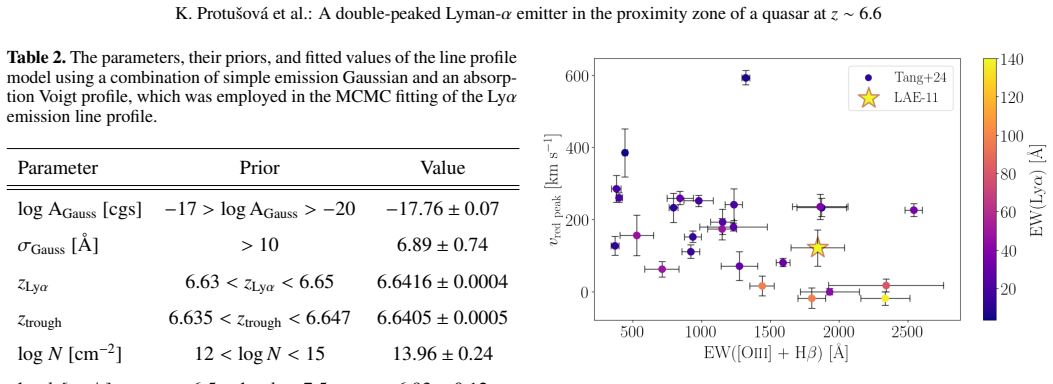
log A_Gauss=-17.76±0.07, σ_Gauss=6.89±0.74 Å, z_trough=6.6405±0.0005, log N=13.96±0.24, log b=6.93±0.12 (Table 2)
- BAGPIPES SED parameters (log M*, log U, log Z, A_V, non-parametric SFH bins) =
log M*/M⊙=7.93, log U=-1.33, log Z/Z⊙=-0.86, A_V<0.01 (Table 6)
assumptions (5)
- standard math ΛCDM Planck18 cosmology (ΩΛ=0.69, Ωm=0.31, H0=67.7 km/s/Mpc)
- domain assumption Case B recombination with ne=1e3 cm^-3, Te=1e4 K to convert Hα/Hβ luminosities to ionising photon rates
- ad hoc to paper Empirical f_esc relations calibrated on z<0.4 galaxies (Eq. 5, Eq. 6, Eq. 7, Jaskot et al. models) remain valid at z~6.6
- domain assumption The double-peaked Lyα trough traces the systemic redshift and the peak separation traces the neutral hydrogen column density (Verhamme et al. 2006, 2018)
- ad hoc to paper The quasar ionises in a simple bipolar cone and both the observer and LAE-11 lie inside it
Cite this review
Pith. "Pith review of A unique window into the Epoch of Reionisation: A double-peaked Lyman-$\alpha$ emitter in the proximity zone of a quasar at $z\sim 6.6$." pith.science (2026). https://pith.science/paper/TAD3MVYF
@misc{pith2026241212256,
  author       = {Pith},
  title        = {Pith review of: A unique window into the Epoch of Reionisation: A double-peaked Lyman-$\alpha$ emitter in the proximity zone of a quasar at $z\sim 6.6$},
  year         = {2026},
  howpublished = {\url{https://pith.science/paper/TAD3MVYF}},
  note         = {Machine review of arXiv:2412.12256}
}
abstract
We present a study of a double-peaked Ly$\alpha$ emitter, named LAE-11, found in the proximity zone of QSO J0910-0414 at $z\sim6.6$. We use a combination of deep photometric data from Subaru Telescope, HST, and JWST with spectroscopic data from Keck/DEIMOS, NIRCam WFSS and NIRSpec MSA to characterise the ionising and general properties of the galaxy, as well as the quasar environment surrounding it. We detect Ly$\alpha$, H$\beta$, [OIII] doublet, and H$\alpha$ emission lines in the various spectral datasets. The presence of a double-peaked Ly$\alpha$ line in the spectrum allows us to characterise the opening angle and lifetime of the QSO as $\theta_Q>49.62${\deg} and $t_Q > 3.8\times10^5$ years. LAE-11 is a fairly bright (M$_\rm{UV} = -19.84^{+0.14}_{-0.16}$), blue galaxy with a UV slope of $\beta = -2.61^{+0.06}_{-0.08}$. Since the galaxy is located in a quasar-ionised region, we have a unique opportunity to measure the escape fraction of Lyman Continuum photons using the un-attenuated double-peaked Ly$\alpha$ emission profile and its equivalent width at such high redshift. We employ diagnostics which do not rely on the detection of Ly$\alpha$ for comparison, and find that all tracers of ionising photon leakage agree within 1$\sigma$ uncertainty. We measure a moderate escape of Lyman Continuum photons from LAE-11 of $f_\rm{esc}^\rm{LyC} = (8 - 33)\%$. Detections of both H$\alpha$ and H$\beta$ emission lines allow for separate measurements of the ionising photon production efficiency, resulting with $\log(\xi_\rm{ion}/\rm{Hz~erg^{-1}}) = 25.59\pm0.08$ and $25.65\pm0.09$, for H$\alpha$ and H$\beta$, respectively. The total ionising output of LAE-11, $\log(f_\rm{esc}^\rm{LyC}\xi_\rm{ion, H\alpha}/\rm{Hz~erg^{-1}}) = 24.85^{+0.24}_{-0.34}$, is higher than the value of $24.3 - 24.8$ which is traditionally assumed as needed to drive Reionisation forward.
Figures


Figures from the paper (5 more)


Forward citations
Cited by 1 Pith paper
-
Subaru meets JWST: A Direct Measurement of Ly$\boldsymbol{\alpha}$ Escape Fraction at $\boldsymbol{z\simeq6.2}$ with Dual Narrow-Band Imaging
Completeness-weighted stacking of 56 HAEs at z≃6.2 gives median f_esc^Lyα = 0.106^{+0.066}_{-0.044} with no strong Hα-luminosity dependence and UV-linked galaxy-to-galaxy trends.
Reference graph
Works this paper leans on
-
[1]
Adelberger, K. L. 2004, ApJ, 612, 706
2004
-
[2]
T., Jahnke, K., Onoue, M., et al
Andika, I. T., Jahnke, K., Onoue, M., et al. 2020, ApJ, 903, 34
2020
-
[3]
2024, MNRAS, 527, 11372
Asada, Y ., Sawicki, M., Abraham, R., et al. 2024, MNRAS, 527, 11372
2024
-
[4]
J., et al
Atek, H., Labbé, I., Furtak, L. J., et al. 2024, Nature, 626, 975 Bañados, E., Venemans, B., Walter, F., et al. 2013, ApJ, 773, 178
2024
-
[5]
J., et al
Begley, R., Cullen, F., McLure, R. J., et al. 2024, MNRAS, 527, 4040
2024
-
[6]
& Arnouts, S
Bertin, E. & Arnouts, S. 1996, A&AS, 117, 393 Article number, page 13 of 17 A&A proofs: manuscript no. aanda
1996
-
[7]
2020, in Astronomical Society of the Pacific Conference Series, V ol
Bertin, E., Schefer, M., Apostolakos, N., et al. 2020, in Astronomical Society of the Pacific Conference Series, V ol. 527, Astronomical Data Analysis Soft- ware and Systems XXIX, ed. R. Pizzo, E. R. Deul, J. D. Mol, J. de Plaa, & H. Verkouter, 461
2020
-
[8]
J., Cantalupo, S., et al
Borisova, E., Lilly, S. J., Cantalupo, S., et al. 2016, ApJ, 830, 120
2016
Show all 168 references
-
[9]
2018, PASJ, 70, S5
Bosch, J., Armstrong, R., & Bickerton, S. 2018, PASJ, 70, S5
2018
-
[10]
Bosman, S. E. I., Davies, F. B., Becker, G. D., et al. 2022, MNRAS, 514, 55
2022
-
[11]
Bosman, S. E. I., Fan, X., Jiang, L., et al. 2018, MNRAS, 479, 1055
2018
-
[12]
Bosman, S. E. I., Kakiichi, K., Meyer, R. A., et al. 2020, ApJ, 896, 49
2020
-
[13]
J., Smit, R., Labbé, I., et al
Bouwens, R. J., Smit, R., Labbé, I., et al. 2016, ApJ, 831, 176
2016
-
[14]
& Charlot, S
Bruzual, G. & Charlot, S. 2003, MNRAS, 344, 1000
2003
-
[15]
2022, JWST Calibration Pipeline
Bushouse, H., Eisenhamer, J., Dencheva, N., et al. 2022, JWST Calibration Pipeline
2022
-
[16]
J., Conroy, C., & Johnson, B
Byler, N., Dalcanton, J. J., Conroy, C., & Johnson, B. D. 2017, ApJ, 840, 44
2017
-
[17]
L., & Storchi-Bergmann, T
Calzetti, D., Kinney, A. L., & Storchi-Bergmann, T. 1994, ApJ, 429, 582
1994
-
[18]
X., Hennawi, J
Cantalupo, S., Arrigoni-Battaia, F., Prochaska, J. X., Hennawi, J. F., & Madau, P. 2014, Nature, 506, 63
2014
-
[19]
J., & Porciani, C
Cantalupo, S., Lilly, S. J., & Porciani, C. 2007, ApJ, 657, 135
2007
-
[20]
C., McLure, R
Carnall, A. C., McLure, R. J., Dunlop, J. S., et al. 2019, MNRAS, 490, 417
2019
-
[21]
C., Magnier, E
Chambers, K. C., Magnier, E. A., Metcalfe, N., et al. 2016, arXiv e-prints, arXiv:1612.05560
2016 arXiv
-
[22]
B., Casey, C
Champagne, J. B., Casey, C. M., Finkelstein, S. L., et al. 2023, ApJ, 952, 99
2023
-
[23]
B., Wang, F., Yang, J., et al
Champagne, J. B., Wang, F., Yang, J., et al. 2024a, arXiv e-prints, arXiv:2410.03827
-
[24]
B., Wang, F., Zhang, H., et al
Champagne, J. B., Wang, F., Zhang, H., et al. 2024b, arXiv e-prints, arXiv:2410.03826
-
[25]
& Gnedin, N
Chen, H. & Gnedin, N. Y . 2018, ApJ, 868, 126
2018
-
[26]
2024, ApJ, 968, 32
Chen, N., Motohara, K., Spitler, L., Nakajima, K., & Terao, Y . 2024, ApJ, 968, 32
2024
-
[27]
2022, MNRAS, 517, 5104
Chisholm, J., Saldana-Lopez, A., Flury, S., et al. 2022, MNRAS, 517, 5104
2022
-
[28]
2024, MNRAS, 529, 3751
Choustikov, N., Katz, H., Saxena, A., et al. 2024, MNRAS, 529, 3751
2024
-
[29]
B., Bosman, S
Davies, F. B., Bosman, S. E. I., & Furlanetto, S. R. 2024, arXiv e-prints, arXiv:2406.18186
2024 arXiv
-
[30]
B., Hennawi, J
Davies, F. B., Hennawi, J. F., & Eilers, A.-C. 2019, ApJ, 884, L19
2019
-
[31]
B., Wang, F., Eilers, A.-C., & Hennawi, J
Davies, F. B., Wang, F., Eilers, A.-C., & Hennawi, J. F. 2020, ApJ, 904, L32
2020
-
[32]
R., et al
Dayal, P., V olonteri, M., Choudhury, T. R., et al. 2020, MNRAS, 495, 3065 De Barros, S., Oesch, P. A., Labbé, I., et al. 2019, MNRAS, 489, 2355
2020
-
[33]
J., Lang, D., et al
Dey, A., Schlegel, D. J., Lang, D., et al. 2019, AJ, 157, 168
2019
-
[34]
2014, PASA, 31, e040
Dijkstra, M. 2014, PASA, 31, e040
2014
-
[35]
Dijkstra, M., Mesinger, A., & Wyithe, J. S. B. 2011, MNRAS, 414, 2139
2011
-
[36]
A., Brotherton, M
DiPompeo, M. A., Brotherton, M. S., & De Breuck, C. 2012, ApJ, 752, 6 Domínguez, A., Siana, B., Brooks, A. M., et al. 2015, MNRAS, 451, 839 Domínguez, A., Siana, B., Henry, A. L., et al. 2013, ApJ, 763, 145
2012
-
[37]
B., Hennawi, J
Eilers, A.-C., Davies, F. B., Hennawi, J. F., et al. 2017, ApJ, 840, 24
2017
-
[38]
F., & Davies, F
Eilers, A.-C., Hennawi, J. F., & Davies, F. B. 2018, ApJ, 867, 30
2018
-
[39]
F., Davies, F
Eilers, A.-C., Hennawi, J. F., Davies, F. B., & Simcoe, R. A. 2021, ApJ, 917, 38
2021
-
[40]
R., et al
Emami, N., Siana, B., Weisz, D. R., et al. 2019, ApJ, 881, 71
2019
-
[41]
P., Chevallard, J., & Charlot, S
Endsley, R., Stark, D. P., Chevallard, J., & Charlot, S. 2021, MNRAS, 500, 5229
2021
-
[42]
P., Whitler, L., et al
Endsley, R., Stark, D. P., Whitler, L., et al. 2023, MNRAS, 524, 2312
2023
-
[43]
M., Phillips, A
Faber, S. M., Phillips, A. C., Kibrick, R. I., et al. 2003, in Society of Photo- Optical Instrumentation Engineers (SPIE) Conference Series, V ol. 4841, In- strument Design and Performance for Optical /Infrared Ground-based Tele- scopes, ed. M. Iye & A. F. M. Moorwood, 1657–1669
2003
-
[44]
Fabian, A. C. 2012, ARA&A, 50, 455 Falcón-Barroso, J., Sánchez-Blázquez, P., Vazdekis, A., et al. 2011, A&A, 532, A95
2012
-
[45]
J., Korista, K
Ferland, G. J., Korista, K. T., Verner, D. A., et al. 1998, PASP, 110, 761
1998
-
[46]
L., D’Aloisio, A., Paardekooper, J.-P., et al
Finkelstein, S. L., D’Aloisio, A., Paardekooper, J.-P., et al. 2019, ApJ, 879, 36
2019
-
[47]
W., Lang, D., & Goodman, J
Foreman-Mackey, D., Hogg, D. W., Lang, D., & Goodman, J. 2013, Publications of the Astronomical Society of the Pacific, 125, 306
2013
-
[48]
Fruchter, A. S. & et al. 2010, in 2010 Space Telescope Science Institute Calibra- tion Workshop, 382–387
2010
-
[49]
2018, PASJ, 70, S3
Furusawa, H., Koike, M., Takata, T., et al. 2018, PASJ, 70, S3
2018
-
[50]
G., Davies, F
Gaikwad, P., Haehnelt, M. G., Davies, F. B., et al. 2023, MNRAS, 525, 4093
2023
-
[51]
Giovinazzo, E., Trebitsch, M., Mauerhofer, V ., Dayal, P., & Oesch, P. A. 2024, A&A, 688, A122
2024
-
[52]
1999, MN- RAS, 306, 843
Glazebrook, K., Blake, C., Economou, F., Lilly, S., & Colless, M. 1999, MN- RAS, 306, 843
1999
-
[53]
2015, ApJ, 812, 123
Gronke, M., Bull, P., & Dijkstra, M. 2015, ApJ, 812, 123
2015
-
[54]
2015, ApJ, 812, 157
Hashimoto, T., Verhamme, A., Ouchi, M., et al. 2015, ApJ, 812, 157
2015
-
[55]
Hennawi, J. F. & Prochaska, J. X. 2013, ApJ, 766, 58
2013
-
[56]
F., Prochaska, J
Hennawi, J. F., Prochaska, J. X., Cantalupo, S., & Arrigoni-Battaia, F. 2015, Science, 348, 779
2015
-
[57]
Hogan, C. J. & Weymann, R. J. 1987, MNRAS, 225, 1P
1987
-
[58]
M., Jørgensen, I., Allington-Smith, J
Hook, I. M., Jørgensen, I., Allington-Smith, J. R., et al. 2004, PASP, 116, 425
2004
-
[59]
M., Cowie, L
Hu, E. M., Cowie, L. L., Songaila, A., et al. 2016, ApJ, 825, L7
2016
-
[60]
K., Shimizu, I., Iwata, I., & Tanaka, M
Inoue, A. K., Shimizu, I., Iwata, I., & Tanaka, M. 2014, MNRAS, 442, 1805
2014
-
[61]
I., Chisholm, J., Worseck, G., et al
Izotov, Y . I., Chisholm, J., Worseck, G., et al. 2022, MNRAS, 515, 2864
2022
-
[62]
I., Schaerer, D., Worseck, G., et al
Izotov, Y . I., Schaerer, D., Worseck, G., et al. 2020, MNRAS, 491, 468
2020
-
[63]
I., Thuan, T
Izotov, Y . I., Thuan, T. X., Guseva, N. G., et al. 2024, MNRAS, 527, 281
2024
-
[64]
I., Worseck, G., Schaerer, D., et al
Izotov, Y . I., Worseck, G., Schaerer, D., et al. 2021, MNRAS, 503, 1734
2021
-
[65]
I., Worseck, G., Schaerer, D., et al
Izotov, Y . I., Worseck, G., Schaerer, D., et al. 2018, MNRAS, 478, 4851
2018
-
[66]
2022, A&A, 661, A80
Jakobsen, P., Ferruit, P., Alves de Oliveira, C., et al. 2022, A&A, 661, A80
2022
-
[67]
E., Dowd, T., Oey, M
Jaskot, A. E., Dowd, T., Oey, M. S., Scarlata, C., & McKinney, J. 2019, ApJ, 885, 96
2019
-
[68]
E., Silveyra, A
Jaskot, A. E., Silveyra, A. C., Plantinga, A., et al. 2024b, ApJ, 973, 111 Juri´c, M., Kantor, J., Lim, K. T., & Lupton. 2017, in Astronomical Society of the Pacific Conference Series, V ol. 512, Astronomical Data Analysis Software and Systems XXV , ed. N. P. F. Lorente, K. Sh...
2017
-
[69]
& Gronke, M
Kakiichi, K. & Gronke, M. 2021, ApJ, 908, 30
2021
-
[70]
2022, MNRAS, 516, 582
Kakiichi, K., Schmidt, T., & Hennawi, J. 2022, MNRAS, 516, 582
2022
-
[71]
2007, ApJ, 663, 765
Kashikawa, N., Kitayama, T., Doi, M., et al. 2007, ApJ, 663, 765
2007
-
[72]
2022, MNRAS, 515, 4265
Katz, H., Garel, T., Rosdahl, J., et al. 2022, MNRAS, 515, 4265
2022
-
[73]
2018, PASJ, 70, 66
Kawanomoto, S., Uraguchi, F., Komiyama, Y ., et al. 2018, PASJ, 70, 66
2018
-
[74]
C., Chojnowski, S
Keel, W. C., Chojnowski, S. D., Bennert, V . N., et al. 2012, MNRAS, 420, 878
2012
-
[75]
1998, ApJ, 498, 541
Kennicutt, Robert C., J. 1998, ApJ, 498, 541
1998
-
[76]
S., Hennawi, J
Khrykin, I. S., Hennawi, J. F., & Worseck, G. 2019, MNRAS, 484, 3897
2019
-
[77]
S., Hennawi, J
Khrykin, I. S., Hennawi, J. F., Worseck, G., & Davies, F. B. 2021, MNRAS, 505, 649
2021
-
[78]
A., MacKenty, J
Kimble, R. A., MacKenty, J. W., O’Connell, R. W., & Townsend, J. A. 2008, in Society of Photo-Optical Instrumentation Engineers (SPIE) Conference
2008
-
[79]
7010, Space Telescopes and Instrumentation 2008: Optical, In- frared, and Millimeter, ed
Series, V ol. 7010, Space Telescopes and Instrumentation 2008: Optical, In- frared, and Millimeter, ed. J. Oschmann, Jacobus M., M. W. M. de Graauw, & H. A. MacEwen, 70101E
2008
-
[80]
& Tytler, D
Kirkman, D. & Tytler, D. 2008, MNRAS, 391, 1457
2008
-
[81]
2018, PASJ, 70, S2
Komiyama, Y ., Obuchi, Y ., Nakaya, H., et al. 2018, PASJ, 70, S2
2018
-
[82]
& Boily, C
Kroupa, P. & Boily, C. M. 2002, MNRAS, 336, 1188
2002
-
[83]
R., Shapley, A
Kulas, K. R., Shapley, A. E., Kollmeier, J. A., et al. 2012, ApJ, 745, 33
2012
-
[84]
C., Haehnelt, M
Kulkarni, G., Keating, L. C., Haehnelt, M. G., et al. 2019, MNRAS, 485, L24 Labbé, I., Oesch, P. A., Bouwens, R. J., et al. 2013, ApJ, 777, L19
2019
-
[85]
Laurent, P., Eftekharzadeh, S., Le Go ff, J.-M., et al. 2017, J. Cosmology As- tropart. Phys., 2017, 017
2017
-
[86]
C., Gil de Paz, A., Tremonti, C., et al
Lee, J. C., Gil de Paz, A., Tremonti, C., et al. 2009, ApJ, 706, 599
2009
-
[87]
& Heckman, T
Leitherer, C. & Heckman, T. M. 1995, ApJS, 96, 9
1995
-
[88]
C., Johnson, B
Leja, J., Carnall, A. C., Johnson, B. D., Conroy, C., & Speagle, J. S. 2019, ApJ, 876, 3
2019
-
[89]
& Dickinson, M
Madau, P. & Dickinson, M. 2014, ARA&A, 52, 415
2014
-
[90]
& Pozzetti, L
Madau, P. & Pozzetti, L. 2000, MNRAS, 312, L9
2000
-
[91]
2024, A&A, 685, A3
Mascia, S., Pentericci, L., Calabrò, A., et al. 2024, A&A, 685, A3
2024
-
[92]
Mason, C. A. & Gronke, M. 2020, MNRAS, 499, 1395
2020
-
[93]
A., Treu, T., Dijkstra, M., et al
Mason, C. A., Treu, T., Dijkstra, M., et al. 2018, ApJ, 856, 2
2018
-
[94]
2006, ApJ, 640, L123
Matsuda, Y ., Yamada, T., Hayashino, T., Yamauchi, R., & Nakamura, Y . 2006, ApJ, 640, L123
2006
-
[95]
2017, MNRAS, 472, 772
Matthee, J., Sobral, D., Darvish, B., et al. 2017, MNRAS, 472, 772
2017
-
[96]
2018, A&A, 619, A136
Matthee, J., Sobral, D., Gronke, M., et al. 2018, A&A, 619, A136
2018
-
[97]
P., et al
Mazzucchelli, C., Bañados, E., Venemans, B. P., et al. 2017, ApJ, 849, 91
2017
-
[98]
A., Bosman, S
Meyer, R. A., Bosman, S. E. I., Kakiichi, K., & Ellis, R. S. 2019, MNRAS, 483, 19
2019
-
[99]
A., Decarli, R., Walter, F., et al
Meyer, R. A., Decarli, R., Walter, F., et al. 2022, ApJ, 927, 141
2022
-
[100]
A., Kakiichi, K., Bosman, S
Meyer, R. A., Kakiichi, K., Bosman, S. E. I., et al. 2020, MNRAS, 494, 1560
2020
-
[101]
A., Laporte, N., Ellis, R
Meyer, R. A., Laporte, N., Ellis, R. S., Verhamme, A., & Garel, T. 2021, MN- RAS, 500, 558
2021
-
[102]
2018, PASJ, 70, S1
Miyazaki, S., Komiyama, Y ., Kawanomoto, S., et al. 2018, PASJ, 70, S1
2018
-
[103]
A., Eilers, A.-C., Davies, F
Morey, K. A., Eilers, A.-C., Davies, F. B., Hennawi, J. F., & Simcoe, R. A. 2021, ApJ, 921, 88
2021
-
[104]
P., Matthee, J., Oesch, P
Naidu, R. P., Matthee, J., Oesch, P. A., et al. 2022, MNRAS, 510, 4582
2022
-
[105]
P., Tacchella, S., Mason, C
Naidu, R. P., Tacchella, S., Mason, C. A., et al. 2020, ApJ, 892, 109
2020
-
[106]
& Vivek, M
Nair, A. & Vivek, M. 2022, MNRAS, 511, 4946
2022
-
[107]
S., Robertson, B
Nakajima, K., Fletcher, T., Ellis, R. S., Robertson, B. E., & Iwata, I. 2018, MN- RAS, 477, 2098
2018
-
[108]
& Ouchi, M
Nakajima, K. & Ouchi, M. 2014, MNRAS, 442, 900
2014
-
[109]
2024, ApJ, 967, 28
Nakane, M., Ouchi, M., Nakajima, K., et al. 2024, ApJ, 967, 28
2024
-
[110]
Oke, J. B. & Gunn, J. E. 1983, The Astrophysical Journal, 266, 713
1983
-
[111]
D., Segers, M., Schaye, J., Richings, A
Oppenheimer, B. D., Segers, M., Schaye, J., Richings, A. J., & Crain, R. A. 2018, MNRAS, 474, 4740 Orlitová, I., Verhamme, A., Henry, A., et al. 2018, A&A, 616, A60
2018
-
[112]
Osterbrock, D. E. 1989, Astrophysics of gaseous nebulae and active galactic nu- clei (University Science Books) Planck Collaboration. 2020, Astronomy & Astrophysics, 641, A1
1989
-
[113]
2020, The Journal of Open Source Software, 5, 2308
Prochaska, J., Hennawi, J., Westfall, K., et al. 2020, The Journal of Open Source Software, 5, 2308
2020
-
[114]
B., Kovalev, Y
Pushkarev, A. B., Kovalev, Y . Y ., Lister, M. L., & Savolainen, T. 2017, MNRAS, 468, 4992
2017
-
[115]
J., Baum, S
Rieke, M. J., Baum, S. A., Beichman, C. A., et al. 2003, in Society of Photo- Optical Instrumentation Engineers (SPIE) Conference Series, V ol. 4850, IR Space Telescopes and Instruments, ed. J. C. Mather, 478–485 Article number, page 14 of 17 K. Protušová et al.: A double-peak...
2003
-
[116]
I., Iani, E., et al
Rinaldi, P., Caputi, K. I., Iani, E., et al. 2024, ApJ, 969, 12
2024
-
[117]
E., Ellis, R
Robertson, B. E., Ellis, R. S., Furlanetto, S. R., & Dunlop, J. S. 2015, ApJ, 802, L19
2015
-
[118]
E., Furlanetto, S
Robertson, B. E., Furlanetto, S. R., Schneider, E., et al. 2013, ApJ, 768, 71
2013
-
[119]
L., et al
Rojas-Ruiz, S., Mazzucchelli, C., Finkelstein, S. L., et al. 2024, ApJ, 967, 27
2024
-
[120]
Salpeter, E. E. 1955, ApJ, 121, 161
1955
-
[121]
2023, MNRAS, 522, 4918
Satyavolu, S., Eilers, A.-C., Kulkarni, G., et al. 2023, MNRAS, 522, 4918
2023
-
[122]
J., Jones, G
Saxena, A., Bunker, A. J., Jones, G. C., et al. 2024, A&A, 684, A84
2024
-
[123]
M., Hennawi, J
Schmidt, T. M., Hennawi, J. F., Lee, K.-G., et al. 2019, ApJ, 882, 165
2019
-
[124]
M., Hennawi, J
Schmidt, T. M., Hennawi, J. F., Worseck, G., et al. 2018, ApJ, 861, 122
2018
-
[125]
M., Worseck, G., Hennawi, J
Schmidt, T. M., Worseck, G., Hennawi, J. F., Prochaska, J. X., & Crighton, N. H. M. 2017, ApJ, 847, 81
2017
-
[126]
H., & Shen, Y
Shankar, F., Weinberg, D. H., & Shen, Y . 2010, MNRAS, 406, 1959
2010
-
[127]
R., Iliev, I
Shapiro, P. R., Iliev, I. T., & Raga, A. C. 2004, MNRAS, 348, 753
2004
-
[128]
A., Oguri, M., et al
Shen, Y ., Strauss, M. A., Oguri, M., et al. 2007, AJ, 133, 2222
2007
-
[129]
2015, ApJS, 219, 15
Shibuya, T., Ouchi, M., & Harikane, Y . 2015, ApJS, 219, 15
2015
-
[130]
2019, ApJ, 871, 164
Shibuya, T., Ouchi, M., Harikane, Y ., & Nakajima, K. 2019, ApJ, 871, 164
2019
-
[131]
2018, PASJ, 70, S15
Shibuya, T., Ouchi, M., Harikane, Y ., et al. 2018, PASJ, 70, S15
2018
-
[132]
& Rees, M
Silk, J. & Rees, M. J. 1998, A&A, 331, L1
1998
-
[133]
A., Burgasser, A
Simcoe, R. A., Burgasser, A. J., Schechter, P. L., et al. 2013, PASP, 125, 270
2013
-
[134]
2024, MNRAS, 527, 6139
Simmonds, C., Tacchella, S., Hainline, K., et al. 2024, MNRAS, 527, 6139
2024
-
[135]
2023, MNRAS, 523, 5468
Simmonds, C., Tacchella, S., Maseda, M., et al. 2023, MNRAS, 523, 5468
2023
-
[136]
M., Barger, A
Songaila, A., Hu, E. M., Barger, A. J., et al. 2018, ApJ, 859, 91
2018
-
[137]
Spina, B., Bosman, S. E. I., Davies, F. B., Gaikwad, P., & Zhu, Y . 2024, A&A, 688, L26
2024
-
[138]
Storey, P. J. & Zeippen, C. J. 2000, MNRAS, 312, 813
2000
-
[139]
A., Ellis, R
Sullivan, M., Treyer, M. A., Ellis, R. S., et al. 2000, MNRAS, 312, 442
2000
-
[140]
2022, ApJ, 936, L8
Sun, F., Egami, E., Pirzkal, N., et al. 2022, ApJ, 936, L8
2022
-
[141]
L., Bagley, M., et al
Tacchella, S., Finkelstein, S. L., Bagley, M., et al. 2022, ApJ, 927, 170
2022
-
[142]
P., Ellis, R
Tang, M., Stark, D. P., Ellis, R. S., et al. 2024b, ApJ, 972, 56 Tepper-García, T. 2006, MNRAS, 369, 2025
2006
-
[143]
W., Stark, D
Topping, M. W., Stark, D. P., Endsley, R., et al. 2024, MNRAS, 529, 4087
2024
-
[144]
P., et al
Torralba-Torregrosa, A., Matthee, J., Naidu, R. P., et al. 2024, arXiv e-prints, arXiv:2404.10040
2024 arXiv
-
[145]
& Steidel, C
Trainor, R. & Steidel, C. C. 2013, ApJ, 775, L3
2013
-
[146]
F., Steidel, C
Trainor, R. F., Steidel, C. C., Strom, A. L., & Rudie, G. C. 2015, ApJ, 809, 89
2015
-
[147]
2016, ApJ, 821, L27
Vanzella, E., De Barros, S., Cupani, G., et al. 2016, ApJ, 821, L27
2016
-
[148]
2018, MNRAS, 476, L15
Vanzella, E., Nonino, M., Cupani, G., et al. 2018, MNRAS, 476, L15
2018
-
[149]
2018, MNRAS, 478, L60
Verhamme, A., Garel, T., Ventou, E., et al. 2018, MNRAS, 478, L60
2018
-
[150]
2015, A&A, 578, A7
Verhamme, A., Orlitová, I., Schaerer, D., & Hayes, M. 2015, A&A, 578, A7
2015
-
[151]
2017, A&A, 597, A13
Verhamme, A., Orlitová, I., Schaerer, D., et al. 2017, A&A, 597, A13
2017
-
[152]
2006, A&A, 460, 397
Verhamme, A., Schaerer, D., & Maselli, A. 2006, A&A, 460, 397
2006
-
[153]
& Croft, R
Visbal, E. & Croft, R. A. C. 2008, ApJ, 674, 660
2008
-
[154]
2024, arXiv e-prints, arXiv:2411.14327
Vitte, E., Verhamme, A., Hibon, P., et al. 2024, arXiv e-prints, arXiv:2411.14327
2024 arXiv
-
[155]
2020, Mapping A Distant Protocluster An- chored by A Luminous Quasar in the Epoch of Reionization, HST Proposal
Wang, F., Banados, E., Bian, F., et al. 2020, Mapping A Distant Protocluster An- chored by A Luminous Quasar in the Epoch of Reionization, HST Proposal. Cycle 28, ID. #16187
2020
-
[156]
2019, ApJ, 884, 30
Wang, F., Yang, J., Fan, X., et al. 2019, ApJ, 884, 30
2019
-
[157]
F., et al
Wang, F., Yang, J., Hennawi, J. F., et al. 2023, ApJ, 951, L4
2023
-
[158]
D., Ross, N
White, M., Myers, A. D., Ross, N. P., et al. 2012, MNRAS, 424, 933
2012
-
[159]
2024, arXiv e-prints, arXiv:2407.07937
Witten, C., McClymont, W., Laporte, N., et al. 2024, arXiv e-prints, arXiv:2407.07937
2024 arXiv
-
[160]
S., Hennawi, J
Worseck, G., Khrykin, I. S., Hennawi, J. F., Prochaska, J. X., & Farina, E. P. 2021, MNRAS, 505, 5084
2021
-
[161]
Wyithe, J. S. B. & Loeb, A. 2004, Nature, 427, 815
2004
-
[162]
2017, ApJ, 844, 171
Yang, H., Malhotra, S., Gronke, M., et al. 2017, ApJ, 844, 171
2017
-
[163]
2021, ApJ, 923, 262
Yang, J., Wang, F., Fan, X., et al. 2021, ApJ, 923, 262
2021
-
[164]
2023, ApJ, 951, L5
Yang, J., Wang, F., Fan, X., et al. 2023, ApJ, 951, L5
2023
-
[165]
& Tremaine, S
Yu, Q. & Tremaine, S. 2002, MNRAS, 335, 965
2002
-
[166]
2017, ApJ, 836, 78
Zackrisson, E., Binggeli, C., Finlator, K., et al. 2017, ApJ, 836, 78
2017
-
[167]
K., & Jensen, H
Zackrisson, E., Inoue, A. K., & Jensen, H. 2013, ApJ, 777, 39
2013
-
[168]
A., Bouwens, R
Zheng, W., Overzier, R. A., Bouwens, R. J., et al. 2006, ApJ, 640, 574 Article number, page 15 of 17 A&A proofs: manuscript no. aanda Appendix A: Additional figures Fig. A.1. (upper) The raw coadded 2D spectrum generated by the Pypeit pipeline. (middle) The sky subtraction res...
2023
Reviewed August 11, 2026 · model on record in the stance chip above.
Discussion (0). Continue with ORCID to comment.