Incompleteness is necessary for activation of nonlocality without entanglement
Pith reviewed 2026-06-29 06:32 UTC · model grok-4.3
The pith
Any complete orthogonal product basis that is initially locally distinguishable remains so under all orthogonality-preserving local projective measurements and classical communication.
A machine-rendered reading of the paper's core claim, the machinery that carries it, and where it could break.
Core claim
Any complete orthogonal product basis that is initially locally distinguishable remains so under all orthogonality-preserving local projective measurements and classical communication, thereby ruling out activation via orthogonality-preserving local projective measurements and classical communication. The paper introduces strongly local sets, namely locally distinguishable sets that remain non-activable under all bipartitions, and states that the study of local activability of distinguishable sets characterizes the boundary between LOCC distinguishability and its irreversible loss in multipartite systems.
What carries the argument
orthogonality-preserving local projective measurements and classical communication applied to complete orthogonal product bases
If this is right
- Complete orthogonal product bases cannot exhibit activation of nonlocality without entanglement under the considered operations.
- Strongly local sets remain locally distinguishable under all bipartitions.
- Local activability provides a way to locate the boundary where LOCC distinguishability is lost in multipartite systems.
Where Pith is reading between the lines
- Activation in complete bases may require either incomplete bases or measurements beyond the projective class.
- The boundary between distinguishability and its loss could be explored further by allowing general local operations in multipartite discrimination tasks.
- The result suggests testing whether non-orthogonality-preserving operations can produce activation even for complete sets.
Load-bearing premise
The allowed transformations are restricted to orthogonality-preserving local projective measurements, so the result would not necessarily hold for general POVMs or operations that do not preserve orthogonality.
What would settle it
An explicit example of a complete orthogonal product basis that becomes locally indistinguishable after an orthogonality-preserving local projective measurement and classical communication would disprove the claim.
Figures



read the original abstract
A set of orthogonal product states is said to exhibit "quantum nonlocality without entanglement" if it is locally indistinguishable, i.e. no sequence of local operations and classical communication (LOCC) can perfectly discriminate the states. Building on this foundational idea, recent studies have highlighted the phenomenon of "genuine activation of hidden nonlocality", where a set of initially distinguishable orthogonal states becomes locally indistinguishable through orthogonality-preserving LOCC transformations. In this letter, we establish that any complete orthogonal product basis that is initially locally distinguishable remains so under all orthogonality-preserving local projective measurements, thereby ruling out activation via orthogonality-preserving local projective measurements and classical communication. We further introduce and formalise the notions of "strongly local sets", namely locally distinguishable sets that remain non-activable under all bipartitions. Interestingly, the study of "local activability" of distinguishable sets is useful to characterise the boundary between LOCC distinguishability and its irreversible loss in multipartite systems. Our results provide a rigorous structural understanding of local-to-nonlocal transitions in quantum state discrimination.
Editorial analysis
A structured set of objections, weighed in public.
Referee Report
Summary. The manuscript proves that any complete orthogonal product basis (OPB) that is initially locally distinguishable remains locally distinguishable under all orthogonality-preserving local projective measurements and classical communication. This establishes that incompleteness is required for activation of nonlocality without entanglement via this restricted class of LOCC operations. The work introduces the notion of 'strongly local sets' (locally distinguishable sets that remain non-activable under all bipartitions) and argues that studying local activability helps characterize the boundary between LOCC distinguishability and irreversible loss in multipartite systems.
Significance. If the no-go result holds, it supplies a precise structural constraint on when hidden nonlocality can be activated, showing that complete OPBs are immune to activation under orthogonality-preserving projective LOCC. The introduction of strongly local sets and the emphasis on local activability provide new classification tools for multipartite state discrimination, which may aid in mapping the transition from local to nonlocal distinguishability.
minor comments (3)
- [Title and Abstract] The title states 'incompleteness is necessary' without qualification, while the abstract and claim are restricted to orthogonality-preserving local projective measurements; add an explicit sentence in the introduction clarifying the precise scope of the no-go result.
- The definition and properties of 'strongly local sets' are introduced but not illustrated with a concrete multipartite example; include at least one low-dimensional example (e.g., three-qubit or two-qutrit) to make the concept operational.
- Notation for local projective measurements and the orthogonality-preservation condition should be standardized early (e.g., define the relevant projectors and the preservation property in a single preliminary section) to improve readability for readers outside the immediate subfield.
Simulated Author's Rebuttal
We thank the referee for their positive assessment of our manuscript, accurate summary of the main result, and recommendation for minor revision. No specific major comments were provided in the report.
Circularity Check
No significant circularity; derivation is self-contained
full rationale
The paper establishes a structural no-go result: any complete orthogonal product basis that is initially locally distinguishable remains distinguishable under orthogonality-preserving local projective measurements plus LOCC. This follows directly from the definitions of the objects (complete OPBs, local distinguishability, orthogonality preservation) and the explicit scoping of the allowed operations. No equations reduce to fitted inputs by construction, no self-citations serve as load-bearing uniqueness theorems, and no ansatz or renaming is smuggled in. The central claim is a direct consequence of the stated premises without circular reduction.
Axiom & Free-Parameter Ledger
axioms (2)
- standard math Standard definitions of orthogonal product states, LOCC, and local distinguishability in finite-dimensional Hilbert spaces
- domain assumption Orthogonality-preserving local projective measurements form a valid subclass of LOCC operations
invented entities (1)
-
strongly local sets
no independent evidence
Reference graph
Works this paper leans on
-
[1]
Bell nonlocality,
N. Brunner, D. Cavalcanti, S. Pironio, V . Scarani and S. Wehner, “Bell nonlocality," Rev. Mod. Phys.86, 419 (2014)
2014
-
[2]
Quantum nonlo- cality without entanglement,
C. H. Bennett, D. P. DiVincenzo, C. A. Fuchs, T. Mor, E. Rains, P. W. Shor, J. A. Smolin and W. K. Wootters, “Quantum nonlo- cality without entanglement,”Phys. Rev. A59, 1070 (1999)
1999
-
[3]
Unextendible Product Bases and Bound Entanglement,
C. H. Bennett, D. P. DiVincenzo, T. Mor, P. W. Shor, J. A. Smolin and B. M. Terhal, “Unextendible Product Bases and Bound Entanglement,”Phys. Rev. Lett.82, 5385 (1999)
1999
-
[4]
Mixed-state entanglement and quantum error correction,
C. H. Bennett, D. P. DiVincenzo, J. A. Smolin and W. K. Woot- ters, “Mixed-state entanglement and quantum error correction,” Phys. Rev. A54, 3824 (1996)
1996
-
[5]
Concentrating entanglement by local actions: Beyond mean values,
H.-K. Lo and S. Popescu, “Concentrating entanglement by local actions: Beyond mean values,”Phys. Rev. A63, 022301 (2001)
2001
-
[6]
Local distinguishability of orthogonal 2⊗ 3 pure states,
Y . Xin and R. Duan, “Local distinguishability of orthogonal 2⊗ 3 pure states,”Phys. Rev. A77, 012315 (2008)
2008
-
[7]
Local Distin- guishability of Multipartite Orthogonal Quantum States,
J. Walgate, A. J. Short, L. Hardy and V . Vedral, “Local Distin- guishability of Multipartite Orthogonal Quantum States,”Phys. Rev. Lett.85, 4972 (2000)
2000
-
[8]
Opti- mal local discrimination of two multipartite pure states,
S. Virmani, M. F. Sacchi, M. B. Plenio and D. Markham, “Opti- mal local discrimination of two multipartite pure states,”Phys. Lett. A288, 62 (2001)
2001
-
[9]
Distin- guishability of Bell States,
S. Ghosh, G. Kar, A. Roy, A. Sen(De) and U. Sen, “Distin- guishability of Bell States,”Phys. Rev. Lett.87, 277902 (2001)
2001
-
[10]
Nonlocal variables with product state eigenstates,
B. Groisman and L. Vaidman, “Nonlocal variables with product state eigenstates,”J. Phys. A: Math. Gen.34, 6881 (2001)
2001
-
[11]
Nonlocality, Asymmetry, and Distin- guishing Bipartite States,
J. Walgate and L. Hardy, “Nonlocality, Asymmetry, and Distin- guishing Bipartite States,”Phys. Rev. Lett.89, 147901 (2002)
2002
-
[12]
Unextendible product bases, uncompletable prod- uct bases and bound entanglement,
D. P. DiVincenzo, T. Mor, P. W. Shor, J. A. Smolin and B. M. Terhal, “Unextendible product bases, uncompletable prod- uct bases and bound entanglement,”Commun. Math. Phys.238, 379 (2003)
2003
-
[13]
Lo- cal Indistinguishability: More Nonlocality with Less Entangle- ment,
M. Horodecki, A. Sen(De), U. Sen and K. Horodecki, “Lo- cal Indistinguishability: More Nonlocality with Less Entangle- ment,”Phys. Rev. Lett.90, 047902 (2003)
2003
-
[14]
Distinguishability and Indistinguishability by Local Operations and Classical Communication,
H. Fan, “Distinguishability and Indistinguishability by Local Operations and Classical Communication,”Phys. Rev. Lett.92, 177905 (2004)
2004
-
[15]
Distinguishability of maximally entangled states,
S. Ghosh, G. Kar, A. Roy and D. Sarkar, “Distinguishability of maximally entangled states,”Phys. Rev. A70, 022304 (2004)
2004
-
[16]
Distinguishing bipartite orthogonal states by LOCC: Best and worst cases,
M. Nathanson, “Distinguishing bipartite orthogonal states by LOCC: Best and worst cases,”J. Math. Phys.46, 062103 (2005)
2005
-
[17]
Bipartite Subspaces Having No Bases Distinguish- able by Local Operations and Classical Communication,
J. Watrous, “Bipartite Subspaces Having No Bases Distinguish- able by Local Operations and Classical Communication,”Phys. Rev. Lett.95, 080505 (2005)
2005
-
[18]
Multipartite nonlocality without entan- glement in many dimensions,
J. Niset and N. J. Cerf, “Multipartite nonlocality without entan- glement in many dimensions,”Phys. Rev. A74, 052103 (2006)
2006
-
[19]
Local distinguishability of orthogonal quan- tum states and generators of SU(N),
M.-Y . Ye, W. Jiang, P.-X. Chen, Y .-S. Zhang, Z.-W. Zhou and G.-C. Guo, “Local distinguishability of orthogonal quan- tum states and generators of SU(N),”Phys. Rev. A76, 032329 (2007)
2007
-
[20]
Distinguishing bipartite states by local operations and classical communication,
H. Fan, “Distinguishing bipartite states by local operations and classical communication,”Phys. Rev. A75, 014305 (2007)
2007
-
[21]
Distinguishing Arbitrary Multipartite Basis Unambiguously Using Local Operations and Classical Communication,
R. Duan, Y . Feng, Z. Ji and M. Ying, “Distinguishing Arbitrary Multipartite Basis Unambiguously Using Local Operations and Classical Communication,”Phys. Rev. Lett.98, 230502 (2007)
2007
-
[22]
Local distinguishability of any three quantum states,
S. Bandyopadhyay and J. Walgate, “Local distinguishability of any three quantum states,”J. Phys. A: Math. Theor.42, 072002 (2009)
2009
-
[23]
Characterizing locally indistinguishable orthogonal product states,
Y . Feng and Y .-Y . Shi, “Characterizing locally indistinguishable orthogonal product states,”IEEE Trans. Inf. Theory55, 2799 (2009)
2009
-
[24]
Locally indistinguishable sub- 7 spaces spanned by three-qubit unextendible product bases,
R. Duan, Y . Xin and M. Ying, “Locally indistinguishable sub- 7 spaces spanned by three-qubit unextendible product bases,” Phys. Rev. A81, 032329 (2010)
2010
-
[25]
Four Locally Indistinguishable Ququad-Ququad Orthogonal Maximally Entangled States,
N. Yu, R. Duan and M. Ying, “Four Locally Indistinguishable Ququad-Ququad Orthogonal Maximally Entangled States,” Phys. Rev. Lett.109, 020506 (2012)
2012
-
[26]
Lo- cal distinguishability of orthogonal quantum states in a 2⊗2⊗2 system,
Y .-H. Yang, F. Gao, G.-J. Tian, T.-Q. Cao, and Q.-Y . Wen, “Lo- cal distinguishability of orthogonal quantum states in a 2⊗2⊗2 system,”Phys. Rev. A88, 024301 (2013)
2013
-
[27]
Nonlocality of orthogonal product basis quantum states,
Z.-C. Zhang, F. Gao, G.-J. Tian, T.-Q. Cao and Q.-Y . Wen, “Nonlocality of orthogonal product basis quantum states,” Phys. Rev. A90, 022313 (2014)
2014
-
[28]
Entanglement cost of nonlocal measurements,
S. Bandyopadhyay, G. Brassard, S. Kimmel and W. K. Woot- ters, “Entanglement cost of nonlocal measurements,”Phys. Rev. A80, 012313 (2009)
2009
-
[29]
Entan- glement cost of two-qubit orthogonal measurements,
S. Bandyopadhyay, R. Rahaman and W. K. Wootters, “Entan- glement cost of two-qubit orthogonal measurements,”J. Phys. A: Math. Theor.43, 455303 (2010)
2010
-
[30]
Distinguishability of quantum states by positive operator-valued measures with positive partial transpose,
N. Yu, R. Duan, and M. Ying, “Distinguishability of quantum states by positive operator-valued measures with positive partial transpose,”IEEE Trans. Inf. Theory60, 2069 (2014)
2069
-
[31]
Limitations on separable measurements by convex optimization,
S. Bandyopadhyay, A. Cosentino, N. Johnston, V . Russo, J. Wa- trous and N. Yu, “Limitations on separable measurements by convex optimization,”IEEE Trans. Inf. Theory61, 3593 (2015)
2015
-
[32]
Entangle- ment as a resource for local state discrimination in multipartite systems,
S. Bandyopadhyay, S. Halder, and M. Nathanson, “Entangle- ment as a resource for local state discrimination in multipartite systems,”Phys. Rev. A94, 022311 (2016)
2016
-
[33]
Nonlocality of orthogonal product states,
Z.-C. Zhang, F. Gao, S.-J. Qin, Y .-H. Yang, and Q.-Y . Wen, “Nonlocality of orthogonal product states,”Phys. Rev. A92, 012332 (2015)
2015
-
[34]
Nonlocality of orthogonal product-basis quantum states,
Y .-L. Wang, M.-S. Li, Z.-J. Zheng, and S.-M. Fei, “Nonlocality of orthogonal product-basis quantum states,”Phys. Rev. A92, 032313 (2015)
2015
-
[35]
The minimum size of unextendible product bases in the bipartite case (and some multipartite cases),
J. Chen and N. Johnston, “The minimum size of unextendible product bases in the bipartite case (and some multipartite cases),”Commun. Math. Phys.333, 351 (2015)
2015
-
[36]
Characterizing unextendible product bases in qutrit- ququad system,
Y .-H. Yang, F. Gao, G.-B. Xu, H.-J. Zuo, Z.-C. Zhang, and Q.- Y . Wen, “Characterizing unextendible product bases in qutrit- ququad system,”Sci. Rep.5, 11963 (2015)
2015
-
[37]
Local indistinguishability of orthogonal product states,
Z.-C. Zhang, F. Gao, Y . Cao, S.-J. Qin, and Q.-Y . Wen, “Local indistinguishability of orthogonal product states,”Phys. Rev. A 93, 012314 (2016)
2016
-
[38]
Quan- tum nonlocality of multipartite orthogonal product states,
G.-B. Xu, Q.-Y . Wen, S.-J. Qin, Y .-H. Yang, and F. Gao, “Quan- tum nonlocality of multipartite orthogonal product states,” Phys. Rev. A93, 032341 (2016)
2016
-
[39]
LOCC indistinguishable orthogonal product quantum states,
X. Zhang, X. Tan, J. Weng, and Y . Li, “LOCC indistinguishable orthogonal product quantum states,”Sci. Rep.6, 28864 (2016)
2016
-
[40]
Lo- cally indistinguishable orthogonal product bases in arbitrary bi- partite quantum system,
G.-B. Xu, Y .-H. Yang, Q.-Y . Wen, S.-J. Qin, and F. Gao, “Lo- cally indistinguishable orthogonal product bases in arbitrary bi- partite quantum system,”Sci. Rep.6, 31048 (2016)
2016
-
[41]
More assistance of entanglement, less rounds of classical communi- cation,
A. Bhunia, I. Biswas, I. Chattopadhyay, and D. Sarkar, “More assistance of entanglement, less rounds of classical communi- cation,”J. Phys. A: Math. Theor.56, 365303 (2023)
2023
-
[42]
En- tangled state distillation from single copy mixed states beyond LOCC,
I. Biswas, A. Bhunia, I. Chattopadhyay, and D. Sarkar, “En- tangled state distillation from single copy mixed states beyond LOCC,”Phys. Lett. A459, 128610 (2023)
2023
-
[43]
Strong quantum nonlocality without entanglement,
S. Halder, M. Banik, S. Agrawal, and S. Bandyopadhyay, “Strong quantum nonlocality without entanglement,”Phys. Rev. Lett.122, 040403 (2019)
2019
-
[44]
Family of bound entangled states on the boundary of the Peres set,
S. Halder, M. Banik, and S. Ghosh, “Family of bound entangled states on the boundary of the Peres set,”Phys. Rev. A99, 062329 (2019)
2019
-
[45]
Indistinguishability of pure orthogonal product states by LOCC,
X. Zhang, J. Weng, X. Tan, and W. Luo, “Indistinguishability of pure orthogonal product states by LOCC,”Quantum Inf. Pro- cess.16, 168 (2017)
2017
-
[46]
Local indistinguishability of multipartite orthogonal product bases,
G.-B. Xu, Q.-Y . Wen, F. Gao, S.-J. Qin, and H.-J. Zuo, “Local indistinguishability of multipartite orthogonal product bases,” Quantum Inf. Process.16, 276 (2017)
2017
-
[47]
The local in- distinguishability of multipartite product states,
Y .-L. Wang, M.-S. Li, Z.-J. Zheng, and S.-M. Fei, “The local in- distinguishability of multipartite product states,”Quantum Inf. Process.16, 5 (2017)
2017
-
[48]
Understanding entanglement as resource: Lo- cally distinguishing unextendible product bases,
S. M. Cohen, “Understanding entanglement as resource: Lo- cally distinguishing unextendible product bases,”Phys. Rev. A 77, 012304 (2008)
2008
-
[49]
Strong quantum nonlocality in multipartite quantum systems,
Z.-C. Zhang and X. Zhang, “Strong quantum nonlocality in multipartite quantum systems,”Phys. Rev. A99, 062108 (2019)
2019
-
[50]
Optimal re- source states for local state discrimination,
S. Bandyopadhyay, S. Halder, and M. Nathanson, “Optimal re- source states for local state discrimination,”Phys. Rev. A97, 022314 (2018)
2018
-
[51]
Local distinguishability of orthogonal quantum states with multiple copies of 2⊗2 maximally entangled states,
Z.-C. Zhang, Y .-Q. Song, T.-T. Song, F. Gao, S.-J. Qin, and Q.- Y . Wen, “Local distinguishability of orthogonal quantum states with multiple copies of 2⊗2 maximally entangled states,”Phys. Rev. A97, 022334 (2018)
2018
-
[52]
Several nonlocal sets of multipartite pure orthogo- nal product states,
S. Halder, “Several nonlocal sets of multipartite pure orthogo- nal product states,”Phys. Rev. A98, 022303 (2018)
2018
-
[53]
Strong quantum nonlocality without entanglement in multipartite quantum systems,
P. Yuan, G. Tian, and X. Sun, “Strong quantum nonlocality without entanglement in multipartite quantum systems,”Phys. Rev. A102, 042228 (2020)
2020
-
[54]
Genuinely nonlocal product bases: Classification and entanglement-assisted discrimination,
S. Rout, A. G. Maity, A. Mukherjee, S. Halder, and M. Banik, “Genuinely nonlocal product bases: Classification and entanglement-assisted discrimination,”Phys. Rev. A100, 032321 (2019)
2019
-
[55]
Nonlocality with- out entanglement: An acyclic configuration,
A. Bhunia, I. Chattopadhyay, and D. Sarkar, “Nonlocality with- out entanglement: An acyclic configuration,”Quantum Inf. Process.21, 169 (2022)
2022
-
[56]
Nonlocality of tripartite orthogonal product states,
A. Bhunia, I. Chattopadhyay, and D. Sarkar, “Nonlocality of tripartite orthogonal product states,”Quantum Inf. Process.20, 45 (2021)
2021
-
[57]
Hiding bits in Bell states,
B. M. Terhal, D. P. DiVincenzo, and D. W. Leung, “Hiding bits in Bell states,”Phys. Rev. Lett.86, 5807 (2001)
2001
-
[58]
Quantum data hiding,
D. P. DiVincenzo, D. W. Leung and B. M. Terhal, “Quantum data hiding,”IEEE Trans. Inf. Theory48, 580 (2002)
2002
-
[59]
Hiding quan- tum data,
D. P. DiVincenzo, P. Hayden, and B. M. Terhal, “Hiding quan- tum data,”Found. Phys.33, 1629 (2003)
2003
-
[60]
Multiparty data hiding of quantum information,
P. Hayden, D. Leung, and G. Smith, “Multiparty data hiding of quantum information,”Phys. Rev. A71, 062339 (2005)
2005
-
[61]
Ultimate data hiding in quantum mechanics and beyond,
L. Lami, C. Palazuelos, and A. Winter, “Ultimate data hiding in quantum mechanics and beyond,”Commun. Math. Phys.361, 661 (2018)
2018
-
[62]
Verifi- able hybrid secret sharing with few qubits,
V . Lipinska, G. Murta, J. Ribeiro, and S. Wehner, “Verifi- able hybrid secret sharing with few qubits,”Phys. Rev. A101, 032332 (2020)
2020
-
[63]
Device- independent secret sharing and a stronger form of Bell nonlo- cality,
M. G. M. Moreno, S. Brito, R. V . Nery, and R. Chaves, “Device- independent secret sharing and a stronger form of Bell nonlo- cality,”Phys. Rev. A101, 052339 (2020)
2020
-
[64]
Quantum data hiding with continuous-variable sys- tems,
L. Lami, “Quantum data hiding with continuous-variable sys- tems,”Phys. Rev. A104, 052428 (2021)
2021
-
[65]
Graph states for quantum se- cret sharing,
D. Markham and B. C. Sanders, “Graph states for quantum se- cret sharing,”Phys. Rev. A78, 042309 (2008)
2008
-
[66]
Quantum scheme for secret sharing based on local distinguishability,
R. Rahaman and M. G. Parker, “Quantum scheme for secret sharing based on local distinguishability,”Phys. Rev. A91, 022330 (2015)
2015
-
[67]
Quantum-secret-sharing scheme based on local distinguishability of orthogonal multi- qudit entangled states,
J. Wang, L. Li, H. Peng and Y . Yang, “Quantum-secret-sharing scheme based on local distinguishability of orthogonal multi- qudit entangled states,”Phys. Rev. A95, 022320 (2017)
2017
-
[68]
Quantum Entanglement,
R. Horodecki, P. Horodecki, M. Horodecki and K. Horodecki, “Quantum Entanglement,"Rev. Mod. Phys.81, 865 (2009)
2009
-
[69]
Strong quantum nonlocality: Unextendible biseparability be- 8 yond unextendible product basis,
A. Bhunia, S. Bera, I. Biswas, I. Chattopadhyay and D. Sarkar, “Strong quantum nonlocality: Unextendible biseparability be- 8 yond unextendible product basis,"Phys. Rev. A109, 052211 (2024)
2024
-
[70]
Exploring strong locality: Quantum state discrimina- tion regime and beyond,
S. Bera, A. Bhunia, I.Biswas, I. Chattopadhyay and D. Sarkar, “Exploring strong locality: Quantum state discrimina- tion regime and beyond,"Phys. Rev. A110, 042424 (2024)
2024
-
[71]
Entanglement of Assistance as a measure of multiparty entan- glement,
I. Biswas, A. Bhunia, S. Bera, I. Chattopadhyay and D. Sarkar, “Entanglement of Assistance as a measure of multiparty entan- glement,"Phys. Rev. A111, 032424 (2025)
2025
-
[72]
Dilution of Entangle- ment: Unveiling Quantum State Discrimination Advantages,
A. Bhunia, P. Char, Subrata Bera, Indranil Biswas, I. Chattopadhyay and D. Sarkar, “Dilution of Entangle- ment: Unveiling Quantum State Discrimination Advantages," arXiv:2506.18128
-
[73]
Everything You Always Wanted to Know About LOCC (But Were Afraid to Ask),
E. Chitambar, D. Leung, L. Mancinska, et al., “Everything You Always Wanted to Know About LOCC (But Were Afraid to Ask),"Commun. Math. Phys.328, 303 (2014)
2014
-
[74]
Genuine activation of non- locality: From locally available to locally hidden information,
S. Bandyopadhyay and S. Halder, “Genuine activation of non- locality: From locally available to locally hidden information,” Phys. Rev. A104, L050201 (2021)
2021
-
[75]
Genuine hidden nonlocality with- out entanglement: from the perspective of local discrimination,
M.-S. Li and Z.-J. Zheng, “Genuine hidden nonlocality with- out entanglement: from the perspective of local discrimination,” New J. Phys.24, 043036 (2022)
2022
-
[76]
Activating strong nonlocality from local sets: An elimination paradigm,
S. B. Ghosh, T. Gupta, A. A. V ., A. D. Bhowmik, S. Saha, T. Guha and A. Mukherjee, “Activating strong nonlocality from local sets: An elimination paradigm,”Phys. Rev. A106, L010202 (2022)
2022
-
[77]
Distinguishability classes, re- source sharing, and bound entanglement distribution,
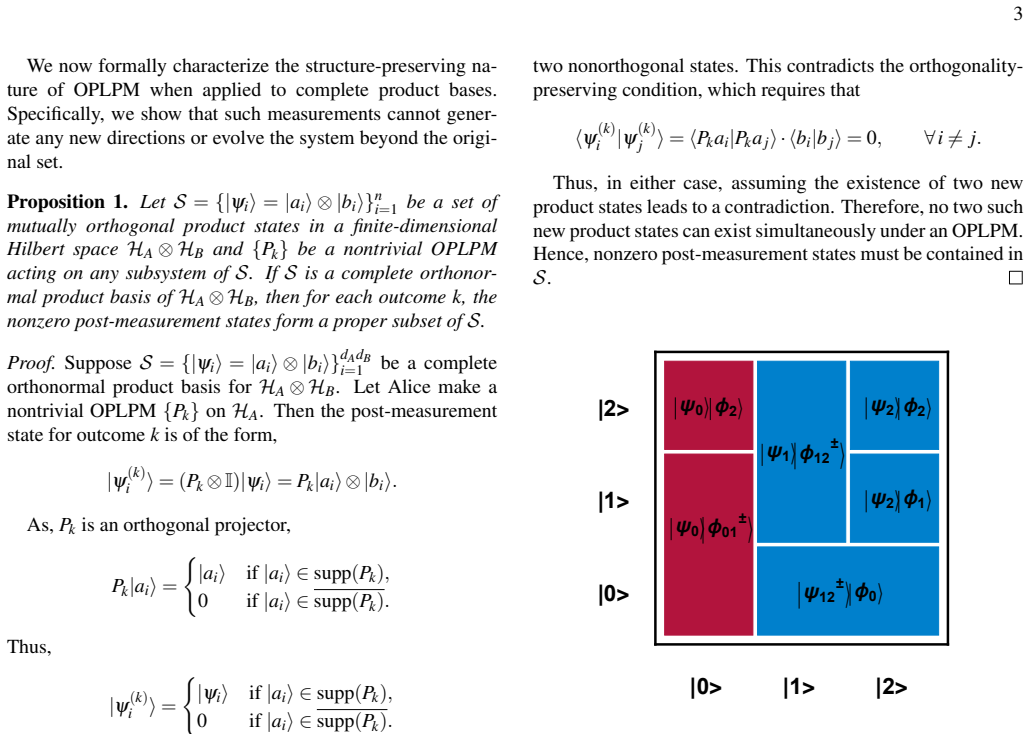
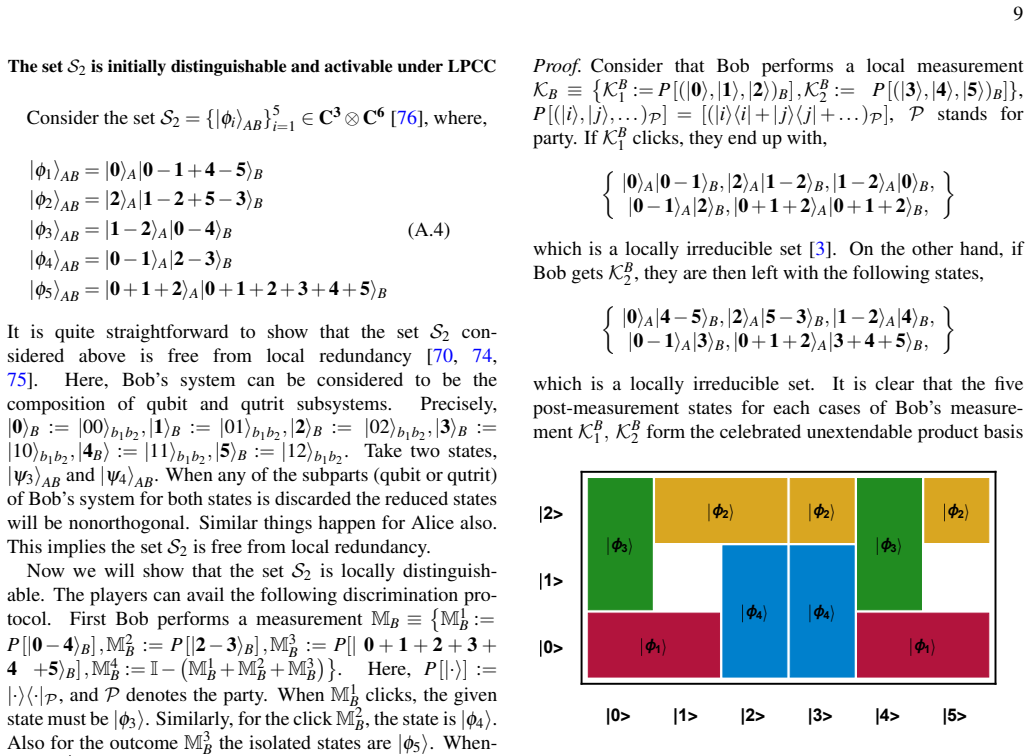
S. Halder and R. Sengupta, “Distinguishability classes, re- source sharing, and bound entanglement distribution,"Phys. Rev. A101, 012311 (2020). The setS 1 is initially distinguishable and not activable under LPCC Now, consider the setS 1 = {|φi⟩AB} ∈C 3 ⊗C 3 [41], by, S1 = |Ψ0⟩A|Φ± 01⟩B,|Ψ 0⟩A|Φ2⟩B,|Ψ ± 12⟩A|Φ0⟩B, |Ψ1⟩A|Φ± 12⟩B,|Ψ 2⟩A|Φ1⟩B,|Ψ 2⟩A|Φ2⟩B (A...
2020
discussion (0)
Sign in with ORCID, Apple, or X to comment. Anyone can read and Pith papers without signing in.