REVIEW 2 major objections 5 minor 123 references
People Are Not Just Their Countries. Disentangling Social Determinants of LLM Value Alignment Across Europe
T0 review · 2 major / 5 minor · reviewed 2026-08-10 · deepseek-v4-flash
Pith's one-line read Ten commercial LLMs align more closely with the stated values of Europe's richer, more educated, and more secular respondents, and a respondent's country of residence explains as much of the mismatch as all socio-demographics combined.
desk verdict Careful cross-national study of LLM value alignment by socio-demographics and country, but English-only prompting leaves a real confound that could explain part of the country and SES gradients. read the letter →
The pith
A machine-rendered reading of the paper's core claim, the machinery that carries it, and where it could break.
The reading
What carries the argument
The load-bearing object is the per-person, per-model alignment score $A_{p,m,q} = 1 - \frac{|a_{p,q} - a_{m,q}|}{|R_q|}$, which turns a Likert-scale answer into a normalized similarity between a survey respondent and a model's majority vote, averaged over questions to give $A_{p,m,\mathcal{Q}}$. This score is what lets the authors compare groups: for each socio-demographic group and country they compute the mean deviation from the population average across all models, and they verify the robustness of these deviations with bootstraps that include model-answer variation. Two further pieces of machinery carry the disentangling: inverse propensity weighting, which reweights each country's respondents so countries share a common socio-demographic distribution, and a variance-decomposition comparison of OLS regressions with gradient-boosted trees over country-only, socio-demographics-only, and combined covariate sets, which separates additive from interaction-driven contributions.
What would settle it
Re-run the ESS alignment protocol with the same ten models prompted in each country's main survey languages and recompute the group and country deviations; if the education-income-religion gradient and the Sweden-versus-Bulgaria gap shrink to near zero, the paper's central finding is a prompting-language artifact rather than a property of the models' value alignment.
Extended reading notes
Core claim
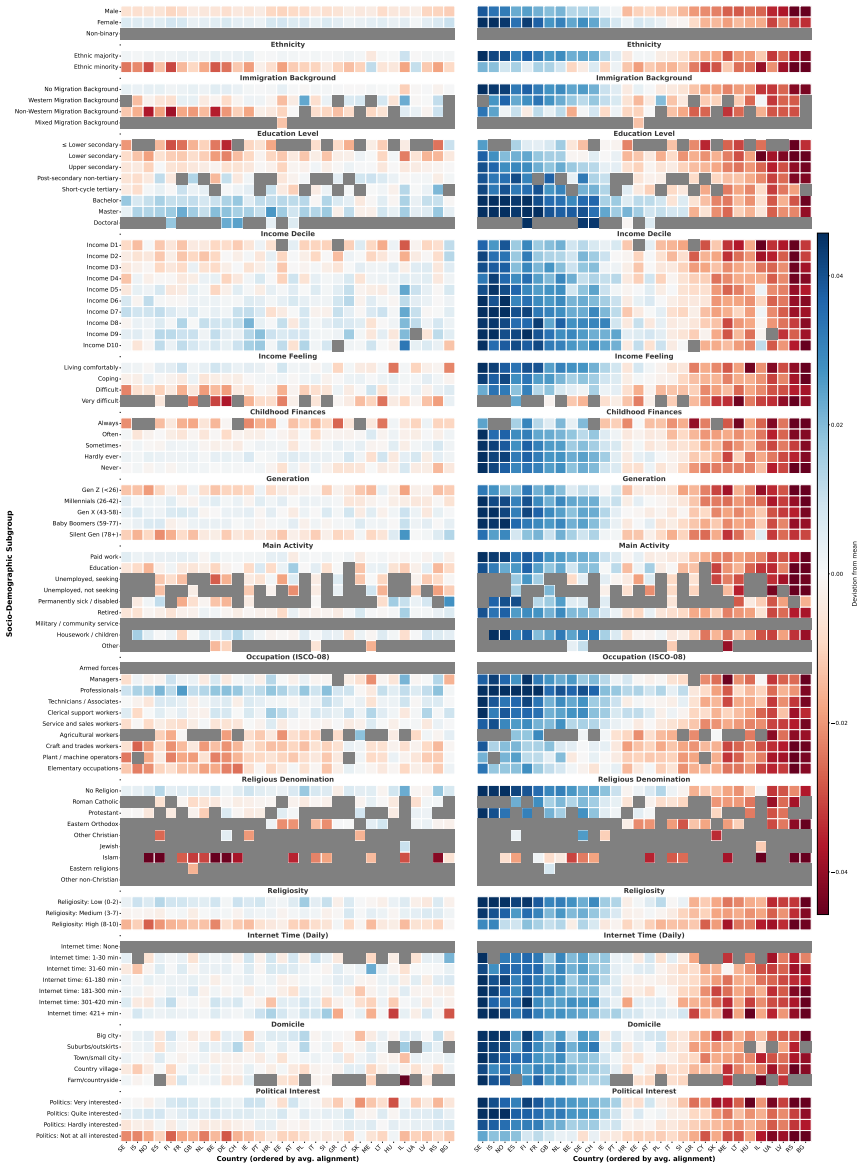
On the paper's own terms, the central discovery is that value alignment between LLMs and humans is structured by social stratification within countries, not only by national borders. Across ten commercially deployed models, the average deviation of a group's alignment from the population mean rises with educational level, income decile, subjective financial comfort, and occupational class, and it is sharply lower for Muslims, Eastern Orthodox respondents, the unemployed, and people with no interest in politics. At the individual level, a respondent's country alone explains between roughly 7% and 28% of the variance in alignment scores depending on the model, which is on par with or above the variance explained by the full set of socio-demographic variables, while the combination of the two explains up to 42.8%, pointing to complementarity. The authors also show that reweighting countries so that they share the same socio-demographic composition does not remove country differences, and that the relative weight of country versus socio-demographics depends on whether values are measured with broader opinion questions or with Schwartz's abstract Portrait Value Questionnaire items.
Load-bearing premise
The core comparison assumes that prompting every model in English, while humans answered in their own languages, does not systematically shift model answers in ways that create the observed country, education, income, and religion gaps.
Editorial extensions
If this is right
- Standard alignment evaluations that aggregate by country hide a systematic within-country skew: higher socio-economic status groups are better represented by commercial LLMs.
- Country of residence cannot be replaced by socio-demographics, or vice versa; both covariate sets are needed to predict individual alignment.
- Between-country differences in alignment are not an artifact of different demographic compositions, since inverse propensity weighting leaves the spread of country means largely unchanged.
- The question set defines the result: on broad value-laden opinion questions countries explain a large share of variance, whereas on Schwartz Portrait Value Questionnaire items the country share shrinks for most models, so alignment claims should state which notion of values they use.
- If LLMs continue to be used as general-purpose information and advice tools, the values of already advantaged groups will be reinforced.
Reading between the lines
- A testable extension left implicit by the English-only design is prompting the same models in each respondent's native language: if the education, income, and religion gradients shrink or vanish, the central finding is partly a language artifact.
- The same alignment-score machinery could be applied to regional surveys outside Europe, such as the Afrobarometer or Latinobarometro; a repeat of the high-socio-economic-status alignment gradient there would show the WEIRD-alignment pattern generalizes beyond Europe.
- Because the country-only and combined models are largely additive, intersectional interaction effects appear to add little beyond main effects, which suggests simple, transparent audit models could be sufficient for monitoring representativeness in production systems.
- Refusal rates differ sharply by model and by sensitive topic, so alignment scores on contested questions are partly measurements of what models are willing to state; a refusal-aware score would treat declined answers differently from explicit disagreement.
Editorial analysis
A structured set of objections, weighed in public.
Referee Report
Summary. The paper studies value alignment between 10 commercial LLMs and ESS Wave 11 respondents (50,116 people across 29 countries and Israel), using 47 value-laden survey questions. It constructs a per-person, per-model alignment score as a normalized Likert-distance to the model's majority-vote answer, then analyzes cross-model deviations by country and 15 socio-demographic variables. The main empirical contributions are: (i) group-level alignment gaps, especially by education, income, occupation, and religion; (ii) an inverse-propensity-weighting analysis suggesting that between-country alignment differences are not explained by socio-demographic composition; and (iii) a variance decomposition showing that country of residence alone explains roughly as much individual-level alignment variance as the full set of socio-demographics, with the two being complementary. The paper includes extensive appendices with bootstrap confidence intervals, a joint bootstrap over model answer variability, IPW balance checks, extremeness analyses, and train/test R^2 tables.
Significance. If the central findings are taken at face value, this is a valuable and timely contribution: it extends the 'WEIRD LLM' finding from country-level aggregates to actual socio-demographic groups within Europe, uses a fresh ESS wave rather than the potentially contaminated WVS, and provides a transparent, reproducible pipeline (code is public; bootstrap, IPW, and cross-validation details are documented). The measurement object is a descriptive alignment score with no fitted parameters, and the paper carefully separates sampling uncertainty from model-answer variability. The main weakness is that the entire comparison is made with English-only prompts, and the authors' response to this threat is an acknowledged limitation rather than a demonstrated invariance. Because the paper's strongest claims concern which European people and groups the LLMs 'represent', the language confound is load-bearing and needs either additional robustness evidence or a substantially softened interpretation.
major comments (2)
- [3.1, 5] The central comparison pairs English-prompted LLM answers ("Models are only prompted in English", §3.1) with human answers collected in each country's native language. If English prompts shift LLM stances toward Anglophone, higher-SES, secular value profiles, then the observed gradients in Figures 1, 2, and 4—higher alignment for more educated, richer, less religious, and Nordic/Central European respondents—could arise even for a model that is equally 'aligned' across groups in its native-language behavior. The invariance evidence cited in the Discussion (Davidov et al. 2008; Alemán and Woods 2016) concerns the human ESS/WVS instruments across languages; it does not establish that an English-prompted LLM's answer distribution is invariant to the respondent's linguistic or cultural context. This is a stated limitation, but it is not resolved. Concretely, the authors should either (a) prompt models in each country's language (or a representative subset of languages) and show that the cross-group and cross-country deviation patterns persist, or (b) measure the English-prompt versus native-prompt discrepancy for a subset of countries and bound its effect on the reported deviations. Without such evidence, the abstract's claim that LLMs are 'unequally aligned to the values of different socio-demographic groups' conflates value alignment with language-mediated response similarity.
- [3.1, 4.1, A.1] The restricted question set Q excludes 8 questions that at least one model refused to answer, and the excluded items are disproportionately 'controversial topics or specific institutions' (§3.1), with four coinciding with the highest human non-response rates. Because group differences on LGB tolerance, gender equality, and left-right placement are likely to be large, restricting to Q removes the very items on which education/income/religion alignment gaps might be strongest. Model refusal is itself a value-relevant behavior and discarding it may bias the measured alignment gradients toward convergence. The authors should report the main group-deviation and R^2 analyses on the maximal set of questions for models with low refusal rates (e.g., the DeepSeek/Mistral models that answer nearly all questions), or otherwise show that conclusions are stable to alternative refusal treatments. The joint bootstrap in Appendix A.5 only varies the question set within Q; it does not address the systematic exclusion of refused items.
minor comments (5)
- [Table 1] The caption uses O, Q, and Q̃ without defining them in the main text; the distinction between the full 53-item set and the restricted 45-item set should be stated where Table 1 is introduced.
- [§3.1] The text says '47 questions' while the appendix lists 53 items, with a parenthetical that 9 items belong to 3 conceptual questions. This is confusing on first reading; please state the 53/47 convention earlier and consistently.
- [Appendix A.1] The legend 'Green: Questions all LLMs answered (Q)set; underlined :Reduced PVQ setset' contains a typo and unclear formatting; the table would benefit from a cleaner visual encoding of Q and the PVQ subset.
- [§4.1] The paragraph on generations mentions a U-shape but the supporting text says it results from diverging model-specific patterns; this should be flagged directly in the figure discussion to avoid over-reading the aggregate pattern.
- [Appendix A.7] The IPW results are presented with clipping at 0.01 in the main text, while the drop-based robustness checks show non-trivial differences for individual countries (e.g., Israel). Please add a sentence in §4.2 explicitly interpreting this country-level instability for the claim that 'country differences remain after reweighting'.
Circularity Check
No significant circularity: the alignment metric is a parameter-free distance against external ESS data, and the variance decompositions are out-of-sample empirical measurements.
full rationale
The paper's derivation chain is self-contained against external data. The alignment score A_{p,m,q} = 1 - |a_{p,q}-a_{m,q}|/|R_q| is a parameter-free normalized distance, then averaged over questions; no parameter is fitted to the ESS responses. The group deviations d_{G,M,Q} are arithmetic summaries of these scores. The IPW reweighting, propensity score estimation, and OLS/XGBoost variance decomposition are all empirical measurements of those fixed scores against external ESS respondent attributes; the R2 values are out-of-sample via 10-fold cross-validation, so they are not fitted values renamed as predictions. The midpoint-model analysis in Appendix A.6 is an explicit artifact check rather than a fitted input. The measurement-invariance citations (Davidov et al. 2008; Alemán and Woods 2016) are external independent sources, not self-citations, and are used only to support comparability of the human survey, not to define any LLM quantity. The English-only prompting limitation is a genuine external-validity threat but does not make any central result equivalent to its inputs by construction. No circular step can be exhibited.
Assumptions & free parameters
free parameters (2)
- Propensity score clipping threshold =
0.01
- Question subset Q (restricted set) =
45 of 53 questions (8 excluded)
assumptions (4)
- domain assumption Equal spacing of Likert scale categories in alignment score
- domain assumption Cross-language and scalar measurement invariance of value questions
- domain assumption Majority vote over 20 calls summarizes the model's stance
- domain assumption Survey weights (pspwght) correct for non-response
Cite this review
Pith. "Pith review of People Are Not Just Their Countries. Disentangling Social Determinants of LLM Value Alignment Across Europe." pith.science (2026). https://pith.science/paper/THVIARTW
@misc{pith2026260807367,
  author       = {Pith},
  title        = {Pith review of: People Are Not Just Their Countries. Disentangling Social Determinants of LLM Value Alignment Across Europe},
  year         = {2026},
  howpublished = {\url{https://pith.science/paper/THVIARTW}},
  note         = {Machine review of arXiv:2608.07367}
}
read the original abstract
As Large Language Models (LLMs) are increasingly used as a primary source of information and advice, understanding their alignment to humans in terms of values becomes a pressing concern. A growing literature has leveraged large scale surveys to investigate to what extent LLMs' and humans' stated values and opinions align. With limited exceptions, studied populations have been defined country borders or cultural bounds. Yet, this focus neglects the role that socio-demographic divides may play for value alignment disparities. Relying on the European Social Survey, we address this knowledge gap by considering value alignment displayed with respect to 10 prominent commercial LLMs in terms of 15 socio-demographic variables as well as country of residence. Our analyses reveal that LLMs are indeed unequally aligned to the values of different socio-demographic groups, notably those defined by education, income, occupation and religion. When examining alignment at the individual level, a respondent's country, taken as a stand-alone variable, explains a substantial amount of variation that is on par with the full set of considered socio-demographics. Further disentangling the respective role of country-level and socio-demographic factors, we find they are complementary in explaining value alignment patterns, with their relative weights varying across the subset of questions considered.
Figures


Figures from the paper (18 more)




Reference graph
Works this paper leans on
-
[1]
International Conference on Machine Learning , pages=
Whose opinions do language models reflect? , author=. International Conference on Machine Learning , pages=. 2023 , organization=
2023
-
[2]
Chalkidis, Ilias and Brandl, Stephanie , month = mar, year =. Llama meets. doi:10.48550/arXiv.2403.13592 , abstract =
-
[3]
Ma, Bolei and Yoztyurk, Berk and Haensch, Anna-Carolina and Wang, Xinpeng and Herklotz, Markus and Kreuter, Frauke and Plank, Barbara and A enmacher, Matthias. Algorithmic Fidelity of Large Language Models in Generating Synthetic G erman Public Opinions: A Case Study. Proceedings of the 63rd Annual Meeting of the Association for Computational Linguistics....
-
[4]
Social Science Computer Review , author =
Vox. Social Science Computer Review , author =. 2025 , pages =. doi:10.1177/08944393251337014 , abstract =
-
[5]
Schäfer, Johannes and Combs, Aidan and Bagdon, Christopher and Li, Jiahui and Probol, Nadine and Greschner, Lynn and Papay, Sean and Resendiz, Yarik Menchaca and Velutharambath, Aswathy and Wührl, Amelie and Weber, Sabine and Klinger, Roman , month = may, year =. Which. doi:10.48550/arXiv.2410.08820 , abstract =
-
[6]
Proceedings of the AAAI Conference on Artificial Intelligence , volume=
On the alignment of large language models with global human opinion , author=. Proceedings of the AAAI Conference on Artificial Intelligence , volume=
-
[7]
Benchmarking
Ju, Chengyi and Shi, Weijie and Liu, Chengzhong and Ji, Jiaming and Zhang, Jipeng and Zhang, Ruiyuan and Xu, Jiajie and Yang, Yaodong and Han, Sirui and Guo, Yike , file =. Benchmarking
-
[8]
Weeber, Franziska and Ceron, Tanise and Padó, Sebastian , month = aug, year =. Do. doi:10.48550/arXiv.2508.05553 , abstract =
Show all 123 references
-
[9]
Sociodemographic
Sun, Huaman and Pei, Jiaxin and Choi, Minje and Jurgens, David , file =. Sociodemographic
- [10]
-
[11]
Proceedings of the Eighth AAAI/ACM Conference on AI, Ethics, and Society (AIES 2025) , year =
Batzner, Jan and Stocker, Volker and Schmid, Stefan and Kasneci, Gjergji , title =. Proceedings of the Eighth AAAI/ACM Conference on AI, Ethics, and Society (AIES 2025) , year =
2025
- [12]
-
[13]
Questioning the
Dominguez-Olmedo, Ricardo and Hardt, Moritz and Mendler-Dünner, Celestine , file =. Questioning the
- [14]
-
[15]
PNAS Nexus , author =
Cultural bias and cultural alignment of large language models , volume =. PNAS Nexus , author =. 2024 , keywords =. doi:10.1093/pnasnexus/pgae346 , abstract =
2024 doi
-
[16]
Investigating Cultural Alignment of Large Language Models
AlKhamissi, Badr and ElNokrashy, Muhammad and Alkhamissi, Mai and Diab, Mona. Investigating Cultural Alignment of Large Language Models. Proceedings of the 62nd Annual Meeting of the Association for Computational Linguistics. 2024. doi:10.18653/v1/2024.acl-long.671
2024 doi
- [17]
-
[18]
Randomness,
Khan, Ariba and Casper, Stephen and Hadfield-Menell, Dylan , month = jun, year =. Randomness,. Proceedings of the 2025. doi:10.1145/3715275.3732147 , abstract =
2025
-
[19]
Arora, Arnav and Kaffee, Lucie-Aimée and Augenstein, Isabelle , year =. Probing
-
[20]
Proceedings of the first workshop on cross-cultural considerations in NLP (C3NLP) , pages=
Assessing cross-cultural alignment between ChatGPT and human societies: An empirical study , author=. Proceedings of the first workshop on cross-cultural considerations in NLP (C3NLP) , pages=
- [21]
- [22]
-
[23]
and Ren, Richard and Phan, Long and Mu, Norman and Khoja, Adam and Zhang, Oliver and Hendrycks, Dan , month = feb, year =
Mazeika, Mantas and Yin, Xuwang and Tamirisa, Rishub and Lim, Jaehyuk and Lee, Bruce W. and Ren, Richard and Phan, Long and Mu, Norman and Khoja, Adam and Zhang, Oliver and Hendrycks, Dan , month = feb, year =. Utility. doi:10.48550/arXiv.2502.08640 , abstract =
- [24]
-
[25]
Are Large Language Models Consistent over Value-laden Questions?
Moore, Jared and Deshpande, Tanvi and Yang, Diyi. Are Large Language Models Consistent over Value-laden Questions?. Findings of the Association for Computational Linguistics: EMNLP 2024. 2024. doi:10.18653/v1/2024.findings-emnlp.891
2024 doi
-
[26]
and Kim, Hyunwoo and Santy, Sebastin and Sorensen, Taylor and Lin, Bill Yuchen and Dziri, Nouha and Ren, Xiang and Choi, Yejin , month = aug, year =
Li, Huihan and Jiang, Liwei and Hwang, Jena D. and Kim, Hyunwoo and Santy, Sebastin and Sorensen, Taylor and Lin, Bill Yuchen and Dziri, Nouha and Ren, Xiang and Choi, Yejin , month = aug, year =. doi:10.48550/arXiv.2404.10199 , abstract =
-
[27]
and Dave, Shachi and Prabhakaran, Vinodkumar and Dev, Sunipa
Jha, Akshita and Davani, Aida and Reddy, Chandan K. and Dave, Shachi and Prabhakaran, Vinodkumar and Dev, Sunipa. S ee GULL : A Stereotype Benchmark with Broad Geo-Cultural Coverage Leveraging Generative Models. Proceedings of the 61st Annual Meeting of the Association for Com...
2023 doi
-
[28]
Are Personalized Stochastic Parrots More Dangerous? Evaluating Persona Biases in Dialogue Systems
Wan, Yixin and Zhao, Jieyu and Chadha, Aman and Peng, Nanyun and Chang, Kai-Wei. Are Personalized Stochastic Parrots More Dangerous? Evaluating Persona Biases in Dialogue Systems. Findings of the Association for Computational Linguistics: EMNLP 2023. 2023. doi:10.18653/v1/2023...
2023 doi
-
[29]
Towards Measuring and Modeling ``Culture'' in LLM s: A Survey
Adilazuarda, Muhammad Farid and Mukherjee, Sagnik and Lavania, Pradhyumna and Singh, Siddhant Shivdutt and Aji, Alham Fikri and O ' Neill, Jacki and Modi, Ashutosh and Choudhury, Monojit. Towards Measuring and Modeling ``Culture'' in LLM s: A Survey. Proceedings of the 2024 Co...
2024 doi
-
[30]
Proceedings of the 2025 Conference on Empirical Methods in Natural Language Processing , pages=
Mind the Value-Action Gap: Do LLMs Act in Alignment with Their Values? , author=. Proceedings of the 2025 Conference on Empirical Methods in Natural Language Processing , pages=
2025
- [31]
- [32]
- [33]
- [34]
-
[35]
doi:10.48550/arXiv.2505.14422 , abstract =
Mao, Xutao and Tao, Ezra Xuanru and Wang, Leyao , month = nov, year =. doi:10.48550/arXiv.2505.14422 , abstract =
-
[36]
Beyond Probabilities: Unveiling the Misalignment in Evaluating Large Language Models
Lyu, Chenyang and Wu, Minghao and Aji, Alham. Beyond Probabilities: Unveiling the Misalignment in Evaluating Large Language Models. Proceedings of the 1st Workshop on Towards Knowledgeable Language Models (KnowLLM 2024). 2024. doi:10.18653/v1/2024.knowllm-1.10
2024 doi
-
[37]
Evaluating the
Scherrer, Nino and Shi, Claudia and Feder, Amir and Blei, David M , file =. Evaluating the
-
[38]
Proceedings of the AAAI Conference on Artificial Intelligence , author =
Value. Proceedings of the AAAI Conference on Artificial Intelligence , author =. 2024 , pages =. doi:10.1609/aaai.v38i18.29970 , abstract =
2024 doi
- [39]
- [40]
-
[41]
SSRN Electronic Journal , author =
The political ideology of conversational. SSRN Electronic Journal , author =. 2023 , file =. doi:10.2139/ssrn.4316084 , language =
2023 doi
-
[42]
Humanities and Social Sciences Communications , author =
“. Humanities and Social Sciences Communications , author =. 2025 , pages =. doi:10.1057/s41599-025-04465-z , abstract =
2025 doi
- [43]
- [44]
-
[45]
Proceedings of the 9th Widening NLP Workshop , pages=
ValueCompass: A framework for measuring contextual value alignment between human and LLMs , author=. Proceedings of the 9th Widening NLP Workshop , pages=
- [46]
- [47]
- [48]
-
[49]
Towards Identifying Social Bias in Dialog Systems: Framework, Dataset, and Benchmark
Zhou, Jingyan and Deng, Jiawen and Mi, Fei and Li, Yitong and Wang, Yasheng and Huang, Minlie and Jiang, Xin and Liu, Qun and Meng, Helen. Towards Identifying Social Bias in Dialog Systems: Framework, Dataset, and Benchmark. Findings of the Association for Computational Lingui...
2022 doi
-
[50]
Advances in Neural Information Processing Systems , volume=
The PRISM alignment dataset: What participatory, representative and individualised human feedback reveals about the subjective and multicultural alignment of large language models , author=. Advances in Neural Information Processing Systems , volume=
- [51]
- [52]
-
[53]
Sociological Methods & Research , author =
Machine. Sociological Methods & Research , author =. 2025 , pages =. doi:10.1177/00491241251330582 , abstract =
2025 doi
- [54]
-
[55]
Missing the
Sen, Indira and Lutz, Marlene and Rogers, Elisa and Garcia, David and Strohmaier, Markus , file =. Missing the
-
[56]
Feng, Shangbin and Park, Chan Young and Liu, Yuhan and Tsvetkov, Yulia , file =. From
-
[57]
Cultivating
Zhang, Lily Hong and Milli, Smitha and Jusko, Karen and Smith, Jonathan and Amos, Brandon and Bouaziz, Wassim and Revel, Manon and Kussman, Jack and Sheynin, Yasha and Titus, Lisa and Radharapu, Bhaktipriya and Yu, Jane and Sarma, Vidya and Rose, Kris and Nickel, Maximilian , ...
-
[58]
Journal of Cross-Cultural Psychology , author =
Whence. Journal of Cross-Cultural Psychology , author =. 2011 , pages =. doi:10.1177/0022022110381429 , abstract =
2011 doi
-
[59]
arXiv preprint arXiv:2411.10109 , volume=
Generative agent simulations of 1,000 people , author=. arXiv preprint arXiv:2411.10109 , volume=
-
[60]
Nature Machine Intelligence , volume=
The benefits, risks and bounds of personalizing the alignment of large language models to individuals , author=. Nature Machine Intelligence , volume=. 2024 , publisher=
2024
-
[61]
Humanities and Social Sciences Communications , author =
Why human–. Humanities and Social Sciences Communications , author =. 2025 , pages =. doi:10.1057/s41599-025-04532-5 , language =
2025 doi
-
[62]
and Plank, Barbara and Kreuter, Frauke
Ma, Bolei and Wang, Xinpeng and Hu, Tiancheng and Haensch, Anna-Carolina and Hedderich, Michael A. and Plank, Barbara and Kreuter, Frauke. The Potential and Challenges of Evaluating Attitudes, Opinions, and Values in Large Language Models. Findings of the Association for Compu...
2024 doi
- [63]
-
[64]
Kennedy, Molly and Parker, Ali and Liu, Yihong and Schütze, Hinrich , year =. Left,. doi:10.48550/ARXIV.2601.05835 , abstract =
-
[65]
Russo, Giuseppe and Nozza, Debora and Röttger, Paul and Hovy, Dirk , file =. The
-
[66]
Persona-driven
Kreutner, Maximilian and Lutz, Marlene and Strohmaier, Markus , file =. Persona-driven
-
[67]
Nadeem, Afrozah and Seth, Agrima and Nasim, Mehwish and Naseem, Usman , month = feb, year =. Bias. doi:10.48550/arXiv.2601.23001 , abstract =
-
[68]
Shetty, Anudeex and Naseem, Usman and Aletras, Nikolaos and Dras, Mark and Ji, Heng and Nakov, Preslav , month = mar, year =. Towards. doi:10.20944/preprints202603.1876.v1 , language =
- [69]
-
[70]
Cultural
Liemt, Erin van and Shelby, Renee and Smart, Andrew and Kumbale, Sinchana and Zhang, Richard and Dixit, Neha and Rashid, Qazi Mamunur and Smith-Loud, Jamila , month = mar, year =. Cultural. doi:10.48550/arXiv.2603.05723 , abstract =
-
[71]
Operationalizing
Ali, Dalia and Zhao, Dora and Koenecke, Allison and Papakyriakopoulos, Orestis , file =. Operationalizing
-
[72]
Proceedings of the AAAI Conference on Artificial Intelligence , volume=
AlignSurvey: A Comprehensive Benchmark for Human Preferences Alignment in Social Surveys , author=. Proceedings of the AAAI Conference on Artificial Intelligence , volume=
-
[73]
Zhao, Weixiang and Li, Haozhen and Zhao, Yanyan and Liu, Haixiao and Li, Biye and Liu, Ting and Qin, Bing , file =
-
[74]
Rethinking
AlKhamissi, Mai and Xiao, Yunze and AlKhamissi, Badr and Diab, Mona , file =. Rethinking
-
[75]
Pan, Weihang and Yu, Zhengxu , file =
-
[76]
Proceedings of the 2026
Yun, Bhada and Su, Renn and Wang, April Yi , month = apr, year =. Proceedings of the 2026. doi:10.1145/3772318.3790566 , abstract =
2026
-
[77]
AI and Ethics , author =
Towards friendly. AI and Ethics , author =. 2026 , pages =. doi:10.1007/s43681-026-01070-x , abstract =
2026 doi
-
[78]
Jiang, Liwei and Sorensen, Taylor and Levine, Sydney and Choi, Yejin , file =. Can
-
[79]
Guan, Jian and Wu, Junfei and Li, Jia-Nan and Cheng, Chuanqi and Wu, Wei , file =. A
-
[80]
Mihalcea, Rada and Ignat, Oana and Bai, Longju and Borah, Angana and Chiruzzo, Luis and Jin, Zhijing and Kwizera, Claude and Nwatu, Joan and Poria, Soujanya and Solorio, Thamar , booktitle=. Why
-
[81]
Language
Suh, Joseph and Jahanparast, Erfan and Moon, Suhong and Kang, Minwoo and Chang, Serina , file =. Language
-
[82]
Orlikowski, Matthias and Pei, Jiaxin and Röttger, Paul and Cimiano, Philipp and Jurgens, David and Hovy, Dirk , file =. Beyond
-
[83]
Analyze the
Fedzechkina, Masha and Gualdoni, Eleonora and Williamson, Sinead and Metcalf, Katherine and Seto, Skyler and Theobald, Barry-John , file =. Analyze the
-
[84]
Steering into
Sundar, Anirudh and Williamson, Sinead and Metcalf, Katherine and Theobald, Barry-John and Seto, Skyler and Fedzechkina, Masha , file =. Steering into
-
[85]
Information Processing & Management , author =
Towards realistic evaluation of cultural value alignment in large language models:. Information Processing & Management , author =. 2025 , pages =. doi:10.1016/j.ipm.2025.104099 , language =
2025
-
[86]
Bulte, Bram and Terryn, Ayla Rigouts , file =
-
[87]
LLM Tropes: Revealing Fine-Grained Values and Opinions in Large Language Models
Wright, Dustin and Arora, Arnav and Borenstein, Nadav and Yadav, Srishti and Belongie, Serge and Augenstein, Isabelle. LLM Tropes: Revealing Fine-Grained Values and Opinions in Large Language Models. Findings of the Association for Computational Linguistics: EMNLP 2024. 2024. ...
2024 doi
-
[88]
Journal of Cross-Cultural Psychology , author =
The. Journal of Cross-Cultural Psychology , author =. 2011 , pages =. doi:10.1177/0022022110362757 , abstract =
2011 doi
- [89]
-
[90]
Benchmarking Distributional Alignment of Large Language Models
Meister, Nicole and Guestrin, Carlos and Hashimoto, Tatsunori. Benchmarking Distributional Alignment of Large Language Models. Proceedings of the 2025 Conference of the Nations of the Americas Chapter of the Association for Computational Linguistics: Human Language Technologie...
2025 doi
-
[91]
Comparative Political Studies , author =
Value. Comparative Political Studies , author =. 2016 , pages =. doi:10.1177/0010414015600458 , abstract =
2016 doi
-
[92]
Journal of Cross-Cultural Psychology , author =
Clashing. Journal of Cross-Cultural Psychology , author =. 2020 , pages =. doi:10.1177/0022022120956716 , abstract =
2020 doi
- [93]
-
[94]
Social Sciences & Humanities Open , author =
Do demographic predictors of personal values vary by context?. Social Sciences & Humanities Open , author =. 2022 , pages =. doi:10.1016/j.ssaho.2022.100264 , abstract =
2022
-
[95]
Journal of Cross-Cultural Psychology , author =
Sociodemographic. Journal of Cross-Cultural Psychology , author =. 2014 , pages =. doi:10.1177/0022022113513402 , abstract =
2014 doi
-
[96]
Public Opinion Quarterly , author =
Bringing. Public Opinion Quarterly , author =. 2008 , pages =. doi:10.1093/poq/nfn035 , language =
2008 doi
-
[97]
Behaviour & Information Technology , author =
Challenges and future directions for integration of large language models into socio-technical systems , issn =. Behaviour & Information Technology , author =. 2024 , pages =. doi:10.1080/0144929X.2024.2431068 , abstract =
2024
-
[98]
Proceedings of the National Academy of Sciences , author =
The simulation of judgment in. Proceedings of the National Academy of Sciences , author =. 2025 , pages =. doi:10.1073/pnas.2518443122 , abstract =
2025 doi
-
[99]
States of knowledge , pages=
Ordering knowledge, ordering society , author=. States of knowledge , pages=. 2004 , publisher=
2004
-
[100]
2025 , howpublished =
2025
-
[101]
Biometrika , volume=
The central role of the propensity score in observational studies for causal effects , author=. Biometrika , volume=. 1983 , publisher=
1983
-
[102]
Proceedings of the 22nd ACM SIGKDD International Conference on Knowledge Discovery and Data Mining , pages=
Xgboost: A scalable tree boosting system , author=. Proceedings of the 22nd ACM SIGKDD International Conference on Knowledge Discovery and Data Mining , pages=
-
[103]
Dolata, Mateusz and Feuerriegel, Stefan and Schwabe, Gerhard , journal=. A. 2022 , publisher=
2022
-
[104]
Fairness and
Selbst, Andrew D and Boyd, Danah and Friedler, Sorelle A and Venkatasubramanian, Suresh and Vertesi, Janet , booktitle=. Fairness and
-
[105]
Journal of communication , volume=
Users as research inventions: How research categories perpetuate inequities , author=. Journal of communication , volume=. 1989 , publisher=
1989
-
[106]
Systems Research and Behavioral Science , volume =
Kroes, Peter and Franssen, Maarten and Poel, Ibo van de and Ottens, Maarten , title =. Systems Research and Behavioral Science , volume =. doi:https://doi.org/10.1002/sres.703 , url =. https://onlinelibrary.wiley.com/doi/pdf/10.1002/sres.703 , year =
-
[107]
Language Model Alignment in Multilingual Trolley Problems , url =
Jin, Zhijing and Kleiman-Weiner, Max and Piatti, Giorgio and Levine, Sydney and Liu, Jiarui and Gonzalez Adauto, Fernando and Ortu, Francesco and Strausz, Andr\'. Language Model Alignment in Multilingual Trolley Problems , url =. International Conference on Learning Representa...
-
[108]
On the algorithmic bias of aligning large language models with
Xiao, Jiancong and Li, Ziniu and Xie, Xingyu and Getzen, Emily and Fang, Cong and Long, Qi and Su, Weijie J , journal=. On the algorithmic bias of aligning large language models with. 2025 , publisher=
2025
-
[109]
European Journal of Political Research , volume=
The theory of human development: A cross-cultural analysis , author=. European Journal of Political Research , volume=. 2003 , publisher=
2003
-
[110]
2005 , publisher=
Modernization, Cultural Change, and Democracy: The Human Development Sequence , author=. 2005 , publisher=
2005
-
[111]
Advances in Experimental Social Psychology , volume=
Universals in the content and structure of values: Theoretical advances and empirical tests in 20 countries , author=. Advances in Experimental Social Psychology , volume=. 1992 , publisher=
1992
-
[112]
1980 , address =
Hofstede, Geert , title =. 1980 , address =
1980
-
[113]
, author=
Age and gender differences in human values: A 20-nation study. , author=. Psychology and aging , volume=. 2020 , publisher=
2020
-
[114]
Comparative Political Studies , volume=
Misconceptions of measurement equivalence: Time for a paradigm shift , author=. Comparative Political Studies , volume=. 2016 , publisher=
2016
-
[115]
Friedman , journal =
Jerome H. Friedman , journal =. Greedy Function Approximation: A Gradient Boosting Machine , urldate =
-
[116]
Missing the Margins : A Systematic Literature Review on the Demographic Representativeness of LLM s
Sen, Indira and Lutz, Marlene and Rogers, Elisa and Garcia, David and Strohmaier, Markus. Missing the Margins : A Systematic Literature Review on the Demographic Representativeness of LLM s. Findings of the Association for Computational Linguistics: ACL 2025. 2025. doi:10.1865...
2025 doi
-
[117]
arXiv preprint arXiv:2404.08382 , year=
Look at the text: Instruction-tuned language models are more robust multiple choice selectors than you think , author=. arXiv preprint arXiv:2404.08382 , year=
-
[118]
nationology
On “nationology”: The gravitational field of national culture , author=. Journal of Cross-Cultural Psychology , volume=. 2021 , publisher=
2021
-
[119]
Rethinking
Xu, Yingwei Wayne and Chi, Christina G and Gursoy, Dogan and Cai, Ruiying Raine , journal=. Rethinking. 2025 , publisher=
2025
-
[120]
Be friendly, not friends: How
Sun, Yuan and Wang, Ting , booktitle=. Be friendly, not friends: How
-
[121]
Frontiers in Psychology , volume=
Outsourcing cognition: the psychological costs of AI-era convenience , author=. Frontiers in Psychology , volume=. 2025 , publisher=
2025
-
[122]
AJOB neuroscience , volume=
Anthropomorphism in AI , author=. AJOB neuroscience , volume=. 2020 , publisher=
2020
-
[123]
AI and Ethics , volume=
Anthropomorphism in AI: hype and fallacy , author=. AI and Ethics , volume=. 2024 , publisher=
2024
Reviewed August 10, 2026 · model on record in the stance chip above.
Discussion (0). Continue with ORCID to comment.