Geometric Prototype Learning in Quantum Hilbert Space with Matrix Product States
Pith reviewed 2026-05-20 11:39 UTC · model grok-4.3
The pith
Class prototypes encoded as matrix product states in quantum Hilbert space allow geometric measures to handle classification and clustering.
A machine-rendered reading of the paper's core claim, the machinery that carries it, and where it could break.
Core claim
By representing class prototypes as generative matrix product states in Hilbert space, the method performs prototype learning tasks through quantum geometric measures, lifting the approach from classical feature space and achieving superior performance on benchmark datasets compared to classical prototypes.
What carries the argument
Generative matrix product states as quantum prototypes that reside in the same Hilbert space as encoded data, permitting direct geometric similarity computations for machine learning tasks.
If this is right
- The quantum prototype method outperforms classical prototype approaches on Fashion-MNIST and electrocardiogram data.
- It competes effectively with standard black-box neural networks.
- An attraction effect is observed due to the quantum-probabilistic nature of the prototypes.
- A dimensionality-reduction scheme can be derived from distances between prototypes.
Where Pith is reading between the lines
- This framework could extend prototype learning to other quantum-inspired tasks by making geometric interpretations a source of built-in explainability.
- The attraction effect might be tested for its role in stabilizing clusters when scaling to larger or noisier datasets.
- Combining the approach with alternative quantum encodings could minimize information loss in high-dimensional inputs.
Load-bearing premise
That representing data and prototypes as matrix product states in Hilbert space preserves enough information for geometric measures to accurately reflect similarities for classification and clustering.
What would settle it
If benchmarks on additional datasets show the quantum prototype approach fails to outperform or match classical prototypes in accuracy, the claim that Hilbert space geometry captures necessary similarities would be challenged.
Figures
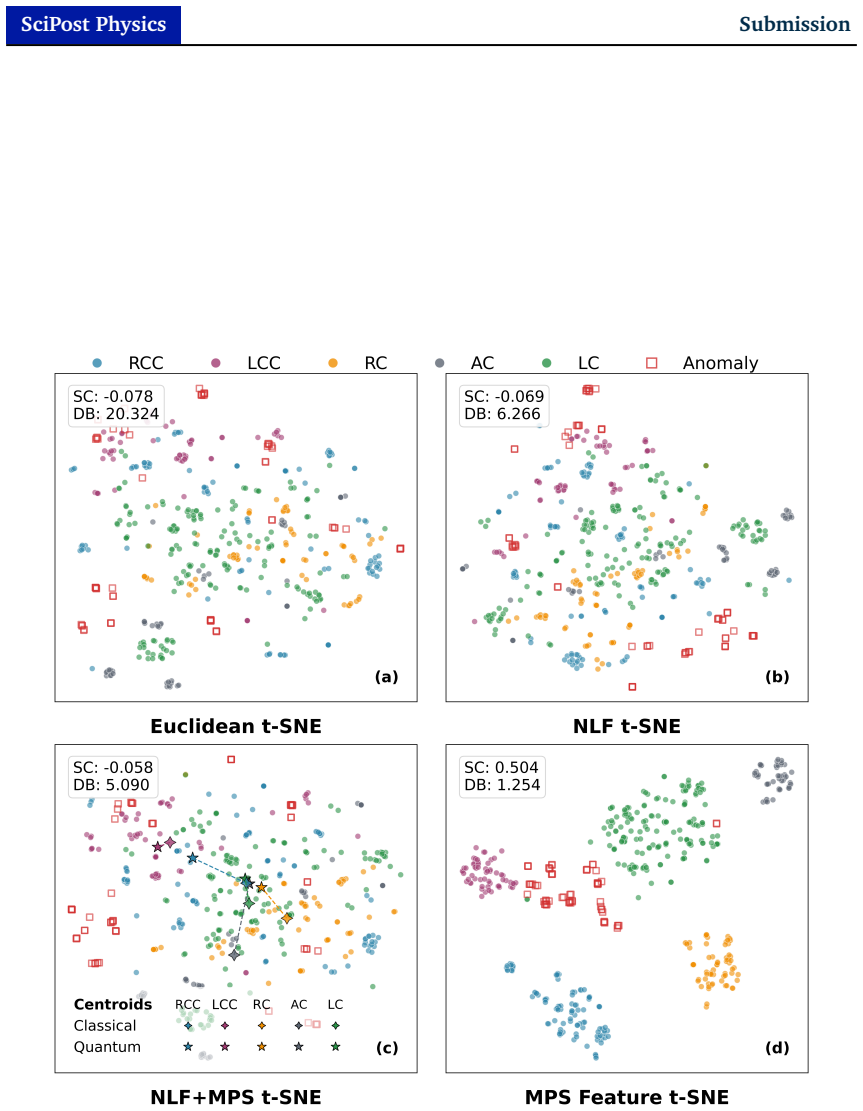
read the original abstract
Quantum probability provides a novel framework for formulating machine-learning (ML) problems in Hilbert space. We introduce a prototype-based learning scheme where class representatives are encoded as generative matrix product states (MPS). Because these prototypes reside in the same Hilbert space as quantum-encoded data samples, various ML tasks such as classification and clustering can be performed through geometric measures of quantum states. This approach lifts prototype learning from classical feature space to quantum Hilbert space. Benchmarks on Fashion-MNIST and a real-world electrocardiogram dataset demonstrate that our method outperforms classical prototype approaches while remaining competitive with standard black-box neural networks. We also identify an ``attraction'' effect induced by the quantum-probabilistic prototypes and introduce a dimensionality-reduction scheme based on prototype distances. Our results establish quantum states as an explainable framework for prototype learning, opening new directions for designing ML algorithms in quantum Hilbert space.
Editorial analysis
A structured set of objections, weighed in public.
Referee Report
Summary. The paper introduces a prototype-based learning framework in which both data samples and class prototypes are encoded as generative matrix product states (MPS) residing in quantum Hilbert space. Classification and clustering are performed using geometric measures such as fidelity or Hilbert-space distances between these quantum states. The approach is benchmarked on Fashion-MNIST and a real-world electrocardiogram dataset, with claims that it outperforms classical prototype methods while remaining competitive with standard neural networks. The manuscript also identifies an 'attraction' effect induced by the quantum-probabilistic prototypes and proposes a dimensionality-reduction scheme based on prototype distances.
Significance. If the empirical gains are shown to arise specifically from the Hilbert-space geometry rather than from the MPS encoding choice alone, the work could establish a new explainable paradigm for prototype learning that leverages quantum probability. The MPS representation offers a scalable route to high-dimensional data, and the explicit geometric formulation may aid interpretability. However, the significance is tempered by the need for stronger controls demonstrating that the quantum measures, rather than the generative encoding, drive the reported advantages.
major comments (3)
- [§4] §4 (Experimental results on Fashion-MNIST): the reported outperformance over classical prototypes is not accompanied by an ablation that applies the same MPS encoding to data but then uses classical distances instead of Hilbert-space fidelity; without this control it is impossible to attribute gains to the quantum geometry rather than the encoding step itself.
- [Methods] Methods (MPS construction and bond dimension): the bond dimension and truncation scheme for the generative MPS are not varied or reported with error bars across runs; for Fashion-MNIST and ECG data, which contain complex local correlations, a fixed low bond dimension risks discarding discriminative features, directly challenging the central assumption that the Hilbert-space representation preserves the similarities needed for accurate classification.
- [§5] §5 (attraction effect): the claimed 'attraction' effect is presented as a qualitative observation without a quantitative metric or derivation showing how it emerges from the MPS inner-product geometry; this weakens the explainability contribution that is positioned as a key advantage of the framework.
minor comments (2)
- [Abstract] Abstract: numerical performance values, error bars, and dataset sizes are omitted, making it harder for readers to gauge the scale of the claimed improvements at first reading.
- [Figures] Figure captions: several figures lack explicit labels for bond dimension, training epochs, or the precise geometric measure (fidelity vs. trace distance) used in each panel.
Simulated Author's Rebuttal
We thank the referee for their constructive review of our manuscript. We respond to each major comment below, indicating where we agree and will revise the paper accordingly.
read point-by-point responses
-
Referee: [§4] §4 (Experimental results on Fashion-MNIST): the reported outperformance over classical prototypes is not accompanied by an ablation that applies the same MPS encoding to data but then uses classical distances instead of Hilbert-space fidelity; without this control it is impossible to attribute gains to the quantum geometry rather than the encoding step itself.
Authors: We concur that an ablation study isolating the role of Hilbert-space geometry is essential. In the revised manuscript, we will add experiments using the same MPS-encoded data but with classical distance measures (such as Euclidean distance on the tensor parameters or vectorized representations) to demonstrate that the performance gains stem from the quantum geometric measures. revision: yes
-
Referee: [Methods] Methods (MPS construction and bond dimension): the bond dimension and truncation scheme for the generative MPS are not varied or reported with error bars across runs; for Fashion-MNIST and ECG data, which contain complex local correlations, a fixed low bond dimension risks discarding discriminative features, directly challenging the central assumption that the Hilbert-space representation preserves the similarities needed for accurate classification.
Authors: We appreciate this point regarding the sensitivity to bond dimension. Although a fixed bond dimension was selected for computational efficiency after initial tuning, we will include additional results varying the bond dimension and report mean performance with standard error bars over multiple runs in the revised version to confirm robustness. revision: yes
-
Referee: [§5] §5 (attraction effect): the claimed 'attraction' effect is presented as a qualitative observation without a quantitative metric or derivation showing how it emerges from the MPS inner-product geometry; this weakens the explainability contribution that is positioned as a key advantage of the framework.
Authors: The attraction effect is indeed presented as an empirical observation in the current manuscript. To enhance the quantitative support, we will add a metric quantifying the attraction based on changes in prototype-data fidelities and provide a brief derivation linking it to the inner-product structure of the MPS in the revised manuscript. revision: yes
Circularity Check
No circularity in derivation chain; claims rest on external benchmarks
full rationale
The paper presents an empirical method for prototype learning by encoding data and prototypes as generative MPS in Hilbert space, then applies geometric measures for classification and clustering. Performance is demonstrated via direct comparisons on Fashion-MNIST and ECG datasets against classical prototypes and neural networks. No equations, fitted parameters, or predictions are described that reduce by construction to the inputs, and no load-bearing self-citations or uniqueness theorems are invoked in the abstract or summary. The central claims are supported by external benchmark results rather than tautological redefinitions or ansatzes.
Axiom & Free-Parameter Ledger
Lean theorems connected to this paper
-
IndisputableMonolith/Cost/FunctionalEquation.leanwashburn_uniqueness_aczel unclear?
unclearRelation between the paper passage and the cited Recognition theorem.
We introduce a prototype-based learning scheme where class representatives are encoded as generative matrix product states (MPS). ... classification and clustering can be performed through geometric measures of quantum states.
What do these tags mean?
- matches
- The paper's claim is directly supported by a theorem in the formal canon.
- supports
- The theorem supports part of the paper's argument, but the paper may add assumptions or extra steps.
- extends
- The paper goes beyond the formal theorem; the theorem is a base layer rather than the whole result.
- uses
- The paper appears to rely on the theorem as machinery.
- contradicts
- The paper's claim conflicts with a theorem or certificate in the canon.
- unclear
- Pith found a possible connection, but the passage is too broad, indirect, or ambiguous to say the theorem truly supports the claim.
Reference graph
Works this paper leans on
-
[1]
H. A. Bethe, Zur Theorie der Metalle. i. Eigenwerte und Eigenfunktionen der linearen Atomkette , Zeit. f \"u r Phys. 71 , 205 (1931), 10.1007\
work page 1931
-
[2]
It was twenty years ago today ...
P. Ginsparg, It was twenty years ago today... , http://arxiv.org/abs/1108.2700
work page internal anchor Pith review Pith/arXiv arXiv
-
[3]
and Strydis, Christos and Hamdioui, Said and Bishnoi, Rajendra , journal=
Diware, Sumit and Dash, Sudeshna and Gebregiorgis, Anteneh and Joshi, Rajiv V. and Strydis, Christos and Hamdioui, Said and Bishnoi, Rajendra , journal=. Severity-Based Hierarchical ECG Classification Using Neural Networks , year=
-
[4]
and Heidarysafa, Mojtaba and Jafari Meimandi, Kiana and Gerber, Matthew S
Kowsari, Kamran and Brown, Donald E. and Heidarysafa, Mojtaba and Jafari Meimandi, Kiana and Gerber, Matthew S. and Barnes, Laura E. , booktitle=. HDLTex: Hierarchical Deep Learning for Text Classification , year=
-
[5]
Computer Science Review , volume=
Deep anomaly detection for time series: A survey , author=. Computer Science Review , volume=. 2025 , publisher=
work page 2025
-
[6]
Quantum machine learning for quantum anomaly detection , author =. Phys. Rev. A , volume =. 2018 , month =. doi:10.1103/PhysRevA.97.042315 , url =
-
[7]
Anomaly detection with tensor networks, 2020
Anomaly detection with tensor networks , author=. arXiv preprint arXiv:2006.02516 , year=
-
[8]
Journal of machine learning research , volume=
Visualizing data using t-SNE , author=. Journal of machine learning research , volume=. 2008 , eprint =
work page 2008
-
[9]
Fashion-MNIST: a Novel Image Dataset for Benchmarking Machine Learning Algorithms
Han Xiao and Kashif Rasul and Roland Vollgraf , title =. CoRR , volume =. 2017 , url =. 1708.07747 , timestamp =
work page internal anchor Pith review Pith/arXiv arXiv 2017
-
[10]
Intelligent Computing , volume =
Sheng-Chen Bai and Kun Zhang and Shi-Ju Ran , title =. Intelligent Computing , volume =. 2026 , doi =
work page 2026
-
[11]
A rigorous and robust quantum speed-up in supervised machine learning , author=. Nature physics , volume=. 2021 , publisher=
work page 2021
-
[12]
Quantum machine learning applications in the biomedical domain: A systematic review , author=. IEEE Access , volume=. 2022 , publisher=
work page 2022
-
[13]
Quantum advantage in learning from experiments , author=. Science , volume=. 2022 , publisher=
work page 2022
-
[14]
Supervised learning with quantum-enhanced feature spaces , author=. Nature , volume=. 2019 , publisher=
work page 2019
-
[15]
Communications of the ACM , volume=
ImageNet classification with deep convolutional neural networks , author=. Communications of the ACM , volume=. 2017 , publisher=
work page 2017
-
[16]
BERT : Pre-training of Deep Bidirectional Transformers for Language Understanding
BERT: Pre-training of Deep Bidirectional Transformers for Language Understanding , author =. Proceedings of the 2019 Conference of the North. 2019 , address =. doi:10.18653/v1/N19-1423 , pages =
-
[17]
Dermatologist-level classification of skin cancer with deep neural networks , author=. nature , volume=. 2017 , publisher=
work page 2017
-
[18]
Gulshan, Varun and Peng, Lily and Coram, Marc and Stumpe, Martin C. and Wu, Derek and Narayanaswamy, Arunachalam and Venugopalan, Subhashini and Widner, Kasumi and Madams, Tom and Cuadros, Jorge and Kim, Ramasamy and Raman, Rajiv and Nelson, Philip C. and Mega, Jessica L. and Webster, Dale R. , title =. JAMA , volume =. 2016 , month =. doi:10.1001/jama.20...
- [19]
-
[20]
Nature machine intelligence , volume=
Stop explaining black box machine learning models for high stakes decisions and use interpretable models instead , author=. Nature machine intelligence , volume=. 2019 , publisher=
work page 2019
-
[21]
Quantum machine learning , author=. Nature , volume=. 2017 , publisher=
work page 2017
-
[22]
Quantum principal component analysis , author=. Nature physics , volume=. 2014 , publisher=
work page 2014
-
[23]
Supervised Learning with Tensor Networks , eprint =
Stoudenmire, Edwin and Schwab, David J , booktitle =. Supervised Learning with Tensor Networks , eprint =
-
[24]
Matrix product states, projected entangled pair states, and variational renormalization group methods for quantum spin systems , author=. Advances in physics , volume=. 2008 , publisher=
work page 2008
- [25]
-
[26]
Intelligent Computing , volume=
Tensor networks for interpretable and efficient quantum-inspired machine learning , author=. Intelligent Computing , volume=. 2023 , publisher=
work page 2023
-
[27]
Schollw \"o ck ,\ 10.1016/j.aop.2010.09.012 journal journal Ann
The density-matrix renormalization group in the age of matrix product states , journal =. 2011 , note =. doi:https://doi.org/10.1016/j.aop.2010.09.012 , url =
-
[28]
Unsupervised Generative Modeling Using Matrix Product States , author =. Phys. Rev. X , volume =. 2018 , month =. doi:10.1103/PhysRevX.8.031012 , url =
-
[29]
Matrix Product State Representations
Matrix product state representations , author=. arXiv preprint quant-ph/0608197 , year=
work page internal anchor Pith review Pith/arXiv arXiv
-
[30]
Expressive power of tensor-network factorizations for probabilistic modeling , eprint =
Glasser, Ivan and Sweke, Ryan and Pancotti, Nicola and Eisert, Jens and Cirac, Ignacio , booktitle =. Expressive power of tensor-network factorizations for probabilistic modeling , eprint =
-
[31]
Long Short-Term Memory , year=
Hochreiter, Sepp and Schmidhuber, Jürgen , journal=. Long Short-Term Memory , year=
-
[32]
Nature communications , volume=
Power of data in quantum machine learning , author=. Nature communications , volume=. 2021 , publisher=
work page 2021
-
[33]
Generative tensor network classification model for supervised machine learning , author =. Phys. Rev. B , volume =. 2020 , month =. doi:10.1103/PhysRevB.101.075135 , eprint =
-
[34]
Tensor network contractions: methods and applications to quantum many-body systems , author=. 2020 , publisher=. doi:10.1007/978-3-030-34489-4 , eprint =
-
[35]
Philip de Chazal and O'Dwyer, M. and Reilly, R.B. , journal=. Automatic classification of heartbeats using ECG morphology and heartbeat interval features , year=
- [36]
-
[37]
Luz and William Robson Schwartz and Guillermo Cámara-Chávez and David Menotti , keywords =
Eduardo José da S. Luz and William Robson Schwartz and Guillermo Cámara-Chávez and David Menotti , keywords =. ECG-based heartbeat classification for arrhythmia detection: A survey , journal =. 2016 , issn =. doi:https://doi.org/10.1016/j.cmpb.2015.12.008 , eprint =
-
[38]
Ramaswamy, Sridhar and Rastogi, Rajeev and Shim, Kyuseok , title =. 2000 , isbn =. https://doi.org/10.1145/342009.335437 , doi =
-
[39]
Visualizing quantum phases and identifying quantum phase transitions by nonlinear dimensional reduction , author =. Phys. Rev. B , volume =. 2021 , month =. doi:10.1103/PhysRevB.103.075106 , eprint =
-
[40]
Silhouettes: A graphical aid to the interpretation and validation of cluster analysis , journal =. 1987 , issn =. doi:https://doi.org/10.1016/0377-0427(87)90125-7 , eprint =
-
[41]
Davies, David L. and Bouldin, Donald W. , journal=. A Cluster Separation Measure , year=
discussion (0)
Sign in with ORCID, Apple, or X to comment. Anyone can read and Pith papers without signing in.