Endpoint Control of Thermodynamic Topological Classes for Fixed Charge texorpdfstring{d}{d}-dimensional Reissner--Nordstr\"om Black Holes in a Cavity
Pith reviewed 2026-06-26 03:24 UTC · model grok-4.3
The pith
For fixed-charge RN black holes in a cavity, electric charge and outer boundary set the thermodynamic topological class, not spacetime dimension.
A machine-rendered reading of the paper's core claim, the machinery that carries it, and where it could break.
Core claim
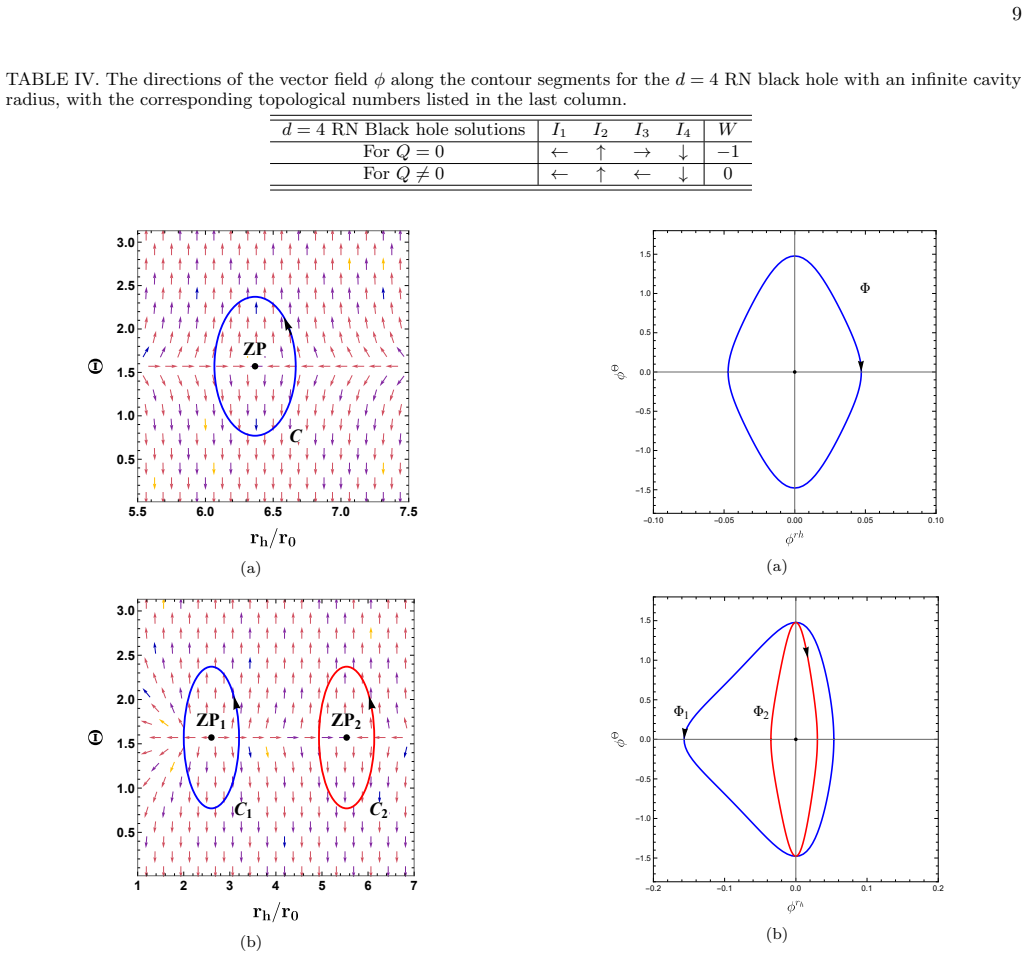
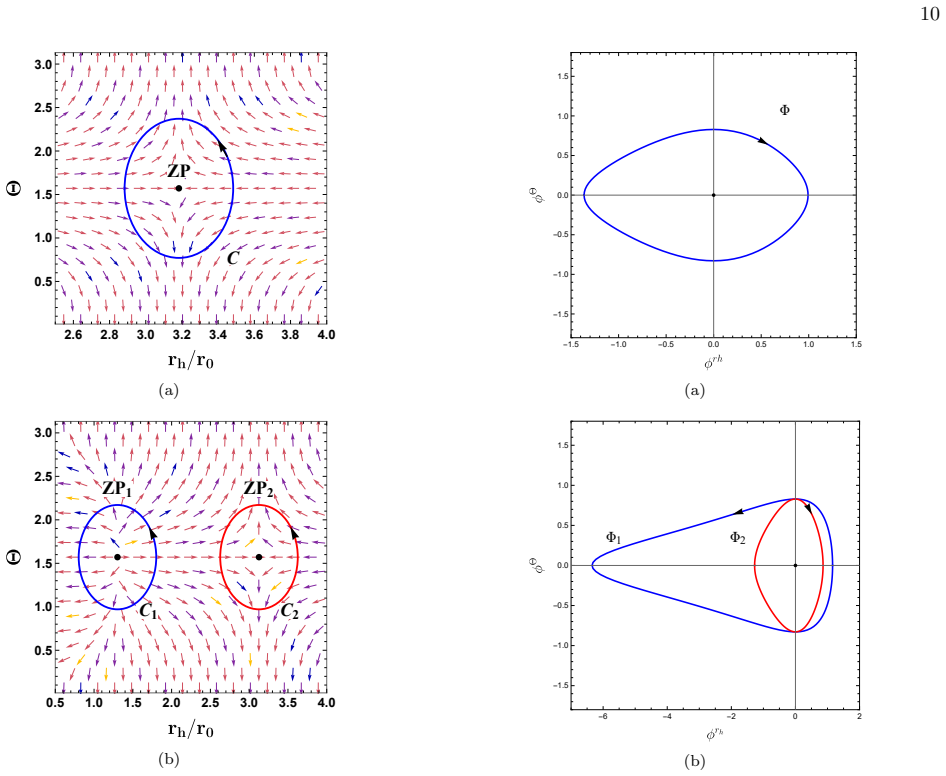
Starting from the reduced Euclidean action, the quasilocal energy, entropy, and on-shell inverse temperature are used to construct the off-shell vector field. This field places neutral black holes in a finite cavity into class W^{0-} and charged black holes into class W^{1+}. Removing the cavity boundary at fixed physical charge switches the assignments to W^{1-} for neutral and W^{0+} for charged cases. The refined topological class is therefore fixed by the presence of charge and the outer boundary rather than by spacetime dimension.
What carries the argument
The off-shell vector field constructed from the reduced Euclidean action, quasilocal energy, entropy, and on-shell inverse temperature, which labels solutions with topological numbers such as W^{0-} or W^{1+}.
If this is right
- Neutral black holes inside a finite cavity belong to topological class W^{0-}.
- Charged black holes inside a finite cavity belong to topological class W^{1+}.
- Sending the cavity radius to infinity at fixed charge moves neutral solutions to W^{1-} and charged solutions to W^{0+}.
- The classification remains unchanged across the four- and five-dimensional cases examined.
Where Pith is reading between the lines
- The same charge-and-boundary dependence may appear in other charged black-hole families once they are placed inside cavities.
- Removing the cavity wall and watching the class switch could link topological changes to the difference between confined and asymptotically flat thermodynamics.
- Continuous variation of charge at fixed cavity radius might produce a transition point between the two classes.
Load-bearing premise
The off-shell vector field built from the reduced Euclidean action, quasilocal energy, entropy, and on-shell inverse temperature correctly identifies the thermodynamic topological class.
What would settle it
Direct evaluation of the winding number for a concrete four-dimensional RN solution at a chosen charge and cavity radius, checking whether the result equals the class assigned by the vector field.
Figures
read the original abstract
We study thermodynamic topological classes of $d$-dimensional Reissner--Nordstr\"om (RN) black holes in a cavity at fixed charge. Starting from the reduced Euclidean action, we use the quasilocal energy, entropy, and on-shell inverse temperature to construct the off-shell vector field. A finite cavity gives two charge dependent classes: neutral black holes belong to $W^{0-}$, whereas charged black holes belong to $W^{1+}$. If the cavity radius is sent to infinity at fixed physical charge, the endpoint data change, giving $W^{1-}$ for the neutral case and $W^{0+}$ for the charged case. Thus the electric charge and the outer boundary, rather than the spacetime dimension in the explicit four- and five-dimensional examples, determine the refined topological class within this RN cavity family.
Editorial analysis
A structured set of objections, weighed in public.
Referee Report
Summary. The paper constructs an off-shell vector field for fixed-charge d-dimensional RN black holes in a cavity using the reduced Euclidean action, quasilocal energy, entropy, and on-shell inverse temperature. It reports that neutral black holes belong to topological class W^{0-} and charged black holes to W^{1+} for finite cavity radius; sending the cavity radius to infinity at fixed charge yields W^{1-} (neutral) and W^{0+} (charged). Based on explicit calculations in d=4 and d=5, the authors conclude that charge and the outer boundary (rather than spacetime dimension) fix the refined topological class.
Significance. If the result holds, the work shows that endpoint conditions (charge and cavity radius) can control thermodynamic topological classes independently of dimension in this family, providing a concrete illustration of how boundary data shape topological invariants in black hole thermodynamics. The systematic off-shell vector field construction is a strength that could extend to other confined systems.
major comments (1)
- [Abstract; d=4,5 calculations] Abstract and the sections presenting the d=4 and d=5 results: the claim that 'the spacetime dimension' does not determine the class rests only on explicit four- and five-dimensional calculations. The reduced Euclidean action contains explicit d-dependent factors (horizon area Ω_{d-2} r_h^{d-2}, metric lapse, and cavity boundary term) that enter the vector field; these can in principle shift zero locations or change winding numbers for d>5, so the dimension-independence statement requires either a general-d derivation or at least one additional explicit case (e.g., d=6) to be load-bearing.
minor comments (2)
- The precise definition of the winding number and the labeling convention for the classes W^{0-}, W^{1+}, etc., should be stated explicitly in the main text (or a short appendix) rather than assumed from prior literature, to improve readability for readers new to thermodynamic topology.
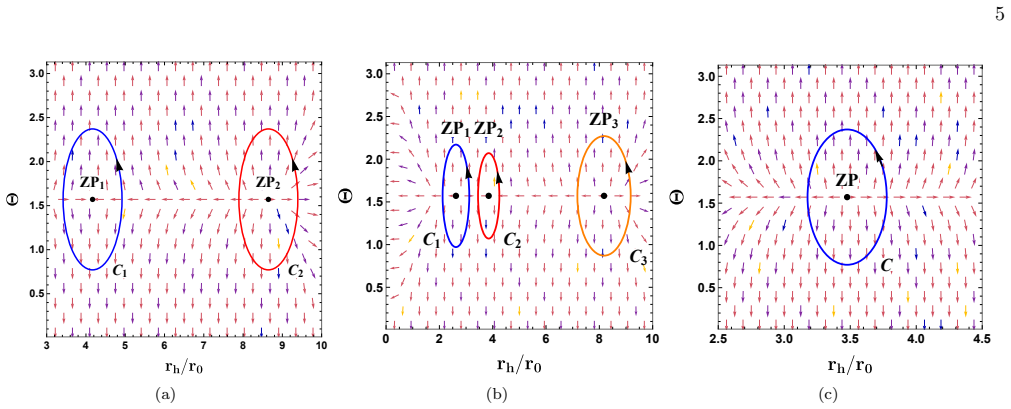
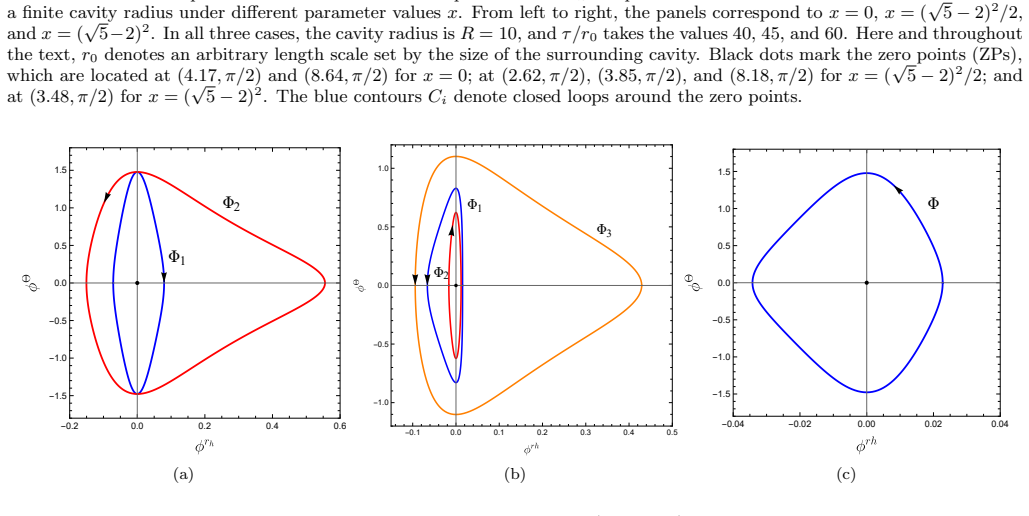
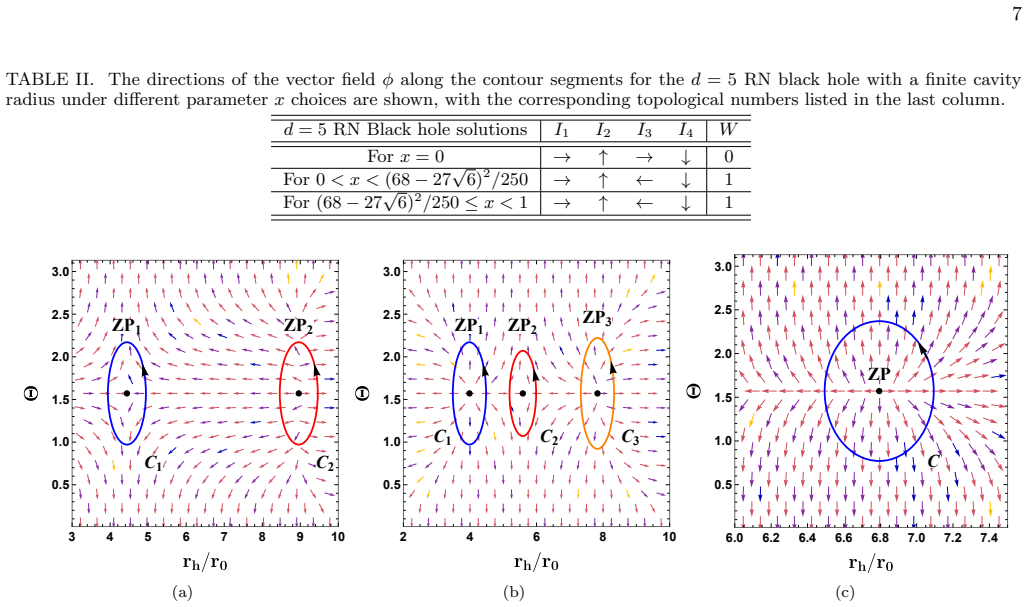
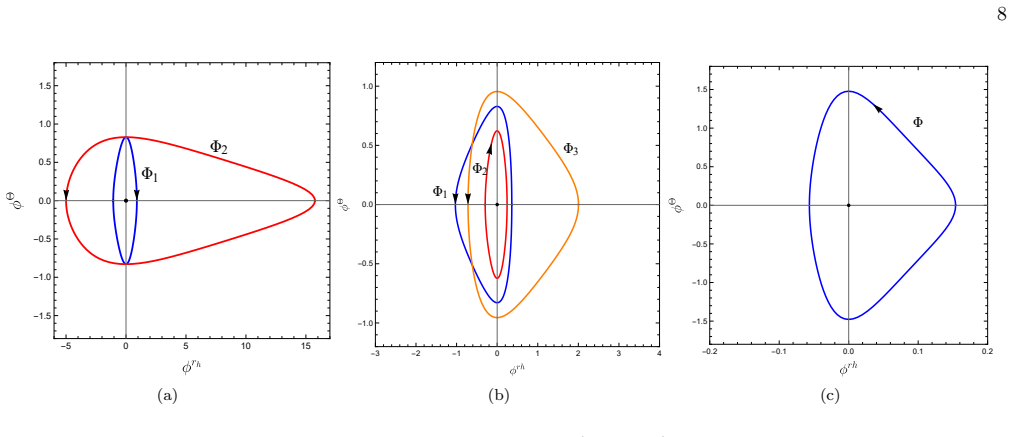
- Figure captions and table headings should indicate the cavity radius and charge values used for each plotted vector field or class assignment.
Simulated Author's Rebuttal
We thank the referee for their careful reading of the manuscript and for the positive assessment of its significance. We address the single major comment below.
read point-by-point responses
-
Referee: [Abstract; d=4,5 calculations] Abstract and the sections presenting the d=4 and d=5 results: the claim that 'the spacetime dimension' does not determine the class rests only on explicit four- and five-dimensional calculations. The reduced Euclidean action contains explicit d-dependent factors (horizon area Ω_{d-2} r_h^{d-2}, metric lapse, and cavity boundary term) that enter the vector field; these can in principle shift zero locations or change winding numbers for d>5, so the dimension-independence statement requires either a general-d derivation or at least one additional explicit case (e.g., d=6) to be load-bearing.
Authors: We agree that the explicit calculations are performed only for d=4 and d=5, and that the presence of d-dependent factors in the reduced Euclidean action means a general proof or additional explicit case is needed to make the dimension-independence claim robust. Although the abstract already qualifies the conclusion as holding 'in the explicit four- and five-dimensional examples', we accept the referee's point that this qualification is insufficient for the stronger phrasing in the title and introduction. We will therefore add an explicit d=6 calculation (both finite and infinite cavity limits) to the manuscript. This will either confirm that the classes remain unchanged or identify any d-dependent transition. The abstract, introduction, and results sections will be updated to reflect the extended evidence. We have already begun these calculations and will include the new figures and discussion in the revised version. revision: yes
Circularity Check
No circularity; derivation is self-contained from action to vector field
full rationale
The paper starts from the reduced Euclidean action and explicitly constructs the off-shell vector field using quasilocal energy, entropy, and on-shell inverse temperature. Topological classes (W^{0-}, W^{1+}, etc.) are read off from the resulting vector field's zeros and winding numbers in explicit d=4 and d=5 calculations. No equation reduces a claimed prediction to a fitted input by construction, no load-bearing uniqueness theorem is imported via self-citation, and no ansatz is smuggled in. The observation that charge and cavity radius fix the class (rather than d) is presented as an empirical pattern from those calculations, not as a self-referential definition.
Axiom & Free-Parameter Ledger
axioms (2)
- standard math Standard definitions of quasilocal energy, entropy, and on-shell inverse temperature from the reduced Euclidean action correctly yield thermodynamic quantities.
- domain assumption The off-shell vector field method accurately classifies thermodynamic topological classes.
Reference graph
Works this paper leans on
-
[1]
Cunha, C.A.R
P.V.P. Cunha, C.A.R. Herdeiro, E. Radu, and H.F. Runarsson, Shadows of Kerr black holes with scalar hair, Phys. Rev. Lett.115, 211102 (2015)
2015
-
[2]
Grenzebach, V
A. Grenzebach, V. Perlick, and C. L¨ ammerzahl, Photon regions and shadows of Kerr-Newman-NUT black holes with a cosmological constant, Phys. Rev. D89, 124004 (2014)
2014
-
[3]
S. Vagnozziet al., Horizon-scale tests of gravity theories and fundamental physics from the Event Horizon Tele- scope image of Sagittarius A*, Classical Quantum Grav- ity40, 165007 (2023)
2023
-
[4]
W. Liu, D. Wu, X. Fang, J. Jing, and J. Wang, Kerr- MOG-(A)dS black hole and its shadow in scalar-tensor- vector gravity theory, J. Cosmol. Astropart. Phys.08 (2024) 035
2024
-
[5]
W. Liu, D. Wu, and J. Wang, Shadow of slowly rotating Kalb-Ramond black holes, arXiv:2407.07416
-
[6]
The Event Horizon Telescope Collaboration, First M87 Event Horizon Telescope Results. I. The Shadow of the Supermassive Black Hole, Astrophys. J. Lett.875, L1 (2019)
2019
-
[7]
The Event Horizon Telescope Collaboration, First Sagit- tarius A* Event Horizon Telescope Results. I. The Shadow of the Supermassive Black Hole in the Center of the Milky Way, Astrophys. J. Lett.930, L12 (2022)
2022
-
[8]
Abbottet al.(LIGO Scientific and Virgo Collabora- tions), Observation of Gravitational Waves from a Binary Black Hole Merger, Phys
B.P. Abbottet al.(LIGO Scientific and Virgo Collabora- tions), Observation of Gravitational Waves from a Binary Black Hole Merger, Phys. Rev. Lett.116, 061102 (2016)
2016
-
[9]
Abbottet al.(LIGO Scientific and Virgo Collabora- tions), GW151226: Observation of Gravitational Waves from a 22-Solar-Mass Binary Black Hole Coalescence, Phys
B.P. Abbottet al.(LIGO Scientific and Virgo Collabora- tions), GW151226: Observation of Gravitational Waves from a 22-Solar-Mass Binary Black Hole Coalescence, Phys. Rev. Lett.116, 241103 (2016)
2016
-
[10]
York, Black-hole thermodynamics and the Eu- clidean Einstein action, Phys
J.W. York, Black-hole thermodynamics and the Eu- clidean Einstein action, Phys. Rev. D33, 2092 (1986)
2092
-
[11]
Li and J
R. Li and J. Wang, Generalized free energy landscape of a black hole phase transition, Phys. Rev. D106, 106015 (2022)
2022
-
[12]
Wei, Y.-X
S.-W. Wei, Y.-X. Liu, and R.B. Mann, Black Hole Solu- tions as Topological Thermodynamic Defects, Phys. Rev. Lett.129, 191101 (2022)
2022
-
[13]
Wei, Y.-X
S.-W. Wei, Y.-X. Liu, and R.B. Mann, Universal topolog- ical classifications of black hole thermodynamics, Phys. Rev. D110, L081501 (2024)
2024
-
[14]
Wu, Topological classes of rotating black holes, Phys
D. Wu, Topological classes of rotating black holes, Phys. Rev. D107, 024024 (2023)
2023
-
[15]
Wu and S.-Q
D. Wu and S.-Q. Wu, Topological classes of thermody- namics of rotating AdS black holes, Phys. Rev. D107, 084002 (2023)
2023
-
[16]
Wu, Classifying topology of consistent thermody- namics of the four-dimensional neutral Lorentzian NUT- charged spacetimes, Eur
D. Wu, Classifying topology of consistent thermody- namics of the four-dimensional neutral Lorentzian NUT- charged spacetimes, Eur. Phys. J. C83, 365 (2023)
2023
-
[17]
Wu, Consistent thermodynamics and topological classes for the four-dimensional Lorentzian charged Taub-NUT spacetimes, Eur
D. Wu, Consistent thermodynamics and topological classes for the four-dimensional Lorentzian charged Taub-NUT spacetimes, Eur. Phys. J. C83, 589 (2023)
2023
-
[18]
Wu, Topological classes of thermodynamics of the four-dimensional static accelerating black holes, Phys
D. Wu, Topological classes of thermodynamics of the four-dimensional static accelerating black holes, Phys. Rev. D108, 084041 (2023)
2023
-
[19]
X.-D. Zhu, D. Wu, and D. Wen, Topological classes of thermodynamics of the rotating charged AdS black holes in gauged supergravities, Phys. Lett. B856, 138919 (2024)
2024
-
[20]
H. Chen, D. Wu, M.-Y. Zhang, H. Hassanabadi, and Z.- W. Long,Thermodynamic topology of phantom AdS black holes in massive gravity, Phys. Dark Univ.46, 101617 (2024)
2024
-
[21]
W. Liu, L. Zhang, D. Wu, and J. Wang, Thermodynamic topological classes of the rotating, accelerating black holes, Classical Quantum Gravity42, 125007 (2025)
2025
-
[22]
X.-D. Zhu, W. Liu, and D. Wu, Universal thermody- namic topological classes of rotating black holes, Phys. Lett. B860, 139163 (2025)
2025
-
[23]
Chen, X.-D
Y. Chen, X.-D. Zhu, and D. Wu, Universal thermody- namic topological classes of three-dimensional BTZ black holes, Phys. Lett. B865, 139482 (2025)
2025
-
[24]
H. Chen, D. Wu, M.-Y. Zhang, S. Zare, H. Hassanabadi, B.C. L¨ utf¨ uoˇ glu, and Z.-W. Long, Universal thermody- namic topological classes of static black holes in Confor- mal Killing Gravity, Eur. Phys. J. C85, 828 (2025)
2025
-
[25]
M. Tian, Y. Chen, and D. Wu, Dimensional structure of thermodynamic topology in ultraspinning Kerr-AdS black holes, arXiv:2602.05231
-
[26]
D. Wu, W. Liu, S.-Q. Wu, and R. B. Mann, Novel topo- logical classes in black hole thermodynamics, Phys. Rev. D111, L061501 (2025)
2025
-
[27]
Ai and D
W. Ai and D. Wu, ˜W 1+ subclass: Extending the topo- logical classification of black hole thermodynamics, Phys. Rev. D112, 124024 (2025)
2025
-
[28]
Wu and S.-Q
D. Wu and S.-Q. Wu, Thermodynamics and topologi- 12 TABLE VI. Thermodynamic topological classifications of fixed charge RN black holes in the canonical ensemble. The table summarizes the endpoint, innermost, and outermost branch data that determine the refined class. The class labelW n± uses n=|W|, while the sign records the winding orientation of the inn...
2026
-
[29]
Wu, S.-Y
D. Wu, S.-Y. Gu, X.-D. Zhu, Q.-Q. Jiang, and S.-Z. Yang, Topological classes of thermodynamics of the static multi-charge AdS black holes in gauged supergravities: novel temperature-dependent thermodynamic topologi- cal phase transition, J. High Energy Phys.06(2024) 213
2024
-
[30]
Duan and M.-L
Y.-S. Duan and M.-L. Ge,SU(2) gauge theory and elec- trodynamics ofNmoving magnetic monopoles, Sci. Sin. 9, 1072 (1979)
1979
-
[31]
Y.-S. Duan, S. Li, and G.-H. Yang, The bifurcation the- ory of the Gauss-Bonnet-Chern topological current and Morse function, Nucl. Phys. B514, 705 (1998)
1998
-
[32]
Fu, Y.-S
L.-B. Fu, Y.-S. Duan, and H. Zhang, Evolution of the Chern-Simons vortices, Phys. Rev. D61, 045004 (2000)
2000
-
[33]
F. R. Tangherlini, Schwarzschild field inndimensions and the dimensionality of space problem, Nuovo Cimento 27, 639 (1967)
1967
-
[34]
C. S. Pe¸ ca and J. P. S. Lemos, Thermodynamics of Reissner-Nordstr¨ om-anti-de Sitter black holes in the grand canonical ensemble, Phys. Rev. D59, 124007 (1999)
1999
-
[35]
T. V. Fernandes and J. S. Lemos, Grand canonical en- semble of ad-dimensional Reissner-N¨ ordstrom black hole in a cavity, Phys. Rev. D108, 084053 (2023)
2023
-
[36]
T. V. Fernandes and J. S. Lemos, Canonical ensemble of ad-dimensional Reissner-Nordstr¨ om black hole in a cavity, Phys. Rev. D111, 104027 (2025)
2025
-
[37]
G. W. Gibbons and S. W. Hawking, Action integrals and partition functions in quantum gravity, Phys. Rev. D15, 2752 (1977)
1977
discussion (0)
Sign in with ORCID, Apple, or X to comment. Anyone can read and Pith papers without signing in.